Python - Modules
• A module is a file containing Python definitions and statements.
• A module can define functions, classes and variables.
• A module can also include runnable code.
# A simple module, calc.py
def add(x, y):
return (x+y)
def subtract(x, y):
return (x-y)
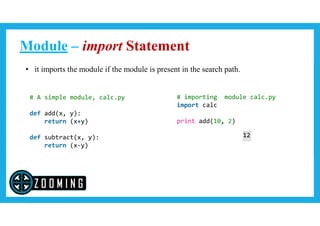
Module – import Statement
# A simple module, calc.py
def add(x, y):
return (x+y)
def subtract(x, y):
return (x-y)
# importing module calc.py
import calc
print add(10, 2)
12
• it imports the module if the module is present in the search path.
Module – from-import Statement
• It import specific attributes from a module
# module math
from math import sqrt, factorial
print sqrt(16)
print factorial(6) 4.0
720
Module – dir() function
• The dir() built-in function returns a sorted list of strings containing the names
defined by a module.
• The list contains the names of all the modules, variables and functions that are
defined in a module.
# Import built-in module random
import random
print dir(math)

Python Modules

  • 2.
    Python - Modules •A module is a file containing Python definitions and statements. • A module can define functions, classes and variables. • A module can also include runnable code. # A simple module, calc.py def add(x, y): return (x+y) def subtract(x, y): return (x-y)
  • 3.
    Module – importStatement # A simple module, calc.py def add(x, y): return (x+y) def subtract(x, y): return (x-y) # importing module calc.py import calc print add(10, 2) 12 • it imports the module if the module is present in the search path.
  • 4.
    Module – from-importStatement • It import specific attributes from a module # module math from math import sqrt, factorial print sqrt(16) print factorial(6) 4.0 720
  • 5.
    Module – dir()function • The dir() built-in function returns a sorted list of strings containing the names defined by a module. • The list contains the names of all the modules, variables and functions that are defined in a module. # Import built-in module random import random print dir(math)