About c++
facts
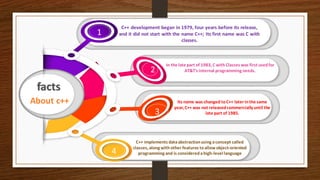
C++ development began in 1979, four years before its release,
and it did not start with the name C++; Its first name was C with
classes.
1
In the late part of 1983, C withClasses was first usedfor
AT&T's internal programming needs.2
Its name was changed toC++ later inthe same
year, C++ was not releasedcommercially until the
late part of 1985.3
C++ implements dataabstractionusing aconcept called
classes, along withother features toallow object-oriented
programming and is consideredahigh-level language4
About c++
facts
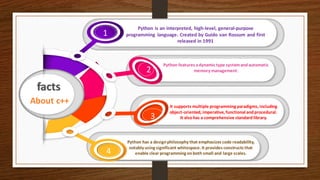
Python is an interpreted, high-level, general-purpose
programming language. Created by Guido van Rossum and first
released in 1991
1
Python features adynamic type systemandautomatic
memory management.2
It supports multiple programming paradigms, including
object-oriented, imperative, functional andprocedural.
It alsohas a comprehensive standardlibrary.3
Python has a designphilosophy that emphasizes code readability,
notably using significant whitespace. It provides constructs that
enable clear programming onboth small and large scales.4
STEP
01
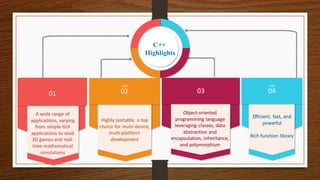
A wide range of
applications, varying
from simple GUI
applications to vivid
3D games and real-
time mathematical
simulations
02
STEP
Highly portable, a top
choice for multi-device,
multi-platform
development
STEP
03
Object-oriented
programming language
leveraging classes, data
abstraction and
encapsulation, inheritance,
and polymorphism
04
STEP
Efficient, fast, and
powerful
Rich function library
C++
Highlights
STEP
01
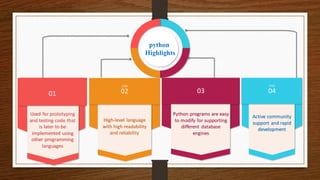
Used for prototyping
and testing code that
is later to be
implemented using
other programming
languages
02
STEP
High-level language
with high readability
and reliability
STEP
03
Python programs are easy
to modify for supporting
different database
engines
04
STEP
Active community
support and rapid
development
python
Highlights
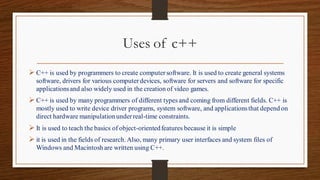
Uses of c++
➢ C++ is used by programmers to create computersoftware. It is used to create general systems
software, drivers for various computerdevices, software for servers and software for specific
applicationsand also widely used in the creation of video games.
➢ C++ is used by many programmers of different types and coming from different fields. C++ is
mostly used to write device driver programs, system software, and applicationsthat depend on
direct hardware manipulationunderreal-time constraints.
➢ It is used to teach the basics of object-orientedfeatures because it is simple
➢ it is used in the fields of research. Also, many primary user interfaces and system files of
Windows and Macintosh are written using C++.
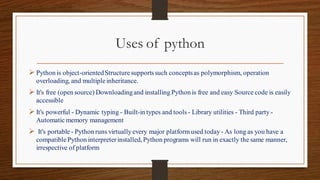
Uses of python
➢ Python is object-orientedStructuresupportssuch conceptsas polymorphism, operation
overloading, and multipleinheritance.
➢ It's free (open source) Downloadingand installing Python is free and easy Source code is easily
accessible
➢ It's powerful - Dynamic typing - Built-in types and tools- Library utilities - Third party -
Automatic memory management
➢ It's portable - Python runs virtually every major platformused today - As long as you have a
compatiblePython interpreterinstalled, Python programs will run in exactly the same manner,
irrespective of platform
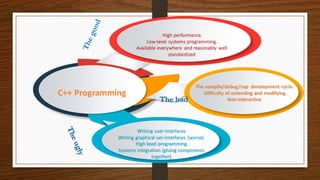
High performance.
Low-level systems programming.
Available everywhere and reasonably well
standardized
The compile/debug/nap development cycle.
Difficulty of extending and modifying.
Non-interactive.
Writing user-interfaces
Writing graphical uer-interfaces (worse).
High level programming.
Systems integration (gluing components
together)
C++ Programming
The bad
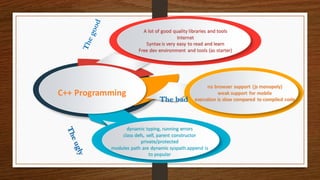
A lot of good quality libraries and tools
Internet
Syntax is very easy to read and learn
Free dev environment and tools (as starter)
no browser support (js monopoly)
weak support for mobile
execution is slow compared to compiled code
dynamic typing, running errors
class defs, self, parent constructor
private/protected
modules path are dynamic syspath.append is
to popular
C++ Programming
The bad
C++ vs python
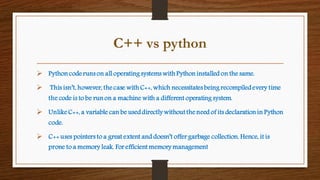
➢ Python code runs on all operating systems with Python installed on the same.
➢ This isn’t, however, the case with C++, which necessitates being recompiledevery time
the code is to be run on a machine with a different operating system.
➢ Unlike C++, a variable can be useddirectly without the need of its declaration in Python
code.
➢ C++ uses pointers to a great extent and doesn’t offer garbage collection. Hence, it is
prone to a memory leak. For efficient memory management
C++ vs python
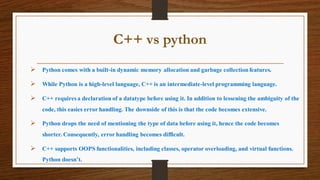
➢ Python comes with a built-in dynamic memory allocation and garbage collection features.
➢ While Python is a high-level language, C++ is an intermediate-level programming language.
➢ C++ requires a declaration of a datatype before using it. In addition to lessening the ambiguity of the
code, this easies error handling. The downside of this is that the code becomes extensive.
➢ Python drops the need of mentioning the type of data before using it, hence the code becomes
shorter. Consequently, error handling becomes difficult.
➢ C++ supports OOPS functionalities, including classes, operator overloading, and virtual functions.
Python doesn’t.
Ali alshehri c++_comparison between c++&python

Ali alshehri c++_comparison between c++&python

  • 2.
    About c++ facts C++ developmentbegan in 1979, four years before its release, and it did not start with the name C++; Its first name was C with classes. 1 In the late part of 1983, C withClasses was first usedfor AT&T's internal programming needs.2 Its name was changed toC++ later inthe same year, C++ was not releasedcommercially until the late part of 1985.3 C++ implements dataabstractionusing aconcept called classes, along withother features toallow object-oriented programming and is consideredahigh-level language4
  • 3.
    About c++ facts Python isan interpreted, high-level, general-purpose programming language. Created by Guido van Rossum and first released in 1991 1 Python features adynamic type systemandautomatic memory management.2 It supports multiple programming paradigms, including object-oriented, imperative, functional andprocedural. It alsohas a comprehensive standardlibrary.3 Python has a designphilosophy that emphasizes code readability, notably using significant whitespace. It provides constructs that enable clear programming onboth small and large scales.4
  • 4.
    STEP 01 A wide rangeof applications, varying from simple GUI applications to vivid 3D games and real- time mathematical simulations 02 STEP Highly portable, a top choice for multi-device, multi-platform development STEP 03 Object-oriented programming language leveraging classes, data abstraction and encapsulation, inheritance, and polymorphism 04 STEP Efficient, fast, and powerful Rich function library C++ Highlights
  • 5.
    STEP 01 Used for prototyping andtesting code that is later to be implemented using other programming languages 02 STEP High-level language with high readability and reliability STEP 03 Python programs are easy to modify for supporting different database engines 04 STEP Active community support and rapid development python Highlights
  • 6.
    Uses of c++ ➢C++ is used by programmers to create computersoftware. It is used to create general systems software, drivers for various computerdevices, software for servers and software for specific applicationsand also widely used in the creation of video games. ➢ C++ is used by many programmers of different types and coming from different fields. C++ is mostly used to write device driver programs, system software, and applicationsthat depend on direct hardware manipulationunderreal-time constraints. ➢ It is used to teach the basics of object-orientedfeatures because it is simple ➢ it is used in the fields of research. Also, many primary user interfaces and system files of Windows and Macintosh are written using C++.
  • 7.
    Uses of python ➢Python is object-orientedStructuresupportssuch conceptsas polymorphism, operation overloading, and multipleinheritance. ➢ It's free (open source) Downloadingand installing Python is free and easy Source code is easily accessible ➢ It's powerful - Dynamic typing - Built-in types and tools- Library utilities - Third party - Automatic memory management ➢ It's portable - Python runs virtually every major platformused today - As long as you have a compatiblePython interpreterinstalled, Python programs will run in exactly the same manner, irrespective of platform
  • 8.
    High performance. Low-level systemsprogramming. Available everywhere and reasonably well standardized The compile/debug/nap development cycle. Difficulty of extending and modifying. Non-interactive. Writing user-interfaces Writing graphical uer-interfaces (worse). High level programming. Systems integration (gluing components together) C++ Programming The bad
  • 9.
    A lot ofgood quality libraries and tools Internet Syntax is very easy to read and learn Free dev environment and tools (as starter) no browser support (js monopoly) weak support for mobile execution is slow compared to compiled code dynamic typing, running errors class defs, self, parent constructor private/protected modules path are dynamic syspath.append is to popular C++ Programming The bad
  • 10.
    C++ vs python ➢Python code runs on all operating systems with Python installed on the same. ➢ This isn’t, however, the case with C++, which necessitates being recompiledevery time the code is to be run on a machine with a different operating system. ➢ Unlike C++, a variable can be useddirectly without the need of its declaration in Python code. ➢ C++ uses pointers to a great extent and doesn’t offer garbage collection. Hence, it is prone to a memory leak. For efficient memory management
  • 11.
    C++ vs python ➢Python comes with a built-in dynamic memory allocation and garbage collection features. ➢ While Python is a high-level language, C++ is an intermediate-level programming language. ➢ C++ requires a declaration of a datatype before using it. In addition to lessening the ambiguity of the code, this easies error handling. The downside of this is that the code becomes extensive. ➢ Python drops the need of mentioning the type of data before using it, hence the code becomes shorter. Consequently, error handling becomes difficult. ➢ C++ supports OOPS functionalities, including classes, operator overloading, and virtual functions. Python doesn’t.