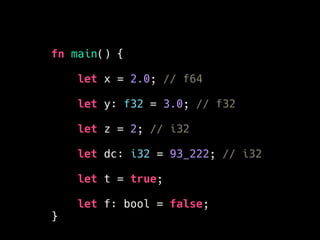
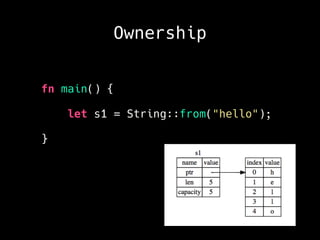
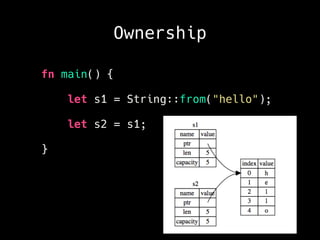
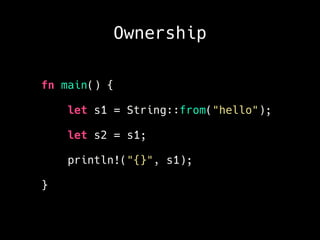
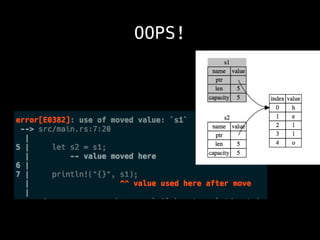
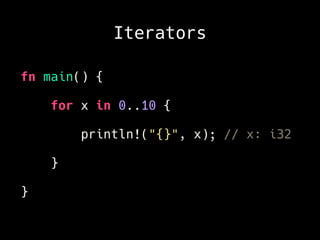
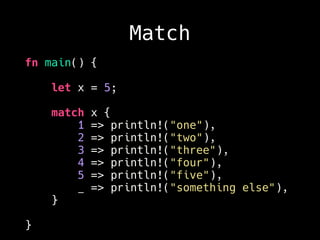
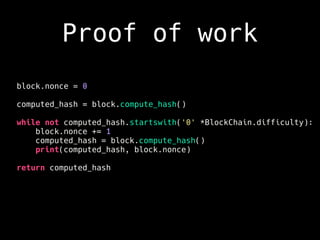
The document discusses Python and Rust programming languages. It provides examples of basic programming concepts in Rust like variables, data types, functions, iterators, and match expressions. It also discusses ownership and borrowing in Rust. Additionally, it covers proof of work algorithms and benchmarking code for mining cryptocurrency blocks.



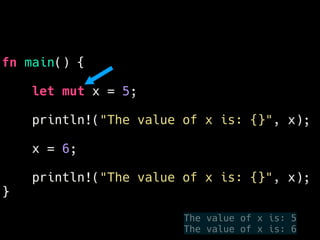
![OOPS!
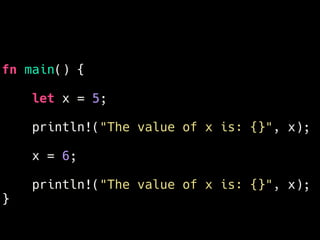
error[E0384]: cannot assign twice to immutable variable
`x`
--> src/main.rs:6:5
|
2 | let x = 5;
| - first assignment to `x`
...
6 | x = 6;
| ^^^^^ cannot assign twice to immutable variable](https://image.slidesharecdn.com/pythonandrust-180802113944/85/Python-and-rust-2018-pythonkorea-jihun-11-320.jpg)

![Slice
fn main() {
let s = String::from("hello world");
let hello = &s[0..5];
let world = &s[6..11];
}](https://image.slidesharecdn.com/pythonandrust-180802113944/85/Python-and-rust-2018-pythonkorea-jihun-19-320.jpg)
![fn main() {
let s = String::from("hello world");
let hello = &s[0..5];
let world = &s[6..11];
}](https://image.slidesharecdn.com/pythonandrust-180802113944/85/Python-and-rust-2018-pythonkorea-jihun-20-320.jpg)
![fn main() {
let s = String::from("hello");
let len = s.len();
let slice = &s[3..len];
let slice = &s[3..];
}](https://image.slidesharecdn.com/pythonandrust-180802113944/85/Python-and-rust-2018-pythonkorea-jihun-21-320.jpg)
![Iterators
fn main() {
let arr = [1, 2, 3, 4, 5];
for v in arr.iter() {
println!("{}", v);
}
}](https://image.slidesharecdn.com/pythonandrust-180802113944/85/Python-and-rust-2018-pythonkorea-jihun-23-320.jpg)


![[Graph] DFS 복사본.pdf](https://cdn.slidesharecdn.com/ss_thumbnails/graphdfs-230117091024-325ee1a5-thumbnail.jpg?width=640&height=640&fit=bounds)


