Safe Routes to School and
     Complete Streets:
Partnerships for Low-Income
        Communities
       Margo Pedroso, Deputy Director
  Safe Routes to School National Partnership
Walking and Bicycling in Low-Income
                     Communities
The numbers
 Poverty line is $22,000 for a family of 4;
  low-income is twice that
 40 million people (13.2%) live in poverty
 41% of children (29.9 million children) are from
  low-income families
 Half of children in rural areas are low-income and half of children in
  urban areas are low-income

Income and Transportation
 Low-income families spend one-third of their budgets on
   transportation and have lower rates of car ownership
 Children from low-income families are twice as likely to walk
   to school as children from higher-income families
Walking and Bicycling in Low-Income
                       Communities
   Low-income neighborhoods or communities have greater traffic-
    related risks
      Urban challenges include higher numbers of busy through streets and
       poor pedestrian/bicycle infrastructure
      In rural areas, distances are greater, high-speed state highways often
       bisect communities, and sidewalks/crosswalks are lacking

   These built environment challenges impact health and safety:
       Children from low-income households have a higher risk of being injured
        or killed as pedestrians
       Residents in low-income communities have lower activity levels and
        higher BMIs


   In spite of the risks:
Challenges to Walking and Bicycling in
                Low-Income Communities
Personal Safety: Crime and Violence
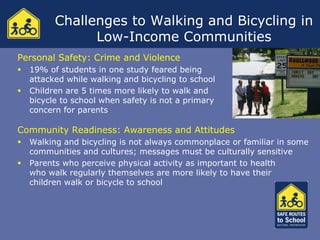
   19% of students in one study feared being
    attacked while walking and bicycling to school
   Children are 5 times more likely to walk and
    bicycle to school when safety is not a primary
    concern for parents

Community Readiness: Awareness and Attitudes
   Walking and bicycling is not always commonplace or familiar in some
    communities and cultures; messages must be culturally sensitive
   Parents who perceive physical activity as important to health
    who walk regularly themselves are more likely to have their
    children walk or bicycle to school
Challenges to Walking and Bicycling in Low-
                   Income Communities
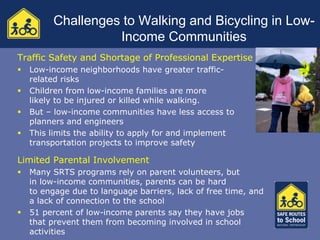
Traffic Safety and Shortage of Professional Expertise
   Low-income neighborhoods have greater traffic-
    related risks
   Children from low-income families are more
    likely to be injured or killed while walking.
   But – low-income communities have less access to
    planners and engineers
   This limits the ability to apply for and implement
    transportation projects to improve safety

Limited Parental Involvement
   Many SRTS programs rely on parent volunteers, but
    in low-income communities, parents can be hard
    to engage due to language barriers, lack of free time, and
    a lack of connection to the school
   51 percent of low-income parents say they have jobs
    that prevent them from becoming involved in school
    activities
SRTS and Low-Income Communities

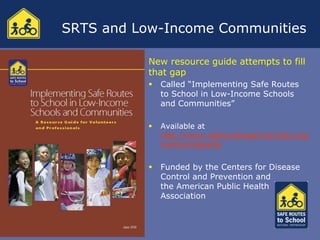
           New resource guide attempts to fill
           that gap
              Called “Implementing Safe Routes
               to School in Low-Income Schools
               and Communities”

              Available at
               http://www.saferoutespartnership.org/
               lowincomeguide


              Funded by the Centers for Disease
               Control and Prevention and
               the American Public Health
               Association
Moving Forward
Solving these challenges takes partnerships
   The potential benefits to low-income communities
    from SRTS and Complete Streets are great
   But, these are big challenges that require many
    partners to solve
   It’s important for us all to ensure that low-income
    communities are able to safely walk and bicycle
   Hope that more nonprofits, DOTs, MPOs, school districts, and
    community leaders offer assistance to low-income schools and
    communities
For More Information

 Questions or comments? Contact:
     Margo Pedroso
     Deputy Director
     Safe Routes to School National Partnership
     margo@saferoutespartnership.org
     301-292-1043

 Go to www.saferoutespartnership.org and sign
  up for our e-news!

Session 13 - SRTS/CS Low-Income Pedroso

  • 1.
    Safe Routes toSchool and Complete Streets: Partnerships for Low-Income Communities Margo Pedroso, Deputy Director Safe Routes to School National Partnership
  • 2.
    Walking and Bicyclingin Low-Income Communities The numbers  Poverty line is $22,000 for a family of 4; low-income is twice that  40 million people (13.2%) live in poverty  41% of children (29.9 million children) are from low-income families  Half of children in rural areas are low-income and half of children in urban areas are low-income Income and Transportation  Low-income families spend one-third of their budgets on transportation and have lower rates of car ownership  Children from low-income families are twice as likely to walk to school as children from higher-income families
  • 3.
    Walking and Bicyclingin Low-Income Communities  Low-income neighborhoods or communities have greater traffic- related risks  Urban challenges include higher numbers of busy through streets and poor pedestrian/bicycle infrastructure  In rural areas, distances are greater, high-speed state highways often bisect communities, and sidewalks/crosswalks are lacking  These built environment challenges impact health and safety:  Children from low-income households have a higher risk of being injured or killed as pedestrians  Residents in low-income communities have lower activity levels and higher BMIs  In spite of the risks:
  • 4.
    Challenges to Walkingand Bicycling in Low-Income Communities Personal Safety: Crime and Violence  19% of students in one study feared being attacked while walking and bicycling to school  Children are 5 times more likely to walk and bicycle to school when safety is not a primary concern for parents Community Readiness: Awareness and Attitudes  Walking and bicycling is not always commonplace or familiar in some communities and cultures; messages must be culturally sensitive  Parents who perceive physical activity as important to health who walk regularly themselves are more likely to have their children walk or bicycle to school
  • 5.
    Challenges to Walkingand Bicycling in Low- Income Communities Traffic Safety and Shortage of Professional Expertise  Low-income neighborhoods have greater traffic- related risks  Children from low-income families are more likely to be injured or killed while walking.  But – low-income communities have less access to planners and engineers  This limits the ability to apply for and implement transportation projects to improve safety Limited Parental Involvement  Many SRTS programs rely on parent volunteers, but in low-income communities, parents can be hard to engage due to language barriers, lack of free time, and a lack of connection to the school  51 percent of low-income parents say they have jobs that prevent them from becoming involved in school activities
  • 6.
    SRTS and Low-IncomeCommunities New resource guide attempts to fill that gap  Called “Implementing Safe Routes to School in Low-Income Schools and Communities”  Available at http://www.saferoutespartnership.org/ lowincomeguide  Funded by the Centers for Disease Control and Prevention and the American Public Health Association
  • 7.
    Moving Forward Solving thesechallenges takes partnerships  The potential benefits to low-income communities from SRTS and Complete Streets are great  But, these are big challenges that require many partners to solve  It’s important for us all to ensure that low-income communities are able to safely walk and bicycle  Hope that more nonprofits, DOTs, MPOs, school districts, and community leaders offer assistance to low-income schools and communities
  • 8.
    For More Information Questions or comments? Contact: Margo Pedroso Deputy Director Safe Routes to School National Partnership margo@saferoutespartnership.org 301-292-1043  Go to www.saferoutespartnership.org and sign up for our e-news!