“PUNJAB, PAKISTAN: THE LAND OF 5
RIVERS.”
STUDENT NAME:- HARRY
TABLE OF CONTENT
1. Introduction.
2. Geography.
3. Climate.
4. Economy & Development.
5. Culture.
6. Festivals & Celebrations.
7. Tourism & Attraction.
8. Hospitality.
9. Conclusion.
1.INTRODUCTION:(MAP OF PAKISTAN)
1. INTRODUCTION
Name of Province Punjab, Pakistan
Capital & Largest City of Punjab Lahore
Population 127,688,922 persons (127.688) millions (1st
rank in Pakistan for Population)
Area 205,344 km2
Population Density 622 persons per km2
Language Urdu, Punjabi & Saraiki.
Male Population 51.2%
Female Population 48.7%
Urban Population 40.71%
Literacy Rate 59.29%
Male Literacy Rate 70%
Female Literacy Rate 51%
Administrative Units 10 Divisions and 41 districts and 148 Tehsils. The Tehsils are further divided into Union Councils.
2.GEOGRAPHY:
 The word “Punjab” meaning “Five Rivers", in Persian came into use after the Muslim
conquest of this region.
 Location: Punjab is Pakistan's second largest province by area after Baluchistan with an area
of 205,344 square kilometers.
 Borders: Sindh(South), Baluchistan(South West), Islamabad & Azad Kashmir (North) &
KPK (West).
 Mountains: Margalla hills, Hill station of Murree, Suleiman mountains & Fort Munro hills.
 Deserts: 2 deserts (Thal desert & Cholistan desert.)
 Major Rivers:5 rivers( Indus River, Jhelum River, Chenab River, Ravi River & Sutlej River).
 During the Mughal times the Punjab region was divided into three subahs. Lahore subah, lying between
Indus and Sutlej, including present day Jammu region. While the areas south of Sutlej were part of
Delhi subah.The 3rd subha is Multan, with northern Sindh and even a few faraway regions in
Baluchistan are shown as part of Multan.
 The Mughal Empire went into a rapid decline in the eighteenth century and in the middle of the century, they lost
control of Punjab to the Sikhs and Afghans. The Sikhs ultimately won the contest with the Afghans for the control
of Punjab under the leadership of Maharaja Ranjit Singh. He not only united all the petty states of Sikh sardars
but also vastly expanded his kingdom in all directions by conquering Multan, Kashmir and Peshawar.
 By the early nineteenth century, the British had become the supreme power and Punjab was the last to fell to their
expanding empire. The first war between the two powers was fought in the winter of 1845-1846 and the Sikhs
were defeated after a series of bloody and hard-fought battles. According to the treaty of Amritsar, signed after
this defeat, Sarkar-i-Khalsa lost the territories between Beas and Sutlej rivers. Jammu was separated from the
Punjab state. They further expanded their state and conquered Gilgit, Baltistan.
 The British Indian Empire was sailing smoothly when suddenly the storm of 1857 rebellion burst upon it and almost the
whole of north India was affected by it. Punjab mostly remained peaceful, except for rebellions by a few battalions of the
Bengal Army stationed in Punjab. The Delhi city was the first to fall on 11 May 1857 but was recovered by late
September the same year. Until then Delhi was part of North West Province, after the war due to some reasons the British
thought it better to administer Delhi city and adjoining districts of Rohtak, Gurgaon, Hissar, Karnal, Ambala etc. from
Lahore.
 In 1901 a new province was created by separating six districts of Dera Ismail Khan, Tank, Kohat, Peshawar,
Mardan and Mansehra, across the river Indus from Punjab. These districts were mostly populated by Pashto
speakers. The new province was given the name of North West Frontier Province.
 For administrative reasons, the British planned to shift the capital from Kolkata to Delhi in 1911. King George V
laid the foundation of the new city on 2 December 1911. It took twenty years to complete the city and the viceroy
Lord Irwin formally inaugurated it on February 13, 1931. Before that Delhi was a district of Punjab.
 To decide the final border between India and Pakistan a boundary commission was set up under a British
barrister Mr. Cyril John Radcliffe. He was given just five weeks to complete this extremely contentious and
gigantic issue. His decision was made public on 17 August 1947. The dividing line which he suggested is called
Radcliffe line and forms the border between India and Pakistan. It also divided Punjab in to two parts.
 However, Bahawalpur the only princely state of Punjab that acceded to Pakistan, was merged with the Punjab
province in 1955.
PUNJAB’S MOUNTAINS(SULEIMAN & MURREE)
PUNJAB’S MOUNTAIN(FORT MUNRO & MARGALA HILLS)
PUNJAB’S DESERTS(THAL & CHOLISTAN)
PUNJAB'S RIVERS (HEAD PANJNAD)
3. CLIMATE OF PUNJAB
 Hot weather (April to June) when temperature rises as high as 123 °F (51 °C).
 Rainy season (July to September). Average annual rainfall ranges between 96 cm sub-mountain
region and 46 cm in the plains.
 Cold / Foggy / mild weather (October to March). Temperature goes down as low as 35.6 °F (2.0 °C).
 Punjab's region temperature ranges from −2° to 45 °C, but can reach 51 °C (123 °F) in summer.
MONTHLY WEATHER & FOG IN PUNJAB
4. ECONOMY & DEVELOPMENT
GDP: 295 USD Billion(2024)
Major Sectors: Agriculture, Industry & Services.
Key Experts: Textile, Rice, Sports Goods & Leader Products.
Challenges: Energy Crisis.
GDP OF PUNJAB
INDUSTRIAL ZONES OF PUNJAB
AGRICULTURE & INDUSTRY SECTORS OF PUNJAB
PUNJAB’S EXPORT TEXTILE & LEATHER PRODUCTS
5. PUNJAB’S CULTURE:
 Major Religion: Islam(97% Muslims).
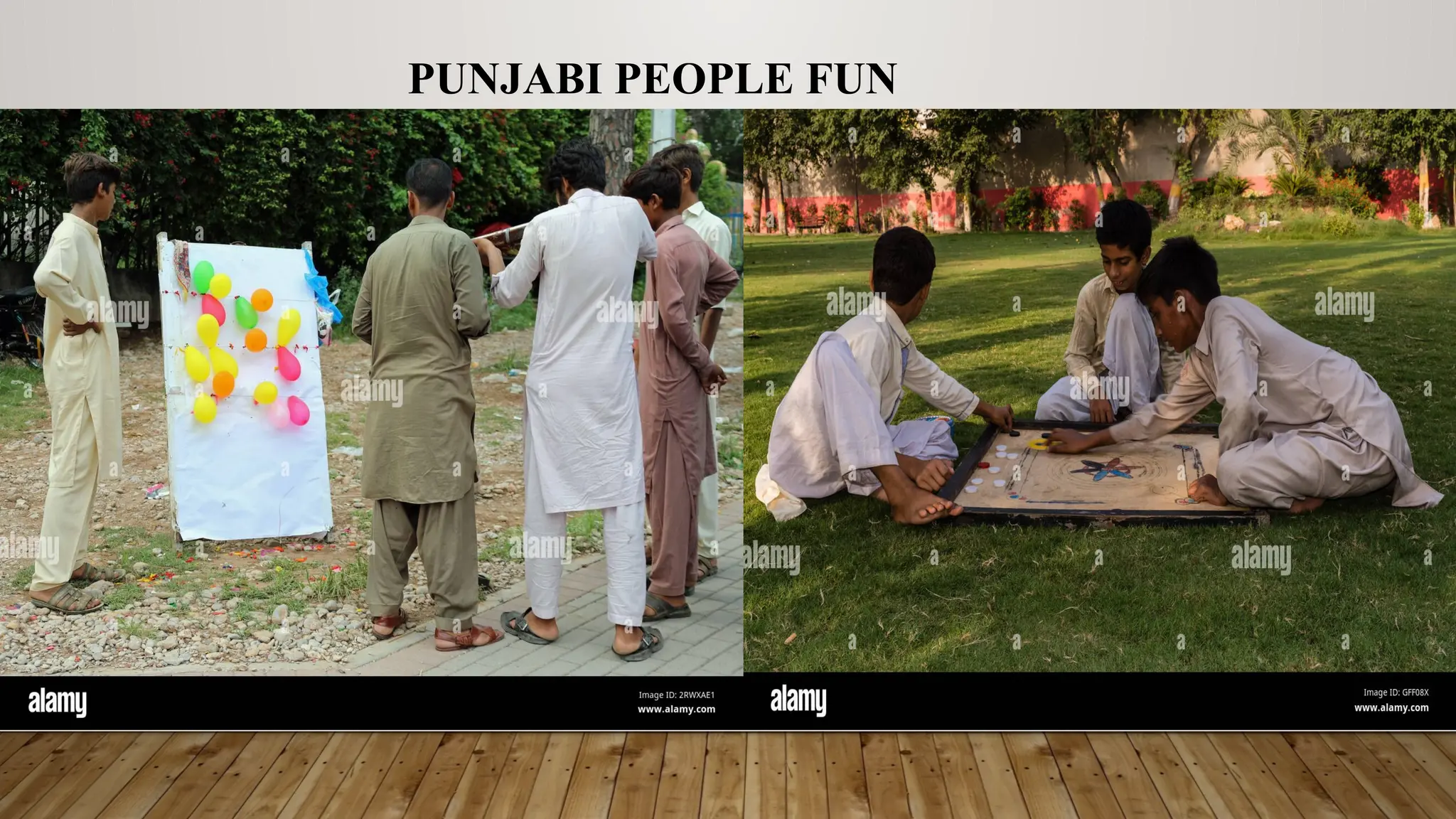
 Punjabi’s People: Punjabi people are very warm hearted and fun loving.
 Dance & Music: Bhangra is most commonly known Punjabi music genre and dance style & Punjabis passionately love folk
songs/music & Qawwali.
 Punjab’s Dress: Shalwar Kameez.
 Cuisine: 32 traditional cuisine like Chicken karahi, chicken handi & Rice.
BADSHAHI MOSQUE & HOLY PRAYER
PUNJABI PEOPLE FUN
RURAL LIFE & URBAN LIFE IN PUNJAB
DANCE COMPETITION B/W 4 TEAMS
PAKISTANI DRESSES
PAKISTANI CUISINE
6. FESTIVALS & CELEBRATIONS
Festivals in Punjab are Eid-ul-Adha, Eid-ul- Fitr, Pakistan Resolution Day, Pakistan
Independence Day, Eid-e-Milad-un-Nabi(SAW), Baisakhi Mela & Muharram.
BAISAKHI FESTIVALS & MELA
7. TOURISM & ATTRACTION
Natural wonders: Murree hills & Fort Munro hills in Punjab.
Historical Sites: Mohenjo-Daro, Lahore fort, Badshahi mosque & Jatoi mosque.
IMAGES OF MURREE & FORT MUNRO HILLS
MOHENJO-DARO & BADSHAHI MOSQUE
JATOI MOSQUE
8. HOSPITALITY
Hospitality/Mehman Nawazi: is an integral part of Punjabi culture.
Welcome to the Guest: it is believe that by welcoming guests & making them feel at
home, one earns blessings & good future.
Offering Tea & Water: is a common way of Punjabi to show hospitality.
The custom of “invitation”: is an important aspects of Punjabi hospitality.
HOSPITALITY BY PUNJABI PEOPLE
OFFERING TEA & THE CUSTOM OF INVITATIONS
HOSPITALITY BY PUNJABI PEOPLE OF CHINESE GIRL IN LAHORE
9. CONCLUSION:
Punjab is a peaceful province where every culture person can come & visit the whole
province.
Punjab is a place of diverse landscapes, rich culture, and significant geographical
importance with a growing economy but facing ongoing social & economic challenges.
Punjab, Pakistan: the land of 5 rivers a beautiful land

Punjab, Pakistan: the land of 5 rivers a beautiful land

  • 1.
    “PUNJAB, PAKISTAN: THELAND OF 5 RIVERS.” STUDENT NAME:- HARRY
  • 2.
    TABLE OF CONTENT 1.Introduction. 2. Geography. 3. Climate. 4. Economy & Development. 5. Culture. 6. Festivals & Celebrations. 7. Tourism & Attraction. 8. Hospitality. 9. Conclusion.
  • 3.
  • 4.
    1. INTRODUCTION Name ofProvince Punjab, Pakistan Capital & Largest City of Punjab Lahore Population 127,688,922 persons (127.688) millions (1st rank in Pakistan for Population) Area 205,344 km2 Population Density 622 persons per km2 Language Urdu, Punjabi & Saraiki. Male Population 51.2% Female Population 48.7% Urban Population 40.71% Literacy Rate 59.29% Male Literacy Rate 70% Female Literacy Rate 51% Administrative Units 10 Divisions and 41 districts and 148 Tehsils. The Tehsils are further divided into Union Councils.
  • 5.
    2.GEOGRAPHY:  The word“Punjab” meaning “Five Rivers", in Persian came into use after the Muslim conquest of this region.  Location: Punjab is Pakistan's second largest province by area after Baluchistan with an area of 205,344 square kilometers.  Borders: Sindh(South), Baluchistan(South West), Islamabad & Azad Kashmir (North) & KPK (West).  Mountains: Margalla hills, Hill station of Murree, Suleiman mountains & Fort Munro hills.  Deserts: 2 deserts (Thal desert & Cholistan desert.)  Major Rivers:5 rivers( Indus River, Jhelum River, Chenab River, Ravi River & Sutlej River).
  • 6.
     During theMughal times the Punjab region was divided into three subahs. Lahore subah, lying between Indus and Sutlej, including present day Jammu region. While the areas south of Sutlej were part of Delhi subah.The 3rd subha is Multan, with northern Sindh and even a few faraway regions in Baluchistan are shown as part of Multan.
  • 8.
     The MughalEmpire went into a rapid decline in the eighteenth century and in the middle of the century, they lost control of Punjab to the Sikhs and Afghans. The Sikhs ultimately won the contest with the Afghans for the control of Punjab under the leadership of Maharaja Ranjit Singh. He not only united all the petty states of Sikh sardars but also vastly expanded his kingdom in all directions by conquering Multan, Kashmir and Peshawar.
  • 10.
     By theearly nineteenth century, the British had become the supreme power and Punjab was the last to fell to their expanding empire. The first war between the two powers was fought in the winter of 1845-1846 and the Sikhs were defeated after a series of bloody and hard-fought battles. According to the treaty of Amritsar, signed after this defeat, Sarkar-i-Khalsa lost the territories between Beas and Sutlej rivers. Jammu was separated from the Punjab state. They further expanded their state and conquered Gilgit, Baltistan.
  • 12.
     The BritishIndian Empire was sailing smoothly when suddenly the storm of 1857 rebellion burst upon it and almost the whole of north India was affected by it. Punjab mostly remained peaceful, except for rebellions by a few battalions of the Bengal Army stationed in Punjab. The Delhi city was the first to fall on 11 May 1857 but was recovered by late September the same year. Until then Delhi was part of North West Province, after the war due to some reasons the British thought it better to administer Delhi city and adjoining districts of Rohtak, Gurgaon, Hissar, Karnal, Ambala etc. from Lahore.
  • 14.
     In 1901a new province was created by separating six districts of Dera Ismail Khan, Tank, Kohat, Peshawar, Mardan and Mansehra, across the river Indus from Punjab. These districts were mostly populated by Pashto speakers. The new province was given the name of North West Frontier Province.
  • 16.
     For administrativereasons, the British planned to shift the capital from Kolkata to Delhi in 1911. King George V laid the foundation of the new city on 2 December 1911. It took twenty years to complete the city and the viceroy Lord Irwin formally inaugurated it on February 13, 1931. Before that Delhi was a district of Punjab.
  • 18.
     To decidethe final border between India and Pakistan a boundary commission was set up under a British barrister Mr. Cyril John Radcliffe. He was given just five weeks to complete this extremely contentious and gigantic issue. His decision was made public on 17 August 1947. The dividing line which he suggested is called Radcliffe line and forms the border between India and Pakistan. It also divided Punjab in to two parts.
  • 20.
     However, Bahawalpurthe only princely state of Punjab that acceded to Pakistan, was merged with the Punjab province in 1955.
  • 23.
  • 24.
  • 25.
  • 26.
  • 27.
    3. CLIMATE OFPUNJAB  Hot weather (April to June) when temperature rises as high as 123 °F (51 °C).  Rainy season (July to September). Average annual rainfall ranges between 96 cm sub-mountain region and 46 cm in the plains.  Cold / Foggy / mild weather (October to March). Temperature goes down as low as 35.6 °F (2.0 °C).  Punjab's region temperature ranges from −2° to 45 °C, but can reach 51 °C (123 °F) in summer.
  • 28.
    MONTHLY WEATHER &FOG IN PUNJAB
  • 29.
    4. ECONOMY &DEVELOPMENT GDP: 295 USD Billion(2024) Major Sectors: Agriculture, Industry & Services. Key Experts: Textile, Rice, Sports Goods & Leader Products. Challenges: Energy Crisis.
  • 30.
  • 31.
  • 32.
    AGRICULTURE & INDUSTRYSECTORS OF PUNJAB
  • 33.
    PUNJAB’S EXPORT TEXTILE& LEATHER PRODUCTS
  • 34.
    5. PUNJAB’S CULTURE: Major Religion: Islam(97% Muslims).  Punjabi’s People: Punjabi people are very warm hearted and fun loving.  Dance & Music: Bhangra is most commonly known Punjabi music genre and dance style & Punjabis passionately love folk songs/music & Qawwali.  Punjab’s Dress: Shalwar Kameez.  Cuisine: 32 traditional cuisine like Chicken karahi, chicken handi & Rice.
  • 35.
    BADSHAHI MOSQUE &HOLY PRAYER
  • 36.
  • 37.
    RURAL LIFE &URBAN LIFE IN PUNJAB
  • 38.
  • 39.
  • 40.
  • 41.
    6. FESTIVALS &CELEBRATIONS Festivals in Punjab are Eid-ul-Adha, Eid-ul- Fitr, Pakistan Resolution Day, Pakistan Independence Day, Eid-e-Milad-un-Nabi(SAW), Baisakhi Mela & Muharram.
  • 43.
  • 44.
    7. TOURISM &ATTRACTION Natural wonders: Murree hills & Fort Munro hills in Punjab. Historical Sites: Mohenjo-Daro, Lahore fort, Badshahi mosque & Jatoi mosque.
  • 45.
    IMAGES OF MURREE& FORT MUNRO HILLS
  • 46.
  • 47.
  • 48.
    8. HOSPITALITY Hospitality/Mehman Nawazi:is an integral part of Punjabi culture. Welcome to the Guest: it is believe that by welcoming guests & making them feel at home, one earns blessings & good future. Offering Tea & Water: is a common way of Punjabi to show hospitality. The custom of “invitation”: is an important aspects of Punjabi hospitality.
  • 49.
  • 50.
    OFFERING TEA &THE CUSTOM OF INVITATIONS
  • 51.
    HOSPITALITY BY PUNJABIPEOPLE OF CHINESE GIRL IN LAHORE
  • 52.
    9. CONCLUSION: Punjab isa peaceful province where every culture person can come & visit the whole province. Punjab is a place of diverse landscapes, rich culture, and significant geographical importance with a growing economy but facing ongoing social & economic challenges.