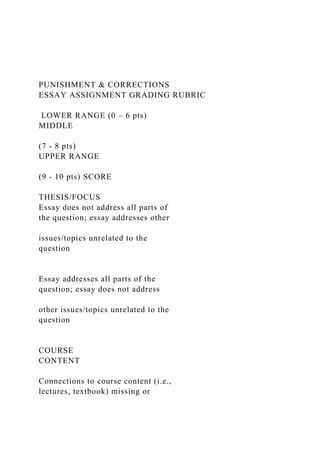
PUNISHMENT & CORRECTIONS
ESSAY ASSIGNMENT GRADING RUBRIC
LOWER RANGE (0 – 6 pts)
MIDDLE
(7 - 8 pts)
UPPER RANGE
(9 - 10 pts) SCORE
THESIS/FOCUS
Essay does not address all parts of
the question; essay addresses other
issues/topics unrelated to the
question
Essay addresses all parts of the
question; essay does not address
other issues/topics unrelated to the
question
COURSE
CONTENT
Connections to course content (i.e.,
lectures, textbook) missing or
linkage unclear; course content
poorly understood
Integrates range of concepts, facts,
ideas from course content;
demonstrates accurate understanding
of course content
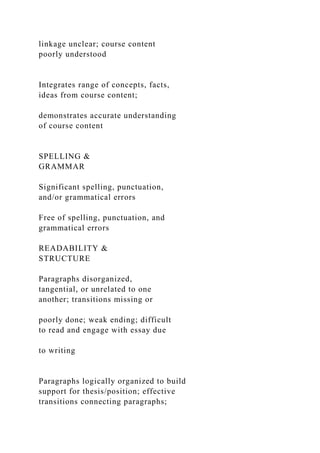
SPELLING &
GRAMMAR
Significant spelling, punctuation,
and/or grammatical errors
Free of spelling, punctuation, and
grammatical errors
READABILITY &
STRUCTURE
Paragraphs disorganized,
tangential, or unrelated to one
another; transitions missing or
poorly done; weak ending; difficult
to read and engage with essay due
to writing
Paragraphs logically organized to build
support for thesis/position; effective
transitions connecting paragraphs;
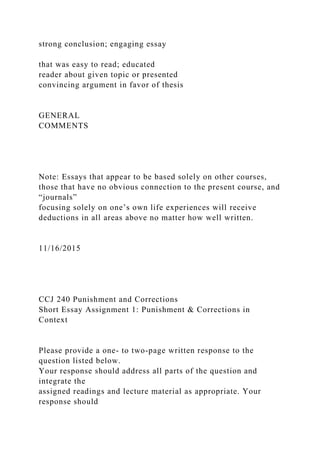
strong conclusion; engaging essay
that was easy to read; educated
reader about given topic or presented
convincing argument in favor of thesis
GENERAL
COMMENTS
Note: Essays that appear to be based solely on other courses,
those that have no obvious connection to the present course, and
“journals”
focusing solely on one’s own life experiences will receive
deductions in all areas above no matter how well written.
11/16/2015
CCJ 240 Punishment and Corrections
Short Essay Assignment 1: Punishment & Corrections in
Context
Please provide a one- to two-page written response to the
question listed below.
Your response should address all parts of the question and
integrate the
assigned readings and lecture material as appropriate. Your
response should
adhere to APA format, with 1” margins all around, Times New
Roman, 12-pt font,
with a left general alignment and double lined spacing. You
must appropriately
cite all references used in your response. You do not need to
seek out other
sources of information for this assignment as you have been
provided with more
than enough information in class and through the assigned
readings to address
this question. If you do refer to material not assigned in the
class, you must also
list them in a supplemental reference page. To receive full
credit, you must use
proper grammar and correct spelling, write in complete
sentences, use
appropriate punctuation, and avoid using abbreviations. I
strongly encourage you
to proof read your essay before turning it in.
Question
One of the goals for this class is for you to be able to identify
which correctional
policies and practices correspond to the main philosophies of
corrections. As
such, I want you to choose one correctional philosophy
(retribution, deterrence,
incapacitation, rehabilitation, or restorative justice) and
advocate for why it should
be advanced in practice in our nations correctional system. Be
sure to describe
the philosophy and emphasize what practices your position
supports (i.e., what
would the criminal justice system look like based on your
position).
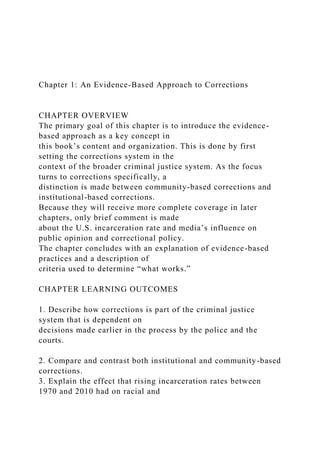
Chapter 1: An Evidence-Based Approach to Corrections
CHAPTER OVERVIEW
The primary goal of this chapter is to introduce the evidence-
based approach as a key concept in
this book’s content and organization. This is done by first
setting the corrections system in the
context of the broader criminal justice system. As the focus
turns to corrections specifically, a
distinction is made between community-based corrections and
institutional-based corrections.
Because they will receive more complete coverage in later
chapters, only brief comment is made
about the U.S. incarceration rate and media’s influence on
public opinion and correctional policy.
The chapter concludes with an explanation of evidence-based
practices and a description of
criteria used to determine “what works.”
CHAPTER LEARNING OUTCOMES
1. Describe how corrections is part of the criminal justice
system that is dependent on
decisions made earlier in the process by the police and the
courts.
2. Compare and contrast both institutional and community-based
corrections.
3. Explain the effect that rising incarceration rates between
1970 and 2010 had on racial and
economic disparity.
4. Analyze the relationships among mass media, public opinion,
and the making of
correctional policy.
5. Characterize the meaning of evidence-based practice and
explain how it can improve the
correctional system.
LECTURE OUTLINE
CORRECTIONS: AN INTEGRAL PART OF THE CRIMINAL
JUSTICE SYSTEM
• Figure 1-1 shows the criminal justice system in a flow chart
with the corrections system
identified as the final part of the system.
Police
o The criminal justice process begins with the report to the
police of a crime by a
victim or witness or, with the observation of a crime by the
police.
o After investigation, and depending on the seriousness of the
offenses, the police may
issue a warning or a citation, or make an arrest.
o Following an arrest or citation, the case moves to the courts.
Pretrial/Courts
o Prosecutors examine quality of evidence and determine
whether to charge the suspect
with a crime or to dismiss the case.
o When the decision is to charge the suspect, the person will
enter a plea of guilty or
not guilty and go before a judge to be sentenced (when the plea
is guilty) or to have a
trial date set (when the plea is not guilty).
o Prosecutors may make plea offers to defendants that could
encourage a guilty plea or
that can result in a sentence recommendation that prosecution
and defense feel is
most appropriate given the facts of the case.
Preadjudication Diversion
o Early in the court process, the judge may offer diversion or
deferred adjudication to
misdemeanor or first-time felony defendants.
o Diversion (e.g., deferred probation supervision) allows
defendants to be supervised in
the community before pleading guilty. With successful
completion of diversion,
charges are dropped and there is no formal record of conviction.
o Defendants not qualifying for diversion may be offered a plea
agreement wherein the
defendant pleads guilty in return for a favorable sentence.
CORRECTIONS AS COMMUNITY-BASED OR
INSTITUTIONAL
• Final case disposition lies with the judge who has available a
continuum of sanctions
from which to select the sentence.
• Figure 1-3 shows the continuum of sanctions as falling into
either community-based or
institutional.
Community Corrections
o Sanctions that rely on resources available in the community
are referred to as
community corrections.
o Examples include probation and residential community
corrections facilities.
Institutional Corrections
o Sanctions that require the offender to live in an institutional
environment apart from
their friends and family are referred to as institutional
corrections.
o Examples include jail and prison.
INCARCERATION RATES
• The United States has one of the highest incarceration rates in
the world.
• The war on drugs greatly increased the number of prisoners in
the federal system.
• Latinos and African-Americans are incarcerated
disproportionately and this may be the
result of police targeting minorities for closer attention or
possibly that minorities are
more likely to engage in behavior for which incarceration is the
appropriate sanction.
MEDIA INFLUENCE ON PUBLIC OPINION AND
CORRECTIONAL POLICY
• Much of the public’s view about the criminal justice system is
determined by the mass
media.
• With their focus on maximum and supermaximum units, the
media present a one-
dimensional and incomplete picture of prison life.
Crime Control Policy
o Affected by media influences and public opinion.
o Fear of crime, whether based in fact or on selected media
reports, may result in more
punitive crime policies that lead to more reliance on
imprisonment.
o Research suggests that the more punitive states tend to also
have higher rates of
poverty, more persons who are African-American, lower
percentage of voter turnout,
and less generous welfare payments for impoverished persons.
Reflection: How has the media influenced your own views about
crime and corrections? Can you
come up with specific examples from television, movies,
newspaper reports, and social media?
What are some of the positive and negative aspects of media
influence?
EVIDENCE-BASED PRACTICES
• There is a need for responses to crime that are more cost-
effective than imprisonment.
• Using evidence-based practices (EBP) is one way to
accomplish that goal.
• Figure 1-5 shows the two parts of EBP: Does it work? and
Applying the techniques.
How to Determine What Works
o Must rely on methodologically strong evaluations to identify
programs that work, are
promising, or don’t work.
o Practitioners will then use program elements that work and
discard those that do not.
EBP Techniques
o Meeting the six conditions for a rigorous study is difficult.
o Programs are said to “work” when two or more studies show a
significant difference
between treatment and control groups.
o At least 12 states have implemented EBP for offender
supervision.
ADDITIONAL MATERIALS
1. Get the most recent incarceration rate data from World Prison
Brief at
http://www.prisonstudies.org/map/europe . This very interesting
and interactive site
provides information about prison populations and prison rates
throughout the world. Not
only does it have interesting data for class lecture or discussion,
it is also a good site for
students to know about early in the term for any research papers
that may be assigned.
2. ACLU report “Every 25 Seconds: The Human Toll of
Criminalizing Drug Use in the
United States” at https://www.aclu.org/report
3. Many of the book’s chapters use Crime
Solution
s.gov as the source for information about
evidence-based practices and programs. Go to the corrections
and reentry section at
https://www.crimesolutions.gov/TopicDetails.aspx?ID=2 and
read
4. For more on “How to determine what works,” visit
https://www.crimesolutions.gov/about_starttofinish.aspx and
review steps used at this
particular site for determining “what works.”
Chapter 2: Why Do We Punish?
CHAPTER OVERVIEW
This chapter introduces five primary punishment philosophies
or rationales and explains each in
detail and under its own major heading. Review begins with
deterrence—distinguishing specific
and general. The importance of certainty, severity, and
swiftness of punishment is highlighted to
emphasize problems in effectively using deterrence as a
punishment system. Incapacitation—both
special and general—is reviewed with attention to its
application through imprisonment but also
in its contemporary use through technology. The various ways
that rehabilitation has been
implemented are noted with particular attention to its current
use as part of reentry. Retribution as
a punishment philosophy is distinguished from revenge and the
importance of proportionality in
punishment is emphasized. The chapter concludes with
discussion of restorative justice and how
it can be used during sentencing, in the community, and in
prison.
CHAPTER LEARNING OUTCOMES
1. Describe the five primary punishment philosophies.
2. Discuss the deterrence philosophy of punishment by
understanding the effects of specific
and general deterrence.
3. Compare and contrast selective and general incapacitation.
4. Summarize rehabilitation’s development from a reclamation
focus to a reentry emphasis.
5. Explain the keys ways in which retribution differs from
revenge.
6. Describe how restorative justice principles are used in
sentencing, during community
supervision, and in prison.
LECTURE OUTLINE
WHY DO WE PUNISH?
• What do we hope punishment will accomplish? Why is it
important that we ask this
question? We need to know the desired outcome in order to
ensure the selected
punishment is effective at achieving the desired result.
DETERRENCE
• This punishment philosophy seeks to prevent future offenses.
Deterrence can be one of
two types.
Specific Deterrence
o Punishment is applied to an offender with the goal of
discouraging that person from
misbehaving again.
General Deterrence
o Punishment is applied to an offender so that others who are
thinking about
committing a crime will decide not to in order to avoid being
punished.
INCAPACITATION
• This punishment philosophy also has two aspects: selective
incapacitation and general
incapacitation. Distinguish each (see Figure 2-3) and discuss in
class the strengths and
weaknesses of each.
Incapacitation Through Technology
o Three types are discussed (see Figure 2-4): chemical
treatment, critical organ surgery,
and electronic monitoring.
REHABILITATION
• Rehabilitation is described as having progressed through four
stages (see Figure 2-6), but
its application as individualized treatment (Twentieth Century)
and for purposes of reenty
(Twenty-First Century) will be of most interest to students and
should be highlighted in
lecture.
• Include discussion of the iron law of imprisonment (i.e.,
essentially all prisoners will
eventually return to free society) when discussing
rehabilitation’s contemporary role.
RETRIBUTION
• Retribution is a legitimate punishment philosophy, revenge
less so (see Table 2-1).
Retribution is non-utilitarian aspect and is unique among the
punishment philosophies in
that it is applied simply because punishment is required of
society when a crime has
occurred. We punish because it’s the right thing to do… our
moral obligation.
RESTORATION
• This punishment philosophy provides a greater role for
victim’s than do the other
rationales. Offender accountability is important, but so too are
concerns for how best to
reintegrate the offender into the community and to restore the
balance that was upset by
the crime.
Criticism of Restorative Justice
o Restorative justice is criticized for bringing people into the
justice system who might
otherwise have been handled informally outside the system (the
problem of net
widening) and for its potential to promote discrimination by
perpetuating social
inequities (e.g., subordinates may be pressured to accept less
than they deserve
because of the power discrepancy).
Chapter 3: Correctional Practices from Ancient to
Contemporary Times
CHAPTER OVERVIEW
A brief review of corrections from ancient times to colonial
America begins Chapter three. Key
points in those sections include the important themes of
isolating prisoners and requiring
prisoners to work. The first was reflected in the early hospice
facilities and the latter in the houses
of corrections. Those themes played a big role in Nineteenth
century America as the merits of
both the Pennsylvania and Auburn systems were debated.
Sometimes prison development in other
parts of the country are ignored when discussion concentrates
on developments in Pennsylvania
and New York, so the chapter spends time on what was
occurring in the American South and
West as well. The section on corrections in the Twentieth
century highlights the role of
progressivism and the importance of the medical model. The
chapter concludes with
contemporary public attitudes that seem to favor greater
reliance on community-based sanctions
and a decreased reliance on prisons.
CHAPTER LEARNING OUTCOMES
1. Describe key features of the Code of Hammurabi, Mosaic
Law, Roman law, and law
during the Middle Ages.
2. Discuss the use of transportation to handle criminal offenders
and identify the two
important themes in the development of imprisonment as
punishment.
3. Compare and contrast the Pennsylvania and Auburn prison
systems in terms of their
architecture, orienting strategies, and advantages/disadvantages.
4. Describe how men’s and women’s prisons differed during the
reformatory movement of
the nineteenth century.
5. Explain how penal systems in the South and West differed
from those in the East and
summarize reasons for those differences.
6. Summarize the development of prison programs and the
treatment of women and other
minorities during the early, middle, and late twentieth century.
7. Explain the effects of changing public opinion on the use of
imprisonment and prison
alternatives in the twenty-first century.
LECTURE OUTLINE
CORRECTIONS IN THE ANCIENT AND MEDIEVAL WORLD
• The Code of Hammurabi introduces concept of lex talionis
(the law of retaliation).
• Under Mosaic Law the concept of lex talionis continues, but
expands to include concept
of proportionality (i.e., punishment should be no more severe
than the crime).
• The Roman Twelve Tables provides legal base and punishment
types for sophisticated
legal systems.
• During the Middle Ages punishments moved away from
capital punishment and by end
of the period was movement toward exhibitory punishment
(e.g., stocks and pillories).
CORRECTIONS IN SEVENTEENTH- AND EIGHTEENTH-
CENTURY ENGLAND
Transportation
o Remove criminal to place where can do no harm.
o Used by England for economic purposes.
o Became major component of British penal policy in 18th
century.
o Especially to American colonies and Australia.
o Initial increase in women transportees to Australia was in part
with a hope the
women would act as a moralizing influence, but that expected
positive influence did
not materialize.
Prisons Before the Prison
o Long-term imprisonment as punishment fully occurs in 19th
century.
o Highlights two themes that continued to influence penal
practice.
o Isolation theme (Hospice facilities).
o Work theme (Houses of correction).
Reflection: There are two important themes in the development
of imprisonment (i.e., prisoners
should be isolated and prisoners should work). Are they still
appropriate today? If so, how can
they be accomplished?
CORRECTIONS IN EIGHTEENTH- AND NINETEENTH-
CENTURY AMERICA
The Pennsylvania System
o Implemented at Eastern State Penitentiary in Philadelphia.
o Followed a “separate and silent” strategy.
o Criticized as causing mental problems and unable to maintain
either separation or
silence.
The Auburn System
o Implemented at Auburn Prison in New York.
o Followed a “congregate and silent” strategy.
o Relied on factory-oriented labor rather than craft-oriented.
The Pennsylvania versus Auburn Debate
o Pennsylvania system avoided cross-contamination through
strict separation of
prisoners, had opportunities for meditation and repentance,
made it easy to control
prisoners.
o Auburn system was cheaper to construct and operate, provided
better vocational
training, and was less damaging to prisoner’s mental health.
The Reformatory Movement
o Relied on a more humanitarian approach to confinement and
an interest in preparing
inmates for eventual return to the community.
o Differed from existing prisons by (1) using indeterminate
sentences, (2) allowing
possibility of early release, (3) placing greater emphasis on
reforming inmate, (4)
providing more trade training, and (5) providing more academic
education.
o First used in U.S. at Elmira Reformatory in Elmira, NY.
SEGREGATING THE SEXES
• Prisons and reformatories specifically for women began
operating in the 1870s.
• Differed from prisons for men in architectural style (women’s
prisons were built in a
cottage plan projecting a domestic atmosphere), goal (getting
women to focus their
attention and interests on their expected role in society, and
programs (consistent with
societal expectations of the time, programs emphasized
domesticity).
• Also, differed in that women received long sentences, even for
misdemeanors, on the
assumption that the needed reform would take a long time.
• Final difference was in terms of racial bias since felons, many
of whom were black, did
not get much empathy from the middle-class (and essentially
white) reformers. As a
result, black women probably served sentence in the women’s
(sometimes men’s)
custodial prisons
PRISON DEVELOPMENT IN THE SOUTH AND WEST
Developments in the American South
o The South found little advantage to building large prison
facilities like those in the
North because of the Southern reliance on decentralization to
local authorities rather
than state, the absence of support from religious groups to
corporal and capital
punishment alternatives, and because the agricultural economy
required workers to
be spread over wide area rather than in a factory.
Developments in the American West
o There were prisons similar to those in Northeast but
overcrowding quickly became a
problem.
o Some territories sent their criminals to others states rather
than build own prison.
o Successful prison systems did develop in states where there
had been more openness
to what was happening in the Northeast.
CORRECTIONS IN THE TWENTIETH CENTURY
• Events during this period were heavily influenced by the
reform movement known as
progressivism.
• Progressives viewed institutions of social control (e.g.,
prisons and reformatories) as
misguided and argued instead that criminals and delinquents
should be cured through
individualized treatment programs.
• Criminal behavior was viewed as the result of sociological,
psychological, and biological
factors rather than the offender’s misdirected free will.
• Appropriate response was to diagnose and treat—the medical
model.
CORRECTIONS AT THE START OF THE TWENTY-FIRST
CENTURY
• Continues many of the Twentieth century developments, but
movement is toward less
reliance on prison and more on the community.
Public Opinion
o A meta-analysis of public opinion research over the previous
15 years show people
backing away from harsh sentencing policies and instead
favoring rehabilitation,
treatment, and support efforts.
o Treatment, job and educational training, housing assistance,
and mental health or
substance abuse services are viewed as vital to successful
reentry.
o Although there is public support for offenders making an
effort to change, the public
also prefers that the process not affect them directly and
hesitate to pay more taxes or
to have a halfway house in their neighborhood.
o Persons of color perceive systemic racial disparities in
policing, sentencing, and
overall treatment by the criminal justice system, whereas white
respondents
acknowledge some disparity but are more likely to believe the
system treats people of
all races equally.
Reflection: A first-of-its-kind national survey finds that crime
victims want shorter prison
sentences, less spending on prisons, and more focus on
rehabilitation. The report can be found
here:
https://www.allianceforsafetyandjustice.org/crimesurvivorsspea
k/
As noted in the text, the general public supports similar
changes. Are you surprised that crime
victims and the general public agree on this topic? Why or why
not?
Decreased Reliance on Prisons
o U.S. prison population has been declining.
o Reasons for the drop include state budget deficits forcing a
reduction in the prison
population as way to save money, fewer prison admissions, the
realization that
taxpayers get better return on public safety dollars with prison
alternatives, and the
point that public opinion supports reform efforts.
ADDITIONAL ASSIGNMENTS AND CLASS ACTIVITIES
1. The United Kingdom National Archives provides an
interesting website at
http://www.nationalarchives.gov.uk/records/looking-for-
person/transportees.htm that has
information on convict transportees to North America and to
Australia.
2. Take a virtual tour of Eastern State Penitentiary by visiting:
http://www.easternstate.org/explore/online-360-tour

PUNISHMENT & CORRECTIONS ESSAY ASSIGNMENT GRADING RUBRIC .docx

  • 1.
    PUNISHMENT & CORRECTIONS ESSAYASSIGNMENT GRADING RUBRIC LOWER RANGE (0 – 6 pts) MIDDLE (7 - 8 pts) UPPER RANGE (9 - 10 pts) SCORE THESIS/FOCUS Essay does not address all parts of the question; essay addresses other issues/topics unrelated to the question Essay addresses all parts of the question; essay does not address other issues/topics unrelated to the question COURSE CONTENT Connections to course content (i.e., lectures, textbook) missing or
  • 2.
    linkage unclear; coursecontent poorly understood Integrates range of concepts, facts, ideas from course content; demonstrates accurate understanding of course content SPELLING & GRAMMAR Significant spelling, punctuation, and/or grammatical errors Free of spelling, punctuation, and grammatical errors READABILITY & STRUCTURE Paragraphs disorganized, tangential, or unrelated to one another; transitions missing or poorly done; weak ending; difficult to read and engage with essay due to writing Paragraphs logically organized to build support for thesis/position; effective transitions connecting paragraphs;
  • 3.
    strong conclusion; engagingessay that was easy to read; educated reader about given topic or presented convincing argument in favor of thesis GENERAL COMMENTS Note: Essays that appear to be based solely on other courses, those that have no obvious connection to the present course, and “journals” focusing solely on one’s own life experiences will receive deductions in all areas above no matter how well written. 11/16/2015 CCJ 240 Punishment and Corrections Short Essay Assignment 1: Punishment & Corrections in Context Please provide a one- to two-page written response to the question listed below. Your response should address all parts of the question and integrate the assigned readings and lecture material as appropriate. Your response should
  • 4.
    adhere to APAformat, with 1” margins all around, Times New Roman, 12-pt font, with a left general alignment and double lined spacing. You must appropriately cite all references used in your response. You do not need to seek out other sources of information for this assignment as you have been provided with more than enough information in class and through the assigned readings to address this question. If you do refer to material not assigned in the class, you must also list them in a supplemental reference page. To receive full credit, you must use proper grammar and correct spelling, write in complete sentences, use appropriate punctuation, and avoid using abbreviations. I strongly encourage you to proof read your essay before turning it in. Question One of the goals for this class is for you to be able to identify which correctional policies and practices correspond to the main philosophies of corrections. As such, I want you to choose one correctional philosophy (retribution, deterrence, incapacitation, rehabilitation, or restorative justice) and advocate for why it should be advanced in practice in our nations correctional system. Be sure to describe the philosophy and emphasize what practices your position supports (i.e., what would the criminal justice system look like based on your position).
  • 5.
    Chapter 1: AnEvidence-Based Approach to Corrections CHAPTER OVERVIEW The primary goal of this chapter is to introduce the evidence- based approach as a key concept in this book’s content and organization. This is done by first setting the corrections system in the context of the broader criminal justice system. As the focus turns to corrections specifically, a distinction is made between community-based corrections and institutional-based corrections. Because they will receive more complete coverage in later chapters, only brief comment is made about the U.S. incarceration rate and media’s influence on public opinion and correctional policy. The chapter concludes with an explanation of evidence-based practices and a description of criteria used to determine “what works.” CHAPTER LEARNING OUTCOMES 1. Describe how corrections is part of the criminal justice system that is dependent on decisions made earlier in the process by the police and the courts. 2. Compare and contrast both institutional and community-based corrections. 3. Explain the effect that rising incarceration rates between 1970 and 2010 had on racial and
  • 6.
    economic disparity. 4. Analyzethe relationships among mass media, public opinion, and the making of correctional policy. 5. Characterize the meaning of evidence-based practice and explain how it can improve the correctional system. LECTURE OUTLINE CORRECTIONS: AN INTEGRAL PART OF THE CRIMINAL JUSTICE SYSTEM • Figure 1-1 shows the criminal justice system in a flow chart with the corrections system identified as the final part of the system. Police o The criminal justice process begins with the report to the police of a crime by a victim or witness or, with the observation of a crime by the police. o After investigation, and depending on the seriousness of the offenses, the police may issue a warning or a citation, or make an arrest. o Following an arrest or citation, the case moves to the courts. Pretrial/Courts o Prosecutors examine quality of evidence and determine whether to charge the suspect with a crime or to dismiss the case. o When the decision is to charge the suspect, the person will
  • 7.
    enter a pleaof guilty or not guilty and go before a judge to be sentenced (when the plea is guilty) or to have a trial date set (when the plea is not guilty). o Prosecutors may make plea offers to defendants that could encourage a guilty plea or that can result in a sentence recommendation that prosecution and defense feel is most appropriate given the facts of the case. Preadjudication Diversion o Early in the court process, the judge may offer diversion or deferred adjudication to misdemeanor or first-time felony defendants. o Diversion (e.g., deferred probation supervision) allows defendants to be supervised in the community before pleading guilty. With successful completion of diversion, charges are dropped and there is no formal record of conviction. o Defendants not qualifying for diversion may be offered a plea agreement wherein the defendant pleads guilty in return for a favorable sentence. CORRECTIONS AS COMMUNITY-BASED OR INSTITUTIONAL • Final case disposition lies with the judge who has available a
  • 8.
    continuum of sanctions fromwhich to select the sentence. • Figure 1-3 shows the continuum of sanctions as falling into either community-based or institutional. Community Corrections o Sanctions that rely on resources available in the community are referred to as community corrections. o Examples include probation and residential community corrections facilities. Institutional Corrections o Sanctions that require the offender to live in an institutional environment apart from their friends and family are referred to as institutional corrections. o Examples include jail and prison. INCARCERATION RATES • The United States has one of the highest incarceration rates in the world. • The war on drugs greatly increased the number of prisoners in the federal system. • Latinos and African-Americans are incarcerated disproportionately and this may be the result of police targeting minorities for closer attention or possibly that minorities are more likely to engage in behavior for which incarceration is the
  • 9.
    appropriate sanction. MEDIA INFLUENCEON PUBLIC OPINION AND CORRECTIONAL POLICY • Much of the public’s view about the criminal justice system is determined by the mass media. • With their focus on maximum and supermaximum units, the media present a one- dimensional and incomplete picture of prison life. Crime Control Policy o Affected by media influences and public opinion. o Fear of crime, whether based in fact or on selected media reports, may result in more punitive crime policies that lead to more reliance on imprisonment. o Research suggests that the more punitive states tend to also have higher rates of poverty, more persons who are African-American, lower percentage of voter turnout, and less generous welfare payments for impoverished persons. Reflection: How has the media influenced your own views about crime and corrections? Can you come up with specific examples from television, movies, newspaper reports, and social media? What are some of the positive and negative aspects of media influence?
  • 10.
    EVIDENCE-BASED PRACTICES • Thereis a need for responses to crime that are more cost- effective than imprisonment. • Using evidence-based practices (EBP) is one way to accomplish that goal. • Figure 1-5 shows the two parts of EBP: Does it work? and Applying the techniques. How to Determine What Works o Must rely on methodologically strong evaluations to identify programs that work, are promising, or don’t work. o Practitioners will then use program elements that work and discard those that do not. EBP Techniques o Meeting the six conditions for a rigorous study is difficult. o Programs are said to “work” when two or more studies show a significant difference between treatment and control groups. o At least 12 states have implemented EBP for offender supervision. ADDITIONAL MATERIALS 1. Get the most recent incarceration rate data from World Prison
  • 11.
    Brief at http://www.prisonstudies.org/map/europe .This very interesting and interactive site provides information about prison populations and prison rates throughout the world. Not only does it have interesting data for class lecture or discussion, it is also a good site for students to know about early in the term for any research papers that may be assigned. 2. ACLU report “Every 25 Seconds: The Human Toll of Criminalizing Drug Use in the United States” at https://www.aclu.org/report 3. Many of the book’s chapters use Crime Solution s.gov as the source for information about evidence-based practices and programs. Go to the corrections and reentry section at https://www.crimesolutions.gov/TopicDetails.aspx?ID=2 and read 4. For more on “How to determine what works,” visit https://www.crimesolutions.gov/about_starttofinish.aspx and review steps used at this particular site for determining “what works.”
  • 12.
    Chapter 2: WhyDo We Punish? CHAPTER OVERVIEW This chapter introduces five primary punishment philosophies or rationales and explains each in detail and under its own major heading. Review begins with deterrence—distinguishing specific and general. The importance of certainty, severity, and swiftness of punishment is highlighted to emphasize problems in effectively using deterrence as a punishment system. Incapacitation—both special and general—is reviewed with attention to its application through imprisonment but also in its contemporary use through technology. The various ways that rehabilitation has been implemented are noted with particular attention to its current use as part of reentry. Retribution as a punishment philosophy is distinguished from revenge and the importance of proportionality in punishment is emphasized. The chapter concludes with discussion of restorative justice and how it can be used during sentencing, in the community, and in prison.
  • 13.
    CHAPTER LEARNING OUTCOMES 1.Describe the five primary punishment philosophies. 2. Discuss the deterrence philosophy of punishment by understanding the effects of specific and general deterrence. 3. Compare and contrast selective and general incapacitation. 4. Summarize rehabilitation’s development from a reclamation focus to a reentry emphasis. 5. Explain the keys ways in which retribution differs from revenge. 6. Describe how restorative justice principles are used in sentencing, during community supervision, and in prison. LECTURE OUTLINE WHY DO WE PUNISH? • What do we hope punishment will accomplish? Why is it important that we ask this
  • 14.
    question? We needto know the desired outcome in order to ensure the selected punishment is effective at achieving the desired result. DETERRENCE • This punishment philosophy seeks to prevent future offenses. Deterrence can be one of two types. Specific Deterrence o Punishment is applied to an offender with the goal of discouraging that person from misbehaving again. General Deterrence o Punishment is applied to an offender so that others who are thinking about committing a crime will decide not to in order to avoid being punished.
  • 15.
    INCAPACITATION • This punishmentphilosophy also has two aspects: selective incapacitation and general incapacitation. Distinguish each (see Figure 2-3) and discuss in class the strengths and weaknesses of each. Incapacitation Through Technology o Three types are discussed (see Figure 2-4): chemical treatment, critical organ surgery, and electronic monitoring. REHABILITATION • Rehabilitation is described as having progressed through four stages (see Figure 2-6), but its application as individualized treatment (Twentieth Century) and for purposes of reenty (Twenty-First Century) will be of most interest to students and should be highlighted in lecture.
  • 16.
    • Include discussionof the iron law of imprisonment (i.e., essentially all prisoners will eventually return to free society) when discussing rehabilitation’s contemporary role. RETRIBUTION • Retribution is a legitimate punishment philosophy, revenge less so (see Table 2-1). Retribution is non-utilitarian aspect and is unique among the punishment philosophies in that it is applied simply because punishment is required of society when a crime has occurred. We punish because it’s the right thing to do… our moral obligation. RESTORATION • This punishment philosophy provides a greater role for victim’s than do the other rationales. Offender accountability is important, but so too are concerns for how best to
  • 17.
    reintegrate the offenderinto the community and to restore the balance that was upset by the crime. Criticism of Restorative Justice o Restorative justice is criticized for bringing people into the justice system who might otherwise have been handled informally outside the system (the problem of net widening) and for its potential to promote discrimination by perpetuating social inequities (e.g., subordinates may be pressured to accept less than they deserve because of the power discrepancy). Chapter 3: Correctional Practices from Ancient to
  • 18.
    Contemporary Times CHAPTER OVERVIEW Abrief review of corrections from ancient times to colonial America begins Chapter three. Key points in those sections include the important themes of isolating prisoners and requiring prisoners to work. The first was reflected in the early hospice facilities and the latter in the houses of corrections. Those themes played a big role in Nineteenth century America as the merits of both the Pennsylvania and Auburn systems were debated. Sometimes prison development in other parts of the country are ignored when discussion concentrates on developments in Pennsylvania and New York, so the chapter spends time on what was occurring in the American South and West as well. The section on corrections in the Twentieth century highlights the role of progressivism and the importance of the medical model. The chapter concludes with contemporary public attitudes that seem to favor greater reliance on community-based sanctions and a decreased reliance on prisons.
  • 19.
    CHAPTER LEARNING OUTCOMES 1.Describe key features of the Code of Hammurabi, Mosaic Law, Roman law, and law during the Middle Ages. 2. Discuss the use of transportation to handle criminal offenders and identify the two important themes in the development of imprisonment as punishment. 3. Compare and contrast the Pennsylvania and Auburn prison systems in terms of their architecture, orienting strategies, and advantages/disadvantages. 4. Describe how men’s and women’s prisons differed during the reformatory movement of the nineteenth century. 5. Explain how penal systems in the South and West differed from those in the East and summarize reasons for those differences. 6. Summarize the development of prison programs and the
  • 20.
    treatment of womenand other minorities during the early, middle, and late twentieth century. 7. Explain the effects of changing public opinion on the use of imprisonment and prison alternatives in the twenty-first century. LECTURE OUTLINE CORRECTIONS IN THE ANCIENT AND MEDIEVAL WORLD • The Code of Hammurabi introduces concept of lex talionis (the law of retaliation). • Under Mosaic Law the concept of lex talionis continues, but expands to include concept of proportionality (i.e., punishment should be no more severe than the crime). • The Roman Twelve Tables provides legal base and punishment types for sophisticated legal systems. • During the Middle Ages punishments moved away from capital punishment and by end
  • 21.
    of the periodwas movement toward exhibitory punishment (e.g., stocks and pillories). CORRECTIONS IN SEVENTEENTH- AND EIGHTEENTH- CENTURY ENGLAND Transportation o Remove criminal to place where can do no harm. o Used by England for economic purposes. o Became major component of British penal policy in 18th century. o Especially to American colonies and Australia. o Initial increase in women transportees to Australia was in part with a hope the women would act as a moralizing influence, but that expected positive influence did not materialize. Prisons Before the Prison o Long-term imprisonment as punishment fully occurs in 19th century.
  • 22.
    o Highlights twothemes that continued to influence penal practice. o Isolation theme (Hospice facilities). o Work theme (Houses of correction). Reflection: There are two important themes in the development of imprisonment (i.e., prisoners should be isolated and prisoners should work). Are they still appropriate today? If so, how can they be accomplished? CORRECTIONS IN EIGHTEENTH- AND NINETEENTH- CENTURY AMERICA The Pennsylvania System o Implemented at Eastern State Penitentiary in Philadelphia. o Followed a “separate and silent” strategy. o Criticized as causing mental problems and unable to maintain either separation or silence. The Auburn System
  • 23.
    o Implemented atAuburn Prison in New York. o Followed a “congregate and silent” strategy. o Relied on factory-oriented labor rather than craft-oriented. The Pennsylvania versus Auburn Debate o Pennsylvania system avoided cross-contamination through strict separation of prisoners, had opportunities for meditation and repentance, made it easy to control prisoners. o Auburn system was cheaper to construct and operate, provided better vocational training, and was less damaging to prisoner’s mental health. The Reformatory Movement o Relied on a more humanitarian approach to confinement and an interest in preparing inmates for eventual return to the community. o Differed from existing prisons by (1) using indeterminate sentences, (2) allowing
  • 24.
    possibility of earlyrelease, (3) placing greater emphasis on reforming inmate, (4) providing more trade training, and (5) providing more academic education. o First used in U.S. at Elmira Reformatory in Elmira, NY. SEGREGATING THE SEXES • Prisons and reformatories specifically for women began operating in the 1870s. • Differed from prisons for men in architectural style (women’s prisons were built in a cottage plan projecting a domestic atmosphere), goal (getting women to focus their attention and interests on their expected role in society, and programs (consistent with societal expectations of the time, programs emphasized domesticity). • Also, differed in that women received long sentences, even for misdemeanors, on the assumption that the needed reform would take a long time.
  • 25.
    • Final differencewas in terms of racial bias since felons, many of whom were black, did not get much empathy from the middle-class (and essentially white) reformers. As a result, black women probably served sentence in the women’s (sometimes men’s) custodial prisons PRISON DEVELOPMENT IN THE SOUTH AND WEST Developments in the American South o The South found little advantage to building large prison facilities like those in the North because of the Southern reliance on decentralization to local authorities rather than state, the absence of support from religious groups to corporal and capital punishment alternatives, and because the agricultural economy required workers to be spread over wide area rather than in a factory.
  • 26.
    Developments in theAmerican West o There were prisons similar to those in Northeast but overcrowding quickly became a problem. o Some territories sent their criminals to others states rather than build own prison. o Successful prison systems did develop in states where there had been more openness to what was happening in the Northeast. CORRECTIONS IN THE TWENTIETH CENTURY • Events during this period were heavily influenced by the reform movement known as progressivism. • Progressives viewed institutions of social control (e.g., prisons and reformatories) as misguided and argued instead that criminals and delinquents should be cured through individualized treatment programs.
  • 27.
    • Criminal behaviorwas viewed as the result of sociological, psychological, and biological factors rather than the offender’s misdirected free will. • Appropriate response was to diagnose and treat—the medical model. CORRECTIONS AT THE START OF THE TWENTY-FIRST CENTURY • Continues many of the Twentieth century developments, but movement is toward less reliance on prison and more on the community. Public Opinion o A meta-analysis of public opinion research over the previous 15 years show people backing away from harsh sentencing policies and instead favoring rehabilitation, treatment, and support efforts. o Treatment, job and educational training, housing assistance,
  • 28.
    and mental healthor substance abuse services are viewed as vital to successful reentry. o Although there is public support for offenders making an effort to change, the public also prefers that the process not affect them directly and hesitate to pay more taxes or to have a halfway house in their neighborhood. o Persons of color perceive systemic racial disparities in policing, sentencing, and overall treatment by the criminal justice system, whereas white respondents acknowledge some disparity but are more likely to believe the system treats people of all races equally. Reflection: A first-of-its-kind national survey finds that crime victims want shorter prison sentences, less spending on prisons, and more focus on rehabilitation. The report can be found here: https://www.allianceforsafetyandjustice.org/crimesurvivorsspea
  • 29.
    k/ As noted inthe text, the general public supports similar changes. Are you surprised that crime victims and the general public agree on this topic? Why or why not? Decreased Reliance on Prisons o U.S. prison population has been declining. o Reasons for the drop include state budget deficits forcing a reduction in the prison population as way to save money, fewer prison admissions, the realization that taxpayers get better return on public safety dollars with prison alternatives, and the point that public opinion supports reform efforts. ADDITIONAL ASSIGNMENTS AND CLASS ACTIVITIES 1. The United Kingdom National Archives provides an
  • 30.
    interesting website at http://www.nationalarchives.gov.uk/records/looking-for- person/transportees.htmthat has information on convict transportees to North America and to Australia. 2. Take a virtual tour of Eastern State Penitentiary by visiting: http://www.easternstate.org/explore/online-360-tour