Diseases of the pulp & periapical tissues
Dept of Oral Pathology,
LEARNING OBJECTIVES
 At the end of the lecture student should describe
describe
– pathophysiology of the pulp disorders
– etiological factors for the pulp diseases
– classification of pulpal diseases
Introduction
 Pulp is the formative organ of the
tooth.
 It is a connective tissue system,
composed of cells, ground
substance and fibers.
 Irritation to pulp causes pulpal
injuries.
 Irritants may be living or nonliving.
 The living irritants are usually bacterial,
 Nonliving irritants may be mechanical,
thermal, chemical .
• The initial response of dental pulp to injury is similar to
other connective tissue but
• The nature & course of the response is different
Because
• Anatomic features
Pathophysiology
Injury
Inflammation
Hyperemia (vasodilatation)
Edema
Pathophysiology
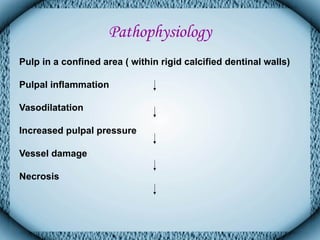
Pulp in a confined area ( within rigid calcified dentinal walls)
Pulpal inflammation
Vasodilatation
Increased pulpal pressure
Vessel damage
Necrosis
Pulpitis :- An inflammation of the pulpal tissue that may be acute or
chronic, with or without symptoms, and reversible or irreversible
Etiologies of
pulp pathologies
Physical Biological
Chemical
Mechanical Thermal Electrical
I. Physical
A) Mechanical
1.Trauma
a. Accidental ( contact sports)
b. Iatrogenic dental procedures
(wedging of teeth, cavity or crown preparation etc.)
2. Pathologic wear ( attrition, abrasion etc.)
3. Crack through body of tooth (Crack tooth syndrome)
4. Barometric changes ( Barodontalgia )
B. Thermal
1. Heat from cavity preparation, at either low or high
speed
2. Exothermic heat from the setting of cement
3. Conduction of heat and cold through deep filling
without a protective base
4. Frictional heat caused by polishing a restoration
C. Electrical ( galvanic current from dissimilar metallic
filling) II. Chemical
A. Phosphoric Acid, acrylic monomer, etc
B. Erosion ( acid )
III. Biological
A. Toxins associated with caries
B. Direct invasion of pulp from caries or trauma
C. Microbial colonization in the pulp by blood borne
microorganisms (anachoresis)
Crack tooth syndrome( Crack through body of tooth)
• Crack may developed in enamel from thermal tensile
stresses, because transient heat is conducted much more
readily in enamel than in dentin.
• When teeth are subjected to sudden temperature change,
the enamel reaches the new temperature much more
rapidly than the dentin.
• With lower temperatures, the enamel is restrained from
contracting by the dentin, resulting in enamel cracks.
• C/O of pain, ranging from mild to excruciating at the
initiation or released of the biting force.
• Crack through body of the tooth may be better visualized
by using a dye or by trasilluminating the tooth with a
fibro-optic light.
Classification
Pulpitis
Acute Chronic
Open Pulpitis
Open Pulpitis
(Pulpitis aperta)
Closed Pulpitis
(Pulpitis clausa)
Closed Pulpitis
Chronic hyperplasic
Pulpitis (pulp polyp)
Chronic Ulcerative
Pulpitis
Pulpitis
Acute Chronic
Partial /focal
Partial /focal Total/Generalised Total/Generalised
Summary
– pathophysiology of the pulp disorders
– etiological factors for the pulp diseases
– classification of pulpal diseases
BIBLIOGRAPHY
 Text book of oral pathology Shafer's, 5 & 6th
edition
 Color Atlas of Oral Diseases Cawson, R. 2nd
edition
 Oral and Maxillofacial Pathology Neville, Brad W. 2nd
 Lucas’s Pathology Of Tumor’s of the Oral Tissues
Cawson, R. A., Bennie, W. H 5th
edition
Pulp and periapical-Pathologies part 1.ppt

Pulp and periapical-Pathologies part 1.ppt

  • 1.
    Diseases of thepulp & periapical tissues Dept of Oral Pathology,
  • 2.
    LEARNING OBJECTIVES  Atthe end of the lecture student should describe describe – pathophysiology of the pulp disorders – etiological factors for the pulp diseases – classification of pulpal diseases
  • 3.
    Introduction  Pulp isthe formative organ of the tooth.  It is a connective tissue system, composed of cells, ground substance and fibers.  Irritation to pulp causes pulpal injuries.  Irritants may be living or nonliving.
  • 4.
     The livingirritants are usually bacterial,  Nonliving irritants may be mechanical, thermal, chemical .
  • 5.
    • The initialresponse of dental pulp to injury is similar to other connective tissue but • The nature & course of the response is different Because • Anatomic features
  • 6.
  • 7.
    Pathophysiology Pulp in aconfined area ( within rigid calcified dentinal walls) Pulpal inflammation Vasodilatation Increased pulpal pressure Vessel damage Necrosis
  • 8.
    Pulpitis :- Aninflammation of the pulpal tissue that may be acute or chronic, with or without symptoms, and reversible or irreversible
  • 9.
    Etiologies of pulp pathologies PhysicalBiological Chemical Mechanical Thermal Electrical
  • 10.
    I. Physical A) Mechanical 1.Trauma a.Accidental ( contact sports) b. Iatrogenic dental procedures (wedging of teeth, cavity or crown preparation etc.) 2. Pathologic wear ( attrition, abrasion etc.) 3. Crack through body of tooth (Crack tooth syndrome) 4. Barometric changes ( Barodontalgia )
  • 11.
    B. Thermal 1. Heatfrom cavity preparation, at either low or high speed 2. Exothermic heat from the setting of cement 3. Conduction of heat and cold through deep filling without a protective base 4. Frictional heat caused by polishing a restoration
  • 12.
    C. Electrical (galvanic current from dissimilar metallic filling) II. Chemical A. Phosphoric Acid, acrylic monomer, etc B. Erosion ( acid ) III. Biological A. Toxins associated with caries B. Direct invasion of pulp from caries or trauma C. Microbial colonization in the pulp by blood borne microorganisms (anachoresis)
  • 13.
    Crack tooth syndrome(Crack through body of tooth) • Crack may developed in enamel from thermal tensile stresses, because transient heat is conducted much more readily in enamel than in dentin. • When teeth are subjected to sudden temperature change, the enamel reaches the new temperature much more rapidly than the dentin.
  • 14.
    • With lowertemperatures, the enamel is restrained from contracting by the dentin, resulting in enamel cracks.
  • 15.
    • C/O ofpain, ranging from mild to excruciating at the initiation or released of the biting force. • Crack through body of the tooth may be better visualized by using a dye or by trasilluminating the tooth with a fibro-optic light.
  • 17.
  • 18.
    Pulpitis Acute Chronic Open Pulpitis OpenPulpitis (Pulpitis aperta) Closed Pulpitis (Pulpitis clausa) Closed Pulpitis Chronic hyperplasic Pulpitis (pulp polyp) Chronic Ulcerative Pulpitis
  • 19.
    Pulpitis Acute Chronic Partial /focal Partial/focal Total/Generalised Total/Generalised
  • 20.
    Summary – pathophysiology ofthe pulp disorders – etiological factors for the pulp diseases – classification of pulpal diseases
  • 21.
    BIBLIOGRAPHY  Text bookof oral pathology Shafer's, 5 & 6th edition  Color Atlas of Oral Diseases Cawson, R. 2nd edition  Oral and Maxillofacial Pathology Neville, Brad W. 2nd  Lucas’s Pathology Of Tumor’s of the Oral Tissues Cawson, R. A., Bennie, W. H 5th edition