Publishing work that
includes 3rd party content
Kate Petherbridge
Photo by Markus Winkler on Unsplash
✔ A fully Open Access library-led academic publisher
✔ Publishes research monographs, textbooks and journals
✔ Scope and strategy set by library-led Management Board
✔ Commissioning by an academic-led Editorial Board, based on peer review
✔ Publishing as a service
✔ Offer support for OA more widely, through local sessions and advice for
academics wanting to engage with OA, and initiatives such as the Jisc NUP
toolkit
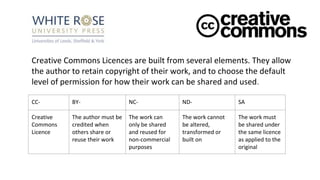
Creative Commons Licences are built from several elements. They allow
the author to retain copyright of their work, and to choose the default
level of permission for how their work can be shared and used.
CC- BY- NC- ND- SA
Creative
Commons
Licence
The author must be
credited when
others share or
reuse their work
The work can
only be shared
and reused for
non-commercial
purposes
The work cannot
be altered,
transformed or
built on
The work must
be shared under
the same licence
as applied to the
original
Photo by Franck on Unsplash
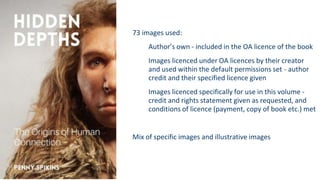
73 images used:
Author’s own - included in the OA licence of the book
Images licenced under OA licences by their creator
and used within the default permissions set - author
credit and their specified licence given
Images licenced specifically for use in this volume -
credit and rights statement given as requested, and
conditions of licence (payment, copy of book etc.) met
Mix of specific images and illustrative images
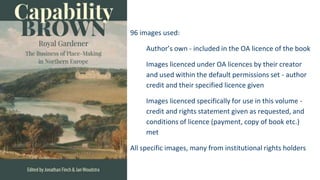
96 images used:
Author’s own - included in the OA licence of the book
Images licenced under OA licences by their creator
and used within the default permissions set - author
credit and their specified licence given
Images licenced specifically for use in this volume -
credit and rights statement given as requested, and
conditions of licence (payment, copy of book etc.)
met
All specific images, many from institutional rights holders
Photo by Emily Morter on Unsplash
Academics need support in this
“But I found it on the web so I can use it”
“I used it in my thesis…”
“Why can’t I use it?- it’s my image!”
“I got permission to use it in a book years ago, so I
don’t need to ask again to use in a different book”.
“I’ve used it before without asking
formally - no one minded.”
Rights holders can make things harder
Some are amazingly engaged and understand OA as a valid publishing model. When
linked to a not-for-profit approach, especially, they often waive or cut licencing/reuse
fees. Increasingly, large collections of images are being made available licenced for
reuse.
There is inconsistency, however. Others show:
● Fear of/lack of engagement with digital publication (ebooks are not websites!)
● Outdated requirements that make the content unusable online even when
licenced specifically for this
● Inability to move on from a time bound or print run model that licences by number
of copies
● Lack of consistency: in their own reuse statements, in fees applied…
OA issues
Visibility: OA publications are by their very nature accessible to everyone. Higher risk if
content used without correct permissions.
Need to explain OA: Authors can need support in explaining OA publication to rights holders
- how their content will be protected by rights statements and attribution is the same as in
other publishing models.
Author engagement: OA presses ask authors to engage with this process, potentially in
ways they haven’t before. This protects the author by making sure everything is as needed.
By asking for this engagement with what should be standard practice, this reinforces the
idea that it is an OA requirement.
Change: This is new and therefore challenging. Move from profit-focus in publishing is not
necessarily going to drive a similar change with rights holders as some use licencing as an
income stream.
Photo by JESHOOTS.COM on Unsplash
How do we fix this?
● Support for academics, from publishers and their institutions, as they navigate
this.
● Sector level engagement with rights holders to really try and explain why the old
models of licencing aren’t really suited for a digital publishing environment.
● More clarity on what open licences actually mean, how third party content is used
and protected in OA publications.
● Recognition that issues around licencing content for use in digital publications is
not an OA issue but faces all modern publishing. OA authors/publishers trying to
doing this right shouldn’t make it an OA publishing issue.

Publishing work that includes 3rd party content

  • 1.
    Publishing work that includes3rd party content Kate Petherbridge Photo by Markus Winkler on Unsplash
  • 2.
    ✔ A fullyOpen Access library-led academic publisher ✔ Publishes research monographs, textbooks and journals ✔ Scope and strategy set by library-led Management Board ✔ Commissioning by an academic-led Editorial Board, based on peer review ✔ Publishing as a service ✔ Offer support for OA more widely, through local sessions and advice for academics wanting to engage with OA, and initiatives such as the Jisc NUP toolkit
  • 3.
    Creative Commons Licencesare built from several elements. They allow the author to retain copyright of their work, and to choose the default level of permission for how their work can be shared and used. CC- BY- NC- ND- SA Creative Commons Licence The author must be credited when others share or reuse their work The work can only be shared and reused for non-commercial purposes The work cannot be altered, transformed or built on The work must be shared under the same licence as applied to the original
  • 4.
    Photo by Franckon Unsplash
  • 5.
    73 images used: Author’sown - included in the OA licence of the book Images licenced under OA licences by their creator and used within the default permissions set - author credit and their specified licence given Images licenced specifically for use in this volume - credit and rights statement given as requested, and conditions of licence (payment, copy of book etc.) met Mix of specific images and illustrative images
  • 9.
    96 images used: Author’sown - included in the OA licence of the book Images licenced under OA licences by their creator and used within the default permissions set - author credit and their specified licence given Images licenced specifically for use in this volume - credit and rights statement given as requested, and conditions of licence (payment, copy of book etc.) met All specific images, many from institutional rights holders
  • 10.
    Photo by EmilyMorter on Unsplash
  • 11.
    Academics need supportin this “But I found it on the web so I can use it” “I used it in my thesis…” “Why can’t I use it?- it’s my image!” “I got permission to use it in a book years ago, so I don’t need to ask again to use in a different book”. “I’ve used it before without asking formally - no one minded.”
  • 12.
    Rights holders canmake things harder Some are amazingly engaged and understand OA as a valid publishing model. When linked to a not-for-profit approach, especially, they often waive or cut licencing/reuse fees. Increasingly, large collections of images are being made available licenced for reuse. There is inconsistency, however. Others show: ● Fear of/lack of engagement with digital publication (ebooks are not websites!) ● Outdated requirements that make the content unusable online even when licenced specifically for this ● Inability to move on from a time bound or print run model that licences by number of copies ● Lack of consistency: in their own reuse statements, in fees applied…
  • 13.
    OA issues Visibility: OApublications are by their very nature accessible to everyone. Higher risk if content used without correct permissions. Need to explain OA: Authors can need support in explaining OA publication to rights holders - how their content will be protected by rights statements and attribution is the same as in other publishing models. Author engagement: OA presses ask authors to engage with this process, potentially in ways they haven’t before. This protects the author by making sure everything is as needed. By asking for this engagement with what should be standard practice, this reinforces the idea that it is an OA requirement. Change: This is new and therefore challenging. Move from profit-focus in publishing is not necessarily going to drive a similar change with rights holders as some use licencing as an income stream.
  • 14.
    Photo by JESHOOTS.COMon Unsplash How do we fix this?
  • 15.
    ● Support foracademics, from publishers and their institutions, as they navigate this. ● Sector level engagement with rights holders to really try and explain why the old models of licencing aren’t really suited for a digital publishing environment. ● More clarity on what open licences actually mean, how third party content is used and protected in OA publications. ● Recognition that issues around licencing content for use in digital publications is not an OA issue but faces all modern publishing. OA authors/publishers trying to doing this right shouldn’t make it an OA publishing issue.