Publishing
•

•

SPIN is now longer published as a magazine, they do just run as an webpage. They stopped
being a magazine in 2012. Because of this they do not have a publisher and it is not possible
for me to find the statistic for who reads it.
Even though they do not have a publisher they are a member of SPIN Music Group, a division
of BUZZMEDIA and they are also a part of SPIN Media.
Bauer Media
•

•

•

Bauer Media are the ones that Publish Q. They are the largest
publisher in Europe and publish over 300 magazines. Bauer Media
was founded in 1875 and at that time they were called Heinrich
Bauer Verlag KG. They do now operate in over 15 countries and they
publish 38 million magazines a week worldwide.
Since Bauer Media publishes over 300 magazines they publish loads
of different kinds of magazines. They have everything from music and
fashion magazines to angling and mothers magazines. They publish
products for all different kinds of target audiences. Q is one of their
most famous magazines, together with Kerrang! which is a rock music
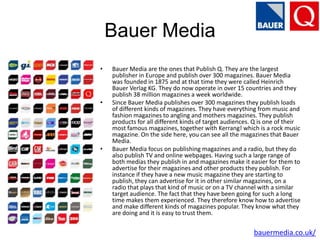
magazine. On the side here, you can see all the magazines that Bauer
Media.
Bauer Media focus on publishing magazines and a radio, but they do
also publish TV and online webpages. Having such a large range of
both medias they publish in and magazines make it easier for them to
advertise for their magazines and other products they publish. For
instance if they have a new music magazine they are starting to
publish, they can advertise for it in other similar magazines, on a
radio that plays that kind of music or on a TV channel with a similar
target audience. The fact that they have been going for such a long
time makes them experienced. They therefore know how to advertise
and make different kinds of magazines popular. They know what they
are doing and it is easy to trust them.

bauermedia.co.uk/
Statistics

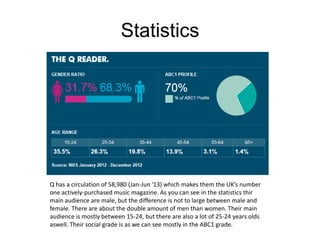
Q has a circulation of 58,980 (Jan-Jun '13) which makes them the UK’s number
one actively-purchased music magazine. As you can see in the statistics thir
main audience are male, but the difference is not to large between male and
female. There are about the double amount of men than women. Their main
audience is mostly between 15-24, but there are also a lot of 25-24 years olds
aswell. Their social grade is as we can see mostly in the ABC1 grade.
NRS Statistics
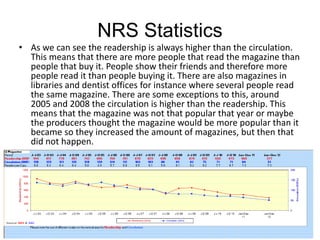
• As we can see the readership is always higher than the circulation.
This means that there are more people that read the magazine than
people that buy it. People show their friends and therefore more
people read it than people buying it. There are also magazines in
libraries and dentist offices for instance where several people read
the same magazine. There are some exceptions to this, around
2005 and 2008 the circulation is higher than the readership. This
means that the magazine was not that popular that year or maybe
the producers thought the magazine would be more popular than it
became so they increased the amount of magazines, but then that
did not happen.
IPC Media

•

•

•

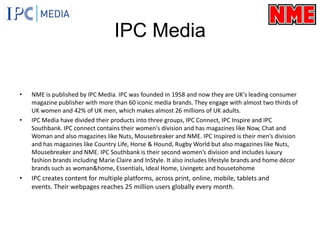
NME is published by IPC Media. IPC was founded in 1958 and now they are UK's leading consumer
magazine publisher with more than 60 iconic media brands. They engage with almost two thirds of
UK women and 42% of UK men, which makes almost 26 millions of UK adults.
IPC Media have divided their products into three groups, IPC Connect, IPC Inspire and IPC
Southbank. IPC connect contains their women's division and has magazines like Now, Chat and
Woman and also magazines like Nuts, Mousebreaker and NME. IPC Inspired is their men’s division
and has magazines like Country Life, Horse & Hound, Rugby World but also magazines like Nuts,
Mousebreaker and NME. IPC Southbank is their second women’s division and includes luxury
fashion brands including Marie Claire and InStyle. It also includes lifestyle brands and home décor
brands such as woman&home, Essentials, Ideal Home, Livingetc and housetohome

IPC creates content for multiple platforms, across print, online, mobile, tablets and
events. Their webpages reaches 25 million users globally every month.
Statistics
•

•
•

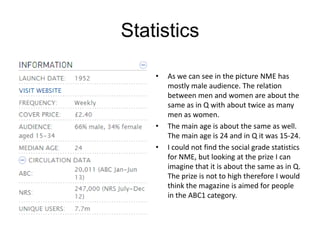
As we can see in the picture NME has
mostly male audience. The relation
between men and women are about the
same as in Q with about twice as many
men as women.
The main age is about the same as well.
The main age is 24 and in Q it was 15-24.
I could not find the social grade statistics
for NME, but looking at the prize I can
imagine that it is about the same as in Q.
The prize is not to high therefore I would
think the magazine is aimed for people
in the ABC1 category.
NRS Statistics
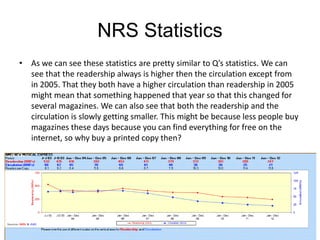
• As we can see these statistics are pretty similar to Q’s statistics. We can
see that the readership always is higher then the circulation except from
in 2005. That they both have a higher circulation than readership in 2005
might mean that something happened that year so that this changed for
several magazines. We can also see that both the readership and the
circulation is slowly getting smaller. This might be because less people buy
magazines these days because you can find everything for free on the
internet, so why buy a printed copy then?
Similarities
•

•

•

As I have already mentioned there are several
things at are almost the same in Q and NME’s
statistics. There is the relation between men and
women, both have about twice as many men than
women. There are 68.3% men in Q while in NME
there is 66%. This mean that NME has just a little
more female readers.
The age range is also almost the same. Q has their
highest age range in 1-24 year olds, while NME
has an median age at 24. Therefore we would
think that NME has a slightly older audience, but
it is almost the same.
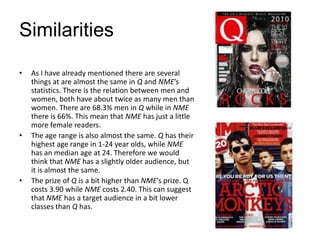
The prize of Q is a bit higher than NME’s prize. Q
costs 3.90 while NME costs 2.40. This can suggest
that NME has a target audience in a bit lower
classes than Q has.
My Magazine
•

I would like Bauer Media to publish my magazine. This is because They have loads
of experience and are a well known company. They could help my magazine get
more readers by advertising it in their different media. They have radio channels
that focus on similar music to the one I am going to write about, they have other
magazines that are similar and they have TV channels. This is then a great
opportunity to advertise my magazine and get it out there. Bauer Media knows
how to deal with magazines like mine and how to get more people to notice it. I
could trust them to do a great job. Also they have published Q which is one of the
most famous indie music magazines and therefore they have experience with
magazines like mine. I am not a niche in their marked, but I think this can be both
a good and bad thing.

Publishing

  • 1.
  • 2.
    • • SPIN is nowlonger published as a magazine, they do just run as an webpage. They stopped being a magazine in 2012. Because of this they do not have a publisher and it is not possible for me to find the statistic for who reads it. Even though they do not have a publisher they are a member of SPIN Music Group, a division of BUZZMEDIA and they are also a part of SPIN Media.
  • 3.
    Bauer Media • • • Bauer Mediaare the ones that Publish Q. They are the largest publisher in Europe and publish over 300 magazines. Bauer Media was founded in 1875 and at that time they were called Heinrich Bauer Verlag KG. They do now operate in over 15 countries and they publish 38 million magazines a week worldwide. Since Bauer Media publishes over 300 magazines they publish loads of different kinds of magazines. They have everything from music and fashion magazines to angling and mothers magazines. They publish products for all different kinds of target audiences. Q is one of their most famous magazines, together with Kerrang! which is a rock music magazine. On the side here, you can see all the magazines that Bauer Media. Bauer Media focus on publishing magazines and a radio, but they do also publish TV and online webpages. Having such a large range of both medias they publish in and magazines make it easier for them to advertise for their magazines and other products they publish. For instance if they have a new music magazine they are starting to publish, they can advertise for it in other similar magazines, on a radio that plays that kind of music or on a TV channel with a similar target audience. The fact that they have been going for such a long time makes them experienced. They therefore know how to advertise and make different kinds of magazines popular. They know what they are doing and it is easy to trust them. bauermedia.co.uk/
  • 4.
    Statistics Q has acirculation of 58,980 (Jan-Jun '13) which makes them the UK’s number one actively-purchased music magazine. As you can see in the statistics thir main audience are male, but the difference is not to large between male and female. There are about the double amount of men than women. Their main audience is mostly between 15-24, but there are also a lot of 25-24 years olds aswell. Their social grade is as we can see mostly in the ABC1 grade.
  • 5.
    NRS Statistics • Aswe can see the readership is always higher than the circulation. This means that there are more people that read the magazine than people that buy it. People show their friends and therefore more people read it than people buying it. There are also magazines in libraries and dentist offices for instance where several people read the same magazine. There are some exceptions to this, around 2005 and 2008 the circulation is higher than the readership. This means that the magazine was not that popular that year or maybe the producers thought the magazine would be more popular than it became so they increased the amount of magazines, but then that did not happen.
  • 6.
    IPC Media • • • NME ispublished by IPC Media. IPC was founded in 1958 and now they are UK's leading consumer magazine publisher with more than 60 iconic media brands. They engage with almost two thirds of UK women and 42% of UK men, which makes almost 26 millions of UK adults. IPC Media have divided their products into three groups, IPC Connect, IPC Inspire and IPC Southbank. IPC connect contains their women's division and has magazines like Now, Chat and Woman and also magazines like Nuts, Mousebreaker and NME. IPC Inspired is their men’s division and has magazines like Country Life, Horse & Hound, Rugby World but also magazines like Nuts, Mousebreaker and NME. IPC Southbank is their second women’s division and includes luxury fashion brands including Marie Claire and InStyle. It also includes lifestyle brands and home décor brands such as woman&home, Essentials, Ideal Home, Livingetc and housetohome IPC creates content for multiple platforms, across print, online, mobile, tablets and events. Their webpages reaches 25 million users globally every month.
  • 7.
    Statistics • • • As we cansee in the picture NME has mostly male audience. The relation between men and women are about the same as in Q with about twice as many men as women. The main age is about the same as well. The main age is 24 and in Q it was 15-24. I could not find the social grade statistics for NME, but looking at the prize I can imagine that it is about the same as in Q. The prize is not to high therefore I would think the magazine is aimed for people in the ABC1 category.
  • 8.
    NRS Statistics • Aswe can see these statistics are pretty similar to Q’s statistics. We can see that the readership always is higher then the circulation except from in 2005. That they both have a higher circulation than readership in 2005 might mean that something happened that year so that this changed for several magazines. We can also see that both the readership and the circulation is slowly getting smaller. This might be because less people buy magazines these days because you can find everything for free on the internet, so why buy a printed copy then?
  • 9.
    Similarities • • • As I havealready mentioned there are several things at are almost the same in Q and NME’s statistics. There is the relation between men and women, both have about twice as many men than women. There are 68.3% men in Q while in NME there is 66%. This mean that NME has just a little more female readers. The age range is also almost the same. Q has their highest age range in 1-24 year olds, while NME has an median age at 24. Therefore we would think that NME has a slightly older audience, but it is almost the same. The prize of Q is a bit higher than NME’s prize. Q costs 3.90 while NME costs 2.40. This can suggest that NME has a target audience in a bit lower classes than Q has.
  • 10.
    My Magazine • I wouldlike Bauer Media to publish my magazine. This is because They have loads of experience and are a well known company. They could help my magazine get more readers by advertising it in their different media. They have radio channels that focus on similar music to the one I am going to write about, they have other magazines that are similar and they have TV channels. This is then a great opportunity to advertise my magazine and get it out there. Bauer Media knows how to deal with magazines like mine and how to get more people to notice it. I could trust them to do a great job. Also they have published Q which is one of the most famous indie music magazines and therefore they have experience with magazines like mine. I am not a niche in their marked, but I think this can be both a good and bad thing.