Success Criteria
Aim
• Statement 1 Lorem ipsum dolor sit amet, consectetur adipiscing elit.
• Statement 2
• Sub statement
Success Criteria
Learning Objective
To learn effective skills when giving a speech in front of an audience.
• To use an appropriate voice while speaking.
• To be make eye contact with the audience while speaking.
• To elaborate information using dot points.
Starter
Be honest!
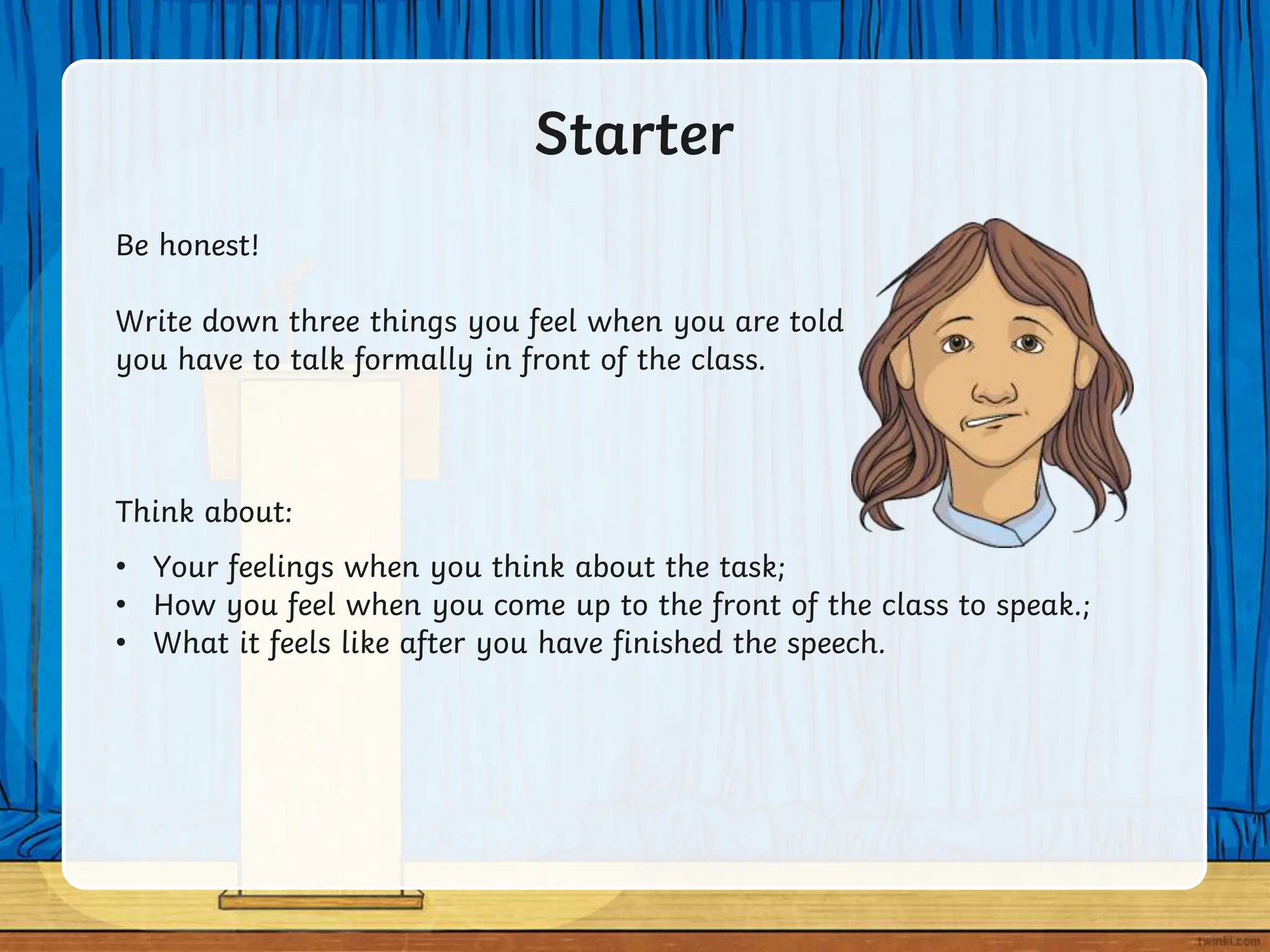
Write down three things you feel when you are told
you have to talk formally in front of the class.
Think about:
• Your feelings when you think about the task;
• How you feel when you come up to the front of the class to speak.;
• What it feels like after you have finished the speech.
Any Ideas?
What advice would you give to a friend if they came to you and were
worried about giving a talk in class?
Feeling Nervous
It’s normal to feel nervous!
If you are feeling nervous or worried:
• Be prepared – if you know you are ready,
you will feel more confident.
• Take three slow, deep breaths before you
stand up to speak.
• Remember your audience wants you to
do well.
• If you are still nervous, imagine your
class mates eating spaghetti bolognese or
wearing their clothes backwards!
Skills
After learning a few simple tricks, you can feel confident about
speaking in front of an audience.
There are three main things to remember:
• How to stand
• How to breathe
• How to read
Of course you can all stand and breathe already,
but these are specific skills for public speaking.
How to Stand
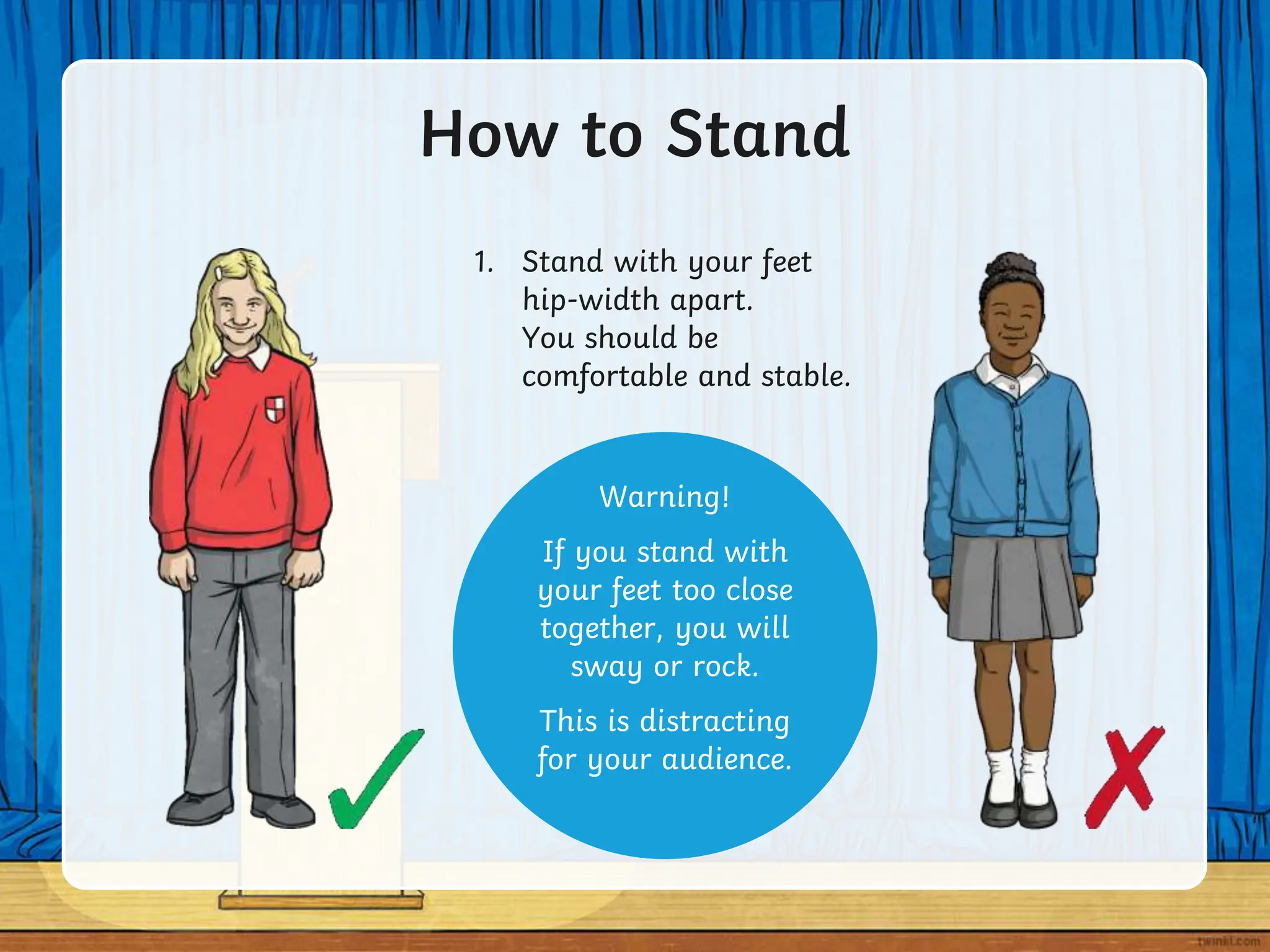
1. Stand with your feet
hip-width apart.
You should be
comfortable and stable.
Warning!
If you stand with
your feet too close
together, you will
sway or rock.
This is distracting
for your audience.
How to Stand
2. Hold your notes at waist level.
Warning!
If you hold your
notes too high,
your voice will
be muffled,
which is not
good for your
audience.
How to Stand
3. Look straight ahead. It helps if you focus your eyes just above the last
row of the audience. Occasionally make eye contact with your audience-
this will engage them. Only look at your notes briefly for reference.
Warning!
If you focus on
your notes and
don’t look up,
your audience
will become
disengaged.
How to Breathe
There’s more to it than breathing in
and out. It’s about biology!
Your breath, lungs and diaphragm
control the strength and quality of
your voice.
When you are speaking in front of an
audience, you must control your
breathing.
How to Breathe
• Breathe in and out, slightly slower than normal.
• This will help you pace your speaking.
• If you breathe too fast, you may speak too fast.
Summary
Take time to stand in the correct posture and steady your breath before
you start to speak. It will only take a few seconds and it could make the
difference between a good speech and a great speech.
• Stand with feet hip-width apart, shoulders relaxed.
• Take a deep breath.
• Let it go.
• Breathe in again and begin!
How to Read
• A great speech is not read word for word. It’s elaborated from dot
points.
• If you read your speech, you will not engage with your audience.
• Dot points are to remind you what to say.
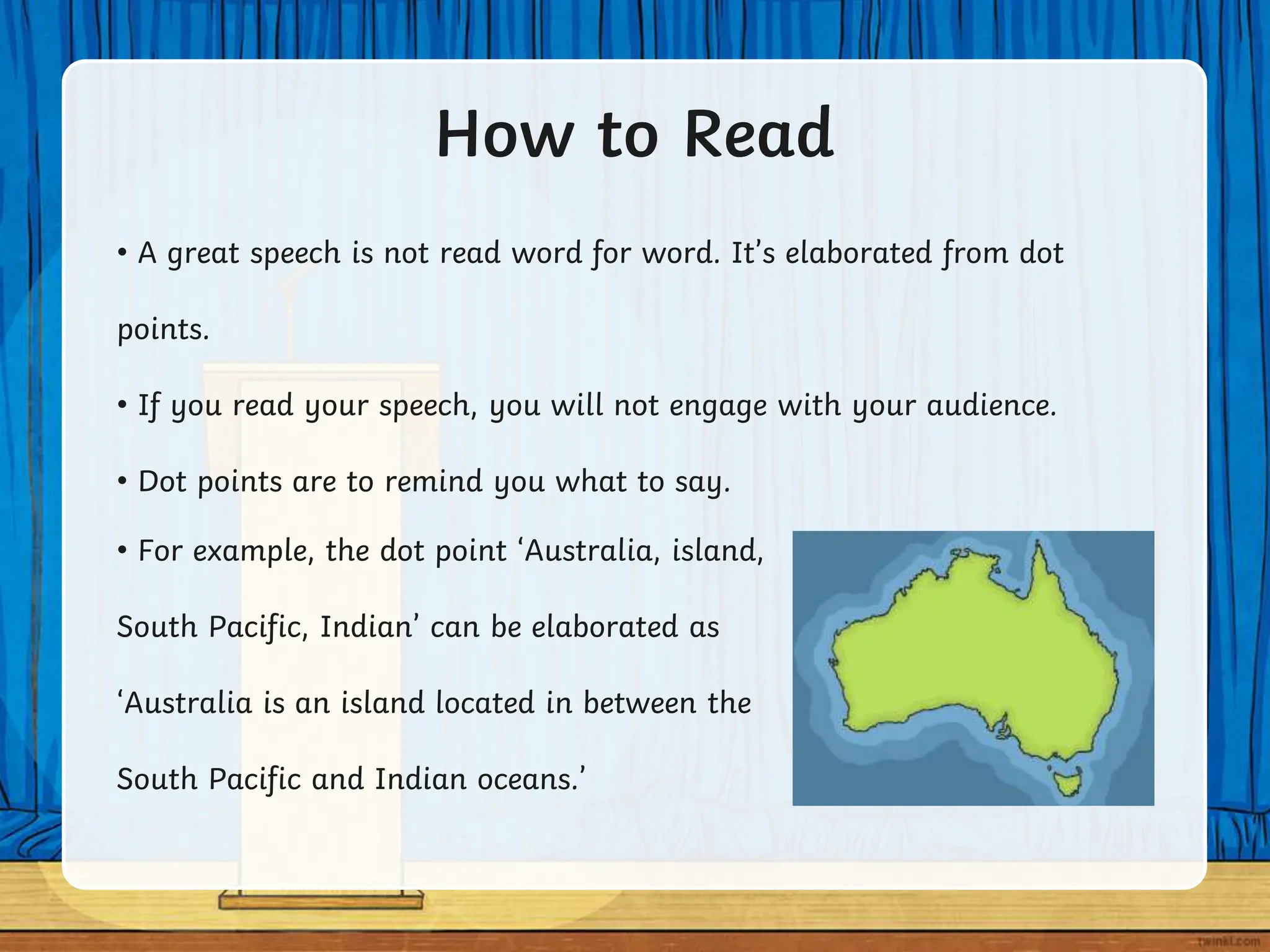
• For example, the dot point ‘Australia, island,
South Pacific, Indian’ can be elaborated as
‘Australia is an island located in between the
South Pacific and Indian oceans.’
How to Read
• Another example, the dot point ‘Papua New Guinea, closest, Australia,
north’ can be elaborated as ‘Papua New Guinea is the closest country
to Australia and is located north.’
• Another example, the dot point ‘Australia, Aborigines,
oldest, culture’ could be elaborated as ‘The Australian
Aborigines are the oldest surviving culture in the
world.’
How to Read
Elaborate these dot points:
• ‘Australia, biggest island,
smallest continent’
• 162,000 convicts, sent,
Australia
• First Aboriginal senator,
Neville Bonner, 1972.
Time to Practise
• Using the skills you have learned, practise speaking to your partner
about three facts about yourself.
• Remember how to stand, how to breathe and how to read.
public-speaking-skills-powerpoint-english_ver_4.ppt

public-speaking-skills-powerpoint-english_ver_4.ppt

  • 2.
    Success Criteria Aim • Statement1 Lorem ipsum dolor sit amet, consectetur adipiscing elit. • Statement 2 • Sub statement Success Criteria Learning Objective To learn effective skills when giving a speech in front of an audience. • To use an appropriate voice while speaking. • To be make eye contact with the audience while speaking. • To elaborate information using dot points.
  • 3.
    Starter Be honest! Write downthree things you feel when you are told you have to talk formally in front of the class. Think about: • Your feelings when you think about the task; • How you feel when you come up to the front of the class to speak.; • What it feels like after you have finished the speech.
  • 4.
    Any Ideas? What advicewould you give to a friend if they came to you and were worried about giving a talk in class?
  • 5.
    Feeling Nervous It’s normalto feel nervous! If you are feeling nervous or worried: • Be prepared – if you know you are ready, you will feel more confident. • Take three slow, deep breaths before you stand up to speak. • Remember your audience wants you to do well. • If you are still nervous, imagine your class mates eating spaghetti bolognese or wearing their clothes backwards!
  • 6.
    Skills After learning afew simple tricks, you can feel confident about speaking in front of an audience. There are three main things to remember: • How to stand • How to breathe • How to read Of course you can all stand and breathe already, but these are specific skills for public speaking.
  • 7.
    How to Stand 1.Stand with your feet hip-width apart. You should be comfortable and stable. Warning! If you stand with your feet too close together, you will sway or rock. This is distracting for your audience.
  • 8.
    How to Stand 2.Hold your notes at waist level. Warning! If you hold your notes too high, your voice will be muffled, which is not good for your audience.
  • 9.
    How to Stand 3.Look straight ahead. It helps if you focus your eyes just above the last row of the audience. Occasionally make eye contact with your audience- this will engage them. Only look at your notes briefly for reference. Warning! If you focus on your notes and don’t look up, your audience will become disengaged.
  • 10.
    How to Breathe There’smore to it than breathing in and out. It’s about biology! Your breath, lungs and diaphragm control the strength and quality of your voice. When you are speaking in front of an audience, you must control your breathing.
  • 11.
    How to Breathe •Breathe in and out, slightly slower than normal. • This will help you pace your speaking. • If you breathe too fast, you may speak too fast.
  • 12.
    Summary Take time tostand in the correct posture and steady your breath before you start to speak. It will only take a few seconds and it could make the difference between a good speech and a great speech. • Stand with feet hip-width apart, shoulders relaxed. • Take a deep breath. • Let it go. • Breathe in again and begin!
  • 13.
    How to Read •A great speech is not read word for word. It’s elaborated from dot points. • If you read your speech, you will not engage with your audience. • Dot points are to remind you what to say. • For example, the dot point ‘Australia, island, South Pacific, Indian’ can be elaborated as ‘Australia is an island located in between the South Pacific and Indian oceans.’
  • 14.
    How to Read •Another example, the dot point ‘Papua New Guinea, closest, Australia, north’ can be elaborated as ‘Papua New Guinea is the closest country to Australia and is located north.’ • Another example, the dot point ‘Australia, Aborigines, oldest, culture’ could be elaborated as ‘The Australian Aborigines are the oldest surviving culture in the world.’
  • 15.
    How to Read Elaboratethese dot points: • ‘Australia, biggest island, smallest continent’ • 162,000 convicts, sent, Australia • First Aboriginal senator, Neville Bonner, 1972.
  • 16.
    Time to Practise •Using the skills you have learned, practise speaking to your partner about three facts about yourself. • Remember how to stand, how to breathe and how to read.