Public Speaking
Session – 10
Objectives
In this lesson, we will learn about the following:
• Public Speaking
• Why it is important?
• Extempore Speaking
• Group Discussions
• Role-play Activities
Public Speaking
Public speaking is the process of speaking to a group of people in a
structured, deliberate manner intended to inform, influence, or
entertain the listeners.
Importance of Public Speaking
• Learn how to speak to a public audience.
• Learn skills that apply to one-on-one communication.
• Develop the oral presentation skills that are prized in the job market.
• An ideal environment for gaining experience and building confidence.
• Permits you to make a contribution to the lives of other people.
Afraid of Public
Speaking?
Building confidence is the key
Prior
Proper
Preparation
Prevents
Poor
Performance
Presenting a Speech
• Know your material: Research, use humour, personal stories and interact.
• Practice. Practice. Practice! Practice, pause and breathe. Practice with a timer.
• Know the audience.
• Know the room. Arrive early, walk around the speaking area and practice using
the microphone and visual aids.
• Relax. Begin by addressing the audience. It buys you time and calms your nerves.
Pause, smile and count to three.
Presenting a Speech
• Visualize. Imagine yourself speaking, your voice loud, clear and confident.
• Realize that people want you to succeed. Audiences want you to be
interesting, informative and entertaining.
• Don’t apologize for any nervousness or problem.
• Concentrate on the message.
• Gain experience.
Extempore Speaking
Extempore Speaking
Extempore is an impromptu speech which the candidate is required to
make on a topic given there and then. No prior preparation is allowed.
Extempore Speaking
• Be specific and focused when discussing a particular topic.
• Avoid excessive talking (without proper knowledge on the subject).
• Don't rely on memorization; it can make your speech rigid and less
engaging.
• Pay attention to your opening and closing statements, as they set
the tone for how your speech is received by the audience.
Example of a good extempore speech
Try these 1 minute topics!
1. The Best Day of My Life
2. Pros and Cons of Online Learning
3. If I had a Superpower
4. My Favorite Pastime/Hobby
5. My Favorite Fictional Character
6. When there’s a will, there is a way
7. Culture of India
8. Excessive usage of the Internet
9. A day when everything went wrong
10. My favorite cartoon character
Group Discussion
Group Discussion
A group discussion is a discussion between a group of participants on
a given subject.
It is a methodology used by an organization to gauge whether an
candidate has certain personality traits and/or skills that it desires in its
members.
Steps involved in Group Discussion
Do’s
• Take leadership responsibility
• Keep an open mind
• Maintain a moderate tone of voice
• Don’t get emotional
• Sit upright and concentrate on your body language
• Be a good listener
Don’ts
• Avoid constant objections to other people’s arguments
• Say no to a pessimistic approach
• Don’t insult other people; criticize in a decent manner
• No irrelevant stories/ personal experiences
• Do not interrupt others
• Do not be casual
Some commonly used words in a GD
• Introducing the topic: The goal of our discussion today is…
• Bringing in other people: What is your opinion, Miss. X?...
• Keeping the Discussion Moving: Let’s go on to another point
• Expressing Disagreement: I’m afraid I can’t agree with his/her opinion
• Dismissing an irrelevant point: I’m afraid you’re missing the point
• Capitulation: I’m convinced by him so I’d like to change my mind.
Group Discussion (GD) Time!
Topics
• Indian Army as a career option
• Women are better at multi-tasking
• Social media influencers – Impact on youth
• Work from home – Pros & Cons
• Hard Work v/s Smart Work
Role Play
Role play
Role play is any speaking activity when you either put yourself into
somebody else's shoes, or when you stay in your own shoes but put
yourself into an imaginary situation!
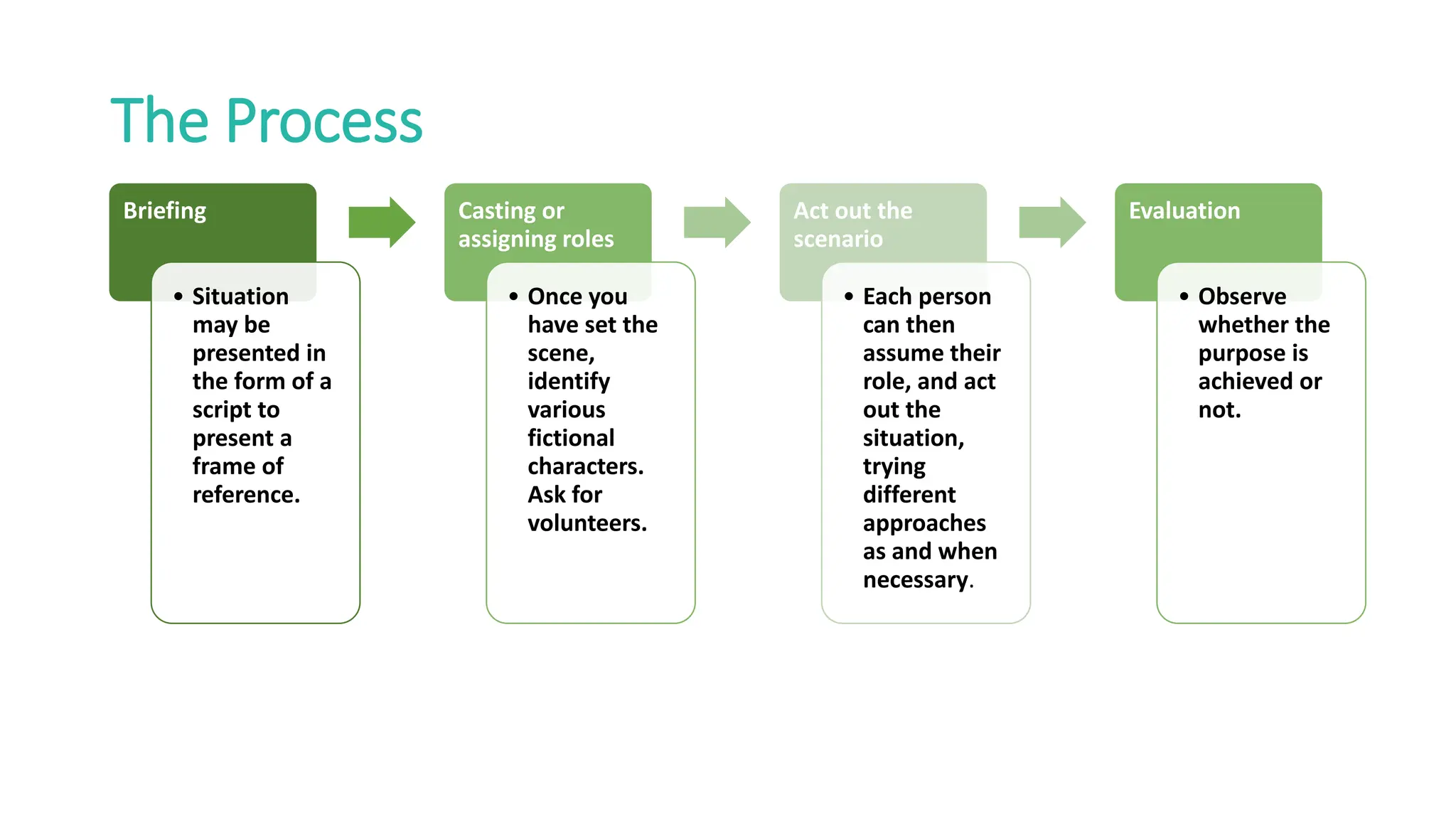
The Process
Briefing
• Situation
may be
presented in
the form of a
script to
present a
frame of
reference.
Casting or
assigning roles
• Once you
have set the
scene,
identify
various
fictional
characters.
Ask for
volunteers.
Act out the
scenario
• Each person
can then
assume their
role, and act
out the
situation,
trying
different
approaches
as and when
necessary.
Evaluation
• Observe
whether the
purpose is
achieved or
not.
Role play- Some conversation topics for you to
try!
• You are watching a horror movie with your friend. She was very excited
about it but after the movie starts, she is very scared. Build a conversation
and motivate your friend to watch till the end.
• You want to implement a Fun Zone in the office. Talk about it with your
colleague who thinks it is a waste of time. Discuss advantages and
disadvantages of Fun Zone.
Role play- Some conversation topics for you to
try!
THANK YOU!

Public Speaking process art and act- SL.pptx

  • 1.
  • 2.
    Objectives In this lesson,we will learn about the following: • Public Speaking • Why it is important? • Extempore Speaking • Group Discussions • Role-play Activities
  • 3.
    Public Speaking Public speakingis the process of speaking to a group of people in a structured, deliberate manner intended to inform, influence, or entertain the listeners.
  • 4.
    Importance of PublicSpeaking • Learn how to speak to a public audience. • Learn skills that apply to one-on-one communication. • Develop the oral presentation skills that are prized in the job market. • An ideal environment for gaining experience and building confidence. • Permits you to make a contribution to the lives of other people.
  • 5.
  • 6.
    Building confidence isthe key Prior Proper Preparation Prevents Poor Performance
  • 7.
    Presenting a Speech •Know your material: Research, use humour, personal stories and interact. • Practice. Practice. Practice! Practice, pause and breathe. Practice with a timer. • Know the audience. • Know the room. Arrive early, walk around the speaking area and practice using the microphone and visual aids. • Relax. Begin by addressing the audience. It buys you time and calms your nerves. Pause, smile and count to three.
  • 8.
    Presenting a Speech •Visualize. Imagine yourself speaking, your voice loud, clear and confident. • Realize that people want you to succeed. Audiences want you to be interesting, informative and entertaining. • Don’t apologize for any nervousness or problem. • Concentrate on the message. • Gain experience.
  • 9.
  • 10.
    Extempore Speaking Extempore isan impromptu speech which the candidate is required to make on a topic given there and then. No prior preparation is allowed.
  • 11.
    Extempore Speaking • Bespecific and focused when discussing a particular topic. • Avoid excessive talking (without proper knowledge on the subject). • Don't rely on memorization; it can make your speech rigid and less engaging. • Pay attention to your opening and closing statements, as they set the tone for how your speech is received by the audience.
  • 12.
    Example of agood extempore speech
  • 13.
    Try these 1minute topics! 1. The Best Day of My Life 2. Pros and Cons of Online Learning 3. If I had a Superpower 4. My Favorite Pastime/Hobby 5. My Favorite Fictional Character 6. When there’s a will, there is a way 7. Culture of India 8. Excessive usage of the Internet 9. A day when everything went wrong 10. My favorite cartoon character
  • 14.
  • 15.
    Group Discussion A groupdiscussion is a discussion between a group of participants on a given subject. It is a methodology used by an organization to gauge whether an candidate has certain personality traits and/or skills that it desires in its members.
  • 16.
    Steps involved inGroup Discussion
  • 17.
    Do’s • Take leadershipresponsibility • Keep an open mind • Maintain a moderate tone of voice • Don’t get emotional • Sit upright and concentrate on your body language • Be a good listener
  • 18.
    Don’ts • Avoid constantobjections to other people’s arguments • Say no to a pessimistic approach • Don’t insult other people; criticize in a decent manner • No irrelevant stories/ personal experiences • Do not interrupt others • Do not be casual
  • 19.
    Some commonly usedwords in a GD • Introducing the topic: The goal of our discussion today is… • Bringing in other people: What is your opinion, Miss. X?... • Keeping the Discussion Moving: Let’s go on to another point • Expressing Disagreement: I’m afraid I can’t agree with his/her opinion • Dismissing an irrelevant point: I’m afraid you’re missing the point • Capitulation: I’m convinced by him so I’d like to change my mind.
  • 20.
  • 21.
    Topics • Indian Armyas a career option • Women are better at multi-tasking • Social media influencers – Impact on youth • Work from home – Pros & Cons • Hard Work v/s Smart Work
  • 22.
  • 23.
    Role play Role playis any speaking activity when you either put yourself into somebody else's shoes, or when you stay in your own shoes but put yourself into an imaginary situation!
  • 24.
    The Process Briefing • Situation maybe presented in the form of a script to present a frame of reference. Casting or assigning roles • Once you have set the scene, identify various fictional characters. Ask for volunteers. Act out the scenario • Each person can then assume their role, and act out the situation, trying different approaches as and when necessary. Evaluation • Observe whether the purpose is achieved or not.
  • 25.
    Role play- Someconversation topics for you to try! • You are watching a horror movie with your friend. She was very excited about it but after the movie starts, she is very scared. Build a conversation and motivate your friend to watch till the end. • You want to implement a Fun Zone in the office. Talk about it with your colleague who thinks it is a waste of time. Discuss advantages and disadvantages of Fun Zone.
  • 26.
    Role play- Someconversation topics for you to try!
  • 27.

Editor's Notes

  • #16 Add: Participants sit facing each other almost in a semi-circle and express their views on the given topic/issue/problem.
  • #22 Note: From groups of four, and give each one topic. Conduct this activity for 5 minutes per group. + Feel free to add other GD topics of choice.
  • #25 Note: Provide atmosphere which allows for volunteering or choosing actors. DO NOT use own names.
  • #26 NOTE: Each role play is designed for 2 students.
  • #27 NOTE: Each role play is designed for 2 students (A and B), with an optional supplementary third role(C) if you need to make groups of 3.