PUBERTY
• Definitions of puberty and adolescence vary.
• Puberty is the physiological phenomenon of
attainment of sexual maturity.
 The onset of adult sexual life
• Adolescence is the broader period of time
including puberty and extending until a person
attains full adult height.
• During childhood the hypothalamus does not secrete
significant amounts of GnRH.
• One of the reasons for this is that, during childhood, the
slightest secretion of any sex steroid hormones exerts a
strong inhibitory effect on hypothalamic secretion of GnRH.
• Yet, for reasons still not understood, at the time of puberty,
the secretion of hypothalamic GnRH breaks through the
childhood inhibition and adult sexual life begins.
• The hypothalamic-pituitary-gonadal axis is activated
• The events of puberty occur in the same sequence in all
individuals, but the age at which they occur varies widely
Age of Onset of Puberty
• The age of onset of puberty varies depending on
various factors like socioeconomic and
environmental conditions and genetic constitutions.
In general, in developed countries, puberty occurs
earlier than in the developing countries.
• In advanced nations, it occurs between the age of
8–13 in girls and 9–14 in boys. In developing
nations, the age of onset of puberty is 11–16 years
in girls and 13–18 years in boys
• Puberty represents the earliest time that
reproduction is possible.
• The ability to reproduce is attained with
puberty and ceased with menopause. In
females, reproducibility totally stops at
menopause, whereas in males reproducibility
continues
Total rates of secretion of gonadotropic hormones
throughout the sexual lives of female and male
• Another event that occurs in humans at the time of puberty is an
increase in the secretion of adrenal androgens.
• The onset of this increase is called adrenarche.
• It occurs at age 8–10 years in girls and age 10–12 years in boys.
Dehydroepiandrosterone (DHEA) values peak at about age 25 in women
and slightly later than that in men. They then decline slowly to low
values in old age.
• The rise appears to be due to an increase in the activity of 17α-
hydroxylase
STAGES OF PUBERTY
In Boys
• The pubertal development in males occurs in five stages. Usually it is
completed within 2 to 4 years from its onset.
• Stage 1
This is the preadolescent stage. There is no enlargement of external genitalia
(penis, scrotum and testes). No pubic hair is present. However, secretion of
adrenal androgen is increased (adrenarche).
• Stage 2
Testes enlarge to more than 2.5 cm, which occurs due to growth of seminiferous
tubules.
1. Though this occurs due to the secretion of adrenal androgen (adrenarche),
testicular androgen also contributes.
2. Testicular testosterone secretion increases significantly.
3. Pubic hairs appear in scanty at the root of the penis.
• Stage 3
Penis enlarges in length. Scrotum and testes are further enlarged.
Pubic hairs become darker and coarser above the pubis. Sperm first
appears in the morning sample urine (spermarchy).
• Stage 4
Penis enlarges in width and further in length. Scrotal and testicular
enlargement continues. Pubic hair becomes adult type. Ejaculation of
sperm occurs either in dreams, or on masturbation or by sexual act.
• Stage 5
Full adult pattern of sexual features develops
In Girls
• The pubertal development in females also described in five.
Usually, it is completed within 2 to 5 years from its onset.
• Stage 1
This is the preadolescent stage. There is no breast development. No
pubic hair is present. However, secretion of adrenal androgen is
increased (adrenarche).
• Stage 2
Breast development starts (thelarche). Breast paillae is elevated and
the diameter of areola is increased. Secretion of estrogen from ovary
increases significantly. Sparse hairs appear along the labia majora.
• Stage 3
Breast enlarges with enlargement of areola. Pubic hairs develop,
grow and become dark (pubarche). Hairs appear in axilla.
• Stage 4
Breast further enlarges with areola and papillae projecting out of it.
Pubic hair becomes adult type, but covers smaller area. Menstrual
cycle starts (menarche), but irregular at the beginning.
• Stage 5
Full adult pattern of breasts and pubic hairs develop. Menstrual cycle
occurs regularly
MECHANISM OF ONSET OF
PUBERTY
• 1. Dehydroepiandrosterone(DHEA) secreted from adrenal
gland plays some role in the maturation of hypothalamic
neurons.
• 2. The adipose tissue via secretion of leptin also plays some
role in the determination of the time of onset of puberty.
• 3. Normally, the secretion of GnRH, LH and FSH is not
pulsatile before the onset of puberty. It is clear that until
puberty the release of GnRH is non-pulsatile, which prevents
puberty to occur.
Role of Leptin
• Body fat is crucial to a female’s ability to
sustain the caloric demands of pregnancy and
lactation, so girls and women don’t ovulate if
they have too little of it.
• A girl must attain about 17% body fat before
she can begin to ovulate and menstruate, and
adult women commonly cease if they drop
below 22% fat.
How does the brain know if fat reserves are
adequate for reproduction?
• Leptin, the hormone secreted by fat cells, acts as an adiposity
signal to the brain. If the leptin level is too low, the
hypothalamus doesn’t secrete gonadotropin-releasing
hormone (GnRH).
• Puberty is therefore delayed in undernourished girls, unusually
thin girls, and in other girls with low body fat due to such
vigorous and habitual physical activity as gymnastics and ballet.
• Ovulation and menstruation may cease even in adult women
who become underweight.
ABNORMALITIES OF PUBERTY
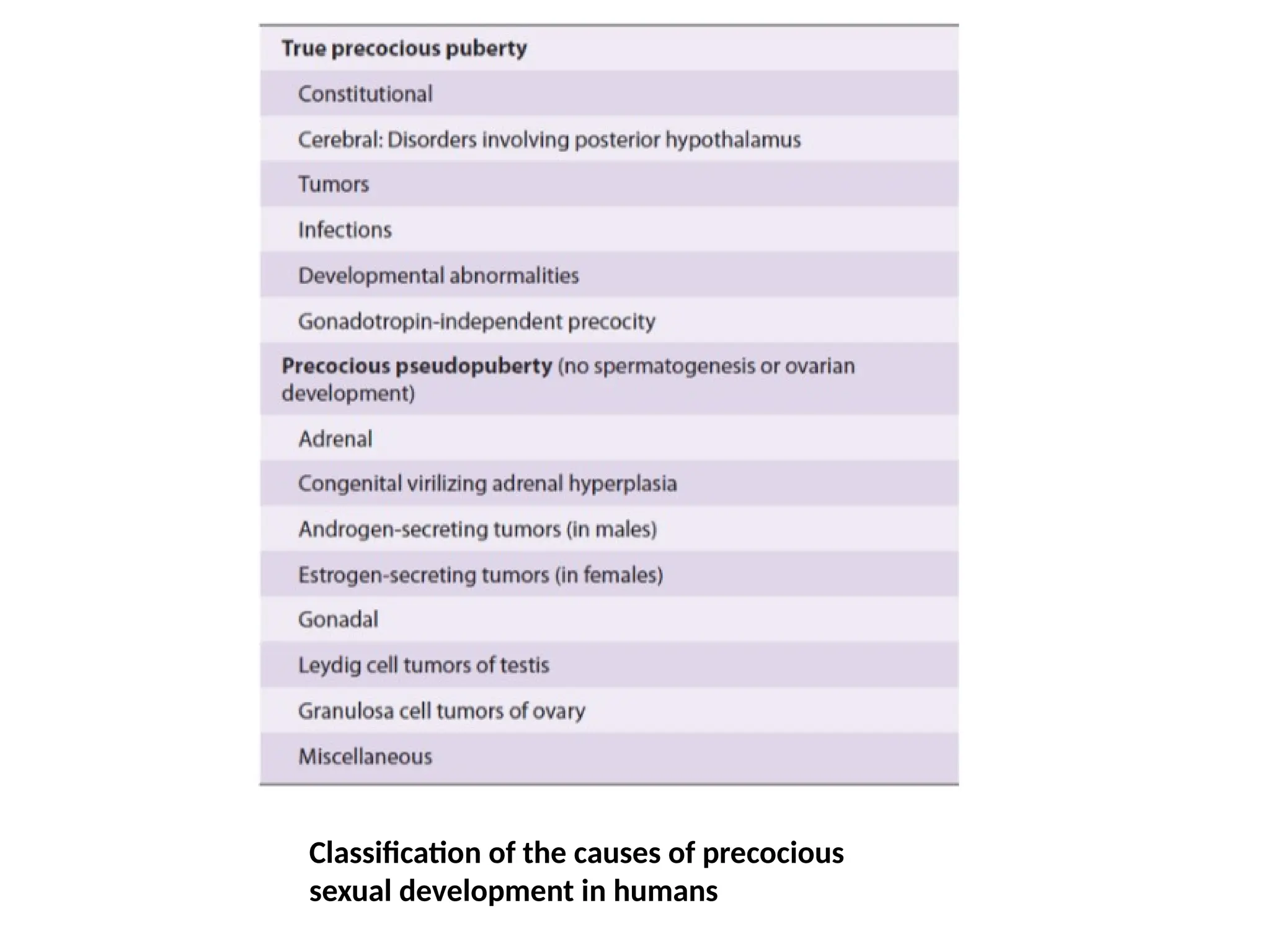
Precocious Puberty
Early development of secondary sexual
characteristics without gametogenesis is caused
by abnormal exposure of immature males to
androgen or females to estrogen.
This syndrome should be called precocious
pseudopuberty to distinguish it from true
precocious puberty due to an early but
otherwise normal pubertal pattern of
gonadotropin secretion from the pituitary
Classification of the causes of precocious
sexual development in humans
• The youngest mother known to history was
Lina Medina of Peru, who began menstruating
at 8 months of age, was impregnated at age 4,
and gave birth at age 5, in 1939.
Delayed or Absent Puberty
The normal variation in the age at which
adolescent changes occur is so wide that puberty
cannot be considered to be pathologically delayed
until
the menarche has failed to occur by the age of
17 or
testicular development by the age of 20.
• 1. It occurs usually due to panhypopituitarism
that causes failure of maturation of gonads.
• 2. It is also associated with chromosomal
abnormality of XO pattern or gonadal dysgenesis.
• 3. Puberty may be delayed in spite of presence of
normal gonads, which is called eunuchoidism in
males and primary amenorrhea in girls.
References
• GUYTON AND HALL TEXTBOOK OF MEDICAL PHYSIOLOGY,
THIRTEENTH EDITION
• Ganong’s Review of Medical Physiology TWENTY-FIFTH EDITION
• Comprehensive Textbook of Medical Physiology
• Human Anatomy & Physiology, TENTH edition, Elaine N. Marieb,
Katja Hoehn
• ANATOMY & PHYSIOLOGY, Ninth Edition, KENNETH S. SALADIN.
THANK YOU

PUBERTY and pubertal changes of human.pptx

  • 1.
  • 2.
    • Definitions ofpuberty and adolescence vary. • Puberty is the physiological phenomenon of attainment of sexual maturity.  The onset of adult sexual life • Adolescence is the broader period of time including puberty and extending until a person attains full adult height.
  • 3.
    • During childhoodthe hypothalamus does not secrete significant amounts of GnRH. • One of the reasons for this is that, during childhood, the slightest secretion of any sex steroid hormones exerts a strong inhibitory effect on hypothalamic secretion of GnRH. • Yet, for reasons still not understood, at the time of puberty, the secretion of hypothalamic GnRH breaks through the childhood inhibition and adult sexual life begins. • The hypothalamic-pituitary-gonadal axis is activated • The events of puberty occur in the same sequence in all individuals, but the age at which they occur varies widely
  • 4.
    Age of Onsetof Puberty • The age of onset of puberty varies depending on various factors like socioeconomic and environmental conditions and genetic constitutions. In general, in developed countries, puberty occurs earlier than in the developing countries. • In advanced nations, it occurs between the age of 8–13 in girls and 9–14 in boys. In developing nations, the age of onset of puberty is 11–16 years in girls and 13–18 years in boys
  • 5.
    • Puberty representsthe earliest time that reproduction is possible. • The ability to reproduce is attained with puberty and ceased with menopause. In females, reproducibility totally stops at menopause, whereas in males reproducibility continues
  • 6.
    Total rates ofsecretion of gonadotropic hormones throughout the sexual lives of female and male
  • 7.
    • Another eventthat occurs in humans at the time of puberty is an increase in the secretion of adrenal androgens. • The onset of this increase is called adrenarche. • It occurs at age 8–10 years in girls and age 10–12 years in boys. Dehydroepiandrosterone (DHEA) values peak at about age 25 in women and slightly later than that in men. They then decline slowly to low values in old age. • The rise appears to be due to an increase in the activity of 17α- hydroxylase
  • 8.
  • 9.
    In Boys • Thepubertal development in males occurs in five stages. Usually it is completed within 2 to 4 years from its onset. • Stage 1 This is the preadolescent stage. There is no enlargement of external genitalia (penis, scrotum and testes). No pubic hair is present. However, secretion of adrenal androgen is increased (adrenarche). • Stage 2 Testes enlarge to more than 2.5 cm, which occurs due to growth of seminiferous tubules. 1. Though this occurs due to the secretion of adrenal androgen (adrenarche), testicular androgen also contributes. 2. Testicular testosterone secretion increases significantly. 3. Pubic hairs appear in scanty at the root of the penis.
  • 10.
    • Stage 3 Penisenlarges in length. Scrotum and testes are further enlarged. Pubic hairs become darker and coarser above the pubis. Sperm first appears in the morning sample urine (spermarchy). • Stage 4 Penis enlarges in width and further in length. Scrotal and testicular enlargement continues. Pubic hair becomes adult type. Ejaculation of sperm occurs either in dreams, or on masturbation or by sexual act. • Stage 5 Full adult pattern of sexual features develops
  • 11.
    In Girls • Thepubertal development in females also described in five. Usually, it is completed within 2 to 5 years from its onset. • Stage 1 This is the preadolescent stage. There is no breast development. No pubic hair is present. However, secretion of adrenal androgen is increased (adrenarche). • Stage 2 Breast development starts (thelarche). Breast paillae is elevated and the diameter of areola is increased. Secretion of estrogen from ovary increases significantly. Sparse hairs appear along the labia majora.
  • 12.
    • Stage 3 Breastenlarges with enlargement of areola. Pubic hairs develop, grow and become dark (pubarche). Hairs appear in axilla. • Stage 4 Breast further enlarges with areola and papillae projecting out of it. Pubic hair becomes adult type, but covers smaller area. Menstrual cycle starts (menarche), but irregular at the beginning. • Stage 5 Full adult pattern of breasts and pubic hairs develop. Menstrual cycle occurs regularly
  • 13.
  • 14.
    • 1. Dehydroepiandrosterone(DHEA)secreted from adrenal gland plays some role in the maturation of hypothalamic neurons. • 2. The adipose tissue via secretion of leptin also plays some role in the determination of the time of onset of puberty. • 3. Normally, the secretion of GnRH, LH and FSH is not pulsatile before the onset of puberty. It is clear that until puberty the release of GnRH is non-pulsatile, which prevents puberty to occur.
  • 15.
    Role of Leptin •Body fat is crucial to a female’s ability to sustain the caloric demands of pregnancy and lactation, so girls and women don’t ovulate if they have too little of it. • A girl must attain about 17% body fat before she can begin to ovulate and menstruate, and adult women commonly cease if they drop below 22% fat.
  • 16.
    How does thebrain know if fat reserves are adequate for reproduction? • Leptin, the hormone secreted by fat cells, acts as an adiposity signal to the brain. If the leptin level is too low, the hypothalamus doesn’t secrete gonadotropin-releasing hormone (GnRH). • Puberty is therefore delayed in undernourished girls, unusually thin girls, and in other girls with low body fat due to such vigorous and habitual physical activity as gymnastics and ballet. • Ovulation and menstruation may cease even in adult women who become underweight.
  • 17.
  • 18.
    Precocious Puberty Early developmentof secondary sexual characteristics without gametogenesis is caused by abnormal exposure of immature males to androgen or females to estrogen. This syndrome should be called precocious pseudopuberty to distinguish it from true precocious puberty due to an early but otherwise normal pubertal pattern of gonadotropin secretion from the pituitary
  • 19.
    Classification of thecauses of precocious sexual development in humans
  • 20.
    • The youngestmother known to history was Lina Medina of Peru, who began menstruating at 8 months of age, was impregnated at age 4, and gave birth at age 5, in 1939.
  • 21.
    Delayed or AbsentPuberty The normal variation in the age at which adolescent changes occur is so wide that puberty cannot be considered to be pathologically delayed until the menarche has failed to occur by the age of 17 or testicular development by the age of 20.
  • 22.
    • 1. Itoccurs usually due to panhypopituitarism that causes failure of maturation of gonads. • 2. It is also associated with chromosomal abnormality of XO pattern or gonadal dysgenesis. • 3. Puberty may be delayed in spite of presence of normal gonads, which is called eunuchoidism in males and primary amenorrhea in girls.
  • 23.
    References • GUYTON ANDHALL TEXTBOOK OF MEDICAL PHYSIOLOGY, THIRTEENTH EDITION • Ganong’s Review of Medical Physiology TWENTY-FIFTH EDITION • Comprehensive Textbook of Medical Physiology • Human Anatomy & Physiology, TENTH edition, Elaine N. Marieb, Katja Hoehn • ANATOMY & PHYSIOLOGY, Ninth Edition, KENNETH S. SALADIN.
  • 24.

Editor's Notes

  • #19 Constitutional precocious puberty, that is, precocious puberty in which no cause can be determined, is more common in girls than in boys.