PU Learning for Aurora Image
Segmentation
https://github.com/RxstydnR/PUlearning_segmentation
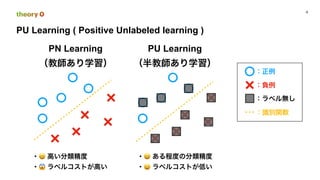
PU Learning ( Positive Unlabeled learning )
4
theory 0
PN Learning PU Learning
!
"
!
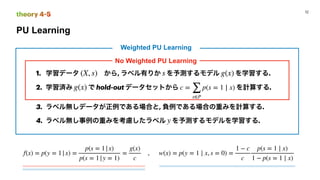
!
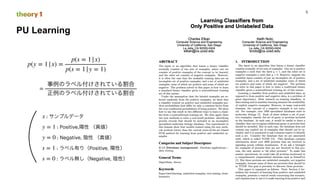
PU Learning
5
theory 1
=
   
   
p(y = 1|x) =
p(s = 1|x)
p(s = 1|y = 1)
:
: Positive,
: Negative,
: Positive,
: Negative,
x
y = 1
y = 0
s = 1
s = 0
x
g(x) = p(s = 1 ∣ x) = p(y = 1 ∧ s = 1 ∣ x)
= p(y = 1 ∣ x) p(s = 1 ∣ y = 1,x)
= p(y = 1 ∣ x) p(s = 1 ∣ y = 1)
= f(x) c
PU Learning
6
theory 2
:
: Positive,
: Negative,
: Positive,
: Negative,
x
y = 1
y = 0
s = 1
s = 0
p(y = 1|x) =
p(s = 1|x)
p(s = 1|y = 1)
c = p(s = 1|y = 1)
f(x) =
g(x)
c
=
   
   
≤ 1
PU Learning
7
theory 3
w(x) = p(y = 1 ∣ x, s = 0)
= ⋯
=
1 − c
c
p(s = 1 ∣ x)
1 − p(s = 1 ∣ x)
:
: Positive,
: Negative,
: Positive,
: Negative,
x
y = 1
y = 0
s = 1
s = 0
p(y = 1|x) =
p(s = 1|x)
p(s = 1|y = 1)
=
g(x)
c
c = p(s = 1|y = 1)
=
1
n ∑
x∈P
g(x) =
1
n ∑
x∈P
p(s = 1 ∣ x)
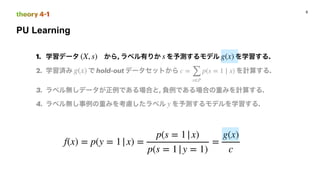
PU Learning
8
theory 4-1
1. , .
2. hold-out .
3. , .
4. .
(X, s) s g(x)
g(x) c =
∑
x∈P
p(s = 1 ∣ x)
y
f(x) = p(y = 1|x) =
p(s = 1|x)
p(s = 1|y = 1)
=
g(x)
c
PU Learning
9
theory 4-2
1. , .
2. hold-out .
3. , .
4. .
(X, s) s g(x)
g(x) c =
∑
x∈P
p(s = 1 ∣ x)
y
f(x) = p(y = 1|x) =
p(s = 1|x)
p(s = 1|y = 1)
=
g(x)
c
PU Learning
10
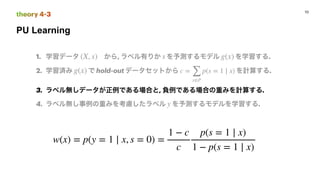
theory 4-3
1. , .
2. hold-out .
3. , .
4. .
(X, s) s g(x)
g(x) c =
∑
x∈P
p(s = 1 ∣ x)
y
w(x) = p(y = 1 ∣ x, s = 0) =
1 − c
c
p(s = 1 ∣ x)
1 − p(s = 1 ∣ x)
PU Learning
11
theory 4-4
1. , .
2. hold-out .
3. , .
4. .
(X, s) s g(x)
g(x) c =
∑
x∈P
p(s = 1 ∣ x)
y
PU Learning
12
theory 4-5
1. , .
2. hold-out .
3. , .
4. .
(X, s) s g(x)
g(x) c =
∑
x∈P
p(s = 1 ∣ x)
y
No Weighted PU Learning
Weighted PU Learning
w(x) = p(y = 1 ∣ x, s = 0) =
1 − c
c
p(s = 1 ∣ x)
1 − p(s = 1 ∣ x)
f(x) = p(y = 1|x) =
p(s = 1|x)
p(s = 1|y = 1)
=
g(x)
c
,
CV
CV
CV
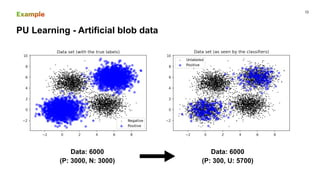
PU Learning - Artificial blob data
13
Example
Data: 6000
(P: 3000, N: 3000)
Data: 6000
(P: 300, U: 5700)
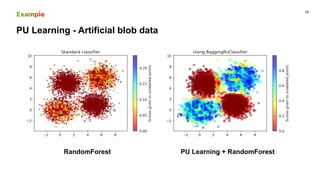
PU Learning - Artificial blob data
14
Example
RandomForest PU Learning + RandomForest
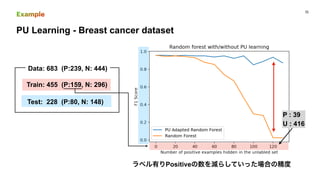
PU Learning - Breast cancer dataset
15
Example
Positive
Train: 455 (P:159, N: 296)
Test: 228 (P:80, N: 148)
Data: 683 (P:239, N: 444)
P : 39
U : 416
PU Learning for DeepLearning
16
theory 5
:
: Positive
: Negative
:
: ,
X
πp = p(Y = + 1)
πn = p(Y = − 1)
g
ℓ(t, y) t y
Risk Estimator PU Learning
̂Rpu(g) = πp
̂R+
p (g) − πp
̂R−
p (g) + ̂R−
u (g)
R−
u (g) = 𝔼X∼p(x)[ℓ(g(X), − 1)]
R+
p (g) = 𝔼p[ℓ(g(X), + 1)],  where 𝔼p[ ⋅ ] = 𝔼X∼pp
[ ⋅ ]
R−
p (g) = 𝔼p[ℓ(g(X), − 1)],  where 𝔼p[ ⋅ ] = 𝔼X∼pp
[ ⋅ ]
∑
θ∈Θ
R(θ, δ)π(θ)
,
PU Learning for DeepLearning
17
theory 6
Risk Estimator PN Learning
̂Rpn(g) = πp
̂R+
p (g) + πn
̂R−
n (g)
R−
n (g) = 𝔼n[ℓ(g(X), − 1)],  where 𝔼n[ ⋅ ] = 𝔼X∼pn
[ ⋅ ]
R+
p (g) = 𝔼p[ℓ(g(X), + 1)],  where 𝔼p[ ⋅ ] = 𝔼X∼pp
[ ⋅ ]
Risk Estimator PU Learning
̂Rpu(g) = πp
̂R+
p (g) − πp
̂R−
p (g) + ̂R−
u (g)
R−
u (g) = 𝔼X∼p(x)[ℓ(g(X), − 1)]
R+
p (g) = 𝔼p[ℓ(g(X), + 1)],  where 𝔼p[ ⋅ ] = 𝔼X∼pp
[ ⋅ ]
R−
p (g) = 𝔼p[ℓ(g(X), − 1)],  where 𝔼p[ ⋅ ] = 𝔼X∼pp
[ ⋅ ]
{
πnpn(x) = p(x) − πppp(x)
πnR−
n (g) = R−
u (g) − πpR−
p (g)
,

PU Learning

  • 1.
    PU Learning forAurora Image Segmentation https://github.com/RxstydnR/PUlearning_segmentation
  • 2.
    PU Learning (Positive Unlabeled learning ) 4 theory 0 PN Learning PU Learning ! " ! !
  • 3.
    PU Learning 5 theory 1 =        p(y = 1|x) = p(s = 1|x) p(s = 1|y = 1) : : Positive, : Negative, : Positive, : Negative, x y = 1 y = 0 s = 1 s = 0
  • 4.
    x g(x) = p(s= 1 ∣ x) = p(y = 1 ∧ s = 1 ∣ x) = p(y = 1 ∣ x) p(s = 1 ∣ y = 1,x) = p(y = 1 ∣ x) p(s = 1 ∣ y = 1) = f(x) c PU Learning 6 theory 2 : : Positive, : Negative, : Positive, : Negative, x y = 1 y = 0 s = 1 s = 0 p(y = 1|x) = p(s = 1|x) p(s = 1|y = 1) c = p(s = 1|y = 1) f(x) = g(x) c =         ≤ 1
  • 5.
    PU Learning 7 theory 3 w(x)= p(y = 1 ∣ x, s = 0) = ⋯ = 1 − c c p(s = 1 ∣ x) 1 − p(s = 1 ∣ x) : : Positive, : Negative, : Positive, : Negative, x y = 1 y = 0 s = 1 s = 0 p(y = 1|x) = p(s = 1|x) p(s = 1|y = 1) = g(x) c c = p(s = 1|y = 1) = 1 n ∑ x∈P g(x) = 1 n ∑ x∈P p(s = 1 ∣ x)
  • 6.
    PU Learning 8 theory 4-1 1., . 2. hold-out . 3. , . 4. . (X, s) s g(x) g(x) c = ∑ x∈P p(s = 1 ∣ x) y f(x) = p(y = 1|x) = p(s = 1|x) p(s = 1|y = 1) = g(x) c
  • 7.
    PU Learning 9 theory 4-2 1., . 2. hold-out . 3. , . 4. . (X, s) s g(x) g(x) c = ∑ x∈P p(s = 1 ∣ x) y f(x) = p(y = 1|x) = p(s = 1|x) p(s = 1|y = 1) = g(x) c
  • 8.
    PU Learning 10 theory 4-3 1., . 2. hold-out . 3. , . 4. . (X, s) s g(x) g(x) c = ∑ x∈P p(s = 1 ∣ x) y w(x) = p(y = 1 ∣ x, s = 0) = 1 − c c p(s = 1 ∣ x) 1 − p(s = 1 ∣ x)
  • 9.
    PU Learning 11 theory 4-4 1., . 2. hold-out . 3. , . 4. . (X, s) s g(x) g(x) c = ∑ x∈P p(s = 1 ∣ x) y
  • 10.
    PU Learning 12 theory 4-5 1., . 2. hold-out . 3. , . 4. . (X, s) s g(x) g(x) c = ∑ x∈P p(s = 1 ∣ x) y No Weighted PU Learning Weighted PU Learning w(x) = p(y = 1 ∣ x, s = 0) = 1 − c c p(s = 1 ∣ x) 1 − p(s = 1 ∣ x) f(x) = p(y = 1|x) = p(s = 1|x) p(s = 1|y = 1) = g(x) c , CV CV CV
  • 11.
    PU Learning -Artificial blob data 13 Example Data: 6000 (P: 3000, N: 3000) Data: 6000 (P: 300, U: 5700)
  • 12.
    PU Learning -Artificial blob data 14 Example RandomForest PU Learning + RandomForest
  • 13.
    PU Learning -Breast cancer dataset 15 Example Positive Train: 455 (P:159, N: 296) Test: 228 (P:80, N: 148) Data: 683 (P:239, N: 444) P : 39 U : 416
  • 14.
    PU Learning forDeepLearning 16 theory 5 : : Positive : Negative : : , X πp = p(Y = + 1) πn = p(Y = − 1) g ℓ(t, y) t y Risk Estimator PU Learning ̂Rpu(g) = πp ̂R+ p (g) − πp ̂R− p (g) + ̂R− u (g) R− u (g) = 𝔼X∼p(x)[ℓ(g(X), − 1)] R+ p (g) = 𝔼p[ℓ(g(X), + 1)],  where 𝔼p[ ⋅ ] = 𝔼X∼pp [ ⋅ ] R− p (g) = 𝔼p[ℓ(g(X), − 1)],  where 𝔼p[ ⋅ ] = 𝔼X∼pp [ ⋅ ] ∑ θ∈Θ R(θ, δ)π(θ) ,
  • 15.
    PU Learning forDeepLearning 17 theory 6 Risk Estimator PN Learning ̂Rpn(g) = πp ̂R+ p (g) + πn ̂R− n (g) R− n (g) = 𝔼n[ℓ(g(X), − 1)],  where 𝔼n[ ⋅ ] = 𝔼X∼pn [ ⋅ ] R+ p (g) = 𝔼p[ℓ(g(X), + 1)],  where 𝔼p[ ⋅ ] = 𝔼X∼pp [ ⋅ ] Risk Estimator PU Learning ̂Rpu(g) = πp ̂R+ p (g) − πp ̂R− p (g) + ̂R− u (g) R− u (g) = 𝔼X∼p(x)[ℓ(g(X), − 1)] R+ p (g) = 𝔼p[ℓ(g(X), + 1)],  where 𝔼p[ ⋅ ] = 𝔼X∼pp [ ⋅ ] R− p (g) = 𝔼p[ℓ(g(X), − 1)],  where 𝔼p[ ⋅ ] = 𝔼X∼pp [ ⋅ ] { πnpn(x) = p(x) − πppp(x) πnR− n (g) = R− u (g) − πpR− p (g) ,