DEVELOPMENTAL PSYCHOLOGY
BY
DR. BADA BUKOLA VICTORIA
DEPARTMENT OF PSYCHOLOGY
COURSE OUTLINE:
• Introduction to Developmental Psychology
• Biological foundation in human development
• Theories of human development
• Research method in developmental
psychology
Introduction to Developmental Psychology
• What is Developmental Psychology?
• Developmental psychology is the branch of
psychology that focuses on how people grow
and change over the course of a lifetime.
• Developmental psychologists are interested in
common patterns of development and growth
and the way in which people differ throughout
the lifespan.
The 12 stages of human life cycle by Thomas Armstrong
• Prebirth - This is a period of potentials.
• Birth – This is a period of hope for parents.
• Infancy (0 – 3years) – This is period of vitality
and pleasure seeking (id principle).
• Early childhood (3 – 6years) – This is a period
of playfulness.
• Middle childhood (6 – 8years) – This is a
period of imagination.
• Late childhood (9-11years) – This is a period of
ingenuity.
• Adolescence (11-20years) – This is a period of
passion.
• Early adulthood (20-35yeras) – This is a period
of enterprise.
• Midlife (35 -50years) – This is a period of
contemplation.
• Matured adulthood (50 – 70years) – This is a
period of benevolence.
• Late adulthood (70 years above) – this is a
period of wisdom.
• Death and dying – This is a period of life,
death teaches about value of living.
Issues in life span development:
1. Continuity and Discontinuity:
• Personality researchers in particular have
attempted to determine whether there are
dispositions that remain consistent over life.
Developmental stages are periods during
which physical or psychological functioning
differs qualitatively from that of either earlier
or later periods.
• Nature-Nurture Controversy
• This is a long-standing debate over relative
importance of heredity and learning in many
aspects of functioning. Nature and nurture in
development is influenced by both “nature,”
or heredity, and “nurture,” or the
environment.
• Furthermore, specific environmental factors
can influence the expression of genes. Some
theorist like;
• John Locke, a British philosopher, believed
that human infants are born without
knowledge or skills.
• Jean Rousseau, a French philosopher, argued
that we bring into our world our evolutionary
legacy.
The Developmental Processes
1. Growth
• Growth refers to quantitative changes in an
organism. This usually involves permanent
increase in size and structure of organisms.
These quantitative changes are both physical
and mental. These include physical changes in
height, weight, girth, internal organs and
mental changes in memory, reasoning,
perception and creative imagination.
• The quantitative changes in height, weight,
girth and others are as a result of multiple cell
divisions called MITOSIS (Mitotic Cell Division).
• This usually involves body cells called Somatic
Cells (Vegetative cells). Somatic cells always
have 23 pairs of Chromosome (i.e. 46) called
the Diploid number (2n).
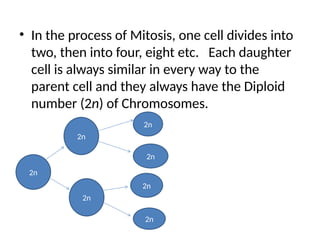
• In the process of Mitosis, one cell divides into
two, then into four, eight etc. Each daughter
cell is always similar in every way to the
parent cell and they always have the Diploid
number (2n) of Chromosomes.
2n
2n
2n
2n
2n
2n
2n
2. Maturation
• Maturation is the process of gradual unfolding
of the inborn potentialities of traits present in
the individual because of hereditary
endowment.
• According to Gessel, “Maturation is the net
sum of the effects operating in a self-limited
life-cycle”. This definition connotes individual
differences
• Maturation goes along with physical growth
and the development of the central nervous
system.
• Maturation is a function of two major factors,
which are in turn dependent on time and
experience viz
• Phylogenetic
• Ontogenetic
Phylogenetic
Functions
• These are functions, which are common to all
members of a species. These include crawling,
creeping, sitting, walking etc.
•
• Experience is not necessary to these functions
as they are time, age and physical and mental
maturity dependent.
Ontogenetic
Functions
• These depend on experience. They are
functions common to individuals. Some of
these functions are swimming, climbing,
painting, speech, etc.
• Here, without experience or training,
development cannot take place.
Biological foundation in human development
• Conception and Pregnancy
• Have you ever imagine how you came to be,
one out of several thousands of eggs and one
out of millions of sperm united to produce
you.
• Development begins at conception when a
single sperm cell from the male unites with an
ovum (egg) in the fallopian tube of the female.
• This process is called fertilization and the
fertilized egg is called a zygote. 23
chromosomes from each parent unite at
conception to form zygote and the period from
conception to birth called the prenatal period.
• The prenatal development is divided into three
periods.
*The Germinal period (Zygote):
*Embryonic period:
*Fetal period (Fetus):
The Germinal Period (Zygote)
• This is the period of prenatal development
that takes place in the first 2weeks after
conception. It includes the creation of zygote,
continued cell division and the attachment of
the zygote to the wall of the uterus which is
called implantation. Implantation takes place
10 days after conception.
Embryonic Period
• This is the period of prenatal development
that occurs between 2 to 8 weeks after
conception.
• This intensity of rate of cell differentiation is
what changes the name of mass of cells from
zygote to embryo
• The inner layer of the cells is endoderm, which will
develop into the digestive and respiratory systems.
• The outer layer of the cells is divided into two
parts called ectoderm and mesoderm.
• The ectoderm is the outermost layer, which will
become the nervous system, sensory receptors
(ears, nose, eyes) and the skin parts (hair and
nails).
• The mesoderm is the middle layer which will
become the circulatory system, bones, muscles,
excretory system, and reproductive system.
Fetal period (Fetus)
• This is the period of prenatal development
that begins 2 months after conception and last
till birth. Growth and development continue
their dramatic course during this time.
Child development during the prenatal
period
• During the first trimester, conception to three
months, the baby develops:
• Nervous system (brain, spinal cord, and
nerves)
• Heart
• Sexual organs
• Muscles, arms, and legs
• During the second trimester, four to six
months, the baby shows:
• Increased body size
• Growth of eyelashes and eyebrows
• Increased size of the head
• Stronger heart beat
• Ability to hear sounds
• Ability to suck and make movement such as
opening and closing hands and kicking
• During the third trimester, seven to nine
months, the baby can survive a premature birth
and he/she shows:
• Fully developed body parts including toenails
and fingernails
• Fully developed organs, including lungs
prepared for oxygen intake at birth
• Ability to sleep and be awake
• Ability to push his/her mother’s ribs or abdomen
• The right position for birth (head down)
3 Stages of birth
• In the first stage, uterine contractions are 15
to 20 minutes apart at the beginning and last
up to a minute
• These contraction causes the woman’s cervix
to stretch and open.
• As the first stage progresses, the contraction
come closer together appearing every 2 to 5
minutes and the intensity increases.
• The second birth stage begins when the
baby’s head starts to move through the cervix
and the birth canal.
• It terminates when the baby completely
emerges from the mother’s body. This stage
lasts for approximately one and half hours.
• By the time the baby’s head is out contraction
reduces to about a minute each till the third
stage.
• The third stage is called the Afterbirth
• At this stage, the placenta, umbilical cord, and
all other membranes are detached and
expelled from the womb of the mother.
• This final stage happens to be the shortest of
all the three stages because it lasts for only
few minutes.
SIGNS OF LABOR
• These are the 10 most common signs and
symptoms that labor is near
• The baby drops
• An increased urge to urinate
• The mucus plug passes
• The cervix dilates
• Thinning of the cervix
• Back pain
• Contractions
• A burst of energy
• Feeling the urge to have a bowel movement
(diarrhea)
• Water break
NOTE: There are characteristic changes
in the body of woman in labor and every
woman's experience is unique and different
Reflexes Present At Birth
• Grasping reflex: Holds a finger or other object
firmly
• Rooting reflex: Turns head towards anything
that strokes their cheek or when touched on
the cheek
• Gag reflex: Clears the throat
• Sucking reflex: Sucks objects placed in mouth
•
• Moro/Startle reflex: Flings out the arms, fans
the fingers, and arches the back in response to
a sudden noise
• Babinski reflex: Curls toes when outer edge of
sole of foot is stroked
• Walking or stepping reflex: when sole of their
feet touches a flat surface they will attempt to
walk by placing one foot in front of the other.

PSY 121 SLIDES DEVELOPMENTAL PSYCHOLOGY.pptx

  • 1.
    DEVELOPMENTAL PSYCHOLOGY BY DR. BADABUKOLA VICTORIA DEPARTMENT OF PSYCHOLOGY
  • 2.
    COURSE OUTLINE: • Introductionto Developmental Psychology • Biological foundation in human development • Theories of human development • Research method in developmental psychology
  • 3.
    Introduction to DevelopmentalPsychology • What is Developmental Psychology? • Developmental psychology is the branch of psychology that focuses on how people grow and change over the course of a lifetime.
  • 4.
    • Developmental psychologistsare interested in common patterns of development and growth and the way in which people differ throughout the lifespan.
  • 5.
    The 12 stagesof human life cycle by Thomas Armstrong • Prebirth - This is a period of potentials. • Birth – This is a period of hope for parents. • Infancy (0 – 3years) – This is period of vitality and pleasure seeking (id principle). • Early childhood (3 – 6years) – This is a period of playfulness.
  • 6.
    • Middle childhood(6 – 8years) – This is a period of imagination. • Late childhood (9-11years) – This is a period of ingenuity. • Adolescence (11-20years) – This is a period of passion. • Early adulthood (20-35yeras) – This is a period of enterprise.
  • 7.
    • Midlife (35-50years) – This is a period of contemplation. • Matured adulthood (50 – 70years) – This is a period of benevolence. • Late adulthood (70 years above) – this is a period of wisdom. • Death and dying – This is a period of life, death teaches about value of living.
  • 8.
    Issues in lifespan development: 1. Continuity and Discontinuity: • Personality researchers in particular have attempted to determine whether there are dispositions that remain consistent over life. Developmental stages are periods during which physical or psychological functioning differs qualitatively from that of either earlier or later periods.
  • 9.
    • Nature-Nurture Controversy •This is a long-standing debate over relative importance of heredity and learning in many aspects of functioning. Nature and nurture in development is influenced by both “nature,” or heredity, and “nurture,” or the environment.
  • 10.
    • Furthermore, specificenvironmental factors can influence the expression of genes. Some theorist like; • John Locke, a British philosopher, believed that human infants are born without knowledge or skills. • Jean Rousseau, a French philosopher, argued that we bring into our world our evolutionary legacy.
  • 11.
    The Developmental Processes 1.Growth • Growth refers to quantitative changes in an organism. This usually involves permanent increase in size and structure of organisms. These quantitative changes are both physical and mental. These include physical changes in height, weight, girth, internal organs and mental changes in memory, reasoning, perception and creative imagination.
  • 12.
    • The quantitativechanges in height, weight, girth and others are as a result of multiple cell divisions called MITOSIS (Mitotic Cell Division). • This usually involves body cells called Somatic Cells (Vegetative cells). Somatic cells always have 23 pairs of Chromosome (i.e. 46) called the Diploid number (2n).
  • 13.
    • In theprocess of Mitosis, one cell divides into two, then into four, eight etc. Each daughter cell is always similar in every way to the parent cell and they always have the Diploid number (2n) of Chromosomes. 2n 2n 2n 2n 2n 2n 2n
  • 14.
    2. Maturation • Maturationis the process of gradual unfolding of the inborn potentialities of traits present in the individual because of hereditary endowment. • According to Gessel, “Maturation is the net sum of the effects operating in a self-limited life-cycle”. This definition connotes individual differences
  • 15.
    • Maturation goesalong with physical growth and the development of the central nervous system. • Maturation is a function of two major factors, which are in turn dependent on time and experience viz • Phylogenetic • Ontogenetic
  • 16.
    Phylogenetic Functions • These arefunctions, which are common to all members of a species. These include crawling, creeping, sitting, walking etc. • • Experience is not necessary to these functions as they are time, age and physical and mental maturity dependent.
  • 17.
    Ontogenetic Functions • These dependon experience. They are functions common to individuals. Some of these functions are swimming, climbing, painting, speech, etc. • Here, without experience or training, development cannot take place.
  • 18.
    Biological foundation inhuman development • Conception and Pregnancy • Have you ever imagine how you came to be, one out of several thousands of eggs and one out of millions of sperm united to produce you. • Development begins at conception when a single sperm cell from the male unites with an ovum (egg) in the fallopian tube of the female.
  • 19.
    • This processis called fertilization and the fertilized egg is called a zygote. 23 chromosomes from each parent unite at conception to form zygote and the period from conception to birth called the prenatal period. • The prenatal development is divided into three periods. *The Germinal period (Zygote): *Embryonic period: *Fetal period (Fetus):
  • 20.
    The Germinal Period(Zygote) • This is the period of prenatal development that takes place in the first 2weeks after conception. It includes the creation of zygote, continued cell division and the attachment of the zygote to the wall of the uterus which is called implantation. Implantation takes place 10 days after conception.
  • 21.
    Embryonic Period • Thisis the period of prenatal development that occurs between 2 to 8 weeks after conception. • This intensity of rate of cell differentiation is what changes the name of mass of cells from zygote to embryo
  • 22.
    • The innerlayer of the cells is endoderm, which will develop into the digestive and respiratory systems. • The outer layer of the cells is divided into two parts called ectoderm and mesoderm. • The ectoderm is the outermost layer, which will become the nervous system, sensory receptors (ears, nose, eyes) and the skin parts (hair and nails). • The mesoderm is the middle layer which will become the circulatory system, bones, muscles, excretory system, and reproductive system.
  • 23.
    Fetal period (Fetus) •This is the period of prenatal development that begins 2 months after conception and last till birth. Growth and development continue their dramatic course during this time.
  • 24.
    Child development duringthe prenatal period • During the first trimester, conception to three months, the baby develops: • Nervous system (brain, spinal cord, and nerves) • Heart • Sexual organs • Muscles, arms, and legs
  • 25.
    • During thesecond trimester, four to six months, the baby shows: • Increased body size • Growth of eyelashes and eyebrows • Increased size of the head • Stronger heart beat • Ability to hear sounds • Ability to suck and make movement such as opening and closing hands and kicking
  • 26.
    • During thethird trimester, seven to nine months, the baby can survive a premature birth and he/she shows: • Fully developed body parts including toenails and fingernails • Fully developed organs, including lungs prepared for oxygen intake at birth • Ability to sleep and be awake • Ability to push his/her mother’s ribs or abdomen • The right position for birth (head down)
  • 27.
    3 Stages ofbirth • In the first stage, uterine contractions are 15 to 20 minutes apart at the beginning and last up to a minute • These contraction causes the woman’s cervix to stretch and open. • As the first stage progresses, the contraction come closer together appearing every 2 to 5 minutes and the intensity increases.
  • 28.
    • The secondbirth stage begins when the baby’s head starts to move through the cervix and the birth canal. • It terminates when the baby completely emerges from the mother’s body. This stage lasts for approximately one and half hours. • By the time the baby’s head is out contraction reduces to about a minute each till the third stage.
  • 29.
    • The thirdstage is called the Afterbirth • At this stage, the placenta, umbilical cord, and all other membranes are detached and expelled from the womb of the mother. • This final stage happens to be the shortest of all the three stages because it lasts for only few minutes.
  • 30.
    SIGNS OF LABOR •These are the 10 most common signs and symptoms that labor is near • The baby drops • An increased urge to urinate • The mucus plug passes • The cervix dilates • Thinning of the cervix
  • 31.
    • Back pain •Contractions • A burst of energy • Feeling the urge to have a bowel movement (diarrhea) • Water break NOTE: There are characteristic changes in the body of woman in labor and every woman's experience is unique and different
  • 32.
    Reflexes Present AtBirth • Grasping reflex: Holds a finger or other object firmly • Rooting reflex: Turns head towards anything that strokes their cheek or when touched on the cheek • Gag reflex: Clears the throat • Sucking reflex: Sucks objects placed in mouth
  • 33.
    • • Moro/Startle reflex:Flings out the arms, fans the fingers, and arches the back in response to a sudden noise • Babinski reflex: Curls toes when outer edge of sole of foot is stroked • Walking or stepping reflex: when sole of their feet touches a flat surface they will attempt to walk by placing one foot in front of the other.