HYG-1429-2004


                             School of Natural Resources, 2021 Coffey Road, Columbus, Ohio 43210
                       Horticulture and Crop Science, 2021 Coffey Road, Columbus, Ohio 43210


            Pruning Backyard Grapevines
               in the First Three Years
                                                        Maurus Brown
              Assistant Professor and Extension Agent, Agriculture, Natural Resources, and Community Development
                                        Ohio State University Extension, Richland County

                                                             Gary Gao
                              Associate Professor and Extension Agent, Horticulture, and County Chair
                                         Ohio State University Extension, Clermont County


Introduction
    Grape gardeners often become confused as to what should
be pruned off and when. Proper pruning will help maintain a
grapevineʼs potential of producing a good quality fruit crop,
develop good vine structure, increase sunlight exposure into the
canopy, promote the development of next yearʼs fruiting wood,
and potentially reduce disease and insect pressure. The key to
good pruning is learning how to select good quality fruiting wood
to leave for cropping.
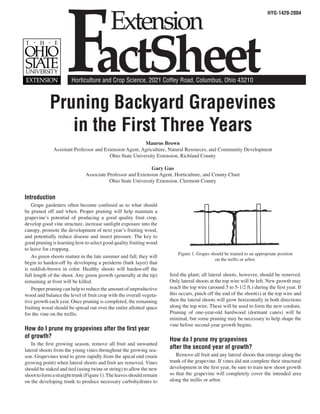
                                                                          Figure 1. Grapes should be trained to an appropriate position
    As green shoots mature in the late summer and fall, they will
                                                                                             on the trellis or arbor.
begin to harden-off by developing a periderm (bark layer) that
is reddish-brown in color. Healthy shoots will harden-off the
full length of the shoot. Any green growth (generally at the tip)     feed the plant; all lateral shoots, however, should be removed.
remaining at frost will be killed.                                    Only lateral shoots at the top wire will be left. New growth may
    Proper pruning can help to reduce the amount of unproductive      reach the top wire (around 5 to 5-1/2 ft.) during the first year. If
wood and balance the level of fruit crop with the overall vegeta-     this occurs, pinch off the end of the shoot(s) at the top wire and
tive growth each year. Once pruning is completed, the remaining       then the lateral shoots will grow horizontally in both directions
fruiting wood should be spread out over the entire allotted space     along the top wire. These will be used to form the new cordons.
for the vine on the trellis.                                          Pruning of one-year-old hardwood (dormant canes) will be
                                                                      minimal, but some pruning may be necessary to help shape the
                                                                      vine before second-year growth begins.
How do I prune my grapevines after the first year
of growth?
                                                                      How do I prune my grapevines
   In the first growing season, remove all fruit and unwanted
lateral shoots from the young vines throughout the growing sea-
                                                                      after the second year of growth?
son. Grapevines tend to grow rapidly from the apical end (main           Remove all fruit and any lateral shoots that emerge along the
growing point) when lateral shoots and fruit are removed. Vines       trunk of the grapevine. If vines did not complete their structural
should be staked and tied (using twine or string) to allow the new    development in the first year, be sure to train new shoot growth
shoot to form a straight trunk (Figure 1). The leaves should remain   so that the grapevine will completely cover the intended area
on the developing trunk to produce necessary carbohydrates to         along the trellis or arbor.
HYG-1429-2004—page 2


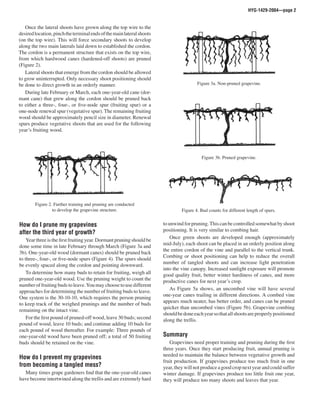
   Once the lateral shoots have grown along the top wire to the
desired location, pinch the terminal ends of the main lateral shoots
(on the top wire). This will force secondary shoots to develop
along the two main laterals laid down to established the cordon.
The cordon is a permanent structure that exists on the top wire,
from which hardwood canes (hardened-off shoots) are pruned
(Figure 2).
   Lateral shoots that emerge from the cordon should be allowed
to grow uninterrupted. Only necessary shoot positioning should
be done to direct growth in an orderly manner.                                          Figure 3a. Non-pruned grapevine.
   During late February or March, each one-year-old cane (dor-
mant cane) that grew along the cordon should be pruned back
to either a three-, four-, or five-node spur (fruiting spur) or a
one-node renewal spur (vegetative spur). The remaining fruiting
wood should be approximately pencil size in diameter. Renewal
spurs produce vegetative shoots that are used for the following
yearʼs fruiting wood.


                                                                                          Figure 3b. Pruned grapevine.


        Figure 2. Further training and pruning are conducted
                 to develop the grapevine structure.                            Figure 4. Bud counts for different length of spurs.


How do I prune my grapevines                                           to unwind for pruning. This can be controlled somewhat by shoot
                                                                       positioning. It is very similar to combing hair.
after the third year of growth?
                                                                           Once green shoots are developed enough (approximately
    Year three is the first fruiting year. Dormant pruning should be
                                                                       mid-July), each shoot can be placed in an orderly position along
done some time in late February through March (Figure 3a and
                                                                       the entire cordon of the vine and parallel to the vertical trunk.
3b). One-year-old wood (dormant canes) should be pruned back
                                                                       Combing or shoot positioning can help to reduce the overall
to three-, four-, or five-node spurs (Figure 4). The spurs should
                                                                       number of tangled shoots and can increase light penetration
be evenly spaced along the cordon and pointing downward.
                                                                       into the vine canopy. Increased sunlight exposure will promote
    To determine how many buds to retain for fruiting, weigh all       good quality fruit, better winter hardiness of canes, and more
pruned one-year-old wood. Use the pruning weight to count the          productive canes for next yearʼs crop.
number of fruiting buds to leave. You may choose to use different
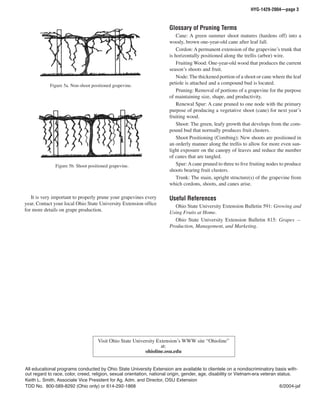
                                                                           As Figure 5a shows, an uncombed vine will have several
approaches for determining the number of fruiting buds to leave.
                                                                       one-year canes trailing in different directions. A combed vine
One system is the 30-10-10, which requires the person pruning
                                                                       appears much neater, has better order, and canes can be pruned
to keep track of the weighed prunings and the number of buds
                                                                       quicker than uncombed vines (Figure 5b). Grapevine combing
remaining on the intact vine.
                                                                       should be done each year so that all shoots are properly positioned
    For the first pound of pruned-off wood, leave 30 buds; second       along the trellis.
pound of wood, leave 10 buds; and continue adding 10 buds for
each pound of wood thereafter. For example: Three pounds of
one-year-old wood have been pruned off; a total of 50 fruiting         Summary
buds should be retained on the vine.                                      Grapevines need proper training and pruning during the first
                                                                       three years. Once they start producing fruit, annual pruning is
                                                                       needed to maintain the balance between vegetative growth and
How do I prevent my grapevines
                                                                       fruit production. If grapevines produce too much fruit in one
from becoming a tangled mess?                                          year, they will not produce a good crop next year and could suffer
   Many times grape gardeners find that the one-year-old canes          winter damage. If grapevines produce too little fruit one year,
have become intertwined along the trellis and are extremely hard       they will produce too many shoots and leaves that year.
HYG-1429-2004—page 3


                                                                        Glossary of Pruning Terms
                                                                            Cane: A green summer shoot matures (hardens off) into a
                                                                        woody, brown one-year-old cane after leaf fall.
                                                                            Cordon: A permanent extension of the grapevineʼs trunk that
                                                                        is horizontally positioned along the trellis (arbor) wire.
                                                                            Fruiting Wood: One-year-old wood that produces the current
                                                                        seasonʼs shoots and fruit.
                                                                            Node: The thickened portion of a shoot or cane where the leaf
            Figure 5a. Non-shoot positioned grapevine.
                                                                        petiole is attached and a compound bud is located.
                                                                            Pruning: Removal of portions of a grapevine for the purpose
                                                                        of maintaining size, shape, and productivity.
                                                                            Renewal Spur: A cane pruned to one node with the primary
                                                                        purpose of producing a vegetative shoot (cane) for next yearʼs
                                                                        fruiting wood.
                                                                            Shoot: The green, leafy growth that develops from the com-
                                                                        pound bud that normally produces fruit clusters.
                                                                            Shoot Positioning (Combing): New shoots are positioned in
                                                                        an orderly manner along the trellis to allow for more even sun-
                                                                        light exposure on the canopy of leaves and reduce the number
                                                                        of canes that are tangled.
               Figure 5b. Shoot positioned grapevine.                       Spur: A cane pruned to three to five fruiting nodes to produce
                                                                        shoots bearing fruit clusters.
                                                                            Trunk: The main, upright structure(s) of the grapevine from
                                                                        which cordons, shoots, and canes arise.

   It is very important to properly prune your grapevines every         Useful References
year. Contact your local Ohio State University Extension office            Ohio State University Extension Bulletin 591: Growing and
for more details on grape production.                                   Using Fruits at Home.
                                                                          Ohio State University Extension Bulletin 815: Grapes —
                                                                        Production, Management, and Marketing.


                                     Visit Ohio State University Extensionʼs WWW site “Ohioline”
                                                                   at:
                                                           ohioline.osu.edu


All educational programs conducted by Ohio State University Extension are available to clientele on a nondiscriminatory basis with-
out regard to race, color, creed, religion, sexual orientation, national origin, gender, age, disability or Vietnam-era veteran status.
Keith L. Smith, Associate Vice President for Ag. Adm. and Director, OSU Extension
TDD No. 800-589-8292 (Ohio only) or 614-292-1868                                                                                 6/2004-jaf

Pruning Backyard Grapevines

  • 1.
    HYG-1429-2004 School of Natural Resources, 2021 Coffey Road, Columbus, Ohio 43210 Horticulture and Crop Science, 2021 Coffey Road, Columbus, Ohio 43210 Pruning Backyard Grapevines in the First Three Years Maurus Brown Assistant Professor and Extension Agent, Agriculture, Natural Resources, and Community Development Ohio State University Extension, Richland County Gary Gao Associate Professor and Extension Agent, Horticulture, and County Chair Ohio State University Extension, Clermont County Introduction Grape gardeners often become confused as to what should be pruned off and when. Proper pruning will help maintain a grapevineʼs potential of producing a good quality fruit crop, develop good vine structure, increase sunlight exposure into the canopy, promote the development of next yearʼs fruiting wood, and potentially reduce disease and insect pressure. The key to good pruning is learning how to select good quality fruiting wood to leave for cropping. Figure 1. Grapes should be trained to an appropriate position As green shoots mature in the late summer and fall, they will on the trellis or arbor. begin to harden-off by developing a periderm (bark layer) that is reddish-brown in color. Healthy shoots will harden-off the full length of the shoot. Any green growth (generally at the tip) feed the plant; all lateral shoots, however, should be removed. remaining at frost will be killed. Only lateral shoots at the top wire will be left. New growth may Proper pruning can help to reduce the amount of unproductive reach the top wire (around 5 to 5-1/2 ft.) during the first year. If wood and balance the level of fruit crop with the overall vegeta- this occurs, pinch off the end of the shoot(s) at the top wire and tive growth each year. Once pruning is completed, the remaining then the lateral shoots will grow horizontally in both directions fruiting wood should be spread out over the entire allotted space along the top wire. These will be used to form the new cordons. for the vine on the trellis. Pruning of one-year-old hardwood (dormant canes) will be minimal, but some pruning may be necessary to help shape the vine before second-year growth begins. How do I prune my grapevines after the first year of growth? How do I prune my grapevines In the first growing season, remove all fruit and unwanted lateral shoots from the young vines throughout the growing sea- after the second year of growth? son. Grapevines tend to grow rapidly from the apical end (main Remove all fruit and any lateral shoots that emerge along the growing point) when lateral shoots and fruit are removed. Vines trunk of the grapevine. If vines did not complete their structural should be staked and tied (using twine or string) to allow the new development in the first year, be sure to train new shoot growth shoot to form a straight trunk (Figure 1). The leaves should remain so that the grapevine will completely cover the intended area on the developing trunk to produce necessary carbohydrates to along the trellis or arbor.
  • 2.
    HYG-1429-2004—page 2 Once the lateral shoots have grown along the top wire to the desired location, pinch the terminal ends of the main lateral shoots (on the top wire). This will force secondary shoots to develop along the two main laterals laid down to established the cordon. The cordon is a permanent structure that exists on the top wire, from which hardwood canes (hardened-off shoots) are pruned (Figure 2). Lateral shoots that emerge from the cordon should be allowed to grow uninterrupted. Only necessary shoot positioning should be done to direct growth in an orderly manner. Figure 3a. Non-pruned grapevine. During late February or March, each one-year-old cane (dor- mant cane) that grew along the cordon should be pruned back to either a three-, four-, or five-node spur (fruiting spur) or a one-node renewal spur (vegetative spur). The remaining fruiting wood should be approximately pencil size in diameter. Renewal spurs produce vegetative shoots that are used for the following yearʼs fruiting wood. Figure 3b. Pruned grapevine. Figure 2. Further training and pruning are conducted to develop the grapevine structure. Figure 4. Bud counts for different length of spurs. How do I prune my grapevines to unwind for pruning. This can be controlled somewhat by shoot positioning. It is very similar to combing hair. after the third year of growth? Once green shoots are developed enough (approximately Year three is the first fruiting year. Dormant pruning should be mid-July), each shoot can be placed in an orderly position along done some time in late February through March (Figure 3a and the entire cordon of the vine and parallel to the vertical trunk. 3b). One-year-old wood (dormant canes) should be pruned back Combing or shoot positioning can help to reduce the overall to three-, four-, or five-node spurs (Figure 4). The spurs should number of tangled shoots and can increase light penetration be evenly spaced along the cordon and pointing downward. into the vine canopy. Increased sunlight exposure will promote To determine how many buds to retain for fruiting, weigh all good quality fruit, better winter hardiness of canes, and more pruned one-year-old wood. Use the pruning weight to count the productive canes for next yearʼs crop. number of fruiting buds to leave. You may choose to use different As Figure 5a shows, an uncombed vine will have several approaches for determining the number of fruiting buds to leave. one-year canes trailing in different directions. A combed vine One system is the 30-10-10, which requires the person pruning appears much neater, has better order, and canes can be pruned to keep track of the weighed prunings and the number of buds quicker than uncombed vines (Figure 5b). Grapevine combing remaining on the intact vine. should be done each year so that all shoots are properly positioned For the first pound of pruned-off wood, leave 30 buds; second along the trellis. pound of wood, leave 10 buds; and continue adding 10 buds for each pound of wood thereafter. For example: Three pounds of one-year-old wood have been pruned off; a total of 50 fruiting Summary buds should be retained on the vine. Grapevines need proper training and pruning during the first three years. Once they start producing fruit, annual pruning is needed to maintain the balance between vegetative growth and How do I prevent my grapevines fruit production. If grapevines produce too much fruit in one from becoming a tangled mess? year, they will not produce a good crop next year and could suffer Many times grape gardeners find that the one-year-old canes winter damage. If grapevines produce too little fruit one year, have become intertwined along the trellis and are extremely hard they will produce too many shoots and leaves that year.
  • 3.
    HYG-1429-2004—page 3 Glossary of Pruning Terms Cane: A green summer shoot matures (hardens off) into a woody, brown one-year-old cane after leaf fall. Cordon: A permanent extension of the grapevineʼs trunk that is horizontally positioned along the trellis (arbor) wire. Fruiting Wood: One-year-old wood that produces the current seasonʼs shoots and fruit. Node: The thickened portion of a shoot or cane where the leaf Figure 5a. Non-shoot positioned grapevine. petiole is attached and a compound bud is located. Pruning: Removal of portions of a grapevine for the purpose of maintaining size, shape, and productivity. Renewal Spur: A cane pruned to one node with the primary purpose of producing a vegetative shoot (cane) for next yearʼs fruiting wood. Shoot: The green, leafy growth that develops from the com- pound bud that normally produces fruit clusters. Shoot Positioning (Combing): New shoots are positioned in an orderly manner along the trellis to allow for more even sun- light exposure on the canopy of leaves and reduce the number of canes that are tangled. Figure 5b. Shoot positioned grapevine. Spur: A cane pruned to three to five fruiting nodes to produce shoots bearing fruit clusters. Trunk: The main, upright structure(s) of the grapevine from which cordons, shoots, and canes arise. It is very important to properly prune your grapevines every Useful References year. Contact your local Ohio State University Extension office Ohio State University Extension Bulletin 591: Growing and for more details on grape production. Using Fruits at Home. Ohio State University Extension Bulletin 815: Grapes — Production, Management, and Marketing. Visit Ohio State University Extensionʼs WWW site “Ohioline” at: ohioline.osu.edu All educational programs conducted by Ohio State University Extension are available to clientele on a nondiscriminatory basis with- out regard to race, color, creed, religion, sexual orientation, national origin, gender, age, disability or Vietnam-era veteran status. Keith L. Smith, Associate Vice President for Ag. Adm. and Director, OSU Extension TDD No. 800-589-8292 (Ohio only) or 614-292-1868 6/2004-jaf