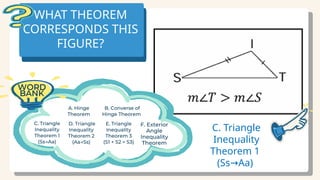
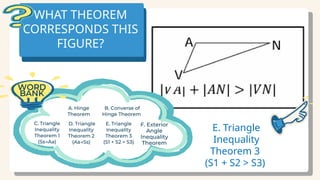
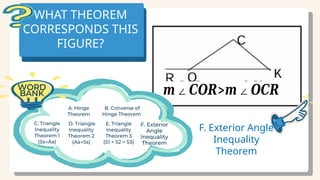
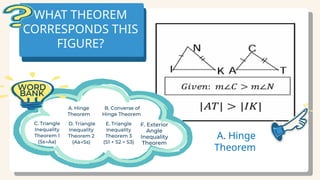
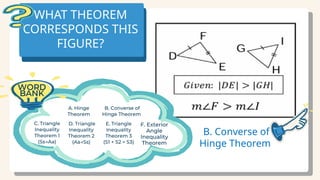
WHAT THEOREMS
CORRESPONDS EACH
FIGURE?
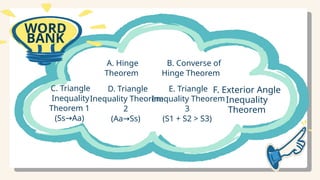
A.Hinge
Theorem
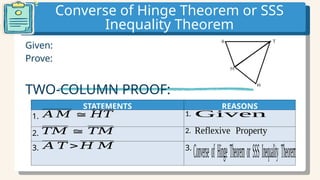
B. Converse of
Hinge Theorem
C. Triangle
Inequality
Theorem 1
(Ss Aa)
→
D. Triangle
Inequality Theorem
2
(Aa Ss)
→
E. Triangle
Inequality Theorem
3
(S1 + S2 > S3)
F. Exterior Angle
Inequality
Theorem
WORD
BANK
At the endof the lesson, learners are expected to:
LESSON OBJECTIVES
State the theorems on triangle inequality,
exterior angle inequality, Hinge and its
converse;
1
Prove statements involving triangle
inequalities using theorems on inequalities in
triangles, and
2
Make a design where triangle inequalities are
applied in real life situation.
3
13.
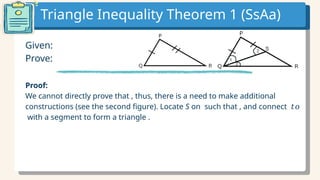
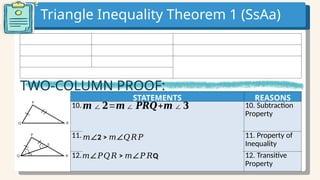
Triangle Inequality Theorem1 (SsAa)
Given:
Prove:
Proof:
We cannot directly prove that , thus, there is a need to make additional
constructions (see the second figure). Locate S on such that , and connect 𝑡𝑜
with a segment to form a triangle .
14.
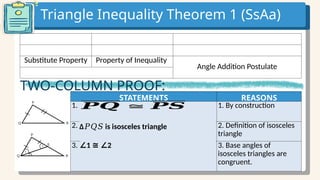
Triangle Inequality Theorem1 (SsAa)
STATEMENTS REASONS
1. _______________ (How do you describe
the relationship between and ?)
1. By construction
2. _______________ (Based on statement
1, what kind of a triangle is ∆ ?)
𝑃𝑄𝑆
2. Definition of isosceles
triangle
3. _____________ (Based on statement 1,
how do you describe the relationship
between 1 and 2?)
∠ ∠
3. Base angles of
isosceles triangles are
congruent.
𝑷𝑸 ≅ 𝑷𝑺
∆𝑃𝑄𝑆 is isosceles triangle
∠1 2
≅ ∠
Substitute Property Property of Inequality
Angle Addition Postulate
is isosceles triangle
TWO-COLUMN PROOF:
15.
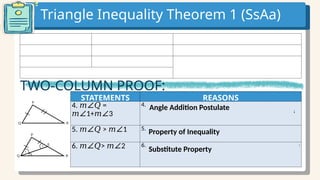
Triangle Inequality Theorem1 (SsAa)
STATEMENTS REASONS
4. =
𝑚∠𝑄
1+ 3
𝑚∠ 𝑚∠
4. ________________ (What postulate supports the
statement that the sum of the measures of 1 and 3 is
∠ ∠
equal to measure of ?)
∠𝑃𝑄𝑅
5. > 1
𝑚∠𝑄 𝑚∠ 5. _______________ (What property supports the inequality
statement focusing on 1 based on statement 4?)
∠
6. > 2
𝑚∠𝑄 𝑚∠ 6. _______________ (What property supports the step where
the right side of the inequality in statement 5 is replaced
with its equivalent in statement 3?)
Angle Addition Postulate
Property of Inequality
Substitute Property
Substitute Property Property of Inequality
Angle Addition Postulate
is isosceles triangle
TWO-COLUMN PROOF:
16.
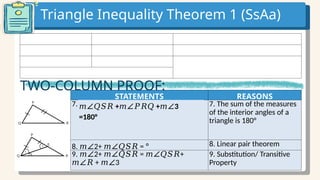
Triangle Inequality Theorem1 (SsAa)
STATEMENTS REASONS
7. _____________ (Based on the
illustration, write an operation
statement involving measures of
, , 3.
∠𝑄𝑆𝑅 ∠𝑅 𝑎𝑛𝑑∠
7. The sum of the measures
of the interior angles of a
triangle is 180°
8. 2+ =
𝑚∠ 𝑚∠𝑄𝑆𝑅 ° 8. Linear pair theorem
9. 2+ = +
𝑚∠ 𝑚∠𝑄𝑆𝑅 𝑚∠𝑄𝑆𝑅
+ 3
𝑚∠𝑅 𝑚∠
9. Substitution/ Transitive
Property
𝑚∠𝑄𝑆𝑅 + + 3
𝑚∠𝑃𝑅𝑄 𝑚∠
=180°
Substitute Property Property of Inequality
Angle Addition Postulate
is isosceles triangle
TWO-COLUMN PROOF:
17.
Triangle Inequality Theorem1 (SsAa)
STATEMENTS REASONS
10. _____________ (What will be the result if
is subtracted from both sides of
𝑚∠𝑄𝑆𝑅
statement 9?)
10. Subtraction
Property
11. _____________ (Based on statement number 10,
write an inequality statement focusing on .)
∠𝑅
11. Property of
Inequality
12. ____________ (Based on statements 6 and 11: If
m > 2 and 2 > , then __)
∠𝑃𝑄𝑅 𝑚∠ 𝑚∠ 𝑚∠𝑅
12. Transitive
Property
𝒎∠𝟐=𝒎∠ 𝑷𝑹𝑸+𝒎∠𝟑
𝑚∠2 > 𝑚∠𝑄𝑅𝑃
𝑚∠𝑃𝑄𝑅 > Q
𝑚∠𝑃𝑅
Substitute Property Property of Inequality
Angle Addition Postulate
is isosceles triangle
TWO-COLUMN PROOF:
18.
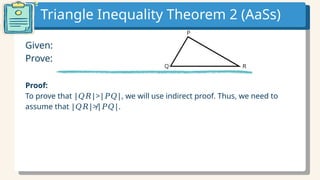
Triangle Inequality Theorem2 (AaSs)
Given:
Prove:
Proof:
To prove that | |>| |, we will use indirect proof. Thus, we need to
𝑄𝑅 𝑃𝑄
assume that | |≯| |.
𝑄𝑅 𝑃𝑄
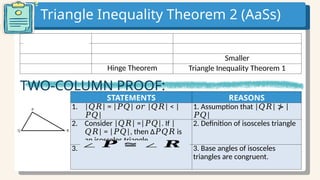
19.
STATEMENTS REASONS
1. || = | | | | < |
𝑄𝑅 𝑃𝑄 𝑜𝑟 𝑄𝑅
|
𝑃𝑄
1. Assumption that | | |
𝑄𝑅 ≯
|
𝑃𝑄
2. Consider | | =| |. If |
𝑄𝑅 𝑃𝑄
| = | |, then ∆ is
𝑄𝑅 𝑃𝑄 𝑃𝑄𝑅
an isosceles triangle.
2. Definition of isosceles triangle
3. _____________ (Consequently,
what can you say about and
∠𝑃
?)
∠𝑅
3. Base angles of isosceles
triangles are congruent.
∠ 𝑷 ≅∠ 𝑹
Smaller
Hinge Theorem Triangle Inequality Theorem 1
TWO-COLUMN PROOF:
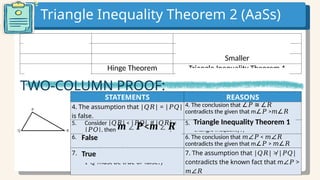
Triangle Inequality Theorem 2 (AaSs)
20.
STATEMENTS REASONS
4. Theassumption that | | = | |
𝑄𝑅 𝑃𝑄
is false.
4. The conclusion that ∠ ≅ ∠
𝑃 𝑅
contradicts the given that m >
∠ ∠
𝑃 𝑚 𝑅
5. Consider | | < | |. If | | <
𝑄𝑅 𝑃𝑄 𝑄𝑅
| |, then _________________.
𝑃𝑄
5. ______________ (By what theorem of
triangle inequality?)
6. _____________ (The assumption
that < is true or false?)
𝑄𝑅 𝑃𝑄
6. The conclusion that <
𝑚∠𝑃 𝑚∠𝑅
contradicts the given that m >
∠ ∠
𝑃 𝑚 𝑅
7. _____________ (Therefore, >
𝑄𝑅
must be true or false?)
𝑃𝑄
7. The assumption that | | ≯ | |
𝑄𝑅 𝑃𝑄
contradicts the known fact that m >
∠𝑃
𝑚∠𝑅
𝒎∠𝑷 <𝒎∠ 𝑹
Smaller
Hinge Theorem Triangle Inequality Theorem 1
TWO-COLUMN PROOF:
False
Triangle Inequality Theorem 1
True
Triangle Inequality Theorem 2 (AaSs)
21.
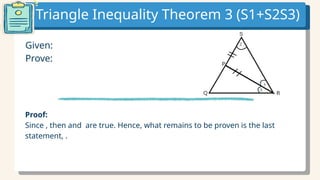
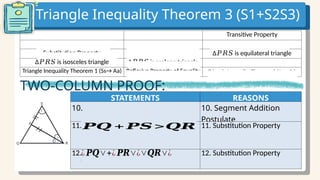
Triangle Inequality Theorem3 (S1+S2S3)
Given:
Prove:
Proof:
Since , then and are true. Hence, what remains to be proven is the last
statement, .
22.
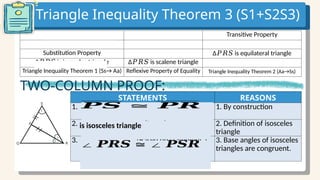
STATEMENTS REASONS
1. _______________(How do you describe
the relationship between and ?)
1. By construction
2. _______________ (Based on statement
1, what kind of a triangle is ∆ ?)
𝑃𝑄𝑆
2. Definition of isosceles
triangle
3. _____________ (Based on statement 1,
what is the relationship between
and ?)
∠𝑃𝑅𝑆 ∠𝑃𝑆𝑅
3. Base angles of isosceles
triangles are congruent.
∠ 𝑷𝑹𝑺 ≅∠ 𝑷𝑺𝑹
Transitive Property
Substitution Property ∆𝑃𝑅𝑆 is equilateral triangle
∆𝑃𝑅𝑆 is isosceles triangle ∆𝑃𝑅𝑆 is scalene triangle
Triangle Inequality Theorem 1 (Ss→ Aa) Reflexive Property of Equality Triangle Inequality Theorem 2 (Aa→Ss)
TWO-COLUMN PROOF:
is isosceles triangle
𝑷𝑺 ≅ 𝑷𝑹
Triangle Inequality Theorem 3 (S1+S2S3)
23.
∠ 𝑷𝑹𝑺 ≅∠𝑷𝑺𝑹
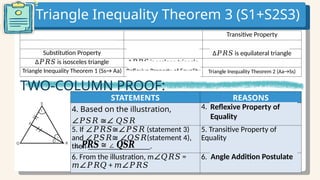
STATEMENTS REASONS
4. Based on the illustration,
∠𝑃𝑆𝑅 ≅∠ 𝑄𝑆𝑅
4. ______________ (By what
property of equality?)
5. If (statement 3)
∠𝑃𝑅𝑆≅∠𝑃𝑆𝑅
and (statement 4),
∠𝑃𝑆𝑅≅ ∠𝑄𝑆𝑅
then ________________.
5. Transitive Property of
Equality
6. From the illustration, m =
∠𝑄𝑅𝑆
+
𝑚∠𝑃𝑅𝑄 𝑚∠𝑃𝑅𝑆
6. _____________ (By what
postulate?)
Transitive Property
Substitution Property ∆𝑃𝑅𝑆 is equilateral triangle
∆𝑃𝑅𝑆 is isosceles triangle ∆𝑃𝑅𝑆 is scalene triangle
Triangle Inequality Theorem 1 (Ss→ Aa) Reflexive Property of Equality Triangle Inequality Theorem 2 (Aa→Ss)
TWO-COLUMN PROOF:
∠𝑷𝑹𝑺≅∠𝑸𝑺𝑹
Reflexive Property of
Equality
Angle Addition Postulate
Triangle Inequality Theorem 3 (S1+S2S3)
24.
∠ 𝑷𝑹𝑺 ≅∠𝑷𝑺𝑹
Transitive Property
Substitution Property ∆𝑃𝑅𝑆 is equilateral triangle
∆𝑃𝑅𝑆 is isosceles triangle ∆𝑃𝑅𝑆 is scalene triangle
Triangle Inequality Theorem 1 (Ss→ Aa) Reflexive Property of Equality Triangle Inequality Theorem 2 (Aa→Ss)
TWO-COLUMN PROOF:
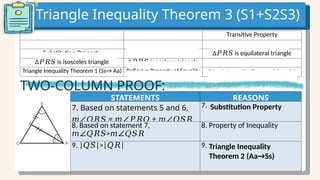
STATEMENTS REASONS
7. Based on statements 5 and 6,
= +
𝑚∠𝑄𝑅𝑆 𝑚∠𝑃𝑅𝑄 𝑚∠𝑄𝑆𝑅
7. _____________ (By what
property?)
8. Based on statement 7,
>
𝑚∠𝑄𝑅𝑆 𝑚∠𝑄𝑆𝑅
8. Property of Inequality
9. | |>| |
𝑄𝑆 𝑄𝑅 9. ______________ (By what
theorem of triangle
inequality?)
Substitution Property
Triangle Inequality
Theorem 2 (Aa→Ss)
Triangle Inequality Theorem 3 (S1+S2S3)
25.
Transitive Property
Substitution Property∆𝑃𝑅𝑆 is equilateral triangle
∆𝑃𝑅𝑆 is isosceles triangle ∆𝑃𝑅𝑆 is scalene triangle
Triangle Inequality Theorem 1 (Ss→ Aa) Reflexive Property of Equality Triangle Inequality Theorem 2 (Aa→Ss)
TWO-COLUMN PROOF:
STATEMENTS REASONS
10. 10. Segment Addition
Postulate
11._____________ (Write a statement
using statements 9 and 10.)
11. Substitution Property
12.____________ (Write a statement
using statements 1 and 11.)
12. Substitution Property
𝑷𝑸 + 𝑷𝑺 >𝑸𝑹
¿ 𝑷𝑸∨+¿ 𝑷𝑹∨¿∨𝑸𝑹∨¿
Triangle Inequality Theorem 3 (S1+S2S3)
26.
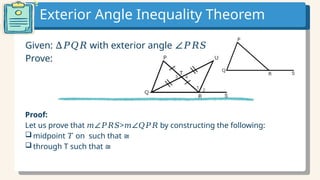
Exterior Angle InequalityTheorem
Given: with exterior angle
∆𝑃𝑄𝑅 ∠𝑃𝑅𝑆
Prove:
Proof:
Let us prove that > by constructing the following:
𝑚∠𝑃𝑅𝑆 𝑚∠𝑄𝑃𝑅
midpoint on such that
𝑇 ≅
through T such that ≅
27.
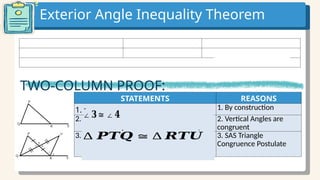
STATEMENTS REASONS
1. ;1. By construction
2. _____________ (What is the
relationship between 3 and 4?)
∠ ∠
2. Vertical Angles are
congruent
3. _____________ (Based on statements 1
and 2, relate two triangles in the
illustration)
3. SAS Triangle
Congruence Postulate
∆ 𝑷𝑻𝑸 ≅ ∆ 𝑹𝑻𝑼
TWO-COLUMN PROOF:
∠𝟑≅∠𝟒
Exterior Angle Inequality Theorem
28.
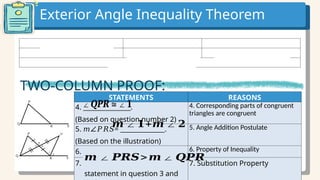
STATEMENTS REASONS
4. _______________.
(Basedon question number 2)
4. Corresponding parts of congruent
triangles are congruent
5. = ______________.
𝑚∠𝑃𝑅𝑆
(Based on the illustration)
5. Angle Addition Postulate
6. 6. Property of Inequality
7. ______________ (Using
statement in question 3 and
7. Substitution Property
𝒎 ∠ 𝑷𝑹𝑺>𝒎∠ 𝑸𝑷𝑹
TWO-COLUMN PROOF:
∠𝑸𝑷𝑹≅∠𝟏
𝒎 ∠𝟏+𝒎 ∠𝟐
Exterior Angle Inequality Theorem
29.
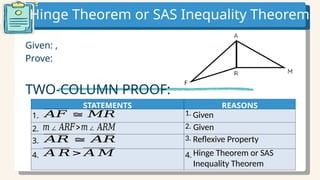
Hinge Theorem orSAS Inequality Theorem
Given: ,
Prove:
TWO-COLUMN PROOF:
STATEMENTS REASONS
1. 1.
2. 2.
3. 3.
4. 4.
𝐴𝐹 ≅ 𝑀𝑅
𝑚∠𝐴𝑅𝐹>𝑚∠ 𝐴𝑅𝑀
𝐴𝑅 ≅ 𝐴𝑅
𝐴 𝑅 > 𝐴 𝑀
Given
Given
Reflexive Property
Hinge Theorem or SAS
Inequality Theorem
NOW IT’S
YOUR TURN!
You’vejust learned how to find a
number’s factors. Time to keep
practicing with today’s assignment.
32.
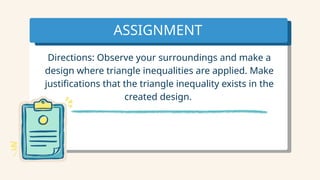
ASSIGNMENT
Directions: Observe yoursurroundings and make a
design where triangle inequalities are applied. Make
justifications that the triangle inequality exists in the
created design.