© 2017 Wolf, Greenfield & Sacks, P.C., CC-BY-SA
Protecting Freedom:
Patents & Open Source
Strategy
November 8, 2017
Justin C. Colannino jcolannino@wolfgreenfield.com
Ed Russavage erussavage@wolfgreenfield.com
© 2017 Wolf, Greenfield & Sacks, P.C., CC-BY-SA
Presenters
Justin Colannino
Associate,
Litigation; Electrical & Computer Technologies
jcolannino@wolfgreenfield.com
BA, Computer Science, McGill University
ScM, Computer Science, McGill University
JD, Columbia Law School
2
Ed Russavage
Shareholder,
Electrical & Computer Technologies
erussavage@wolfgreenfield.com
BS, Electrical Engineering, University of Pittsburgh
MS, Computer Science, Rensselaer Polytechnic Institute
MS, Electrical Engineering, Rensselaer Polytechnic Institute
JD, Suffolk University Law School
© 2017 Wolf, Greenfield & Sacks, P.C., CC-BY-SA
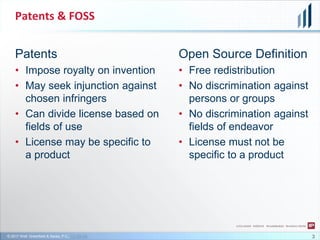
Patents & FOSS
Patents
• Impose royalty on invention
• May seek injunction against
chosen infringers
• Can divide license based on
fields of use
• License may be specific to
a product
3
Open Source Definition
• Free redistribution
• No discrimination against
persons or groups
• No discrimination against
fields of endeavor
• License must not be
specific to a product
© 2017 Wolf, Greenfield & Sacks, P.C., CC-BY-SA
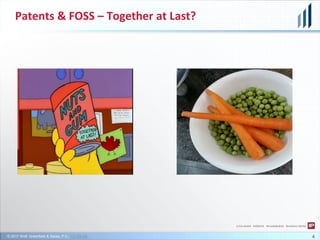
Patents & FOSS – Together at Last?
4
© 2017 Wolf, Greenfield & Sacks, P.C., CC-BY-SA
Agenda
• What is a patent? (Patents 101).
• Patents and FOSS contributions.
• Patent & FOSS Strategy.
5
© 2017 Wolf, Greenfield & Sacks, P.C., CC-BY-SA
What Is A Patent?
• Patents vs. Copyrights
• A copyright protects the expression of a particular piece
of code.
• A patent covers the way the code operates.
• A patent needs to be new and non-obvious.
6
© 2017 Wolf, Greenfield & Sacks, P.C., CC-BY-SA
What Is A Patent?
• A Patent Has Three Parts
• Specification – “a written description of the invention, in
such … terms as to enable any person skilled in the art
… to make and use the [invention]” 35 U.S.C. § 112(a).
• Figures – “The applicant shall furnish a drawing where
necessary for the understanding of the subject matter
sought to be patented.” 35 U.S.C. § 113.
• Claims – “The specification shall conclude with one or
more claims … distinctly claiming the subject matter
which the inventor … regards as the invention.” 35
U.S.C. § 112(b).
7
© 2017 Wolf, Greenfield & Sacks, P.C., CC-BY-SA
Independent & Dependent Claims
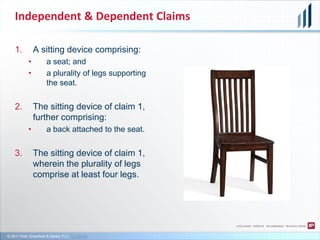
1. A sitting device comprising:
• a seat; and
• a plurality of legs supporting
the seat.
2. The sitting device of claim 1,
further comprising:
• a back attached to the seat.
3. The sitting device of claim 1,
wherein the plurality of legs
comprise at least four legs.
© 2017 Wolf, Greenfield & Sacks, P.C., CC-BY-SA
Dependent Claims – Avoiding Prior Art
1. A sitting device comprising:
• a seat; and
• a plurality of legs supporting
the seat.
2. The sitting device of claim 1,
further comprising:
• a back attached to the seat.
3. The sitting device of claim 1,
wherein the plurality of legs
comprise at least four legs.
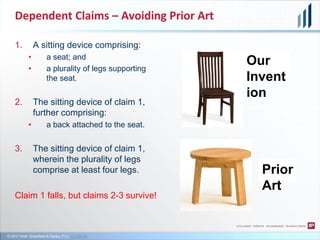
Claim 1 falls, but claims 2-3 survive!
Our
Invent
ion
Prior
Art
© 2017 Wolf, Greenfield & Sacks, P.C., CC-BY-SA
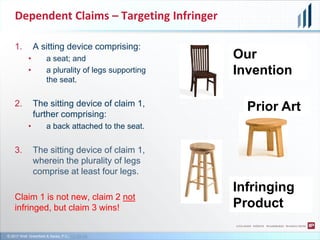
Dependent Claims – Targeting Infringer
1. A sitting device comprising:
• a seat; and
• a plurality of legs supporting
the seat.
2. The sitting device of claim 1,
further comprising:
• a back attached to the seat.
3. The sitting device of claim 1,
wherein the plurality of legs
comprise at least four legs.
Claim 1 is not new, claim 2 not
infringed, but claim 3 wins!
Our
Invention
Prior Art
Infringing
Product
© 2017 Wolf, Greenfield & Sacks, P.C., CC-BY-SA
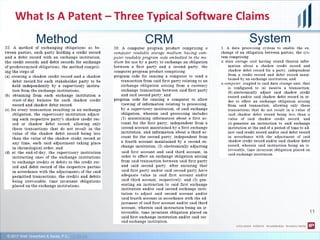
What Is A Patent – Three Typical Software Claims
11
Method CRM System
© 2017 Wolf, Greenfield & Sacks, P.C., CC-BY-SA
Patents & FOSS Contributions
• Patents Rights Licensed By FOSS Contributions?
• Depends on the mechanism for contributing.
• Given under a standard FOSS license – look to that license.
• CLA / other agreement?
• Important to consider, not discussed here.
• (Conservative) rule of thumb:
• Distributing code under FOSS license → patent license to that
code’s functionality, but only for license compliant activity
including that code.
12
© 2017 Wolf, Greenfield & Sacks, P.C., CC-BY-SA
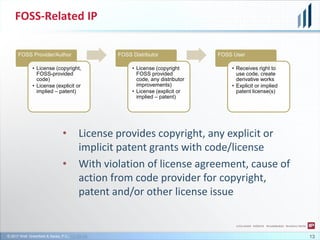
FOSS-Related IP
FOSS Provider/Author
• License (copyright,
FOSS-provided
code)
• License (explicit or
implied – patent)
FOSS Distributor
• License (copyright
FOSS provided
code, any distributor
improvements)
• License (explicit or
implied – patent)
FOSS User
• Receives right to
use code, create
derivative works
• Explicit or implied
patent license(s)
13
• License provides copyright, any explicit or
implicit patent grants with code/license
• With violation of license agreement, cause of
action from code provider for copyright,
patent and/or other license issue
© 2017 Wolf, Greenfield & Sacks, P.C., CC-BY-SA
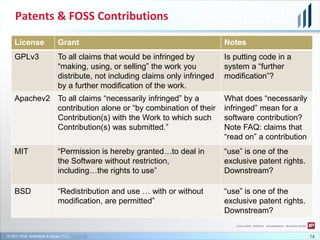
Patents & FOSS Contributions
License Grant Notes
GPLv3 To all claims that would be infringed by
“making, using, or selling” the work you
distribute, not including claims only infringed
by a further modification of the work.
Is putting code in a
system a “further
modification”?
Apachev2 To all claims “necessarily infringed” by a
contribution alone or “by combination of their
Contribution(s) with the Work to which such
Contribution(s) was submitted.”
What does “necessarily
infringed” mean for a
software contribution?
Note FAQ: claims that
“read on” a contribution
MIT “Permission is hereby granted…to deal in
the Software without restriction,
including…the rights to use”
“use” is one of the
exclusive patent rights.
Downstream?
BSD “Redistribution and use … with or without
modification, are permitted”
“use” is one of the
exclusive patent rights.
Downstream?
14
© 2017 Wolf, Greenfield & Sacks, P.C., CC-BY-SA
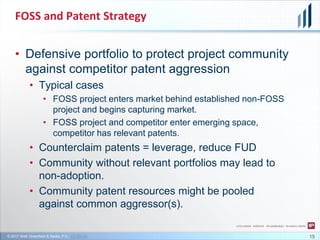
FOSS and Patent Strategy
15
• Defensive portfolio to protect project community
against competitor patent aggression
• Typical cases
• FOSS project enters market behind established non-FOSS
project and begins capturing market.
• FOSS project and competitor enter emerging space,
competitor has relevant patents.
• Counterclaim patents = leverage, reduce FUD
• Community without relevant portfolios may lead to
non-adoption.
• Community patent resources might be pooled
against common aggressor(s).
© 2017 Wolf, Greenfield & Sacks, P.C., CC-BY-SA
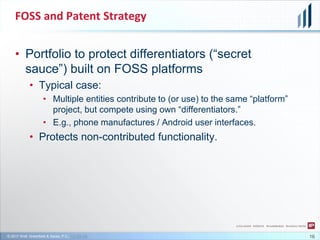
FOSS and Patent Strategy
16
• Portfolio to protect differentiators (“secret
sauce”) built on FOSS platforms
• Typical case:
• Multiple entities contribute to (or use) to the same “platform”
project, but compete using own “differentiators.”
• E.g., phone manufactures / Android user interfaces.
• Protects non-contributed functionality.
© 2017 Wolf, Greenfield & Sacks, P.C., CC-BY-SA
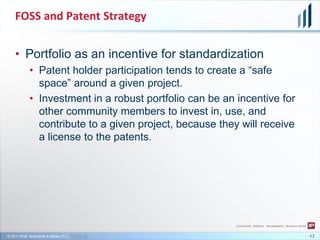
FOSS and Patent Strategy
17
• Portfolio as an incentive for standardization
• Patent holder participation tends to create a “safe
space” around a given project.
• Investment in a robust portfolio can be an incentive for
other community members to invest in, use, and
contribute to a given project, because they will receive
a license to the patents.
© 2017 Wolf, Greenfield & Sacks, P.C., CC-BY-SA
FOSS and Patent Strategy
18
• Licensing program for non-project use
• Patents last 20 years – hard to predict value.
• Change in circumstances, e.g., rise of a competing
product or project becoming defunct could lead to
heightened value for defensive or offensive purposes
at a later time.
• Patents have commercial value beyond the code.
© 2017 Wolf, Greenfield & Sacks, P.C., CC-BY-SA© 2017 Wolf, Greenfield & Sacks, P.C., CC-BY-SA 19

Protecting Freedom: Patents & Open Source Strategy

  • 1.
    © 2017 Wolf,Greenfield & Sacks, P.C., CC-BY-SA Protecting Freedom: Patents & Open Source Strategy November 8, 2017 Justin C. Colannino jcolannino@wolfgreenfield.com Ed Russavage erussavage@wolfgreenfield.com
  • 2.
    © 2017 Wolf,Greenfield & Sacks, P.C., CC-BY-SA Presenters Justin Colannino Associate, Litigation; Electrical & Computer Technologies jcolannino@wolfgreenfield.com BA, Computer Science, McGill University ScM, Computer Science, McGill University JD, Columbia Law School 2 Ed Russavage Shareholder, Electrical & Computer Technologies erussavage@wolfgreenfield.com BS, Electrical Engineering, University of Pittsburgh MS, Computer Science, Rensselaer Polytechnic Institute MS, Electrical Engineering, Rensselaer Polytechnic Institute JD, Suffolk University Law School
  • 3.
    © 2017 Wolf,Greenfield & Sacks, P.C., CC-BY-SA Patents & FOSS Patents • Impose royalty on invention • May seek injunction against chosen infringers • Can divide license based on fields of use • License may be specific to a product 3 Open Source Definition • Free redistribution • No discrimination against persons or groups • No discrimination against fields of endeavor • License must not be specific to a product
  • 4.
    © 2017 Wolf,Greenfield & Sacks, P.C., CC-BY-SA Patents & FOSS – Together at Last? 4
  • 5.
    © 2017 Wolf,Greenfield & Sacks, P.C., CC-BY-SA Agenda • What is a patent? (Patents 101). • Patents and FOSS contributions. • Patent & FOSS Strategy. 5
  • 6.
    © 2017 Wolf,Greenfield & Sacks, P.C., CC-BY-SA What Is A Patent? • Patents vs. Copyrights • A copyright protects the expression of a particular piece of code. • A patent covers the way the code operates. • A patent needs to be new and non-obvious. 6
  • 7.
    © 2017 Wolf,Greenfield & Sacks, P.C., CC-BY-SA What Is A Patent? • A Patent Has Three Parts • Specification – “a written description of the invention, in such … terms as to enable any person skilled in the art … to make and use the [invention]” 35 U.S.C. § 112(a). • Figures – “The applicant shall furnish a drawing where necessary for the understanding of the subject matter sought to be patented.” 35 U.S.C. § 113. • Claims – “The specification shall conclude with one or more claims … distinctly claiming the subject matter which the inventor … regards as the invention.” 35 U.S.C. § 112(b). 7
  • 8.
    © 2017 Wolf,Greenfield & Sacks, P.C., CC-BY-SA Independent & Dependent Claims 1. A sitting device comprising: • a seat; and • a plurality of legs supporting the seat. 2. The sitting device of claim 1, further comprising: • a back attached to the seat. 3. The sitting device of claim 1, wherein the plurality of legs comprise at least four legs.
  • 9.
    © 2017 Wolf,Greenfield & Sacks, P.C., CC-BY-SA Dependent Claims – Avoiding Prior Art 1. A sitting device comprising: • a seat; and • a plurality of legs supporting the seat. 2. The sitting device of claim 1, further comprising: • a back attached to the seat. 3. The sitting device of claim 1, wherein the plurality of legs comprise at least four legs. Claim 1 falls, but claims 2-3 survive! Our Invent ion Prior Art
  • 10.
    © 2017 Wolf,Greenfield & Sacks, P.C., CC-BY-SA Dependent Claims – Targeting Infringer 1. A sitting device comprising: • a seat; and • a plurality of legs supporting the seat. 2. The sitting device of claim 1, further comprising: • a back attached to the seat. 3. The sitting device of claim 1, wherein the plurality of legs comprise at least four legs. Claim 1 is not new, claim 2 not infringed, but claim 3 wins! Our Invention Prior Art Infringing Product
  • 11.
    © 2017 Wolf,Greenfield & Sacks, P.C., CC-BY-SA What Is A Patent – Three Typical Software Claims 11 Method CRM System
  • 12.
    © 2017 Wolf,Greenfield & Sacks, P.C., CC-BY-SA Patents & FOSS Contributions • Patents Rights Licensed By FOSS Contributions? • Depends on the mechanism for contributing. • Given under a standard FOSS license – look to that license. • CLA / other agreement? • Important to consider, not discussed here. • (Conservative) rule of thumb: • Distributing code under FOSS license → patent license to that code’s functionality, but only for license compliant activity including that code. 12
  • 13.
    © 2017 Wolf,Greenfield & Sacks, P.C., CC-BY-SA FOSS-Related IP FOSS Provider/Author • License (copyright, FOSS-provided code) • License (explicit or implied – patent) FOSS Distributor • License (copyright FOSS provided code, any distributor improvements) • License (explicit or implied – patent) FOSS User • Receives right to use code, create derivative works • Explicit or implied patent license(s) 13 • License provides copyright, any explicit or implicit patent grants with code/license • With violation of license agreement, cause of action from code provider for copyright, patent and/or other license issue
  • 14.
    © 2017 Wolf,Greenfield & Sacks, P.C., CC-BY-SA Patents & FOSS Contributions License Grant Notes GPLv3 To all claims that would be infringed by “making, using, or selling” the work you distribute, not including claims only infringed by a further modification of the work. Is putting code in a system a “further modification”? Apachev2 To all claims “necessarily infringed” by a contribution alone or “by combination of their Contribution(s) with the Work to which such Contribution(s) was submitted.” What does “necessarily infringed” mean for a software contribution? Note FAQ: claims that “read on” a contribution MIT “Permission is hereby granted…to deal in the Software without restriction, including…the rights to use” “use” is one of the exclusive patent rights. Downstream? BSD “Redistribution and use … with or without modification, are permitted” “use” is one of the exclusive patent rights. Downstream? 14
  • 15.
    © 2017 Wolf,Greenfield & Sacks, P.C., CC-BY-SA FOSS and Patent Strategy 15 • Defensive portfolio to protect project community against competitor patent aggression • Typical cases • FOSS project enters market behind established non-FOSS project and begins capturing market. • FOSS project and competitor enter emerging space, competitor has relevant patents. • Counterclaim patents = leverage, reduce FUD • Community without relevant portfolios may lead to non-adoption. • Community patent resources might be pooled against common aggressor(s).
  • 16.
    © 2017 Wolf,Greenfield & Sacks, P.C., CC-BY-SA FOSS and Patent Strategy 16 • Portfolio to protect differentiators (“secret sauce”) built on FOSS platforms • Typical case: • Multiple entities contribute to (or use) to the same “platform” project, but compete using own “differentiators.” • E.g., phone manufactures / Android user interfaces. • Protects non-contributed functionality.
  • 17.
    © 2017 Wolf,Greenfield & Sacks, P.C., CC-BY-SA FOSS and Patent Strategy 17 • Portfolio as an incentive for standardization • Patent holder participation tends to create a “safe space” around a given project. • Investment in a robust portfolio can be an incentive for other community members to invest in, use, and contribute to a given project, because they will receive a license to the patents.
  • 18.
    © 2017 Wolf,Greenfield & Sacks, P.C., CC-BY-SA FOSS and Patent Strategy 18 • Licensing program for non-project use • Patents last 20 years – hard to predict value. • Change in circumstances, e.g., rise of a competing product or project becoming defunct could lead to heightened value for defensive or offensive purposes at a later time. • Patents have commercial value beyond the code.
  • 19.
    © 2017 Wolf,Greenfield & Sacks, P.C., CC-BY-SA© 2017 Wolf, Greenfield & Sacks, P.C., CC-BY-SA 19