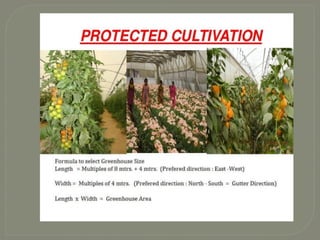
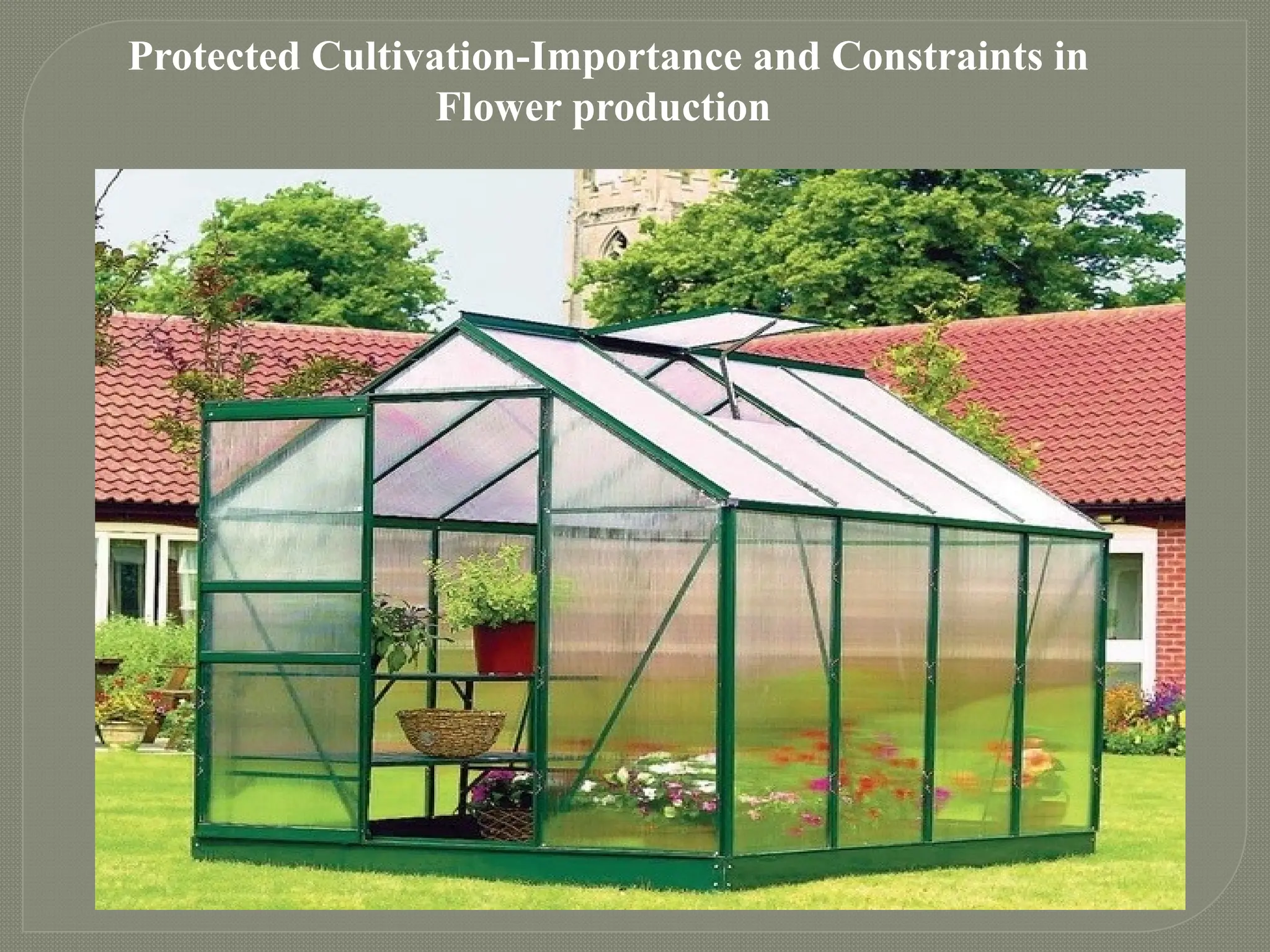
Protected Cultivation-Importance and Constraints in
Flower production
What is Greenhouse Technology?
 Greenhouse Technology is the science of providing favourable environment
conditions to the plants.
 It also protects the plants from the adverse climatic conditions such as wind
cold, precipitation, excessive radiation, extreme temperature, insects and
diseases.
An ideal micro climate can be created around the plants.
Greenhouses are framed or inflated structures covered with transparent or
translucent material large enough to grow crops under partial or full
controlled environmental conditions to get optimum growth and productivity.
Importance of Green house Technology
Green house crop production is at present
practiced in more than 50 countries.
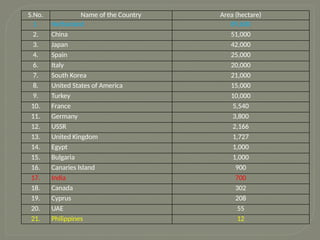
Area under green house for a few countries is
given in the following table.
S.No. Name of the Country Area (hectare)
1. Netharland 89,600
2. China 51,000
3. Japan 42,000
4. Spain 25,000
6. Italy 20,000
7. South Korea 21,000
8. United States of America 15,000
9. Turkey 10,000
10. France 5,540
11. Germany 3,800
12. USSR 2,166
13. United Kingdom 1,727
14. Egypt 1,000
15. Bulgaria 1,000
16. Canaries Island 900
17. India 700
18. Canada 302
19. Cyprus 208
20. UAE 55
21. Philippines 12
Flower Crops grown in Green houses:
Roses, Chrysanthemum, Gerbera, Anthurium, Carnation, Orchids,
Lilium, Lathyrus, Poinsettias, Spathyphyllium and Potted plants
Scope in India
The scope in Indian Agriculture is tremendous if properly organized.
Following are some promising field.
1.Cultivation in Problematic Agro-climate
There is about 75 m.ha of an area in India comprising of such
problematic conditions as of barren and uncultivable, waste land, fallow
land and desert. Even a fraction of this area, if brought under green house,
could produce substantial returns for the local inhabitants.
2.Greenhouse complexes around Big Cities
There is a large and substantiated demand of fresh vegetables, fruits and
Ornamental plants round the year in big cities. Demand for Off-season and high value
crops also exists in the big cities. Greenhouse cultivation could therefore, be promoted
to meet the city requirements adequately.
3.Export of Agricultural Produce
Agriculture in India is being looked upon increasingly to reduce the foreign
trade deficit. There is a good international market for horticultural produce. Promotion
of greenhouse cultivation of export-oriented crops near the convenient lifting points is a
definite step towards export promotion of Indian Agriculture.
4.Greenhouse for plant propagation
Raising of seedling and cutting is a specialized job requiring
control of growth environment. The existing nurseries with a greenhouse
facility could increase their capacity and the quantity of their plant material.
In temperate climatic conditions, plant propagation in greenhouses could
mean a considerable reduction in the total time for preparation of saplings.
5.Greenhouse technology as Base for other Biotechnologies
Environmental control in the form of greenhouses is desirable as
in case of Hydroponics or Nutrient Film Technique (NFT). It is essential in
case of tissue culture for raising crop productivities.
6.Greenhouses for cultivation of Rare and Medicinal plants
India has a variety of orchids/herbs, which have been identified for
large-scale cultivation. Greenhouse could provide the right type of
environmental conditions for the intensive cultivation of these plants.
Greenhouse cultivation leads to higher rural development and a
check on migration from rural to urban areas, higher income to small land
holdings and dignified self-employment opportunities for educated youths. In
the final analysis, greenhouse technology has all positive attributes for wide
spread application in the area mentioned above.
Classification of greenhouse based on suitability and cost
a) Low cost or low tech greenhouse
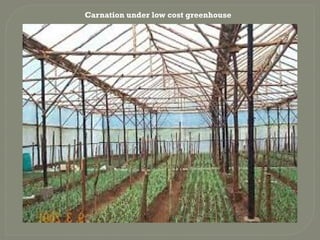
Low cost greenhouse is a simple structure constructed with locally available
materials such as bamboo, timber etc. The ultra violet (UV) film is used as
cladding materials. Unlike conventional or hi-tech greenhouses, no specific
control device for regulating environmental parameters inside the greenhouse
are provided. Simple techniques are, however, adopted for increasing or
decreasing the temperature and humidity. Even light intensity can be reduced by
incorporating shading materials like nets. The temperature can be reduced
during summer by opening the side walls. Such structure is used as rain shelter
for crop cultivation. Otherwise, inside temperature is increased when all
sidewalls are covered with plastic film. This type of greenhouse is mainly
suitable for cold climatic zone.
Carnation under low cost greenhouse
b) Medium-tech greenhouse
Greenhouse users prefers to have manually or semiautomatic control
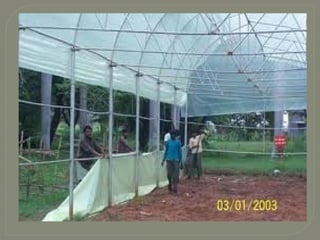
arrangement owing to minimum investment. This type of greenhouse is
constructed using galvanized iron (G.I) pipes. The canopy cover is attached
with structure with the help of screws. Whole structure is firmly fixed with the
ground to withstand the disturbance against wind. Exhaust fans with thermostat
are provided to control the temperature. Evaporative cooling pads and misting
arrangements are also made to maintain a favourable humidity inside the
greenhouse. As these system are semi-automatic, hence, require a lot of
attention and care, and it is very difficult and cumbersome to maintain uniform
environment throughout the cropping period. These greenhouses are suitable for
dry and composite climatic zones.
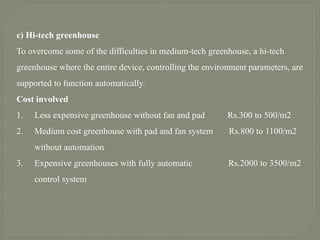
c) Hi-tech greenhouse
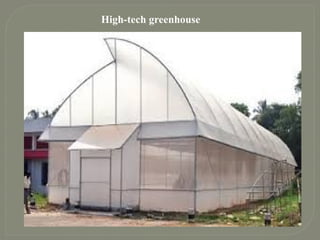
To overcome some of the difficulties in medium-tech greenhouse, a hi-tech
greenhouse where the entire device, controlling the environment parameters, are
supported to function automatically.
Cost involved
1. Less expensive greenhouse without fan and pad Rs.300 to 500/m2
2. Medium cost greenhouse with pad and fan system Rs.800 to 1100/m2
without automation
3. Expensive greenhouses with fully automatic Rs.2000 to 3500/m2
control system
High-tech greenhouse
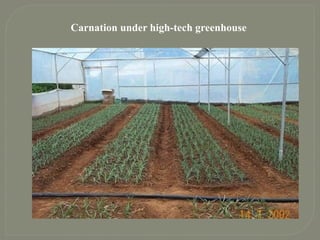
Carnation under high-tech greenhouse
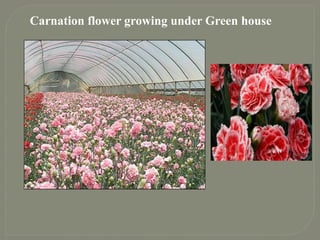
Carnation flower growing under Green house
Some advantages of greenhouses:
1. Its yield may be 15-17 times higher than that of outdoor cultivation
depending upon the type of greenhouse, type of crop, and its
environmental control facilities.
2. The reliability of crop increases under greenhouse cultivation.
3. Ideally suited for vegetables and flower crops.
4. Year round production of floricultural crops.
5. The off-season production of vegetable and fruit crops.
6. Disease-free and genetically superior transplants that can be produced
continuously.
7. Efficient utilization of chemicals, pesticides to control pest and diseases.
8. The water requirement of crops very limited and easy to control.
9. Maintenance of stock plants, cultivating grafted plant-lets and micro
hardening of tissue cultured plants
10. Production of quality produce free of blemishes.
Constraints in Cut Flower Production Development
Being a new concept, the requirements of scientific and commercial
floriculture is not properly understood in the country.
 The developmental initiatives of the government have to keep in mind the
low knowledge base, small land holdings, unorganized marketing and poor
infrastructural support.
While long experience of flower growing in the open field conditions enable
sufficient flower production for domestic markets, the quality of the
produce,
in view of its exposure to various kinds of biotic and abiotic stresses, is not
The production technology for flowers under protected environment of
green houses needs to be standardized. There is hardly any post harvest
management of flowers for the domestic market.
Availability of surplus flowers from exports for sale in the domestic
market, has increased the appreciation of quality produce and the demand
for good quality flowers is increasing.
With the introduction of new varieties of crops in the country, facilities for
generating their planting material for large scale production need
strengthening.
Special attention needs to be paid to strengthen the marketing
infrastructure
like organised marketing yards, auction platforms, controlled condition
storage chambers etc.
Greater research efforts are also needed for integrated pest management,
development of location specific package of practices for traditional
flowers, value addition to traditional flowers etc.
The initial cost and availability of finance is a critical matter in the
development of large commercial projects requiring heavy investments.
More options for developmental finance, such as the soft loan scheme of
the National Horticulture Board need to be identified.
In the initial years of commercial floriculture development, the
governmental support in terms of subsidies etc. needs special attention.
The potential for growth of export market is always linked to the
strength of domestic market - its capacity to absorb surplus and over
production, and quality consciousness of consumers. Though we have
a large domestic market, the marketing system and facilities need to
be modernized.
The production for exports at present has suffered due to a few
constraints. While our growers have been successful in producing
world class quality at low cost, high air freight rates, low cargo
capacity available, imposition of import duties, inadequate export
infrastructure etc. have reduced their competitiveness.
There is also a shortage of trained manpower to handle commercial
floriculture activity. The demands of the growing export oriented industry
would require adequate attention to be paid for human resource
development, particularly at the supervisory level.

L-3 - Protected cultivation.pptxvhhvvvvc

  • 1.
    Protected Cultivation-Importance andConstraints in Flower production
  • 3.
    What is GreenhouseTechnology?  Greenhouse Technology is the science of providing favourable environment conditions to the plants.  It also protects the plants from the adverse climatic conditions such as wind cold, precipitation, excessive radiation, extreme temperature, insects and diseases. An ideal micro climate can be created around the plants. Greenhouses are framed or inflated structures covered with transparent or translucent material large enough to grow crops under partial or full controlled environmental conditions to get optimum growth and productivity.
  • 4.
    Importance of Greenhouse Technology Green house crop production is at present practiced in more than 50 countries. Area under green house for a few countries is given in the following table.
  • 5.
    S.No. Name ofthe Country Area (hectare) 1. Netharland 89,600 2. China 51,000 3. Japan 42,000 4. Spain 25,000 6. Italy 20,000 7. South Korea 21,000 8. United States of America 15,000 9. Turkey 10,000 10. France 5,540 11. Germany 3,800 12. USSR 2,166 13. United Kingdom 1,727 14. Egypt 1,000 15. Bulgaria 1,000 16. Canaries Island 900 17. India 700 18. Canada 302 19. Cyprus 208 20. UAE 55 21. Philippines 12
  • 6.
    Flower Crops grownin Green houses: Roses, Chrysanthemum, Gerbera, Anthurium, Carnation, Orchids, Lilium, Lathyrus, Poinsettias, Spathyphyllium and Potted plants Scope in India The scope in Indian Agriculture is tremendous if properly organized. Following are some promising field. 1.Cultivation in Problematic Agro-climate There is about 75 m.ha of an area in India comprising of such problematic conditions as of barren and uncultivable, waste land, fallow land and desert. Even a fraction of this area, if brought under green house, could produce substantial returns for the local inhabitants.
  • 7.
    2.Greenhouse complexes aroundBig Cities There is a large and substantiated demand of fresh vegetables, fruits and Ornamental plants round the year in big cities. Demand for Off-season and high value crops also exists in the big cities. Greenhouse cultivation could therefore, be promoted to meet the city requirements adequately. 3.Export of Agricultural Produce Agriculture in India is being looked upon increasingly to reduce the foreign trade deficit. There is a good international market for horticultural produce. Promotion of greenhouse cultivation of export-oriented crops near the convenient lifting points is a definite step towards export promotion of Indian Agriculture.
  • 8.
    4.Greenhouse for plantpropagation Raising of seedling and cutting is a specialized job requiring control of growth environment. The existing nurseries with a greenhouse facility could increase their capacity and the quantity of their plant material. In temperate climatic conditions, plant propagation in greenhouses could mean a considerable reduction in the total time for preparation of saplings. 5.Greenhouse technology as Base for other Biotechnologies Environmental control in the form of greenhouses is desirable as in case of Hydroponics or Nutrient Film Technique (NFT). It is essential in case of tissue culture for raising crop productivities.
  • 9.
    6.Greenhouses for cultivationof Rare and Medicinal plants India has a variety of orchids/herbs, which have been identified for large-scale cultivation. Greenhouse could provide the right type of environmental conditions for the intensive cultivation of these plants. Greenhouse cultivation leads to higher rural development and a check on migration from rural to urban areas, higher income to small land holdings and dignified self-employment opportunities for educated youths. In the final analysis, greenhouse technology has all positive attributes for wide spread application in the area mentioned above.
  • 10.
    Classification of greenhousebased on suitability and cost a) Low cost or low tech greenhouse Low cost greenhouse is a simple structure constructed with locally available materials such as bamboo, timber etc. The ultra violet (UV) film is used as cladding materials. Unlike conventional or hi-tech greenhouses, no specific control device for regulating environmental parameters inside the greenhouse are provided. Simple techniques are, however, adopted for increasing or decreasing the temperature and humidity. Even light intensity can be reduced by incorporating shading materials like nets. The temperature can be reduced during summer by opening the side walls. Such structure is used as rain shelter for crop cultivation. Otherwise, inside temperature is increased when all sidewalls are covered with plastic film. This type of greenhouse is mainly suitable for cold climatic zone.
  • 11.
    Carnation under lowcost greenhouse
  • 12.
    b) Medium-tech greenhouse Greenhouseusers prefers to have manually or semiautomatic control arrangement owing to minimum investment. This type of greenhouse is constructed using galvanized iron (G.I) pipes. The canopy cover is attached with structure with the help of screws. Whole structure is firmly fixed with the ground to withstand the disturbance against wind. Exhaust fans with thermostat are provided to control the temperature. Evaporative cooling pads and misting arrangements are also made to maintain a favourable humidity inside the greenhouse. As these system are semi-automatic, hence, require a lot of attention and care, and it is very difficult and cumbersome to maintain uniform environment throughout the cropping period. These greenhouses are suitable for dry and composite climatic zones.
  • 14.
    c) Hi-tech greenhouse Toovercome some of the difficulties in medium-tech greenhouse, a hi-tech greenhouse where the entire device, controlling the environment parameters, are supported to function automatically. Cost involved 1. Less expensive greenhouse without fan and pad Rs.300 to 500/m2 2. Medium cost greenhouse with pad and fan system Rs.800 to 1100/m2 without automation 3. Expensive greenhouses with fully automatic Rs.2000 to 3500/m2 control system
  • 15.
  • 16.
  • 17.
    Carnation flower growingunder Green house
  • 18.
    Some advantages ofgreenhouses: 1. Its yield may be 15-17 times higher than that of outdoor cultivation depending upon the type of greenhouse, type of crop, and its environmental control facilities. 2. The reliability of crop increases under greenhouse cultivation. 3. Ideally suited for vegetables and flower crops. 4. Year round production of floricultural crops. 5. The off-season production of vegetable and fruit crops.
  • 19.
    6. Disease-free andgenetically superior transplants that can be produced continuously. 7. Efficient utilization of chemicals, pesticides to control pest and diseases. 8. The water requirement of crops very limited and easy to control. 9. Maintenance of stock plants, cultivating grafted plant-lets and micro hardening of tissue cultured plants 10. Production of quality produce free of blemishes.
  • 20.
    Constraints in CutFlower Production Development Being a new concept, the requirements of scientific and commercial floriculture is not properly understood in the country.  The developmental initiatives of the government have to keep in mind the low knowledge base, small land holdings, unorganized marketing and poor infrastructural support. While long experience of flower growing in the open field conditions enable sufficient flower production for domestic markets, the quality of the produce, in view of its exposure to various kinds of biotic and abiotic stresses, is not
  • 21.
    The production technologyfor flowers under protected environment of green houses needs to be standardized. There is hardly any post harvest management of flowers for the domestic market. Availability of surplus flowers from exports for sale in the domestic market, has increased the appreciation of quality produce and the demand for good quality flowers is increasing. With the introduction of new varieties of crops in the country, facilities for generating their planting material for large scale production need strengthening. Special attention needs to be paid to strengthen the marketing infrastructure like organised marketing yards, auction platforms, controlled condition storage chambers etc.
  • 22.
    Greater research effortsare also needed for integrated pest management, development of location specific package of practices for traditional flowers, value addition to traditional flowers etc. The initial cost and availability of finance is a critical matter in the development of large commercial projects requiring heavy investments. More options for developmental finance, such as the soft loan scheme of the National Horticulture Board need to be identified. In the initial years of commercial floriculture development, the governmental support in terms of subsidies etc. needs special attention.
  • 23.
    The potential forgrowth of export market is always linked to the strength of domestic market - its capacity to absorb surplus and over production, and quality consciousness of consumers. Though we have a large domestic market, the marketing system and facilities need to be modernized. The production for exports at present has suffered due to a few constraints. While our growers have been successful in producing world class quality at low cost, high air freight rates, low cargo capacity available, imposition of import duties, inadequate export infrastructure etc. have reduced their competitiveness.
  • 24.
    There is alsoa shortage of trained manpower to handle commercial floriculture activity. The demands of the growing export oriented industry would require adequate attention to be paid for human resource development, particularly at the supervisory level.