Propositional logic is the simplest form of logic that uses propositions that are either true or false. A proposition is a declarative statement. Propositional logic represents knowledge using symbolic variables and logical connectors. There are two types of propositions: atomic propositions which are single statements, and compound propositions which combine simpler propositions using logical connectors like AND and OR. Propositional logic is also known as Boolean logic as it uses 1s and 0s to represent true and false values.
Propositional logic
Prof. NeerajBhargava
Kapil Chauhan
Department of Computer Science
School of Engineering & Systems Sciences
MDS University, Ajmer
2.
Introduction
Propositional logic(PL) is the simplest form of logic
where all the statements are made by propositions.
A proposition is a declarative statement which is either
true or false.
It is a technique of knowledge representation in
logical and mathematical form.
3.
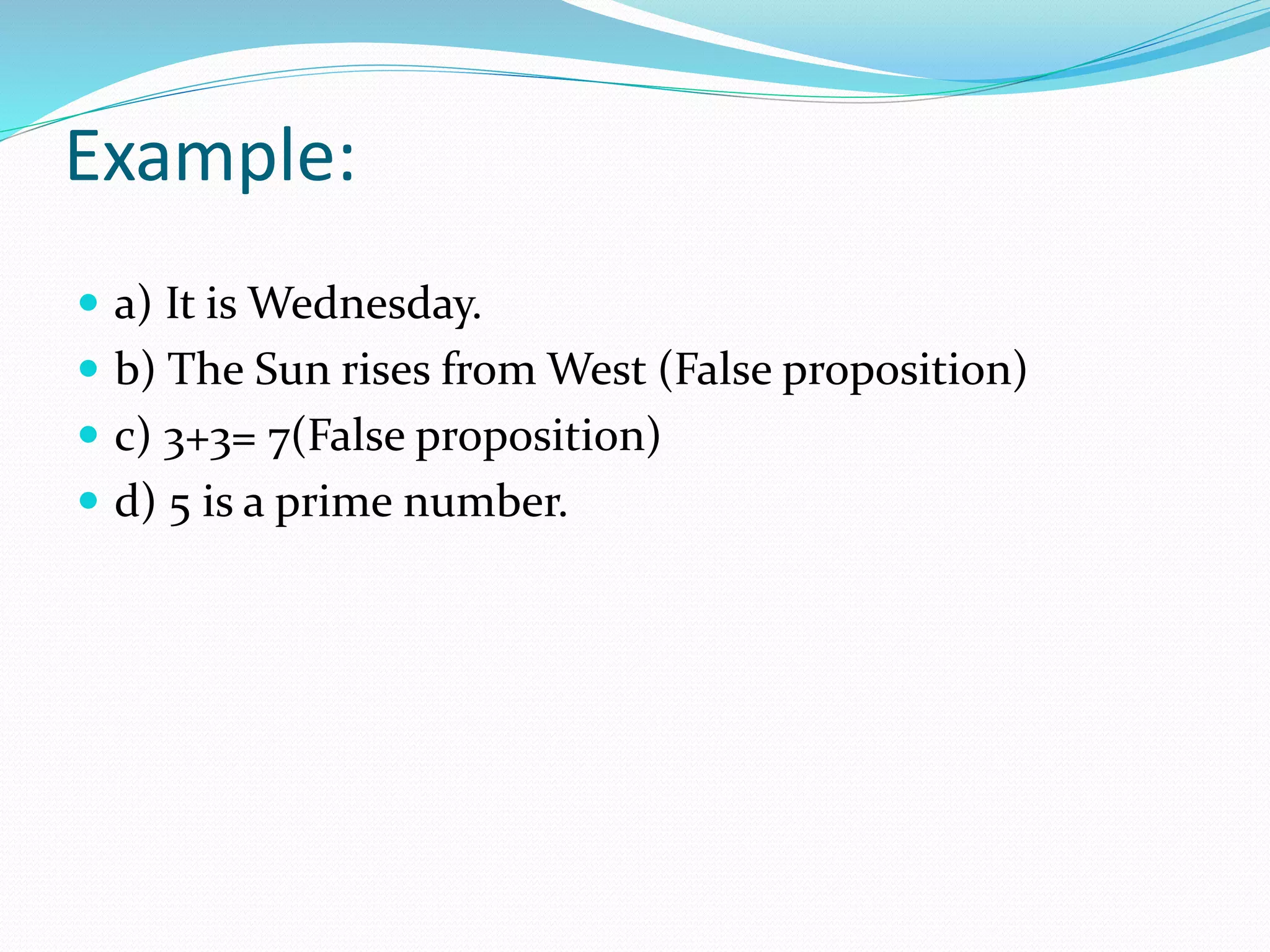
Example:
a) Itis Wednesday.
b) The Sun rises from West (False proposition)
c) 3+3= 7(False proposition)
d) 5 is a prime number.
4.
basic facts aboutpropositional
logic:
Propositional logic is also called Boolean logic as it
works on 0 and 1.
In propositional logic, we use symbolic variables to
represent the logic, and we can use any symbol for a
representing a proposition, such A, B, C, P, Q, R, etc.
Propositions can be either true or false, but it cannot
be both.
5.
Cont..
Propositional logicconsists of an object, relations or
function, and logical connectives.
These connectives are also called logical operators.
The propositions and connectives are the basic
elements of the propositional logic.
Connectives can be said as a logical operator which
connects two sentences.
6.
Syntax of propositionallogic:
The syntax of propositional logic defines the allowable
sentences for the knowledge representation. There are
two types of Propositions:
Atomic Propositions
Compound propositions
7.
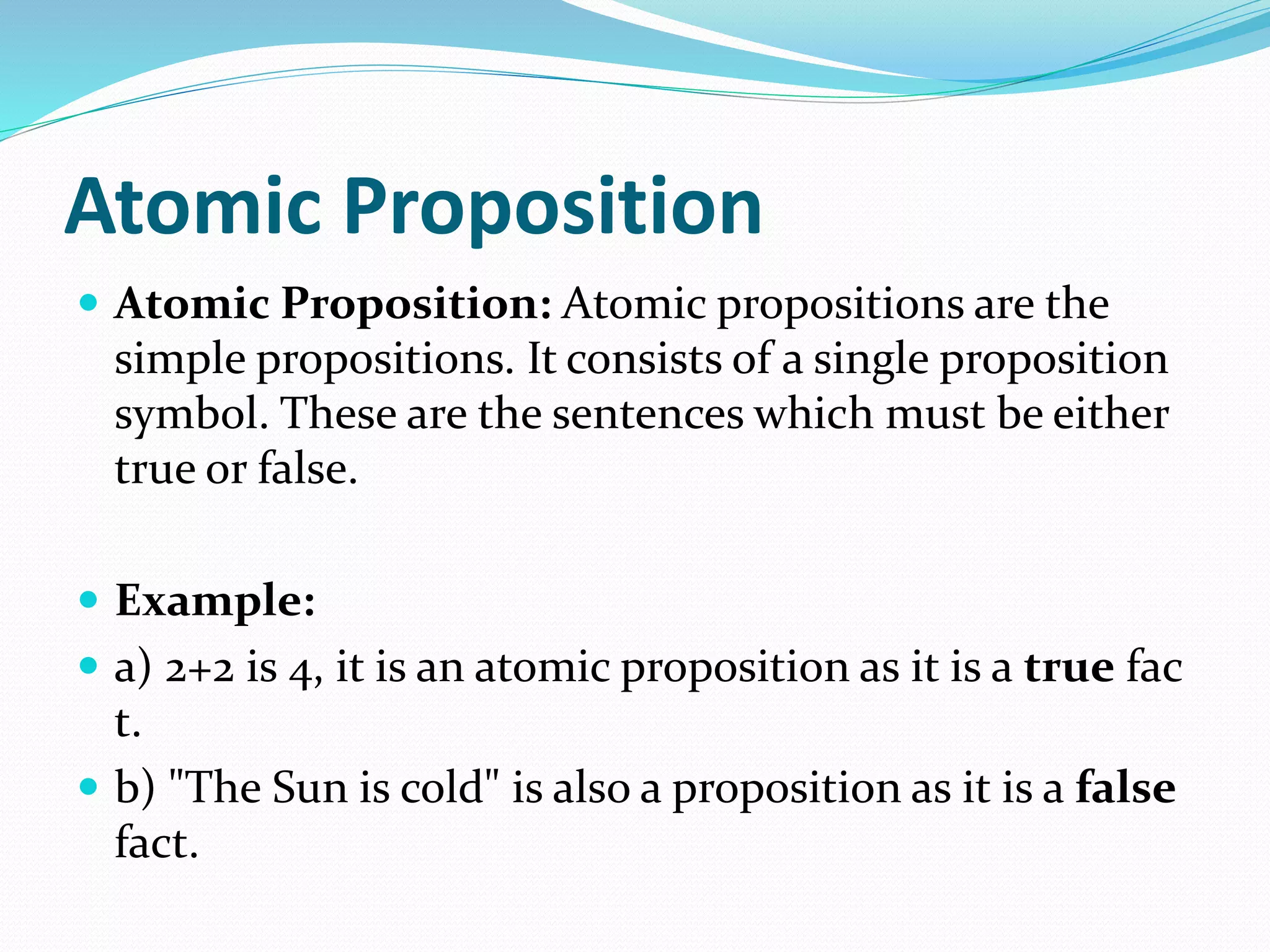
Atomic Proposition
AtomicProposition: Atomic propositions are the
simple propositions. It consists of a single proposition
symbol. These are the sentences which must be either
true or false.
Example:
a) 2+2 is 4, it is an atomic proposition as it is a true fac
t.
b) "The Sun is cold" is also a proposition as it is a false
fact.
8.
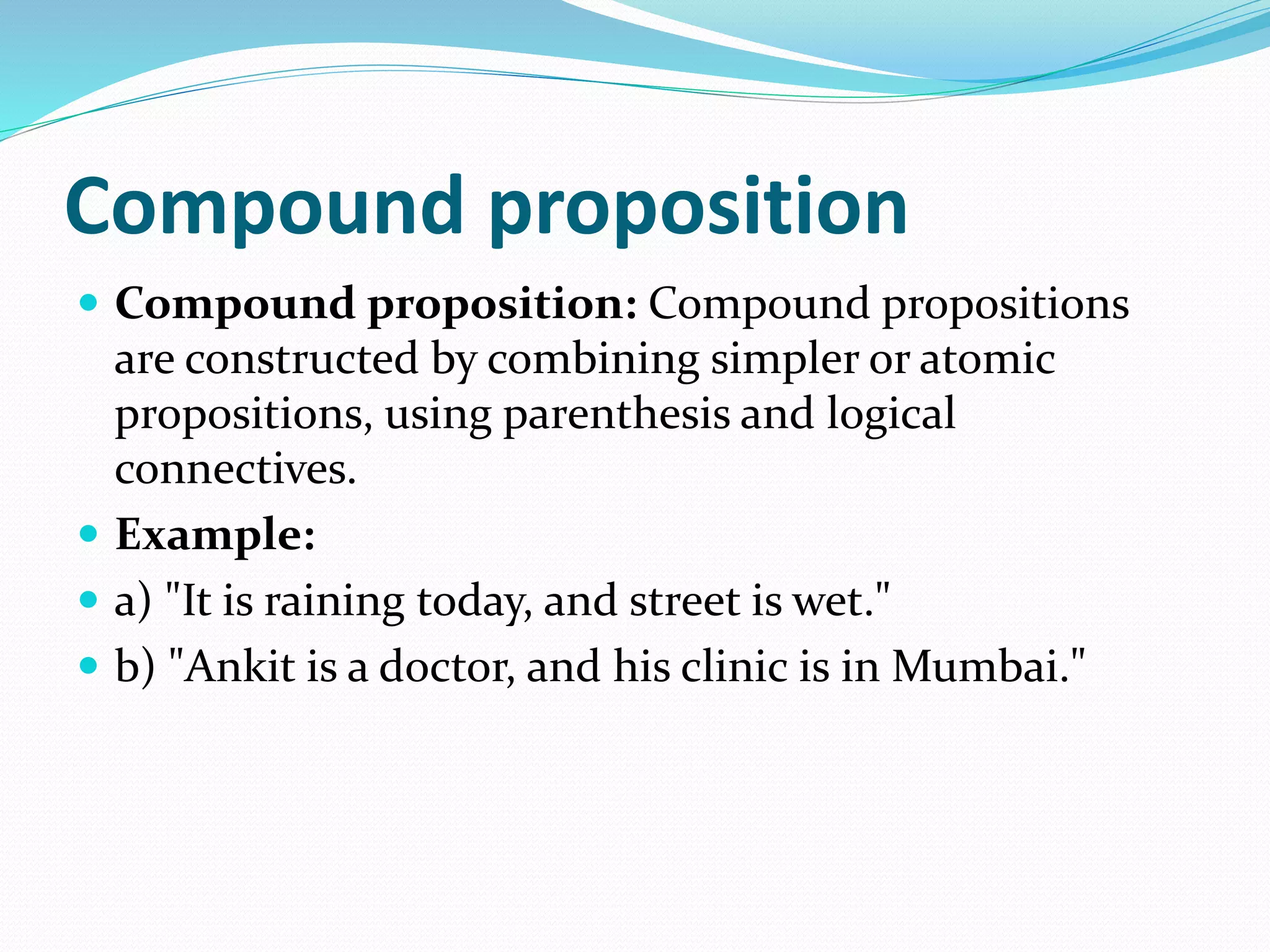
Compound proposition
Compoundproposition: Compound propositions
are constructed by combining simpler or atomic
propositions, using parenthesis and logical
connectives.
Example:
a) "It is raining today, and street is wet."
b) "Ankit is a doctor, and his clinic is in Mumbai."