Introduction to Generative
Adversarial Networks (GANs)
Prof. Neeraj Bhargava
Kapil Chauhan
Department of Computer Science
School of Engineering & Systems Sciences
MDS University, Ajmer
Introduction
 Generative Adversarial Networks, or GANs for short,
are an approach to generative modeling using deep
learning methods, such as convolutional neural
networks.
 Generative modeling is an unsupervised learning task
in machine learning that involves automatically
discovering and learning the regularities or patterns in
input data in such a way that the model can be used to
generate or output new examples.
Cont..
 GANs are a clever way of training a generative model
by framing the problem as a supervised learning
problem with two sub-models:
 The generator model that we train to generate new
examples, and the discriminator model that tries to
classify examples as either real (from the domain) or
fake (generated).
Supervised Learning
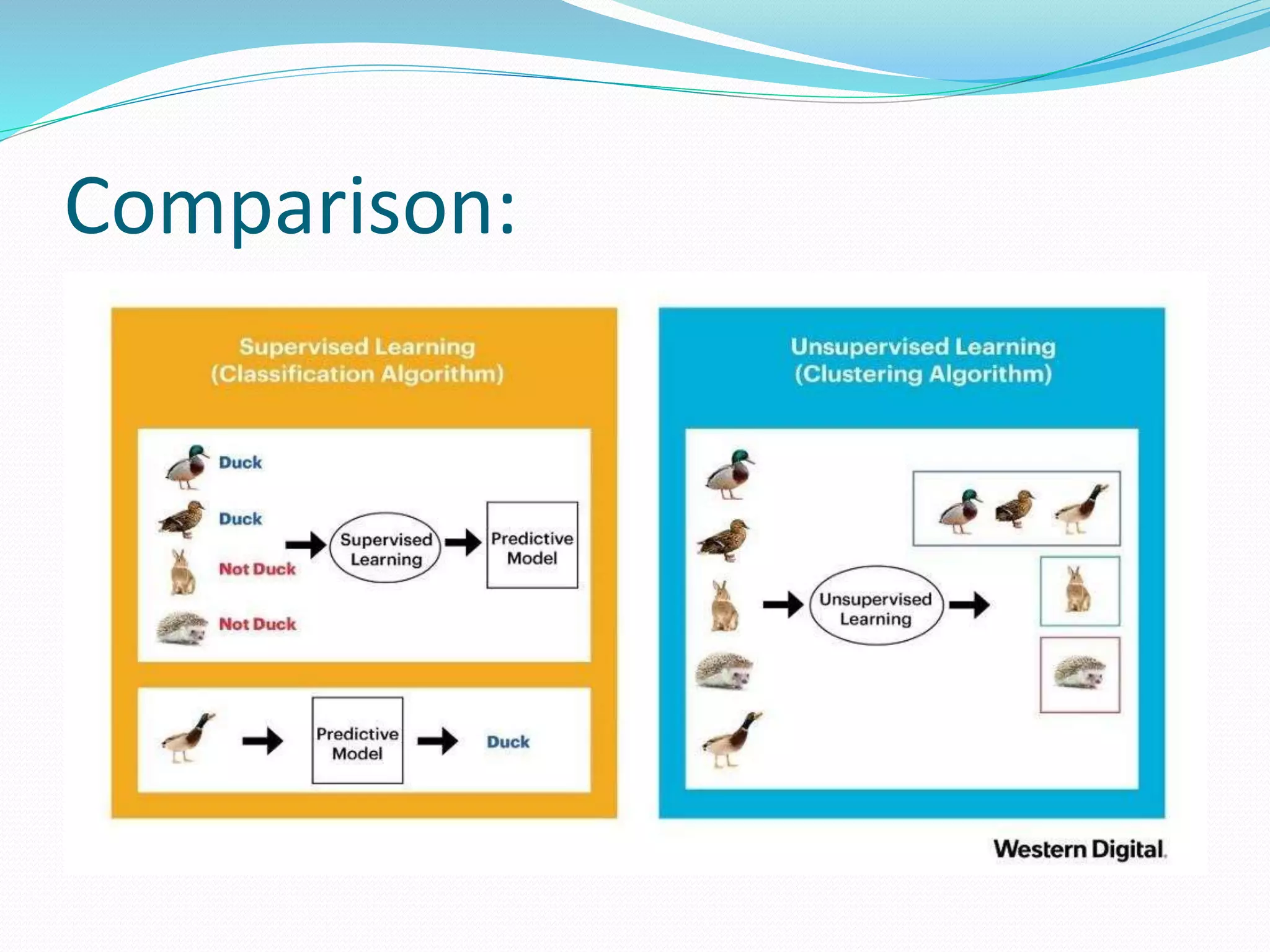
 In Supervised Learning, we train the machine using
data that is well “labeled”.
 It means the data is already tagged with the correct
answer. A supervised learning algorithm learns from
labeled training data and predicts outcomes for
unforeseen data.
Cont..
 There are two subcategories of supervised learning,
viz- Regression and Classification.
Classification means to group the output into a class.
 On the other hand, Regression Algorithms are used to
predict continuous values such as price, salary, and
age.
Unsupervised Learning
 In Unsupervised Learning is a machine learning
technique, where the model does not need any
supervision.
 Instead, we need to allow the model to work on its own
to discover information. It mainly deals with the
unlabelled data.
Cont..
 Density estimation, dimensionality reduction, and
clustering and some of the main applications of
unsupervised learning.
Comparison:
Assignment
 Explain Generative Adversarial Networks in deep
learning with example.

Introduction to generative adversarial networks (GANs)

  • 1.
    Introduction to Generative AdversarialNetworks (GANs) Prof. Neeraj Bhargava Kapil Chauhan Department of Computer Science School of Engineering & Systems Sciences MDS University, Ajmer
  • 2.
    Introduction  Generative AdversarialNetworks, or GANs for short, are an approach to generative modeling using deep learning methods, such as convolutional neural networks.  Generative modeling is an unsupervised learning task in machine learning that involves automatically discovering and learning the regularities or patterns in input data in such a way that the model can be used to generate or output new examples.
  • 3.
    Cont..  GANs area clever way of training a generative model by framing the problem as a supervised learning problem with two sub-models:  The generator model that we train to generate new examples, and the discriminator model that tries to classify examples as either real (from the domain) or fake (generated).
  • 4.
    Supervised Learning  InSupervised Learning, we train the machine using data that is well “labeled”.  It means the data is already tagged with the correct answer. A supervised learning algorithm learns from labeled training data and predicts outcomes for unforeseen data.
  • 5.
    Cont..  There aretwo subcategories of supervised learning, viz- Regression and Classification. Classification means to group the output into a class.  On the other hand, Regression Algorithms are used to predict continuous values such as price, salary, and age.
  • 6.
    Unsupervised Learning  InUnsupervised Learning is a machine learning technique, where the model does not need any supervision.  Instead, we need to allow the model to work on its own to discover information. It mainly deals with the unlabelled data.
  • 7.
    Cont..  Density estimation,dimensionality reduction, and clustering and some of the main applications of unsupervised learning.
  • 8.
  • 9.
    Assignment  Explain GenerativeAdversarial Networks in deep learning with example.