Constructors in Java are special methods that are used to initialize objects. There are two types of constructors: default (no-arg) constructors that take no parameters, and parameterized constructors that allow passing parameters to initialize an object. Constructors must have the same name as the class and cannot have a return type. They are automatically called when an object is created using the new keyword to allocate memory and initialize fields.
Constructors in Java
Prof.Neeraj Bhargava
Kapil Chauhan
Department of Computer Science
School of Engineering & Systems Sciences
MDS University, Ajmer
2.
Inroduction
It callsa default constructor if there is no constructor
available in the class. In such case, Java compiler
provides a default constructor by default.
There are two types of constructors in Java: no-arg
constructor, and parameterized constructor.
3.
Rules for creatingJava constructor
There are two rules defined for the constructor.
Constructor name must be the same as its class name
A Constructor must have no explicit return type
A Java constructor cannot be abstract, static, final, and
synchronized
4.
Cont..
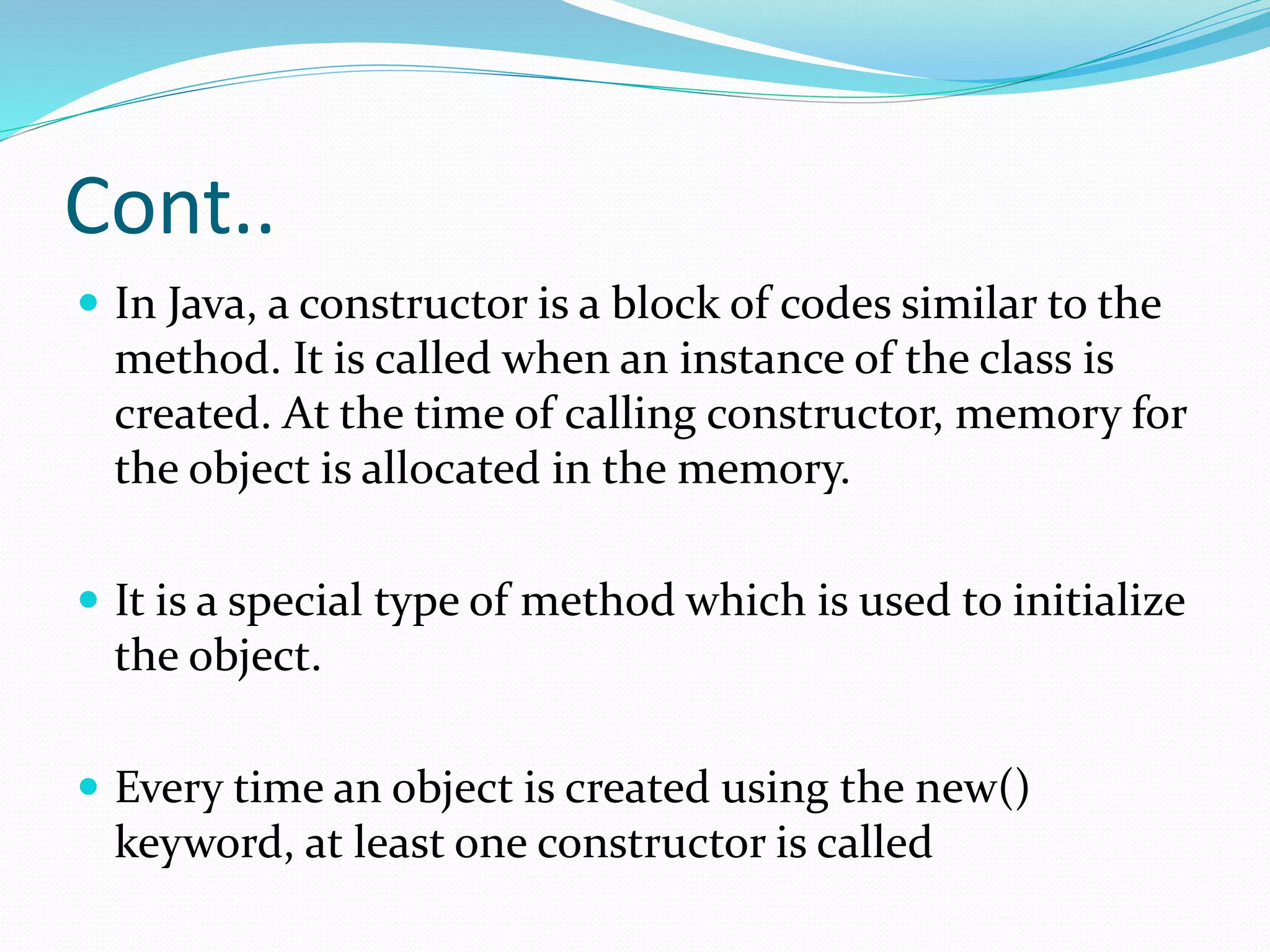
In Java,a constructor is a block of codes similar to the
method. It is called when an instance of the class is
created. At the time of calling constructor, memory for
the object is allocated in the memory.
It is a special type of method which is used to initialize
the object.
Every time an object is created using the new()
keyword, at least one constructor is called
5.
Types of Javaconstructors
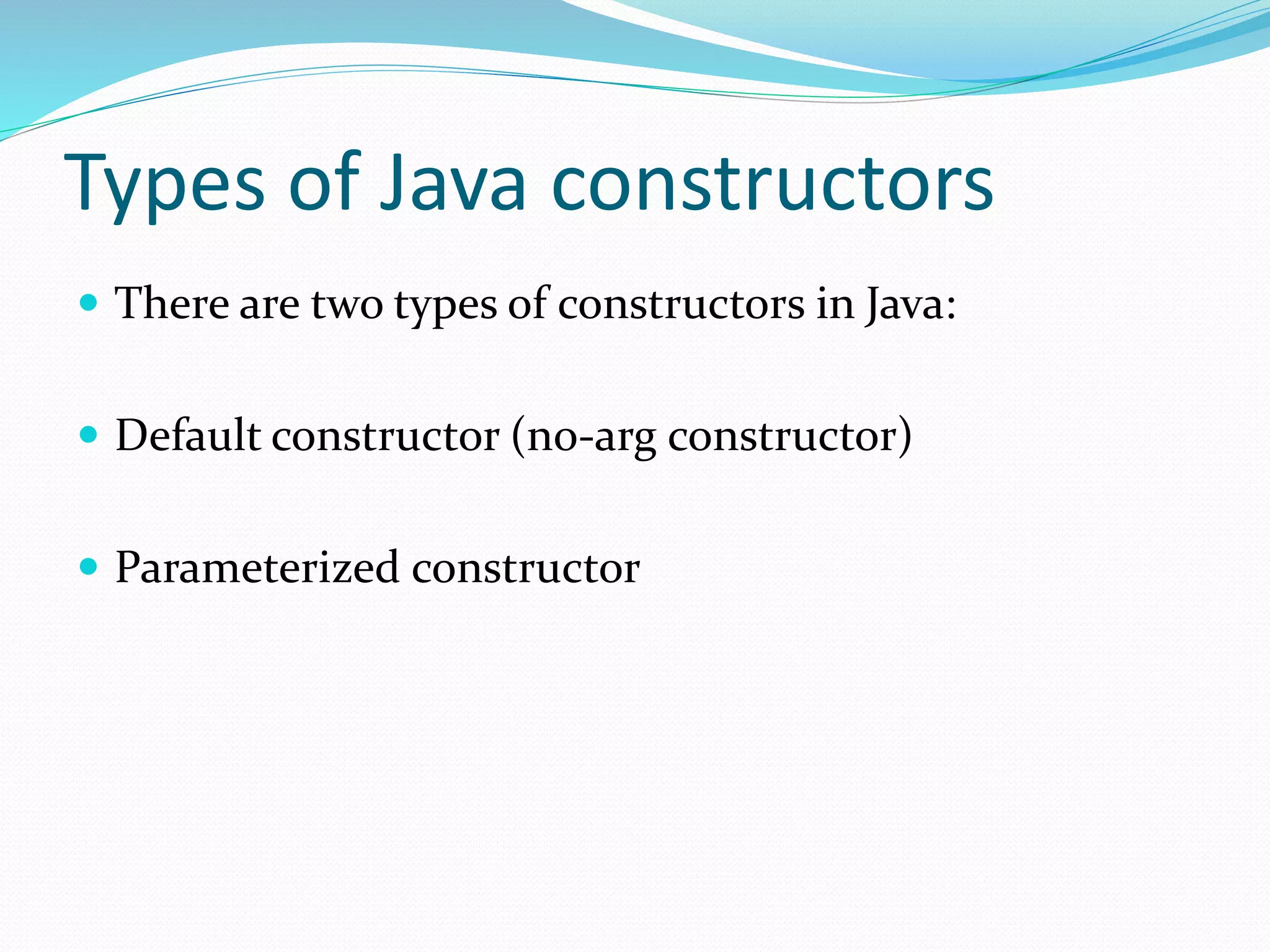
There are two types of constructors in Java:
Default constructor (no-arg constructor)
Parameterized constructor
6.
Java Default Constructor
A constructor is called "Default Constructor" when it
doesn't have any parameter.
class Bike1{
//creating a default constructor
Bike1(){System.out.println("Bike is created");}
//main method
public static void main(String args[]){
//calling a default constructor
Bike1 b=new Bike1();
}
}
7.
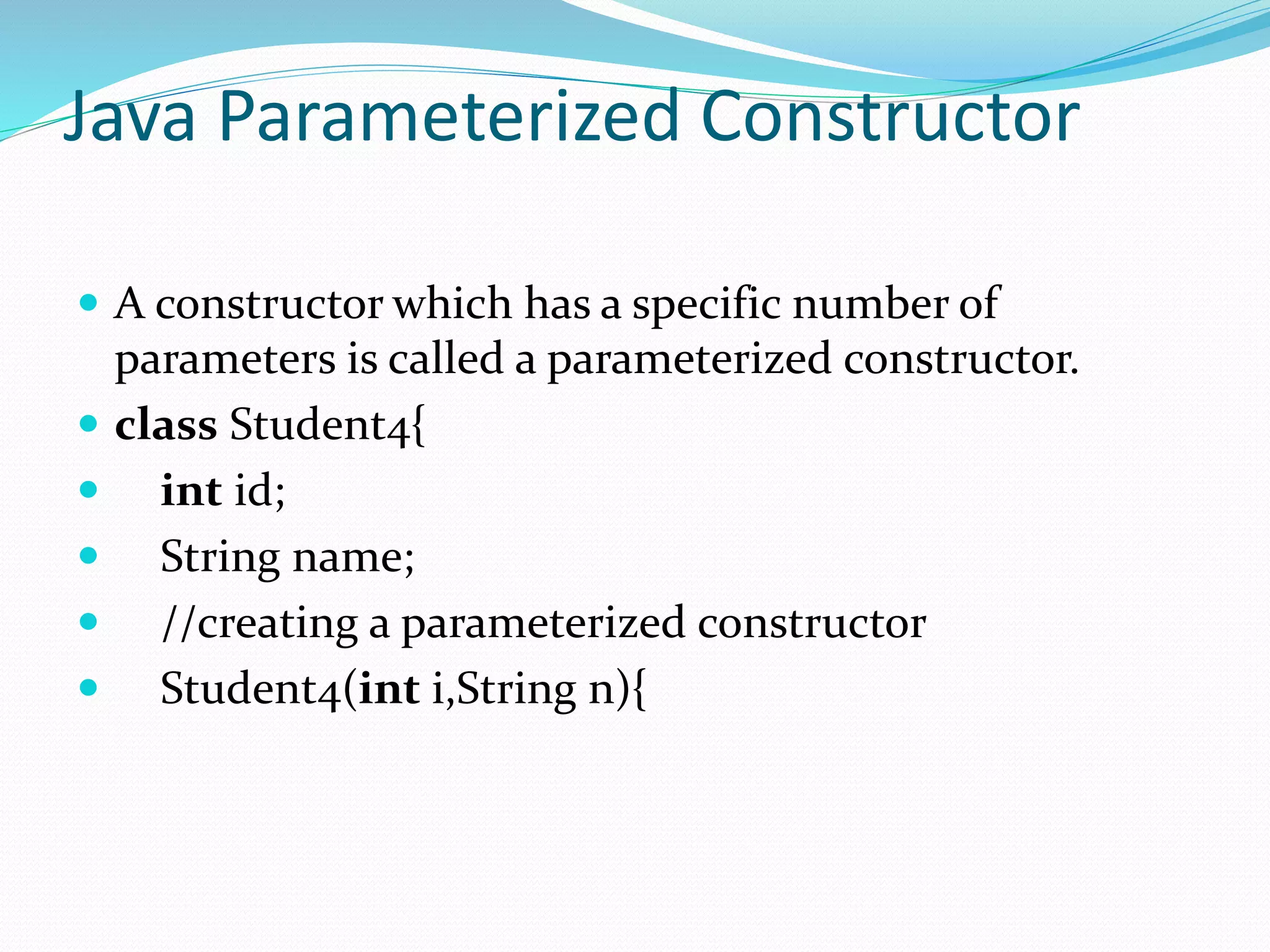
Java Parameterized Constructor
A constructor which has a specific number of
parameters is called a parameterized constructor.
class Student4{
int id;
String name;
//creating a parameterized constructor
Student4(int i,String n){
8.
Cont..
id =i;
name = n;
}
//method to display the values
void display(){System.out.println(id+" "+name);}
public static void main(String args[]){
//creating objects and passing values
Student4 s1 = new Student4(111,"Karan");
Student4 s2 = new Student4(222,"Aryan");
//calling method to display the values of object
s1.display();
s2.display();
}
}
![Java Default Constructor
A constructor is called "Default Constructor" when it
doesn't have any parameter.
class Bike1{
//creating a default constructor
Bike1(){System.out.println("Bike is created");}
//main method
public static void main(String args[]){
//calling a default constructor
Bike1 b=new Bike1();
}
}](https://image.slidesharecdn.com/constructorsinjava-200923055154/75/Constructors-in-java-6-2048.jpg)
![Cont..
id = i;
name = n;
}
//method to display the values
void display(){System.out.println(id+" "+name);}
public static void main(String args[]){
//creating objects and passing values
Student4 s1 = new Student4(111,"Karan");
Student4 s2 = new Student4(222,"Aryan");
//calling method to display the values of object
s1.display();
s2.display();
}
}](https://image.slidesharecdn.com/constructorsinjava-200923055154/75/Constructors-in-java-8-2048.jpg)