Introduction of Predicate Logics
Prof. Neeraj Bhargava
Kapil Chauhan
Department of Computer Science
School of Engineering & Systems Sciences
MDS University, Ajmer
Predicate Symbols and Signatures
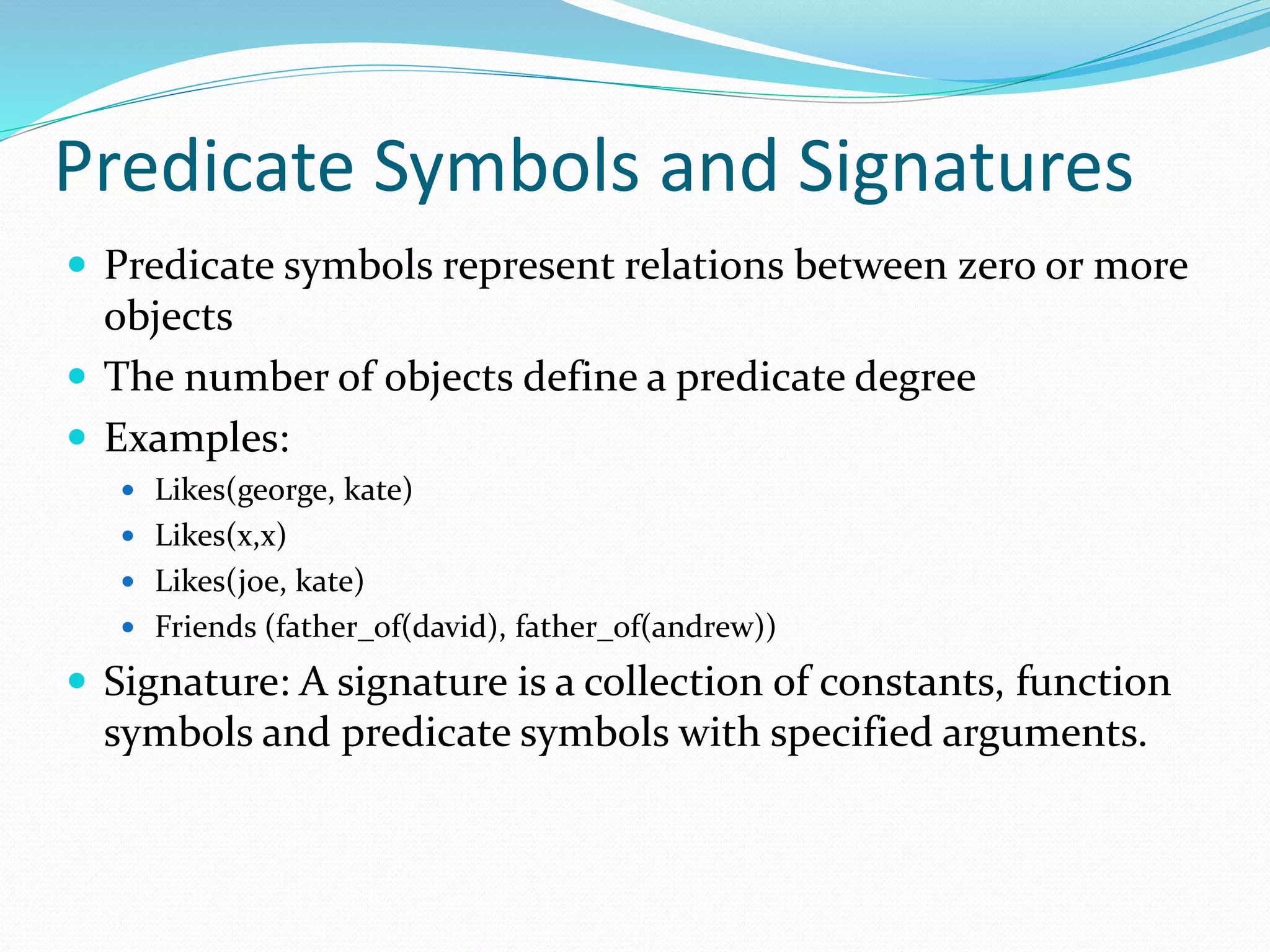
 Predicate symbols represent relations between zero or more
objects
 The number of objects define a predicate degree
 Examples:
 Likes(george, kate)
 Likes(x,x)
 Likes(joe, kate)
 Friends (father_of(david), father_of(andrew))
 Signature: A signature is a collection of constants, function
symbols and predicate symbols with specified arguments.
Connectives
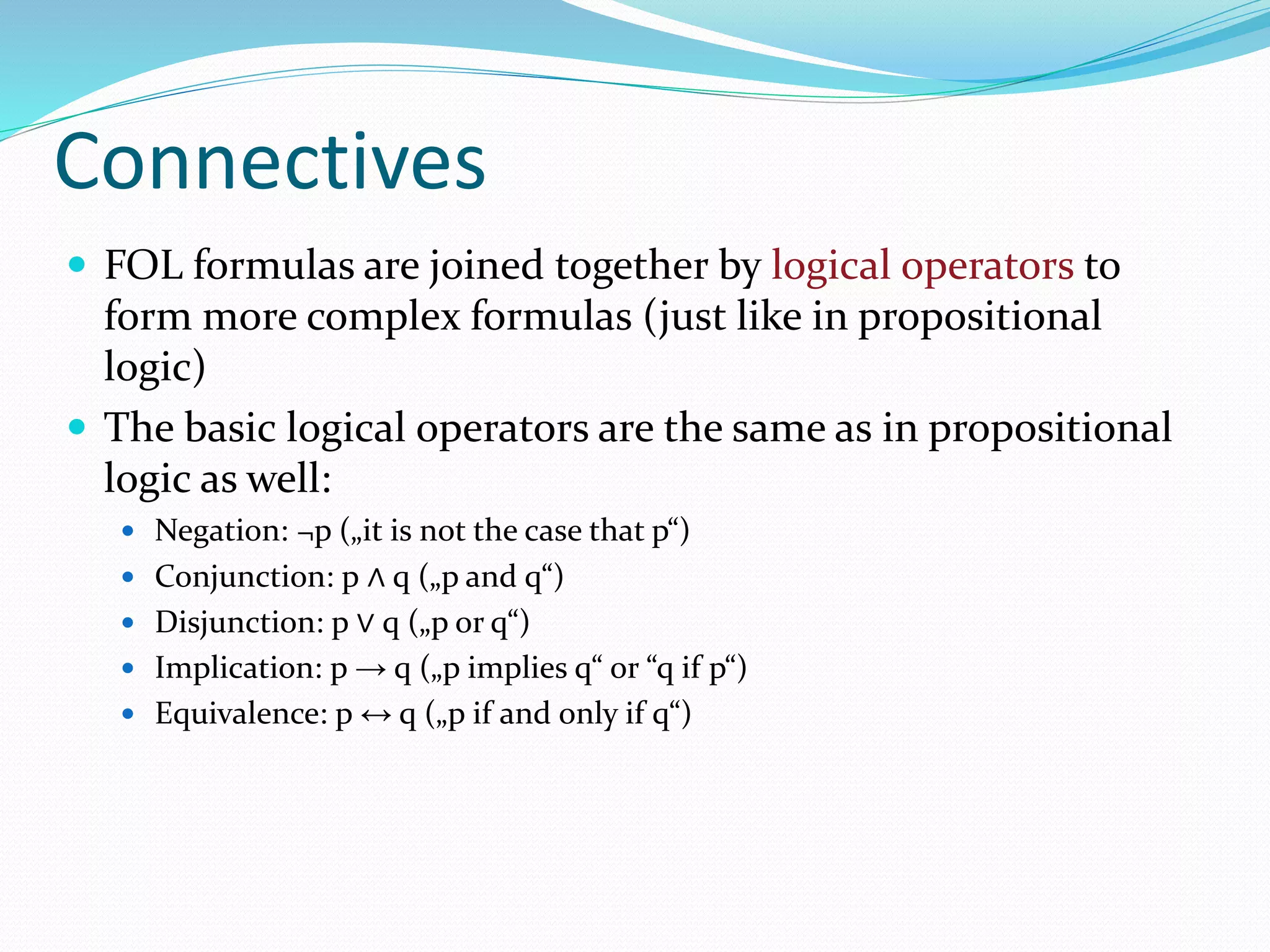
 FOL formulas are joined together by logical operators to
form more complex formulas (just like in propositional
logic)
 The basic logical operators are the same as in propositional
logic as well:
 Negation: ¬p („it is not the case that p“)
 Conjunction: p ∧ q („p and q“)
 Disjunction: p ∨ q („p or q“)
 Implication: p → q („p implies q“ or “q if p“)
 Equivalence: p ↔ q („p if and only if q“)
Quantifiers
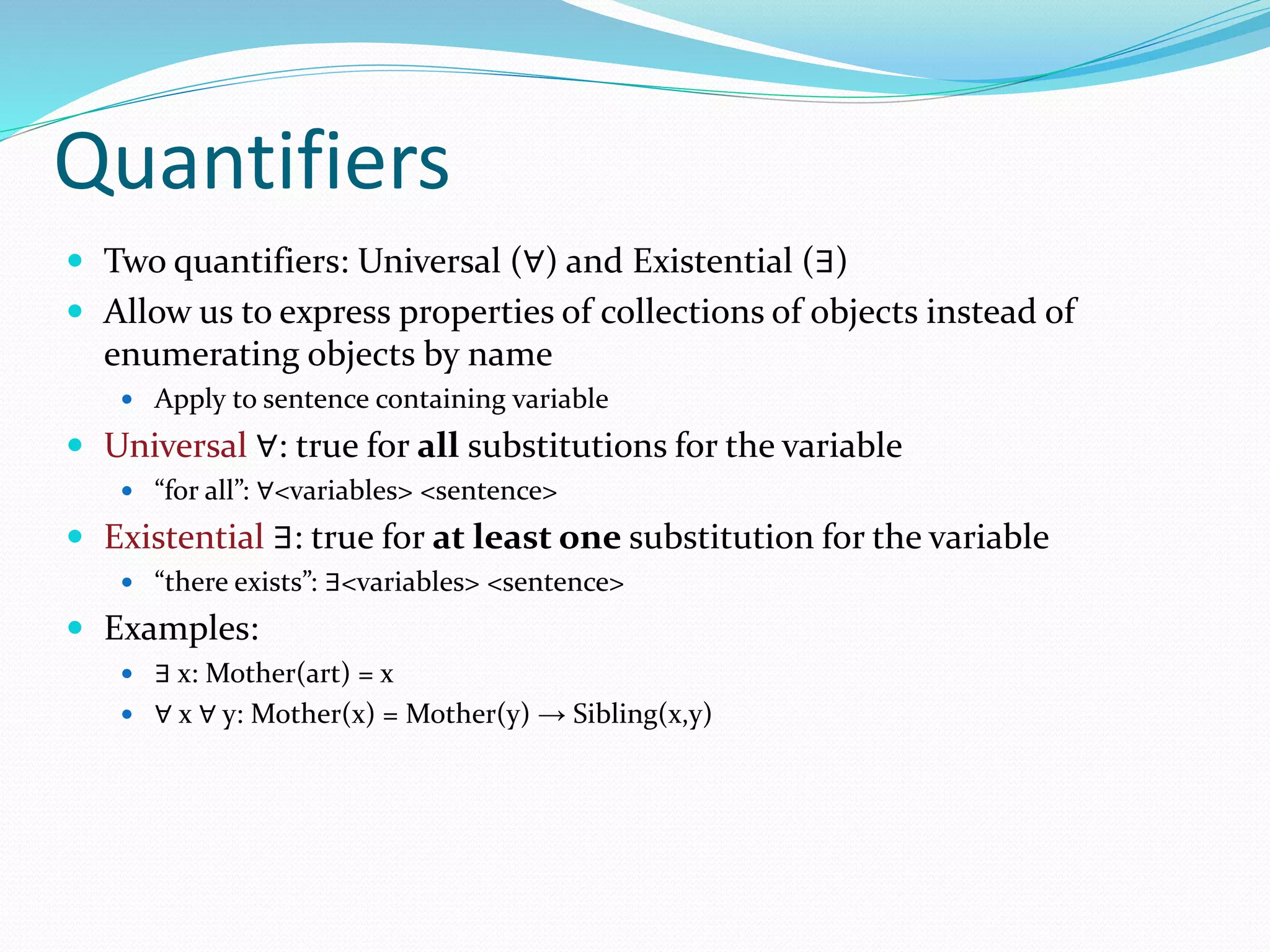
 Two quantifiers: Universal (∀) and Existential (∃)
 Allow us to express properties of collections of objects instead of
enumerating objects by name
 Apply to sentence containing variable
 Universal ∀: true for all substitutions for the variable
 “for all”: ∀<variables> <sentence>
 Existential ∃: true for at least one substitution for the variable
 “there exists”: ∃<variables> <sentence>
 Examples:
 ∃ x: Mother(art) = x
 ∀ x ∀ y: Mother(x) = Mother(y) → Sibling(x,y)
Predicate logic, syntax
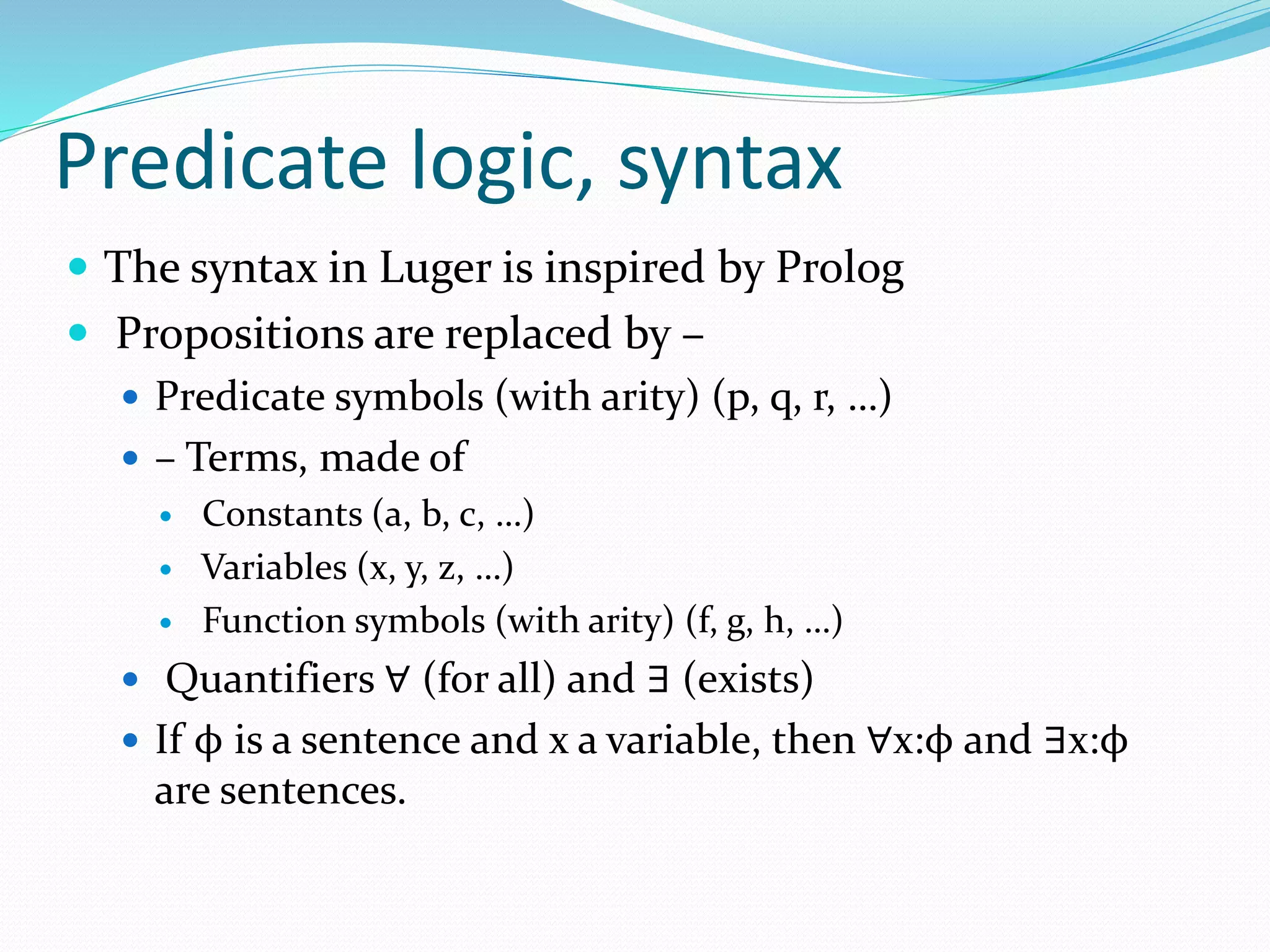
 The syntax in Luger is inspired by Prolog
 Propositions are replaced by –
 Predicate symbols (with arity) (p, q, r, …)
 – Terms, made of
 Constants (a, b, c, …)
 Variables (x, y, z, …)
 Function symbols (with arity) (f, g, h, …)
 Quantifiers ∀ (for all) and ∃ (exists)
 If ϕ is a sentence and x a variable, then ∀x:ϕ and ∃x:ϕ
are sentences.
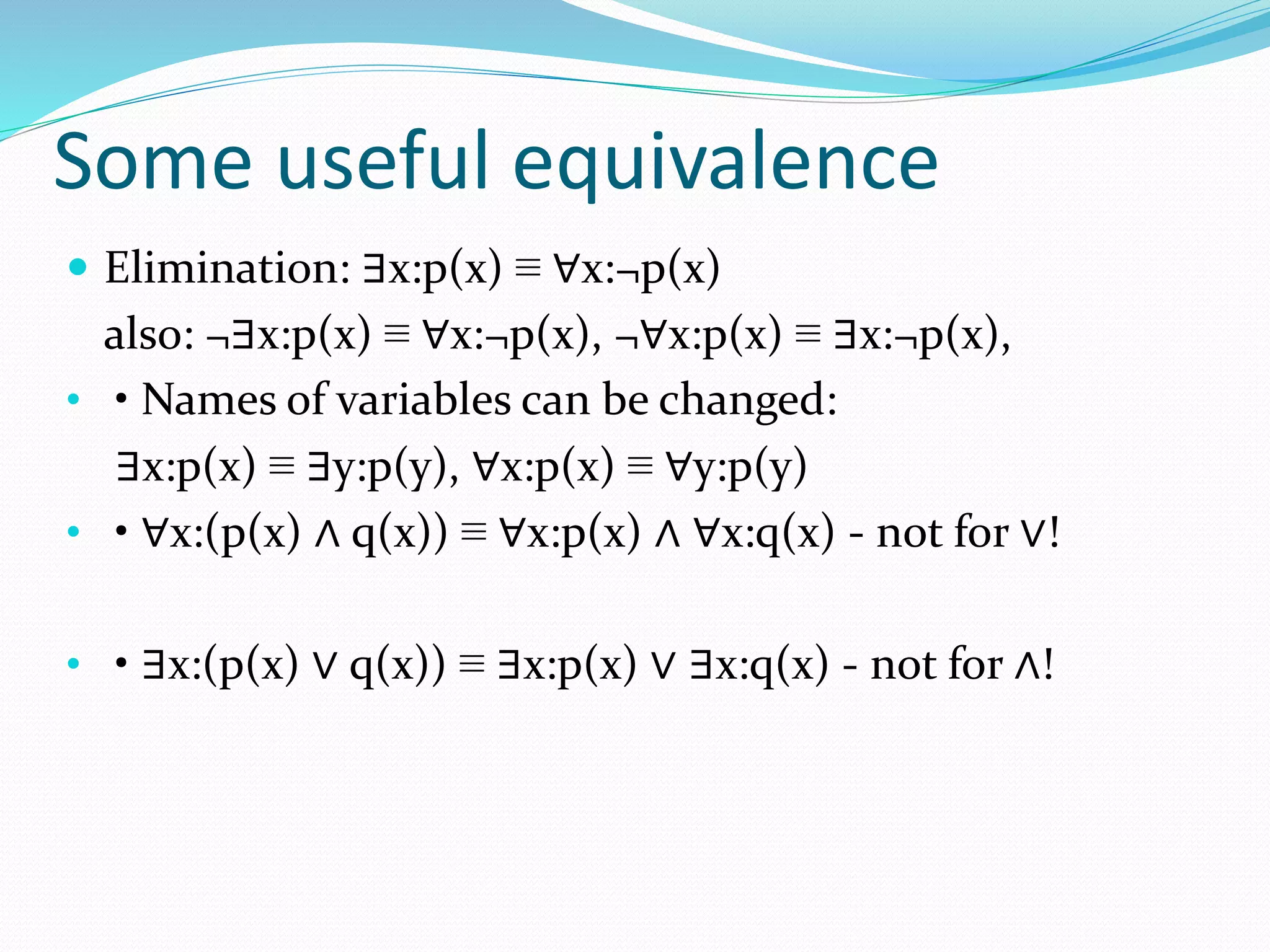
Some useful equivalence
 Elimination: ∃x:p(x) ≡ ∀x:¬p(x)
also: ¬∃x:p(x) ≡ ∀x:¬p(x), ¬∀x:p(x) ≡ ∃x:¬p(x),
• • Names of variables can be changed:
∃x:p(x) ≡ ∃y:p(y), ∀x:p(x) ≡ ∀y:p(y)
• • ∀x:(p(x) ∧ q(x)) ≡ ∀x:p(x) ∧ ∀x:q(x) - not for ∨!
• • ∃x:(p(x) ∨ q(x)) ≡ ∃x:p(x) ∨ ∃x:q(x) - not for ∧!
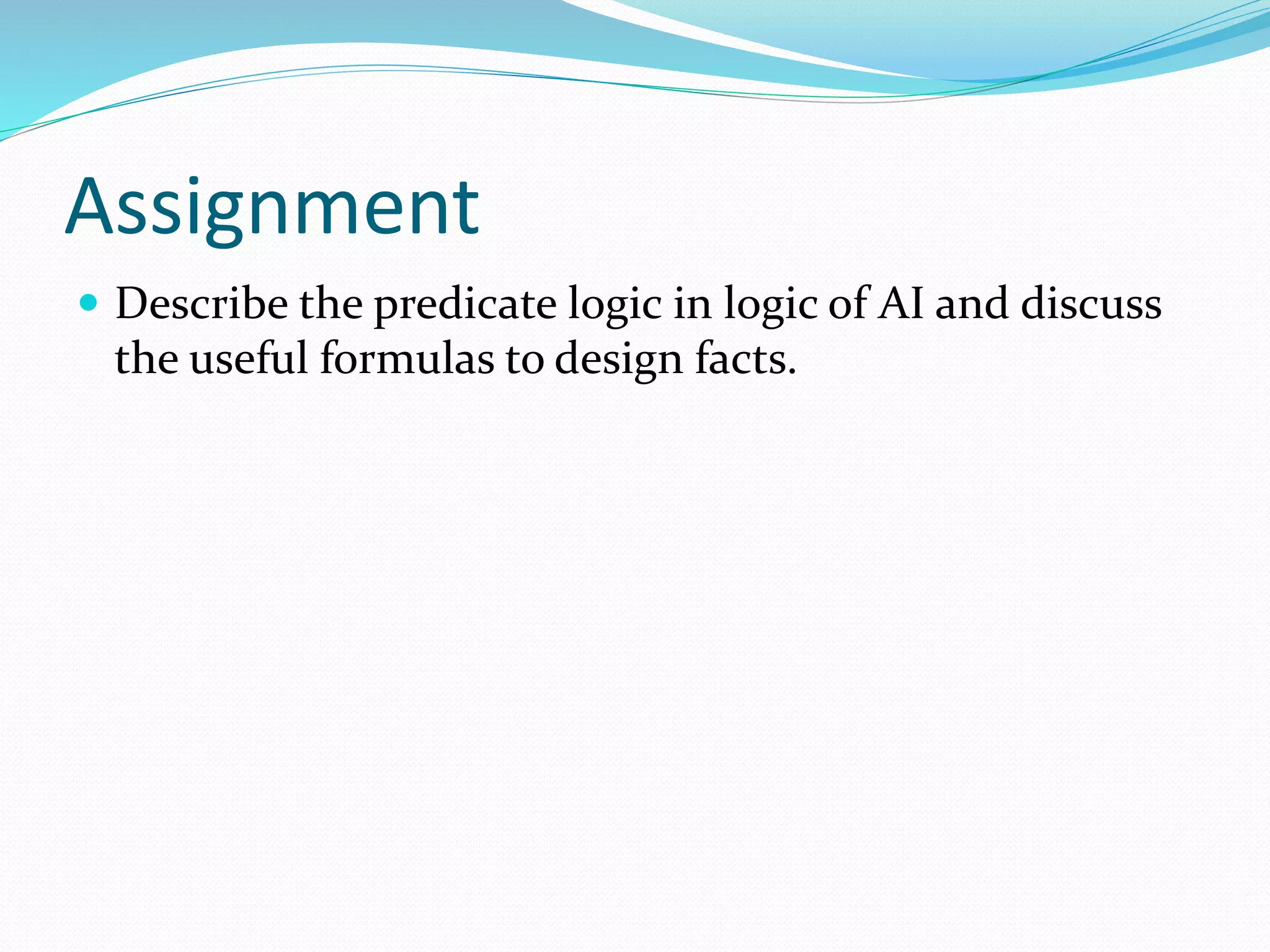
Assignment
 Describe the predicate logic in logic of AI and discuss
the useful formulas to design facts.

Introduction of predicate logics

  • 1.
    Introduction of PredicateLogics Prof. Neeraj Bhargava Kapil Chauhan Department of Computer Science School of Engineering & Systems Sciences MDS University, Ajmer
  • 2.
    Predicate Symbols andSignatures  Predicate symbols represent relations between zero or more objects  The number of objects define a predicate degree  Examples:  Likes(george, kate)  Likes(x,x)  Likes(joe, kate)  Friends (father_of(david), father_of(andrew))  Signature: A signature is a collection of constants, function symbols and predicate symbols with specified arguments.
  • 3.
    Connectives  FOL formulasare joined together by logical operators to form more complex formulas (just like in propositional logic)  The basic logical operators are the same as in propositional logic as well:  Negation: ¬p („it is not the case that p“)  Conjunction: p ∧ q („p and q“)  Disjunction: p ∨ q („p or q“)  Implication: p → q („p implies q“ or “q if p“)  Equivalence: p ↔ q („p if and only if q“)
  • 4.
    Quantifiers  Two quantifiers:Universal (∀) and Existential (∃)  Allow us to express properties of collections of objects instead of enumerating objects by name  Apply to sentence containing variable  Universal ∀: true for all substitutions for the variable  “for all”: ∀<variables> <sentence>  Existential ∃: true for at least one substitution for the variable  “there exists”: ∃<variables> <sentence>  Examples:  ∃ x: Mother(art) = x  ∀ x ∀ y: Mother(x) = Mother(y) → Sibling(x,y)
  • 5.
    Predicate logic, syntax The syntax in Luger is inspired by Prolog  Propositions are replaced by –  Predicate symbols (with arity) (p, q, r, …)  – Terms, made of  Constants (a, b, c, …)  Variables (x, y, z, …)  Function symbols (with arity) (f, g, h, …)  Quantifiers ∀ (for all) and ∃ (exists)  If ϕ is a sentence and x a variable, then ∀x:ϕ and ∃x:ϕ are sentences.
  • 6.
    Some useful equivalence Elimination: ∃x:p(x) ≡ ∀x:¬p(x) also: ¬∃x:p(x) ≡ ∀x:¬p(x), ¬∀x:p(x) ≡ ∃x:¬p(x), • • Names of variables can be changed: ∃x:p(x) ≡ ∃y:p(y), ∀x:p(x) ≡ ∀y:p(y) • • ∀x:(p(x) ∧ q(x)) ≡ ∀x:p(x) ∧ ∀x:q(x) - not for ∨! • • ∃x:(p(x) ∨ q(x)) ≡ ∃x:p(x) ∨ ∃x:q(x) - not for ∧!
  • 7.
    Assignment  Describe thepredicate logic in logic of AI and discuss the useful formulas to design facts.