ORIENTATION & ONBORDING
Do you Remember your 1st working day?
Do you have a formal Orientation
program in your organization?
Recruiting and selection high potential
employees doesn’t guarantee they will
perform effectively even if they want to.
Therefore your next step is to ensure that
your employees know what to do and how
to do it.
EMPLOYEE ORIENTATION
A systematic and planned introduction
of new employees to their jobs, co-
workers and the organization.
EMPLOYEE ORIENTATION
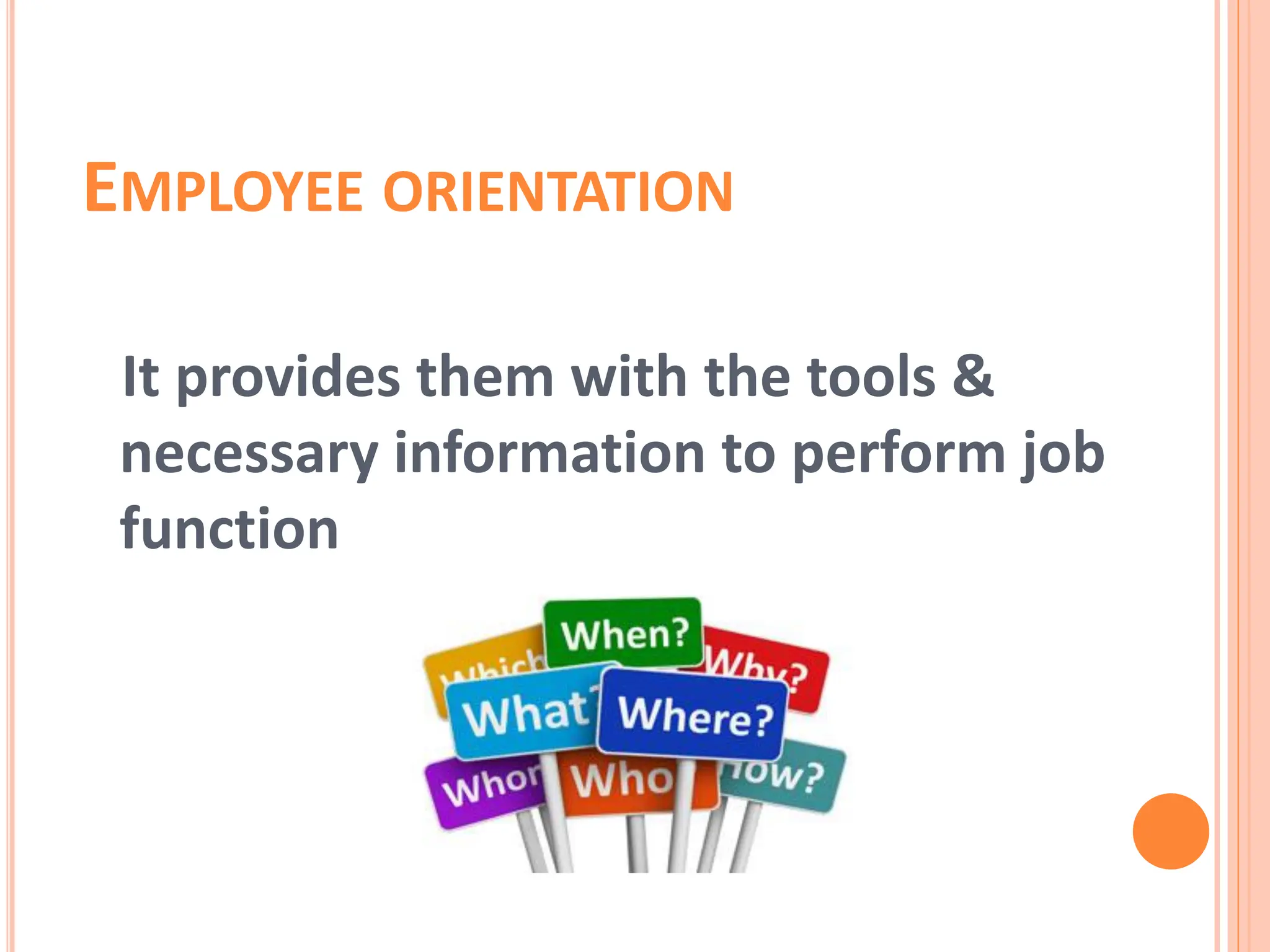
It provides them with the tools &
necessary information to perform job
function
WHY?
Reduce the new employees anxiety.
WHY?
Employees feel welcome.
WHY?
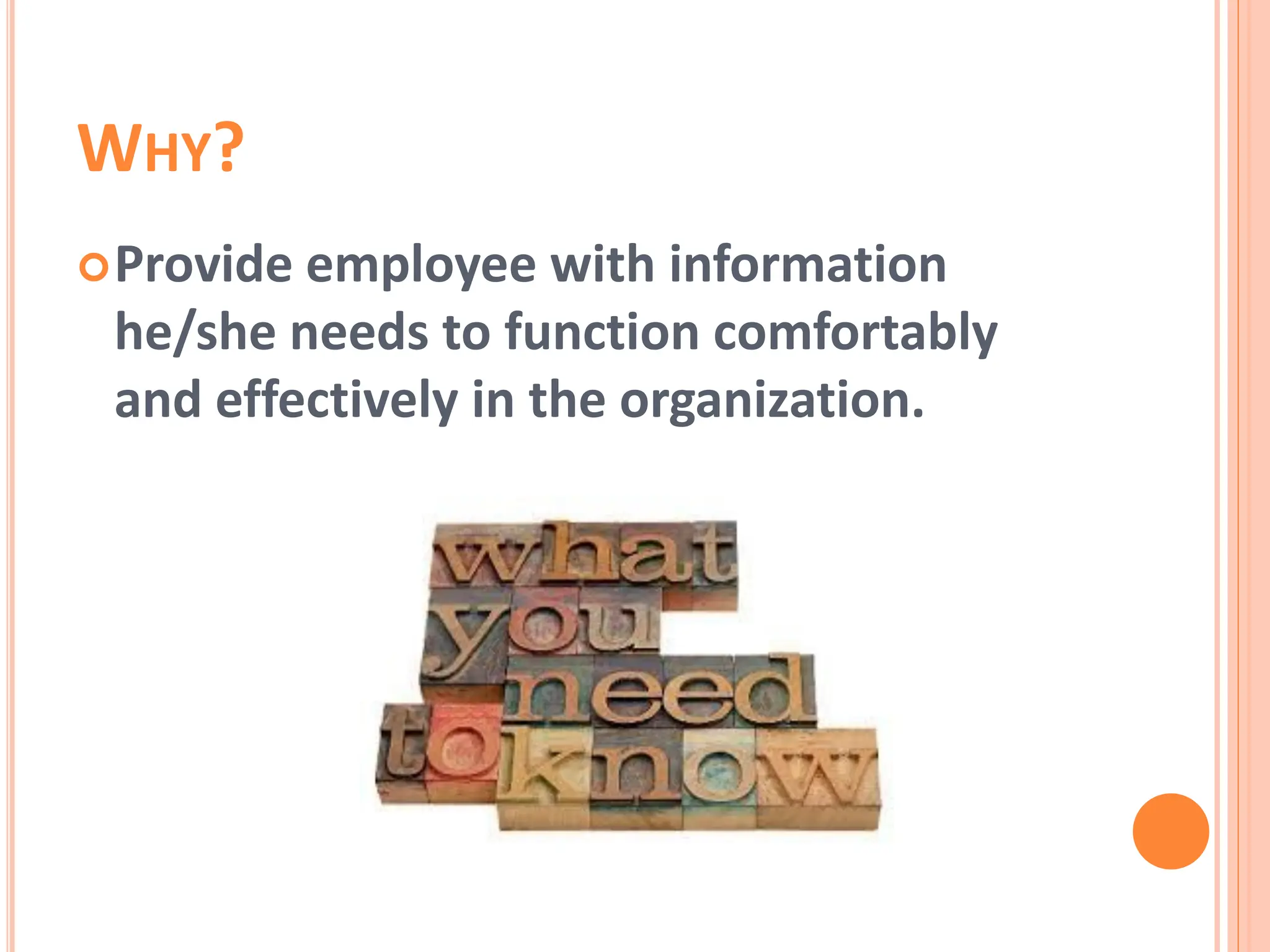
Provide employee with information
he/she needs to function comfortably
and effectively in the organization.
WHY?
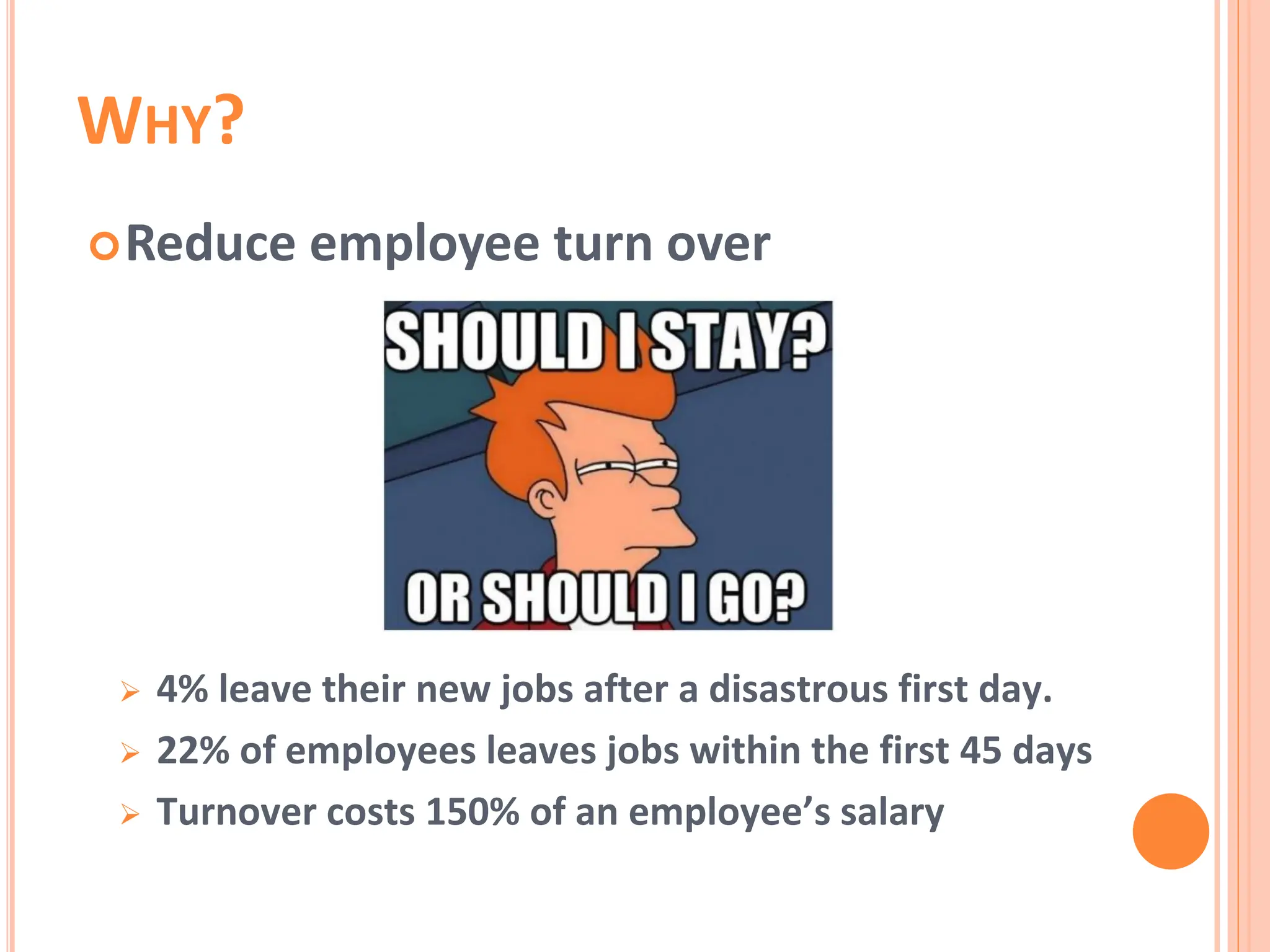
Reduce employee turn over
 4% leave their new jobs after a disastrous first day.
 22% of employees leaves jobs within the first 45 days
 Turnover costs 150% of an employee’s salary
WHY?
Develop realistic job expectation and job
satisfaction
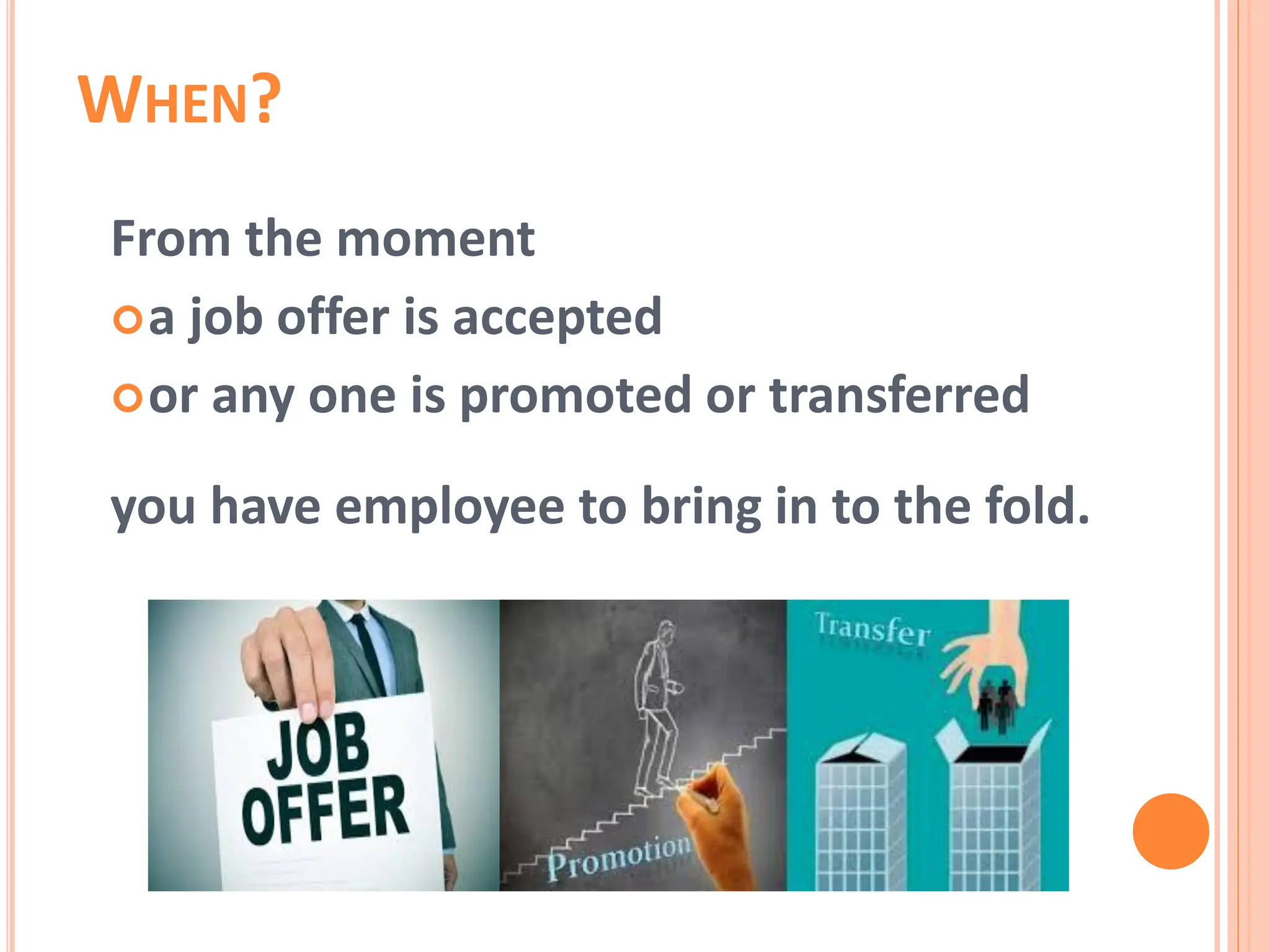
From the moment
a job offer is accepted
or any one is promoted or transferred
you have employee to bring in to the fold.
WHEN?
 HR Specialist
 Direct supervisor
WHO CONDUCT OR INVOLVED IN?
1) HR SPECIALIST
TASKS TO BE COMPLETED
PRIOR TO SESSION:
TASKS TO BE COMPLETED PRIOR TO SESSION:
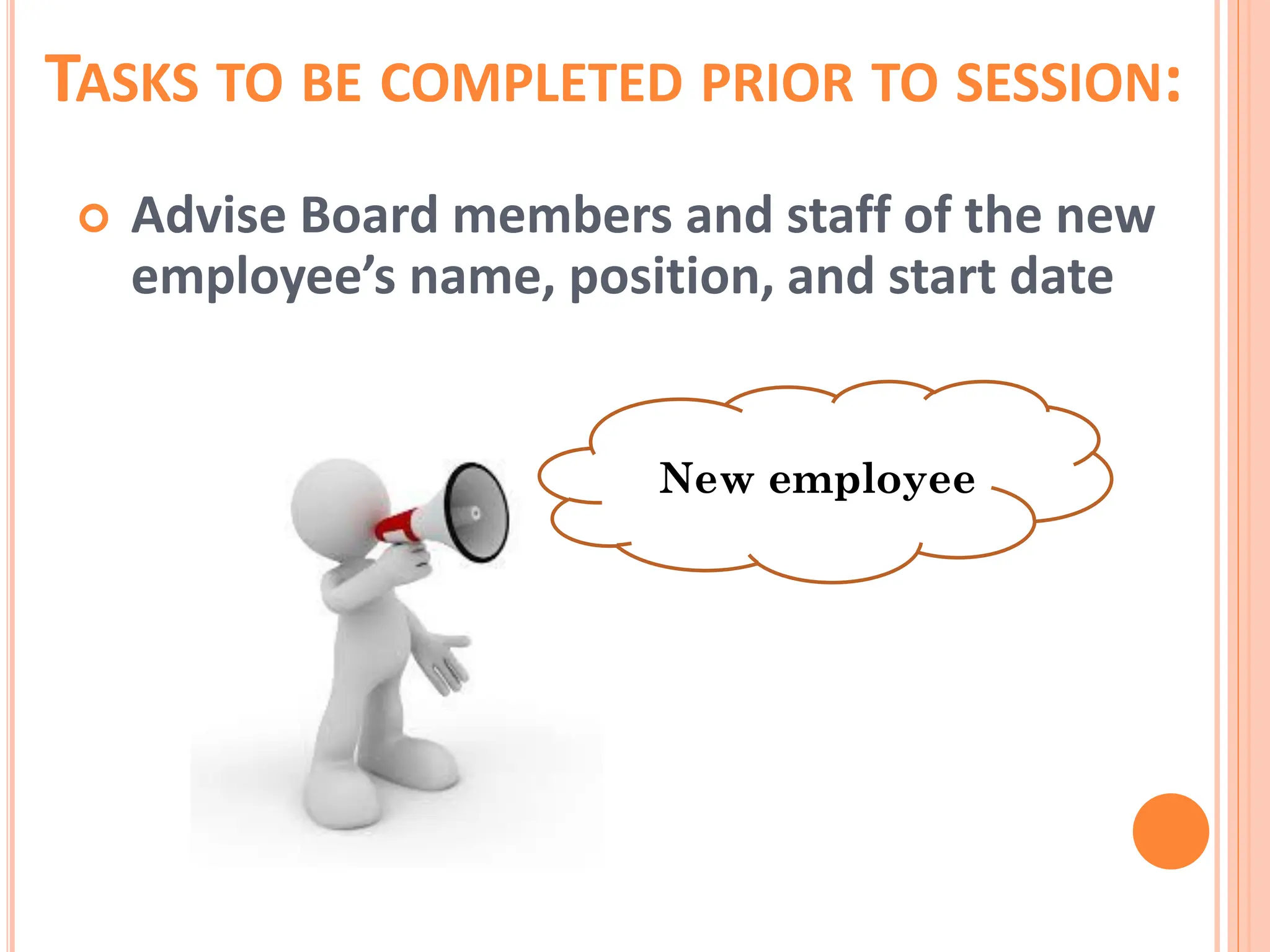
 Advise Board members and staff of the new
employee’s name, position, and start date
New employee
TASKS TO BE COMPLETED PRIOR TO SESSION:
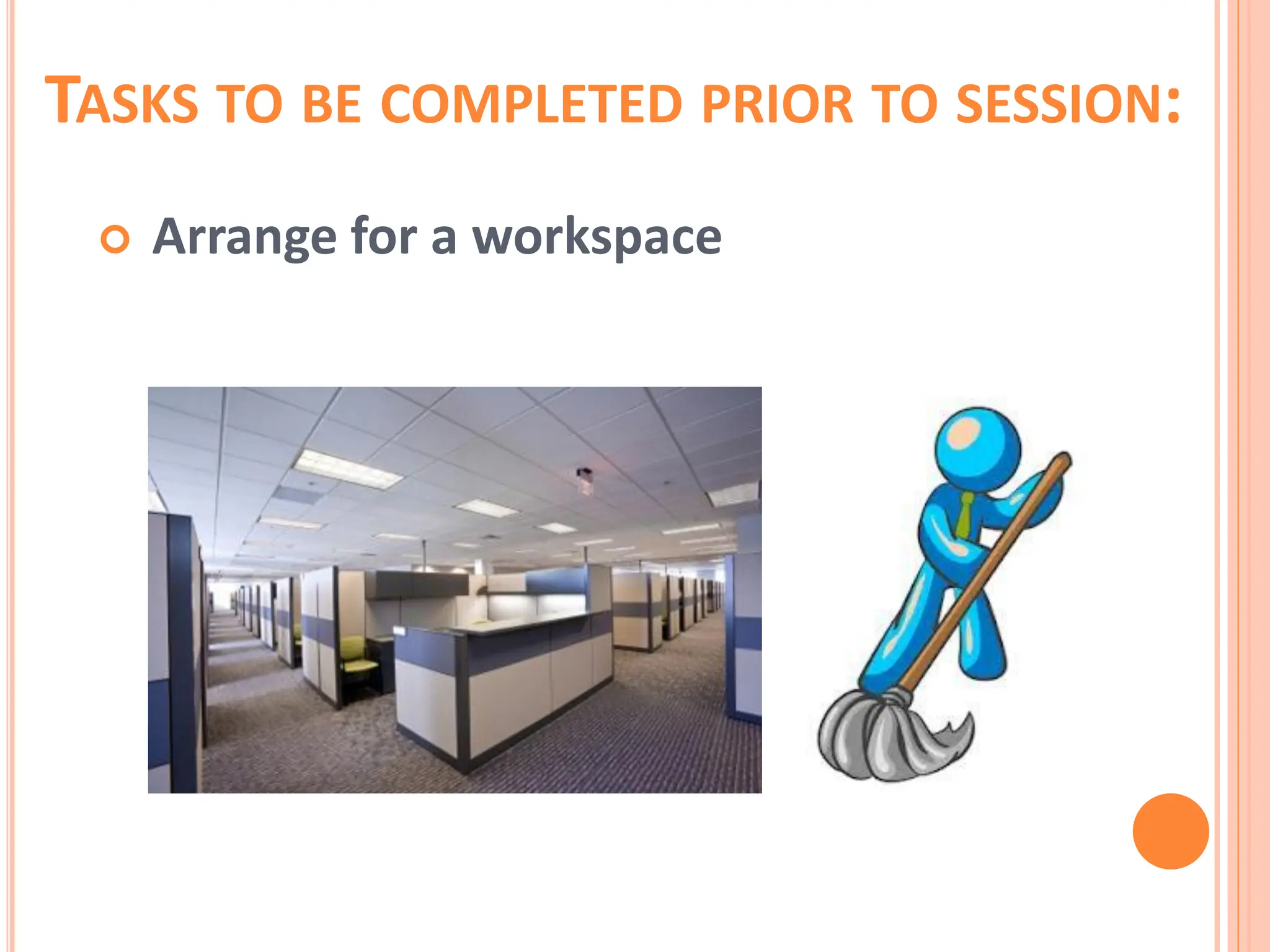
 Arrange for a workspace
TASKS TO BE COMPLETED PRIOR TO SESSION:
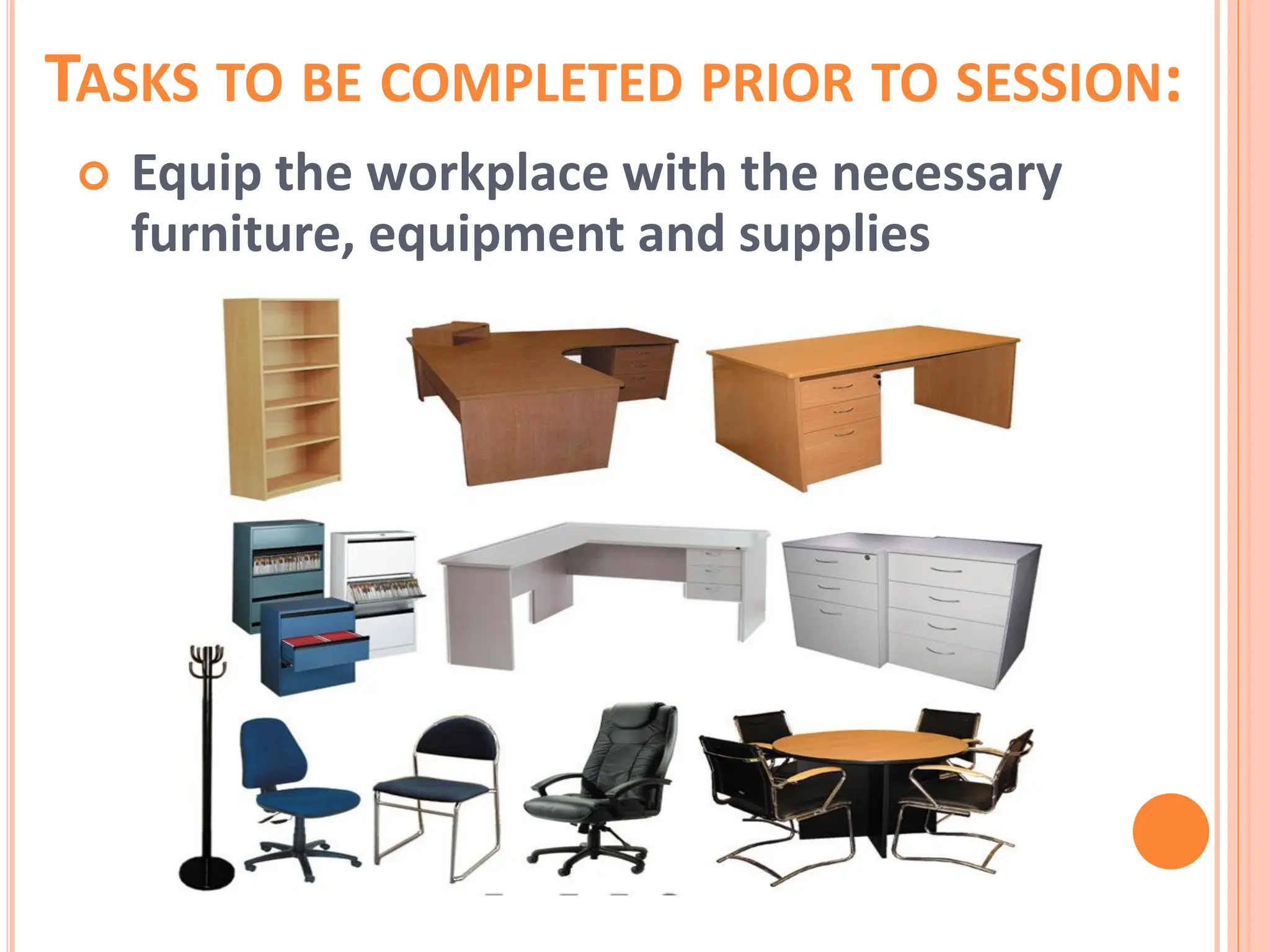
 Equip the workplace with the necessary
furniture, equipment and supplies
TASKS TO BE COMPLETED PRIOR TO SESSION:
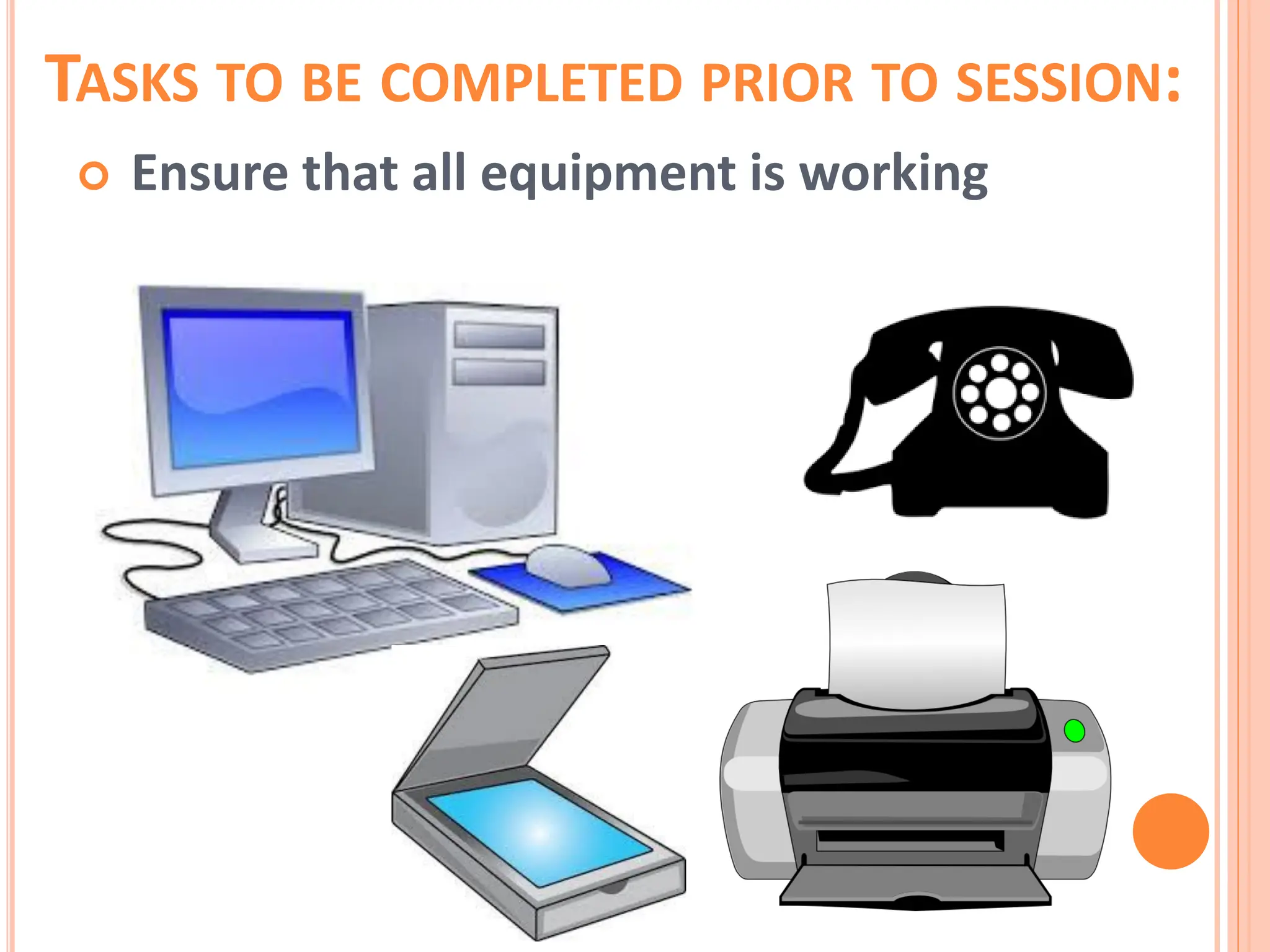
 Ensure that all equipment is working
TASKS TO BE COMPLETED PRIOR TO SESSION:
 Set up an e-mail address
TASKS TO BE COMPLETED PRIOR TO SESSION:
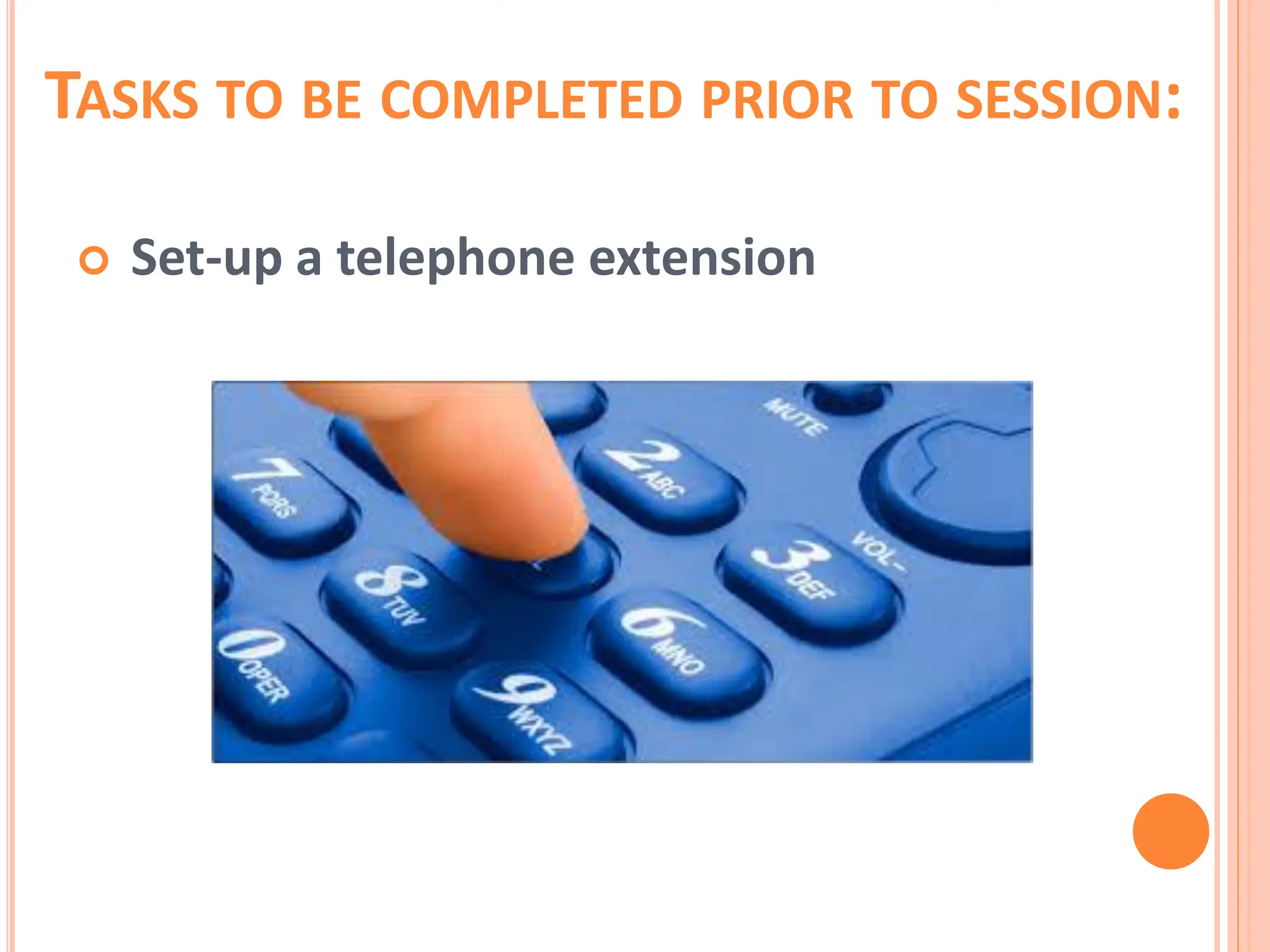
 Set-up a telephone extension
TASKS TO BE COMPLETED PRIOR TO SESSION:
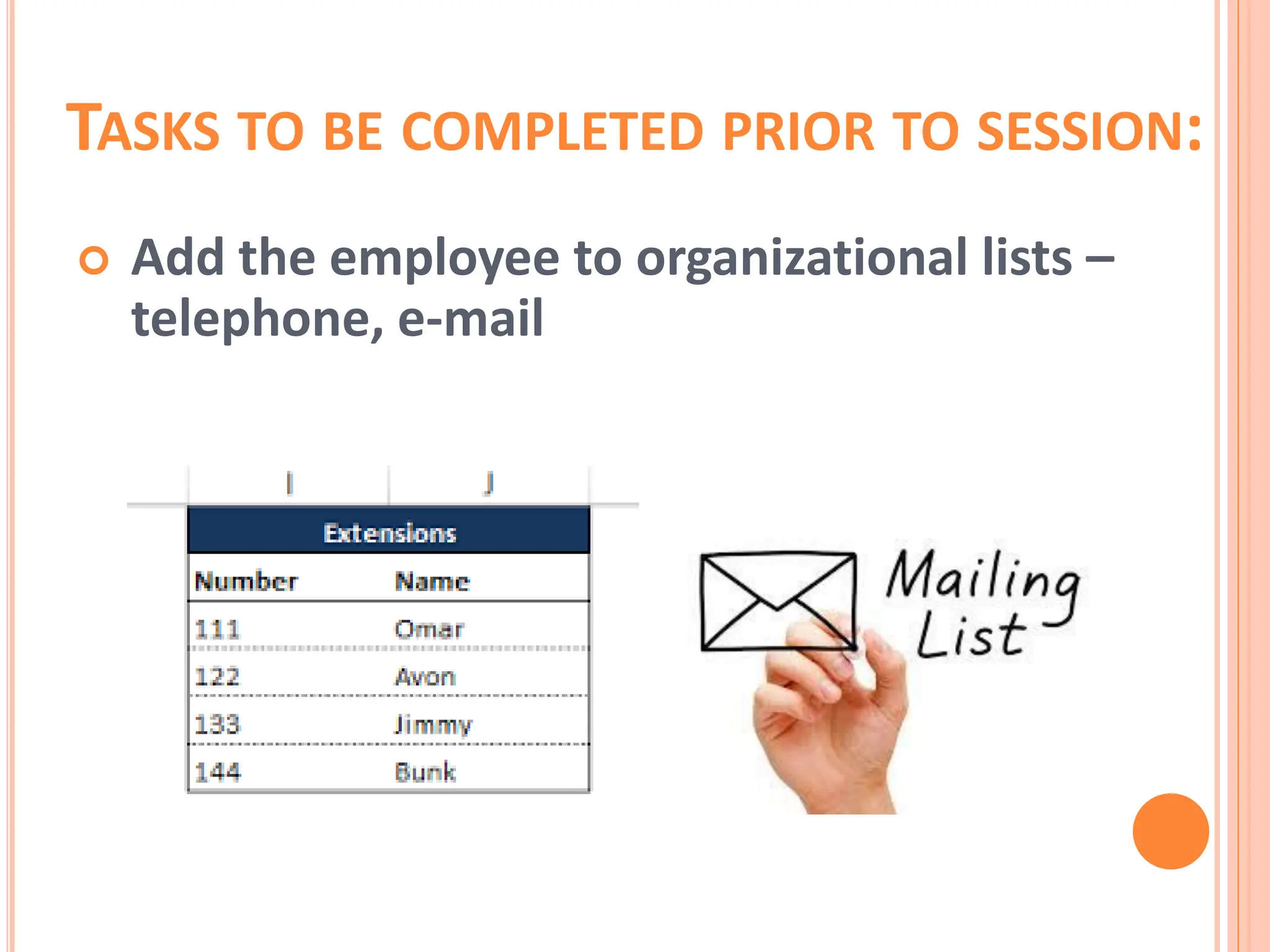
 Add the employee to organizational lists –
telephone, e-mail
TASKS TO BE COMPLETED PRIOR TO SESSION:
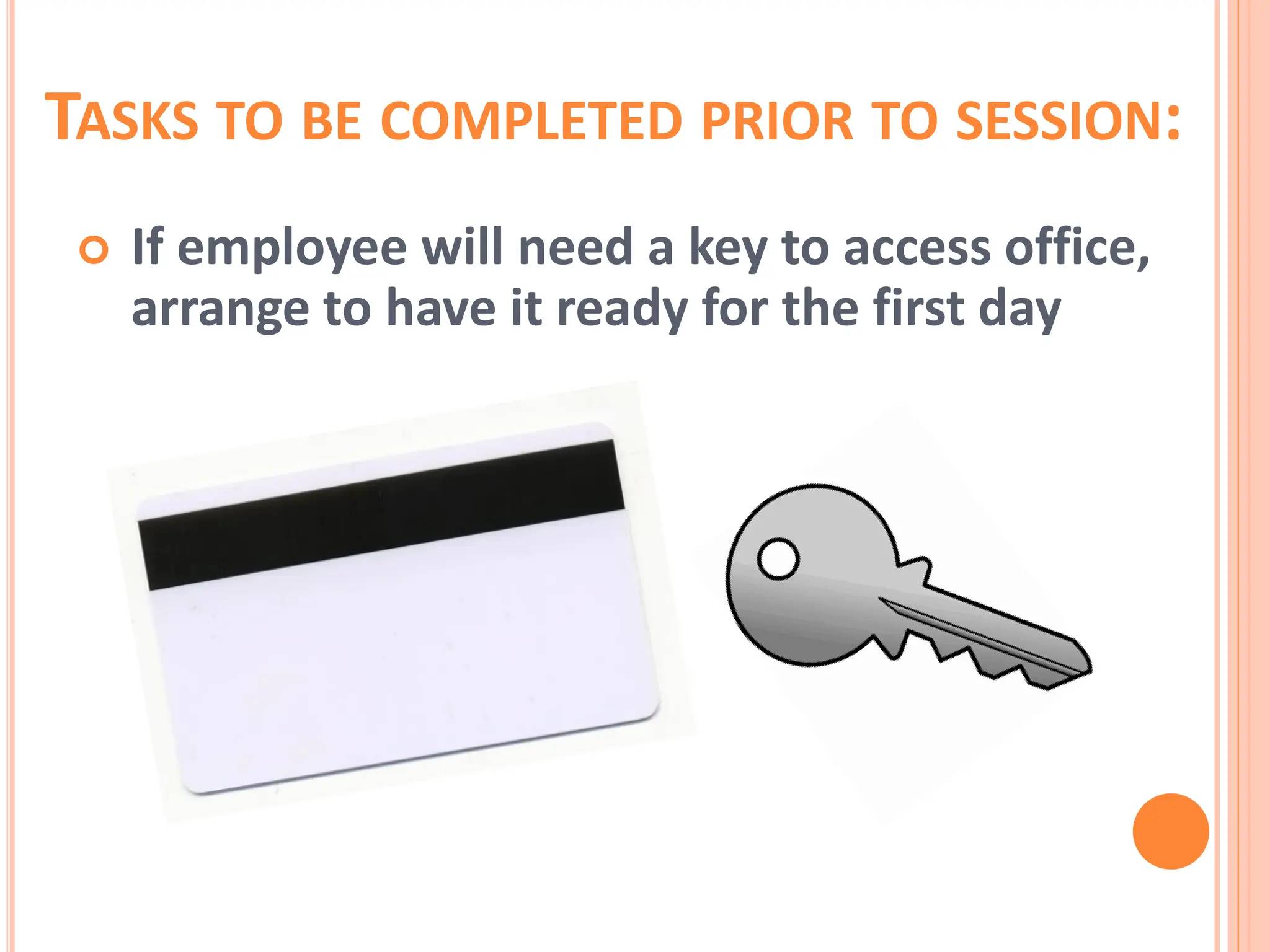
 If employee will need a key to access office,
arrange to have it ready for the first day
TASKS TO BE COMPLETED PRIOR TO SESSION:
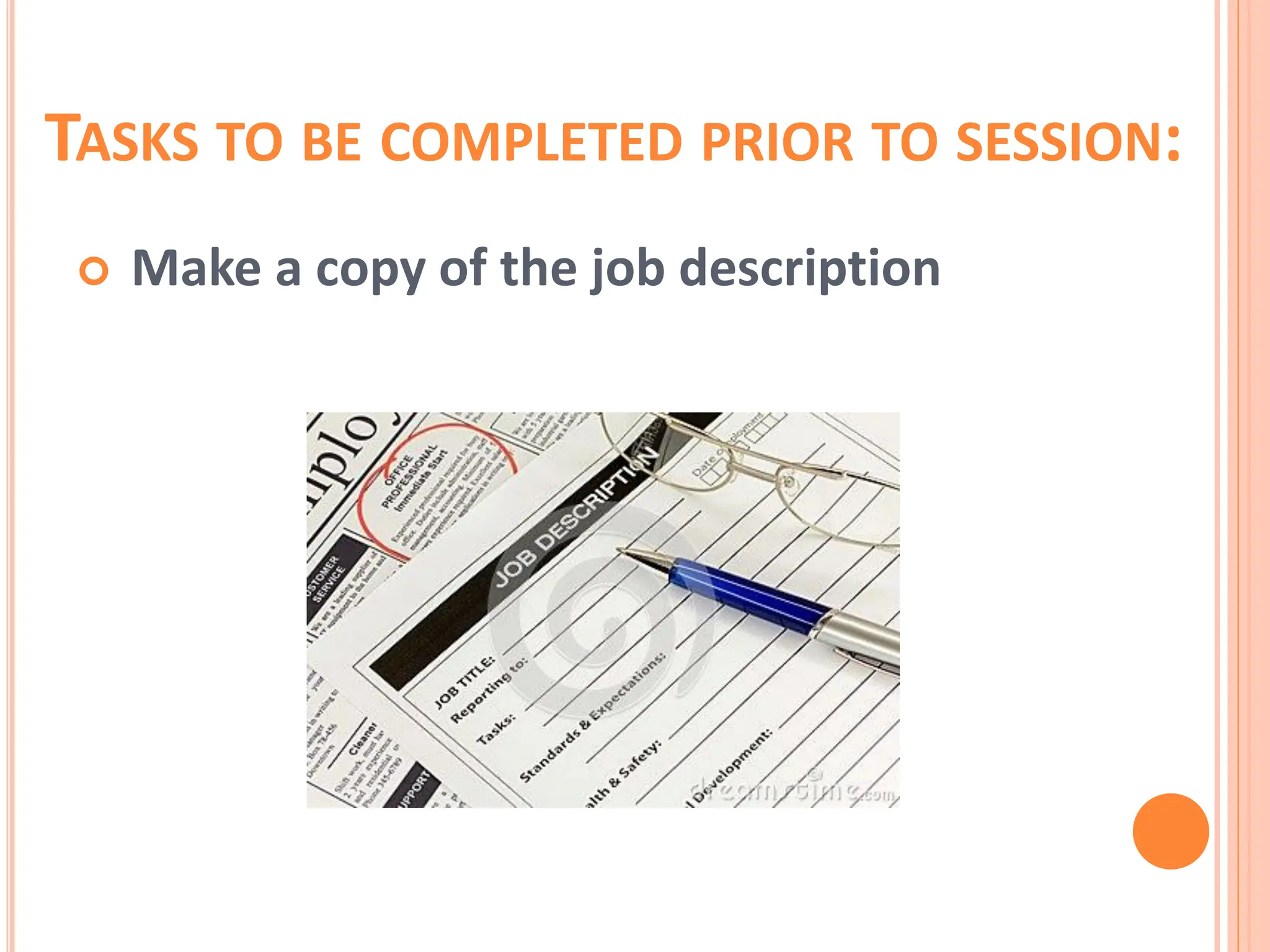
 Make a copy of the job description
TASKS TO BE COMPLETED PRIOR TO SESSION:
 Add employee information on HR system
TASKS TO BE COMPLETED PRIOR TO SESSION:
 Prepare /Complete the necessary paperwork
for pay and benefits
TASKS TO BE COMPLETED PRIOR TO SESSION:
 Set up the orientation team – who will be
doing what for the orientation
TASKS TO BE COMPLETED PRIOR TO SESSION:
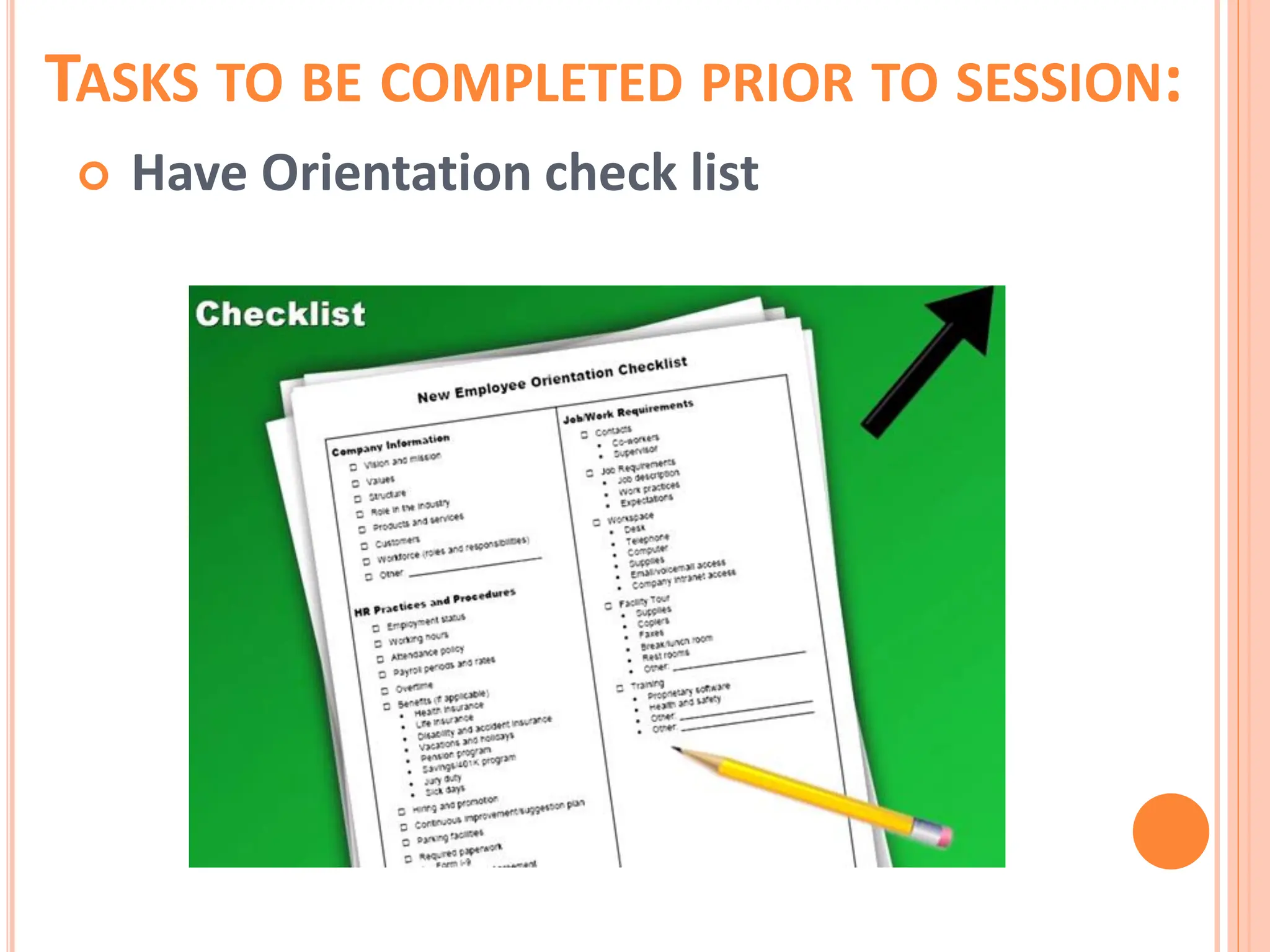
 Have Orientation check list
FIRST DAY
 Keep your schedule as free
as possible for the first day
Getting Started
 Welcome the new employee
 Personal introduction and
individual history with the
company
 Outline the orientation process for the day
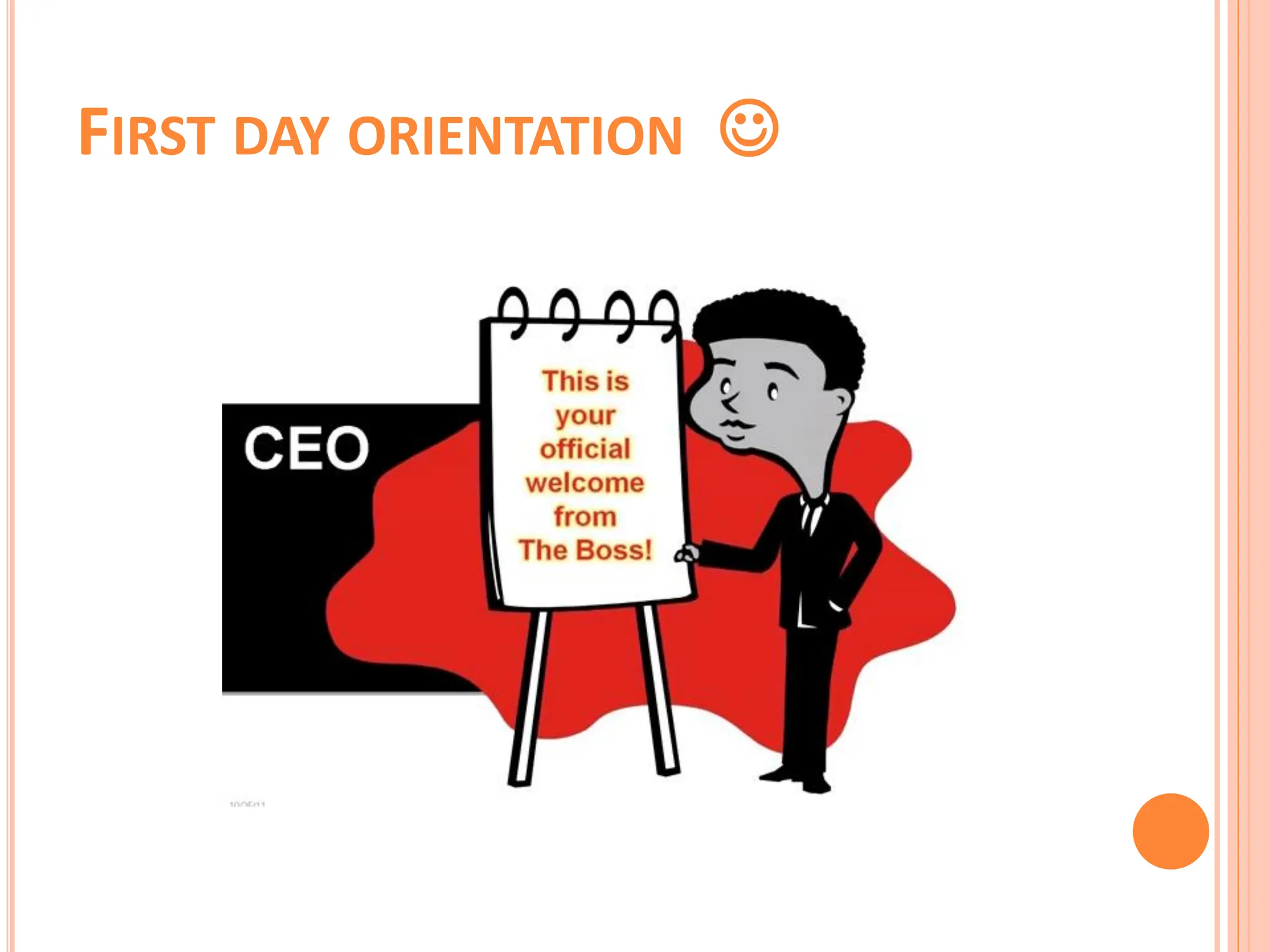
FIRST DAY ORIENTATION 
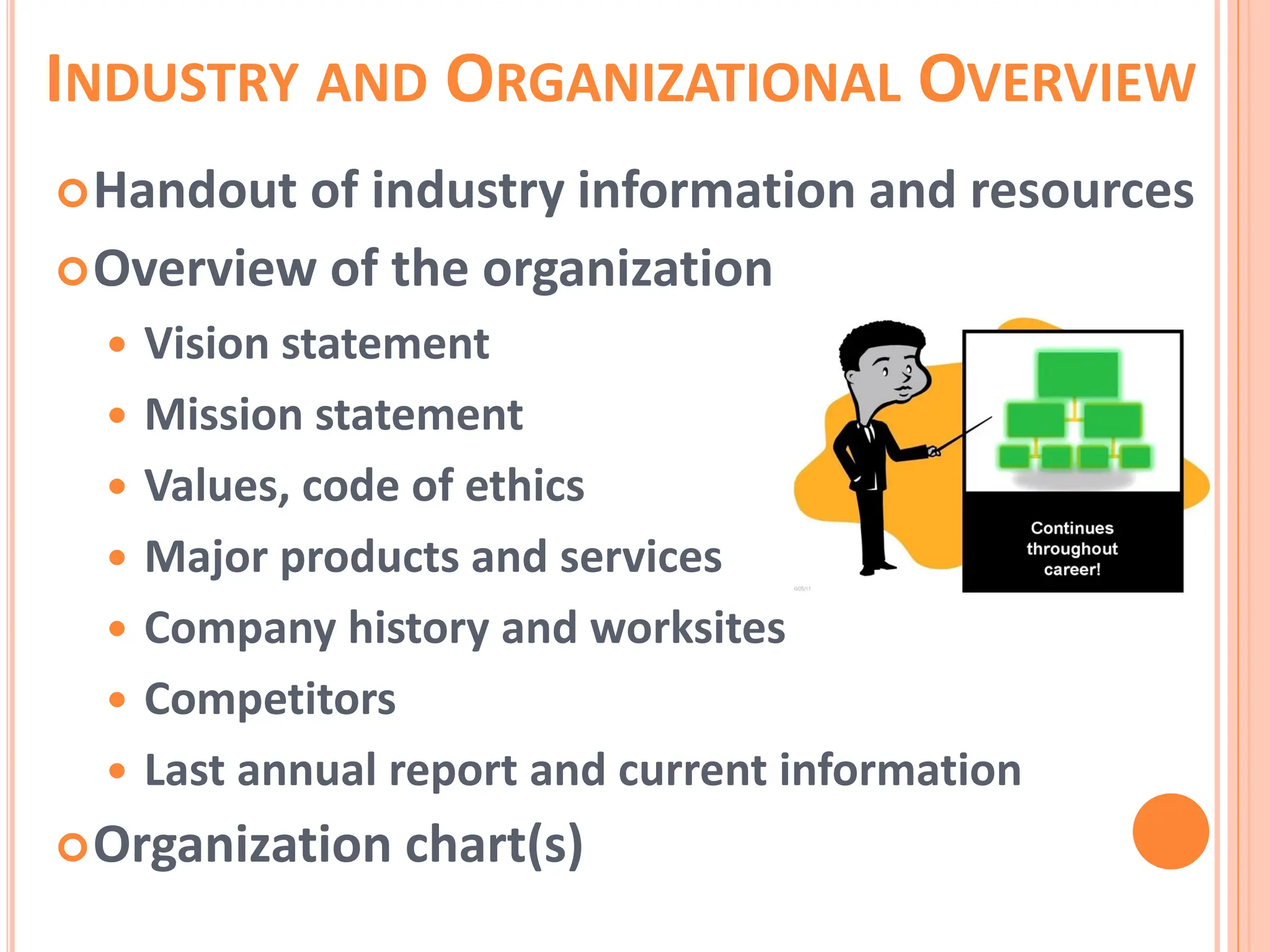
INDUSTRY AND ORGANIZATIONAL OVERVIEW
Handout of industry information and resources
Overview of the organization
 Vision statement
 Mission statement
 Values, code of ethics
 Major products and services
 Company history and worksites
 Competitors
 Last annual report and current information
Organization chart(s)
EMPLOYEE ROLE
Review the employee’s job description
and expected outcomes
Stress importance of employees to the
company
Explain how the job is related to the
other jobs in the organization
WORK EXPECTATION
It should be explained and the participants
referred to the handbook or other explanatory
material for more information.
It includes:
 Working hours (start& end time)
 Tea &coffee breaks, launch time.
 Paid time off, such as vacation, sick, holiday and
personal days
 Dress code
 Employee benefits
WORK EXPECTATION
 Pay processing including pay days, how pay is
distributed, and automatic deposit
 Probationary period
 Transportation facilities
 Employee lives.
 Special words and phrases used by work
group abbreviations.
 Safety procedures and measures
 Grievance system
 Opportunities for training, promotion,
transfers …etc
POLICY & PROCEDURES REVIEW
Copies of written rules, policies and
procedures other than in the handbook.
New employees should be encouraged to
ask questions about any work-related
matter of concern to them.
WORKPLACE TOUR
Give the employee a tour of the
assigned workspace and the rest
of the office/facility including:
WORKPLACE TOUR
Facilities’ location
 Employee entrance and exit. (how to use)
 Rest rooms / washrooms
 Eating places
 Parking and bus stops
 Lockers to safely put belonging as where
to hang coat, store lunch,…etc
 Equipment could be used as photocopier,
fax machine, and supplies, etc.
WORKPLACE TOUR
Health and safety considerations as
 Safe procedures
 Emergency exits
 First aid Kit / Clinic
 Whom to contact in case of problems
or difficulties
Show employee’s office
Introduce the new employee to his/her
Manager
2) SUPERVISOR
SUPERVISOR
Help employee to reduce first day jilters
Introduce the new employee to his/ her
new colleagues.
Explain the job duties, responsibilities
and the expected performance.
Give the employee reports, information
that is need for the job and explain each
item is.
LUNCH/ COFFEE BREAK WITH NEW COLLEAGUES
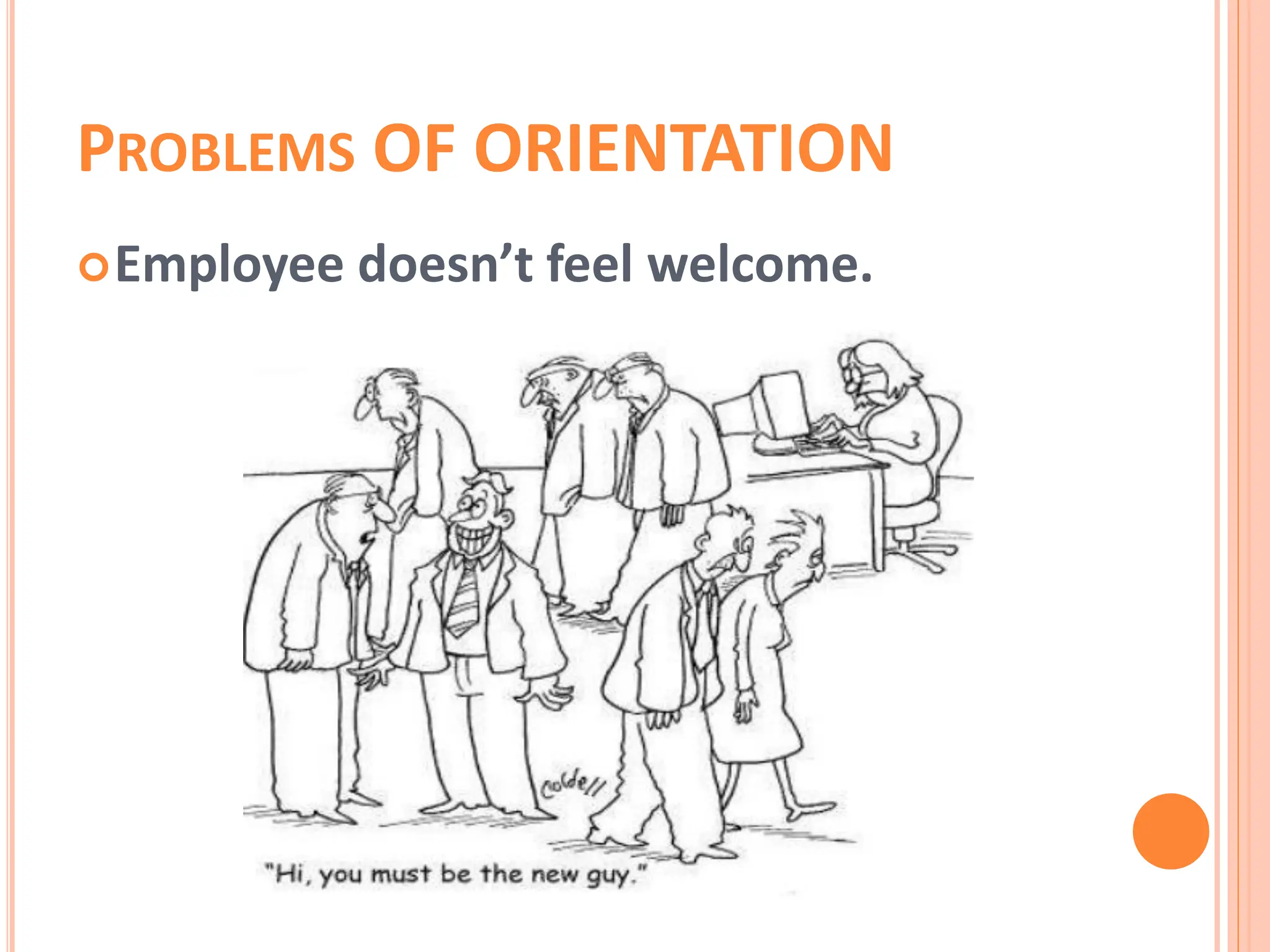
PROBLEMS OF ORIENTATION
Employee doesn’t feel welcome.
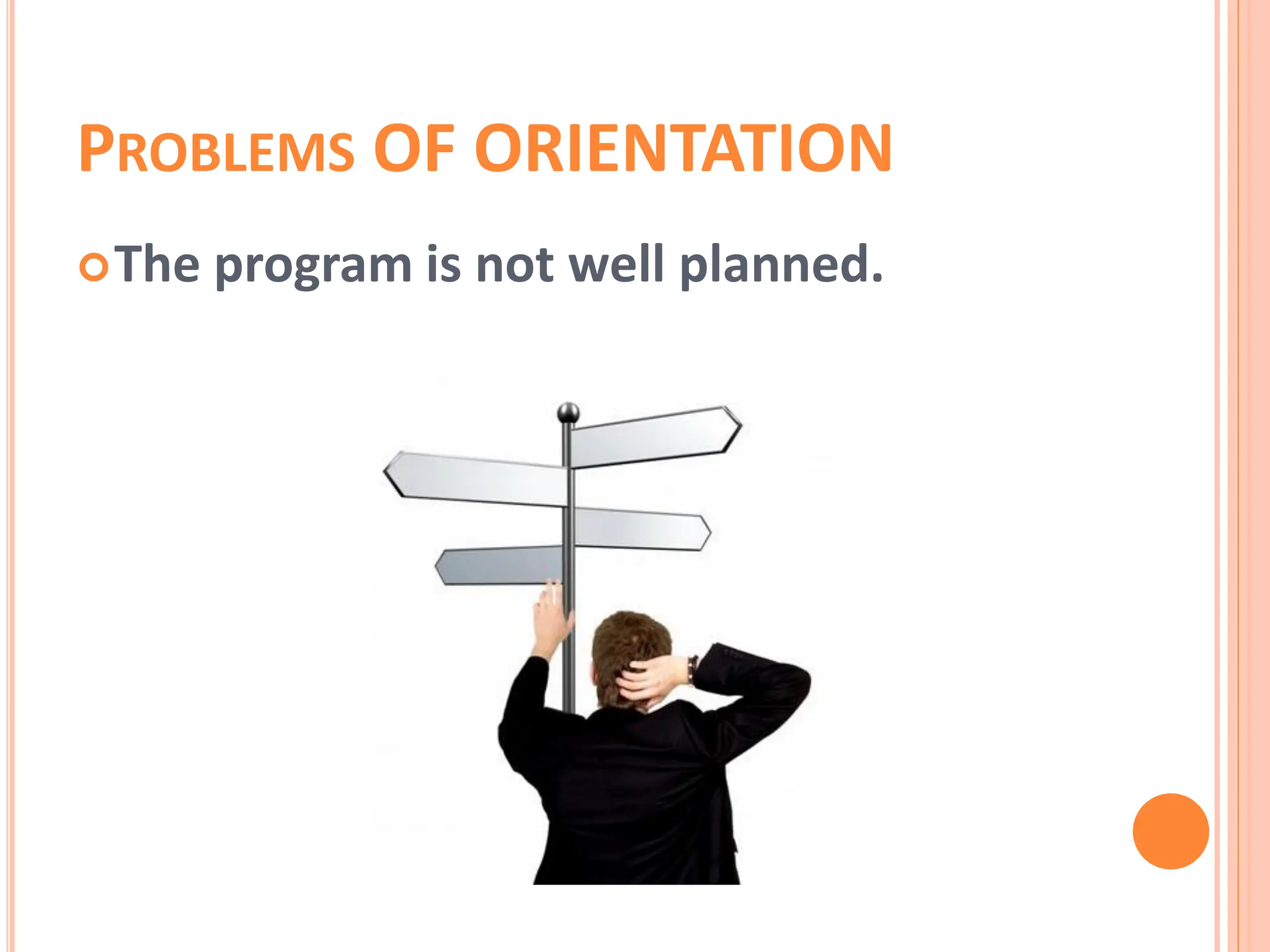
PROBLEMS OF ORIENTATION
The program is not well planned.
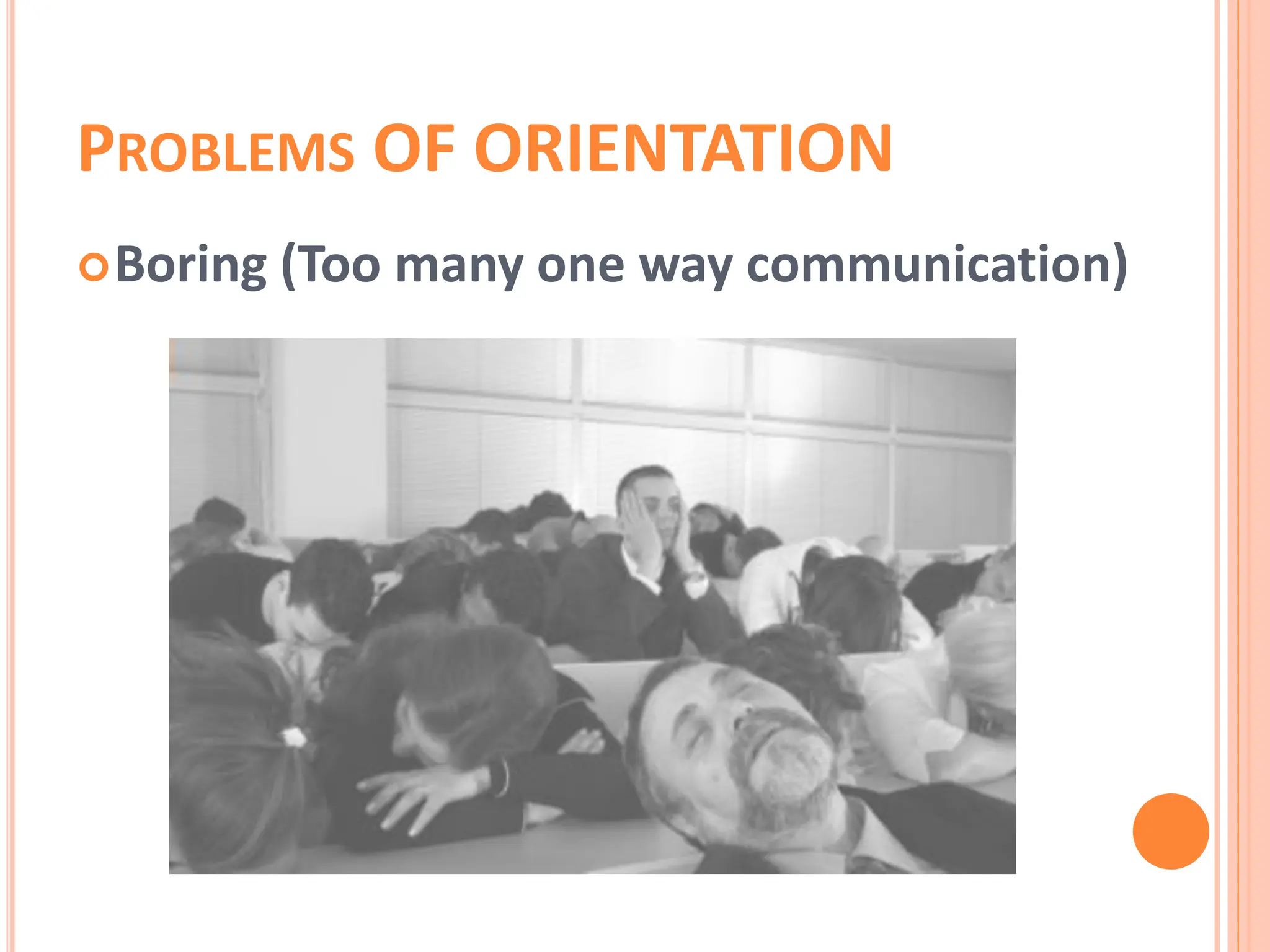
PROBLEMS OF ORIENTATION
Boring (Too many one way communication)
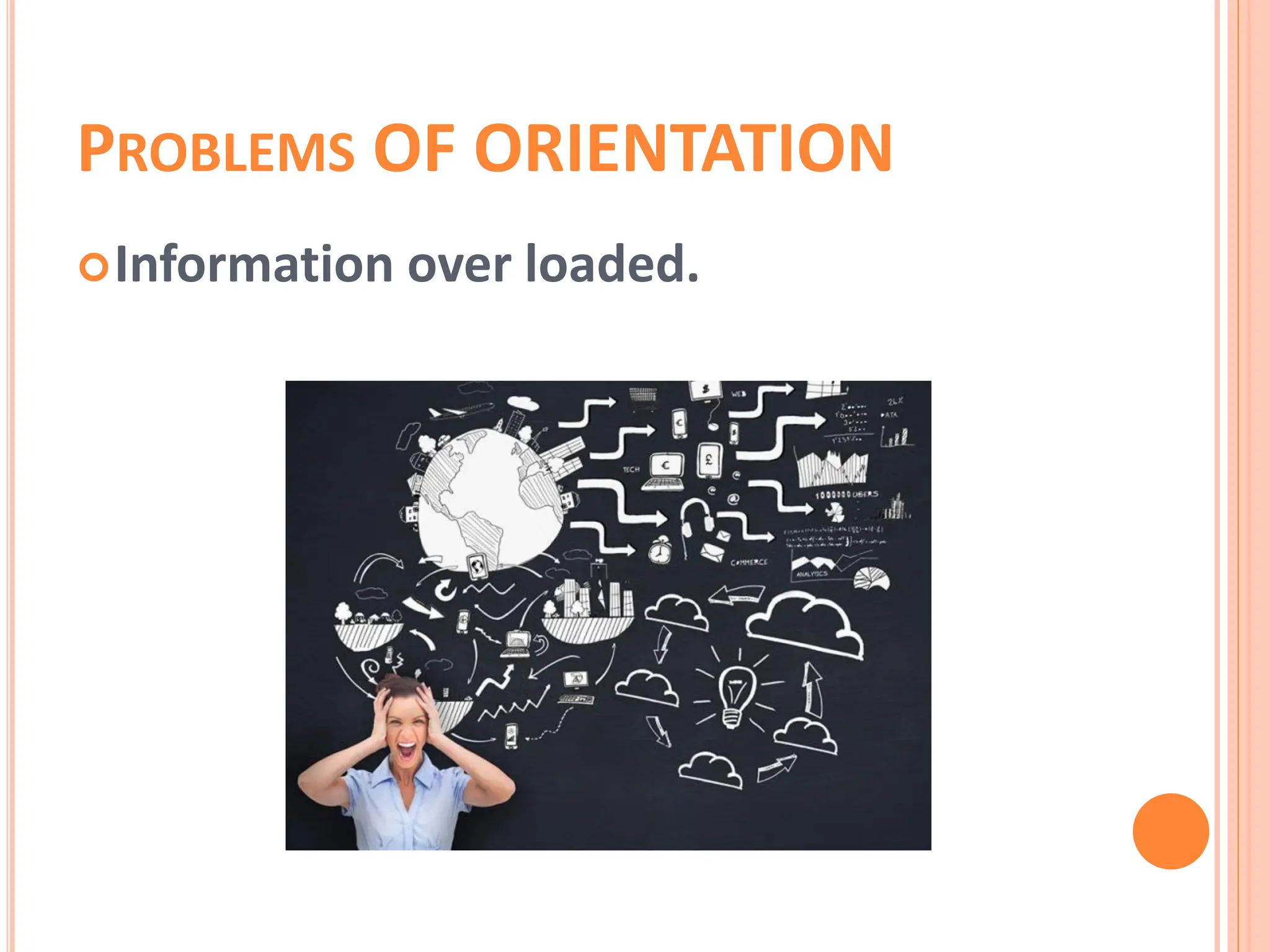
PROBLEMS OF ORIENTATION
Information over loaded.
PROBLEMS OF ORIENTATION
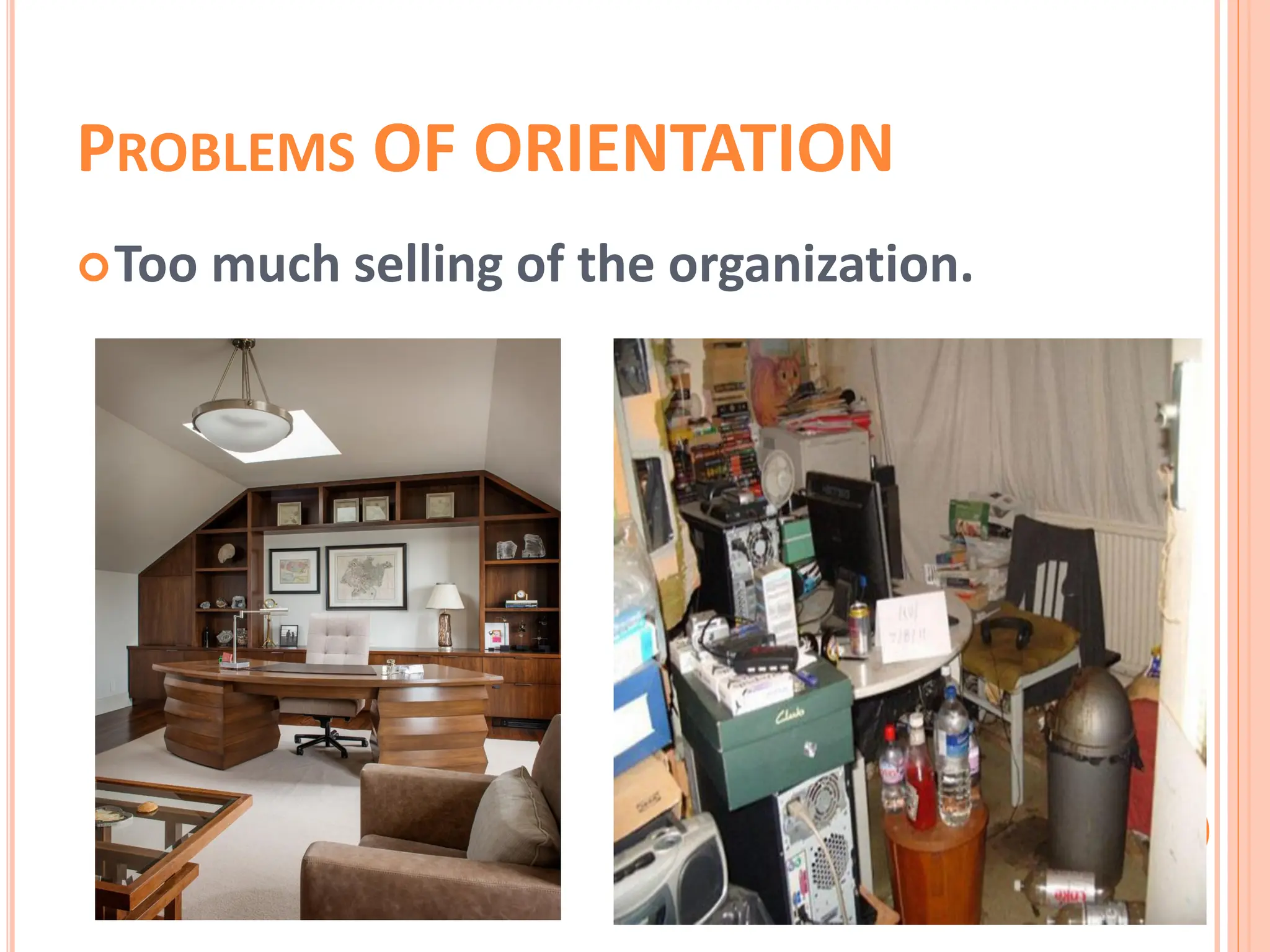
Too much selling of the organization.
PROBLEMS OF ORIENTATION
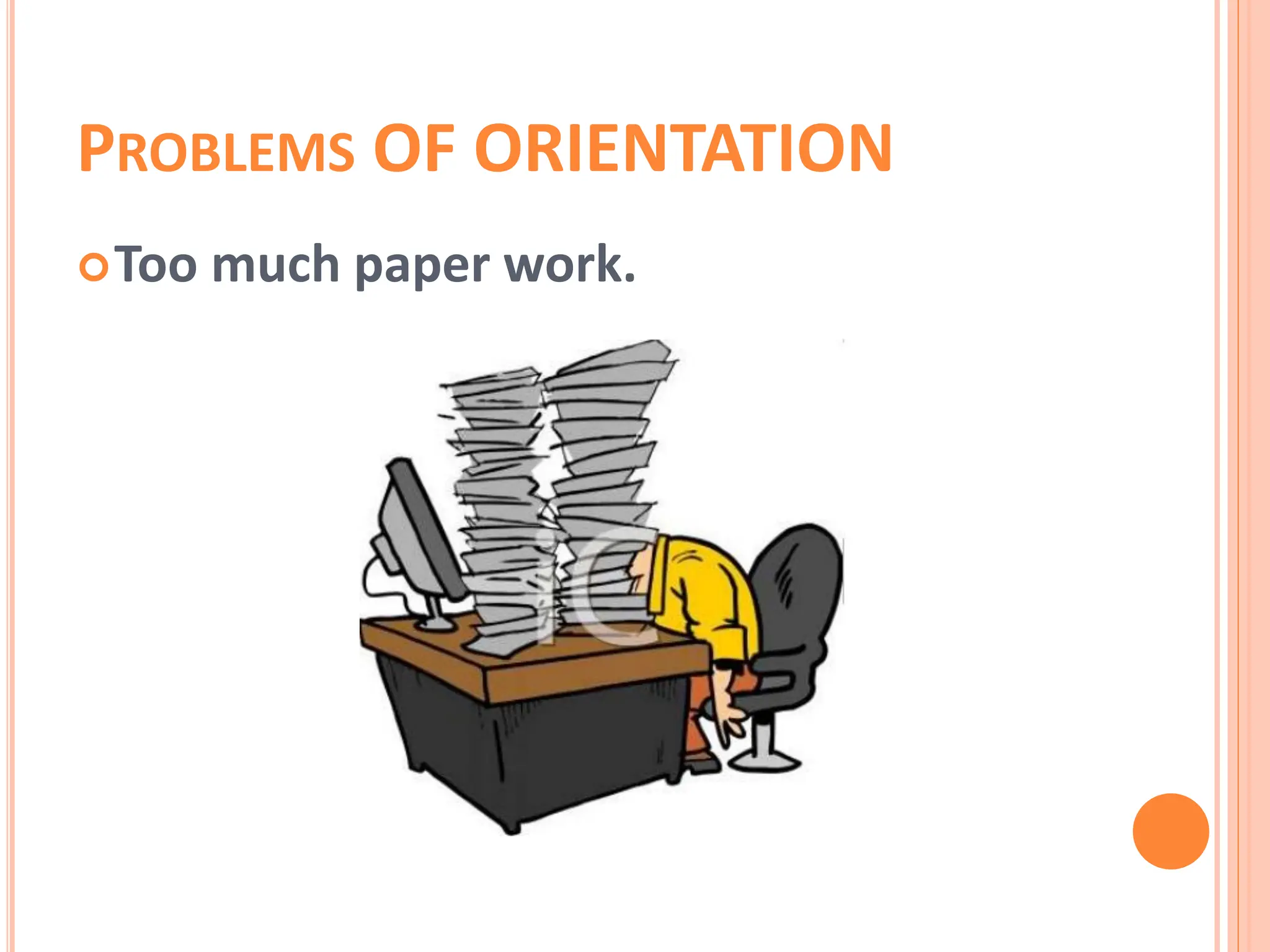
Too much paper work.
 The process of new employee
assimilation into his or her position with
a quicker ramp-up to productivity.
 It is an expansion of the initial orientation
 It can last up to 6 months or a year.
ONBOARDING
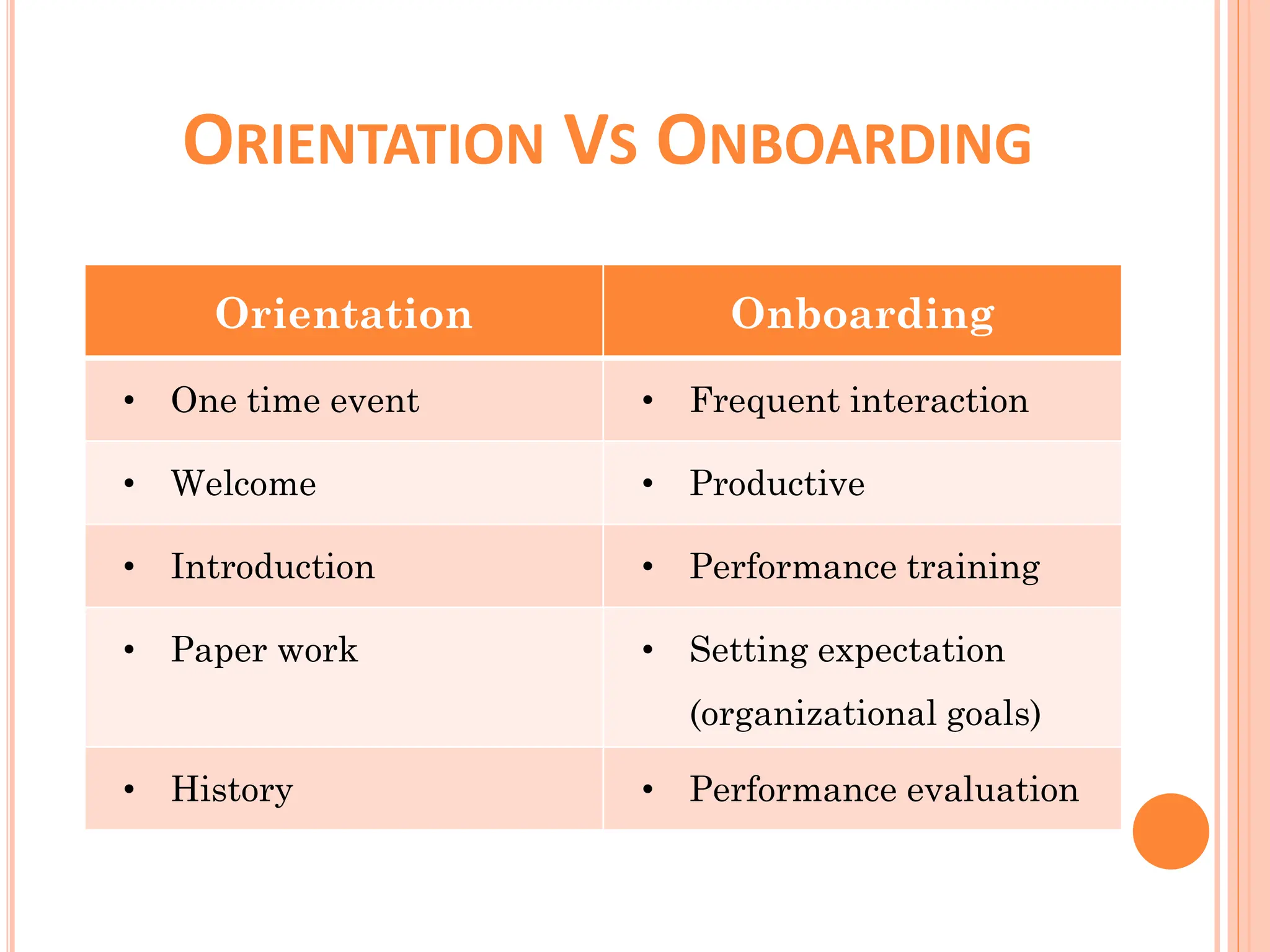
ORIENTATION VS ONBOARDING
Orientation Onboarding
• One time event • Frequent interaction
• Welcome • Productive
• Introduction • Performance training
• Paper work • Setting expectation
(organizational goals)
• History • Performance evaluation
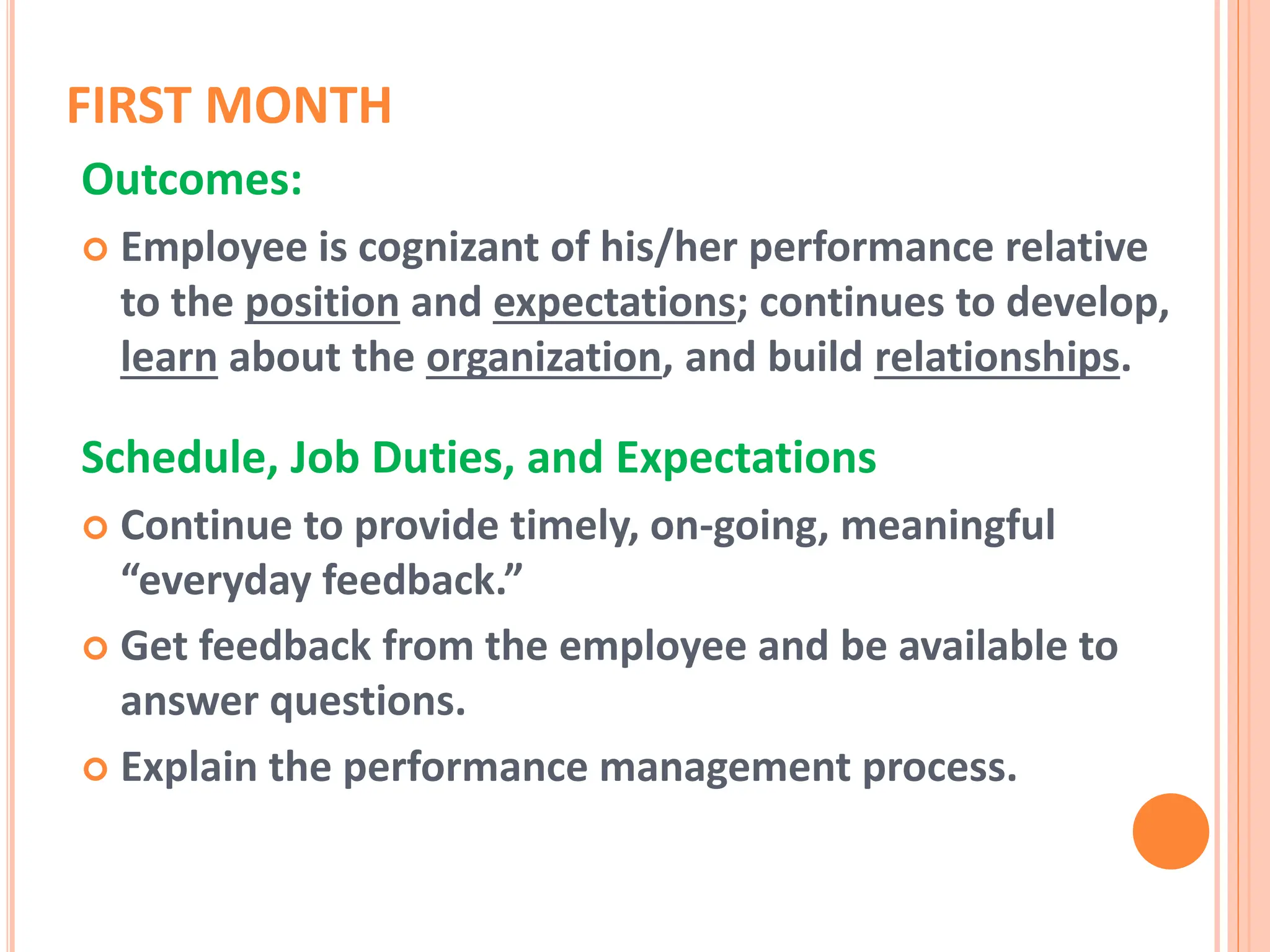
FIRST MONTH
Outcomes:
 Employee is cognizant of his/her performance relative
to the position and expectations; continues to develop,
learn about the organization, and build relationships.
Schedule, Job Duties, and Expectations
 Continue to provide timely, on-going, meaningful
“everyday feedback.”
 Get feedback from the employee and be available to
answer questions.
 Explain the performance management process.
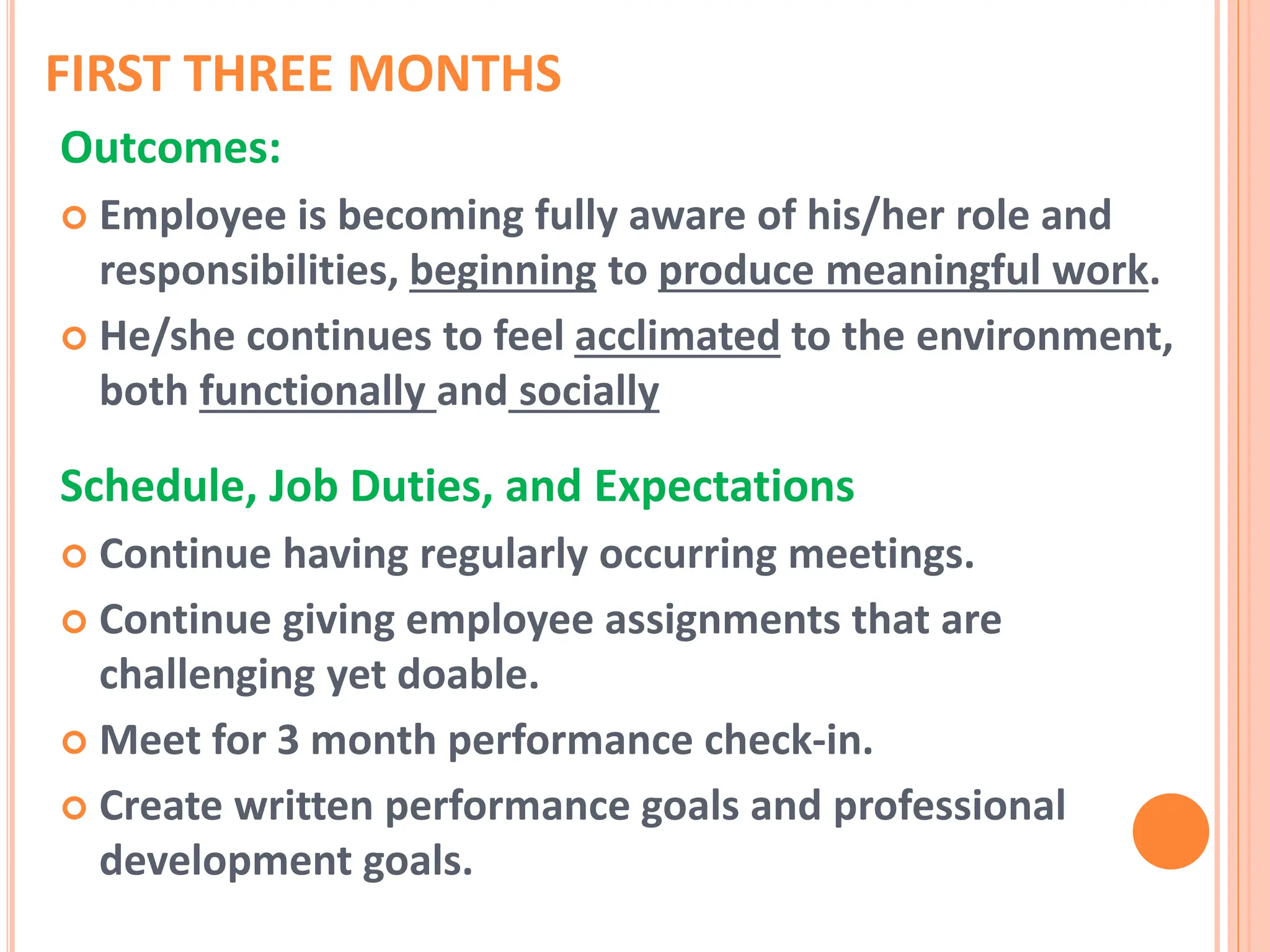
FIRST THREE MONTHS
Outcomes:
 Employee is becoming fully aware of his/her role and
responsibilities, beginning to produce meaningful work.
 He/she continues to feel acclimated to the environment,
both functionally and socially
Schedule, Job Duties, and Expectations
 Continue having regularly occurring meetings.
 Continue giving employee assignments that are
challenging yet doable.
 Meet for 3 month performance check-in.
 Create written performance goals and professional
development goals.
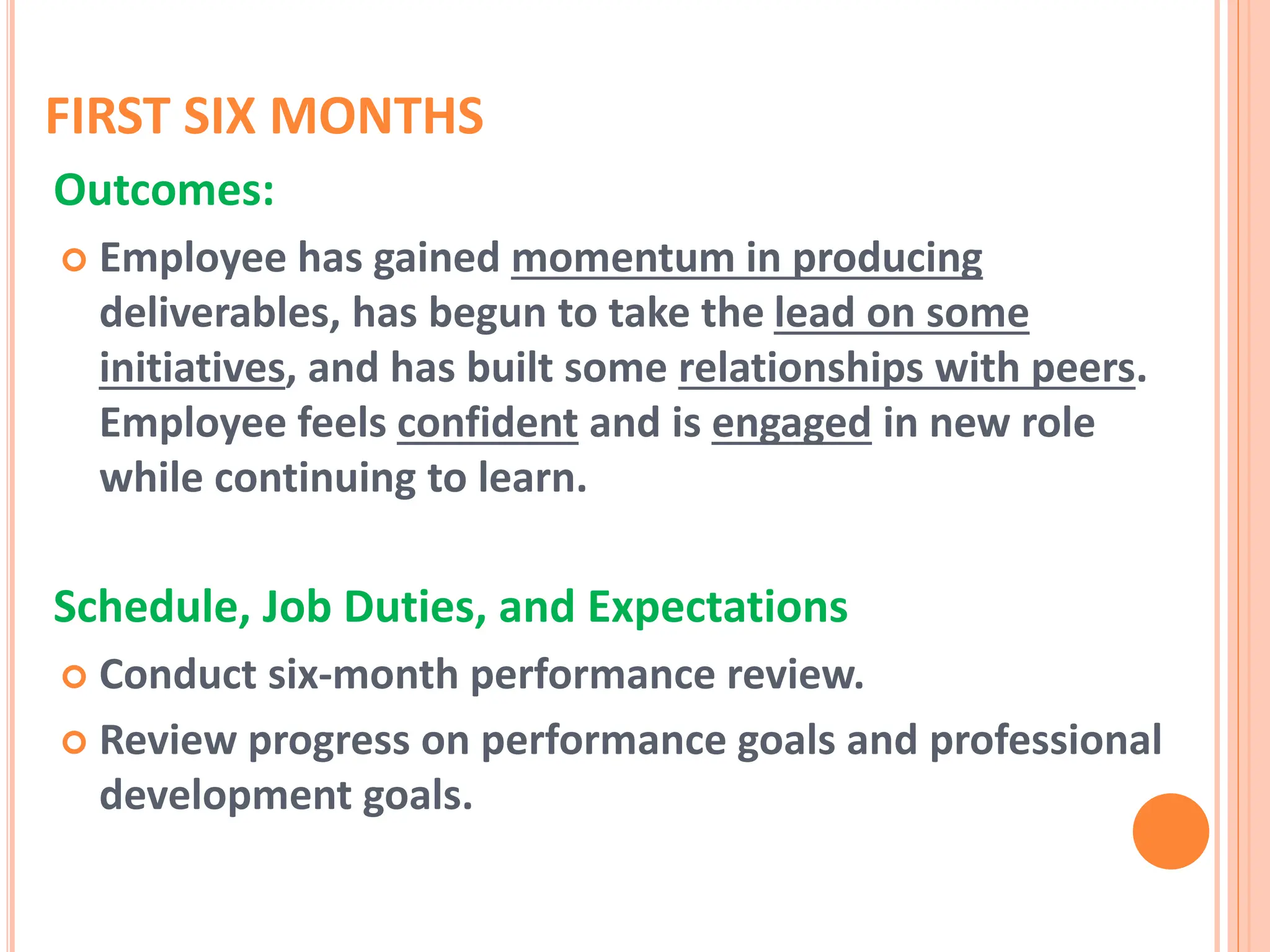
FIRST SIX MONTHS
Outcomes:
 Employee has gained momentum in producing
deliverables, has begun to take the lead on some
initiatives, and has built some relationships with peers.
Employee feels confident and is engaged in new role
while continuing to learn.
Schedule, Job Duties, and Expectations
 Conduct six-month performance review.
 Review progress on performance goals and professional
development goals.
FIRST YEAR [BETWEEN 6 & 12 MONTHS]
Outcomes:
 Employee is fully engaged in new role – applies skills and
knowledge, makes sound decisions, contributes to team goals,
understands how his/her assignments affect others in the
organization, and develops effective working relationships.
 Employee has gained greater confidence in position; begins to take
on additional assignments and works with level of autonomy.
Schedule, Job Duties, and Expectations
 Celebrate successes and recognition of employee’s contributions.
 Provide formal feedback during the annual review process.
 Have a conversation with employee about his/her experience at
the company (Extent to which employee’s expectations of role
and align with reality).
 Begin discussing the year ahead.
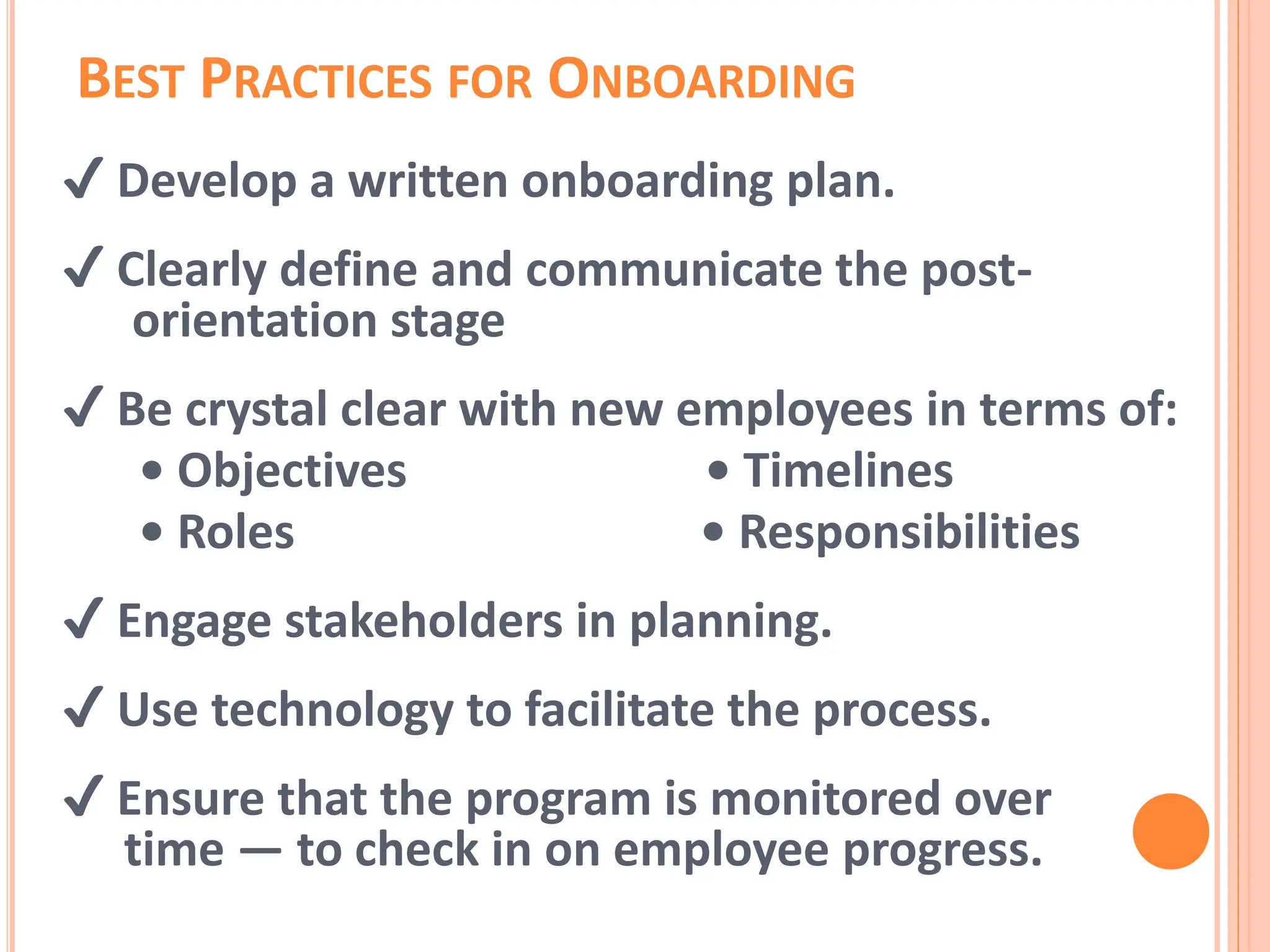
BEST PRACTICES FOR ONBOARDING
✔ Develop a written onboarding plan.
✔ Clearly define and communicate the post-
orientation stage
✔ Be crystal clear with new employees in terms of:
• Objectives • Timelines
• Roles • Responsibilities
✔ Engage stakeholders in planning.
✔ Use technology to facilitate the process.
✔ Ensure that the program is monitored over
time — to check in on employee progress.
EVALUATION AND FOLLOW UP
 The process of evaluation should occur
over a period of time.
 Consider asking for written feedback
from orientation/ onboarding
participants.
 Ensure that the feedback is used to
change and modify the orientation/
onboarding program to better meet the
needs of the new employees.
 Share feedback with managers and
suggest methods to implement change.
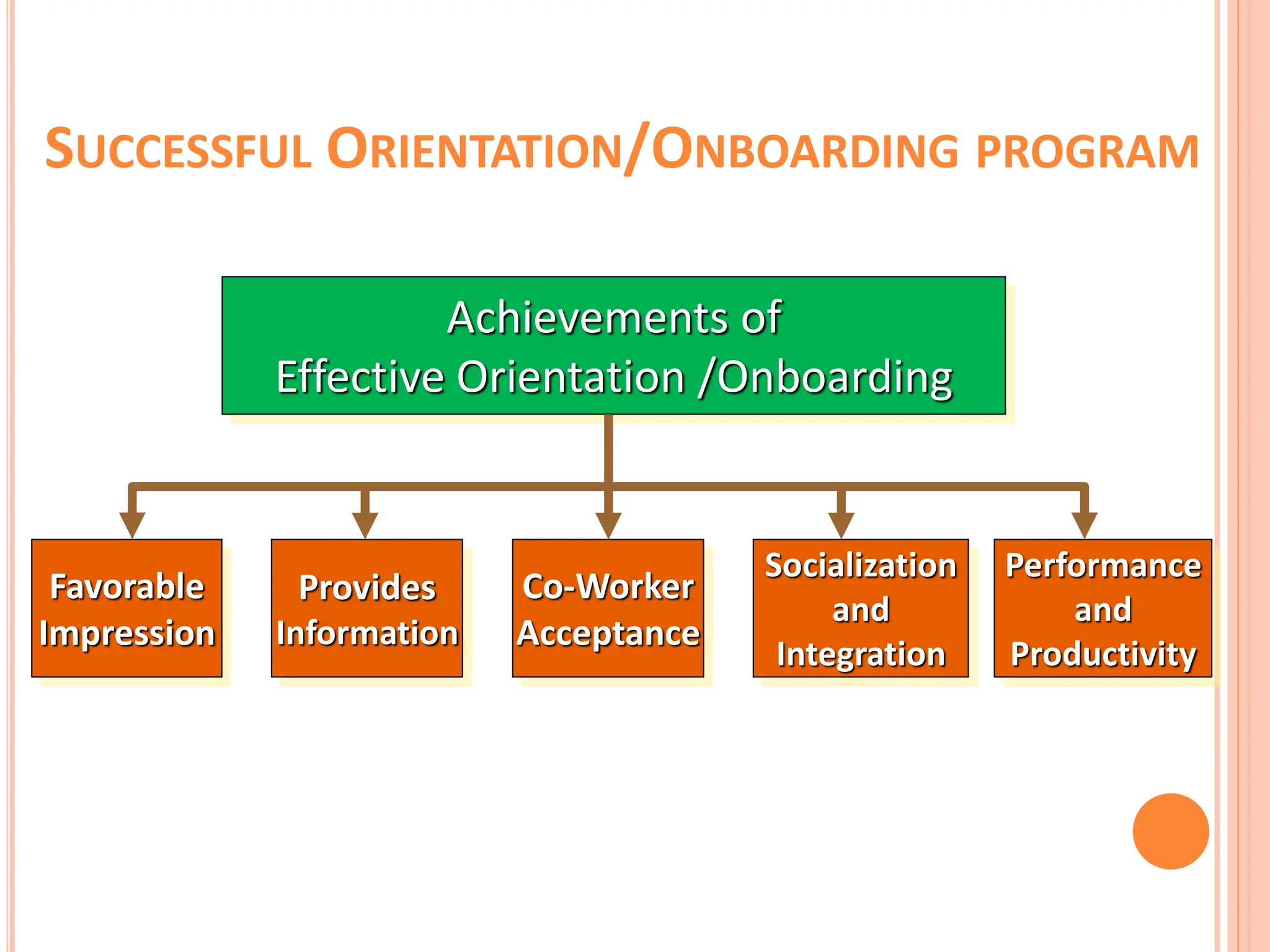
SUCCESSFUL ORIENTATION/ONBOARDING PROGRAM
Achievements of
Effective Orientation /Onboarding
Co-Worker
Acceptance
Favorable
Impression
Provides
Information
Socialization
and
Integration
Performance
and
Productivity

chabter 1 & 2 Orientation & Onboarding.pdf

  • 1.
  • 2.
    Do you Rememberyour 1st working day? Do you have a formal Orientation program in your organization?
  • 3.
    Recruiting and selectionhigh potential employees doesn’t guarantee they will perform effectively even if they want to.
  • 4.
    Therefore your nextstep is to ensure that your employees know what to do and how to do it.
  • 5.
    EMPLOYEE ORIENTATION A systematicand planned introduction of new employees to their jobs, co- workers and the organization.
  • 6.
    EMPLOYEE ORIENTATION It providesthem with the tools & necessary information to perform job function
  • 7.
    WHY? Reduce the newemployees anxiety.
  • 8.
  • 9.
    WHY? Provide employee withinformation he/she needs to function comfortably and effectively in the organization.
  • 10.
    WHY? Reduce employee turnover  4% leave their new jobs after a disastrous first day.  22% of employees leaves jobs within the first 45 days  Turnover costs 150% of an employee’s salary
  • 11.
    WHY? Develop realistic jobexpectation and job satisfaction
  • 12.
    From the moment ajob offer is accepted or any one is promoted or transferred you have employee to bring in to the fold. WHEN?
  • 13.
     HR Specialist Direct supervisor WHO CONDUCT OR INVOLVED IN?
  • 14.
  • 15.
    TASKS TO BECOMPLETED PRIOR TO SESSION:
  • 16.
    TASKS TO BECOMPLETED PRIOR TO SESSION:  Advise Board members and staff of the new employee’s name, position, and start date New employee
  • 17.
    TASKS TO BECOMPLETED PRIOR TO SESSION:  Arrange for a workspace
  • 18.
    TASKS TO BECOMPLETED PRIOR TO SESSION:  Equip the workplace with the necessary furniture, equipment and supplies
  • 19.
    TASKS TO BECOMPLETED PRIOR TO SESSION:  Ensure that all equipment is working
  • 20.
    TASKS TO BECOMPLETED PRIOR TO SESSION:  Set up an e-mail address
  • 21.
    TASKS TO BECOMPLETED PRIOR TO SESSION:  Set-up a telephone extension
  • 22.
    TASKS TO BECOMPLETED PRIOR TO SESSION:  Add the employee to organizational lists – telephone, e-mail
  • 23.
    TASKS TO BECOMPLETED PRIOR TO SESSION:  If employee will need a key to access office, arrange to have it ready for the first day
  • 24.
    TASKS TO BECOMPLETED PRIOR TO SESSION:  Make a copy of the job description
  • 25.
    TASKS TO BECOMPLETED PRIOR TO SESSION:  Add employee information on HR system
  • 26.
    TASKS TO BECOMPLETED PRIOR TO SESSION:  Prepare /Complete the necessary paperwork for pay and benefits
  • 27.
    TASKS TO BECOMPLETED PRIOR TO SESSION:  Set up the orientation team – who will be doing what for the orientation
  • 28.
    TASKS TO BECOMPLETED PRIOR TO SESSION:  Have Orientation check list
  • 29.
    FIRST DAY  Keepyour schedule as free as possible for the first day Getting Started  Welcome the new employee  Personal introduction and individual history with the company  Outline the orientation process for the day
  • 30.
  • 31.
    INDUSTRY AND ORGANIZATIONALOVERVIEW Handout of industry information and resources Overview of the organization  Vision statement  Mission statement  Values, code of ethics  Major products and services  Company history and worksites  Competitors  Last annual report and current information Organization chart(s)
  • 32.
    EMPLOYEE ROLE Review theemployee’s job description and expected outcomes Stress importance of employees to the company Explain how the job is related to the other jobs in the organization
  • 33.
    WORK EXPECTATION It shouldbe explained and the participants referred to the handbook or other explanatory material for more information. It includes:  Working hours (start& end time)  Tea &coffee breaks, launch time.  Paid time off, such as vacation, sick, holiday and personal days  Dress code  Employee benefits
  • 34.
    WORK EXPECTATION  Payprocessing including pay days, how pay is distributed, and automatic deposit  Probationary period  Transportation facilities  Employee lives.  Special words and phrases used by work group abbreviations.  Safety procedures and measures  Grievance system  Opportunities for training, promotion, transfers …etc
  • 35.
    POLICY & PROCEDURESREVIEW Copies of written rules, policies and procedures other than in the handbook. New employees should be encouraged to ask questions about any work-related matter of concern to them.
  • 36.
    WORKPLACE TOUR Give theemployee a tour of the assigned workspace and the rest of the office/facility including:
  • 37.
    WORKPLACE TOUR Facilities’ location Employee entrance and exit. (how to use)  Rest rooms / washrooms  Eating places  Parking and bus stops  Lockers to safely put belonging as where to hang coat, store lunch,…etc  Equipment could be used as photocopier, fax machine, and supplies, etc.
  • 38.
    WORKPLACE TOUR Health andsafety considerations as  Safe procedures  Emergency exits  First aid Kit / Clinic  Whom to contact in case of problems or difficulties Show employee’s office Introduce the new employee to his/her Manager
  • 39.
  • 40.
    SUPERVISOR Help employee toreduce first day jilters Introduce the new employee to his/ her new colleagues. Explain the job duties, responsibilities and the expected performance. Give the employee reports, information that is need for the job and explain each item is.
  • 41.
    LUNCH/ COFFEE BREAKWITH NEW COLLEAGUES
  • 43.
    PROBLEMS OF ORIENTATION Employeedoesn’t feel welcome.
  • 44.
    PROBLEMS OF ORIENTATION Theprogram is not well planned.
  • 45.
    PROBLEMS OF ORIENTATION Boring(Too many one way communication)
  • 46.
  • 47.
    PROBLEMS OF ORIENTATION Toomuch selling of the organization.
  • 48.
  • 49.
     The processof new employee assimilation into his or her position with a quicker ramp-up to productivity.  It is an expansion of the initial orientation  It can last up to 6 months or a year. ONBOARDING
  • 50.
    ORIENTATION VS ONBOARDING OrientationOnboarding • One time event • Frequent interaction • Welcome • Productive • Introduction • Performance training • Paper work • Setting expectation (organizational goals) • History • Performance evaluation
  • 51.
    FIRST MONTH Outcomes:  Employeeis cognizant of his/her performance relative to the position and expectations; continues to develop, learn about the organization, and build relationships. Schedule, Job Duties, and Expectations  Continue to provide timely, on-going, meaningful “everyday feedback.”  Get feedback from the employee and be available to answer questions.  Explain the performance management process.
  • 52.
    FIRST THREE MONTHS Outcomes: Employee is becoming fully aware of his/her role and responsibilities, beginning to produce meaningful work.  He/she continues to feel acclimated to the environment, both functionally and socially Schedule, Job Duties, and Expectations  Continue having regularly occurring meetings.  Continue giving employee assignments that are challenging yet doable.  Meet for 3 month performance check-in.  Create written performance goals and professional development goals.
  • 53.
    FIRST SIX MONTHS Outcomes: Employee has gained momentum in producing deliverables, has begun to take the lead on some initiatives, and has built some relationships with peers. Employee feels confident and is engaged in new role while continuing to learn. Schedule, Job Duties, and Expectations  Conduct six-month performance review.  Review progress on performance goals and professional development goals.
  • 54.
    FIRST YEAR [BETWEEN6 & 12 MONTHS] Outcomes:  Employee is fully engaged in new role – applies skills and knowledge, makes sound decisions, contributes to team goals, understands how his/her assignments affect others in the organization, and develops effective working relationships.  Employee has gained greater confidence in position; begins to take on additional assignments and works with level of autonomy. Schedule, Job Duties, and Expectations  Celebrate successes and recognition of employee’s contributions.  Provide formal feedback during the annual review process.  Have a conversation with employee about his/her experience at the company (Extent to which employee’s expectations of role and align with reality).  Begin discussing the year ahead.
  • 55.
    BEST PRACTICES FORONBOARDING ✔ Develop a written onboarding plan. ✔ Clearly define and communicate the post- orientation stage ✔ Be crystal clear with new employees in terms of: • Objectives • Timelines • Roles • Responsibilities ✔ Engage stakeholders in planning. ✔ Use technology to facilitate the process. ✔ Ensure that the program is monitored over time — to check in on employee progress.
  • 56.
    EVALUATION AND FOLLOWUP  The process of evaluation should occur over a period of time.  Consider asking for written feedback from orientation/ onboarding participants.  Ensure that the feedback is used to change and modify the orientation/ onboarding program to better meet the needs of the new employees.  Share feedback with managers and suggest methods to implement change.
  • 57.
    SUCCESSFUL ORIENTATION/ONBOARDING PROGRAM Achievementsof Effective Orientation /Onboarding Co-Worker Acceptance Favorable Impression Provides Information Socialization and Integration Performance and Productivity