Writing2001
Dr. Ángel G. Graciani Germán
CPL,
Objectives of Course
• 1. Examine the content and organization of articles used for social and behavioral sciences.
• 2. Conduct a search of psychological literature using the catalog and databases available at the
Information Access Center.
• 3. Employ the APA's editorial style consistently.
• 4. Use non-discriminatory vocabulary in writing a manuscript.
• 5. Identify the components necessary to produce direct, indirect, and secondary citations in a
manuscript.
• 6. Identify the components needed to write data collection instruments.
• 7. Identify the components needed to develop the reference list of a manuscript.
• 8. Develop the reference list by incorporating different information resources.
• 9. Develop an appropriate manuscript that meets the requirements of the PLA.
• Empirical Studies
• Literature Review
• Theoretical articles
• Methodological articles
• Case studies
• Critical Analysis
• Monograph
Content
Style of writing for social and behavioral sciences: Types of articles
2. Selection of the topic for report writing.
B. Conduct a search for psychological literature
1. Search the library catalogue
2. Using databases to retrieve scientific literature
APA Editorial
Style
1. Score
2. Spelling
•Capital letters
•Italics
5. Abbreviations
6. Headings and series
7. Numbers
8. Statistical and mathematical material
9. Tables
10. Figures
11. Footnotes
12. Appendices
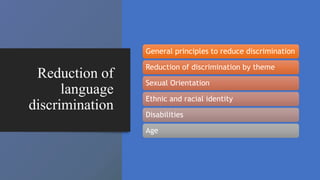
Reduction of
language
discrimination
General principles to reduce discrimination
Reduction of discrimination by theme
Sexual Orientation
Ethnic and racial identity
Disabilities
Age
Appointment
Writing
1. Direct citation of sources
2. Paraphrasing of the material
3. Direct online material quotes
4. Quotations within the textual quotations
5. Citation of references in the text
6. Quoting from groups of authors
7. Works by unidentified authors
8. Two or more works within the same parenthesis
9. Secondary Sources
10. Plagiarism and its implications in the academic field.
Writing
instruments to
collect data.
Preparation of
Questionnaire
2. Interview
preparation
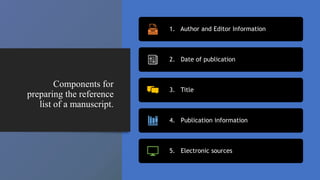
Components for
preparing the reference
list of a manuscript.
1. Author and Editor Information
2. Date of publication
3. Title
4. Publication information
5. Electronic sources
Reference Lists
1. Periodic
publications
2. Books,
pamphlets and
book chapters
3. Technical and
research reports
4. Minutes of
assemblies and
symposia
5. Doctoral
dissertations and
master's theses
6. Unpublished
work and
publications of
limited circulation
7. Reviews
8. Audiovisual
media
9. Electronic
means
Preparation of the
manuscript and
sample document
1. General instructions for
the preparation of the
manuscript
2. Instructions for typing
parts of the manuscript

PRONTUARIO.pptx

  • 1.
    Writing2001 Dr. Ángel G.Graciani Germán CPL,
  • 2.
    Objectives of Course •1. Examine the content and organization of articles used for social and behavioral sciences. • 2. Conduct a search of psychological literature using the catalog and databases available at the Information Access Center. • 3. Employ the APA's editorial style consistently. • 4. Use non-discriminatory vocabulary in writing a manuscript. • 5. Identify the components necessary to produce direct, indirect, and secondary citations in a manuscript. • 6. Identify the components needed to write data collection instruments. • 7. Identify the components needed to develop the reference list of a manuscript. • 8. Develop the reference list by incorporating different information resources. • 9. Develop an appropriate manuscript that meets the requirements of the PLA.
  • 3.
    • Empirical Studies •Literature Review • Theoretical articles • Methodological articles • Case studies • Critical Analysis • Monograph Content Style of writing for social and behavioral sciences: Types of articles
  • 4.
    2. Selection ofthe topic for report writing. B. Conduct a search for psychological literature 1. Search the library catalogue 2. Using databases to retrieve scientific literature
  • 5.
    APA Editorial Style 1. Score 2.Spelling •Capital letters •Italics 5. Abbreviations 6. Headings and series 7. Numbers 8. Statistical and mathematical material 9. Tables 10. Figures 11. Footnotes 12. Appendices
  • 6.
    Reduction of language discrimination General principlesto reduce discrimination Reduction of discrimination by theme Sexual Orientation Ethnic and racial identity Disabilities Age
  • 7.
    Appointment Writing 1. Direct citationof sources 2. Paraphrasing of the material 3. Direct online material quotes 4. Quotations within the textual quotations 5. Citation of references in the text 6. Quoting from groups of authors 7. Works by unidentified authors 8. Two or more works within the same parenthesis 9. Secondary Sources 10. Plagiarism and its implications in the academic field.
  • 8.
    Writing instruments to collect data. Preparationof Questionnaire 2. Interview preparation
  • 9.
    Components for preparing thereference list of a manuscript. 1. Author and Editor Information 2. Date of publication 3. Title 4. Publication information 5. Electronic sources
  • 10.
    Reference Lists 1. Periodic publications 2.Books, pamphlets and book chapters 3. Technical and research reports 4. Minutes of assemblies and symposia 5. Doctoral dissertations and master's theses 6. Unpublished work and publications of limited circulation 7. Reviews 8. Audiovisual media 9. Electronic means
  • 11.
    Preparation of the manuscriptand sample document 1. General instructions for the preparation of the manuscript 2. Instructions for typing parts of the manuscript