Revision 1


Revised Handbook for

Promoting Behavior-Based
Energy Efficiency
in Military Housing


Prepared for the
U.S. Department of Energy
Office of Energy Efficiency and Renewable Energy
Federal Energy Management Program


Prepared by
Pacific Northwest National Laboratory
Andrea H. McMakin
Regina E. Lundgren
Elizabeth L. Malone


March 2000
DISCLAIMER


This report was prepared as an account of work sponsored by an agency of the
United States Government. Neither the United States Government nor any
agency thereof, nor Battelle Memorial Institute, nor any of their employees,
makes any warranty, express or implied, or assumes any legal liability or
responsibility for the accuracy, completeness, or usefulness of any infor­
mation, apparatus, product, or process disclosed, or represents that its
use would not infringe privately owned rights. Reference herein to any spe­
cific commercial product, process, or service by trade name, trademark, manu­
facturer, or otherwise does not necessarily constitute or imply its endorsement,
recommendation, or favoring by the United States Government or any agency
thereof, or Battelle Memorial Institute. The views and opinions of authors
expressed herein do not necessarily state or reflect those of the United States
Government or any agency thereof.


                PACIFIC NORTHWEST NATIONAL LABORATORY

                                 operated by

                                  BATTELLE

                                    for the

                  UNITED STATES DEPARTMENT OF ENERGY

                     under Contract DE-AC06-76RLO 1830


                           Printed in the United States of America

          Available from DOE’s Energy Efficiency and Renewable Energy Clearinghouse,
 1-800-363-3732, P.O. Box 3048, Merrifield, VA 22116, www.eren.doe.gov, fax: 202-586-3000


                      This document was printed on recycled paper.
Revision 1


Revised Handbook for Promoting
Behavior-Based Energy
Efficiency in Military Housing


Andrea H. McMakin
Regina E. Lundgren
Elizabeth L. Malone(a)


March 2000


Prepared for
the U.S. Department of Energy
under Contract DE-AC06-76RLO 1830


Pacific Northwest National Laboratory
Richland, Washington 99352


(a) Battelle’s Washington Office, Washington, DC
Contents

Preface .................................................................................................................. iii

Acknowledgments ................................................................................................ iv

1.0      Introduction ...............................................................................................       1


         1.1     Background ........................................................................................        1

         1.2 Purpose and Audience .....................................................................                     1


         1.3 Scope and Use ..................................................................................               1

         1.4 What the Handbook Contains ......................................................... 2

2.0      Energy Efficiency in On-Base Military Housing ................................. 2


         2.1	 Drivers ................................................................................................ 2

         2.2	 Characteristics of Military Bases and Populations .................... 3


         2.3	 In Summary: Energy Efficiency in On-Base

              Military Housing ............................................................................... 5

3.0      Planning the Effort .................................................................................. 6


         3.1 Resources Required ......................................................................... 6

         3.2 Options for Approaches ................................................................. 8

         3.3 In Summary: Planning the Effort ................................................. 10


4.0      Designing and Executing a Campaign .................................................... 10

         4.1 Establish Goals .................................................................................. 10


         4.2 Establish Objectives ........................................................................ 11

         4.3	 Set a Budget ...................................................................................... 11


         4.4	 Set a Schedule .................................................................................. 12

         4.5	 Understand Your Base Setting by Talking with Residents

              and Officials ..................................................................................... 12


         4.6 Consider a Pre-Survey .................................................................... 14

         4.7	 Identify Desired Behaviors ............................................................ 16

         4.8	 Select Themes, Messages, and Visuals ......................................... 17


         4.9	 Choose Communication Channels .................................................... 19

         4.10 Identify Motivators and Incentives ............................................. 20


         4.11 Get the Word Out ............................................................................. 23

         4.12 Conduct Activities and Involve Residents.................................... 26

         4.13 In Summary: Designing and Executing a Campaign .................. 27


5.0      Evaluating and Reporting on the Campaign ........................................... 29

         5.1 Mid-Course Evaluation ..................................................................... 29


         5.2 Final Evaluation................................................................................. 30


U.S. Department of Energy, Federal Energy Management Program © March 2000                                                         i
5.3 Factors that Affect Energy Use Results ..................................... 32

       5.4 Reporting on and Publicizing Results ............................................ 34

       5.5 In Summary: Evaluating and Reporting on the Campaign ......... 34


6.0    Sustaining the Effort ............................................................................... 35

       6.1 Reaching Newcomers ....................................................................... 35


       6.2 Self-Motivation ................................................................................. 36

       6.3 Commitment ........................................................................................ 36

       6.4 Feedback through Mock Billing ..................................................... 37


       6.5 Institutionalization ........................................................................... 38

       6.6 In Summary: Sustaining the Effort ............................................. 39


7.0    Reference Materials and Resources...................................................... 39

Appendix A: Typical Budget Items for a Campaign .................................... A.1

Appendix B: Examples of Printed Information Materials .......................... B.1


Appendix C: Survey Examples ......................................................................... C.1

Appendix D: Example Video Script ................................................................ D.1


Appendix E: Additional Resources ................................................................. E.1

Appendix F: Process for Accounting for Weather Effects in

            Energy-Use Data ........................................................................ F.1


ii                                Promoting Behavior-Based Energy Efficiency in Military Housing
Preface

The mission of the U.S. Department of Energy’s Federal Energy Manage­
ment Program (FEMP) is to reduce the cost of government by advancing
energy efficiency, water conservation, and the use of solar and other
renewable technologies. This is accomplished by creating partnerships,
leveraging resources, transferring technology, and providing training and
technical guidance and assistance to agencies. These activities sup­
port requirements stated in the Energy Policy Act of 1992 and goals
established in the June 1999 Executive Order 13123.
To bolster energy awareness across the federal government, FEMP
launched a communications campaign entitled “You Have the Power” in
1997. This campaign assists federal energy managers by spreading the
word about energy-efficient practices and products, as well as facilitating
partnerships with energy-related organizations in the private sector. The
campaign is intended to instill energy efficiency as a basic value among
federal workers and the public.
The Pacific Northwest National Laboratory (PNNL) supports the FEMP
mission in all activity areas, including the “You Have the Power” campaign.
Specifically, PNNL is working with FEMP to develop methods for promot­
ing energy efficiency in federal facilities. In doing so, the cost of govern­
ment can be further decreased.
This handbook suggests ways federal energy managers can take the “You
Have the Power” campaign one step further: to develop site-specific
activities that encourage residents of military family housing to use
energy more efficiently. The approach and examples provided in the hand­
book are based on two campaigns conducted for FEMP—one at the Fort
Lewis Army Installation in Washington State and the other at the Marine
Corps Air Station in Yuma, Arizona. This revised handbook reflects insights
from the final energy data and resident survey results from the two
campaigns.


U.S. Department of Energy, Federal Energy Management Program © March 2000   iii
Acknowledgments

This handbook benefits greatly from lessons learned from energy-
efficiency campaigns conducted at Fort Lewis Army Installation, near
Tacoma, Washington, and the Marine Corps Air Station, Yuma, Arizona, in
1998 and 1999. The campaigns were a cooperative effort between the
U.S. Department of Energy’s Federal Energy Management Program (FEMP),
Fort Lewis, and the Yuma Air Station.
Annie Haskins, Outreach Program Manager for FEMP, provided guidance
and assistance. FEMP’s Tatiana Muessel provided early guidance and
direction.

In conducting the campaign at Fort Lewis, we are indebted to contribu­
tions from Fort Lewis’s Department of Public Works, especially Resource
Efficiency Manager Charles Howell, personnel from the Base’s Housing and
Training departments, mayors, and of course the residents themselves. At
the Yuma Air Station, we thank Housing Manager Mark Smith, Assistant
Housing Manager Pat Queen, and Energy Manager Ron Durfey and his
Energy Monitors Gunnery Sergeants Dale Billingsley and Daniel Drier. We
also thank Anne N’Ait Ali and her Family Childcare Providers Network for
their insightful comments and assistance.

We thank energy science professionals at Pacific Northwest National
Laboratory for technical assistance, guidance, and review. We thank
Merrilee Harrigan, the Alliance to Save Energy, for review and sugges­
tions. We thank Judi Heerwagen, former Laboratory staff member, for
early direction. We also appreciate Washington State University Coopera­
tive Extension Program’s Energy Ideas Clearinghouse for making additional
resources available to us.


Andrea McMakin
Regina Lundgren
Elizabeth Malone


Pacific Northwest National Laboratory
March 2000


U.S. Department of Energy, Federal Energy Management Program © March 2000   iv
1.0 Introduction

This revised handbook was prepared as part of a government energy-effi­
ciency program with emphasis on military housing, as described below.

1.1       Background
The U.S. Department of Energy’s Federal Energy Management Program
(FEMP) helps agencies reduce the cost of doing business through energy
efficiency, water conservation, and the use of solar and other renewable
energy. As a large energy user, the U.S. Department of Defense (DoD)
has been one of the government sectors of focus.

Several military installations have shown substantial energy savings since
1985. Most of these efficiency projects, however, have focused primarily
on physical upgrades, technologies, and purchasing habits. Further, most
projects have focused on administrative and operational areas of energy
use.

The energy-related behaviors of residents in military housing, in particu­
lar, have received little formal attention. Behavior-based change is a chal­
lenging, but potentially fruitful area for energy conservation programs.
Efforts to change behaviors involve links with values, social networks and
organizations, and new ways of thinking about living patterns. This hand­
book attempts to fill a gap by offering guidance for promoting such
efforts.

This revision of the handbook reflects insights from the final energy data
and resident survey results from two campaigns.

1.2       Purpose and Audience
This brief handbook is intended to be used by energy managers, housing
officials, and others who want to improve energy efficiency in on-base
residential housing by emphasizing behavioral changes.
Specifically, the handbook was written with two primary groups of people
in mind: 1) military personnel and contractors, and 2) nonmilitary organiza­
tions and groups, including Department of Energy employees, utilities, con­
tractors, energy coalitions, and universities.

1.3       Scope and Use
The guidelines here are based on low-cost or no-cost behaviors that resi­
dents can carry out themselves, as opposed to physical facility upgrades
or technology. The guidelines are particularly applicable to situations
where residents do not pay their own utility bills and thus are not moti­
vated to conserve energy by reducing personal expenditures.

The guidelines have been applied in field studies conducted at the Fort
Lewis Army Installation in Washington State and the Marine Corps Air
Station in Yuma, Arizona. However, the guidelines are intended to be


U.S. Department of Energy, Federal Energy Management Program   ©   March 2000   1
broad enough to apply in other situations. Individual bases should choose
                                                  and adapt their own activities to fit their unique situations.
                                                  For quick reference and ease of use, each section ends with a short list of
                                                  highlights, called “In Summary.” These highlights represent the essential
                                                  kernels of information necessary for planning, designing, implementing, and
                                                  evaluating a campaign.

                                                  1.4 What the Handbook Contains
                                                  The handbook describes some factors driving energy efficiency in military
                                                  housing and characteristics of military bases that affect residential en­
                                                  ergy use (2.0). Following sections describe steps in planning (3.0), con­
                                                  ducting (4.0), and evaluating (5.0) a campaign and sustaining the effort
                                                  (6.0).

                                                  The appendixes provide sample information materials, surveys, and other
                                                  resources.


2.0 Energy Efficiency in On-Base Military Housing
                                                  With literally thousands of facilities nationwide consuming significant
                                                  amounts of energy daily, why is military housing a particular area of focus?
                                                  And how might military housing residents be motivated to use energy effi­
                                                  ciently? The drivers and the unique characteristics of military populations
                                                  need to be understood in order to design an effective energy-efficiency
                                                  campaign.

                                                  2.1         Drivers
                                                  Several factors make military housing a prime target for energy
                                                  conservation:

                                                                          © Regulations and federal targets for energy con­
                                                                            servation are set in federal facilities. The fed­
                                                                            eral government has set goals of a 30% reduction
                                                                            in energy consumption from 1985 levels by fiscal
                                                                            year 2005. In June 1999, a Presidential Executive
                                                                            Order extended this goal to a 35% reduction in
                                                                            federal facilities by 2010 from 1985 levels.
                                                                          © Congressional and public scrutiny has
                                                                            increased taxpayer-funded military programs.
                                                                            Over the past several decades, the DoD has been
                                                                            held to increased standards of accountability,
                                                                            both by its funding source (Congress) and by citi­
                                                                            zens who pay for it and whose loved ones serve in
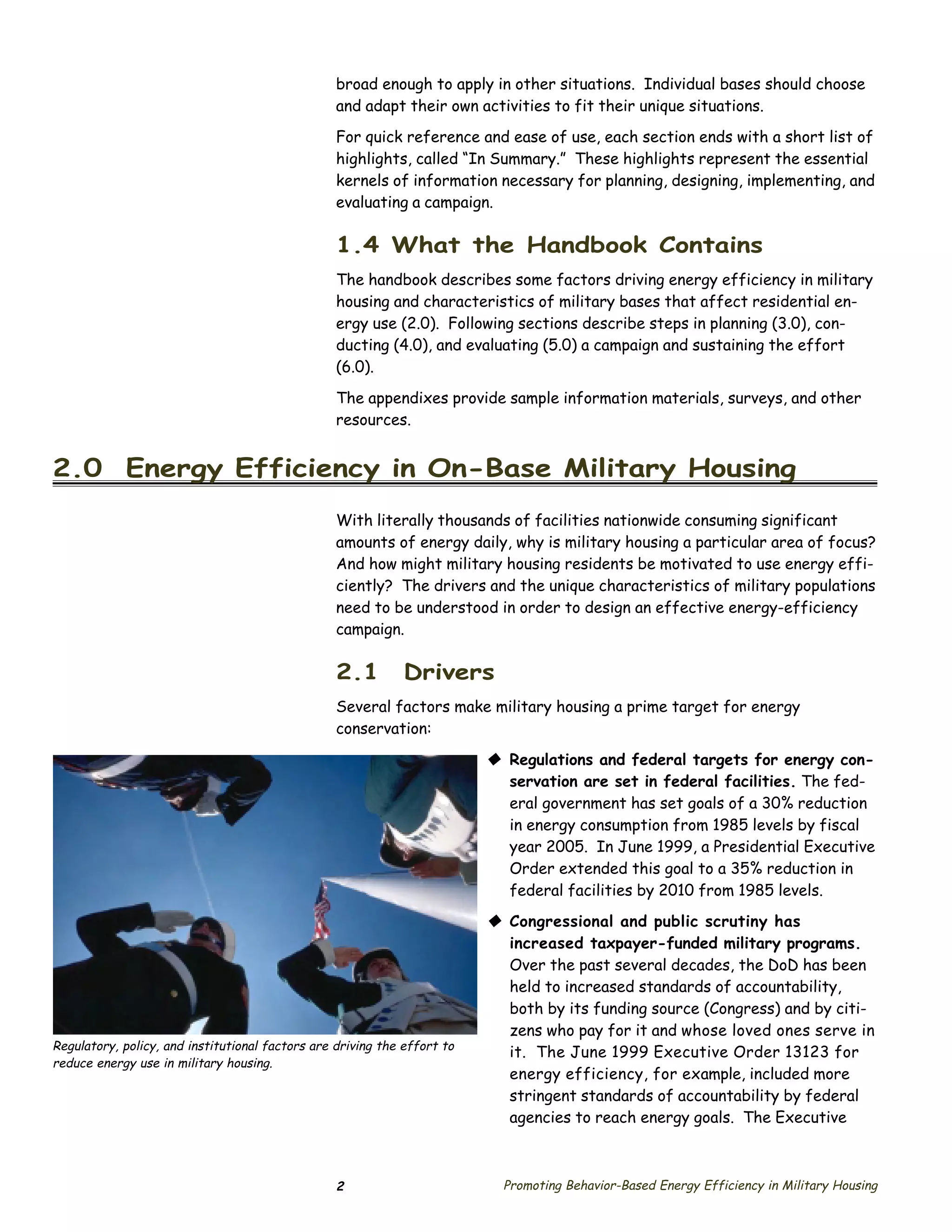
Regulatory, policy, and institutional factors are driving the effort to
                                                                            it. The June 1999 Executive Order 13123 for
reduce energy use in military housing.
                                                                            energy efficiency, for example, included more
                                                                            stringent standards of accountability by federal
                                                                            agencies to reach energy goals. The Executive


                                                  2                         Promoting Behavior-Based Energy Efficiency in Military Housing
Order requires each federal agency to submit an annual report to the
   President describing its progress in meeting energy reduction goals,
   and the Office of Management and Budget will evaluate each agency’s
   performance using “score cards” that are submitted to the President.
   The President’s Management Council will monitor agencies’ progress on
   energy management and identify ways to accelerate improvements. The
   military, being one of the largest energy users among federal agencies,
   is a particularly high-visibility target.
© Energy use in residential housing is a substantial portion of total
  base energy costs, representing an often-untapped source with
  large potential savings. The DoD is the largest energy user of all fed­
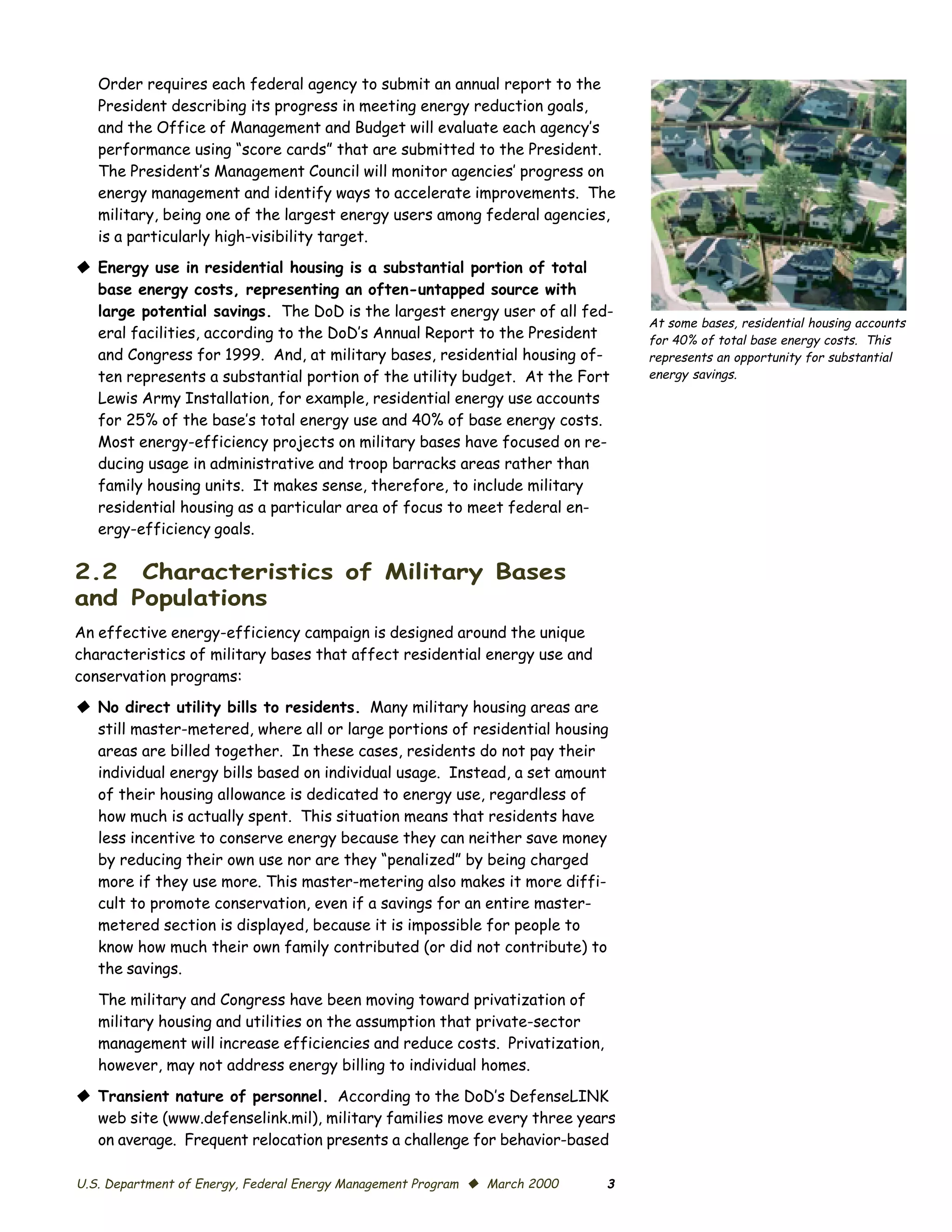
                                                                                At some bases, residential housing accounts
  eral facilities, according to the DoD’s Annual Report to the President        for 40% of total base energy costs. This
  and Congress for 1999. And, at military bases, residential housing of­        represents an opportunity for substantial
  ten represents a substantial portion of the utility budget. At the Fort       energy savings.
  Lewis Army Installation, for example, residential energy use accounts
  for 25% of the base’s total energy use and 40% of base energy costs.
  Most energy-efficiency projects on military bases have focused on re­
  ducing usage in administrative and troop barracks areas rather than
  family housing units. It makes sense, therefore, to include military
  residential housing as a particular area of focus to meet federal en­
  ergy-efficiency goals.

2.2 Characteristics of Military Bases
and Populations
An effective energy-efficiency campaign is designed around the unique
characteristics of military bases that affect residential energy use and
conservation programs:
© No direct utility bills to residents. Many military housing areas are
  still master-metered, where all or large portions of residential housing
  areas are billed together. In these cases, residents do not pay their
  individual energy bills based on individual usage. Instead, a set amount
  of their housing allowance is dedicated to energy use, regardless of
  how much is actually spent. This situation means that residents have
  less incentive to conserve energy because they can neither save money
  by reducing their own use nor are they “penalized” by being charged
  more if they use more. This master-metering also makes it more diffi­
  cult to promote conservation, even if a savings for an entire master-
  metered section is displayed, because it is impossible for people to
  know how much their own family contributed (or did not contribute) to
  the savings.

   The military and Congress have been moving toward privatization of
   military housing and utilities on the assumption that private-sector
   management will increase efficiencies and reduce costs. Privatization,
   however, may not address energy billing to individual homes.

© Transient nature of personnel. According to the DoD’s DefenseLINK
  web site (www.defenselink.mil), military families move every three years
  on average. Frequent relocation presents a challenge for behavior-based

U.S. Department of Energy, Federal Energy Management Program © March 2000   3
energy efficiency. If organizers are relying on people to be aware of
                                            the need to conserve energy and get into the habit of doing so, these
                                            behaviors must be reemphasized and relearned every so often with
                                            each new wave of residents, or the behaviors will not continue. This
                                            means a sustained effort—really what is needed is institutional
                                            change—that is ingrained into behavior regardless of where families
                                            move.

                                        © Varying housing quality that affects energy loss. Housing units on
                                          many military bases were constructed decades ago, some dating back to
                                          World War II. According to the DoD’s Annual Report to the President
                                          and Congress for 1999, two-thirds of the agency’s 297,000 existing
                                          housing units are in need of extensive repair. Houses may be under­
                                          going continual upgrades, and newer homes have more energy-efficient
                                          features. However, at any one time, families may be living in houses
                                          with inefficient energy features such as single-paned windows, inad­
                                          equate insulation, nonprogrammable thermostats, or inadequately
                                          sealed doors and windows. In these homes, energy efficiency will be
                                          limited by structural deficiencies, and resident behavior can accomplish
                                          only so much.

                                        © Limitations on upgrades. The military must carefully budget for and
                                          schedule housing upgrades while maintaining a consistency in housing
                                          conditions for its constantly changing residents. These restrictions
                                          can affect energy efficiency. For example, like civilian renters, many
                                          military families are restricted in upgrades they themselves can make
                                          to improve energy efficiency. For example, a base may not allow resi­
                                          dents to install plastic sheeting on windows to improve insulation.
                                            In addition, a base’s housing budget at any one time may pay for some
                                            things to do be done, but not others. For example, a base may pay for
                                            defective caulking around windows to be replaced, but not for caulking
                                            to be installed where none existed before. A base may pay to have a
                                            broken thermostat repaired but not replaced with a programmable one.

                                        © Chain of command and accountability. Instituting a campaign on a
                                          military base is somewhat like mounting a campaign inside a large corpo­
                                          ration that has many layers of approval and external oversight. The
                                          entire campaign usually requires the endorsement and involvement of
                                          one or more organizations, such as Housing, Public Works, and Energy
                                          Management. The approach, activities, and information materials must
                                          all be carefully reviewed and approved through the proper channels.
                                          Any financial incentives, of course, must be approved at appropriately
                                          high levels.

                                            Costs and/or time provided by the base for activities or materials are
                                            carefully scrutinized to ensure that they fit within the base’s mission
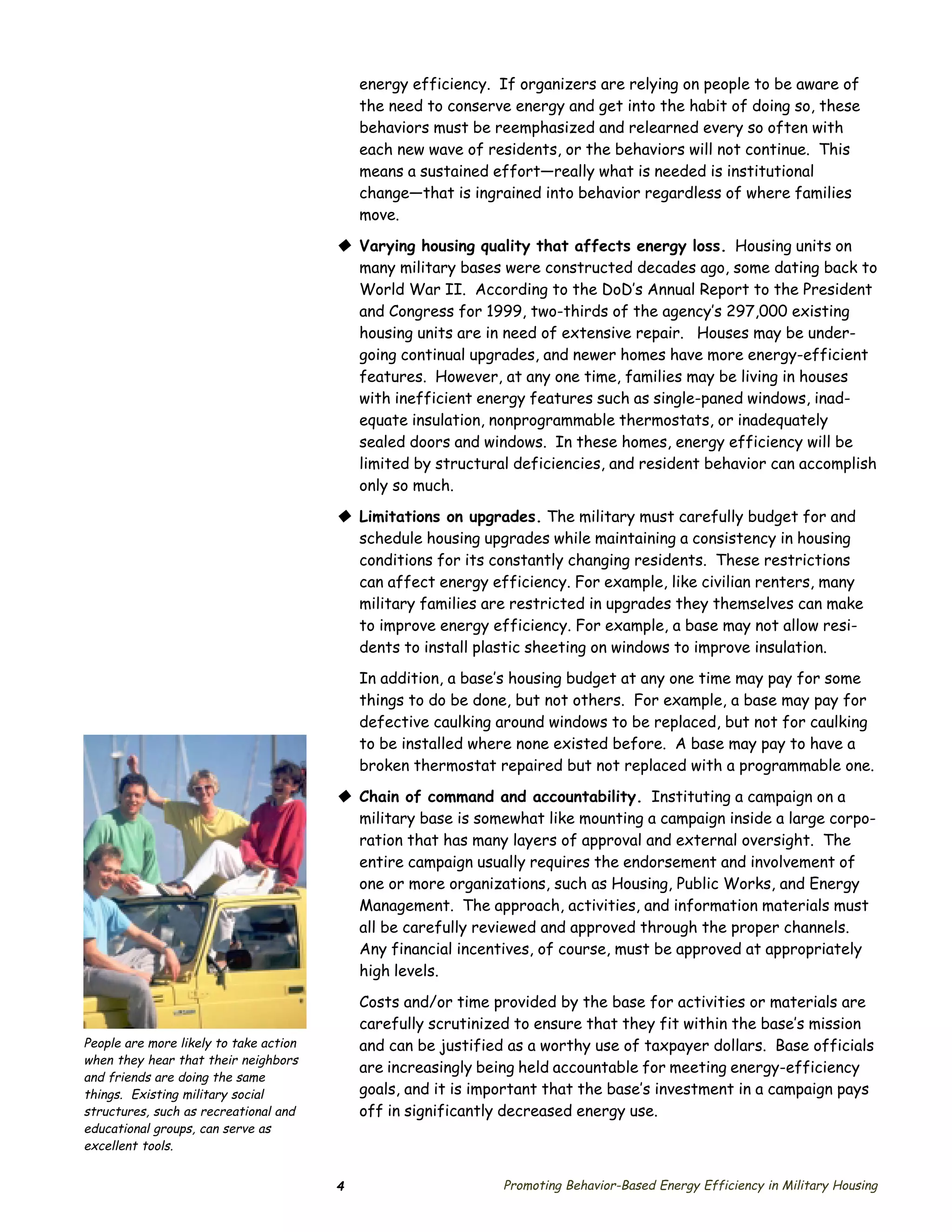
People are more likely to take action       and can be justified as a worthy use of taxpayer dollars. Base officials
when they hear that their neighbors
                                            are increasingly being held accountable for meeting energy-efficiency
and friends are doing the same
things. Existing military social            goals, and it is important that the base’s investment in a campaign pays
structures, such as recreational and        off in significantly decreased energy use.
educational groups, can serve as
excellent tools.


                                        4                       Promoting Behavior-Based Energy Efficiency in Military Housing
© Institutionalized family and social support structures. In the inter­
  est of supporting the well-being of troops and their families, most
  bases have extensive family and social support structures. These
  include programs for educational, social, spiritual, and recreational
  well-being. Many of the same programs enjoyed by civilians, such as
  Scouts, clubs, and recreational groups, are supported on military bases.

   Studies have shown that people are more likely to engage in long-term
   behavioral change when their neighbors and friends also engage in the
   behavior. These social structures can serve as excellent tools for
   designing and carrying out a campaign that is institutionalized across
   the base.
© Competition. Studies have shown that competition among similar
  groups improved workplace performance. The culture of competition
  that is ingrained into the military can be tapped into for a campaign.
   However, the frequent turnover in military housing may mean that com­
   petition in that setting may not be as effective as competition in pro­
   fessional military activities. It may be that competition between
   branches of the armed services would be a better source of motivation
   than competition among neighbors or neighborhoods.

© Patriotism. Patriotism, endemic in the military, can be an underlying
  message in a campaign, in terms of national goals and conserving our
  nation’s environmental resources. In fact, it has been argued that
  practicing energy conservation in the United States makes us less vul­
  nerable to worldwide oil crises that might prompt military intervention.

© Desire to do the right thing. Researchers mention this explicitly as a
  characteristic of military communities. Housing residents at Fort
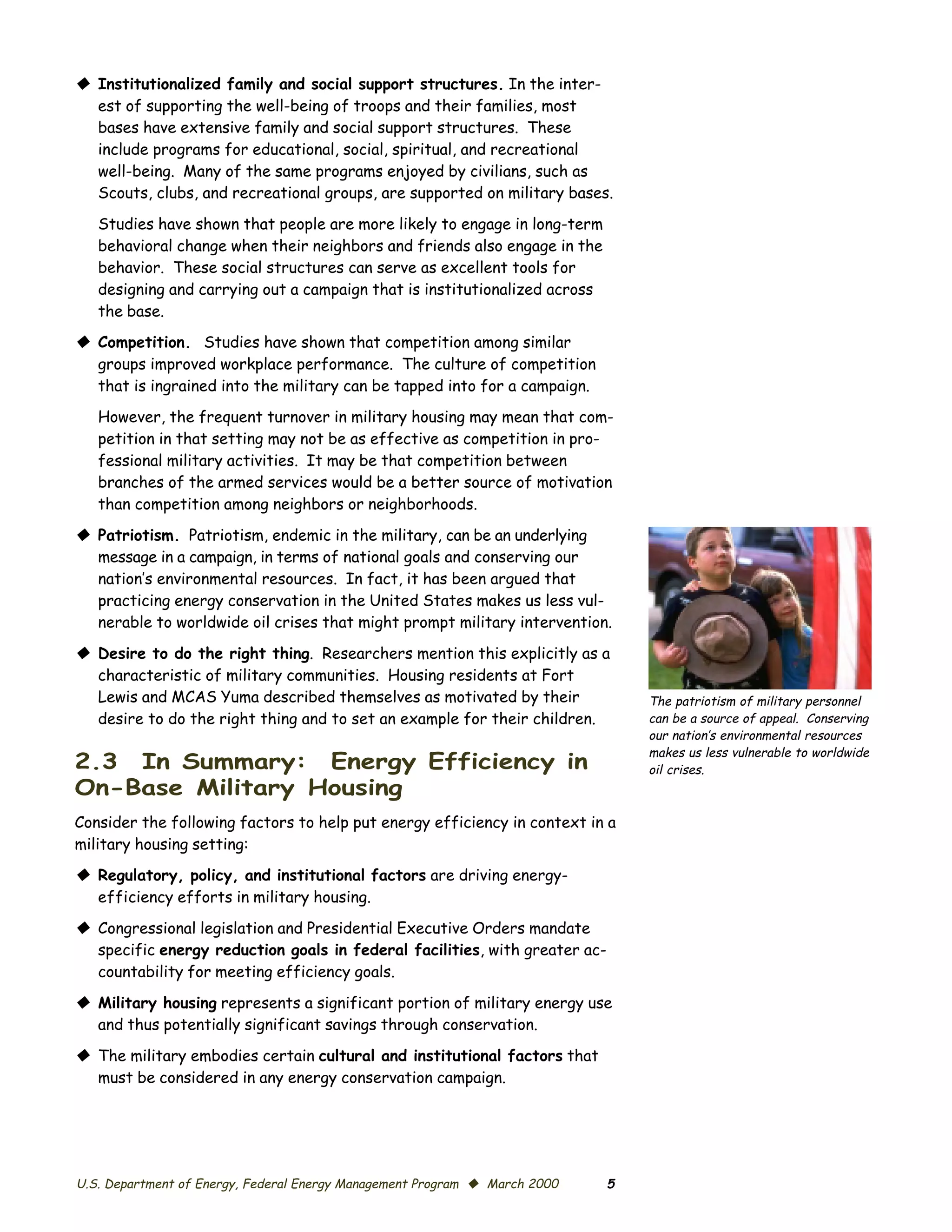
  Lewis and MCAS Yuma described themselves as motivated by their                The patriotism of military personnel
  desire to do the right thing and to set an example for their children.        can be a source of appeal. Conserving
                                                                                our nation’s environmental resources
                                                                                makes us less vulnerable to worldwide
2.3 In Summary: Energy Efficiency in                                            oil crises.
On-Base Military Housing
Consider the following factors to help put energy efficiency in context in a
military housing setting:
© Regulatory, policy, and institutional factors are driving energy-
  efficiency efforts in military housing.

© Congressional legislation and Presidential Executive Orders mandate
  specific energy reduction goals in federal facilities, with greater ac­
  countability for meeting efficiency goals.

© Military housing represents a significant portion of military energy use
  and thus potentially significant savings through conservation.

© The military embodies certain cultural and institutional factors that
  must be considered in any energy conservation campaign.


U.S. Department of Energy, Federal Energy Management Program © March 2000   5
© Factors that make energy conservation more challenging are (1) resi­
                                                 dents not being billed for their own energy use, (2) transient nature of
                                                 personnel, (3) varying housing designs and limitations on improvements,
                                                 and (4) chain of command requiring approval of various campaign
                                                 aspects.
                                               © Factors that can work in favor of energy-efficiency campaigns
                                                 include (1) institutionalized family and support structures, (2) a culture
                                                 of competition, (3) patriotism, and (4) the desire to “do the right
                                                 thing” and set a good example for children in the home.


3.0 Planning the Effort

                                                In deciding whether to launch an effort at a certain base, consider
                                               whether the necessary resources are available there. If the appropriate
                                               resources can be marshaled, decide how you will approach the effort.

                                               For simplicity, this handbook uses the term “campaign” to represent all
                                               energy-efficiency efforts of limited duration.

                                               3.1       Resources Required
                                               The following elements should be in place for an effective campaign. Of
                                               the listed items, the most important is enthusiasm of a person or people
                                               who can pull together resources and get things done at the site.
                                               © Approvals and champions. Base officials from the affected divisions
                                                 must give permission for the effort. These would include, as a mini­
                                                 mum, the site commander, the energy manager, the housing office, and
                                                 the office that deals with military personnel and family life. It is im­
                                                 portant that these officials understand which resources they are com­
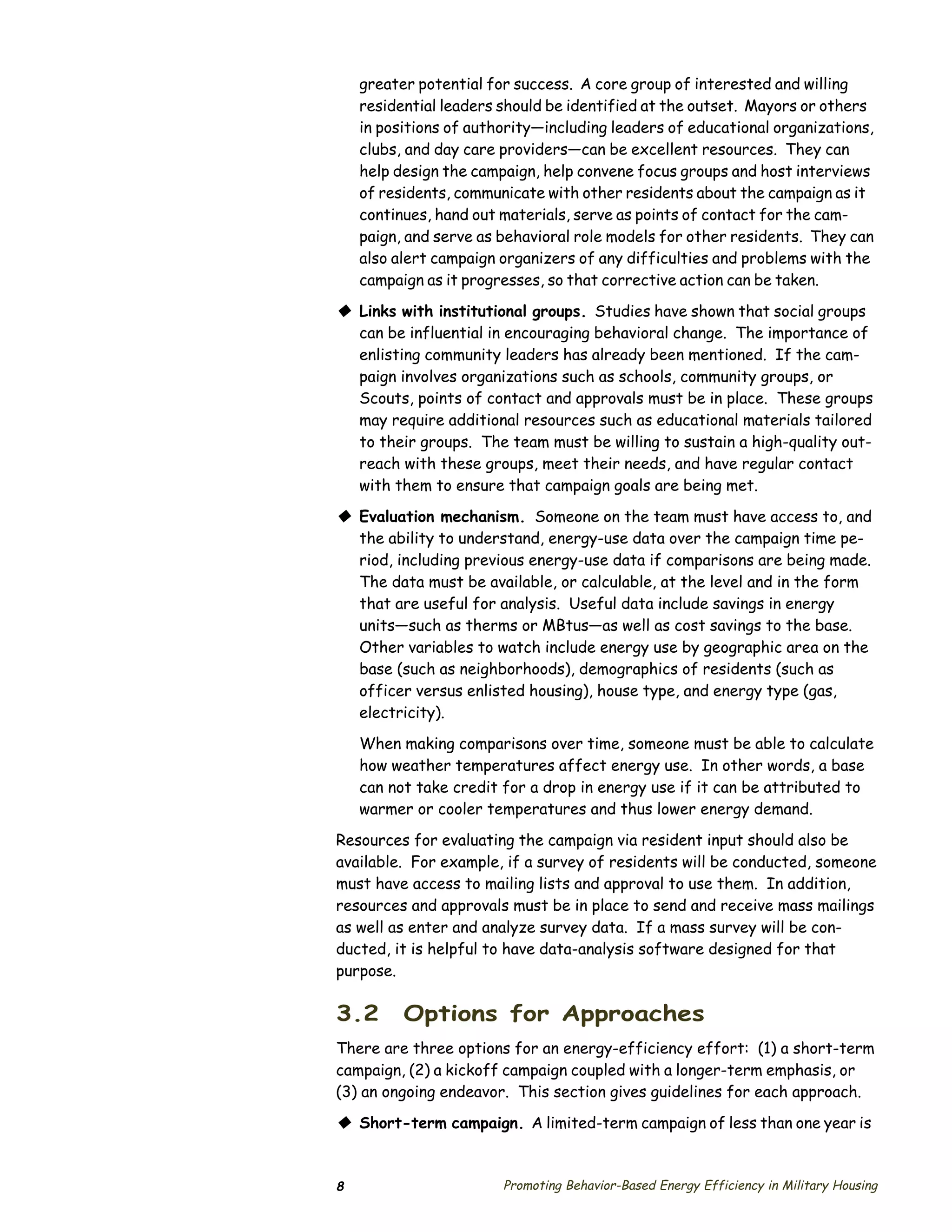
To offset the lack of individual billing for
                                                 mitting, especially those involving funds, personnel, and other resources
utilities, one incentive is to return to
residents a portion of money from energy         from their divisions.
saved.
                                                   The appropriate people in the chains of command must be on board and
                                                   be willing to pass information through their commands as appropriate.
                                                   Beyond merely approving the effort, a high-level, well-respected base
                                                   official should personally “champion” it. This means he or she endorses
                                                   it, perhaps even serving as a spokesperson. The involvement of this
                                                   high-ranking official demonstrates the importance of the effort to
                                                   residents, as well as a top-down commitment to energy efficiency.

                                                   A logical candidate to champion energy efficiency is the base’s Energy
                                                   Manager. At Yuma MCAS, the Energy Manager was well liked and
                                                   respected—and had won awards for energy efficiency. In addition, a
                                                   base Energy Monitor toured the base (on a bicycle) to visually check
                                                   energy-use practices.
                                               © Funding. If not funded by an outside grant or project, or not part of
                                                 existing on-base jobs, the base must

                                               be willing to fund certain activities associated with a campaign. Buy-in


                                               6                       Promoting Behavior-Based Energy Efficiency in Military Housing
from the base in the form of in-kind support demonstrates a commitment
   to the campaign. In-kind support may include producing and distributing
   information, conducting surveys, and collecting and analyzing energy-use
   data. A budget describing each expense and its purpose should be ap­
   proved by all funding sources in advance. Appendix A gives examples of
   typical budget items.

© Incentives. Most behavior-based campaigns will not be effective with­
  out incentives and perhaps disincentives. For example, the base may
  decide to give a portion of money saved back to residents, or some
  other incentive award. Residents who “overuse” an energy allotment
  could be required to pay for the extra usage, or not receive some sort
  of “perk” that other users get. Obviously, base officials must desig­
  nate and approve these incentives and disincentives, especially when
  money is involved. If a portion of money from energy saved is being
  given back to residents in some way, the base must also ensure that the
  funds can be transferred from the utility account to an account that
  benefits residents directly.
© A team with specialized skills. A team of people must have adequate
  time and resources available to design and execute the campaign. Team
  members should have strong communication skills and the ability to
  work well with people, including high-ranking officials. Members should
  also be experienced in field research, conducting focus groups and
  interviews, developing activities, producing targeted information mate­
  rials, and evaluating results. One or more team members should be
  experienced in graphic design.

   If this experience is not available on base, a consultant could help train
   and guide an on-base team. However, a core group of on-base team
   members is essential to any site-specific campaign.

© Access to communication channels and production capabilities. Com­
  municating during a campaign requires access to channels of communi­
  cation and production resources. Someone on the team needs access to
  media (newspapers, newsletters, radio, closed-circuit TV, electronic
  billboards), as well as any specialized methods for communicating with
  residents, such as community meetings.

   Depending on the campaign’s specific activities, facilities and capabili­
   ties must be available for producing printed materials, displays, and
   videotapes. Special activities could include printing of T-shirts, Scout
   badges, banners and flags, educational materials for schools, and so
   forth. Access to a high-quality computer system and software will en­
   able printed materials, including graphics, to be easily produced, up­
   dated, and digitally translated so that the same art can be used for a
   variety of materials.

   Many bases already have these resources in their Public Affairs and
   Training Divisions; however, the proper facilities and approvals for pro­
   ducing campaign-specific information must be in place.

© Residential leaders who are willing to volunteer time. The more
  involved residents are in the campaign’s design and implementation, the

U.S. Department of Energy, Federal Energy Management Program © March 2000      7
greater potential for success. A core group of interested and willing
    residential leaders should be identified at the outset. Mayors or others
    in positions of authority—including leaders of educational organizations,
    clubs, and day care providers—can be excellent resources. They can
    help design the campaign, help convene focus groups and host interviews
    of residents, communicate with other residents about the campaign as it
    continues, hand out materials, serve as points of contact for the cam­
    paign, and serve as behavioral role models for other residents. They can
    also alert campaign organizers of any difficulties and problems with the
    campaign as it progresses, so that corrective action can be taken.

© Links with institutional groups. Studies have shown that social groups
  can be influential in encouraging behavioral change. The importance of
  enlisting community leaders has already been mentioned. If the cam­
  paign involves organizations such as schools, community groups, or
  Scouts, points of contact and approvals must be in place. These groups
  may require additional resources such as educational materials tailored
  to their groups. The team must be willing to sustain a high-quality out­
  reach with these groups, meet their needs, and have regular contact
  with them to ensure that campaign goals are being met.

© Evaluation mechanism. Someone on the team must have access to, and
  the ability to understand, energy-use data over the campaign time pe­
  riod, including previous energy-use data if comparisons are being made.
  The data must be available, or calculable, at the level and in the form
  that are useful for analysis. Useful data include savings in energy
  units—such as therms or MBtus—as well as cost savings to the base.
  Other variables to watch include energy use by geographic area on the
  base (such as neighborhoods), demographics of residents (such as
  officer versus enlisted housing), house type, and energy type (gas,
  electricity).
    When making comparisons over time, someone must be able to calculate
    how weather temperatures affect energy use. In other words, a base
    can not take credit for a drop in energy use if it can be attributed to
    warmer or cooler temperatures and thus lower energy demand.

Resources for evaluating the campaign via resident input should also be
available. For example, if a survey of residents will be conducted, someone
must have access to mailing lists and approval to use them. In addition,
resources and approvals must be in place to send and receive mass mailings
as well as enter and analyze survey data. If a mass survey will be con­
ducted, it is helpful to have data-analysis software designed for that
purpose.

3.2       Options for Approaches
There are three options for an energy-efficiency effort: (1) a short-term
campaign, (2) a kickoff campaign coupled with a longer-term emphasis, or
(3) an ongoing endeavor. This section gives guidelines for each approach.

© Short-term campaign. A limited-term campaign of less than one year is


8                       Promoting Behavior-Based Energy Efficiency in Military Housing
useful when testing approaches and activities specific to a particular
   base. For example, a base may mount a three-month campaign emphasizing
   certain energy conservation activities tailored to that base, certain in­
   formation and social channels, and certain incentives for residents to en­
   courage energy efficiency. At the end of the campaign, the managers
   compare energy use and get feedback from residents to determine which
   activities and approaches were useful and why or why not. The results
   can be used to design a longer-term campaign tailored to that base.
   Short campaigns may also be useful for educational efforts. For ex­
   ample, say a base has just upgraded all its residential heating to use
   programmable thermostats that require proper programming and use
   by residents. A short-term campaign may be useful to emphasize the
   benefits and steps of proper thermostat use.

   Short-term campaigns may also be useful periodically as personnel
   change. For example, if the population of residents has significantly
   changed over two years, a short campaign could be run every two years
   to reemphasize and motivate energy efficiency.
© Kickoff campaign. A campaign can also be used to “jump start” a
  longer-term emphasis. Used in this way, the campaign raises awareness
  and attention to start a more sustained effort.
   A kickoff campaign attempts to attract widespread attention. If
   resources are available, a festival or other celebratory event could be
   held, prizes could be given out, a competition could be announced, a
   high-profile speaker could be brought in, and local media could be
   invited to cover it. The sustained effort, lower key, would continue
   with continued reporting of results and reminders.
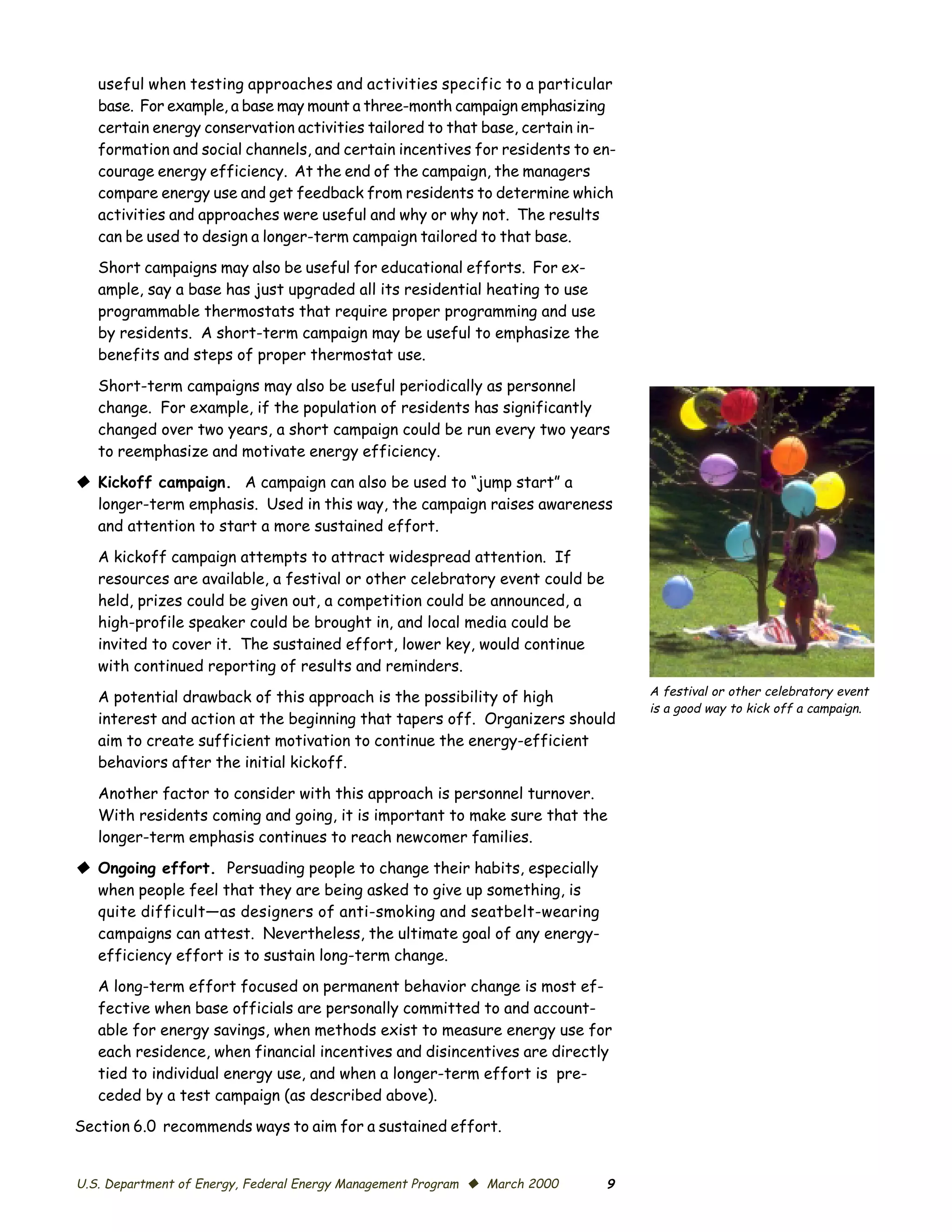
                                                                                 A festival or other celebratory event
   A potential drawback of this approach is the possibility of high
                                                                                 is a good way to kick off a campaign.
   interest and action at the beginning that tapers off. Organizers should
   aim to create sufficient motivation to continue the energy-efficient
   behaviors after the initial kickoff.

   Another factor to consider with this approach is personnel turnover.
   With residents coming and going, it is important to make sure that the
   longer-term emphasis continues to reach newcomer families.

© Ongoing effort. Persuading people to change their habits, especially
  when people feel that they are being asked to give up something, is
  quite difficult—as designers of anti-smoking and seatbelt-wearing
  campaigns can attest. Nevertheless, the ultimate goal of any energy-
  efficiency effort is to sustain long-term change.
   A long-term effort focused on permanent behavior change is most ef­
   fective when base officials are personally committed to and account­
   able for energy savings, when methods exist to measure energy use for
   each residence, when financial incentives and disincentives are directly
   tied to individual energy use, and when a longer-term effort is pre­
   ceded by a test campaign (as described above).
Section 6.0 recommends ways to aim for a sustained effort.


U.S. Department of Energy, Federal Energy Management Program © March 2000    9
3.3       In Summary:                 Planning the Effort
                                      Consider the following factors in the planning phase:

                                      © With the proper base approvals in place, the most important resource is
                                        the presence of an on-base champion(s) who has the willingness, time,
                                        and authority to pull together resources and get things done.

                                      © Other important factors are funding, incentives, a team with special­
                                        ized skills, access to communication channels and production capabili­
                                        ties, residential leaders who are willing to volunteer time, links to
                                        institutional groups, and an evaluation mechanism.
                                      © An energy-efficiency effort can take one of three approaches: (1) a
                                        short-term campaign, (2) a kickoff campaign as part of a longer effort,
                                        and (3) an ongoing endeavor.


4.0 Designing and Executing a Campaign

                                      After a team is convened and resources are secured, the campaign can be
                                      designed and carried out. The guidelines in this section should be adapted
                                      as necessary to fit particular sites and situations.

                                      4.1      Establish Goals
                                      Goals are the ultimate desired outcomes. In a behavior-based campaign, a
                                      typical goal is to get residents to modify their habits so that energy use is
                                      reduced by a certain amount over a specified time period. The target
                                      amount of reduction can be based on a variety of factors, including fed­
                                      eral energy goals, base energy goals, or behavior-based energy reductions
                                      achieved in other areas of the base.
                                      Another goal may be to reduce energy costs over a certain time period.
                                      Be aware, however, that reduced costs, though desirable, may not neces­
                                      sarily mean reduced energy use. Reduced costs could reflect reduced gas
                                      or electricity rates even when the same, or more, energy is expended.
                                      Thus, one of the campaign’s goals must be actual reductions in energy use,
                                      not simply lower expenses to the base.
                                      Set campaign goals while keeping in mind available resources and time to
                                      carry out the campaign. Getting people to change their behaviros is chal­
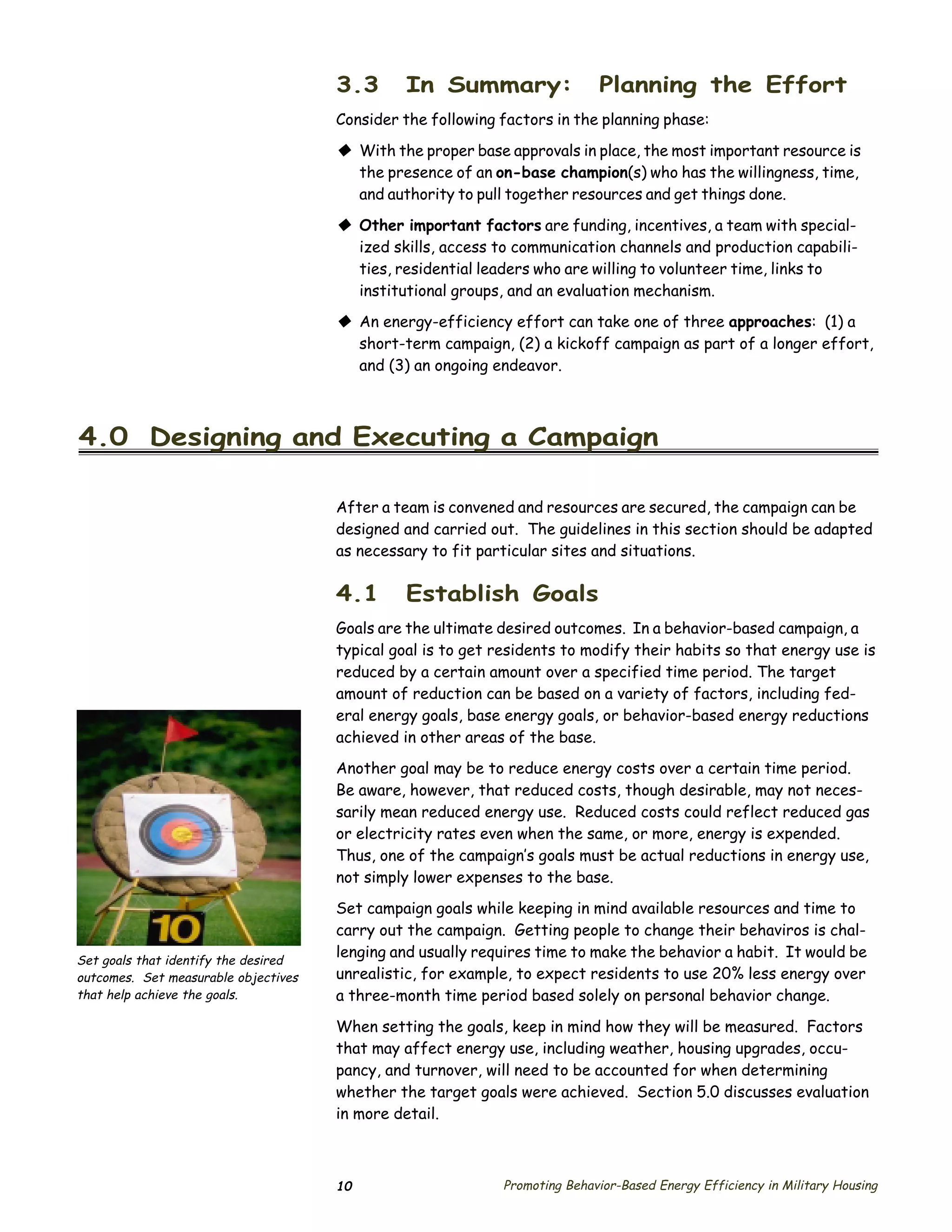
Set goals that identify the desired
                                      lenging and usually requires time to make the behavior a habit. It would be
outcomes. Set measurable objectives   unrealistic, for example, to expect residents to use 20% less energy over
that help achieve the goals.          a three-month time period based solely on personal behavior change.

                                      When setting the goals, keep in mind how they will be measured. Factors
                                      that may affect energy use, including weather, housing upgrades, occu­
                                      pancy, and turnover, will need to be accounted for when determining
                                      whether the target goals were achieved. Section 5.0 discusses evaluation
                                      in more detail.


                                      10                     Promoting Behavior-Based Energy Efficiency in Military Housing
4.2        Establish Objectives
Develop objectives that help achieve the campaign goals. In a behavior-
based campaign, objectives could include increasing the percent of people
who engaged in certain behaviors, such as the following:

© kept their thermostats at a certain level when the house was occupied
  and at night
© requested energy audits or other in-home visits
© signed a commitment form promising to do certain things
© eeplaced incandescent lights with compact fluorescents
© turned off their outside lights during the daytime
© replaced their furnace filters monthly
© filled out home energy checklists with their children.
Make sure you have a way to measure these behavior changes before you
set them as objectives. Some changes, such as outside porch lights being
turned off, can be directly observed by people whose job it is to monitor
energy use. The number of audits requested by residents can be tracked.
Items purchased at base commissaries and PXs can be tracked, such as
compact fluorescent bulbs and furnace filters.
For many behaviors, however, residents must be asked directly what they
are doing differently as compared with the baseline period before the
campaign started. Getting feedback that represents a good cross section
of residents usually requires a survey, as described in Section 5.2.

4.3      Set a Budget
In the planning stages, a preliminary budget may be all you need. Then,
after campaign activities are better defined, you may need to develop a
detailed budget to be approved by base officials. You should establish the
budgets and obtain approvals early in the process.

The budget must cover all labor, materials, production, distribution, activi­
ties, and monetary incentives, if any. Appendix A shows typical budget
items.

A budget may be predetermined by the base’s resources, or it may be
somewhat negotiable. Some services and materials may be donated by the
base, local utilities, government organizations, and even local universities
as student projects. In addition, certain services, such as creating train­      The budget for an energy conservation
                                                                                 effort must cover all labor, materials,
ing videos, may be part of the base’s existing mission and thus covered
                                                                                 production, distribution, activities, and
under other budgets.                                                             monetary incentives, if any.

Base officials may ask you to document the return on investment—the
cost of the campaign versus the amount of reduced energy costs you hope
to achieve. If the costs of carrying out a campaign significantly exceed
the expected energy cost savings, you may have a tough time defending
your plan.


U.S. Department of Energy, Federal Energy Management Program © March 2000   11
4.4       Set a Schedule
                                             A campaign schedule is necessary to keep the work on track. It also keeps
                                             the team from missing certain time-dependent events such as school
                                             schedules, Energy Awareness Month (October), or base community fairs.
                                             It also takes advantage of times when base populations are more likely to
                                             be performing certain behaviors that the campaign is targeting for change
                                             (for example, starting just before the heating or cooling season).

                                             Depending on how energy usage statistics are tallied at a given base, there
                                             may be a delay before statistics such as monthly meter readings and bill­
                                             ings are available. If so, factor this into the schedule. For example, if
                                             final campaign results have been promised in December, but energy statis­
                                             tics are available 30 days after the previous month, you will need to end
                                             the data collection with November’s results, or even October’s, so you
                                             have time to tally the results and conduct a survey, if necessary.

                                             Some aspects of a campaign schedule may be somewhat inflexible. The
                                             endpoint may be set by the budget running out at the end of a fiscal year.
                                             The endpoint may be set by the base’s previous energy goals or driven by
                                             federal goals. If you have flexibility in setting the endpoint, keep in mind
                                             that a campaign targeting several behaviors for large base populations can
                                             take a minimum of six months to get visible results, with a year being a
                                             more reasonable time frame.
                                             You may wish to set the schedule by starting with the endpoint and work­
                                             ing backward. With this approach, determine how much time it will take to
                                             complete each step before the endpoint. This sequence will determine
                                             when the campaign needs to begin. This exercise will reveal any schedule
                                             problems, where planned activities must be deleted or modified to fit into
                                             a timeline.

                                             4.5 Understand Your Base Setting by
                                             Talking with Residents and Officials
                                             The most successful campaigns are tailored to the specific military base,
                                             using input and ideas from residents themselves and emphasizing the
                                             things residents are allowed to do themselves and those for which the
                                             base will pay. Thus, organizers should fully understand the base’s policies
                                             and practices before starting a campaign, to become aware of what can
                                             and can’t be done by residents.

                                             Using input from residents to design the campaign is important for three
                                             reasons. First, it ensures that the campaign’s content, themes, activities,
                                             and communication channels are valid for that population. It does no good
                                             to emphasize proper use of air conditioners, for example, if a base is
                                             located in a temperate climate that rarely requires air conditioning. If
                                             residents resent energy auditors coming to their homes without being
                                             requested, don’t make this a campaign activity. If the residents seem par­
Use the input and ideas of residents to      ticularly receptive to education activities that involve children, this could
design the campaign for a particular base.
                                             become an emphasis. And if residents tell you they get most of their


                                             12                     Promoting Behavior-Based Energy Efficiency in Military Housing
information through newsletters and newspapers, radio can probably be
eliminated as a communication channel.
The second reason to involve residents is that more involvement up front
encourages more buy-in and participation as the campaign gets under way.
If residents have been involved in designing the campaign, they are more
likely to feel a part of it and want it to succeed. Another way to view this
is to consider the opposite effect. Without their input, residents may well
perceive a campaign as another imposition by the military bureaucracy
(“They’re telling us what to do again”), designed to deprive residents of
personal comfort or convenience. Residents with this attitude are more
likely to resent the campaign, ignore it, or even sabotage it.
The third reason for involving residents up front is to gain individual con­
tacts that can be drawn upon as resources for the remainder of the
campaign. Because these people have already expressed enough interest
to contribute ideas for the formative phase of the campaign, they may be
willing to continue to contribute in other ways later. For example, you may
call on them later to help distribute information, participate in events,
contribute energy-saving tips for publication, help develop educational pro­
grams, poll their neighbors, and other such activities.

To gather background information from residents, small discussion groups
(focus groups) are helpful. It often works well to include the focus group
discussion as an additional agenda item for an existing community meeting
or other such event. That way, you don’t have to seek focus group mem­
bers, schedule a meeting time and location, or advertise the meeting;
someone else has already done that for you.

The following general questions for focus groups can be adapted for par­
ticular sites:                                                                   Focus groups and informal interviews are
                                                                                 good ways to gather background
© What’s the best way to get people interested and involved in saving            information, test slogans and logos, and
  energy?                                                                        identify feasible behaviors to target for
                                                                                 the campaign.
© What are the best ways to communicate project results?
© How should energy conservation progress and results be depicted?
© Here are some things we’re asking people to do to use energy wisely.
  Are any of these unreasonable or not doable? If so, why?

© Would you be interested in being in a training video/participating in
  other events/etc.?
© Do you have any other suggestions for us as we plan this campaign?
You can also use the focus groups to brainstorm and select campaign
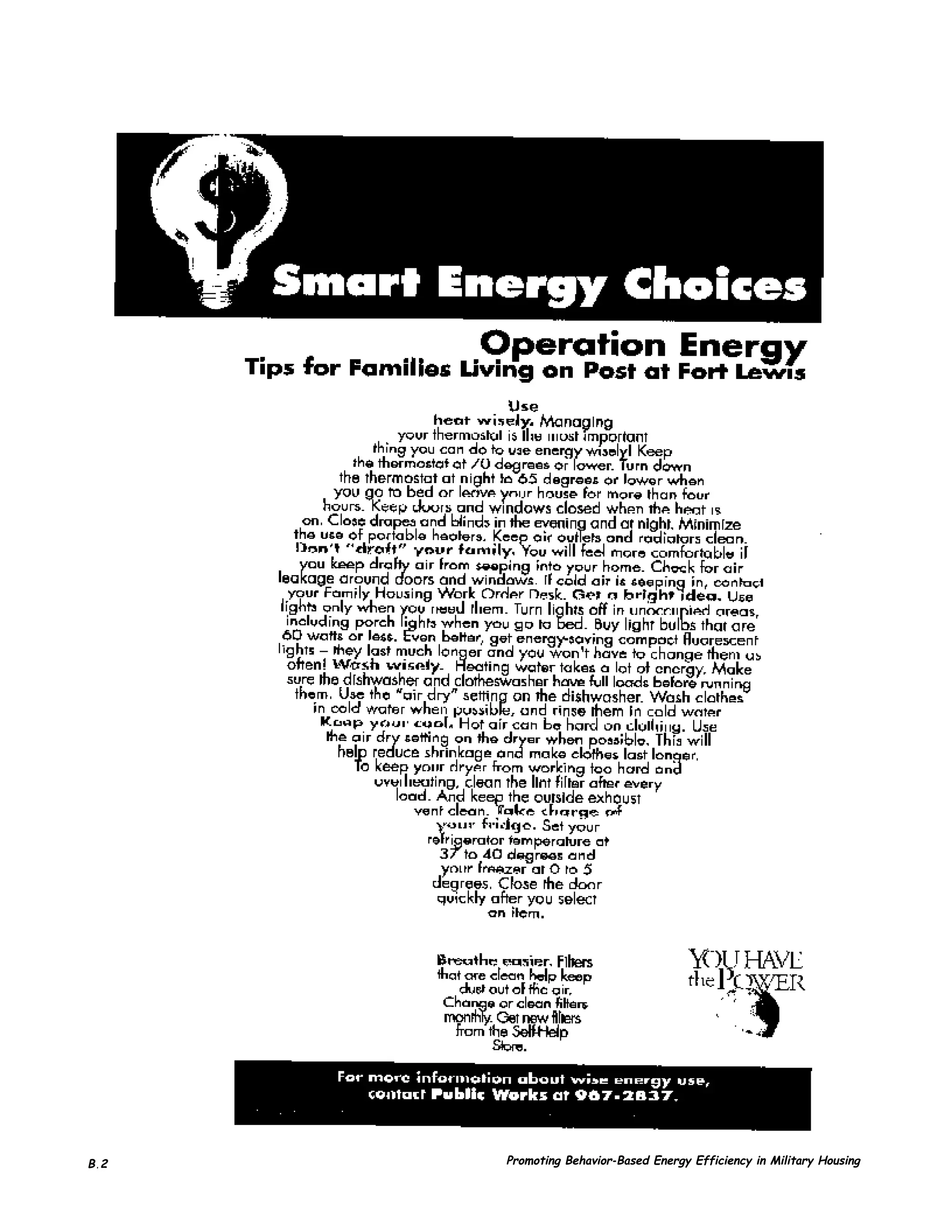
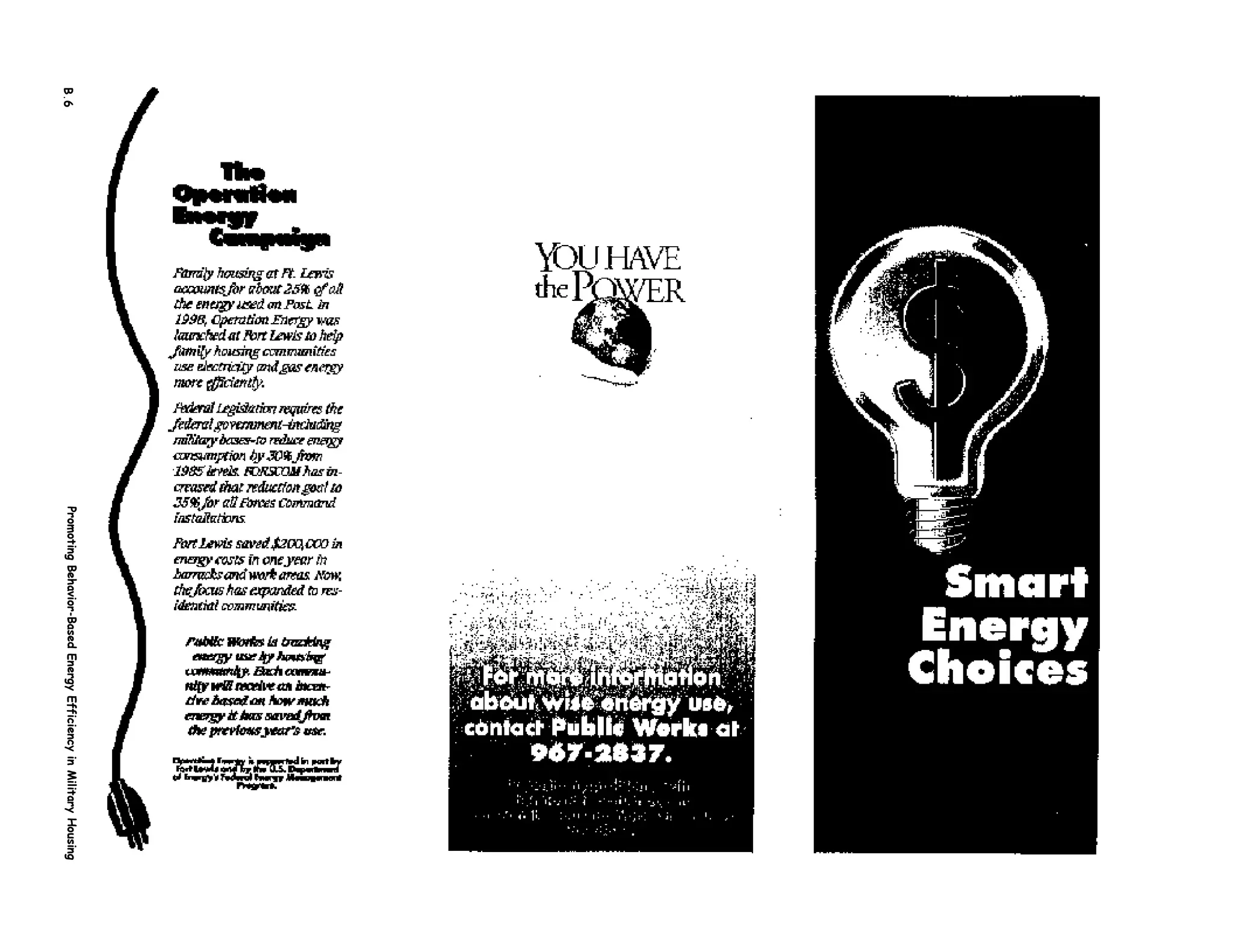
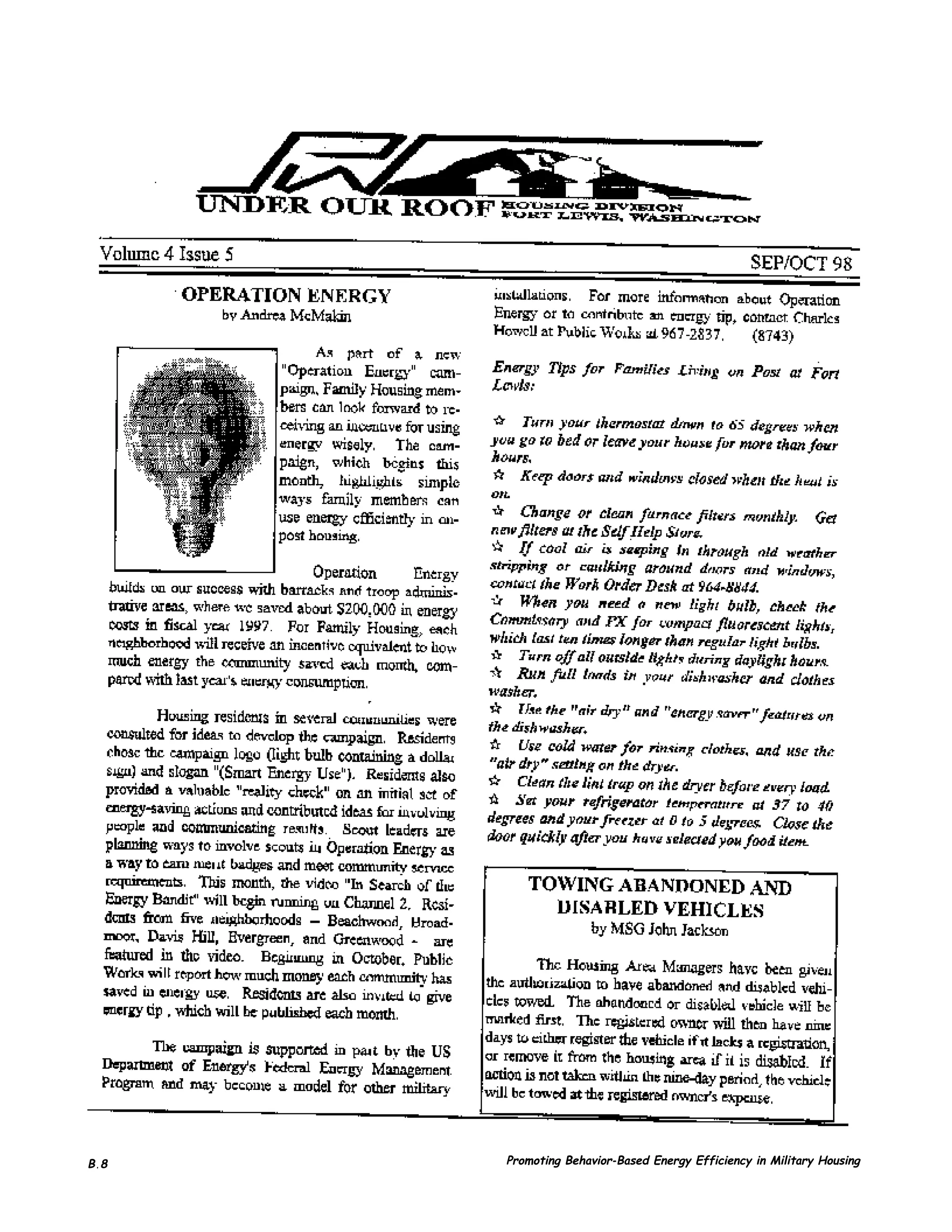
themes, slogans, and art. Appendix B, for example, shows a logo (light bulb
containing a dollar sign) and a slogan (“Smart Energy Use”) selected by
Fort Lewis residents for an energy-efficiency campaign.

In addition to talking with residents, it is important to get input from base
officials who are responsible for housing and utilities, including housing
maintenance. You will not want to tell residents to adjust their own water


U.S. Department of Energy, Federal Energy Management Program © March 2000   13
heater temperatures, for example, if housing authorities have determined
                                        that the switches are close to high-voltage wires and thus present a safety
                                        hazard. Base officials can also clarify what residents are responsible for
                                        purchasing and what the base provides, such as weatherization materials,
                                        solar-screening films for windows, furnace filters, and compact fluorescent
                                        lights.

                                        Personal interviews are the best format for getting input from base offi­
                                        cials. You can ask them the same questions as the residents. An additional
                                        question for officials is, “Are there any constraints or additional neces­
                                        sary approvals we should be aware of in carrying out this campaign?” And,
                                        as mentioned, verify the details of any financial incentive or other awards
                                        provided by base officials. It is important to understand the exact nature
                                        of the incentive so that it can be communicated in a way that properly rep­
                                        resents the intention of officials giving it.
                                        Public Affairs or other base personnel who are responsible for base com­
                                        munications should also be interviewed. These could be newspaper or
                                        newsletter publishers, on-base TV and radio studios, people who manage
                                        reader boards, and so on. You’ll want to understand their requirements,
                                        deadlines, and approval processes.

                                        4.6      Consider a Pre-Survey
                                        A pre-survey of residents is not essential, but if you have the resources
                                        to carry it out, it can be very useful.
                                        A pre-survey of residents can be used in four ways. First, you can use it
                                        to design the campaign. With this approach, residents are asked about
                                        their current housing situations (appliances, thermostats, air conditioners,
                                        etc.) and which actions they are already taking. This information can be
                                        used to help identify behaviors and actions to emphasize for the campaign.

                                        You can also use a pre-survey to gather some of the same information
                                        described previously with the focus groups. For this purpose, you would
                                        ask residents about communication channels, logos and slogans, and poten­
                                        tial incentives.
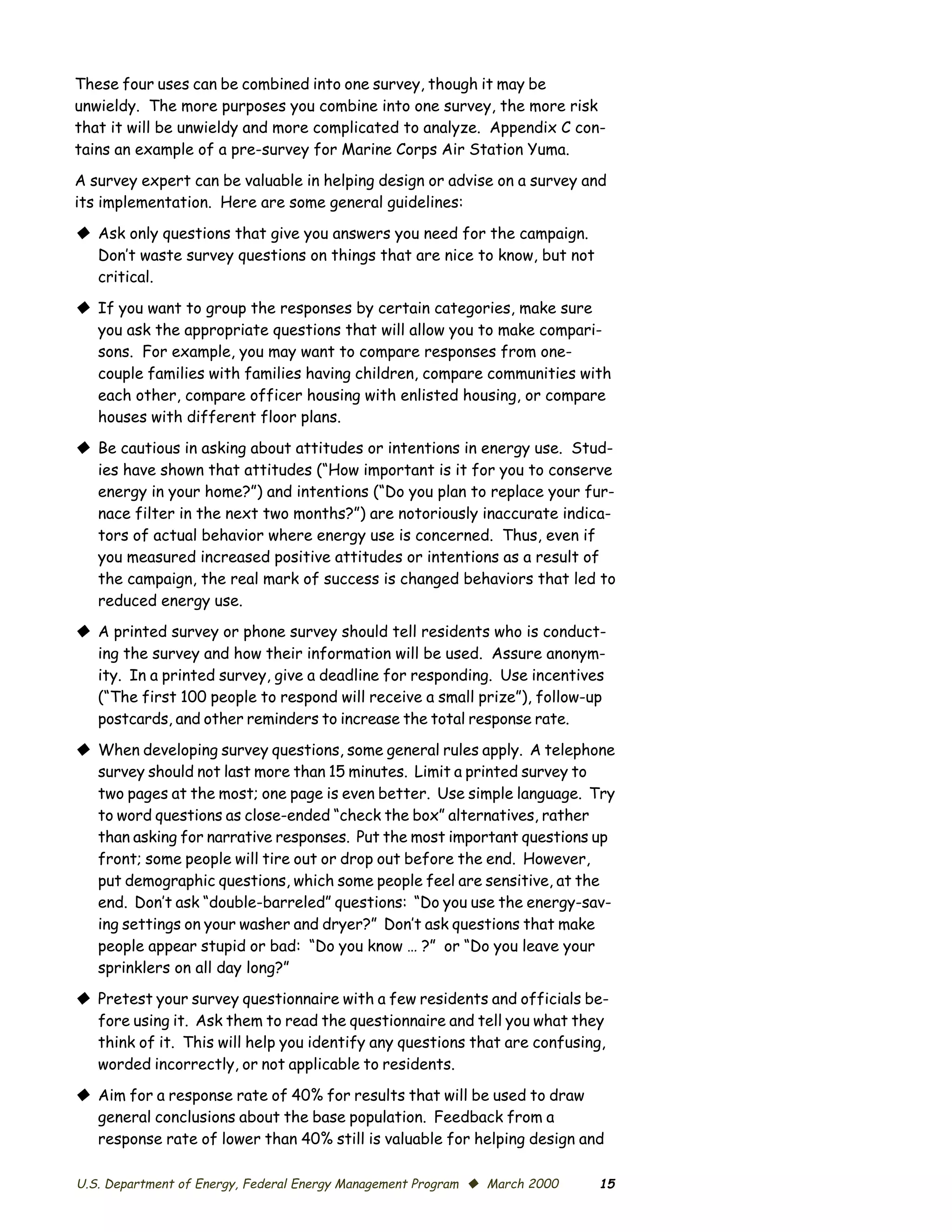
A pre-survey of residents establishes
a baseline of actions that people are   The third use for a pre-survey is as a “pretest”—a baseline for later com­
already taking. It also gets people     parison and evaluation with a post-survey. With this approach, you com­
thinking about the behaviors you are    pare responses about energy-use behaviors before and after the campaign
targeting to change.
                                        to help evaluate how effective the campaign was in changing peoples’ habits.

                                        A fourth use of a pre-survey is to initiate or introduce the behaviors you are
                                        targeting for change. By asking people whether they are already doing
                                        energy-efficient things, you educate them on what those activities are and
                                        imply that such activities are somehow better or more important than others
                                        are. In this way, you actually start your campaign with the pre-survey.
                                        If considering a pretest-type survey, remember that it is less effective if
                                        the resident turnover rate is significant or occupancy is likely to vary
                                        considerably. In these situations, many people who initially filled out
                                        the survey will not be the same population surveyed at the end, thus invali­
                                        dating the comparison.

                                        14                      Promoting Behavior-Based Energy Efficiency in Military Housing
These four uses can be combined into one survey, though it may be
unwieldy. The more purposes you combine into one survey, the more risk
that it will be unwieldy and more complicated to analyze. Appendix C con­
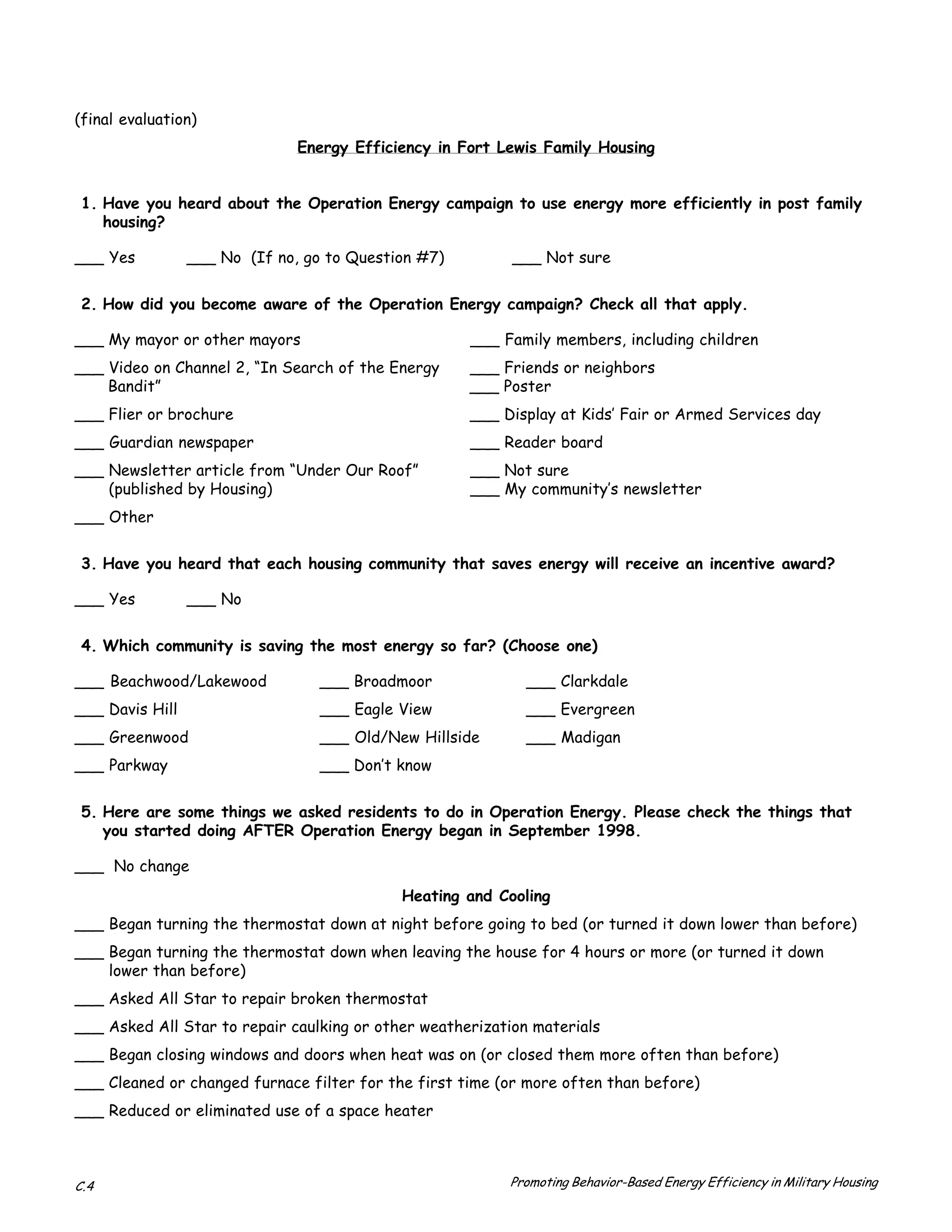
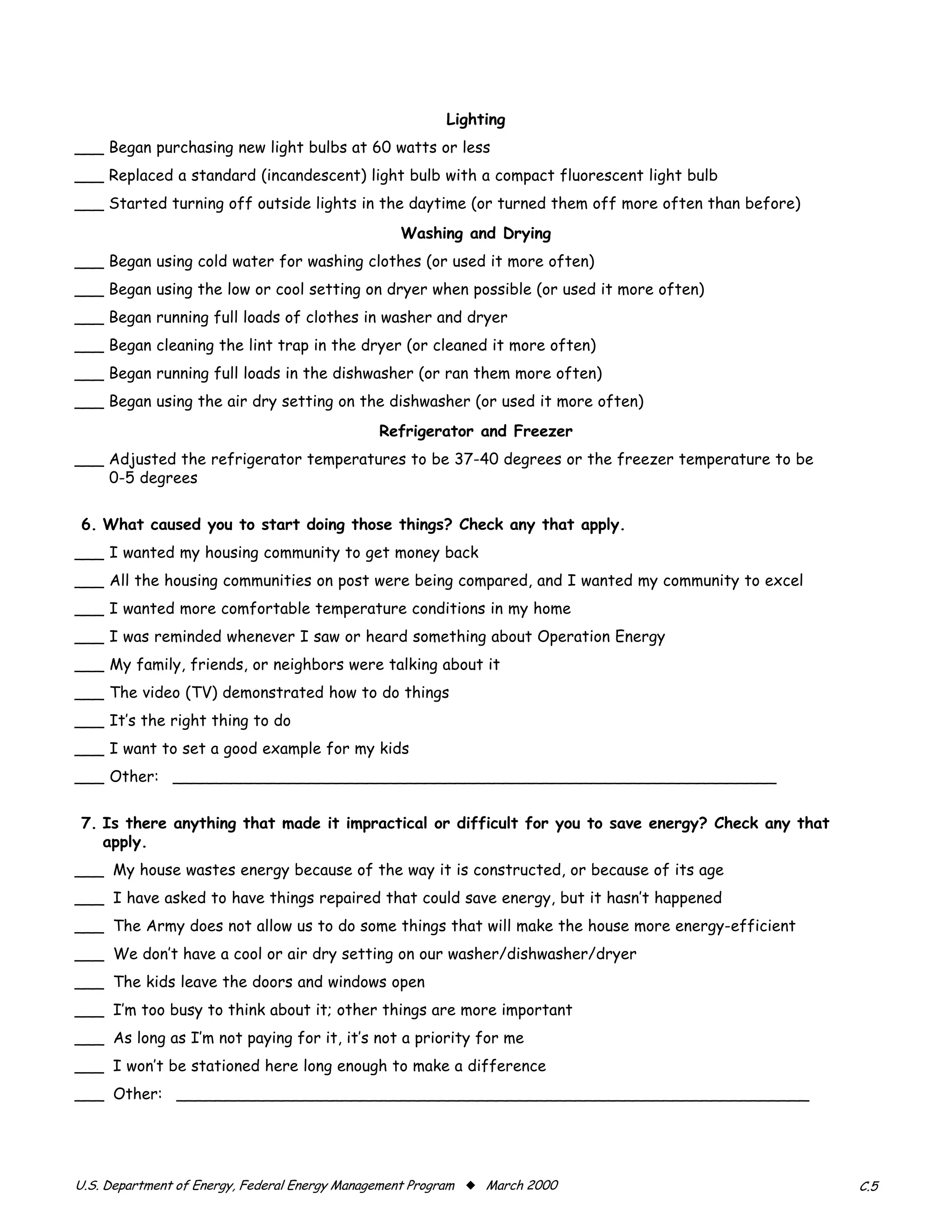
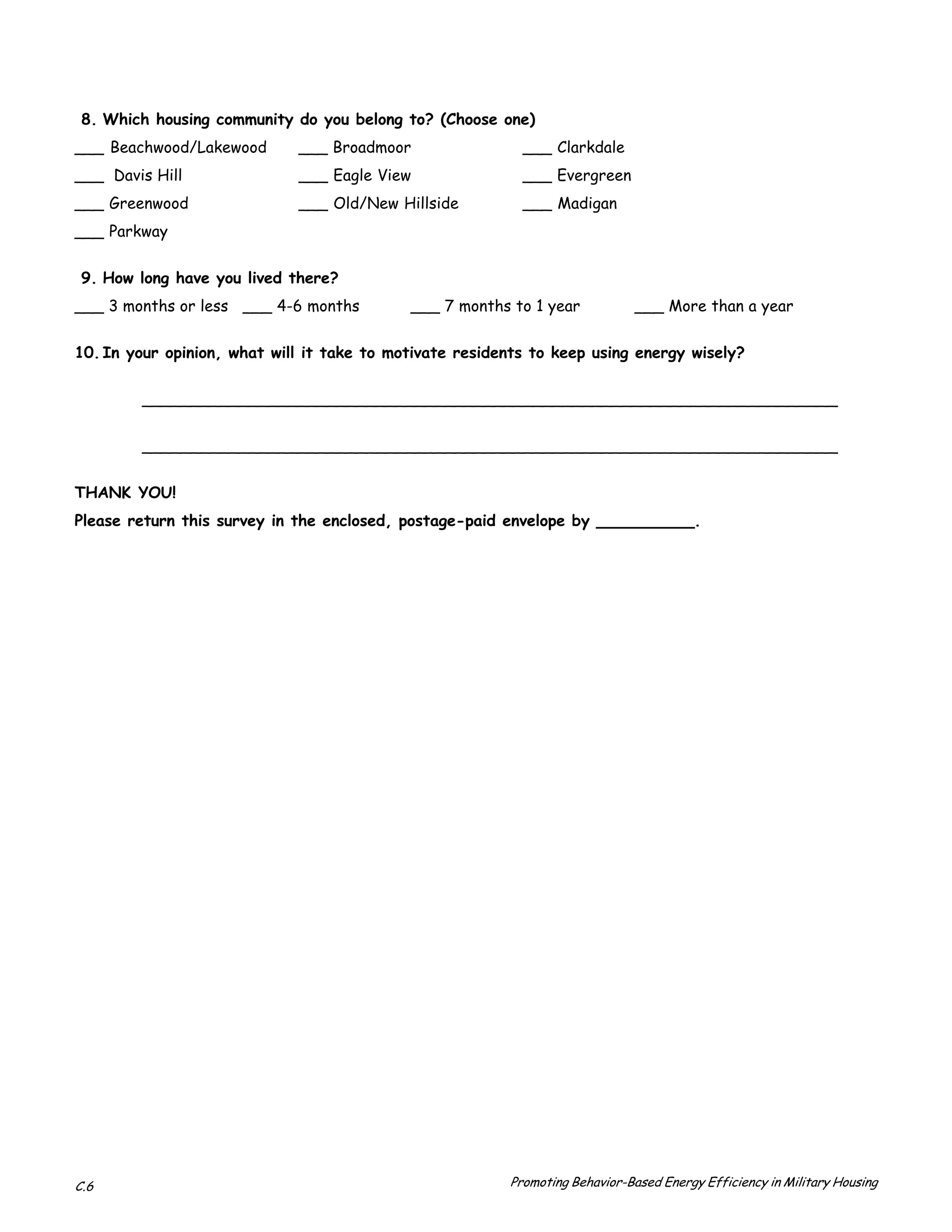
tains an example of a pre-survey for Marine Corps Air Station Yuma.

A survey expert can be valuable in helping design or advise on a survey and
its implementation. Here are some general guidelines:

© Ask only questions that give you answers you need for the campaign.
  Don’t waste survey questions on things that are nice to know, but not
  critical.

© If you want to group the responses by certain categories, make sure
  you ask the appropriate questions that will allow you to make compari­
  sons. For example, you may want to compare responses from one-
  couple families with families having children, compare communities with
  each other, compare officer housing with enlisted housing, or compare
  houses with different floor plans.

© Be cautious in asking about attitudes or intentions in energy use. Stud­
  ies have shown that attitudes (“How important is it for you to conserve
  energy in your home?”) and intentions (“Do you plan to replace your fur­
  nace filter in the next two months?”) are notoriously inaccurate indica­
  tors of actual behavior where energy use is concerned. Thus, even if
  you measured increased positive attitudes or intentions as a result of
  the campaign, the real mark of success is changed behaviors that led to
  reduced energy use.
© A printed survey or phone survey should tell residents who is conduct­
  ing the survey and how their information will be used. Assure anonym­
  ity. In a printed survey, give a deadline for responding. Use incentives
  (“The first 100 people to respond will receive a small prize”), follow-up
  postcards, and other reminders to increase the total response rate.

© When developing survey questions, some general rules apply. A telephone
  survey should not last more than 15 minutes. Limit a printed survey to
  two pages at the most; one page is even better. Use simple language. Try
  to word questions as close-ended “check the box” alternatives, rather
  than asking for narrative responses. Put the most important questions up
  front; some people will tire out or drop out before the end. However,
  put demographic questions, which some people feel are sensitive, at the
  end. Don’t ask “double-barreled” questions: “Do you use the energy-sav­
  ing settings on your washer and dryer?” Don’t ask questions that make
  people appear stupid or bad: “Do you know … ?” or “Do you leave your
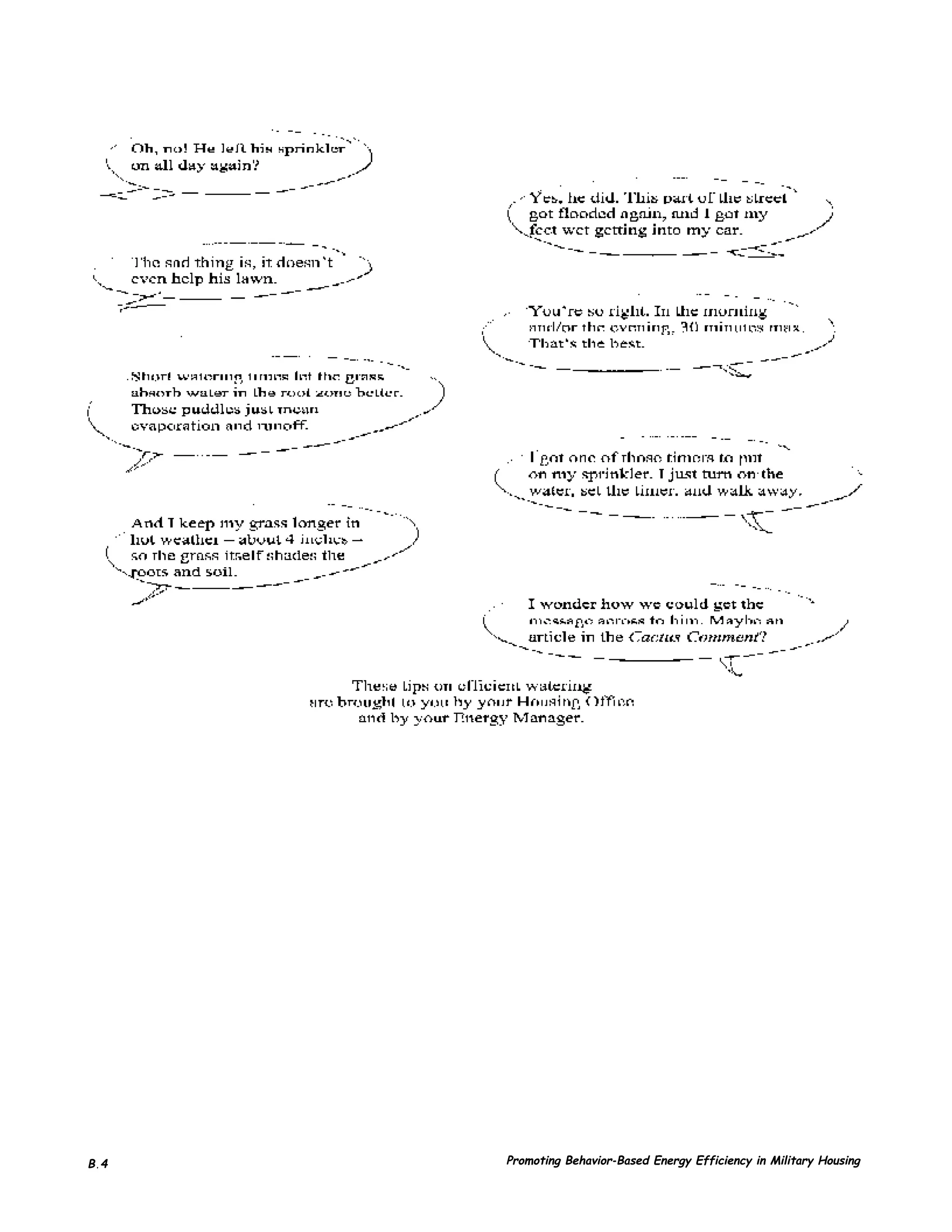
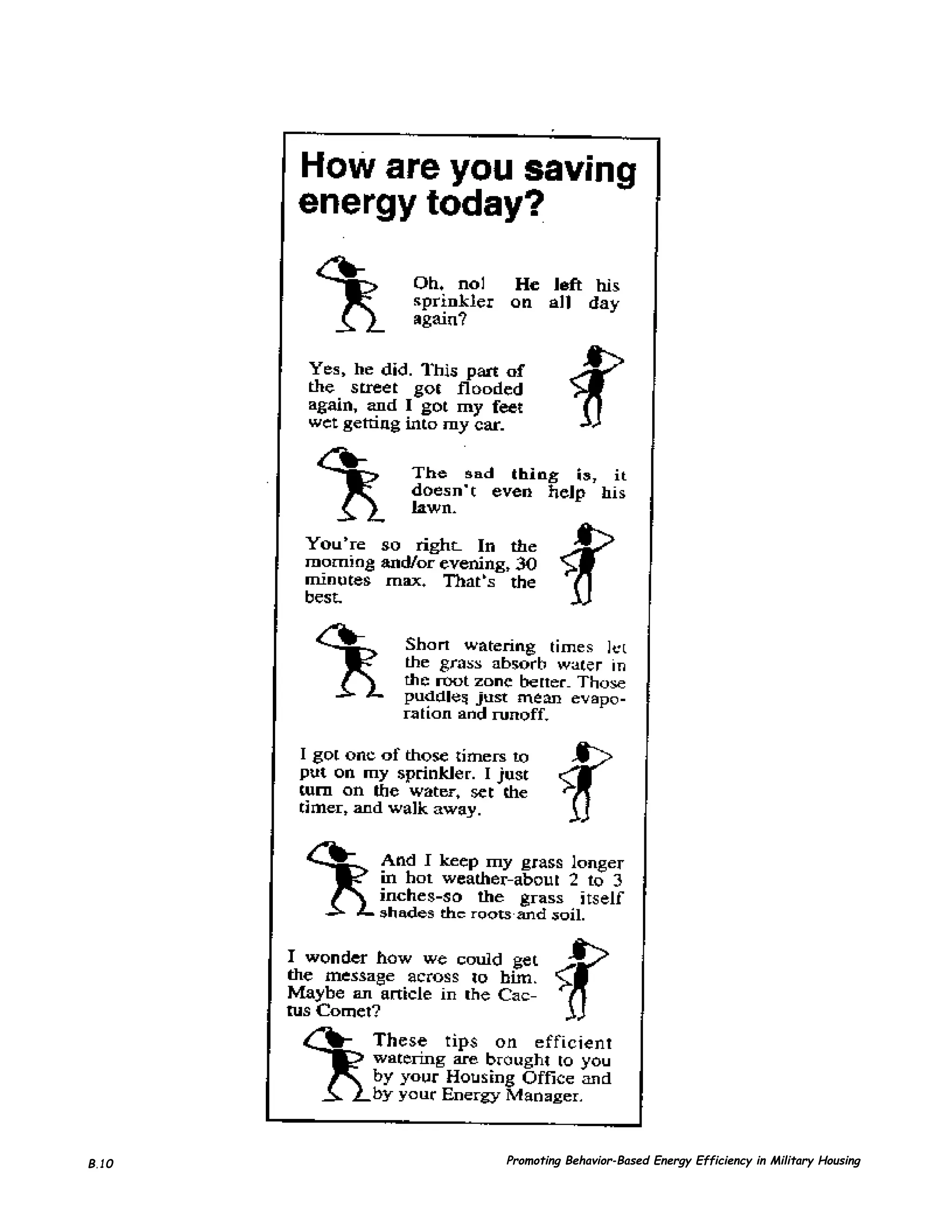
  sprinklers on all day long?”

© Pretest your survey questionnaire with a few residents and officials be­
  fore using it. Ask them to read the questionnaire and tell you what they
  think of it. This will help you identify any questions that are confusing,
  worded incorrectly, or not applicable to residents.

© Aim for a response rate of 40% for results that will be used to draw
  general conclusions about the base population. Feedback from a
  response rate of lower than 40% still is valuable for helping design and

U.S. Department of Energy, Federal Energy Management Program © March 2000   15
evaluate a campaign. Nevertheless, the lower the response rate, the less
                                                  representative the data and conclusions.

                                             4.7        Identify Desired Behaviors
                                             Using the results of focus groups and interviews described above, identify
                                             the actions you will be asking residents to take in the campaign. Here is a
                                             partial list of actions that may be appropriate for military housing:

                                             © When heating a house, set back or program the thermostat 5 to 10
                                               degrees lower at night or when leaving the house for more than four
                                               hours.

                                             © Use air conditioners only when the in-home temperature is more than
                                               78 degrees.

                                             © Clean the air conditioning filter monthly.
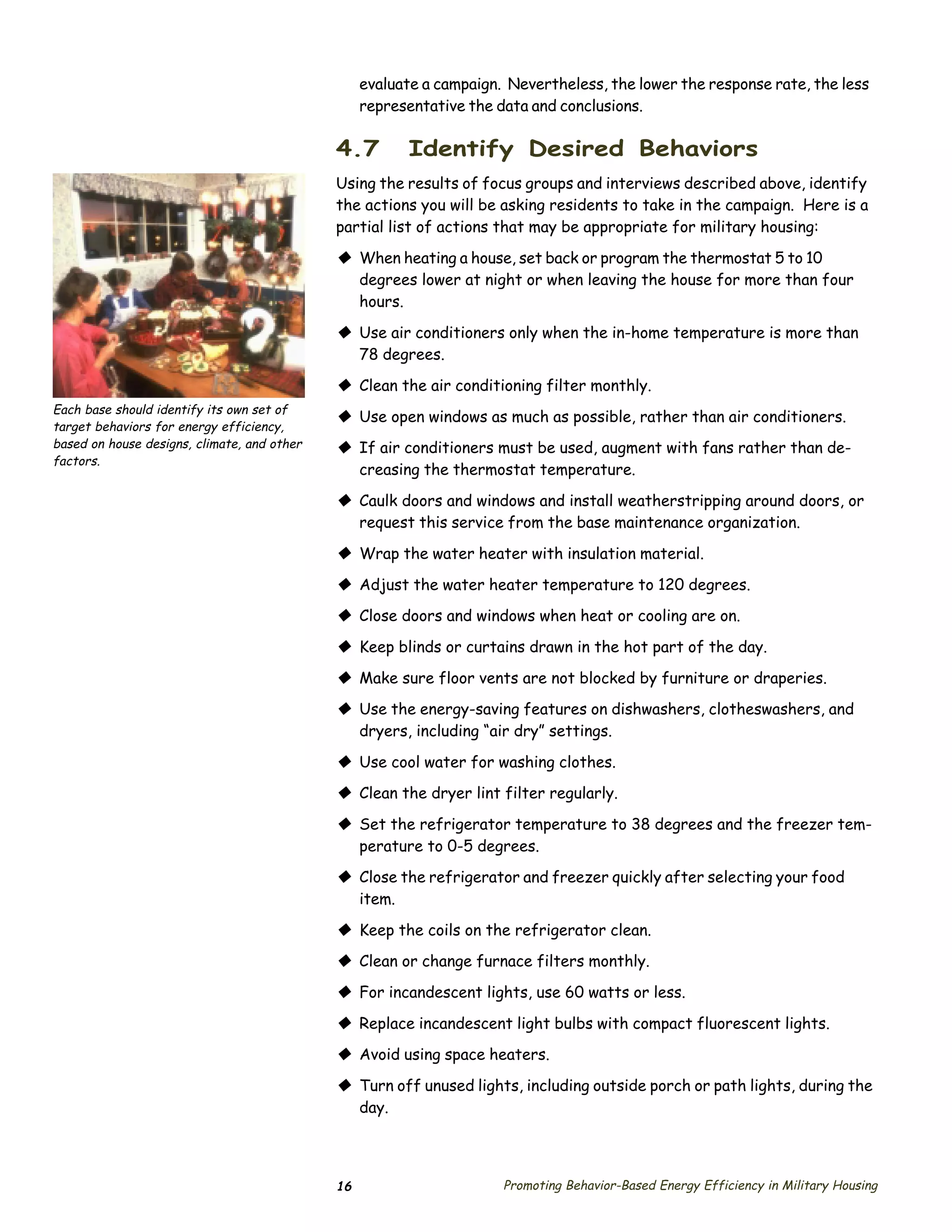
Each base should identify its own set of
                                             © Use open windows as much as possible, rather than air conditioners.
target behaviors for energy efficiency,
based on house designs, climate, and other   © If air conditioners must be used, augment with fans rather than de­
factors.
                                               creasing the thermostat temperature.

                                             © Caulk doors and windows and install weatherstripping around doors, or
                                               request this service from the base maintenance organization.

                                             © Wrap the water heater with insulation material.
                                             © Adjust the water heater temperature to 120 degrees.
                                             © Close doors and windows when heat or cooling are on.
                                             © Keep blinds or curtains drawn in the hot part of the day.
                                             © Make sure floor vents are not blocked by furniture or draperies.
                                             © Use the energy-saving features on dishwashers, clotheswashers, and
                                               dryers, including “air dry” settings.

                                             © Use cool water for washing clothes.
                                             © Clean the dryer lint filter regularly.
                                             © Set the refrigerator temperature to 38 degrees and the freezer tem­
                                               perature to 0-5 degrees.
                                             © Close the refrigerator and freezer quickly after selecting your food
                                               item.

                                             © Keep the coils on the refrigerator clean.
                                             © Clean or change furnace filters monthly.
                                             © For incandescent lights, use 60 watts or less.
                                             © Replace incandescent light bulbs with compact fluorescent lights.
                                             © Avoid using space heaters.
                                             © Turn off unused lights, including outside porch or path lights, during the
                                               day.


                                             16                       Promoting Behavior-Based Energy Efficiency in Military Housing
© Install a timer on the porch light that automatically turns it off when
  daylight comes.
© Turn off unused appliances.
© Install solar-reflecting films or other heat-blocking materials on
  windows.
© Install water-restriction flow valves in showerheads and faucets.
© Close vents in unused or little-used rooms, such as laundry rooms.
Guidelines for choosing and listing actions follow.
© Make sure the actions chosen are allowable, feasible, and reasonable
  for your base and its house floor plans. For example, military residents
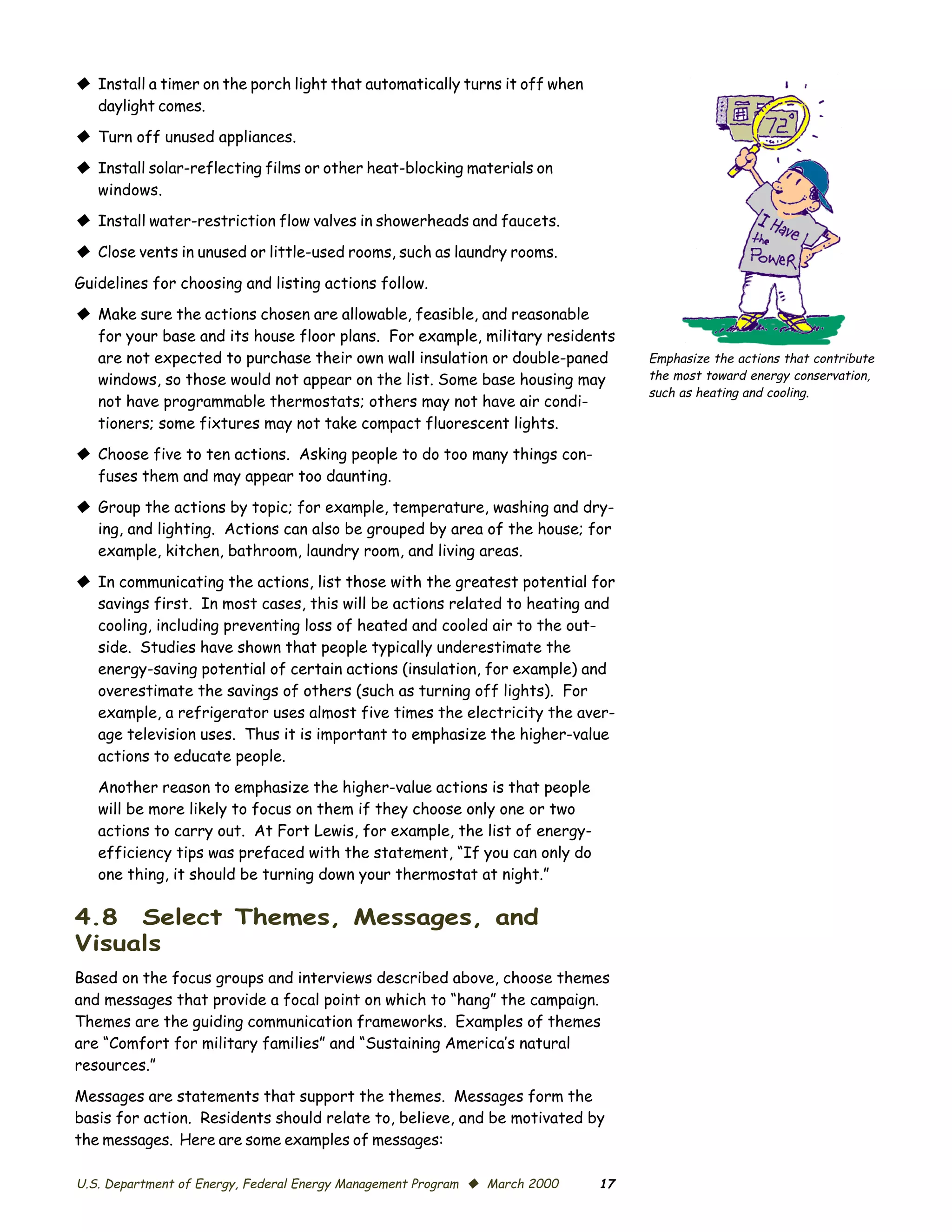
  are not expected to purchase their own wall insulation or double-paned         Emphasize the actions that contribute
  windows, so those would not appear on the list. Some base housing may          the most toward energy conservation,
                                                                                 such as heating and cooling.
  not have programmable thermostats; others may not have air condi­
  tioners; some fixtures may not take compact fluorescent lights.
© Choose five to ten actions. Asking people to do too many things con­
  fuses them and may appear too daunting.

© Group the actions by topic; for example, temperature, washing and dry­
  ing, and lighting. Actions can also be grouped by area of the house; for
  example, kitchen, bathroom, laundry room, and living areas.

© In communicating the actions, list those with the greatest potential for
  savings first. In most cases, this will be actions related to heating and
  cooling, including preventing loss of heated and cooled air to the out­
  side. Studies have shown that people typically underestimate the
  energy-saving potential of certain actions (insulation, for example) and
  overestimate the savings of others (such as turning off lights). For
  example, a refrigerator uses almost five times the electricity the aver­
  age television uses. Thus it is important to emphasize the higher-value
  actions to educate people.

   Another reason to emphasize the higher-value actions is that people
   will be more likely to focus on them if they choose only one or two
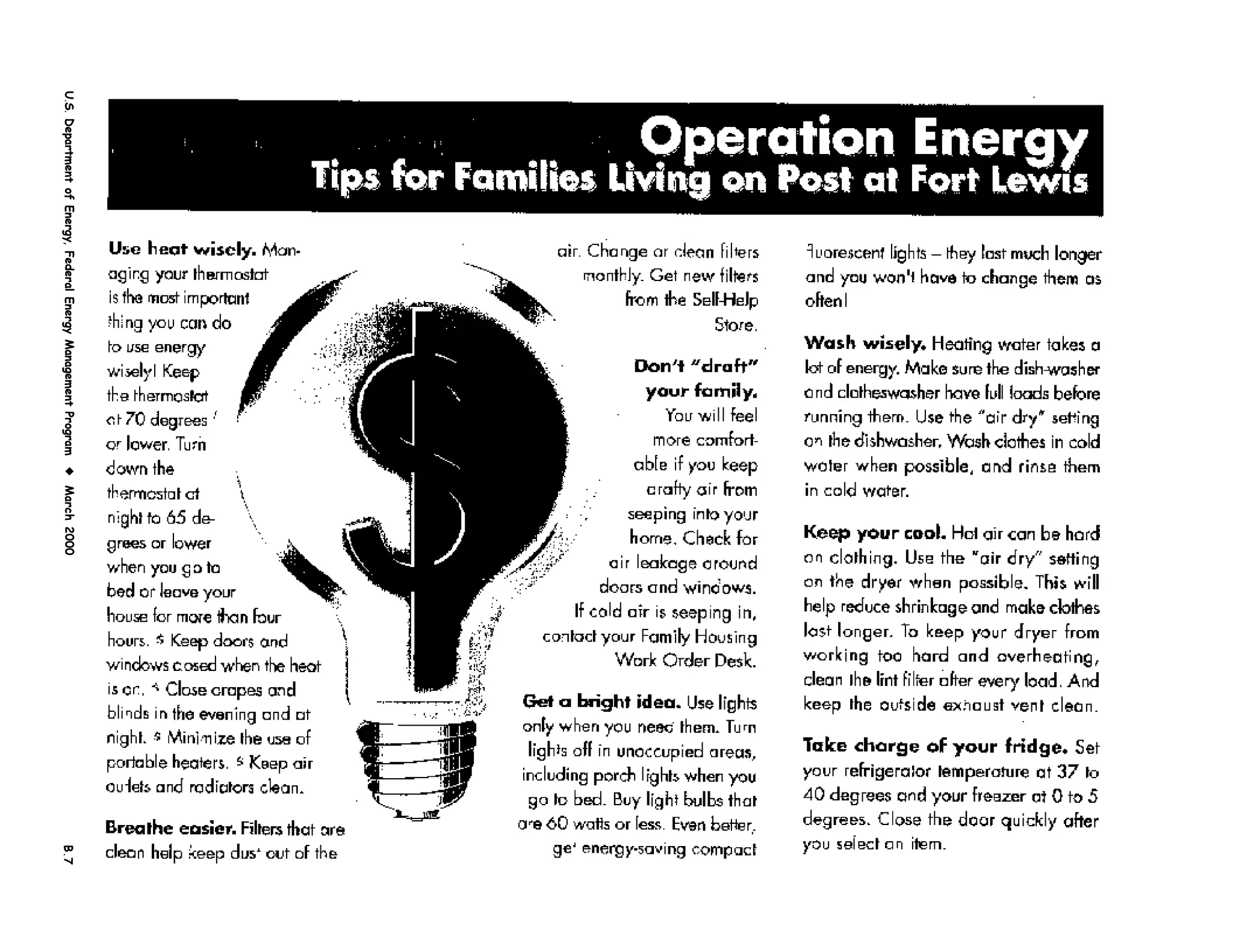
   actions to carry out. At Fort Lewis, for example, the list of energy-
   efficiency tips was prefaced with the statement, “If you can only do
   one thing, it should be turning down your thermostat at night.”

4.8 Select Themes, Messages, and
Visuals
Based on the focus groups and interviews described above, choose themes
and messages that provide a focal point on which to “hang” the campaign.
Themes are the guiding communication frameworks. Examples of themes
are “Comfort for military families” and “Sustaining America’s natural
resources.”

Messages are statements that support the themes. Messages form the
basis for action. Residents should relate to, believe, and be motivated by
the messages. Here are some examples of messages:

U.S. Department of Energy, Federal Energy Management Program © March 2000   17
© The base is being held accountable for reducing energy use.
                                        © Every person’s actions count. It takes everyone’s efforts to accomplish
                                          the goal.

                                        © Make your home more comfortable.
                                        © Make your home a healthier environment.
                                        © It’s easy to do these things. People here will help you.
                                        © Teach your kids good habits that will last a lifetime.
                                        © Make a commitment to do three new things this year.
                                        © Your neighbors, friends, and relatives are all doing this.
                                        © Get an incentive award for smart energy use.
                                        © Make your community the leader.
                                        © Let’s do even better than last year.
                                        At Yuma Air Station, targeted behaviors were the focal points for weeklong
                                        messages. The first week’s cartoon, electronic billboard messages and the
                                        Energy Monitor’s activities related to water conservation, the next week’s
                                        messages to air conditioning use, and so on.

                                        Messages do not have to be stated explicitly in the campaign, but they
                                        underlie information materials, visuals, and activities of the campaign.
                                        Let’s say, for example, that one of your messages was about how easy it is
                                        to do certain things and that others are there to help you. This message
                                        could be reaffirmed by showing children in a video doing energy-efficient
                                        actions in their homes, offering home energy visits, listing the phone num­
                                        bers of energy managers who can answer questions, describing the things
                                        the family housing maintenance organization can do to make homes more
                                        energy efficient, and by holding workshops and open houses to demon­
                                        strate certain actions.
                                        Themes and messages also form the basis for slogans. A slogan is a short,
                                        catchy phrase that is repeated throughout the campaign and usually ap­
                                        pears with the logo or other identifying visual. Examples of slogans are
                                        “Smart Energy Use,” “Save Army Energy,” “Healthy Homes,” and “Energy
                                        Winners.”

                                        To raise awareness and visibility, call the campaign something with a mili­
                                        tary tone, such as Operation Energy. Groups of kids or energy auditors
                                        can be called “The E-Team” or other upbeat names.

                                        In your communications, look for ways to adapt popular movie or book
                                        titles; TV, movie, or cartoon characters; historical and military figures; or
                                        even famous sayings. Heroes and villains are especially effective for a
                                        military setting—as long as residents are not made the bad guys! The Fort
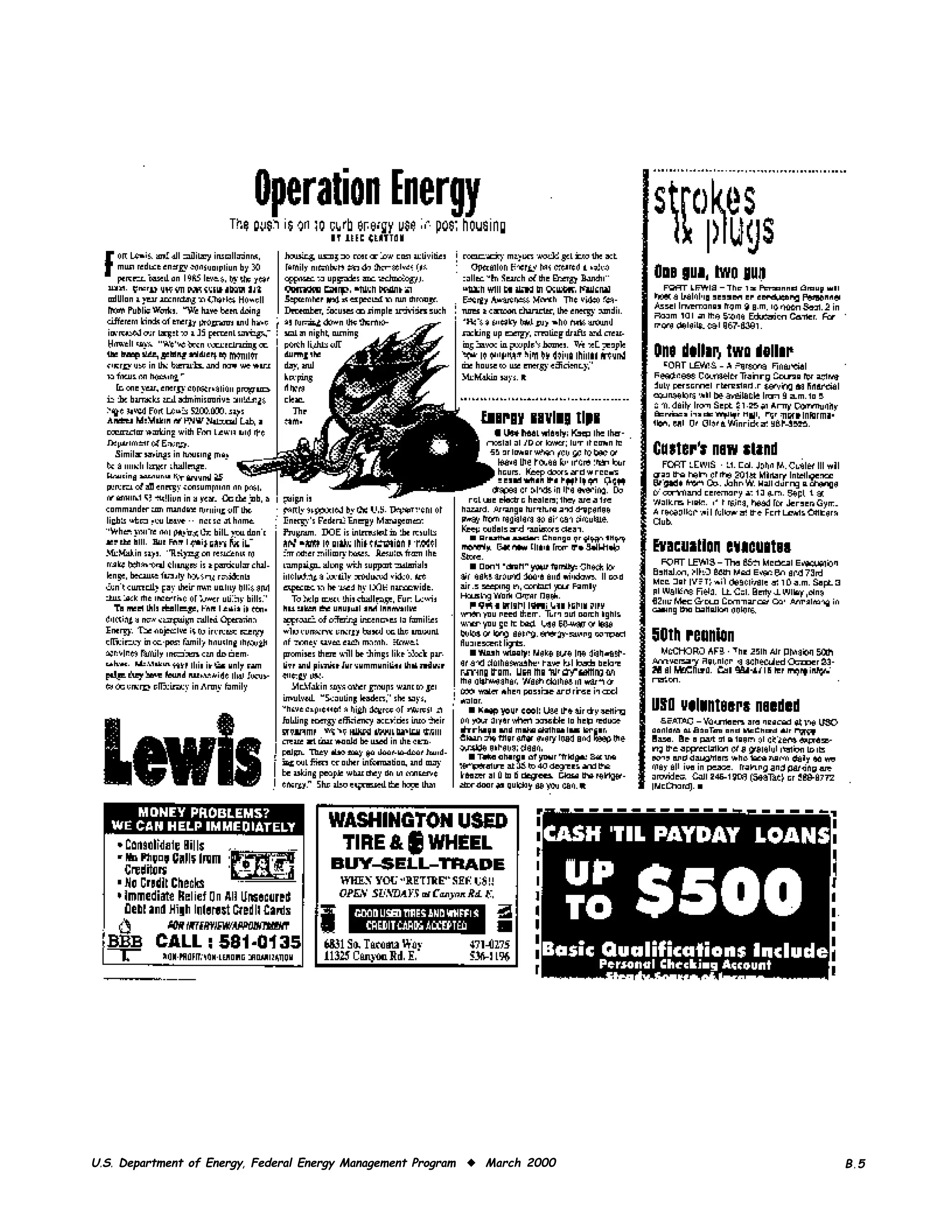
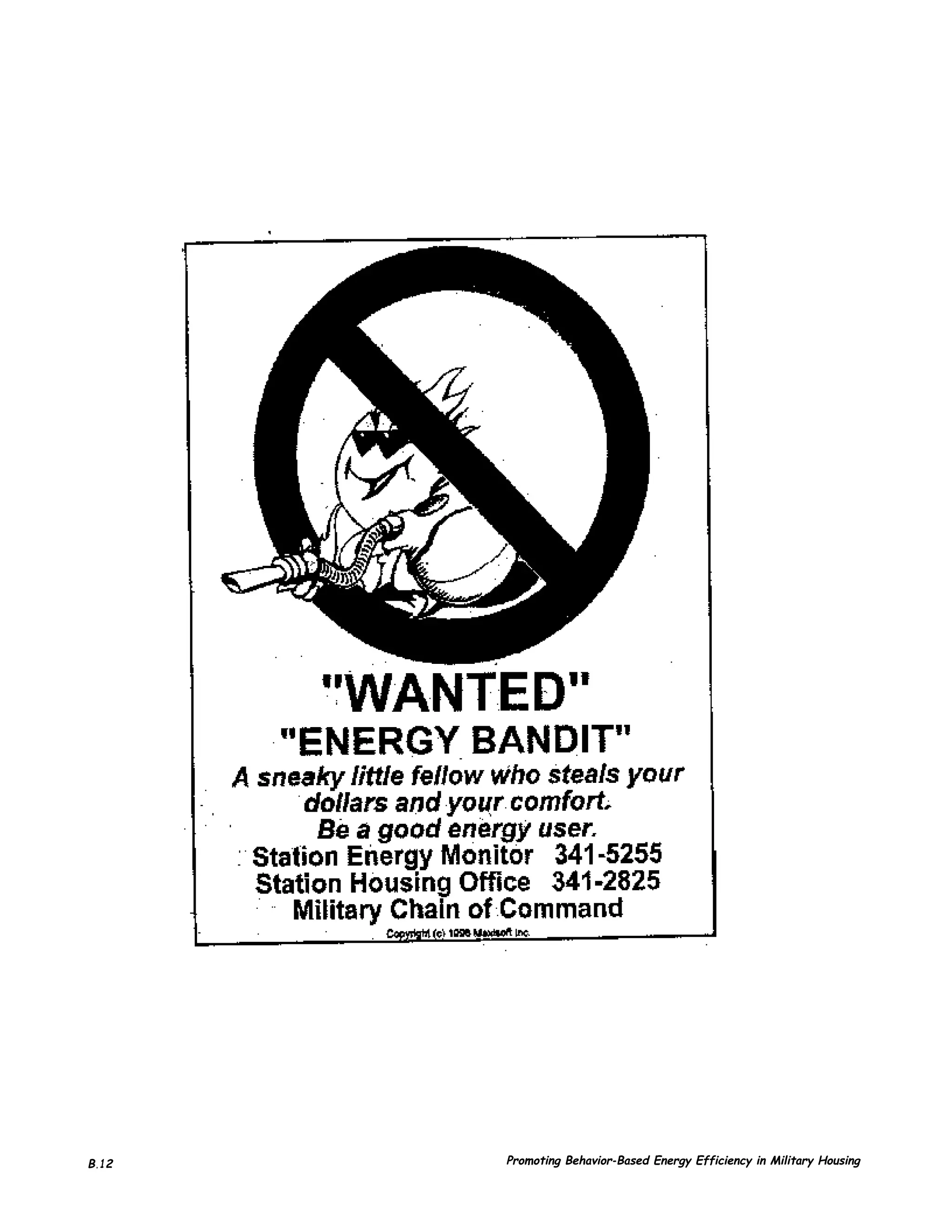
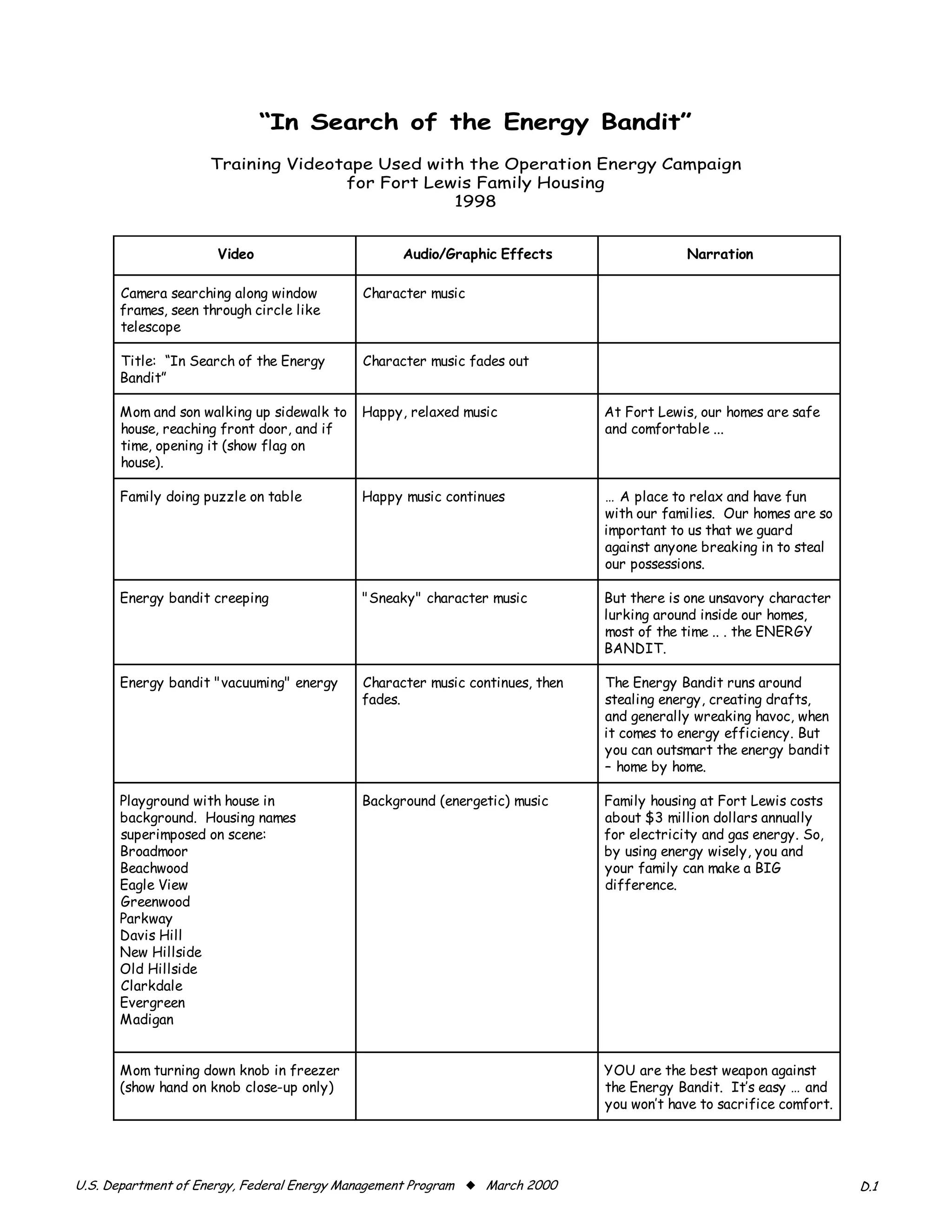
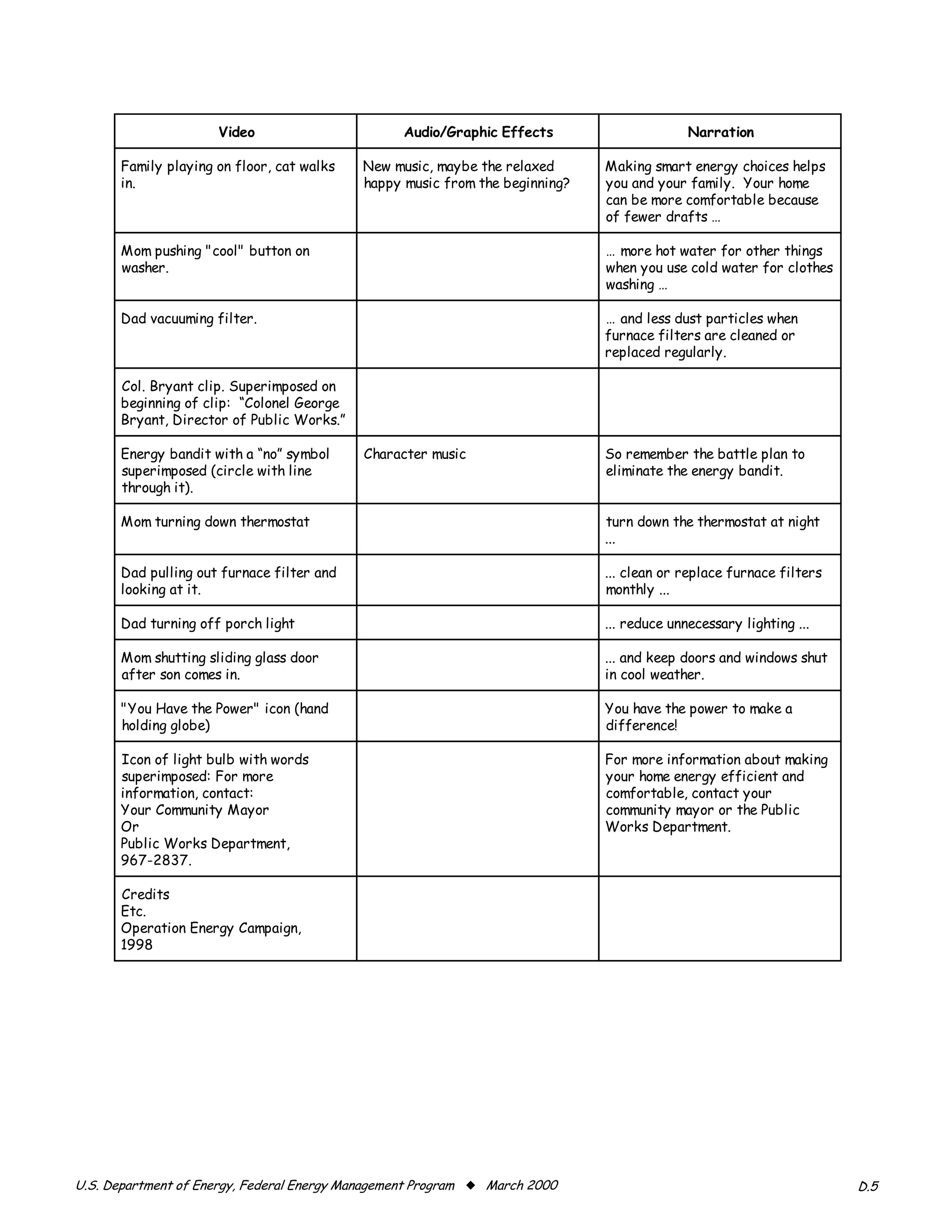
The Energy Bandit, a sneaky bad guy,    Lewis and Yuma Air Station campaign videos, for example, used a character
was created for a base residential      called the Energy Bandit, a sneaky bad guy who stole energy but was ulti­
energy campaign. A videotape showed
                                        mately conquered by energy-saving things residents did (one of the scripts
residents doing things to save energy
in their homes, thus outsmarting the
bandit.


                                        18                     Promoting Behavior-Based Energy Efficiency in Military Housing
is in Appendix D). In choosing these characters and sayings, make sure the
intended audience relates to them, and don’t use anything that is
trademarked.

Based on the theme, choose an identifying visual or logo for the campaign,
and place it on all campaign materials. The logo should be simple, self-
explanatory, distinguishable in black and white (as well as color), and visible
when reduced to a small size. It may use a familiar landmark from the base.
Be careful, however, not to infringe on logos copyrighted by other organi­
zations or to mimic the logo of a particular command or division of the           DOE’s Federal Energy Management
military.                                                                         Program logo for its “You Have the
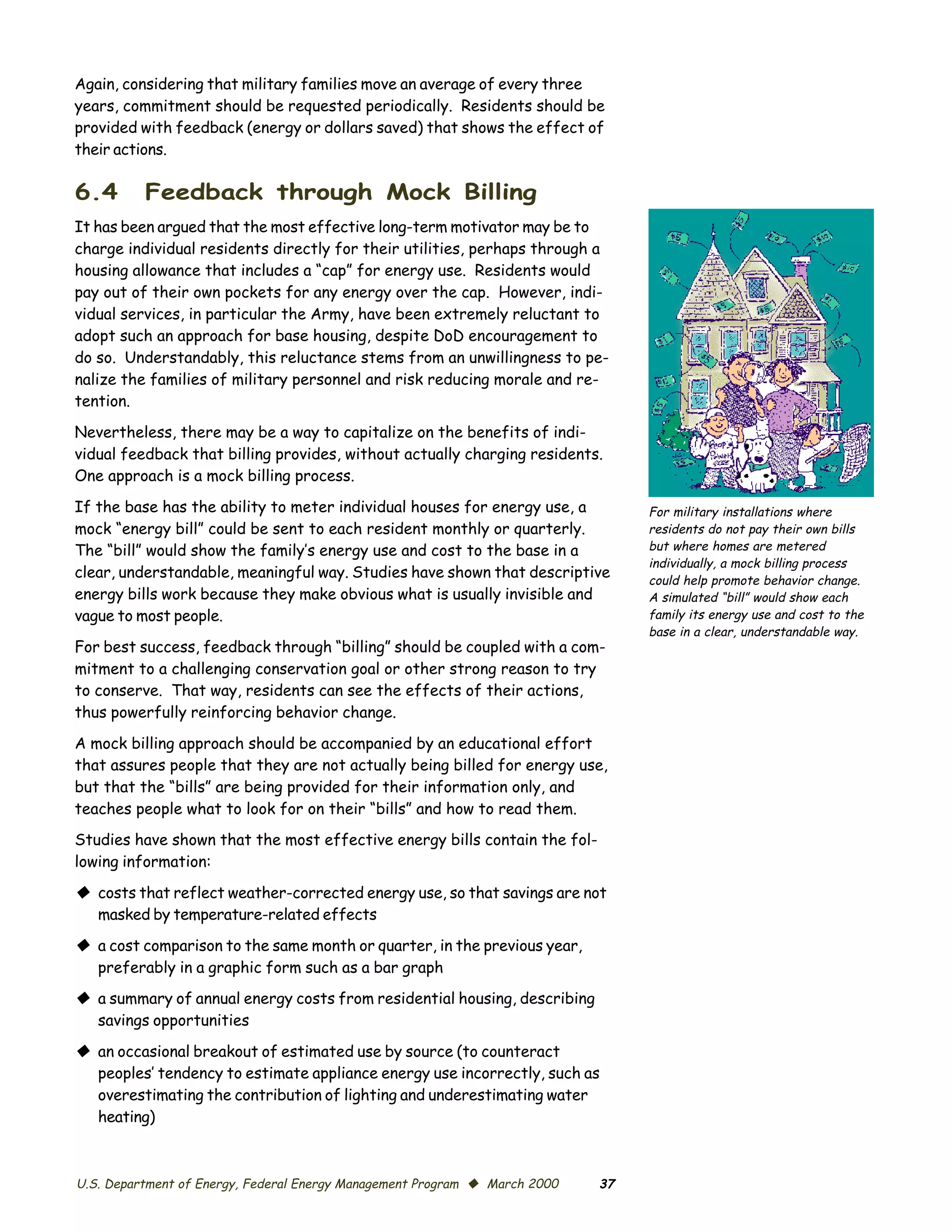
                                                                                  Power” campaigns
You can raise awareness and interest in the campaign by hosting a logo and
slogan contest for residents. Or, post sample logos and slogans and have
residents vote on them.

If your campaign falls under the U.S. Department of Energy’s Federal
Energy Management Program (FEMP), you must use their logo and slogan (a
hand holding a globe, “You Have the Power”) in your materials. You also
need to credit the Department of Energy as a sponsor or partner. At Fort
Lewis, the FEMP logo was used as a secondary visual, but the primary logo
and slogan were chosen by the residents: a lightbulb with a glowing dollar
sign inside it and “Smart Energy Use” (Appendix B). At MCAS Yuma, the
FEMP logo and slogan were the primary visual and slogan. If you are inter­
ested in linking with FEMP, visit http://www.eren.doe.gov/femp or call
(800) DOE-EREN.
Other visuals can include kids’ art made into posters, cartoon strips
created by residents, banners, displays, skits, videos, or anything else that
is feasible and tailored to the base.
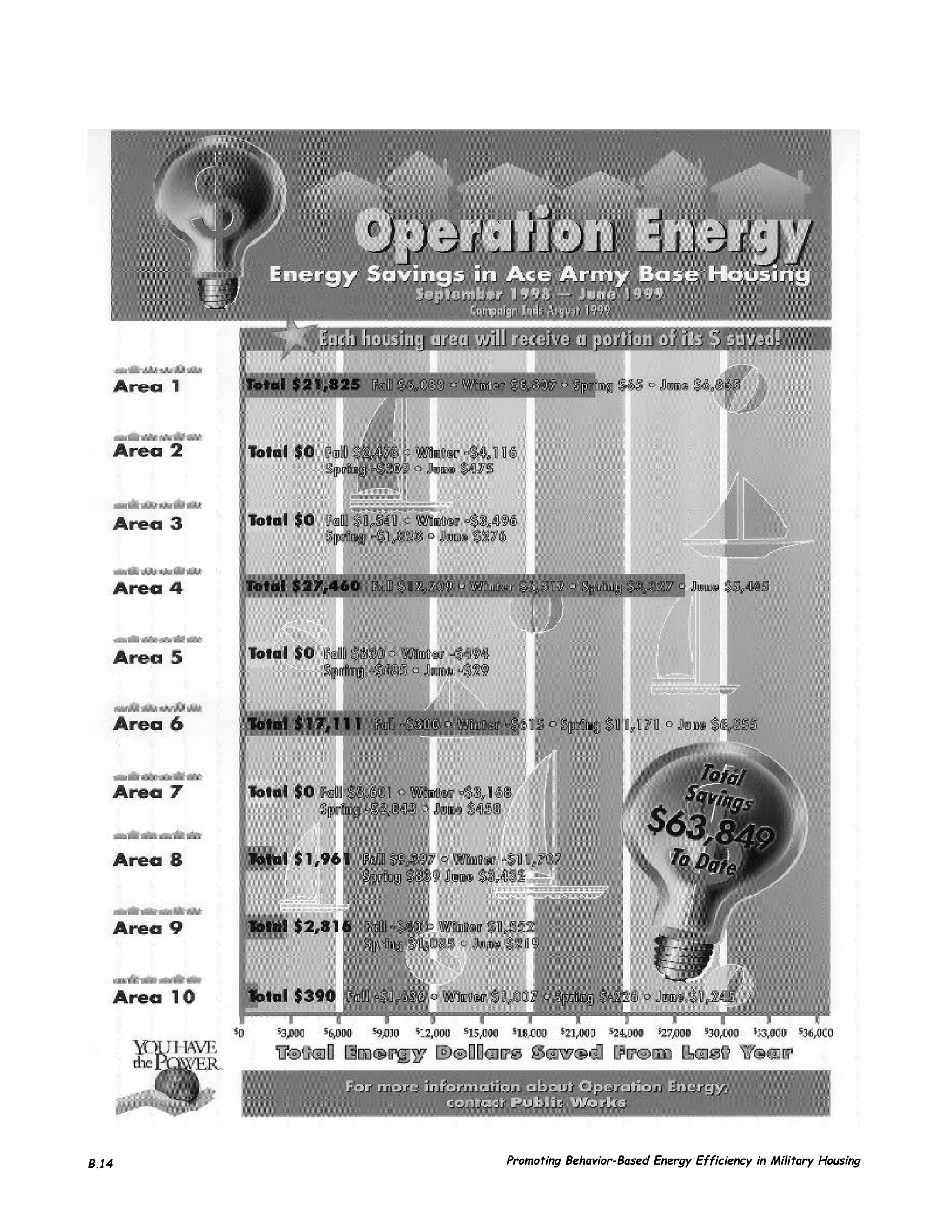
An important aspect of developing visuals is deciding how energy use and
savings will be communicated to residents periodically. Regular feedback
in an easy-to-understand format is critical for motivating residents and
keeping them on track. Bar charts, pie charts, and other visual formats
are better than numbers only. Show trends and comparisons, not just a
new number each time. If you are aiming for a specific goal, consider
showing progress toward the goal.

Residents usually can relate better to dollars than to energy units such as
Btus or therms. If you do use energy units, put them in context. For
example, it may help to say that the base has saved enough energy to
“light up the Astrodome for a week” or other memorable analogy.

4.9       Choose Communication Channels
Identify the communication channels you will use in the campaign, and when
and how you will use them. Choose communication channels based on what
residents said in previous discussions and interviews. The channels will
vary for each base. Examples of typical communication channels include
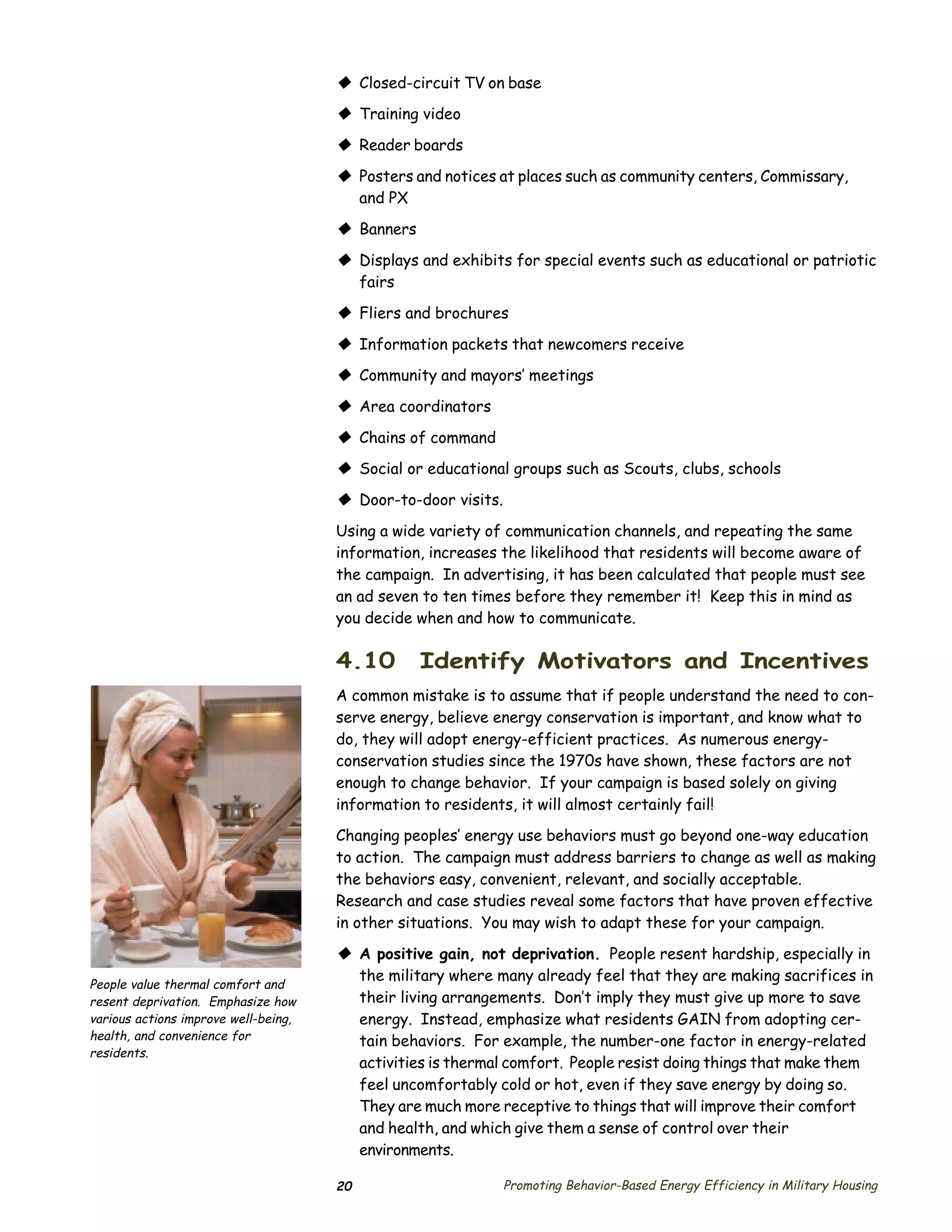
                                                                                  Using a wide variety of communication
© Base newspapers                                                                 channels, and repeating information,
                                                                                  increases the likelihood that residents
© Base newsletters
                                                                                  will become aware of the campaign.


U.S. Department of Energy, Federal Energy Management Program © March 2000    19
© Closed-circuit TV on base
                                      © Training video
                                      © Reader boards
                                      © Posters and notices at places such as community centers, Commissary,
                                        and PX

                                      © Banners
                                      © Displays and exhibits for special events such as educational or patriotic
                                        fairs

                                      © Fliers and brochures
                                      © Information packets that newcomers receive
                                      © Community and mayors’ meetings
                                      © Area coordinators
                                      © Chains of command
                                      © Social or educational groups such as Scouts, clubs, schools
                                      © Door-to-door visits.
                                      Using a wide variety of communication channels, and repeating the same
                                      information, increases the likelihood that residents will become aware of
                                      the campaign. In advertising, it has been calculated that people must see
                                      an ad seven to ten times before they remember it! Keep this in mind as
                                      you decide when and how to communicate.

                                      4.10        Identify Motivators and Incentives
                                      A common mistake is to assume that if people understand the need to con­
                                      serve energy, believe energy conservation is important, and know what to
                                      do, they will adopt energy-efficient practices. As numerous energy-
                                      conservation studies since the 1970s have shown, these factors are not
                                      enough to change behavior. If your campaign is based solely on giving
                                      information to residents, it will almost certainly fail!
                                      Changing peoples’ energy use behaviors must go beyond one-way education
                                      to action. The campaign must address barriers to change as well as making
                                      the behaviors easy, convenient, relevant, and socially acceptable.
                                      Research and case studies reveal some factors that have proven effective
                                      in other situations. You may wish to adapt these for your campaign.

                                      © A positive gain, not deprivation. People resent hardship, especially in
                                        the military where many already feel that they are making sacrifices in
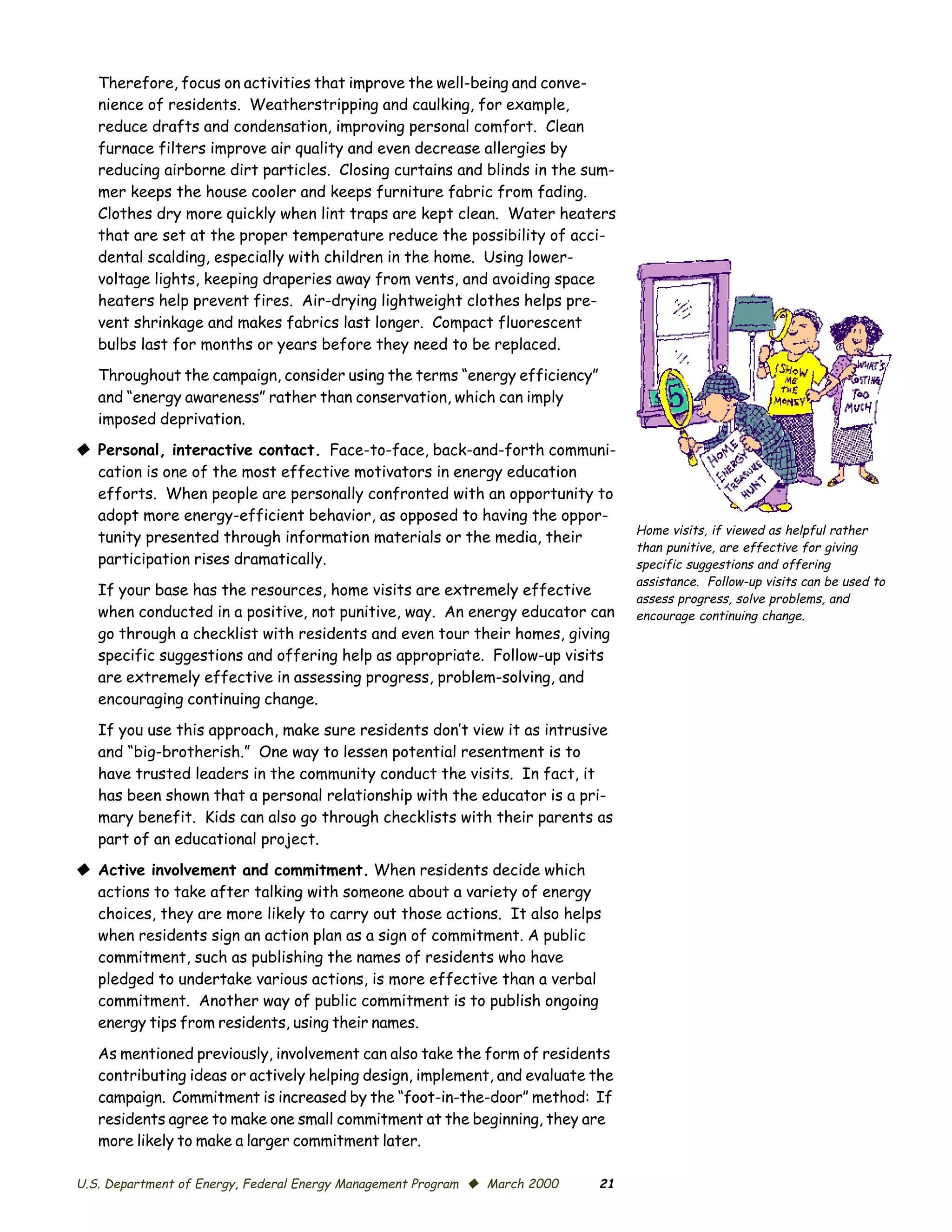
People value thermal comfort and
resent deprivation. Emphasize how       their living arrangements. Don’t imply they must give up more to save
various actions improve well-being,     energy. Instead, emphasize what residents GAIN from adopting cer­
health, and convenience for             tain behaviors. For example, the number-one factor in energy-related
residents.
                                        activities is thermal comfort. People resist doing things that make them
                                        feel uncomfortably cold or hot, even if they save energy by doing so.
                                        They are much more receptive to things that will improve their comfort
                                        and health, and which give them a sense of control over their
                                        environments.

                                      20                       Promoting Behavior-Based Energy Efficiency in Military Housing
Therefore, focus on activities that improve the well-being and conve­
   nience of residents. Weatherstripping and caulking, for example,
   reduce drafts and condensation, improving personal comfort. Clean
   furnace filters improve air quality and even decrease allergies by
   reducing airborne dirt particles. Closing curtains and blinds in the sum­
   mer keeps the house cooler and keeps furniture fabric from fading.
   Clothes dry more quickly when lint traps are kept clean. Water heaters
   that are set at the proper temperature reduce the possibility of acci­
   dental scalding, especially with children in the home. Using lower-
   voltage lights, keeping draperies away from vents, and avoiding space
   heaters help prevent fires. Air-drying lightweight clothes helps pre­
   vent shrinkage and makes fabrics last longer. Compact fluorescent
   bulbs last for months or years before they need to be replaced.
   Throughout the campaign, consider using the terms “energy efficiency”
   and “energy awareness” rather than conservation, which can imply
   imposed deprivation.
© Personal, interactive contact. Face-to-face, back-and-forth communi­
  cation is one of the most effective motivators in energy education
  efforts. When people are personally confronted with an opportunity to
  adopt more energy-efficient behavior, as opposed to having the oppor­
                                                                                 Home visits, if viewed as helpful rather
  tunity presented through information materials or the media, their
                                                                                 than punitive, are effective for giving
  participation rises dramatically.                                              specific suggestions and offering
                                                                                 assistance. Follow-up visits can be used to
   If your base has the resources, home visits are extremely effective
                                                                                 assess progress, solve problems, and
   when conducted in a positive, not punitive, way. An energy educator can       encourage continuing change.
   go through a checklist with residents and even tour their homes, giving
   specific suggestions and offering help as appropriate. Follow-up visits
   are extremely effective in assessing progress, problem-solving, and
   encouraging continuing change.
   If you use this approach, make sure residents don’t view it as intrusive
   and “big-brotherish.” One way to lessen potential resentment is to
   have trusted leaders in the community conduct the visits. In fact, it
   has been shown that a personal relationship with the educator is a pri­
   mary benefit. Kids can also go through checklists with their parents as
   part of an educational project.
© Active involvement and commitment. When residents decide which
  actions to take after talking with someone about a variety of energy
  choices, they are more likely to carry out those actions. It also helps
  when residents sign an action plan as a sign of commitment. A public
  commitment, such as publishing the names of residents who have
  pledged to undertake various actions, is more effective than a verbal
  commitment. Another way of public commitment is to publish ongoing
  energy tips from residents, using their names.

   As mentioned previously, involvement can also take the form of residents
   contributing ideas or actively helping design, implement, and evaluate the
   campaign. Commitment is increased by the “foot-in-the-door” method: If
   residents agree to make one small commitment at the beginning, they are
   more likely to make a larger commitment later.

U.S. Department of Energy, Federal Energy Management Program © March 2000   21
© Demonstrated commitment by the military leadership to the comfort
                                                and health of residents. At both Fort Lewis and MCAS YUMA, resi­
                                                dents overwhelmingly cited energy-efficient homes as the number-one
                                                factor that makes energy conservation difficult. Many residents com­
                                                plained in detail about poorly weatherized windows and doors, thermo­
                                                stats that didn’t work, and repairs that had been requested but not made.
                                                One resident said “When the Army fixes our houses, then we will care
                                                [enough to do energy-efficient things].” Responses such as these indi­
                                                cate that residents are less inclined to take personal action when they
                                                perceive that the military is not doing all it can to provide a reasonably
                                                comfortable home environment.
                                              © Feedback. Feedback is information residents receive about actions they
                                                have already taken. In an energy campaign, feedback shows residents
                                                how much energy they have saved over certain periods of time. Feed­
                                                back helps people visualize the results of their actions, which is impor­
                                                tant because these results are often invisible or difficult for residents
                                                to evaluate. Feedback is most effective when used in conjunction with a
                                                commitment to take action. For specific suggestions about how to display
Ask residents to choose certain energy-         progress visually, see Section 4.8.
efficiency actions and sign a commitment to
                                              © Incentives. An incentive can take the form of a monetary reward or
carry them out.
                                                other desired outcome such as a new playground on the base. The
                                                incentive could be a portion of energy costs saved over a period of
                                                time. Use of incentives has been mixed, with most effectiveness for
                                                short-term change rather than sustained habits.

                                                   Group incentives appear effective under certain conditions. The money
                                                   should be provided to the entire group or every member of the group,
                                                   not individuals who receive it in a raffle. If the group receives the
                                                   money in a lump sum, all members should have the opportunity to say
                                                   how the money should be allocated. The amount received must be
                                                   enough to elicit behavior change. Payment should be received periodi­
                                                   cally rather than delayed for long periods of time.

                                                   Make sure monetary incentives for energy savings are feasible. At the
                                                   Fort Lewis and MCAS Yuma bases it was impossible to transfer money
                                                   from the utility account to the account that directly benefits family
                                                   housing residents. This situation may become more flexible as military
                                                   housing becomes privatized.

                                              © Social interaction. People are more likely to adopt an innovation or
                                                behavior change if they have heard about it or seen it adopted by a
                                                friend or respected member of the community. Community meetings
                                                and other events can be used to conduct focus groups that design and
                                                evaluate campaigns, and help foster exchanges of information.
                                                Community leaders can make energy efficiency a high-status activity.
                                                Service clubs can promote energy efficiency through their existing
                                                missions. Schools, Scouts, and other youth programs and events can
                                                promote educational activities that involve kids. Kids, in turn, help in­
                                                fluence and remind their parents to use energy wisely.


                                              22                      Promoting Behavior-Based Energy Efficiency in Military Housing
© Competition. Competition among similar groups has been shown to
  motivate behavior changes. This is especially true in the military culture,
  which is based on competition and winning. For
  example, energy use of various housing areas can be
  compared with each other. If housing areas are
  architecturally and/or demographically different,
  energy use of various housing areas can be com­
  pared with their own use from a previous time
  period, or energy use-data can be normalized
  according to the number of people participating.
  Incentives can be offered to “winners” or to all
  those who achieve a certain goal.

   For competition to work, people must perceive that

   the comparison is fair; in other words, that groups

   being compared are equivalent in factors that

   affect energy use. In addition, as many group mem­

                                                          Competition—prized in the military culture—sometimes can be
   bers as possible must be aware of where they stand
 used to motivate behavior changes among residents.
   in comparison with others. Individuals must feel

   that their actions make a difference in the entire group’s outcome.


   The groups being compared must have enough pride in their group identi­
   ties to motivate competition. At Fort Lewis, for example, the
   relatively high personnel turnover rate may have kept housing residents
   from establishing neighborhood bonds and thus lowered the motivation to
   compete against other neighborhoods, on base. At MCAS Yuma, however,
   many residents said they were motivated by the desire to make their
   entire post the most energy-efficient in the Marines. In this case, resi­
   dents (with lower turnover and a smaller housing community) apparently
   identified strongly enough with their post to want to elevate it above
   other installations in their branch of the service.
© Vivid, relevant, personalized information. Information that is pre­
  sented in a vivid form, such as a personal story involving danger or vic­
  tory, is more likely to prompt action than something like a standard list of
  tips or numbers. If the desired behaviors are modeled, people are more
  likely to visualize themselves doing them. Videotapes of people doing
  energy-efficient things in their homes have prompted similar actions by
  viewers, even after one viewing.

4.11        Get the Word Out
In accordance with your schedule, produce and distribute information and
use the channels of communication you’ve identified. Information materials
may fit into several categories:
© Campaign description. These materials are intended to raise awareness
  among residents about the campaign, its incentives, their role, and the
  time frame. Names and phone numbers of campaign managers and re­
  source people should be listed. Appendix B contains some examples of
  materials introducing the campaign.


U.S. Department of Energy, Federal Energy Management Program © March 2000      23
Fliers, brochures, posters, news articles, and community meetings can be
                                               used to convey this information. It is important to get the word out to as
                                               many people as possible, as early as possible, about the campaign to moti­
                                               vate behavior change.

                                               To maintain awareness despite personnel turnover, information about the
                                               campaign must be conveyed on a regular basis. For example, materials
                                               could be placed in newcomers’ packets, letters could be sent to homes
                                               when families move in, or newcomers could be required to view a short
                                               video as part of their base orientation.

                                          © Information channels for targeted behaviors. The desired energy-
                                            saving actions (see Section 4.7) should be conveyed in many different
                                            ways, to reinforce them and to ensure that as many people as possible
                                            become aware of them. Here are some examples of ways behaviors can
                                            be described:
                                               • Posters (see example in Appendix B)

                                               • Brochures and fliers (see Appendix B)

                                               • Children’s art work
                                               • Videos where residents demonstrate the actions (see Appendix D)

                                               • Reader boards highlighting one action each time

                                               • Cartoon strips (see examples in Appendix B)
                                               • Refrigerator magnets, T-shirts, door hangers

                                               • Workshops

                                               • As part of displays and fairs
                                               • On a “commitment sheet” where residents check off the actions they
                                                plan to take

                                               • On educational worksheets where children and parents are
                                                 guided through their own homes by answering questions about energy
                                                 use in each room

                                               • Mock “tests” (“Guess which one of these appliances is the biggest
                                                 energy hog?”).

                                               Studies have shown that a particularly effective “grabber” is to convey
                                               one or more behaviors in a personal story form. The more vivid and
                                               dramatic, the better. These stories could emphasize the impacts of tak­
                                               ing certain actions. For example, a pediatrician may be willing to speak
                                               about how she treated a child for hot water burns, which could have
                                               been prevented if the water heater was set at the proper temperature. A
                                               dad could describe how his children suffered fewer allergy symptoms
                                               after he began cleaning the furnace filter monthly. A base firefighter
                                               could describe a home fire that was caused by improper use of a space
Use stories from residents to emphasize        heater or high-wattage light bulbs. A teenager could brag that her job of
the target behaviors. Water heaters set        replacing burnt-out light bulbs has all but disappeared after she talked
at the proper temperature, for example,
                                               her family into replacing the incandescent bulbs with compact fluores­
reduce the possibility of accidental
scalding.                                      cent ones.


                                          24                       Promoting Behavior-Based Energy Efficiency in Military Housing
Another way to get these stories is to have residents contribute their
   own energy-conservation tips—and publish them with the names of the
   contributors. This approach highlights residents as role models while
   conveying the feeling that neighbors and friends are indeed making
   changes.
© Progress by residents. It is critical to give regular feedback about
  how well residents are doing, in comparison with a goal, if appropriate.
  Residents need to visualize a tangible result of their efforts to be
  motivated, especially in the absence of personal utility bills that typi­
  cally provide this feedback to homeowners.

   This feedback can be shown in bar charts, pie charts, and other visual
   formats. As mentioned previously, put results in a format familiar to
   residents, such as dollars saved versus Btus. Appendix B shows a for­
   mat that could be adapted to show progress in energy savings among
   various communities or neighborhoods on a base.

   Another way to show progress is to tie it to a goal that the base is
   working toward. For example, if residents are working toward a goal of
   upgrading playground equipment, you could show a picture of the equip­
   ment gradually being “filled in,” representing the portion of the goal
   achieved so far. List the targeted behaviors at the same time
   progress is being shown, to reinforce the idea that these behaviors are
   resulting in this amount of savings.

   Again, information on progress should be shown in several different
   forums to help ensure visibility among as many residents as possible.
   These could include posters, fliers, news articles, direct mail, and door-
   to-door fliers handed out by energy monitors or community leaders.
© Final results and rewards. At the end of the campaign, or whenever
  awards or other incentives are given out, residents must be made aware
  of them. If incentives are given out periodically, conveying this to resi­
  dents will help motivate continued behavior change.

   Results and rewards should be announced with some degree of fanfare
   and celebration. If awards are given to certain housing areas or parts
   of the base, it may be appropriate to have a high-level base official
   hand out the award at a ceremony where those residents are invited. If
   the base achieved a tangible award such as a playground upgrade, a
   plaque could be permanently placed there, engraved with words such as
   “New playground equipment made possible by energy savings in XYZ
   Base family housing, 2000.” Individual, low-cost awards, such as certifi­
   cates, can be given out to individuals or groups who carried out special
   activities to make the campaign a success, such as energy monitors,
   community leaders, schools, Scouts, and clubs.
   Posters, news articles, and other materials can help convey the results
   across the base.


U.S. Department of Energy, Federal Energy Management Program © March 2000   25
4.12 Conduct Activities and Involve
                                          Residents
                                          Visible, interactive activities help get the word out, invite participation in
                                          fun ways, and reach specific groups. Activities can claim huge amounts of
                                          time and resources, so make sure you have sufficient amounts of both
                                          before beginning. Examples of activities include the following:

                                          © Hosting displays or exhibits at fairs and other community events.
                                            At Fort Lewis’s Kids Fest, for example, the energy resource manager
                                            staffed an energy-education booth and handed out hundreds of “give­
                                            away” materials donated by local utilities. MCAS Yuma has made an
                                            Energy Fair a yearly event, with local utilities and the University of
                                            Arizona providing exhibits and prizes for drawings.
Visible, interactive activities such as
exhibits are great for getting the word
                                          © Working with education-oriented groups to target children. Family
out and showing progress in base energy     housing residents are very attuned to the well-being of their children,
savings.                                    and this can be capitalized on for campaigns. Sometimes the same resi­
                                            dents who are reluctant to have energy monitors come to their houses
                                            may welcome visits from students as part of an educational project. In
                                            addition, an excited and involved child can motivate and serve as a role
                                            model for other family members, including parents. Results of the final
                                            survey at MCAS Yuma indicated a large number of housing residents
                                            surveyed (42%) chose energy-efficient behaviors because they wanted
                                            to set a good example for their children.
                                                Work with existing education-oriented groups whose missions involve
                                                children. Scouting groups, for example, may wish to include family
                                                energy efficiency as part of the requirements to earn certain badges.
                                                Scout leaders may also be willing to set up required community service
                                                projects that contribute to the campaign. Schools where the base’s
                                                children attend may also be willing to include an energy-efficiency unit
                                                in their curricula. Day care centers for school-age children may wel­
                                                come age-appropriate energy-related activities, such as art work by
                                                children that is converted into posters and used in the campaign or
                                                games featuring energy-efficient behaviors.

                                                Resources for working with kids on energy issues are also available
                                                from the Alliance to Save Energy. The Alliance’s Green Schools
                                                project offers free lesson plans on the Internet for elementary and
                                                middle-school ages (www.ase.org/educators). The Green Schools Project
                                                is designed to reduce facility energy costs while educating students.
                                                Lesson plans include activities, games, and home energy audits that kids
                                                can do themselves.

                                          In working with education-oriented groups, keep the following guidelines in
                                          mind:

                                           •	 Have a single point of contact representing each group. This person
                                              must be willing to expend personal effort and lead others to make sure
                                              the energy-related educational projects are carried out effectively.
                                              Make sure that person is willing to get the proper approvals for any
                                              energy-related projects (school district officials, etc.).


                                          26	                       Promoting Behavior-Based Energy Efficiency in Military Housing
•	 Be prepared to work closely with group members to prepare materials
    and activities. Most educational groups are extremely busy and will
    look to you for ideas and help. Some teachers and other leaders may
    not feel competent teaching about energy use and may want a prepack­
    aged curriculum that fits with their teaching goals. Resources such as
    the free lesson plans from the Green Schools Project, mentioned ear­
    lier, can be very effective. Appendix E lists other resources. Most
    materials will need to be tailored to your particular base and situation.
 •	 Understand the group’s mission and how you fit into it. Most schools,
    for example, will require that children learn something from a particu­
    lar activity. Thus, school officials may frown on children simply
    carrying fliers home, but they may be very interested in an educational      Work with existing education-oriented groups
    unit that teaches children how to calculate “before and after” energy        to involve children. Children can motivate and
                                                                                 serve as role models for other family
    use in their homes.
                                                                                 members.
 •	 Make sure everyone involved understands each other’s roles. For
    example, who will provide the educational materials? In what form?
    Who will tailor them to meet the group’s needs? Who pays for what?
    Who will host activities for children? Who will provide prizes and
    other awards for children, if required?

 •	 Make sure all activities are age-appropriate. Older children, for

    example, may enjoy participating in neighborhood energy audits with

    adult energy monitors, whereas younger children may prefer going

    through a simple checklist with their parents. The leaders of each

    group can advise you on what is age-appropriate for their group of

    children.


© Using October, Energy Awareness Month, to highlight the campaign.
  Examples of activities that fit well with this theme include the
  following:

   • Contests and giveaways
   • Fairs

   • Awards for progress to date

   • Open houses in various neighborhoods where energy-efficient

    elements are highlighted (and snacks are given out!)


   • Community workshops demonstrating certain activities, such as how to
     program a thermostat and when to use the various styles of compact
     fluorescent lights, with lights given out as door prizes

   • Special activities for kids.

4.13 In Summary: Designing and
Executing a Campaign
In designing and executing a campaign, consider the following steps:

© Establish goals, or the desired outcomes. A typical goal is to get resi­
  dents to modify their habits to reduce energy use by a certain amount
  over a certain time period.

U.S. Department of Energy, Federal Energy Management Program © March 2000   27
© Establish objectives to achieve goals. Typical objectives are to increase
  the percent of people who engage in certain measurable behaviors.
© Set a budget that covers all labor, materials, production, distribution,
  activities, and monetary incentives, if any. Get the budget approved
  early.
© Set a schedule to keep the work on track and to include time-specific
  events. The schedule may be influenced by the availability of energy-
  use data and the time required for behavior change.
© Understand your base setting by talking with residents and officials.
  Use input from them to design a campaign that is tailored to the site.
  Use focus groups and interviews to learn what residents are interested
  in and willing to do, allowed to do, want to participate in, and how they
  want information communicated. Talk with base communication person­
  nel to learn about their requirements, deadlines, and approval
  processes.

© Consider a pre-survey. A pre-survey of residents can be used to de­
  sign the campaign; select logos, slogans, and incentives; form a baseline
  for later comparison and evaluation; and begin introducing the target
  actions. Design surveys using accepted practices for data gathering
  and wording. Pretest the survey with residents before administering
  it.

© Identify desired behaviors. Choose actions that are allowable, fea­
  sible, and reasonable for the base and the houses’ floor plans. Empha­
  size the actions with the greatest potential for savings.

© Select themes, messages, and visuals. Themes are the guiding com­
  munication frameworks. Messages are statements that support the
  themes and provide the basis for action. A slogan is a short, catchy
  phrase that often appears with an identifying visual or logo. All visuals
  should be in familiar, easy-to-understand formats.
© Choose communication channels that residents have said they pay
  attention to. Use a variety of channels and repeat information for best
  coverage.
© Identify motivators and incentives to prompt behavior change. Giving
  out information is not enough. Emphasize gain rather than
  deprivation—health, well-being, and convenience. Use personal, inter­
  active contact such as home visits. Encourage written commitment by
  residents. Use feedback to show residents how much energy they have
  saved over time. Consider monetary or other tangible rewards. Work
  through existing social groups. Foster competition. Make information
  vivid, relevant, and personalized.

© Get the word out. Produce and distribute information about the cam­
  paign itself, the targeted behaviors, progress, and final results and
  rewards.

© Conduct activities and involve residents. Use interactive activities to
  share information, invite participation, and reach specific groups.


28                     Promoting Behavior-Based Energy Efficiency in Military Housing
When working with educational groups, understand their mission, clarify

   each others’ roles, and be prepared to provide tailored information

   materials.


5.0 Evaluating and Reporting on the Campaign

Evaluating the effectiveness of a campaign involves measuring the results
against the goals. Evaluation enables you to understand the extent to
which the expected results were achieved. Perhaps more importantly,
evaluation should also reveal what elements of the campaign were effec­
tive and which were not—in other words, what worked, what didn’t, and
why? The findings can be used for mid-course correction or to design
future efforts.

5.1       Mid-Course Evaluation
Persuading people to change their habits is challenging, because so many
things influence peoples’ behaviors. Thus, even if you’ve done your
homework to tailor a campaign to your base, some surprises are bound to
arise along the way. That’s where a mid-course evaluation becomes valu­
able.
If you wait until the campaign ends before evaluating it, you may discover
that certain aspects of your approach were not effective. By that time,
however, you’ve lost the opportunity to make changes or corrections. A
mid-course evaluation allows you to fine-tune the campaign in progress to
better achieve the desired outcomes. In addition, you can shift resources
to areas that are working well, while eliminating or cutting back on activi­
ties that are less effective.
                                                                                 A few telephone calls to responsive
A mid-course evaluation need not be expensive or time-consuming. Several         residents can be used to evaluate a
strategic phone calls, personal interviews, or a couple of informal discus­      campaign that is under way. Use feedback
                                                                                 to make mid-course corrections.
sions with a group of community members can reveal much about what’s
working, what’s not, and what needs to be done differently.

If you are using phone or face-to-face interviews, start with your estab­
lished contacts—the people who provided input to design the campaign or
leaders who are contributing to its implementation. Ask each person if
there are others to whom they can refer you who would be willing to
answer a few questions. If possible, try to get a diverse group of
respondents—men, women, and children from different kinds of houses or
different locations on the base. Assure them that their responses will
help improve the campaign and that no names will be used.

A mid-course correction should provide answers to the following questions:

© Are residents aware of the key elements of the campaign, including
  incentives, if any?

© Where are they getting their information about the campaign?
© Do they know what they’re being asked to do to use energy efficiently?


U.S. Department of Energy, Federal Energy Management Program © March 2000   29
© Are they doing anything differently now in their homes as a result of the
                                               campaign, and if so, what?
                                             © Is there anything keeping them from doing these things? If so, what?
                                             In phone interviews or group discussions, listen carefully to what residents
                                             volunteer when they answer questions. Their comments may indicate mis­
                                             understandings that need to be corrected as well as the need for greater
                                             emphasis in some areas.

                                             At Fort Lewis, for example, many residents said they didn’t need compact
                                             fluorescent lights, thinking that they were only for the fluorescent-type
                                             tube fixtures. Though the campaign had encouraged the use of compact
                                             fluorescents, people didn’t understand what they were or that they were
                                             available at the base PX. From this finding, future campaign communica­
                                             tions placed more emphasis on showing compact fluorescent lights, demon­
                                             strating how they fit into various existing fixtures, and reminding people
                                             to purchase them on base.

                                             5.2        Final Evaluation
                                             As a minimum, the final evaluation should investigate two factors: (1) the
                                             amount of energy saved, and (2) the extent of peoples’ behavior change
                                             that contributed to the savings. Together, these two factors indicate the
                                             effectiveness of the campaign. The first factor is relatively straight­
                                             forward to measure by examining before-and-after energy-use data. The
                                             second factor is more interpretative, but just as important.
                                             © Energy saved. Energy-use data should be available from Housing, an­
                                               other base organization responsible for base energy, or the provider
                                               utility. Depending on how data are gathered, you can calculate and
                                               present energy use and savings in various ways that make sense for
                                               your campaign. For example, energy savings can be calculated by sea­
Evaluate two factors as a minimum: (1) the
                                               son, by neighborhoods or parts of the base, by different house
amount of energy saved and (2) the
influence of residents’ actions on the         designs, by gas versus electricity, and so on.
savings.
                                                  Section 5.3 describes factors that should be considered when calculat­
                                                  ing energy savings.
                                             © Behavior change. To understand peoples’ behavior change and to what
                                               extent the campaign contributed to it, you need direct feedback from
                                               residents. The best ways to do this are to conduct small discussion
                                               groups and/or survey all residents who were targeted in the campaign.

                                                  The discussion groups and survey process can be similar to those
                                                  described in Section 4.5 for designing the campaign. When conducting
                                                  focus groups for this final evaluation, try to convene groups that
                                                  represent a diversity of people and housing situations. Conduct focus
                                                  groups until you begin to hear people from different groups repeating
                                                  the same things, with no significantly different information arising.
                                                  According to noted focus group expert and Portland State University
                                                  professor David L. Morgan, a typical number of groups is three to five
                                                  with six to ten participants, for topics and participants with moderate di­
                                                  versity. When you begin hearing the same information coming up in

                                             30                       Promoting Behavior-Based Energy Efficiency in Military Housing
various focus groups, you will have confidence that what you are hearing
   is somewhat representative of the larger population.
At the end of the campaign, you want to understand two fundamental things:

© to what extent people took actions that reduced energy use (including
  actions taken)
© the effectiveness of various campaign activities and communications in
  prompting those changes.

You may also wish to gauge residents’ willingness to continue their energy-
efficient lifestyles.

To learn about these things, ask questions similar to those described in
the mid-course evaluation (Section 5.1), tailoring them for the end of the
campaign. The goal of the evaluation is to understand the effectiveness
of the campaign well enough to be able to use or adapt its activities for
longer-term efforts, eliminating or replacing activities that were
ineffective.

When asking about the target behaviors, ask which things residents were
already doing before the campaign began and which ones they began doing
after the campaign started (see the MCAS Yuma survey in Appendix C).
Asking the question this way has three benefits: (1) people like to “get
credit” for the positive things they’re already doing, (2) it more clearly
shows which activities were caused by the campaign, and (3) it shows which
activities may need more or less emphasis in ongoing efforts.

A mail survey can ask similar questions and give you more confidence of
having representative results, though you won’t get the insights or depth
of responses as in oral discussions. With an adequate response rate, a mail
survey adds somewhat more rigor to an evaluation because it goes to the
entire target population and shows the percent of respondents who said
certain things. Appendix C shows examples of mail surveys sent to all resi­
dents for final evaluation of a campaign.
A telephone survey can also be conducted, though it can be very time-
consuming if you are trying to hear from a large population of residents.
In addition, people who are “cold-called” (as from a telephone list of all
residents) may resent the intrusion.

The information received from residents, combined with other information
you may have access to, helps you put the energy-use data in perspective.
You may discover, for example, that one area of residential housing saved
considerably more than others, but not know why until you hear from its
residents. You may learn from them that their members were the only
ones who received a certain newsletter or had educational projects involv­
ing children. You may also discover that they had the highest percent of
home visits or signed the most commitment forms promising to take cer­
tain energy-saving actions in their homes.

On the other hand, you may discover that residents who moved to the base
after a certain date were unaware of the campaign and consequently did
nothing to change. Or perhaps people were enthused at the beginning of the


U.S. Department of Energy, Federal Energy Management Program © March 2000    31
campaign, but as time went on, enthusiasm waned and behaviors reverted.
                                    Or perhaps certain behaviors, such as turning down a thermostat, proved un­
                                    comfortable or inconvenient over time.

                                    These kinds of findings, both positive and negative, help shed light on the
                                    effectiveness and timing of certain campaign activities in contributing to the
                                    overall result.

                                    With adequate resources and time, the best evaluation uses several methods,
                                    quantitative (involving numbers such as energy amounts saved, how many
                                    people said what, or number of energy home visits requested) and qualitative
                                    (interpreting the meaning in what people have said or done). Once the com­
                                    bined data are analyzed and compared, the key findings about the effec­
                                    tiveness of the campaign will rise to the top. It helps to have various team
                                    members conduct this evaluation together and discuss the combined find­
                                    ings, to reach a consensus of perspectives.

                                    5.3 Factors that Affect Energy Use
                                    Results
                                    Several factors can make energy-use results appear artificially high or low.
                                    You need to acknowledge and account for the factors that apply to your
                                    campaign.

                                    © Account for temperature-related weather conditions. Let’s say, for
                                      example, that you launched a campaign for summer and winter 2000,
                                      and you are comparing it with summer and winter energy use from 1999
                                      to calculate savings from one year to the next. If the year 2000
                                      happened to have an unusually cool summer or warm winter, people
                                      would likely not use their cooling or heating systems as much, thus sav­
                                      ing energy. However, this reduced use alone would not be a result of
                                      informed behavior change, but of weather conditions. The resulting
                                      energy saved could appear very positive, but artificially so. By the same
                                      token, if the year 2000 happened to be an unusually hot summer and cold
                                      winter, the energy results could look particularly bleak because people
                                      would have used their cooling and heating more than usual. In fact, even
                                      if residents did take actions to save more energy, the results could be
                                      masked by weather-related increases in heating and cooling.

                                         What you really want to measure is, did residents save even more energy
Account for temperature-related          beyond that associated with weather-related heating and cooling? For
weather conditions when comparing        the answer, correct energy data for weather effects by using a math­
energy use from different time           ematical calculation. Appendix F describes the process.
periods.
                                    © Account for physical upgrades in housing. If the base is upgrading
                                      certain physical features of base housing during the time of your
                                      campaign, it may affect campaign results. Upgrades such as installing
                                      double-pane windows, insulation, programmable thermostats, and sealing
                                      door and window frames should improve energy efficiency and reduce
                                      energy use. Yet most of these upgrades do not require behavior
                                      change by residents. (An exception is the programmable thermostat,
                                      which residents must program and not manually override.) To account


                                    32                      Promoting Behavior-Based Energy Efficiency in Military Housing
for the effect of upgrades on energy savings, subtract the expected up­
   grade-related savings from the energy-use data. Estimates of savings
   from upgrades are available from analysis that the military or its con­
   tractors must conduct to justify housing modifications.

© Account for occupancy. Occupancy that is significantly lower than
  usual during the time of the campaign or during the comparison period
  may affect energy results. In such cases, it could appear that resi­
  dents saved more or less than they did when the energy use actually
  reflects fewer occupants in the homes.

   Which occupancy situations probably are not cause for concern? Most
   bases have slightly fluctuating occupancies as people move in and out
   and routine maintenance is performed. These constant, slight fluctua­
   tions won’t affect energy results because they are the same in both
   time periods of comparison.
   Another cause of occupancy is deployment. Deployments usually don’t
   affect energy use significantly, however. Though one parent may be
   deployed away from the home, most energy use continues at the same
   rate, especially heating and cooling. What about when both parents are
   deployed at the same time? According to the DoD’s DefenseLINK web
   site, only about 6% of service members are married to other service
   members. Though some bases may have higher rates of married ser­
   vice members, the military makes an effort not to deploy both parents
   at the same time to prevent children from temporarily moving else­
   where, meaning few homes are completely unoccupied during
   deployments.

   A situation that could affect energy rates, however, would be if the
   base were performing major upgrades on a significant percentage of
   homes, leaving them empty for a time. To determine how much this situa­
   tion would affect energy results, you would need to “normalize” the data
   on a per-house or per-square-foot basis. This involves dividing total en­
   ergy consumption by the number of homes to get the consumption per
   residence. Then, a ratio using the percent of unoccupied homes could be
   compared with the same ratio from the time period when homes were oc­
   cupied, to determine the difference in energy use. A more general way
   to do this would be to estimate the energy use from the unoccupied
   homes and subtract that from the energy used when the homes were oc­
   cupied. This would become your new energy baseline.

© Account for changes in energy rates. One of your campaign goals may
  be to reduce the base’s energy bill for family housing. Be aware, how­
  ever, that changes in costs of gas, oil, and electricity rates will also af­
  fect costs. In other words, if electricity rates dropped significantly
  during the year of the campaign, the base could show energy cost savings
  from the previous year even if the same, or even more, energy was used
  by residents. The reduced costs would be the result of reduced energy
  rates, not necessarily behavior changes by residents. By the same token,
  if rates increased substantially, energy savings could look artificially
  negative even if residents had saved more energy from the previous year.


U.S. Department of Energy, Federal Energy Management Program © March 2000   33
This situation is not a problem if your cost savings are based on energy
                                               units used (such as therms) that you multiply by a constant dollar amount.
                                               If you’re using the energy bills the base received from the utility, how­
                                               ever, you should also examine actual energy use and not just what the
                                               base was charged.

                                          5.4        Reporting on and Publicizing Results
                                          Residents, base officials, and sponsors have the right to know the results of
                                          the campaign in some form. Base community leaders who participated in the
                                          campaign may appreciate a separate briefing. Higher-level military
                                          officials, U.S. Department of Energy organizations, local utilities, profes­
                                          sional scientific societies, schools, and energy coalitions may also be
                                          interested in the results. All of these people will also want to know about
                                          any follow-up or ongoing efforts.
                                          Reporting can take many different forms, but should be tailored to the audi­
                                          ence for which it is intended. For example, communications with residents
                                          may emphasize incentives won, pride, and celebration, as well as the need
                                          for ongoing action. Base officials may be interested in how to extend or
                                          improve on the results to meet future energy conservation goals. The base’s
                                          public affairs office may wish to send press releases to local news media,
In reporting on a campaign, be prepared   emphasizing local angles such as school or utility involvement. Scientific so­
to discuss findings, recommendatins,      cieties and coalitions may be interested in new or corroborative findings
future plans, and how the campaign
                                          and implications for future studies.
contributed toward federal energy
goals.                                    In reporting on campaign results, be prepared to provide or discuss the fol­
                                          lowing:

                                          © Data, visuals, other information, and quotes in various formats and for
                                            various audiences

                                          © Why the campaign was or was not successful, and, more importantly,
                                            what will be done in the future as a result
                                          © How the campaign fits into a broader context, such as meeting federal
                                            and military energy goals

                                          © Implications of upcoming changes that could affect future energy use.
                                            Examples are privatization of military housing and increased use of
                                            Energy Saving Performance Contracts, where contractors upgrade
                                            facilities to make them more energy efficient and are paid from the re­
                                            sulting energy cost reductions.

                                          5.5 In Summary: Evaluating and
                                          Reporting on the Campaign
                                          Keep these guidelines in mind when evaluating and reporting on the final re­
                                          sults of the campaign:

                                          © Evaluating the effectiveness of a campaign involves measuring the
                                            results against the goals. Evaluation should also reveal what elements
                                            of the campaign were effective and which were not—in other words,
                                            what worked, what didn’t, and why.


                                          34                       Promoting Behavior-Based Energy Efficiency in Military Housing
© A mid-course evaluation allows you to change or correct your approach
  and activities to help achieve the final goals more effectively.
© A final evaluation should be more extensive and representative. A com­
  bination of methods is helpful. As a minimum, the final evaluation should
  investigate two factors: (1) the amount of energy saved, and (2) the ex­
  tent of peoples’ behavior changes that contributed to the savings.

© In calculating the amount of energy used and saved, account for factors
  such as weather conditions, physical upgrades in houses, occupancy,
  and changes in energy rates.

© Report the campaign results to residents, base officials, and sponsors,
  at a minimum. Convey information about the effectiveness of the cam­
  paign and any follow-on efforts in forms tailored to the intended
  audiences.


6.0 Sustaining the Effort
Studies have shown that the most challenging aspect of energy-efficiency
programs aimed at changing behavior is sustaining new behaviors over time.
For a variety of reasons, it is very difficult to change ingrained habits and
underlying attitudes. (As evidence, recall how many years it took to get
people to recycle, wear seatbelts, and exercise regularly—and many people
still don’t do these things, despite the obvious benefits!)

Added to this challenge is residential turnover on military bases, which
makes it difficult to sustain messages and interest. (On the other hand,
people who take changed attitudes and behaviors with them can spark
changes on other bases.) The most significant challenge, of course, is the
need to maintain motivation in the absence of individual utility bills.
Despite these barriers, federal mandates for energy reductions in federal
facilities are becoming more stringent. Every tool must be used to meet
energy conservation goals and drive costs down. That is why technology
and upgrades proven effective in achieving long-term savings must be aug­
mented with enduring efficiency actions by people if continuing energy
goals are to be met.
One campaign, regardless of how effective, is not much help if people
revert to their former behaviors when the campaign ends. The following
sections give some guidelines for sustained behavior change, based on
research findings and programs found to be effective.

6.1       Reaching Newcomers
Newcomers to base housing, including children, should be targeted to keep
resident awareness high as personnel move in and out. Newcomers typi­
cally receive a package of many different kinds of information materials,
but many don’t take the time to read all of them. Thus, don’t rely on
printed materials in the orientation package to carry the message about
the base’s energy programs.


U.S. Department of Energy, Federal Energy Management Program © March 2000   35
More effective would be a requirement, as part of housing orientation, to
                                       view an energy-efficiency video that models the desired behaviors. New­
                                       comers could receive a personal visit or phone call from an energy manager
                                       describing the base’s energy-efficiency program and offering assistance.
                                       Energy managers could work with schools where the base’s children attend
                                       to offer repeatable educational materials and curricula; each year could
                                       focus on a new action or theme.

                                       6.2      Self-Motivation
                                       Financial incentives have been shown to have some effect on short-term
                                       behavior, but are less effective in maintaining that behavior when the
                                       incentive ends. In addition, studies have shown that weak or small incen­
                                       tives, including those not involving money, seem to be as effective, or
                                       sometimes even more effective, than large incentives. This is apparently
                                       because people who receive smaller “prompts” are more likely to feel that
                                       they are acting out of their own desires rather than simply doing what
                                       someone else told them to do.
                                       The underlying principle is that motivation from within (self-directed, or
A long-term effort should remind       intrinsic) has been shown more effective in changing energy-use habits
residents of the self-satisfaction     than from an outside source (external), including money. Studies have
associated with using energy wisely.   shown that people obtain a great deal of satisfaction from being frugal,
                                       participating in a worthwhile endeavor, and behaving in an ecologically
                                       responsible fashion. In addition, environmental programs have found that
                                       parents often are motivated to take actions that will make a better world
                                       for their children.

                                       These are exactly the attitudes that a long-term effort must capitalize on
                                       to succeed. A long-term efficiency effort, therefore, could include
                                       reminding residents of the self-satisfaction associated with using energy
                                       wisely. The importance of passing along energy-efficiency values to chil­
                                       dren should also be emphasized.

                                       Non-financial, ongoing incentives might include such things as certificates
                                       of achievement, public recognition such as having names of energy savers
                                       listed in the base newspaper, recognition of military personnel by chains of
                                       command, the opportunity to be held up as an energy leader or mentor on
                                       base, and school award programs. To identify effective non-financial
                                       incentives, get feedback from residents. Test the effect of the incen­
                                       tives by evaluating savings and behavior change after incentives are made
                                       available.

                                       6.3      Commitment
                                       Personal commitment to take certain energy-efficiency actions seems to
                                       be one of the best techniques for lasting behavior change. In one study,
                                       for example, participants who agreed to have their names published as
                                       part of the conservation study used 15% less natural gas and 20% less
                                       electricity than the control group. The most encouraging finding is that
                                       the differences were still significant 12 months later.


                                       36                     Promoting Behavior-Based Energy Efficiency in Military Housing
Again, considering that military families move an average of every three
years, commitment should be requested periodically. Residents should be
provided with feedback (energy or dollars saved) that shows the effect of
their actions.

6.4       Feedback through Mock Billing
It has been argued that the most effective long-term motivator may be to
charge individual residents directly for their utilities, perhaps through a
housing allowance that includes a “cap” for energy use. Residents would
pay out of their own pockets for any energy over the cap. However, indi­
vidual services, in particular the Army, have been extremely reluctant to
adopt such an approach for base housing, despite DoD encouragement to
do so. Understandably, this reluctance stems from an unwillingness to pe­
nalize the families of military personnel and risk reducing morale and re­
tention.

Nevertheless, there may be a way to capitalize on the benefits of indi­
vidual feedback that billing provides, without actually charging residents.
One approach is a mock billing process.

If the base has the ability to meter individual houses for energy use, a         For military installations where
mock “energy bill” could be sent to each resident monthly or quarterly.          residents do not pay their own bills
The “bill” would show the family’s energy use and cost to the base in a          but where homes are metered
                                                                                 individually, a mock billing process
clear, understandable, meaningful way. Studies have shown that descriptive       could help promote behavior change.
energy bills work because they make obvious what is usually invisible and        A simulated “bill” would show each
vague to most people.                                                            family its energy use and cost to the
                                                                                 base in a clear, understandable way.
For best success, feedback through “billing” should be coupled with a com­
mitment to a challenging conservation goal or other strong reason to try
to conserve. That way, residents can see the effects of their actions,
thus powerfully reinforcing behavior change.

A mock billing approach should be accompanied by an educational effort
that assures people that they are not actually being billed for energy use,
but that the “bills” are being provided for their information only, and
teaches people what to look for on their “bills” and how to read them.
Studies have shown that the most effective energy bills contain the fol­
lowing information:

© costs that reflect weather-corrected energy use, so that savings are not
  masked by temperature-related effects

© a cost comparison to the same month or quarter, in the previous year,
  preferably in a graphic form such as a bar graph
© a summary of annual energy costs from residential housing, describing
  savings opportunities

© an occasional breakout of estimated use by source (to counteract
  peoples’ tendency to estimate appliance energy use incorrectly, such as
  overestimating the contribution of lighting and underestimating water
  heating)
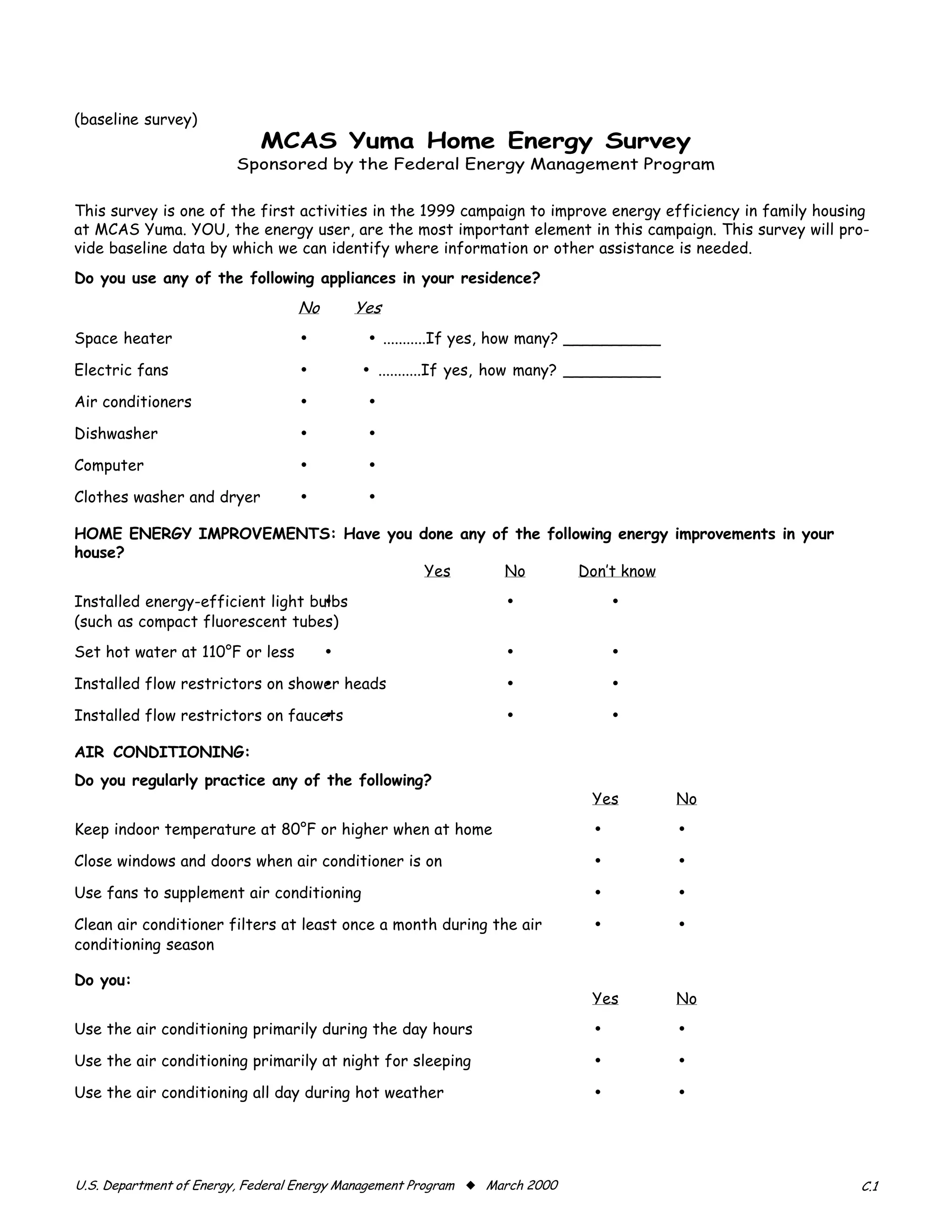


U.S. Department of Energy, Federal Energy Management Program © March 2000   37
© plain language that helps residents understand how to interpret their
                                              bills, what to look for on them, and how their energy-use habits (and per­
                                              haps the base’s housing upgrades) influence costs
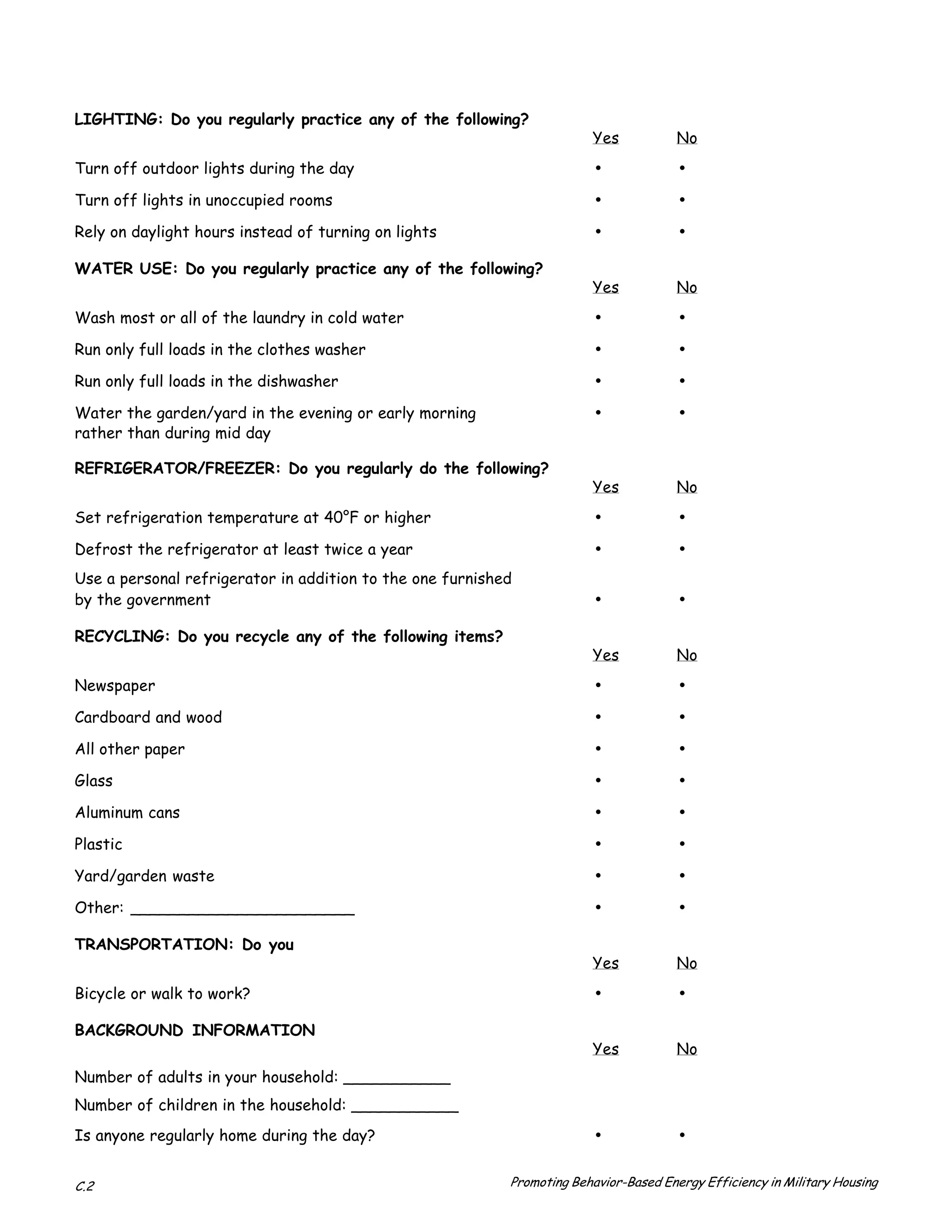
                                            © tips on how to lower costs.

                                            6.5       Institutionalization
                                            The foundation for fostering enduring energy-efficient behavior must be
                                            built on institutionalization throughout all DoD bases. This means that
                                            regulations, policy, decisions, and behaviors incorporate energy efficiency
                                            as a fundamental value, rather than being imposed or added on. The ulti­
                                            mate outcome is that residents incorporate energy efficiency into their
                                            daily lives by habit and because it’s important to them—like keeping their
                                            lawns mowed and their children immunized.

Several government initiatives are paving   The government already has several initiatives in place that are helping
the way for institutionalized energy        institutionalize energy efficiency in military family housing. A 1999 Presi­
efficiency in military housing.             dential Executive Order reaffirmed and extended previous energy reduc­
                                            tion goals for federal facilities. The DoD’s Military Housing Privatization
                                            Initiative, signed into law in 1996, is paving the way to increased private
                                            funding of construction, operations, maintenance, and management of mili­
                                            tary housing units. Existing, inadequate family housing is expected to be
                                            eliminated by 2010.

                                            Department of Defense Reform Initiative Directive #49, issued December
                                            1998, directs military departments to award privatization contracts, if cost-
                                            effective, for all utility systems by September 30, 2003. Solicitations are
                                            to be released in 2001.

                                            The DoD has its own Federal Energy Management Program and Energy Con­
                                            servation Investment Program to implement energy conservation measures.
                                            Energy Savings Performance Contracting also is being used to cut energy
                                            costs. These contractors can make energy-efficiency investments in housing
                                            and obtain a portion of the energy savings in return.

                                            The DoD’s working group on sustainable design, under the White House Cli­
                                            mate Change Task Force, is integrating energy-efficiency and environmental
                                            sustainability principles into facility design, construction, and management.
                                            The DoD is implementing sustainable design in all new buildings and facili­
                                            ties planned for construction after FY 2000, for a planned 30 to 50% in­
                                            crease in energy efficiency.

                                            Most of these efforts are focused on better facility design, upgrades, new
                                            technology, and improved management of housing and utilities. Once institu­
                                            tionalized, these kinds of changes produce tremendous gains in energy effi­
                                            ciency. In partnership with these efforts, however, we must continue to
                                            harness the power of peoples’ values—values that translate into ongoing ac­
                                            tions by residents in their homes. These combined efforts, supported and
                                            institutionalized by military bases and their partners, ultimately will result
                                            in long-lasting efficiencies.


                                            38                      Promoting Behavior-Based Energy Efficiency in Military Housing
6.6 In Summary:                        Sustaining the
Effort
To sustain long-term energy-efficiency behaviors, consider the following
guidelines and principles:
© Target base newcomers to keep awareness and interest high.
© Tap into self-directed motivation, rather than financial incentives or
  external awards.
© Ask residents to commit to specific actions, preferably in writing.
© Consider a mock billing process, combined with a commitment to
  achieve certain energy goals, that shows residents the results of their
  actions. Teach them how to understand and interpret these informa­
  tive “bills.”

© Use the power of institutionalization to foster enduring behavior
  change.


7.0 Reference Materials and Resources

Costanzo, M., Archer, D., Aronson, M., & Pettigrew, T. (1986). Energy con­
servation behavior: The difficult path from information to action. American
Psychologist, 41 (5), 521-528.
Dennis, M.L., Soderstrom, E.J., Koncinski, W.S., Jr., & Cavanaugh, B. (1990).
Effective dissemination of energy-related information. American Psycholo­
gist, 45 (10), 1109-1117.
Executive Order 13123, Greening the Government. Federal Register,
June 8, 1999, Vol. 64, No. 109, pp. 30851-30860.
Friedman, A.F. (1990). Going to war in the kingdom of oil. Wall Street
Journal, August 20, p. A7.
Harrigan, M.S. (1991). Moving consumers to choose energy efficiency.
Washington, DC: The Alliance to Save Energy.

Harrigan, M.S., and Gregory, J.M. (1994). Do savings from energy educa­
tion persist? Washington, D.C.: The Alliance to Save Energy.
Harrigan, M.S., Kempton, W., and Ramakrishna, V. (1995). Empowering
customer energy choices: A review of personal interaction and feedback
in energy efficiency programs. Washington, D.C.: The Alliance to Save
Energy.

Lister, L.D., Chalifoux, A.T., and Derickson, R.G. (1996). Energy use and
conservation opportunities in Army family housing: Results of the Fort
Hood study. ASHRAE Transactions, 102 (2), 707-715.

Morgan, D.L. 1998. Planning focus groups. Thousand Oaks, CA: Sage
Publications.


U.S. Department of Energy, Federal Energy Management Program © March 2000   39
National Renewable Energy Laboratory. (1997). Energy savers: Tips on sav­
ing energy & money at home. DOE/GO-10097-431. Prepared for the U.S.
Department of Energy, Washington, D.C.

Neuman, K. (1986). Personal values and commitment to energy conservation.
Environment and Behavior, 18 (1), 53-74.
Rodgers, L.M. (1990). Domestic energy sources urged as Middle East situa­
tion heats. Public Utilities Fortnightly, 126 (7), 40-42.

Rospond, K.M. (1997). Greening the government. Consulting-Specifying En­
gineer, p. 44 (March).
Shapard, R. (1996). Energy efficiency is taking the shock out of power
bills. American City & Country, 3 (3), 46-52+.
Siero, F.W., Bakker, A.B., Dekker, G.B., and van den Burg, M.T.C. (1996).
Changing organizational energy consumption behavior through comparative
feedback. Journal of Environmental Psychology, 16, 235-246.


40                    Promoting Behavior-Based Energy Efficiency in Military Housing
Simpson, J. (1993). Big conservation push begins at West Coast Army base.
Public Utilities Fortnightly, 131 (12), 10.
Stern, P.C. (1992). What psychology knows about energy conservation. The
American Psychologist, 47 (10), 1224-1232.
U.S. Army Forces Command Takes Alternative Approach to Energy Project
Funding. (1998). Internet web site www.eren.doe.gov/femp/femp_focus.
U.S. Department of Energy, Federal Energy Management Program.

U.S. Department of Defense. DefenseLINK Internet web site. http://
www.defenselink.mil

U.S. Department of Defense. (1998). Department Defense Reform Initia­
tive Directive #49 - Privatizing Utility Systems. December 23. Deputy
Secretary of Defense. www.defenselink.mil/dodreform/drids/drid49.html

U.S. Department of Defense. (1999). Annual report to the President and
the Congress (annual defense report). U.S. Secretary of Defense. http://
www.defenselink.mil.


U.S. Department of Energy, Federal Energy Management Program © March 2000   41
����������
�����������������������������������
Here are some typical items to consider when developing a campaign budget. Costs should be estimated for
each item that applies. Some labor and materials may be donated by base organizations, utilities, energy coa-
litions, and schools, thus reducing costs.

�����
x Obtaining base approvals, identifying necessary resources, and designing the campaign
x Conducting focus groups
x Conducting surveys
x Researching, writing, designing, and printing information materials
x Creating art, including a logo, cartoons, etc.
x Shooting, narrating, and editing a video
x Working with media representatives to encourage coverage
x Working with residents and base leaders to develop, carry out, and evaluate the campaign
x Preparing educational materials for kids
x Gathering and analyzing energy-use data
x Preparing and conducting events such as energy fairs
x Distributing materials around base
x Answering resident questions
x Preparing a summary report for base officials/sponsors

���������
x Postage for mailing surveys and/or information materials to residents
x Postage for mailing draft materials back and forth to team members, if not all reside on base
x Paper for printed materials, including poster paper
x Computer programs, disks, and color printers
x Videotape cartridges
x Display materials for special events
x “Giveaways” or prizes such as refrigerator magnets, T-shirts, coffee mugs, coloring books

������������
x Incentives for residents
x Travel costs, if some team members do not reside on base
x Food, beverages for focus groups and meetings.


������������������������������������������������������������� x ����������                                ���
Appendix B
                 Examples of Printed Information
                 Materials


U.S. Department of Energy, Federal Energy Management Program ◆ March 2000   B.15
(press release introducing campaign)

FOR IMMEDIATE RELEASE
Today we kick off the MCAS Yuma “You Have the Power” campaign to use energy and water efficiently in
base housing. You will be asked to complete a survey about how you use energy and water. You will see infor­
mation and reminders on the electronic bulletin boards, in the “Cactus Comment” and the newsletter. Your
children may be involved in energy-saving projects.
We hope to decrease energy use – focusing on our electricity-guzzling air conditioners – and water use.
Together, we can improve the environment, cut our energy and water bills, and become recognized as a
Marine Corps leader in the efficient use of energy and water.


U.S. Department of Energy, Federal Energy Management Program ◆ March 2000                                  B.1
B.2   Promoting Behavior-Based Energy Efficiency in Military Housing
U.S. Department of Energy, Federal Energy Management Program ◆ March 2000   B.3
B.4   Promoting Behavior-Based Energy Efficiency in Military Housing
U.S. Department of Energy, Federal Energy Management Program ◆ March 2000   B.5
B.6   Promoting Behavior-Based Energy Efficiency in Military Housing
U.S. Department of Energy, Federal Energy Management Program ◆ March 2000   B.7
B.8   Promoting Behavior-Based Energy Efficiency in Military Housing
U.S. Department of Energy, Federal Energy Management Program ◆ March 2000   B.9
B.10   Promoting Behavior-Based Energy Efficiency in Military Housing
U.S. Department of Energy, Federal Energy Management Program ◆ March 2000   B.11
B.12   Promoting Behavior-Based Energy Efficiency in Military Housing
We know you have a lot to say.

                                       So say it.


                                   If you live in Family Housing at Fort Lewis,

                               you may have heard about OPERATION ENERGY.

                          Since last fall, we’ve been telling residents how they can

                                       use energy wisely in their homes …

                                           while staying comfortable …

                            and getting an incentive award for their communities.


                                         Now, we want to hear from you.


                                                     Did it work?

                                     Are people doing anything differently?

                             What really motivates people to use energy wisely?

                                             What should we do next?

                 ______________________________________________________
                                    You talk. We listen. Free refreshments.


                                           Not a bad way to spend an hour.
                                    _________________________________
                                          Family Housing Residents Invited

                                               Friday, August 13, 1999

                                                   7:00 - 8:00 p.m.

                                               Family Resource Center


U.S. Department of Energy, Federal Energy Management Program ◆ March 2000               B.13
B.14   Promoting Behavior-Based Energy Efficiency in Military Housing
����������
                  ���������������


U.S. Department of Energy, Federal Energy Management Program x March 2000   C.7
(baseline survey)
                            ����������������������������
                        Sponsored by the Federal Energy Management Program


This survey is one of the first activities in the 1999 campaign to improve energy efficiency in family housing
at MCAS Yuma. YOU, the energy user, are the most important element in this campaign. This survey will pro-
vide baseline data by which we can identify where information or other assistance is needed.
Do you use any of the following appliances in your residence?
                                 ��       ���
Space heater                     •          • ...........If yes, how many? __________

Electric fans                    •         • ...........If yes, how many? __________

Air conditioners                 •          •

Dishwasher                       •          •

Computer                         •          •

Clothes washer and dryer         •          •

HOME ENERGY IMPROVEMENTS: Have you done any of the following energy improvements in your
house?
                                    Yes       No        Don’t know
Installed energy-efficient light bulbs
                                  •                              •              •

(such as compact fluorescent tubes)

Set hot water at 110°F or less        •                          •              •

Installed flow restrictors on shower heads
                                  •                              •              •

Installed flow restrictors on faucets
                                  •                              •              •

AIR CONDITIONING:

Do you regularly practice any of the following?

                                                                            Yes          No
Keep indoor temperature at 80°F or higher when at home                      •            •
Close windows and doors when air conditioner is on                          •            •
Use fans to supplement air conditioning                                     •            •
Clean air conditioner filters at least once a month during the air          •            •
conditioning season

Do you:
                                                                            Yes          No
Use the air conditioning primarily during the day hours                     •            •
Use the air conditioning primarily at night for sleeping                    •            •
Use the air conditioning all day during hot weather                         •            •


U.S. Department of Energy, Federal Energy Management Program x March 2000                                   C.1
LIGHTING: Do you regularly practice any of the following?
                                                                        Yes            No
Turn off outdoor lights during the day                                  •              •
Turn off lights in unoccupied rooms                                     •              •
Rely on daylight hours instead of turning on lights                     •              •
WATER USE: Do you regularly practice any of the following?
                                                                        Yes            No
Wash most or all of the laundry in cold water                           •              •
Run only full loads in the clothes washer                               •              •
Run only full loads in the dishwasher                                   •              •
Water the garden/yard in the evening or early morning                   •              •
rather than during mid day

REFRIGERATOR/FREEZER: Do you regularly do the following?
                                                                        Yes            No
Set refrigeration temperature at 40°F or higher                         •              •
Defrost the refrigerator at least twice a year                          •              •
Use a personal refrigerator in addition to the one furnished
by the government                                                       •              •
RECYCLING: Do you recycle any of the following items?
                                                                        Yes            No
Newspaper                                                               •              •
Cardboard and wood                                                      •              •
All other paper                                                         •              •
Glass                                                                   •              •
Aluminum cans                                                           •              •
Plastic                                                                 •              •
Yard/garden waste                                                       •              •
Other: _______________________                                          •              •
TRANSPORTATION: Do you
                                                                        Yes            No
Bicycle or walk to work?                                                •              •
BACKGROUND INFORMATION
                                                                        Yes            No
Number of adults in your household: ___________
Number of children in the household: ___________
Is anyone regularly home during the day?                                •              •

C.2                                                        Promoting Behavior-Based Energy Efficiency in Military Housing
Thank you for your participation!
Please feel free to call me if you have any questions or concerns.


Pat Queen
Assistant Housing Manager
MCAS Yuma


Please return this survey to the Housing Office between 0700 and 1600 Monday
through Friday or tape it to your front door on 19 July and it will be collected during
the day. Thanks!


U.S. Department of Energy, Federal Energy Management Program x March 2000             C.3
(final evaluation)
                               Energy Efficiency in Fort Lewis Family Housing


 1. Have you heard about the Operation Energy campaign to use energy more efficiently in post family
    housing?

___ Yes          ___ No (If no, go to Question #7)         ___ Not sure


 2. How did you become aware of the Operation Energy campaign? Check all that apply.

___ My mayor or other mayors                         ___ Family members, including children
___ Video on Channel 2, “In Search of the Energy     ___ Friends or neighbors
    Bandit”                                          ___ Poster
___ Flier or brochure                                ___ Display at Kids’ Fair or Armed Services day
___ Guardian newspaper                               ___ Reader board
___ Newsletter article from “Under Our Roof”         ___ Not sure
    (published by Housing)                           ___ My community’s newsletter
___ Other


 3. Have you heard that each housing community that saves energy will receive an incentive award?

___ Yes          ___ No


 4. Which community is saving the most energy so far? (Choose one)

___ Beachwood/Lakewood            ___ Broadmoor              ___ Clarkdale
___ Davis Hill                    ___ Eagle View             ___ Evergreen
___ Greenwood                     ___ Old/New Hillside       ___ Madigan
___ Parkway                       ___ Don’t know


 5. Here are some things we asked residents to do in Operation Energy. Please check the things that
    you started doing AFTER Operation Energy began in September 1998.

___ No change
                                            Heating and Cooling
___ Began turning the thermostat down at night before going to bed (or turned it down lower than before)
___ Began turning the thermostat down when leaving the house for 4 hours or more (or turned it down
    lower than before)
___ Asked All Star to repair broken thermostat
___ Asked All Star to repair caulking or other weatherization materials
___ Began closing windows and doors when heat was on (or closed them more often than before)
___ Cleaned or changed furnace filter for the first time (or more often than before)
___ Reduced or eliminated use of a space heater


C.4                                                       Promoting Behavior-Based Energy Efficiency in Military Housing
Lighting
___ Began purchasing new light bulbs at 60 watts or less
___ Replaced a standard (incandescent) light bulb with a compact fluorescent light bulb
___ Started turning off outside lights in the daytime (or turned them off more often than before)
                                                 Washing and Drying
___ Began using cold water for washing clothes (or used it more often)

___ Began using the low or cool setting on dryer when possible (or used it more often)

___ Began running full loads of clothes in washer and dryer

___ Began cleaning the lint trap in the dryer (or cleaned it more often)

___ Began running full loads in the dishwasher (or ran them more often)

___ Began using the air dry setting on the dishwasher (or used it more often)

                                              Refrigerator and Freezer
___ Adjusted the refrigerator temperatures to be 37-40 degrees or the freezer temperature to be
    0-5 degrees


6. What caused you to start doing those things? Check any that apply.
___ I wanted my housing community to get money back
___ All the housing communities on post were being compared, and I wanted my community to excel
___ I wanted more comfortable temperature conditions in my home
___ I was reminded whenever I saw or heard something about Operation Energy
___ My family, friends, or neighbors were talking about it
___ The video (TV) demonstrated how to do things
___ It’s the right thing to do
___ I want to set a good example for my kids
___ Other: ______________________________________________________________


7. Is there anything that made it impractical or difficult for you to save energy? Check any that
   apply.
___ My house wastes energy because of the way it is constructed, or because of its age
___ I have asked to have things repaired that could save energy, but it hasn’t happened
___ The Army does not allow us to do some things that will make the house more energy-efficient
___ We don’t have a cool or air dry setting on our washer/dishwasher/dryer
___ The kids leave the doors and windows open
___ I’m too busy to think about it; other things are more important
___ As long as I’m not paying for it, it’s not a priority for me
___ I won’t be stationed here long enough to make a difference
___ Other: _________________________________________________________________


U.S. Department of Energy, Federal Energy Management Program x March 2000                           C.5
8. Which housing community do you belong to? (Choose one)

___ Beachwood/Lakewood       ___ Broadmoor                 ___ Clarkdale
___ Davis Hill               ___ Eagle View                ___ Evergreen
___ Greenwood                ___ Old/New Hillside          ___ Madigan
___ Parkway


 9. How long have you lived there?
___ 3 months or less ___ 4-6 months         ___ 7 months to 1 year            ___ More than a year


10. In your opinion, what will it take to motivate residents to keep using energy wisely?


        _______________________________________________________________________

        _______________________________________________________________________


THANK YOU!

Please return this survey in the enclosed, postage-paid envelope by __________.


C.6                                                      Promoting Behavior-Based Energy Efficiency in Military Housing
����������
      ��������������������


D.6                          Promoting Behavior-Based Energy Efficiency in Military Housing
��������������������������������
                    Training Videotape Used with the Operation Energy Campaign

                                   for Fort Lewis Family Housing

                                               1998


                     �����                       ������������� �������                    ���������

      Camera searching along window        Character music
      frames, seen through circle like
      telescope

      Title: “In Search of the Energy      Character music fades out
      Bandit”

      Mom and son walking up sidewalk to   Happy, relaxed music              At Fort Lewis, our homes are safe
      house, reaching front door, and if                                     and comfortable ...
      time, opening it (show flag on
      house).

      Family doing puzzle on table         Happy music continues             … A place to relax and have fun
                                                                             with our families. Our homes are so
                                                                             important to us that we guard
                                                                             against anyone breaking in to steal
                                                                             our possessions.

      Energy bandit creeping               "Sneaky" character music          But there is one unsavory character
                                                                             lurking around inside our homes,
                                                                             most of the time .. . the ENERGY
                                                                             BANDIT.

      Energy bandit "vacuuming" energy     Character music continues, then   The Energy Bandit runs around
                                           fades.                            stealing energy, creating drafts,
                                                                             and generally wreaking havoc, when
                                                                             it comes to energy efficiency. But
                                                                             you can outsmart the energy bandit
                                                                             – home by home.

      Playground with house in             Background (energetic) music      Family housing at Fort Lewis costs
      background. Housing names                                              about $3 million dollars annually
      superimposed on scene:                                                 for electricity and gas energy. So,
      Broadmoor                                                              by using energy wisely, you and
      Beachwood                                                              your family can make a BIG
      Eagle View                                                             difference.
      Greenwood
      Parkway
      Davis Hill
      New Hillside
      Old Hillside
      Clarkdale
      Evergreen
      Madigan


      Mom turning down knob in freezer                                       YOU are the best weapon against
      (show hand on knob close-up only)                                      the Energy Bandit. It’s easy … and
                                                                             you won’t have to sacrifice comfort.


U.S. Department of Energy, Federal Energy Management Program x March 2000                                           D.1
�����                          ������������� �������                       ���������

      Dad and mom changing lightbulb                                              By making smart energy choices
      [very quick clip, maybe taking the                                          around the house, you can reduce
      old bulb out]                                                               the amount of energy that the
                                                                                  Bandit is getting away with.

      Energy Bandit moving across             New music
      screen, holding sign saying
      “Temperature”


      Setting back the thermostat             Energetic music.                    One of the most important things
                                                                                  you can do is to control the
                                                                                  temperature in your home. If you
                                                                                  do only one thing to save energy,
                                                                                  this should be the one.

                                                                                  Keep the thermostat at 70 degrees
                                                                                  or lower to heat your home during
                                                                                  the day. Turn it down to 65
                                                                                  degrees at night, or if you’ll be
                                                                                  gone for more than four hours.

      Words:                                                                      Turning your thermostat down 5
      5 degrees less at night = $500 -                                            degrees at night saves a substantial
      $3,000 saved per month, for a                                               amount of energy and money. If
      typical housing community                                                   everyone in a typical housing area
                                                                                  did this, they could save five
                                                                                  hundred to three thousand dollars
                                                                                  each month in energy costs, for that
                                                                                  neighborhood alone!

      Mom guiding son inside from patio                                           Your furnace has to work harder if
      on Big Wheel, closing sliding glass                                         doors are left open. Make sure
      door.                                                                       doors are firmly closed when
                                                                                  someone enters or leaves.

      Mom shutting heating vent in                                                Close the heating vents in rooms
      ceiling.                                                                    that don't get much use.


      Mom, carrying baby, putting                                                 Minimize the use of portable
      heater-in closet.                                                           heaters. They use a lot of energy
                                                                                  and can be a fire hazard.


      Dad taking out filter and looking at                                        It’s important to clean or replace
      it. Vacuuming it, then hosing it off.                                       your furnace filter monthly. Not
                                                                                  only does this help your furnace
                                                                                  run more efficiently, it reduces the
                                                                                  amount of dust in the air. Less dust
                                                                                  means a healthier home with fewer
                                                                                  allergies, and hey, maybe even a
                                                                                  little less housework. When your
                                                                                  furnace filter wears out, get a new
                                                                                  one at the Self-Help Store.


D.2                                                                Promoting Behavior-Based Energy Efficiency in Military Housing
�����                         ������������� �������                   ���������

       Words on screen:                                                         Report any problems with
       Family Housing Work Order                                                thermostats or furnaces to the
       Desk 964-8844                                                            Family Housing Work Order Desk.

       Energy Bandit pulling sign that says    New music--Energetic or sneaky
       "Drafts"


       Mom cranking window shut.                                                Open windows can cause
                                                                                uncomfortable drafts when it’s cool
                                                                                outside. Make sure your windows
                                                                                are closed.

       Full shot of camera moving around                                        If you can still feel air leaking in
       inside window frame (one without                                         through closed windows and doors,
       shades).                                                                 your sealant materials may be worn
                                                                                out.

       All Star technician ripping off old                                      Old weather-stripping can be
       weather-stripping, screwing new                                          replaced, and caulking can be
       weather-strip into door frame and                                        reapplied, as the maintenance
       squeezing out new caulking in                                            technician is doing here. This will
       window.                                                                  make your home much more warm
                                                                                and cozy, eliminating those drafty
                                                                                spots. Contact the Family Housing
                                                                                Work Order Desk for this service.

       Energy Bandit pulling screen that       New music
       says "Lighting."


       Mom and son entering house and                                           Using light wisely helps beat the
       turning on light in living room. [Try                                    Energy Bandit. Turn lights on only
       to cut before Mom walks out of                                           in rooms where you need them.
       scene. We want to imply that she is
       staying in the room with the light
       on.]

       Dad leaving house to go to work,                                         Of course outdoor lighting is
       seeing porch light, turning it off,                                      necessary for safety and security,
       then coming down front steps.                                            but don’t forget to turn off your
                                                                                porch light when you go to bed … or
                                                                                at least when you get up in the
                                                                                morning.

       Mom and Dad changing light bulb                                          You might want to check all the
       and turning on light                                                     light fixtures in the house – after
                                                                                turning off the lights, of course—to
                                                                                see if the right wattage bulbs are
                                                                                installed. It is unsafe to have a
                                                                                100-watt bulb in a fixture that is
                                                                                marked for 60 watts.


U.S. Department of Energy, Federal Energy Management Program x March 2000                                              D.3
�����                         ������������� �������                       ���������

      Dad, holding son, at Commissary                                            Check the Commissary and PX for
      checkout counter buying CFL.                                               energy-efficient compact
                                                                                 fluorescent lights. These lights last
                                                                                 ten times longer than regular bulbs,
                                                                                 so you won’t have to change them as
                                                                                 often.

      Energy Bandit pulling screen that       New music
      says "Laundry."

      Mom putting clothes in washer,                                             The laundry is a great place to put
      turning knob to cool.                                                      a lid on the Energy Bandit. Do full
                                                                                 loads of laundry. Use cold water
                                                                                 for washing whenever possible, and
                                                                                 always use cold water in the rinse
                                                                                 cycle.

      Mom shaking out mesh shirt, putting                                         To dry lighter-weight items, use the
      it in dryer, turning to “air fluff,”                                        air-dry setting. If you need to use
      turning on.                                                                 heat, dry several loads of laundry
                                                                                  one after another. It takes a lot of
                                                                                  energy to heat up a cold dryer.

      Mom pulling out lint screen and                                            Clean the lint screen in the dryer
      cleaning it off.                                                           between each load. This way, your
                                                                                 dryer will not have to work as hard
                                                                                 to produce heat.

      Mom cleaning exhaust vent.                                                 And keep the outside exhaust vent
                                                                                 clean.

      Energy Bandit pulling screen that       New music
      says "Kitchen"

      Mom opening fridge door, turning                                           The energy bandit loves to lurk
      down temp controls, closing door.                                          around your kitchen. Check your
                                                                                 refrigerator and freezer. They
                                                                                 may be too cold. Set your
                                                                                 refrigerator at a level that reaches
                                                                                 about 37 to 40 degrees. And push
                                                                                 the “energy saver” button if you
                                                                                 have one.

      Mom turning down freezer                                                   Set your freezer temperature at
      temperature, closing door.                                                 mid-level, reaching about zero to
                                                                                 five degrees.

      Girl opening refrigerator door,                                            And we don’t want all that cold air
      taking milk carton out, closing door,                                      leaking out. Select your items
      pouring milk [and taking a drink, if                                       quickly, and then shut the door.
      time]

      Dad putting last glass and plate in                                        Always run the dishwasher with a
      dishwasher, pushing air dry, and                                           full load, and use the air dry
      water saver buttons.                                                       setting. Use the ”water saver”
                                                                                 feature if your dishwasher has one.


D.4                                                              Promoting Behavior-Based Energy Efficiency in Military Housing
�����                       ������������� �������                     ���������

      Family playing on floor, cat walks   New music, maybe the relaxed      Making smart energy choices helps
      in.                                  happy music from the beginning?   you and your family. Your home
                                                                             can be more comfortable because
                                                                             of fewer drafts …

      Mom pushing "cool" button on                                           … more hot water for other things
      washer.                                                                when you use cold water for clothes
                                                                             washing …

      Dad vacuuming filter.                                                  … and less dust particles when
                                                                             furnace filters are cleaned or
                                                                             replaced regularly.

      Col. Bryant clip. Superimposed on
      beginning of clip: “Colonel George
      Bryant, Director of Public Works.”

      Energy bandit with a “no” symbol     Character music                   So remember the battle plan to
      superimposed (circle with line                                         eliminate the energy bandit.
      through it).

      Mom turning down thermostat                                            turn down the thermostat at night
                                                                             ...

      Dad pulling out furnace filter and                                     ... clean or replace furnace filters
      looking at it.                                                         monthly ...

      Dad turning off porch light                                            ... reduce unnecessary lighting ...

      Mom shutting sliding glass door                                        ... and keep doors and windows shut
      after son comes in.                                                    in cool weather.

      "You Have the Power" icon (hand                                        You have the power to make a
      holding globe)                                                         difference!

      Icon of light bulb with words                                          For more information about making
      superimposed: For more                                                 your home energy efficient and
      information, contact:                                                  comfortable, contact your
      Your Community Mayor                                                   community mayor or the Public
      Or                                                                     Works Department.
      Public Works Department,
      967-2837.

      Credits
      Etc.
      Operation Energy Campaign,
      1998


U.S. Department of Energy, Federal Energy Management Program x March 2000                                           D.5
����������
��������������������
U.S. Department of Energy

Federal Energy Management Program (FEMP)

FEMP Help Desk: 1-800-363-3732 (DOE-EREC)
FEMP Office: 202-586-5772
FEMP Fax: 202-586-3000
http://www.eren.doe.gov/femp/femp.html
Internet site includes an electronic order form for FEMP publications, including software, CDs, case studies,
annual reports, posters, newsletter, and other materials

DOE’s Energy Efficiency and Renewable Energy Clearinghouse
P.O. Box 3048
Merrifield, VA 22116
Phone: 1-800-363-3732
Fax: 703-893-0400
E-mail: doe.erec@nciinc.com
http://www.eren.doe.gov

U.S. Department of Defense
Information and publications on the U.S. military, including family housing and energy efficiency initiatives
Internet site: DefenseLINK
http://www.defenselink.mil/index.html


The Alliance to Save Energy
A nonprofit coalition that promotes the efficient and clean use of energy worldwide. Offers free, energy-
related lesson plans for educators and a “green schools” program. Offers an on-line, interactive, personalized
“home energy checkup.” Sponsors and conducts research.
 1200 18th Street, NW

 Suite 900

 Washington, DC 20036

 Phone: 202/857-0666

 Fax: 202/331-9588

 E-mail: info@ase.org

 http://www.ase.org/


Home Energy Saver
Internet tool that lets users enter their zip codes and, based on geographic area, suggests ways to improve
energy efficiency in homes
Sponsored by the U.S. Environmental Protection Agency and the U.S. Department of Energy
http://HomeEnergySaver.lbl.gov/


Washington State University
Energy Ideas Clearinghouse
Will search for existing published energy-related materials by topic
1-800-872-3568


Executive Order 13123
Greening the Government through Efficient Energy Management
June 3, 1999
http://www.eren.doe.gov/femp/aboutfemp/exec13123.html


������������������������������������������������������������� x ����������                                      ���
����������
����������������������������������
��������������������������
A billing analysis comparison approach is the standard method for estimating energy savings from energy con-
servation programs. The utility billing approach estimates energy savings by establishing an energy consump-
tion baseline or baseline model using 12 or more months of energy consumption (the energy source used for
heating and cooling) for the housing area of interest. That baseline consumption is compared with actual con-
sumption after implementation of the conservation project.
One limitation of a simple comparison of the monthly consumption, however, is that it does not account for
other factors that can affect energy consumption and vary over time, such as weather. For example, we
know that the amount of natural gas or electricity consumed for heating depends on the outside air tempera-
ture – the colder it is, the more heating required to maintain the same comfort level in the residence. So, if
the outdoor temperatures in the winter months used to establish the energy use baseline were significantly
colder than the months used to determine the actual energy use, the predicted energy use based on the
baseline model would be significantly greater than actual energy use, artificially inflating the “real” energy
savings derived from the project.

A multivariate regression analysis is one technique to account for the differences in weather conditions
between the pre- and the post-project periods. The basic data requirements for this approach are housing
community-level monthly natural gas consumption, the dates of the meter reading, and daily average outdoor
air temperature representative of the site.
The baseline statistical model is constructed by regressing the daily energy consumption against the daily
average temperature (or heating degree day) for the billing period to determine the baseline energy perfor-
mance model. Once the appropriate baseline model has been determined for the housing project, the post-
installation energy use is estimated by running the baseline model using post-project daily temperature and
operating conditions as model input. The energy savings are calculated by comparing the differences
between the actual energy use and the energy use predicted by the model for the same time period.


������������������������������������������������������������� x ����������                                  ���
������������

�������                                                         ������
                                                                ������
������
������                                                          10 Bill Martin
                                                                   Energy Efficiency and Renewable Energy
5	 Annie Haskins                                                    Clearinghouse
   U.S. Department of Energy                                       P.O. Box 3048

   Office of Energy Efficiency and Renewable                       Merrifield, VA 22116

    Energy

   Federal Energy Management Program
                                Malcolm Verdict

   1000 Independence Avenue, S.W.
                                   The Alliance to Save Energy

   Washington, DC 20585
                                             1200 18�� Street, NW

                                                                     Suite 900

    Arun Jhaveri                                                     Washington, DC 20036

    U.S. Department of Energy

    Seattle Regional Office
                                     5	 Charles Howell
    800 Fifth Avenue, Suite 3950
                                   Public Works Division
    Seattle, WA 98104
                                              AFZH-PWP MS17F, Building 2012
                                                                    Box 339500
    Freddie Beason                                                  Fort Lewis, WA 98433
    U.S. Department of the Air Force

    HQ, AFCESA/CESE
                                                 Scott Wolf
    139 Barnes Drive, Suite 1
                                       Washington State University Energy Program
    Tyndall AFB, FL 32403-5319
                                      P.O. Box 43165

                                                                     Olympia, WA 98504-3165

    Jim Campbell
    U.S. Department of the Army
                                     Judi Heerwagen

    ODCSLOG, DALO-7SE
                                               SPACE

    Room 1E-575
                                                     1520 4�� Avenue, Suite 400

    Washington, DC 20310
                                            Seattle, WA 98101


    Ed Krupa                                                    ������
    U.S. Department of the Navy

    NAVFACENGCOM
                                               33	 �������������������������������������
    Hoffman Building 2

    200 Stovall Street
                                              Doug Dixon
    Alexandria, VA 22332-2300
                                       Gariann Gelston
                                                                     Don Hadley
2	 U.S. Department of Energy                                         Chip Larson
   Office of Scientific and Technical Information                    Regina Lundgren
   P.O. Box 62
                                                      Elizabeth Malone
   Oak Ridge, TN 37831
                                              Andrea McMakin (20)
                                                                     Bill Sandusky
                                                                     Greg Sullivan
                                                                     Information Release (5)


������������������������������������������������������������� x �����������	                                  ������

Promoting Behavior-Based Energy Efficiency in Military Housing

  • 1.
    Revision 1 Revised Handbookfor Promoting Behavior-Based Energy Efficiency in Military Housing Prepared for the U.S. Department of Energy Office of Energy Efficiency and Renewable Energy Federal Energy Management Program Prepared by Pacific Northwest National Laboratory Andrea H. McMakin Regina E. Lundgren Elizabeth L. Malone March 2000
  • 2.
    DISCLAIMER This report wasprepared as an account of work sponsored by an agency of the United States Government. Neither the United States Government nor any agency thereof, nor Battelle Memorial Institute, nor any of their employees, makes any warranty, express or implied, or assumes any legal liability or responsibility for the accuracy, completeness, or usefulness of any infor­ mation, apparatus, product, or process disclosed, or represents that its use would not infringe privately owned rights. Reference herein to any spe­ cific commercial product, process, or service by trade name, trademark, manu­ facturer, or otherwise does not necessarily constitute or imply its endorsement, recommendation, or favoring by the United States Government or any agency thereof, or Battelle Memorial Institute. The views and opinions of authors expressed herein do not necessarily state or reflect those of the United States Government or any agency thereof. PACIFIC NORTHWEST NATIONAL LABORATORY operated by BATTELLE for the UNITED STATES DEPARTMENT OF ENERGY under Contract DE-AC06-76RLO 1830 Printed in the United States of America Available from DOE’s Energy Efficiency and Renewable Energy Clearinghouse, 1-800-363-3732, P.O. Box 3048, Merrifield, VA 22116, www.eren.doe.gov, fax: 202-586-3000 This document was printed on recycled paper.
  • 3.
    Revision 1 Revised Handbookfor Promoting Behavior-Based Energy Efficiency in Military Housing Andrea H. McMakin Regina E. Lundgren Elizabeth L. Malone(a) March 2000 Prepared for the U.S. Department of Energy under Contract DE-AC06-76RLO 1830 Pacific Northwest National Laboratory Richland, Washington 99352 (a) Battelle’s Washington Office, Washington, DC
  • 4.
    Contents Preface .................................................................................................................. iii Acknowledgments................................................................................................ iv 1.0 Introduction ............................................................................................... 1 1.1 Background ........................................................................................ 1 1.2 Purpose and Audience ..................................................................... 1 1.3 Scope and Use .................................................................................. 1 1.4 What the Handbook Contains ......................................................... 2 2.0 Energy Efficiency in On-Base Military Housing ................................. 2 2.1 Drivers ................................................................................................ 2 2.2 Characteristics of Military Bases and Populations .................... 3 2.3 In Summary: Energy Efficiency in On-Base Military Housing ............................................................................... 5 3.0 Planning the Effort .................................................................................. 6 3.1 Resources Required ......................................................................... 6 3.2 Options for Approaches ................................................................. 8 3.3 In Summary: Planning the Effort ................................................. 10 4.0 Designing and Executing a Campaign .................................................... 10 4.1 Establish Goals .................................................................................. 10 4.2 Establish Objectives ........................................................................ 11 4.3 Set a Budget ...................................................................................... 11 4.4 Set a Schedule .................................................................................. 12 4.5 Understand Your Base Setting by Talking with Residents and Officials ..................................................................................... 12 4.6 Consider a Pre-Survey .................................................................... 14 4.7 Identify Desired Behaviors ............................................................ 16 4.8 Select Themes, Messages, and Visuals ......................................... 17 4.9 Choose Communication Channels .................................................... 19 4.10 Identify Motivators and Incentives ............................................. 20 4.11 Get the Word Out ............................................................................. 23 4.12 Conduct Activities and Involve Residents.................................... 26 4.13 In Summary: Designing and Executing a Campaign .................. 27 5.0 Evaluating and Reporting on the Campaign ........................................... 29 5.1 Mid-Course Evaluation ..................................................................... 29 5.2 Final Evaluation................................................................................. 30 U.S. Department of Energy, Federal Energy Management Program © March 2000 i
  • 5.
    5.3 Factors thatAffect Energy Use Results ..................................... 32 5.4 Reporting on and Publicizing Results ............................................ 34 5.5 In Summary: Evaluating and Reporting on the Campaign ......... 34 6.0 Sustaining the Effort ............................................................................... 35 6.1 Reaching Newcomers ....................................................................... 35 6.2 Self-Motivation ................................................................................. 36 6.3 Commitment ........................................................................................ 36 6.4 Feedback through Mock Billing ..................................................... 37 6.5 Institutionalization ........................................................................... 38 6.6 In Summary: Sustaining the Effort ............................................. 39 7.0 Reference Materials and Resources...................................................... 39 Appendix A: Typical Budget Items for a Campaign .................................... A.1 Appendix B: Examples of Printed Information Materials .......................... B.1 Appendix C: Survey Examples ......................................................................... C.1 Appendix D: Example Video Script ................................................................ D.1 Appendix E: Additional Resources ................................................................. E.1 Appendix F: Process for Accounting for Weather Effects in Energy-Use Data ........................................................................ F.1 ii Promoting Behavior-Based Energy Efficiency in Military Housing
  • 6.
    Preface The mission ofthe U.S. Department of Energy’s Federal Energy Manage­ ment Program (FEMP) is to reduce the cost of government by advancing energy efficiency, water conservation, and the use of solar and other renewable technologies. This is accomplished by creating partnerships, leveraging resources, transferring technology, and providing training and technical guidance and assistance to agencies. These activities sup­ port requirements stated in the Energy Policy Act of 1992 and goals established in the June 1999 Executive Order 13123. To bolster energy awareness across the federal government, FEMP launched a communications campaign entitled “You Have the Power” in 1997. This campaign assists federal energy managers by spreading the word about energy-efficient practices and products, as well as facilitating partnerships with energy-related organizations in the private sector. The campaign is intended to instill energy efficiency as a basic value among federal workers and the public. The Pacific Northwest National Laboratory (PNNL) supports the FEMP mission in all activity areas, including the “You Have the Power” campaign. Specifically, PNNL is working with FEMP to develop methods for promot­ ing energy efficiency in federal facilities. In doing so, the cost of govern­ ment can be further decreased. This handbook suggests ways federal energy managers can take the “You Have the Power” campaign one step further: to develop site-specific activities that encourage residents of military family housing to use energy more efficiently. The approach and examples provided in the hand­ book are based on two campaigns conducted for FEMP—one at the Fort Lewis Army Installation in Washington State and the other at the Marine Corps Air Station in Yuma, Arizona. This revised handbook reflects insights from the final energy data and resident survey results from the two campaigns. U.S. Department of Energy, Federal Energy Management Program © March 2000 iii
  • 7.
    Acknowledgments This handbook benefitsgreatly from lessons learned from energy- efficiency campaigns conducted at Fort Lewis Army Installation, near Tacoma, Washington, and the Marine Corps Air Station, Yuma, Arizona, in 1998 and 1999. The campaigns were a cooperative effort between the U.S. Department of Energy’s Federal Energy Management Program (FEMP), Fort Lewis, and the Yuma Air Station. Annie Haskins, Outreach Program Manager for FEMP, provided guidance and assistance. FEMP’s Tatiana Muessel provided early guidance and direction. In conducting the campaign at Fort Lewis, we are indebted to contribu­ tions from Fort Lewis’s Department of Public Works, especially Resource Efficiency Manager Charles Howell, personnel from the Base’s Housing and Training departments, mayors, and of course the residents themselves. At the Yuma Air Station, we thank Housing Manager Mark Smith, Assistant Housing Manager Pat Queen, and Energy Manager Ron Durfey and his Energy Monitors Gunnery Sergeants Dale Billingsley and Daniel Drier. We also thank Anne N’Ait Ali and her Family Childcare Providers Network for their insightful comments and assistance. We thank energy science professionals at Pacific Northwest National Laboratory for technical assistance, guidance, and review. We thank Merrilee Harrigan, the Alliance to Save Energy, for review and sugges­ tions. We thank Judi Heerwagen, former Laboratory staff member, for early direction. We also appreciate Washington State University Coopera­ tive Extension Program’s Energy Ideas Clearinghouse for making additional resources available to us. Andrea McMakin Regina Lundgren Elizabeth Malone Pacific Northwest National Laboratory March 2000 U.S. Department of Energy, Federal Energy Management Program © March 2000 iv
  • 8.
    1.0 Introduction This revisedhandbook was prepared as part of a government energy-effi­ ciency program with emphasis on military housing, as described below. 1.1 Background The U.S. Department of Energy’s Federal Energy Management Program (FEMP) helps agencies reduce the cost of doing business through energy efficiency, water conservation, and the use of solar and other renewable energy. As a large energy user, the U.S. Department of Defense (DoD) has been one of the government sectors of focus. Several military installations have shown substantial energy savings since 1985. Most of these efficiency projects, however, have focused primarily on physical upgrades, technologies, and purchasing habits. Further, most projects have focused on administrative and operational areas of energy use. The energy-related behaviors of residents in military housing, in particu­ lar, have received little formal attention. Behavior-based change is a chal­ lenging, but potentially fruitful area for energy conservation programs. Efforts to change behaviors involve links with values, social networks and organizations, and new ways of thinking about living patterns. This hand­ book attempts to fill a gap by offering guidance for promoting such efforts. This revision of the handbook reflects insights from the final energy data and resident survey results from two campaigns. 1.2 Purpose and Audience This brief handbook is intended to be used by energy managers, housing officials, and others who want to improve energy efficiency in on-base residential housing by emphasizing behavioral changes. Specifically, the handbook was written with two primary groups of people in mind: 1) military personnel and contractors, and 2) nonmilitary organiza­ tions and groups, including Department of Energy employees, utilities, con­ tractors, energy coalitions, and universities. 1.3 Scope and Use The guidelines here are based on low-cost or no-cost behaviors that resi­ dents can carry out themselves, as opposed to physical facility upgrades or technology. The guidelines are particularly applicable to situations where residents do not pay their own utility bills and thus are not moti­ vated to conserve energy by reducing personal expenditures. The guidelines have been applied in field studies conducted at the Fort Lewis Army Installation in Washington State and the Marine Corps Air Station in Yuma, Arizona. However, the guidelines are intended to be U.S. Department of Energy, Federal Energy Management Program © March 2000 1
  • 9.
    broad enough toapply in other situations. Individual bases should choose and adapt their own activities to fit their unique situations. For quick reference and ease of use, each section ends with a short list of highlights, called “In Summary.” These highlights represent the essential kernels of information necessary for planning, designing, implementing, and evaluating a campaign. 1.4 What the Handbook Contains The handbook describes some factors driving energy efficiency in military housing and characteristics of military bases that affect residential en­ ergy use (2.0). Following sections describe steps in planning (3.0), con­ ducting (4.0), and evaluating (5.0) a campaign and sustaining the effort (6.0). The appendixes provide sample information materials, surveys, and other resources. 2.0 Energy Efficiency in On-Base Military Housing With literally thousands of facilities nationwide consuming significant amounts of energy daily, why is military housing a particular area of focus? And how might military housing residents be motivated to use energy effi­ ciently? The drivers and the unique characteristics of military populations need to be understood in order to design an effective energy-efficiency campaign. 2.1 Drivers Several factors make military housing a prime target for energy conservation: © Regulations and federal targets for energy con­ servation are set in federal facilities. The fed­ eral government has set goals of a 30% reduction in energy consumption from 1985 levels by fiscal year 2005. In June 1999, a Presidential Executive Order extended this goal to a 35% reduction in federal facilities by 2010 from 1985 levels. © Congressional and public scrutiny has increased taxpayer-funded military programs. Over the past several decades, the DoD has been held to increased standards of accountability, both by its funding source (Congress) and by citi­ zens who pay for it and whose loved ones serve in Regulatory, policy, and institutional factors are driving the effort to it. The June 1999 Executive Order 13123 for reduce energy use in military housing. energy efficiency, for example, included more stringent standards of accountability by federal agencies to reach energy goals. The Executive 2 Promoting Behavior-Based Energy Efficiency in Military Housing
  • 10.
    Order requires eachfederal agency to submit an annual report to the President describing its progress in meeting energy reduction goals, and the Office of Management and Budget will evaluate each agency’s performance using “score cards” that are submitted to the President. The President’s Management Council will monitor agencies’ progress on energy management and identify ways to accelerate improvements. The military, being one of the largest energy users among federal agencies, is a particularly high-visibility target. © Energy use in residential housing is a substantial portion of total base energy costs, representing an often-untapped source with large potential savings. The DoD is the largest energy user of all fed­ At some bases, residential housing accounts eral facilities, according to the DoD’s Annual Report to the President for 40% of total base energy costs. This and Congress for 1999. And, at military bases, residential housing of­ represents an opportunity for substantial ten represents a substantial portion of the utility budget. At the Fort energy savings. Lewis Army Installation, for example, residential energy use accounts for 25% of the base’s total energy use and 40% of base energy costs. Most energy-efficiency projects on military bases have focused on re­ ducing usage in administrative and troop barracks areas rather than family housing units. It makes sense, therefore, to include military residential housing as a particular area of focus to meet federal en­ ergy-efficiency goals. 2.2 Characteristics of Military Bases and Populations An effective energy-efficiency campaign is designed around the unique characteristics of military bases that affect residential energy use and conservation programs: © No direct utility bills to residents. Many military housing areas are still master-metered, where all or large portions of residential housing areas are billed together. In these cases, residents do not pay their individual energy bills based on individual usage. Instead, a set amount of their housing allowance is dedicated to energy use, regardless of how much is actually spent. This situation means that residents have less incentive to conserve energy because they can neither save money by reducing their own use nor are they “penalized” by being charged more if they use more. This master-metering also makes it more diffi­ cult to promote conservation, even if a savings for an entire master- metered section is displayed, because it is impossible for people to know how much their own family contributed (or did not contribute) to the savings. The military and Congress have been moving toward privatization of military housing and utilities on the assumption that private-sector management will increase efficiencies and reduce costs. Privatization, however, may not address energy billing to individual homes. © Transient nature of personnel. According to the DoD’s DefenseLINK web site (www.defenselink.mil), military families move every three years on average. Frequent relocation presents a challenge for behavior-based U.S. Department of Energy, Federal Energy Management Program © March 2000 3
  • 11.
    energy efficiency. Iforganizers are relying on people to be aware of the need to conserve energy and get into the habit of doing so, these behaviors must be reemphasized and relearned every so often with each new wave of residents, or the behaviors will not continue. This means a sustained effort—really what is needed is institutional change—that is ingrained into behavior regardless of where families move. © Varying housing quality that affects energy loss. Housing units on many military bases were constructed decades ago, some dating back to World War II. According to the DoD’s Annual Report to the President and Congress for 1999, two-thirds of the agency’s 297,000 existing housing units are in need of extensive repair. Houses may be under­ going continual upgrades, and newer homes have more energy-efficient features. However, at any one time, families may be living in houses with inefficient energy features such as single-paned windows, inad­ equate insulation, nonprogrammable thermostats, or inadequately sealed doors and windows. In these homes, energy efficiency will be limited by structural deficiencies, and resident behavior can accomplish only so much. © Limitations on upgrades. The military must carefully budget for and schedule housing upgrades while maintaining a consistency in housing conditions for its constantly changing residents. These restrictions can affect energy efficiency. For example, like civilian renters, many military families are restricted in upgrades they themselves can make to improve energy efficiency. For example, a base may not allow resi­ dents to install plastic sheeting on windows to improve insulation. In addition, a base’s housing budget at any one time may pay for some things to do be done, but not others. For example, a base may pay for defective caulking around windows to be replaced, but not for caulking to be installed where none existed before. A base may pay to have a broken thermostat repaired but not replaced with a programmable one. © Chain of command and accountability. Instituting a campaign on a military base is somewhat like mounting a campaign inside a large corpo­ ration that has many layers of approval and external oversight. The entire campaign usually requires the endorsement and involvement of one or more organizations, such as Housing, Public Works, and Energy Management. The approach, activities, and information materials must all be carefully reviewed and approved through the proper channels. Any financial incentives, of course, must be approved at appropriately high levels. Costs and/or time provided by the base for activities or materials are carefully scrutinized to ensure that they fit within the base’s mission People are more likely to take action and can be justified as a worthy use of taxpayer dollars. Base officials when they hear that their neighbors are increasingly being held accountable for meeting energy-efficiency and friends are doing the same things. Existing military social goals, and it is important that the base’s investment in a campaign pays structures, such as recreational and off in significantly decreased energy use. educational groups, can serve as excellent tools. 4 Promoting Behavior-Based Energy Efficiency in Military Housing
  • 12.
    © Institutionalized familyand social support structures. In the inter­ est of supporting the well-being of troops and their families, most bases have extensive family and social support structures. These include programs for educational, social, spiritual, and recreational well-being. Many of the same programs enjoyed by civilians, such as Scouts, clubs, and recreational groups, are supported on military bases. Studies have shown that people are more likely to engage in long-term behavioral change when their neighbors and friends also engage in the behavior. These social structures can serve as excellent tools for designing and carrying out a campaign that is institutionalized across the base. © Competition. Studies have shown that competition among similar groups improved workplace performance. The culture of competition that is ingrained into the military can be tapped into for a campaign. However, the frequent turnover in military housing may mean that com­ petition in that setting may not be as effective as competition in pro­ fessional military activities. It may be that competition between branches of the armed services would be a better source of motivation than competition among neighbors or neighborhoods. © Patriotism. Patriotism, endemic in the military, can be an underlying message in a campaign, in terms of national goals and conserving our nation’s environmental resources. In fact, it has been argued that practicing energy conservation in the United States makes us less vul­ nerable to worldwide oil crises that might prompt military intervention. © Desire to do the right thing. Researchers mention this explicitly as a characteristic of military communities. Housing residents at Fort Lewis and MCAS Yuma described themselves as motivated by their The patriotism of military personnel desire to do the right thing and to set an example for their children. can be a source of appeal. Conserving our nation’s environmental resources makes us less vulnerable to worldwide 2.3 In Summary: Energy Efficiency in oil crises. On-Base Military Housing Consider the following factors to help put energy efficiency in context in a military housing setting: © Regulatory, policy, and institutional factors are driving energy- efficiency efforts in military housing. © Congressional legislation and Presidential Executive Orders mandate specific energy reduction goals in federal facilities, with greater ac­ countability for meeting efficiency goals. © Military housing represents a significant portion of military energy use and thus potentially significant savings through conservation. © The military embodies certain cultural and institutional factors that must be considered in any energy conservation campaign. U.S. Department of Energy, Federal Energy Management Program © March 2000 5
  • 13.
    © Factors thatmake energy conservation more challenging are (1) resi­ dents not being billed for their own energy use, (2) transient nature of personnel, (3) varying housing designs and limitations on improvements, and (4) chain of command requiring approval of various campaign aspects. © Factors that can work in favor of energy-efficiency campaigns include (1) institutionalized family and support structures, (2) a culture of competition, (3) patriotism, and (4) the desire to “do the right thing” and set a good example for children in the home. 3.0 Planning the Effort In deciding whether to launch an effort at a certain base, consider whether the necessary resources are available there. If the appropriate resources can be marshaled, decide how you will approach the effort. For simplicity, this handbook uses the term “campaign” to represent all energy-efficiency efforts of limited duration. 3.1 Resources Required The following elements should be in place for an effective campaign. Of the listed items, the most important is enthusiasm of a person or people who can pull together resources and get things done at the site. © Approvals and champions. Base officials from the affected divisions must give permission for the effort. These would include, as a mini­ mum, the site commander, the energy manager, the housing office, and the office that deals with military personnel and family life. It is im­ portant that these officials understand which resources they are com­ To offset the lack of individual billing for mitting, especially those involving funds, personnel, and other resources utilities, one incentive is to return to residents a portion of money from energy from their divisions. saved. The appropriate people in the chains of command must be on board and be willing to pass information through their commands as appropriate. Beyond merely approving the effort, a high-level, well-respected base official should personally “champion” it. This means he or she endorses it, perhaps even serving as a spokesperson. The involvement of this high-ranking official demonstrates the importance of the effort to residents, as well as a top-down commitment to energy efficiency. A logical candidate to champion energy efficiency is the base’s Energy Manager. At Yuma MCAS, the Energy Manager was well liked and respected—and had won awards for energy efficiency. In addition, a base Energy Monitor toured the base (on a bicycle) to visually check energy-use practices. © Funding. If not funded by an outside grant or project, or not part of existing on-base jobs, the base must be willing to fund certain activities associated with a campaign. Buy-in 6 Promoting Behavior-Based Energy Efficiency in Military Housing
  • 14.
    from the basein the form of in-kind support demonstrates a commitment to the campaign. In-kind support may include producing and distributing information, conducting surveys, and collecting and analyzing energy-use data. A budget describing each expense and its purpose should be ap­ proved by all funding sources in advance. Appendix A gives examples of typical budget items. © Incentives. Most behavior-based campaigns will not be effective with­ out incentives and perhaps disincentives. For example, the base may decide to give a portion of money saved back to residents, or some other incentive award. Residents who “overuse” an energy allotment could be required to pay for the extra usage, or not receive some sort of “perk” that other users get. Obviously, base officials must desig­ nate and approve these incentives and disincentives, especially when money is involved. If a portion of money from energy saved is being given back to residents in some way, the base must also ensure that the funds can be transferred from the utility account to an account that benefits residents directly. © A team with specialized skills. A team of people must have adequate time and resources available to design and execute the campaign. Team members should have strong communication skills and the ability to work well with people, including high-ranking officials. Members should also be experienced in field research, conducting focus groups and interviews, developing activities, producing targeted information mate­ rials, and evaluating results. One or more team members should be experienced in graphic design. If this experience is not available on base, a consultant could help train and guide an on-base team. However, a core group of on-base team members is essential to any site-specific campaign. © Access to communication channels and production capabilities. Com­ municating during a campaign requires access to channels of communi­ cation and production resources. Someone on the team needs access to media (newspapers, newsletters, radio, closed-circuit TV, electronic billboards), as well as any specialized methods for communicating with residents, such as community meetings. Depending on the campaign’s specific activities, facilities and capabili­ ties must be available for producing printed materials, displays, and videotapes. Special activities could include printing of T-shirts, Scout badges, banners and flags, educational materials for schools, and so forth. Access to a high-quality computer system and software will en­ able printed materials, including graphics, to be easily produced, up­ dated, and digitally translated so that the same art can be used for a variety of materials. Many bases already have these resources in their Public Affairs and Training Divisions; however, the proper facilities and approvals for pro­ ducing campaign-specific information must be in place. © Residential leaders who are willing to volunteer time. The more involved residents are in the campaign’s design and implementation, the U.S. Department of Energy, Federal Energy Management Program © March 2000 7
  • 15.
    greater potential forsuccess. A core group of interested and willing residential leaders should be identified at the outset. Mayors or others in positions of authority—including leaders of educational organizations, clubs, and day care providers—can be excellent resources. They can help design the campaign, help convene focus groups and host interviews of residents, communicate with other residents about the campaign as it continues, hand out materials, serve as points of contact for the cam­ paign, and serve as behavioral role models for other residents. They can also alert campaign organizers of any difficulties and problems with the campaign as it progresses, so that corrective action can be taken. © Links with institutional groups. Studies have shown that social groups can be influential in encouraging behavioral change. The importance of enlisting community leaders has already been mentioned. If the cam­ paign involves organizations such as schools, community groups, or Scouts, points of contact and approvals must be in place. These groups may require additional resources such as educational materials tailored to their groups. The team must be willing to sustain a high-quality out­ reach with these groups, meet their needs, and have regular contact with them to ensure that campaign goals are being met. © Evaluation mechanism. Someone on the team must have access to, and the ability to understand, energy-use data over the campaign time pe­ riod, including previous energy-use data if comparisons are being made. The data must be available, or calculable, at the level and in the form that are useful for analysis. Useful data include savings in energy units—such as therms or MBtus—as well as cost savings to the base. Other variables to watch include energy use by geographic area on the base (such as neighborhoods), demographics of residents (such as officer versus enlisted housing), house type, and energy type (gas, electricity). When making comparisons over time, someone must be able to calculate how weather temperatures affect energy use. In other words, a base can not take credit for a drop in energy use if it can be attributed to warmer or cooler temperatures and thus lower energy demand. Resources for evaluating the campaign via resident input should also be available. For example, if a survey of residents will be conducted, someone must have access to mailing lists and approval to use them. In addition, resources and approvals must be in place to send and receive mass mailings as well as enter and analyze survey data. If a mass survey will be con­ ducted, it is helpful to have data-analysis software designed for that purpose. 3.2 Options for Approaches There are three options for an energy-efficiency effort: (1) a short-term campaign, (2) a kickoff campaign coupled with a longer-term emphasis, or (3) an ongoing endeavor. This section gives guidelines for each approach. © Short-term campaign. A limited-term campaign of less than one year is 8 Promoting Behavior-Based Energy Efficiency in Military Housing
  • 16.
    useful when testingapproaches and activities specific to a particular base. For example, a base may mount a three-month campaign emphasizing certain energy conservation activities tailored to that base, certain in­ formation and social channels, and certain incentives for residents to en­ courage energy efficiency. At the end of the campaign, the managers compare energy use and get feedback from residents to determine which activities and approaches were useful and why or why not. The results can be used to design a longer-term campaign tailored to that base. Short campaigns may also be useful for educational efforts. For ex­ ample, say a base has just upgraded all its residential heating to use programmable thermostats that require proper programming and use by residents. A short-term campaign may be useful to emphasize the benefits and steps of proper thermostat use. Short-term campaigns may also be useful periodically as personnel change. For example, if the population of residents has significantly changed over two years, a short campaign could be run every two years to reemphasize and motivate energy efficiency. © Kickoff campaign. A campaign can also be used to “jump start” a longer-term emphasis. Used in this way, the campaign raises awareness and attention to start a more sustained effort. A kickoff campaign attempts to attract widespread attention. If resources are available, a festival or other celebratory event could be held, prizes could be given out, a competition could be announced, a high-profile speaker could be brought in, and local media could be invited to cover it. The sustained effort, lower key, would continue with continued reporting of results and reminders. A festival or other celebratory event A potential drawback of this approach is the possibility of high is a good way to kick off a campaign. interest and action at the beginning that tapers off. Organizers should aim to create sufficient motivation to continue the energy-efficient behaviors after the initial kickoff. Another factor to consider with this approach is personnel turnover. With residents coming and going, it is important to make sure that the longer-term emphasis continues to reach newcomer families. © Ongoing effort. Persuading people to change their habits, especially when people feel that they are being asked to give up something, is quite difficult—as designers of anti-smoking and seatbelt-wearing campaigns can attest. Nevertheless, the ultimate goal of any energy- efficiency effort is to sustain long-term change. A long-term effort focused on permanent behavior change is most ef­ fective when base officials are personally committed to and account­ able for energy savings, when methods exist to measure energy use for each residence, when financial incentives and disincentives are directly tied to individual energy use, and when a longer-term effort is pre­ ceded by a test campaign (as described above). Section 6.0 recommends ways to aim for a sustained effort. U.S. Department of Energy, Federal Energy Management Program © March 2000 9
  • 17.
    3.3 In Summary: Planning the Effort Consider the following factors in the planning phase: © With the proper base approvals in place, the most important resource is the presence of an on-base champion(s) who has the willingness, time, and authority to pull together resources and get things done. © Other important factors are funding, incentives, a team with special­ ized skills, access to communication channels and production capabili­ ties, residential leaders who are willing to volunteer time, links to institutional groups, and an evaluation mechanism. © An energy-efficiency effort can take one of three approaches: (1) a short-term campaign, (2) a kickoff campaign as part of a longer effort, and (3) an ongoing endeavor. 4.0 Designing and Executing a Campaign After a team is convened and resources are secured, the campaign can be designed and carried out. The guidelines in this section should be adapted as necessary to fit particular sites and situations. 4.1 Establish Goals Goals are the ultimate desired outcomes. In a behavior-based campaign, a typical goal is to get residents to modify their habits so that energy use is reduced by a certain amount over a specified time period. The target amount of reduction can be based on a variety of factors, including fed­ eral energy goals, base energy goals, or behavior-based energy reductions achieved in other areas of the base. Another goal may be to reduce energy costs over a certain time period. Be aware, however, that reduced costs, though desirable, may not neces­ sarily mean reduced energy use. Reduced costs could reflect reduced gas or electricity rates even when the same, or more, energy is expended. Thus, one of the campaign’s goals must be actual reductions in energy use, not simply lower expenses to the base. Set campaign goals while keeping in mind available resources and time to carry out the campaign. Getting people to change their behaviros is chal­ Set goals that identify the desired lenging and usually requires time to make the behavior a habit. It would be outcomes. Set measurable objectives unrealistic, for example, to expect residents to use 20% less energy over that help achieve the goals. a three-month time period based solely on personal behavior change. When setting the goals, keep in mind how they will be measured. Factors that may affect energy use, including weather, housing upgrades, occu­ pancy, and turnover, will need to be accounted for when determining whether the target goals were achieved. Section 5.0 discusses evaluation in more detail. 10 Promoting Behavior-Based Energy Efficiency in Military Housing
  • 18.
    4.2 Establish Objectives Develop objectives that help achieve the campaign goals. In a behavior- based campaign, objectives could include increasing the percent of people who engaged in certain behaviors, such as the following: © kept their thermostats at a certain level when the house was occupied and at night © requested energy audits or other in-home visits © signed a commitment form promising to do certain things © eeplaced incandescent lights with compact fluorescents © turned off their outside lights during the daytime © replaced their furnace filters monthly © filled out home energy checklists with their children. Make sure you have a way to measure these behavior changes before you set them as objectives. Some changes, such as outside porch lights being turned off, can be directly observed by people whose job it is to monitor energy use. The number of audits requested by residents can be tracked. Items purchased at base commissaries and PXs can be tracked, such as compact fluorescent bulbs and furnace filters. For many behaviors, however, residents must be asked directly what they are doing differently as compared with the baseline period before the campaign started. Getting feedback that represents a good cross section of residents usually requires a survey, as described in Section 5.2. 4.3 Set a Budget In the planning stages, a preliminary budget may be all you need. Then, after campaign activities are better defined, you may need to develop a detailed budget to be approved by base officials. You should establish the budgets and obtain approvals early in the process. The budget must cover all labor, materials, production, distribution, activi­ ties, and monetary incentives, if any. Appendix A shows typical budget items. A budget may be predetermined by the base’s resources, or it may be somewhat negotiable. Some services and materials may be donated by the base, local utilities, government organizations, and even local universities as student projects. In addition, certain services, such as creating train­ The budget for an energy conservation effort must cover all labor, materials, ing videos, may be part of the base’s existing mission and thus covered production, distribution, activities, and under other budgets. monetary incentives, if any. Base officials may ask you to document the return on investment—the cost of the campaign versus the amount of reduced energy costs you hope to achieve. If the costs of carrying out a campaign significantly exceed the expected energy cost savings, you may have a tough time defending your plan. U.S. Department of Energy, Federal Energy Management Program © March 2000 11
  • 19.
    4.4 Set a Schedule A campaign schedule is necessary to keep the work on track. It also keeps the team from missing certain time-dependent events such as school schedules, Energy Awareness Month (October), or base community fairs. It also takes advantage of times when base populations are more likely to be performing certain behaviors that the campaign is targeting for change (for example, starting just before the heating or cooling season). Depending on how energy usage statistics are tallied at a given base, there may be a delay before statistics such as monthly meter readings and bill­ ings are available. If so, factor this into the schedule. For example, if final campaign results have been promised in December, but energy statis­ tics are available 30 days after the previous month, you will need to end the data collection with November’s results, or even October’s, so you have time to tally the results and conduct a survey, if necessary. Some aspects of a campaign schedule may be somewhat inflexible. The endpoint may be set by the budget running out at the end of a fiscal year. The endpoint may be set by the base’s previous energy goals or driven by federal goals. If you have flexibility in setting the endpoint, keep in mind that a campaign targeting several behaviors for large base populations can take a minimum of six months to get visible results, with a year being a more reasonable time frame. You may wish to set the schedule by starting with the endpoint and work­ ing backward. With this approach, determine how much time it will take to complete each step before the endpoint. This sequence will determine when the campaign needs to begin. This exercise will reveal any schedule problems, where planned activities must be deleted or modified to fit into a timeline. 4.5 Understand Your Base Setting by Talking with Residents and Officials The most successful campaigns are tailored to the specific military base, using input and ideas from residents themselves and emphasizing the things residents are allowed to do themselves and those for which the base will pay. Thus, organizers should fully understand the base’s policies and practices before starting a campaign, to become aware of what can and can’t be done by residents. Using input from residents to design the campaign is important for three reasons. First, it ensures that the campaign’s content, themes, activities, and communication channels are valid for that population. It does no good to emphasize proper use of air conditioners, for example, if a base is located in a temperate climate that rarely requires air conditioning. If residents resent energy auditors coming to their homes without being requested, don’t make this a campaign activity. If the residents seem par­ Use the input and ideas of residents to ticularly receptive to education activities that involve children, this could design the campaign for a particular base. become an emphasis. And if residents tell you they get most of their 12 Promoting Behavior-Based Energy Efficiency in Military Housing
  • 20.
    information through newslettersand newspapers, radio can probably be eliminated as a communication channel. The second reason to involve residents is that more involvement up front encourages more buy-in and participation as the campaign gets under way. If residents have been involved in designing the campaign, they are more likely to feel a part of it and want it to succeed. Another way to view this is to consider the opposite effect. Without their input, residents may well perceive a campaign as another imposition by the military bureaucracy (“They’re telling us what to do again”), designed to deprive residents of personal comfort or convenience. Residents with this attitude are more likely to resent the campaign, ignore it, or even sabotage it. The third reason for involving residents up front is to gain individual con­ tacts that can be drawn upon as resources for the remainder of the campaign. Because these people have already expressed enough interest to contribute ideas for the formative phase of the campaign, they may be willing to continue to contribute in other ways later. For example, you may call on them later to help distribute information, participate in events, contribute energy-saving tips for publication, help develop educational pro­ grams, poll their neighbors, and other such activities. To gather background information from residents, small discussion groups (focus groups) are helpful. It often works well to include the focus group discussion as an additional agenda item for an existing community meeting or other such event. That way, you don’t have to seek focus group mem­ bers, schedule a meeting time and location, or advertise the meeting; someone else has already done that for you. The following general questions for focus groups can be adapted for par­ ticular sites: Focus groups and informal interviews are good ways to gather background © What’s the best way to get people interested and involved in saving information, test slogans and logos, and energy? identify feasible behaviors to target for the campaign. © What are the best ways to communicate project results? © How should energy conservation progress and results be depicted? © Here are some things we’re asking people to do to use energy wisely. Are any of these unreasonable or not doable? If so, why? © Would you be interested in being in a training video/participating in other events/etc.? © Do you have any other suggestions for us as we plan this campaign? You can also use the focus groups to brainstorm and select campaign themes, slogans, and art. Appendix B, for example, shows a logo (light bulb containing a dollar sign) and a slogan (“Smart Energy Use”) selected by Fort Lewis residents for an energy-efficiency campaign. In addition to talking with residents, it is important to get input from base officials who are responsible for housing and utilities, including housing maintenance. You will not want to tell residents to adjust their own water U.S. Department of Energy, Federal Energy Management Program © March 2000 13
  • 21.
    heater temperatures, forexample, if housing authorities have determined that the switches are close to high-voltage wires and thus present a safety hazard. Base officials can also clarify what residents are responsible for purchasing and what the base provides, such as weatherization materials, solar-screening films for windows, furnace filters, and compact fluorescent lights. Personal interviews are the best format for getting input from base offi­ cials. You can ask them the same questions as the residents. An additional question for officials is, “Are there any constraints or additional neces­ sary approvals we should be aware of in carrying out this campaign?” And, as mentioned, verify the details of any financial incentive or other awards provided by base officials. It is important to understand the exact nature of the incentive so that it can be communicated in a way that properly rep­ resents the intention of officials giving it. Public Affairs or other base personnel who are responsible for base com­ munications should also be interviewed. These could be newspaper or newsletter publishers, on-base TV and radio studios, people who manage reader boards, and so on. You’ll want to understand their requirements, deadlines, and approval processes. 4.6 Consider a Pre-Survey A pre-survey of residents is not essential, but if you have the resources to carry it out, it can be very useful. A pre-survey of residents can be used in four ways. First, you can use it to design the campaign. With this approach, residents are asked about their current housing situations (appliances, thermostats, air conditioners, etc.) and which actions they are already taking. This information can be used to help identify behaviors and actions to emphasize for the campaign. You can also use a pre-survey to gather some of the same information described previously with the focus groups. For this purpose, you would ask residents about communication channels, logos and slogans, and poten­ tial incentives. A pre-survey of residents establishes a baseline of actions that people are The third use for a pre-survey is as a “pretest”—a baseline for later com­ already taking. It also gets people parison and evaluation with a post-survey. With this approach, you com­ thinking about the behaviors you are pare responses about energy-use behaviors before and after the campaign targeting to change. to help evaluate how effective the campaign was in changing peoples’ habits. A fourth use of a pre-survey is to initiate or introduce the behaviors you are targeting for change. By asking people whether they are already doing energy-efficient things, you educate them on what those activities are and imply that such activities are somehow better or more important than others are. In this way, you actually start your campaign with the pre-survey. If considering a pretest-type survey, remember that it is less effective if the resident turnover rate is significant or occupancy is likely to vary considerably. In these situations, many people who initially filled out the survey will not be the same population surveyed at the end, thus invali­ dating the comparison. 14 Promoting Behavior-Based Energy Efficiency in Military Housing
  • 22.
    These four usescan be combined into one survey, though it may be unwieldy. The more purposes you combine into one survey, the more risk that it will be unwieldy and more complicated to analyze. Appendix C con­ tains an example of a pre-survey for Marine Corps Air Station Yuma. A survey expert can be valuable in helping design or advise on a survey and its implementation. Here are some general guidelines: © Ask only questions that give you answers you need for the campaign. Don’t waste survey questions on things that are nice to know, but not critical. © If you want to group the responses by certain categories, make sure you ask the appropriate questions that will allow you to make compari­ sons. For example, you may want to compare responses from one- couple families with families having children, compare communities with each other, compare officer housing with enlisted housing, or compare houses with different floor plans. © Be cautious in asking about attitudes or intentions in energy use. Stud­ ies have shown that attitudes (“How important is it for you to conserve energy in your home?”) and intentions (“Do you plan to replace your fur­ nace filter in the next two months?”) are notoriously inaccurate indica­ tors of actual behavior where energy use is concerned. Thus, even if you measured increased positive attitudes or intentions as a result of the campaign, the real mark of success is changed behaviors that led to reduced energy use. © A printed survey or phone survey should tell residents who is conduct­ ing the survey and how their information will be used. Assure anonym­ ity. In a printed survey, give a deadline for responding. Use incentives (“The first 100 people to respond will receive a small prize”), follow-up postcards, and other reminders to increase the total response rate. © When developing survey questions, some general rules apply. A telephone survey should not last more than 15 minutes. Limit a printed survey to two pages at the most; one page is even better. Use simple language. Try to word questions as close-ended “check the box” alternatives, rather than asking for narrative responses. Put the most important questions up front; some people will tire out or drop out before the end. However, put demographic questions, which some people feel are sensitive, at the end. Don’t ask “double-barreled” questions: “Do you use the energy-sav­ ing settings on your washer and dryer?” Don’t ask questions that make people appear stupid or bad: “Do you know … ?” or “Do you leave your sprinklers on all day long?” © Pretest your survey questionnaire with a few residents and officials be­ fore using it. Ask them to read the questionnaire and tell you what they think of it. This will help you identify any questions that are confusing, worded incorrectly, or not applicable to residents. © Aim for a response rate of 40% for results that will be used to draw general conclusions about the base population. Feedback from a response rate of lower than 40% still is valuable for helping design and U.S. Department of Energy, Federal Energy Management Program © March 2000 15
  • 23.
    evaluate a campaign.Nevertheless, the lower the response rate, the less representative the data and conclusions. 4.7 Identify Desired Behaviors Using the results of focus groups and interviews described above, identify the actions you will be asking residents to take in the campaign. Here is a partial list of actions that may be appropriate for military housing: © When heating a house, set back or program the thermostat 5 to 10 degrees lower at night or when leaving the house for more than four hours. © Use air conditioners only when the in-home temperature is more than 78 degrees. © Clean the air conditioning filter monthly. Each base should identify its own set of © Use open windows as much as possible, rather than air conditioners. target behaviors for energy efficiency, based on house designs, climate, and other © If air conditioners must be used, augment with fans rather than de­ factors. creasing the thermostat temperature. © Caulk doors and windows and install weatherstripping around doors, or request this service from the base maintenance organization. © Wrap the water heater with insulation material. © Adjust the water heater temperature to 120 degrees. © Close doors and windows when heat or cooling are on. © Keep blinds or curtains drawn in the hot part of the day. © Make sure floor vents are not blocked by furniture or draperies. © Use the energy-saving features on dishwashers, clotheswashers, and dryers, including “air dry” settings. © Use cool water for washing clothes. © Clean the dryer lint filter regularly. © Set the refrigerator temperature to 38 degrees and the freezer tem­ perature to 0-5 degrees. © Close the refrigerator and freezer quickly after selecting your food item. © Keep the coils on the refrigerator clean. © Clean or change furnace filters monthly. © For incandescent lights, use 60 watts or less. © Replace incandescent light bulbs with compact fluorescent lights. © Avoid using space heaters. © Turn off unused lights, including outside porch or path lights, during the day. 16 Promoting Behavior-Based Energy Efficiency in Military Housing
  • 24.
    © Install atimer on the porch light that automatically turns it off when daylight comes. © Turn off unused appliances. © Install solar-reflecting films or other heat-blocking materials on windows. © Install water-restriction flow valves in showerheads and faucets. © Close vents in unused or little-used rooms, such as laundry rooms. Guidelines for choosing and listing actions follow. © Make sure the actions chosen are allowable, feasible, and reasonable for your base and its house floor plans. For example, military residents are not expected to purchase their own wall insulation or double-paned Emphasize the actions that contribute windows, so those would not appear on the list. Some base housing may the most toward energy conservation, such as heating and cooling. not have programmable thermostats; others may not have air condi­ tioners; some fixtures may not take compact fluorescent lights. © Choose five to ten actions. Asking people to do too many things con­ fuses them and may appear too daunting. © Group the actions by topic; for example, temperature, washing and dry­ ing, and lighting. Actions can also be grouped by area of the house; for example, kitchen, bathroom, laundry room, and living areas. © In communicating the actions, list those with the greatest potential for savings first. In most cases, this will be actions related to heating and cooling, including preventing loss of heated and cooled air to the out­ side. Studies have shown that people typically underestimate the energy-saving potential of certain actions (insulation, for example) and overestimate the savings of others (such as turning off lights). For example, a refrigerator uses almost five times the electricity the aver­ age television uses. Thus it is important to emphasize the higher-value actions to educate people. Another reason to emphasize the higher-value actions is that people will be more likely to focus on them if they choose only one or two actions to carry out. At Fort Lewis, for example, the list of energy- efficiency tips was prefaced with the statement, “If you can only do one thing, it should be turning down your thermostat at night.” 4.8 Select Themes, Messages, and Visuals Based on the focus groups and interviews described above, choose themes and messages that provide a focal point on which to “hang” the campaign. Themes are the guiding communication frameworks. Examples of themes are “Comfort for military families” and “Sustaining America’s natural resources.” Messages are statements that support the themes. Messages form the basis for action. Residents should relate to, believe, and be motivated by the messages. Here are some examples of messages: U.S. Department of Energy, Federal Energy Management Program © March 2000 17
  • 25.
    © The baseis being held accountable for reducing energy use. © Every person’s actions count. It takes everyone’s efforts to accomplish the goal. © Make your home more comfortable. © Make your home a healthier environment. © It’s easy to do these things. People here will help you. © Teach your kids good habits that will last a lifetime. © Make a commitment to do three new things this year. © Your neighbors, friends, and relatives are all doing this. © Get an incentive award for smart energy use. © Make your community the leader. © Let’s do even better than last year. At Yuma Air Station, targeted behaviors were the focal points for weeklong messages. The first week’s cartoon, electronic billboard messages and the Energy Monitor’s activities related to water conservation, the next week’s messages to air conditioning use, and so on. Messages do not have to be stated explicitly in the campaign, but they underlie information materials, visuals, and activities of the campaign. Let’s say, for example, that one of your messages was about how easy it is to do certain things and that others are there to help you. This message could be reaffirmed by showing children in a video doing energy-efficient actions in their homes, offering home energy visits, listing the phone num­ bers of energy managers who can answer questions, describing the things the family housing maintenance organization can do to make homes more energy efficient, and by holding workshops and open houses to demon­ strate certain actions. Themes and messages also form the basis for slogans. A slogan is a short, catchy phrase that is repeated throughout the campaign and usually ap­ pears with the logo or other identifying visual. Examples of slogans are “Smart Energy Use,” “Save Army Energy,” “Healthy Homes,” and “Energy Winners.” To raise awareness and visibility, call the campaign something with a mili­ tary tone, such as Operation Energy. Groups of kids or energy auditors can be called “The E-Team” or other upbeat names. In your communications, look for ways to adapt popular movie or book titles; TV, movie, or cartoon characters; historical and military figures; or even famous sayings. Heroes and villains are especially effective for a military setting—as long as residents are not made the bad guys! The Fort The Energy Bandit, a sneaky bad guy, Lewis and Yuma Air Station campaign videos, for example, used a character was created for a base residential called the Energy Bandit, a sneaky bad guy who stole energy but was ulti­ energy campaign. A videotape showed mately conquered by energy-saving things residents did (one of the scripts residents doing things to save energy in their homes, thus outsmarting the bandit. 18 Promoting Behavior-Based Energy Efficiency in Military Housing
  • 26.
    is in AppendixD). In choosing these characters and sayings, make sure the intended audience relates to them, and don’t use anything that is trademarked. Based on the theme, choose an identifying visual or logo for the campaign, and place it on all campaign materials. The logo should be simple, self- explanatory, distinguishable in black and white (as well as color), and visible when reduced to a small size. It may use a familiar landmark from the base. Be careful, however, not to infringe on logos copyrighted by other organi­ zations or to mimic the logo of a particular command or division of the DOE’s Federal Energy Management military. Program logo for its “You Have the Power” campaigns You can raise awareness and interest in the campaign by hosting a logo and slogan contest for residents. Or, post sample logos and slogans and have residents vote on them. If your campaign falls under the U.S. Department of Energy’s Federal Energy Management Program (FEMP), you must use their logo and slogan (a hand holding a globe, “You Have the Power”) in your materials. You also need to credit the Department of Energy as a sponsor or partner. At Fort Lewis, the FEMP logo was used as a secondary visual, but the primary logo and slogan were chosen by the residents: a lightbulb with a glowing dollar sign inside it and “Smart Energy Use” (Appendix B). At MCAS Yuma, the FEMP logo and slogan were the primary visual and slogan. If you are inter­ ested in linking with FEMP, visit http://www.eren.doe.gov/femp or call (800) DOE-EREN. Other visuals can include kids’ art made into posters, cartoon strips created by residents, banners, displays, skits, videos, or anything else that is feasible and tailored to the base. An important aspect of developing visuals is deciding how energy use and savings will be communicated to residents periodically. Regular feedback in an easy-to-understand format is critical for motivating residents and keeping them on track. Bar charts, pie charts, and other visual formats are better than numbers only. Show trends and comparisons, not just a new number each time. If you are aiming for a specific goal, consider showing progress toward the goal. Residents usually can relate better to dollars than to energy units such as Btus or therms. If you do use energy units, put them in context. For example, it may help to say that the base has saved enough energy to “light up the Astrodome for a week” or other memorable analogy. 4.9 Choose Communication Channels Identify the communication channels you will use in the campaign, and when and how you will use them. Choose communication channels based on what residents said in previous discussions and interviews. The channels will vary for each base. Examples of typical communication channels include Using a wide variety of communication © Base newspapers channels, and repeating information, increases the likelihood that residents © Base newsletters will become aware of the campaign. U.S. Department of Energy, Federal Energy Management Program © March 2000 19
  • 27.
    © Closed-circuit TVon base © Training video © Reader boards © Posters and notices at places such as community centers, Commissary, and PX © Banners © Displays and exhibits for special events such as educational or patriotic fairs © Fliers and brochures © Information packets that newcomers receive © Community and mayors’ meetings © Area coordinators © Chains of command © Social or educational groups such as Scouts, clubs, schools © Door-to-door visits. Using a wide variety of communication channels, and repeating the same information, increases the likelihood that residents will become aware of the campaign. In advertising, it has been calculated that people must see an ad seven to ten times before they remember it! Keep this in mind as you decide when and how to communicate. 4.10 Identify Motivators and Incentives A common mistake is to assume that if people understand the need to con­ serve energy, believe energy conservation is important, and know what to do, they will adopt energy-efficient practices. As numerous energy- conservation studies since the 1970s have shown, these factors are not enough to change behavior. If your campaign is based solely on giving information to residents, it will almost certainly fail! Changing peoples’ energy use behaviors must go beyond one-way education to action. The campaign must address barriers to change as well as making the behaviors easy, convenient, relevant, and socially acceptable. Research and case studies reveal some factors that have proven effective in other situations. You may wish to adapt these for your campaign. © A positive gain, not deprivation. People resent hardship, especially in the military where many already feel that they are making sacrifices in People value thermal comfort and resent deprivation. Emphasize how their living arrangements. Don’t imply they must give up more to save various actions improve well-being, energy. Instead, emphasize what residents GAIN from adopting cer­ health, and convenience for tain behaviors. For example, the number-one factor in energy-related residents. activities is thermal comfort. People resist doing things that make them feel uncomfortably cold or hot, even if they save energy by doing so. They are much more receptive to things that will improve their comfort and health, and which give them a sense of control over their environments. 20 Promoting Behavior-Based Energy Efficiency in Military Housing
  • 28.
    Therefore, focus onactivities that improve the well-being and conve­ nience of residents. Weatherstripping and caulking, for example, reduce drafts and condensation, improving personal comfort. Clean furnace filters improve air quality and even decrease allergies by reducing airborne dirt particles. Closing curtains and blinds in the sum­ mer keeps the house cooler and keeps furniture fabric from fading. Clothes dry more quickly when lint traps are kept clean. Water heaters that are set at the proper temperature reduce the possibility of acci­ dental scalding, especially with children in the home. Using lower- voltage lights, keeping draperies away from vents, and avoiding space heaters help prevent fires. Air-drying lightweight clothes helps pre­ vent shrinkage and makes fabrics last longer. Compact fluorescent bulbs last for months or years before they need to be replaced. Throughout the campaign, consider using the terms “energy efficiency” and “energy awareness” rather than conservation, which can imply imposed deprivation. © Personal, interactive contact. Face-to-face, back-and-forth communi­ cation is one of the most effective motivators in energy education efforts. When people are personally confronted with an opportunity to adopt more energy-efficient behavior, as opposed to having the oppor­ Home visits, if viewed as helpful rather tunity presented through information materials or the media, their than punitive, are effective for giving participation rises dramatically. specific suggestions and offering assistance. Follow-up visits can be used to If your base has the resources, home visits are extremely effective assess progress, solve problems, and when conducted in a positive, not punitive, way. An energy educator can encourage continuing change. go through a checklist with residents and even tour their homes, giving specific suggestions and offering help as appropriate. Follow-up visits are extremely effective in assessing progress, problem-solving, and encouraging continuing change. If you use this approach, make sure residents don’t view it as intrusive and “big-brotherish.” One way to lessen potential resentment is to have trusted leaders in the community conduct the visits. In fact, it has been shown that a personal relationship with the educator is a pri­ mary benefit. Kids can also go through checklists with their parents as part of an educational project. © Active involvement and commitment. When residents decide which actions to take after talking with someone about a variety of energy choices, they are more likely to carry out those actions. It also helps when residents sign an action plan as a sign of commitment. A public commitment, such as publishing the names of residents who have pledged to undertake various actions, is more effective than a verbal commitment. Another way of public commitment is to publish ongoing energy tips from residents, using their names. As mentioned previously, involvement can also take the form of residents contributing ideas or actively helping design, implement, and evaluate the campaign. Commitment is increased by the “foot-in-the-door” method: If residents agree to make one small commitment at the beginning, they are more likely to make a larger commitment later. U.S. Department of Energy, Federal Energy Management Program © March 2000 21
  • 29.
    © Demonstrated commitmentby the military leadership to the comfort and health of residents. At both Fort Lewis and MCAS YUMA, resi­ dents overwhelmingly cited energy-efficient homes as the number-one factor that makes energy conservation difficult. Many residents com­ plained in detail about poorly weatherized windows and doors, thermo­ stats that didn’t work, and repairs that had been requested but not made. One resident said “When the Army fixes our houses, then we will care [enough to do energy-efficient things].” Responses such as these indi­ cate that residents are less inclined to take personal action when they perceive that the military is not doing all it can to provide a reasonably comfortable home environment. © Feedback. Feedback is information residents receive about actions they have already taken. In an energy campaign, feedback shows residents how much energy they have saved over certain periods of time. Feed­ back helps people visualize the results of their actions, which is impor­ tant because these results are often invisible or difficult for residents to evaluate. Feedback is most effective when used in conjunction with a commitment to take action. For specific suggestions about how to display Ask residents to choose certain energy- progress visually, see Section 4.8. efficiency actions and sign a commitment to © Incentives. An incentive can take the form of a monetary reward or carry them out. other desired outcome such as a new playground on the base. The incentive could be a portion of energy costs saved over a period of time. Use of incentives has been mixed, with most effectiveness for short-term change rather than sustained habits. Group incentives appear effective under certain conditions. The money should be provided to the entire group or every member of the group, not individuals who receive it in a raffle. If the group receives the money in a lump sum, all members should have the opportunity to say how the money should be allocated. The amount received must be enough to elicit behavior change. Payment should be received periodi­ cally rather than delayed for long periods of time. Make sure monetary incentives for energy savings are feasible. At the Fort Lewis and MCAS Yuma bases it was impossible to transfer money from the utility account to the account that directly benefits family housing residents. This situation may become more flexible as military housing becomes privatized. © Social interaction. People are more likely to adopt an innovation or behavior change if they have heard about it or seen it adopted by a friend or respected member of the community. Community meetings and other events can be used to conduct focus groups that design and evaluate campaigns, and help foster exchanges of information. Community leaders can make energy efficiency a high-status activity. Service clubs can promote energy efficiency through their existing missions. Schools, Scouts, and other youth programs and events can promote educational activities that involve kids. Kids, in turn, help in­ fluence and remind their parents to use energy wisely. 22 Promoting Behavior-Based Energy Efficiency in Military Housing
  • 30.
    © Competition. Competitionamong similar groups has been shown to motivate behavior changes. This is especially true in the military culture, which is based on competition and winning. For example, energy use of various housing areas can be compared with each other. If housing areas are architecturally and/or demographically different, energy use of various housing areas can be com­ pared with their own use from a previous time period, or energy use-data can be normalized according to the number of people participating. Incentives can be offered to “winners” or to all those who achieve a certain goal. For competition to work, people must perceive that the comparison is fair; in other words, that groups being compared are equivalent in factors that affect energy use. In addition, as many group mem­ Competition—prized in the military culture—sometimes can be bers as possible must be aware of where they stand used to motivate behavior changes among residents. in comparison with others. Individuals must feel that their actions make a difference in the entire group’s outcome. The groups being compared must have enough pride in their group identi­ ties to motivate competition. At Fort Lewis, for example, the relatively high personnel turnover rate may have kept housing residents from establishing neighborhood bonds and thus lowered the motivation to compete against other neighborhoods, on base. At MCAS Yuma, however, many residents said they were motivated by the desire to make their entire post the most energy-efficient in the Marines. In this case, resi­ dents (with lower turnover and a smaller housing community) apparently identified strongly enough with their post to want to elevate it above other installations in their branch of the service. © Vivid, relevant, personalized information. Information that is pre­ sented in a vivid form, such as a personal story involving danger or vic­ tory, is more likely to prompt action than something like a standard list of tips or numbers. If the desired behaviors are modeled, people are more likely to visualize themselves doing them. Videotapes of people doing energy-efficient things in their homes have prompted similar actions by viewers, even after one viewing. 4.11 Get the Word Out In accordance with your schedule, produce and distribute information and use the channels of communication you’ve identified. Information materials may fit into several categories: © Campaign description. These materials are intended to raise awareness among residents about the campaign, its incentives, their role, and the time frame. Names and phone numbers of campaign managers and re­ source people should be listed. Appendix B contains some examples of materials introducing the campaign. U.S. Department of Energy, Federal Energy Management Program © March 2000 23
  • 31.
    Fliers, brochures, posters,news articles, and community meetings can be used to convey this information. It is important to get the word out to as many people as possible, as early as possible, about the campaign to moti­ vate behavior change. To maintain awareness despite personnel turnover, information about the campaign must be conveyed on a regular basis. For example, materials could be placed in newcomers’ packets, letters could be sent to homes when families move in, or newcomers could be required to view a short video as part of their base orientation. © Information channels for targeted behaviors. The desired energy- saving actions (see Section 4.7) should be conveyed in many different ways, to reinforce them and to ensure that as many people as possible become aware of them. Here are some examples of ways behaviors can be described: • Posters (see example in Appendix B) • Brochures and fliers (see Appendix B) • Children’s art work • Videos where residents demonstrate the actions (see Appendix D) • Reader boards highlighting one action each time • Cartoon strips (see examples in Appendix B) • Refrigerator magnets, T-shirts, door hangers • Workshops • As part of displays and fairs • On a “commitment sheet” where residents check off the actions they plan to take • On educational worksheets where children and parents are guided through their own homes by answering questions about energy use in each room • Mock “tests” (“Guess which one of these appliances is the biggest energy hog?”). Studies have shown that a particularly effective “grabber” is to convey one or more behaviors in a personal story form. The more vivid and dramatic, the better. These stories could emphasize the impacts of tak­ ing certain actions. For example, a pediatrician may be willing to speak about how she treated a child for hot water burns, which could have been prevented if the water heater was set at the proper temperature. A dad could describe how his children suffered fewer allergy symptoms after he began cleaning the furnace filter monthly. A base firefighter could describe a home fire that was caused by improper use of a space Use stories from residents to emphasize heater or high-wattage light bulbs. A teenager could brag that her job of the target behaviors. Water heaters set replacing burnt-out light bulbs has all but disappeared after she talked at the proper temperature, for example, her family into replacing the incandescent bulbs with compact fluores­ reduce the possibility of accidental scalding. cent ones. 24 Promoting Behavior-Based Energy Efficiency in Military Housing
  • 32.
    Another way toget these stories is to have residents contribute their own energy-conservation tips—and publish them with the names of the contributors. This approach highlights residents as role models while conveying the feeling that neighbors and friends are indeed making changes. © Progress by residents. It is critical to give regular feedback about how well residents are doing, in comparison with a goal, if appropriate. Residents need to visualize a tangible result of their efforts to be motivated, especially in the absence of personal utility bills that typi­ cally provide this feedback to homeowners. This feedback can be shown in bar charts, pie charts, and other visual formats. As mentioned previously, put results in a format familiar to residents, such as dollars saved versus Btus. Appendix B shows a for­ mat that could be adapted to show progress in energy savings among various communities or neighborhoods on a base. Another way to show progress is to tie it to a goal that the base is working toward. For example, if residents are working toward a goal of upgrading playground equipment, you could show a picture of the equip­ ment gradually being “filled in,” representing the portion of the goal achieved so far. List the targeted behaviors at the same time progress is being shown, to reinforce the idea that these behaviors are resulting in this amount of savings. Again, information on progress should be shown in several different forums to help ensure visibility among as many residents as possible. These could include posters, fliers, news articles, direct mail, and door- to-door fliers handed out by energy monitors or community leaders. © Final results and rewards. At the end of the campaign, or whenever awards or other incentives are given out, residents must be made aware of them. If incentives are given out periodically, conveying this to resi­ dents will help motivate continued behavior change. Results and rewards should be announced with some degree of fanfare and celebration. If awards are given to certain housing areas or parts of the base, it may be appropriate to have a high-level base official hand out the award at a ceremony where those residents are invited. If the base achieved a tangible award such as a playground upgrade, a plaque could be permanently placed there, engraved with words such as “New playground equipment made possible by energy savings in XYZ Base family housing, 2000.” Individual, low-cost awards, such as certifi­ cates, can be given out to individuals or groups who carried out special activities to make the campaign a success, such as energy monitors, community leaders, schools, Scouts, and clubs. Posters, news articles, and other materials can help convey the results across the base. U.S. Department of Energy, Federal Energy Management Program © March 2000 25
  • 33.
    4.12 Conduct Activitiesand Involve Residents Visible, interactive activities help get the word out, invite participation in fun ways, and reach specific groups. Activities can claim huge amounts of time and resources, so make sure you have sufficient amounts of both before beginning. Examples of activities include the following: © Hosting displays or exhibits at fairs and other community events. At Fort Lewis’s Kids Fest, for example, the energy resource manager staffed an energy-education booth and handed out hundreds of “give­ away” materials donated by local utilities. MCAS Yuma has made an Energy Fair a yearly event, with local utilities and the University of Arizona providing exhibits and prizes for drawings. Visible, interactive activities such as exhibits are great for getting the word © Working with education-oriented groups to target children. Family out and showing progress in base energy housing residents are very attuned to the well-being of their children, savings. and this can be capitalized on for campaigns. Sometimes the same resi­ dents who are reluctant to have energy monitors come to their houses may welcome visits from students as part of an educational project. In addition, an excited and involved child can motivate and serve as a role model for other family members, including parents. Results of the final survey at MCAS Yuma indicated a large number of housing residents surveyed (42%) chose energy-efficient behaviors because they wanted to set a good example for their children. Work with existing education-oriented groups whose missions involve children. Scouting groups, for example, may wish to include family energy efficiency as part of the requirements to earn certain badges. Scout leaders may also be willing to set up required community service projects that contribute to the campaign. Schools where the base’s children attend may also be willing to include an energy-efficiency unit in their curricula. Day care centers for school-age children may wel­ come age-appropriate energy-related activities, such as art work by children that is converted into posters and used in the campaign or games featuring energy-efficient behaviors. Resources for working with kids on energy issues are also available from the Alliance to Save Energy. The Alliance’s Green Schools project offers free lesson plans on the Internet for elementary and middle-school ages (www.ase.org/educators). The Green Schools Project is designed to reduce facility energy costs while educating students. Lesson plans include activities, games, and home energy audits that kids can do themselves. In working with education-oriented groups, keep the following guidelines in mind: • Have a single point of contact representing each group. This person must be willing to expend personal effort and lead others to make sure the energy-related educational projects are carried out effectively. Make sure that person is willing to get the proper approvals for any energy-related projects (school district officials, etc.). 26 Promoting Behavior-Based Energy Efficiency in Military Housing
  • 34.
    • Be preparedto work closely with group members to prepare materials and activities. Most educational groups are extremely busy and will look to you for ideas and help. Some teachers and other leaders may not feel competent teaching about energy use and may want a prepack­ aged curriculum that fits with their teaching goals. Resources such as the free lesson plans from the Green Schools Project, mentioned ear­ lier, can be very effective. Appendix E lists other resources. Most materials will need to be tailored to your particular base and situation. • Understand the group’s mission and how you fit into it. Most schools, for example, will require that children learn something from a particu­ lar activity. Thus, school officials may frown on children simply carrying fliers home, but they may be very interested in an educational Work with existing education-oriented groups unit that teaches children how to calculate “before and after” energy to involve children. Children can motivate and serve as role models for other family use in their homes. members. • Make sure everyone involved understands each other’s roles. For example, who will provide the educational materials? In what form? Who will tailor them to meet the group’s needs? Who pays for what? Who will host activities for children? Who will provide prizes and other awards for children, if required? • Make sure all activities are age-appropriate. Older children, for example, may enjoy participating in neighborhood energy audits with adult energy monitors, whereas younger children may prefer going through a simple checklist with their parents. The leaders of each group can advise you on what is age-appropriate for their group of children. © Using October, Energy Awareness Month, to highlight the campaign. Examples of activities that fit well with this theme include the following: • Contests and giveaways • Fairs • Awards for progress to date • Open houses in various neighborhoods where energy-efficient elements are highlighted (and snacks are given out!) • Community workshops demonstrating certain activities, such as how to program a thermostat and when to use the various styles of compact fluorescent lights, with lights given out as door prizes • Special activities for kids. 4.13 In Summary: Designing and Executing a Campaign In designing and executing a campaign, consider the following steps: © Establish goals, or the desired outcomes. A typical goal is to get resi­ dents to modify their habits to reduce energy use by a certain amount over a certain time period. U.S. Department of Energy, Federal Energy Management Program © March 2000 27
  • 35.
    © Establish objectivesto achieve goals. Typical objectives are to increase the percent of people who engage in certain measurable behaviors. © Set a budget that covers all labor, materials, production, distribution, activities, and monetary incentives, if any. Get the budget approved early. © Set a schedule to keep the work on track and to include time-specific events. The schedule may be influenced by the availability of energy- use data and the time required for behavior change. © Understand your base setting by talking with residents and officials. Use input from them to design a campaign that is tailored to the site. Use focus groups and interviews to learn what residents are interested in and willing to do, allowed to do, want to participate in, and how they want information communicated. Talk with base communication person­ nel to learn about their requirements, deadlines, and approval processes. © Consider a pre-survey. A pre-survey of residents can be used to de­ sign the campaign; select logos, slogans, and incentives; form a baseline for later comparison and evaluation; and begin introducing the target actions. Design surveys using accepted practices for data gathering and wording. Pretest the survey with residents before administering it. © Identify desired behaviors. Choose actions that are allowable, fea­ sible, and reasonable for the base and the houses’ floor plans. Empha­ size the actions with the greatest potential for savings. © Select themes, messages, and visuals. Themes are the guiding com­ munication frameworks. Messages are statements that support the themes and provide the basis for action. A slogan is a short, catchy phrase that often appears with an identifying visual or logo. All visuals should be in familiar, easy-to-understand formats. © Choose communication channels that residents have said they pay attention to. Use a variety of channels and repeat information for best coverage. © Identify motivators and incentives to prompt behavior change. Giving out information is not enough. Emphasize gain rather than deprivation—health, well-being, and convenience. Use personal, inter­ active contact such as home visits. Encourage written commitment by residents. Use feedback to show residents how much energy they have saved over time. Consider monetary or other tangible rewards. Work through existing social groups. Foster competition. Make information vivid, relevant, and personalized. © Get the word out. Produce and distribute information about the cam­ paign itself, the targeted behaviors, progress, and final results and rewards. © Conduct activities and involve residents. Use interactive activities to share information, invite participation, and reach specific groups. 28 Promoting Behavior-Based Energy Efficiency in Military Housing
  • 36.
    When working witheducational groups, understand their mission, clarify each others’ roles, and be prepared to provide tailored information materials. 5.0 Evaluating and Reporting on the Campaign Evaluating the effectiveness of a campaign involves measuring the results against the goals. Evaluation enables you to understand the extent to which the expected results were achieved. Perhaps more importantly, evaluation should also reveal what elements of the campaign were effec­ tive and which were not—in other words, what worked, what didn’t, and why? The findings can be used for mid-course correction or to design future efforts. 5.1 Mid-Course Evaluation Persuading people to change their habits is challenging, because so many things influence peoples’ behaviors. Thus, even if you’ve done your homework to tailor a campaign to your base, some surprises are bound to arise along the way. That’s where a mid-course evaluation becomes valu­ able. If you wait until the campaign ends before evaluating it, you may discover that certain aspects of your approach were not effective. By that time, however, you’ve lost the opportunity to make changes or corrections. A mid-course evaluation allows you to fine-tune the campaign in progress to better achieve the desired outcomes. In addition, you can shift resources to areas that are working well, while eliminating or cutting back on activi­ ties that are less effective. A few telephone calls to responsive A mid-course evaluation need not be expensive or time-consuming. Several residents can be used to evaluate a strategic phone calls, personal interviews, or a couple of informal discus­ campaign that is under way. Use feedback to make mid-course corrections. sions with a group of community members can reveal much about what’s working, what’s not, and what needs to be done differently. If you are using phone or face-to-face interviews, start with your estab­ lished contacts—the people who provided input to design the campaign or leaders who are contributing to its implementation. Ask each person if there are others to whom they can refer you who would be willing to answer a few questions. If possible, try to get a diverse group of respondents—men, women, and children from different kinds of houses or different locations on the base. Assure them that their responses will help improve the campaign and that no names will be used. A mid-course correction should provide answers to the following questions: © Are residents aware of the key elements of the campaign, including incentives, if any? © Where are they getting their information about the campaign? © Do they know what they’re being asked to do to use energy efficiently? U.S. Department of Energy, Federal Energy Management Program © March 2000 29
  • 37.
    © Are theydoing anything differently now in their homes as a result of the campaign, and if so, what? © Is there anything keeping them from doing these things? If so, what? In phone interviews or group discussions, listen carefully to what residents volunteer when they answer questions. Their comments may indicate mis­ understandings that need to be corrected as well as the need for greater emphasis in some areas. At Fort Lewis, for example, many residents said they didn’t need compact fluorescent lights, thinking that they were only for the fluorescent-type tube fixtures. Though the campaign had encouraged the use of compact fluorescents, people didn’t understand what they were or that they were available at the base PX. From this finding, future campaign communica­ tions placed more emphasis on showing compact fluorescent lights, demon­ strating how they fit into various existing fixtures, and reminding people to purchase them on base. 5.2 Final Evaluation As a minimum, the final evaluation should investigate two factors: (1) the amount of energy saved, and (2) the extent of peoples’ behavior change that contributed to the savings. Together, these two factors indicate the effectiveness of the campaign. The first factor is relatively straight­ forward to measure by examining before-and-after energy-use data. The second factor is more interpretative, but just as important. © Energy saved. Energy-use data should be available from Housing, an­ other base organization responsible for base energy, or the provider utility. Depending on how data are gathered, you can calculate and present energy use and savings in various ways that make sense for your campaign. For example, energy savings can be calculated by sea­ Evaluate two factors as a minimum: (1) the son, by neighborhoods or parts of the base, by different house amount of energy saved and (2) the influence of residents’ actions on the designs, by gas versus electricity, and so on. savings. Section 5.3 describes factors that should be considered when calculat­ ing energy savings. © Behavior change. To understand peoples’ behavior change and to what extent the campaign contributed to it, you need direct feedback from residents. The best ways to do this are to conduct small discussion groups and/or survey all residents who were targeted in the campaign. The discussion groups and survey process can be similar to those described in Section 4.5 for designing the campaign. When conducting focus groups for this final evaluation, try to convene groups that represent a diversity of people and housing situations. Conduct focus groups until you begin to hear people from different groups repeating the same things, with no significantly different information arising. According to noted focus group expert and Portland State University professor David L. Morgan, a typical number of groups is three to five with six to ten participants, for topics and participants with moderate di­ versity. When you begin hearing the same information coming up in 30 Promoting Behavior-Based Energy Efficiency in Military Housing
  • 38.
    various focus groups,you will have confidence that what you are hearing is somewhat representative of the larger population. At the end of the campaign, you want to understand two fundamental things: © to what extent people took actions that reduced energy use (including actions taken) © the effectiveness of various campaign activities and communications in prompting those changes. You may also wish to gauge residents’ willingness to continue their energy- efficient lifestyles. To learn about these things, ask questions similar to those described in the mid-course evaluation (Section 5.1), tailoring them for the end of the campaign. The goal of the evaluation is to understand the effectiveness of the campaign well enough to be able to use or adapt its activities for longer-term efforts, eliminating or replacing activities that were ineffective. When asking about the target behaviors, ask which things residents were already doing before the campaign began and which ones they began doing after the campaign started (see the MCAS Yuma survey in Appendix C). Asking the question this way has three benefits: (1) people like to “get credit” for the positive things they’re already doing, (2) it more clearly shows which activities were caused by the campaign, and (3) it shows which activities may need more or less emphasis in ongoing efforts. A mail survey can ask similar questions and give you more confidence of having representative results, though you won’t get the insights or depth of responses as in oral discussions. With an adequate response rate, a mail survey adds somewhat more rigor to an evaluation because it goes to the entire target population and shows the percent of respondents who said certain things. Appendix C shows examples of mail surveys sent to all resi­ dents for final evaluation of a campaign. A telephone survey can also be conducted, though it can be very time- consuming if you are trying to hear from a large population of residents. In addition, people who are “cold-called” (as from a telephone list of all residents) may resent the intrusion. The information received from residents, combined with other information you may have access to, helps you put the energy-use data in perspective. You may discover, for example, that one area of residential housing saved considerably more than others, but not know why until you hear from its residents. You may learn from them that their members were the only ones who received a certain newsletter or had educational projects involv­ ing children. You may also discover that they had the highest percent of home visits or signed the most commitment forms promising to take cer­ tain energy-saving actions in their homes. On the other hand, you may discover that residents who moved to the base after a certain date were unaware of the campaign and consequently did nothing to change. Or perhaps people were enthused at the beginning of the U.S. Department of Energy, Federal Energy Management Program © March 2000 31
  • 39.
    campaign, but astime went on, enthusiasm waned and behaviors reverted. Or perhaps certain behaviors, such as turning down a thermostat, proved un­ comfortable or inconvenient over time. These kinds of findings, both positive and negative, help shed light on the effectiveness and timing of certain campaign activities in contributing to the overall result. With adequate resources and time, the best evaluation uses several methods, quantitative (involving numbers such as energy amounts saved, how many people said what, or number of energy home visits requested) and qualitative (interpreting the meaning in what people have said or done). Once the com­ bined data are analyzed and compared, the key findings about the effec­ tiveness of the campaign will rise to the top. It helps to have various team members conduct this evaluation together and discuss the combined find­ ings, to reach a consensus of perspectives. 5.3 Factors that Affect Energy Use Results Several factors can make energy-use results appear artificially high or low. You need to acknowledge and account for the factors that apply to your campaign. © Account for temperature-related weather conditions. Let’s say, for example, that you launched a campaign for summer and winter 2000, and you are comparing it with summer and winter energy use from 1999 to calculate savings from one year to the next. If the year 2000 happened to have an unusually cool summer or warm winter, people would likely not use their cooling or heating systems as much, thus sav­ ing energy. However, this reduced use alone would not be a result of informed behavior change, but of weather conditions. The resulting energy saved could appear very positive, but artificially so. By the same token, if the year 2000 happened to be an unusually hot summer and cold winter, the energy results could look particularly bleak because people would have used their cooling and heating more than usual. In fact, even if residents did take actions to save more energy, the results could be masked by weather-related increases in heating and cooling. What you really want to measure is, did residents save even more energy Account for temperature-related beyond that associated with weather-related heating and cooling? For weather conditions when comparing the answer, correct energy data for weather effects by using a math­ energy use from different time ematical calculation. Appendix F describes the process. periods. © Account for physical upgrades in housing. If the base is upgrading certain physical features of base housing during the time of your campaign, it may affect campaign results. Upgrades such as installing double-pane windows, insulation, programmable thermostats, and sealing door and window frames should improve energy efficiency and reduce energy use. Yet most of these upgrades do not require behavior change by residents. (An exception is the programmable thermostat, which residents must program and not manually override.) To account 32 Promoting Behavior-Based Energy Efficiency in Military Housing
  • 40.
    for the effectof upgrades on energy savings, subtract the expected up­ grade-related savings from the energy-use data. Estimates of savings from upgrades are available from analysis that the military or its con­ tractors must conduct to justify housing modifications. © Account for occupancy. Occupancy that is significantly lower than usual during the time of the campaign or during the comparison period may affect energy results. In such cases, it could appear that resi­ dents saved more or less than they did when the energy use actually reflects fewer occupants in the homes. Which occupancy situations probably are not cause for concern? Most bases have slightly fluctuating occupancies as people move in and out and routine maintenance is performed. These constant, slight fluctua­ tions won’t affect energy results because they are the same in both time periods of comparison. Another cause of occupancy is deployment. Deployments usually don’t affect energy use significantly, however. Though one parent may be deployed away from the home, most energy use continues at the same rate, especially heating and cooling. What about when both parents are deployed at the same time? According to the DoD’s DefenseLINK web site, only about 6% of service members are married to other service members. Though some bases may have higher rates of married ser­ vice members, the military makes an effort not to deploy both parents at the same time to prevent children from temporarily moving else­ where, meaning few homes are completely unoccupied during deployments. A situation that could affect energy rates, however, would be if the base were performing major upgrades on a significant percentage of homes, leaving them empty for a time. To determine how much this situa­ tion would affect energy results, you would need to “normalize” the data on a per-house or per-square-foot basis. This involves dividing total en­ ergy consumption by the number of homes to get the consumption per residence. Then, a ratio using the percent of unoccupied homes could be compared with the same ratio from the time period when homes were oc­ cupied, to determine the difference in energy use. A more general way to do this would be to estimate the energy use from the unoccupied homes and subtract that from the energy used when the homes were oc­ cupied. This would become your new energy baseline. © Account for changes in energy rates. One of your campaign goals may be to reduce the base’s energy bill for family housing. Be aware, how­ ever, that changes in costs of gas, oil, and electricity rates will also af­ fect costs. In other words, if electricity rates dropped significantly during the year of the campaign, the base could show energy cost savings from the previous year even if the same, or even more, energy was used by residents. The reduced costs would be the result of reduced energy rates, not necessarily behavior changes by residents. By the same token, if rates increased substantially, energy savings could look artificially negative even if residents had saved more energy from the previous year. U.S. Department of Energy, Federal Energy Management Program © March 2000 33
  • 41.
    This situation isnot a problem if your cost savings are based on energy units used (such as therms) that you multiply by a constant dollar amount. If you’re using the energy bills the base received from the utility, how­ ever, you should also examine actual energy use and not just what the base was charged. 5.4 Reporting on and Publicizing Results Residents, base officials, and sponsors have the right to know the results of the campaign in some form. Base community leaders who participated in the campaign may appreciate a separate briefing. Higher-level military officials, U.S. Department of Energy organizations, local utilities, profes­ sional scientific societies, schools, and energy coalitions may also be interested in the results. All of these people will also want to know about any follow-up or ongoing efforts. Reporting can take many different forms, but should be tailored to the audi­ ence for which it is intended. For example, communications with residents may emphasize incentives won, pride, and celebration, as well as the need for ongoing action. Base officials may be interested in how to extend or improve on the results to meet future energy conservation goals. The base’s public affairs office may wish to send press releases to local news media, In reporting on a campaign, be prepared emphasizing local angles such as school or utility involvement. Scientific so­ to discuss findings, recommendatins, cieties and coalitions may be interested in new or corroborative findings future plans, and how the campaign and implications for future studies. contributed toward federal energy goals. In reporting on campaign results, be prepared to provide or discuss the fol­ lowing: © Data, visuals, other information, and quotes in various formats and for various audiences © Why the campaign was or was not successful, and, more importantly, what will be done in the future as a result © How the campaign fits into a broader context, such as meeting federal and military energy goals © Implications of upcoming changes that could affect future energy use. Examples are privatization of military housing and increased use of Energy Saving Performance Contracts, where contractors upgrade facilities to make them more energy efficient and are paid from the re­ sulting energy cost reductions. 5.5 In Summary: Evaluating and Reporting on the Campaign Keep these guidelines in mind when evaluating and reporting on the final re­ sults of the campaign: © Evaluating the effectiveness of a campaign involves measuring the results against the goals. Evaluation should also reveal what elements of the campaign were effective and which were not—in other words, what worked, what didn’t, and why. 34 Promoting Behavior-Based Energy Efficiency in Military Housing
  • 42.
    © A mid-courseevaluation allows you to change or correct your approach and activities to help achieve the final goals more effectively. © A final evaluation should be more extensive and representative. A com­ bination of methods is helpful. As a minimum, the final evaluation should investigate two factors: (1) the amount of energy saved, and (2) the ex­ tent of peoples’ behavior changes that contributed to the savings. © In calculating the amount of energy used and saved, account for factors such as weather conditions, physical upgrades in houses, occupancy, and changes in energy rates. © Report the campaign results to residents, base officials, and sponsors, at a minimum. Convey information about the effectiveness of the cam­ paign and any follow-on efforts in forms tailored to the intended audiences. 6.0 Sustaining the Effort Studies have shown that the most challenging aspect of energy-efficiency programs aimed at changing behavior is sustaining new behaviors over time. For a variety of reasons, it is very difficult to change ingrained habits and underlying attitudes. (As evidence, recall how many years it took to get people to recycle, wear seatbelts, and exercise regularly—and many people still don’t do these things, despite the obvious benefits!) Added to this challenge is residential turnover on military bases, which makes it difficult to sustain messages and interest. (On the other hand, people who take changed attitudes and behaviors with them can spark changes on other bases.) The most significant challenge, of course, is the need to maintain motivation in the absence of individual utility bills. Despite these barriers, federal mandates for energy reductions in federal facilities are becoming more stringent. Every tool must be used to meet energy conservation goals and drive costs down. That is why technology and upgrades proven effective in achieving long-term savings must be aug­ mented with enduring efficiency actions by people if continuing energy goals are to be met. One campaign, regardless of how effective, is not much help if people revert to their former behaviors when the campaign ends. The following sections give some guidelines for sustained behavior change, based on research findings and programs found to be effective. 6.1 Reaching Newcomers Newcomers to base housing, including children, should be targeted to keep resident awareness high as personnel move in and out. Newcomers typi­ cally receive a package of many different kinds of information materials, but many don’t take the time to read all of them. Thus, don’t rely on printed materials in the orientation package to carry the message about the base’s energy programs. U.S. Department of Energy, Federal Energy Management Program © March 2000 35
  • 43.
    More effective wouldbe a requirement, as part of housing orientation, to view an energy-efficiency video that models the desired behaviors. New­ comers could receive a personal visit or phone call from an energy manager describing the base’s energy-efficiency program and offering assistance. Energy managers could work with schools where the base’s children attend to offer repeatable educational materials and curricula; each year could focus on a new action or theme. 6.2 Self-Motivation Financial incentives have been shown to have some effect on short-term behavior, but are less effective in maintaining that behavior when the incentive ends. In addition, studies have shown that weak or small incen­ tives, including those not involving money, seem to be as effective, or sometimes even more effective, than large incentives. This is apparently because people who receive smaller “prompts” are more likely to feel that they are acting out of their own desires rather than simply doing what someone else told them to do. The underlying principle is that motivation from within (self-directed, or A long-term effort should remind intrinsic) has been shown more effective in changing energy-use habits residents of the self-satisfaction than from an outside source (external), including money. Studies have associated with using energy wisely. shown that people obtain a great deal of satisfaction from being frugal, participating in a worthwhile endeavor, and behaving in an ecologically responsible fashion. In addition, environmental programs have found that parents often are motivated to take actions that will make a better world for their children. These are exactly the attitudes that a long-term effort must capitalize on to succeed. A long-term efficiency effort, therefore, could include reminding residents of the self-satisfaction associated with using energy wisely. The importance of passing along energy-efficiency values to chil­ dren should also be emphasized. Non-financial, ongoing incentives might include such things as certificates of achievement, public recognition such as having names of energy savers listed in the base newspaper, recognition of military personnel by chains of command, the opportunity to be held up as an energy leader or mentor on base, and school award programs. To identify effective non-financial incentives, get feedback from residents. Test the effect of the incen­ tives by evaluating savings and behavior change after incentives are made available. 6.3 Commitment Personal commitment to take certain energy-efficiency actions seems to be one of the best techniques for lasting behavior change. In one study, for example, participants who agreed to have their names published as part of the conservation study used 15% less natural gas and 20% less electricity than the control group. The most encouraging finding is that the differences were still significant 12 months later. 36 Promoting Behavior-Based Energy Efficiency in Military Housing
  • 44.
    Again, considering thatmilitary families move an average of every three years, commitment should be requested periodically. Residents should be provided with feedback (energy or dollars saved) that shows the effect of their actions. 6.4 Feedback through Mock Billing It has been argued that the most effective long-term motivator may be to charge individual residents directly for their utilities, perhaps through a housing allowance that includes a “cap” for energy use. Residents would pay out of their own pockets for any energy over the cap. However, indi­ vidual services, in particular the Army, have been extremely reluctant to adopt such an approach for base housing, despite DoD encouragement to do so. Understandably, this reluctance stems from an unwillingness to pe­ nalize the families of military personnel and risk reducing morale and re­ tention. Nevertheless, there may be a way to capitalize on the benefits of indi­ vidual feedback that billing provides, without actually charging residents. One approach is a mock billing process. If the base has the ability to meter individual houses for energy use, a For military installations where mock “energy bill” could be sent to each resident monthly or quarterly. residents do not pay their own bills The “bill” would show the family’s energy use and cost to the base in a but where homes are metered individually, a mock billing process clear, understandable, meaningful way. Studies have shown that descriptive could help promote behavior change. energy bills work because they make obvious what is usually invisible and A simulated “bill” would show each vague to most people. family its energy use and cost to the base in a clear, understandable way. For best success, feedback through “billing” should be coupled with a com­ mitment to a challenging conservation goal or other strong reason to try to conserve. That way, residents can see the effects of their actions, thus powerfully reinforcing behavior change. A mock billing approach should be accompanied by an educational effort that assures people that they are not actually being billed for energy use, but that the “bills” are being provided for their information only, and teaches people what to look for on their “bills” and how to read them. Studies have shown that the most effective energy bills contain the fol­ lowing information: © costs that reflect weather-corrected energy use, so that savings are not masked by temperature-related effects © a cost comparison to the same month or quarter, in the previous year, preferably in a graphic form such as a bar graph © a summary of annual energy costs from residential housing, describing savings opportunities © an occasional breakout of estimated use by source (to counteract peoples’ tendency to estimate appliance energy use incorrectly, such as overestimating the contribution of lighting and underestimating water heating) U.S. Department of Energy, Federal Energy Management Program © March 2000 37
  • 45.
    © plain languagethat helps residents understand how to interpret their bills, what to look for on them, and how their energy-use habits (and per­ haps the base’s housing upgrades) influence costs © tips on how to lower costs. 6.5 Institutionalization The foundation for fostering enduring energy-efficient behavior must be built on institutionalization throughout all DoD bases. This means that regulations, policy, decisions, and behaviors incorporate energy efficiency as a fundamental value, rather than being imposed or added on. The ulti­ mate outcome is that residents incorporate energy efficiency into their daily lives by habit and because it’s important to them—like keeping their lawns mowed and their children immunized. Several government initiatives are paving The government already has several initiatives in place that are helping the way for institutionalized energy institutionalize energy efficiency in military family housing. A 1999 Presi­ efficiency in military housing. dential Executive Order reaffirmed and extended previous energy reduc­ tion goals for federal facilities. The DoD’s Military Housing Privatization Initiative, signed into law in 1996, is paving the way to increased private funding of construction, operations, maintenance, and management of mili­ tary housing units. Existing, inadequate family housing is expected to be eliminated by 2010. Department of Defense Reform Initiative Directive #49, issued December 1998, directs military departments to award privatization contracts, if cost- effective, for all utility systems by September 30, 2003. Solicitations are to be released in 2001. The DoD has its own Federal Energy Management Program and Energy Con­ servation Investment Program to implement energy conservation measures. Energy Savings Performance Contracting also is being used to cut energy costs. These contractors can make energy-efficiency investments in housing and obtain a portion of the energy savings in return. The DoD’s working group on sustainable design, under the White House Cli­ mate Change Task Force, is integrating energy-efficiency and environmental sustainability principles into facility design, construction, and management. The DoD is implementing sustainable design in all new buildings and facili­ ties planned for construction after FY 2000, for a planned 30 to 50% in­ crease in energy efficiency. Most of these efforts are focused on better facility design, upgrades, new technology, and improved management of housing and utilities. Once institu­ tionalized, these kinds of changes produce tremendous gains in energy effi­ ciency. In partnership with these efforts, however, we must continue to harness the power of peoples’ values—values that translate into ongoing ac­ tions by residents in their homes. These combined efforts, supported and institutionalized by military bases and their partners, ultimately will result in long-lasting efficiencies. 38 Promoting Behavior-Based Energy Efficiency in Military Housing
  • 46.
    6.6 In Summary: Sustaining the Effort To sustain long-term energy-efficiency behaviors, consider the following guidelines and principles: © Target base newcomers to keep awareness and interest high. © Tap into self-directed motivation, rather than financial incentives or external awards. © Ask residents to commit to specific actions, preferably in writing. © Consider a mock billing process, combined with a commitment to achieve certain energy goals, that shows residents the results of their actions. Teach them how to understand and interpret these informa­ tive “bills.” © Use the power of institutionalization to foster enduring behavior change. 7.0 Reference Materials and Resources Costanzo, M., Archer, D., Aronson, M., & Pettigrew, T. (1986). Energy con­ servation behavior: The difficult path from information to action. American Psychologist, 41 (5), 521-528. Dennis, M.L., Soderstrom, E.J., Koncinski, W.S., Jr., & Cavanaugh, B. (1990). Effective dissemination of energy-related information. American Psycholo­ gist, 45 (10), 1109-1117. Executive Order 13123, Greening the Government. Federal Register, June 8, 1999, Vol. 64, No. 109, pp. 30851-30860. Friedman, A.F. (1990). Going to war in the kingdom of oil. Wall Street Journal, August 20, p. A7. Harrigan, M.S. (1991). Moving consumers to choose energy efficiency. Washington, DC: The Alliance to Save Energy. Harrigan, M.S., and Gregory, J.M. (1994). Do savings from energy educa­ tion persist? Washington, D.C.: The Alliance to Save Energy. Harrigan, M.S., Kempton, W., and Ramakrishna, V. (1995). Empowering customer energy choices: A review of personal interaction and feedback in energy efficiency programs. Washington, D.C.: The Alliance to Save Energy. Lister, L.D., Chalifoux, A.T., and Derickson, R.G. (1996). Energy use and conservation opportunities in Army family housing: Results of the Fort Hood study. ASHRAE Transactions, 102 (2), 707-715. Morgan, D.L. 1998. Planning focus groups. Thousand Oaks, CA: Sage Publications. U.S. Department of Energy, Federal Energy Management Program © March 2000 39
  • 47.
    National Renewable EnergyLaboratory. (1997). Energy savers: Tips on sav­ ing energy & money at home. DOE/GO-10097-431. Prepared for the U.S. Department of Energy, Washington, D.C. Neuman, K. (1986). Personal values and commitment to energy conservation. Environment and Behavior, 18 (1), 53-74. Rodgers, L.M. (1990). Domestic energy sources urged as Middle East situa­ tion heats. Public Utilities Fortnightly, 126 (7), 40-42. Rospond, K.M. (1997). Greening the government. Consulting-Specifying En­ gineer, p. 44 (March). Shapard, R. (1996). Energy efficiency is taking the shock out of power bills. American City & Country, 3 (3), 46-52+. Siero, F.W., Bakker, A.B., Dekker, G.B., and van den Burg, M.T.C. (1996). Changing organizational energy consumption behavior through comparative feedback. Journal of Environmental Psychology, 16, 235-246. 40 Promoting Behavior-Based Energy Efficiency in Military Housing
  • 48.
    Simpson, J. (1993).Big conservation push begins at West Coast Army base. Public Utilities Fortnightly, 131 (12), 10. Stern, P.C. (1992). What psychology knows about energy conservation. The American Psychologist, 47 (10), 1224-1232. U.S. Army Forces Command Takes Alternative Approach to Energy Project Funding. (1998). Internet web site www.eren.doe.gov/femp/femp_focus. U.S. Department of Energy, Federal Energy Management Program. U.S. Department of Defense. DefenseLINK Internet web site. http:// www.defenselink.mil U.S. Department of Defense. (1998). Department Defense Reform Initia­ tive Directive #49 - Privatizing Utility Systems. December 23. Deputy Secretary of Defense. www.defenselink.mil/dodreform/drids/drid49.html U.S. Department of Defense. (1999). Annual report to the President and the Congress (annual defense report). U.S. Secretary of Defense. http:// www.defenselink.mil. U.S. Department of Energy, Federal Energy Management Program © March 2000 41
  • 49.
  • 50.
    Here are sometypical items to consider when developing a campaign budget. Costs should be estimated for each item that applies. Some labor and materials may be donated by base organizations, utilities, energy coa- litions, and schools, thus reducing costs. ����� x Obtaining base approvals, identifying necessary resources, and designing the campaign x Conducting focus groups x Conducting surveys x Researching, writing, designing, and printing information materials x Creating art, including a logo, cartoons, etc. x Shooting, narrating, and editing a video x Working with media representatives to encourage coverage x Working with residents and base leaders to develop, carry out, and evaluate the campaign x Preparing educational materials for kids x Gathering and analyzing energy-use data x Preparing and conducting events such as energy fairs x Distributing materials around base x Answering resident questions x Preparing a summary report for base officials/sponsors ��������� x Postage for mailing surveys and/or information materials to residents x Postage for mailing draft materials back and forth to team members, if not all reside on base x Paper for printed materials, including poster paper x Computer programs, disks, and color printers x Videotape cartridges x Display materials for special events x “Giveaways” or prizes such as refrigerator magnets, T-shirts, coffee mugs, coloring books ������������ x Incentives for residents x Travel costs, if some team members do not reside on base x Food, beverages for focus groups and meetings. ������������������������������������������������������������� x ���������� ���
  • 51.
    Appendix B Examples of Printed Information Materials U.S. Department of Energy, Federal Energy Management Program ◆ March 2000 B.15
  • 52.
    (press release introducingcampaign) FOR IMMEDIATE RELEASE Today we kick off the MCAS Yuma “You Have the Power” campaign to use energy and water efficiently in base housing. You will be asked to complete a survey about how you use energy and water. You will see infor­ mation and reminders on the electronic bulletin boards, in the “Cactus Comment” and the newsletter. Your children may be involved in energy-saving projects. We hope to decrease energy use – focusing on our electricity-guzzling air conditioners – and water use. Together, we can improve the environment, cut our energy and water bills, and become recognized as a Marine Corps leader in the efficient use of energy and water. U.S. Department of Energy, Federal Energy Management Program ◆ March 2000 B.1
  • 53.
    B.2 Promoting Behavior-Based Energy Efficiency in Military Housing
  • 54.
    U.S. Department ofEnergy, Federal Energy Management Program ◆ March 2000 B.3
  • 55.
    B.4 Promoting Behavior-Based Energy Efficiency in Military Housing
  • 56.
    U.S. Department ofEnergy, Federal Energy Management Program ◆ March 2000 B.5
  • 57.
    B.6 Promoting Behavior-Based Energy Efficiency in Military Housing
  • 58.
    U.S. Department ofEnergy, Federal Energy Management Program ◆ March 2000 B.7
  • 59.
    B.8 Promoting Behavior-Based Energy Efficiency in Military Housing
  • 60.
    U.S. Department ofEnergy, Federal Energy Management Program ◆ March 2000 B.9
  • 61.
    B.10 Promoting Behavior-Based Energy Efficiency in Military Housing
  • 62.
    U.S. Department ofEnergy, Federal Energy Management Program ◆ March 2000 B.11
  • 63.
    B.12 Promoting Behavior-Based Energy Efficiency in Military Housing
  • 64.
    We know youhave a lot to say. So say it. If you live in Family Housing at Fort Lewis, you may have heard about OPERATION ENERGY. Since last fall, we’ve been telling residents how they can use energy wisely in their homes … while staying comfortable … and getting an incentive award for their communities. Now, we want to hear from you. Did it work? Are people doing anything differently? What really motivates people to use energy wisely? What should we do next? ______________________________________________________ You talk. We listen. Free refreshments. Not a bad way to spend an hour. _________________________________ Family Housing Residents Invited Friday, August 13, 1999 7:00 - 8:00 p.m. Family Resource Center U.S. Department of Energy, Federal Energy Management Program ◆ March 2000 B.13
  • 65.
    B.14 Promoting Behavior-Based Energy Efficiency in Military Housing
  • 66.
    ���������� ��������������� U.S. Department of Energy, Federal Energy Management Program x March 2000 C.7
  • 67.
    (baseline survey) ���������������������������� Sponsored by the Federal Energy Management Program This survey is one of the first activities in the 1999 campaign to improve energy efficiency in family housing at MCAS Yuma. YOU, the energy user, are the most important element in this campaign. This survey will pro- vide baseline data by which we can identify where information or other assistance is needed. Do you use any of the following appliances in your residence? �� ��� Space heater • • ...........If yes, how many? __________ Electric fans • • ...........If yes, how many? __________ Air conditioners • • Dishwasher • • Computer • • Clothes washer and dryer • • HOME ENERGY IMPROVEMENTS: Have you done any of the following energy improvements in your house? Yes No Don’t know Installed energy-efficient light bulbs • • • (such as compact fluorescent tubes) Set hot water at 110°F or less • • • Installed flow restrictors on shower heads • • • Installed flow restrictors on faucets • • • AIR CONDITIONING: Do you regularly practice any of the following? Yes No Keep indoor temperature at 80°F or higher when at home • • Close windows and doors when air conditioner is on • • Use fans to supplement air conditioning • • Clean air conditioner filters at least once a month during the air • • conditioning season Do you: Yes No Use the air conditioning primarily during the day hours • • Use the air conditioning primarily at night for sleeping • • Use the air conditioning all day during hot weather • • U.S. Department of Energy, Federal Energy Management Program x March 2000 C.1
  • 68.
    LIGHTING: Do youregularly practice any of the following? Yes No Turn off outdoor lights during the day • • Turn off lights in unoccupied rooms • • Rely on daylight hours instead of turning on lights • • WATER USE: Do you regularly practice any of the following? Yes No Wash most or all of the laundry in cold water • • Run only full loads in the clothes washer • • Run only full loads in the dishwasher • • Water the garden/yard in the evening or early morning • • rather than during mid day REFRIGERATOR/FREEZER: Do you regularly do the following? Yes No Set refrigeration temperature at 40°F or higher • • Defrost the refrigerator at least twice a year • • Use a personal refrigerator in addition to the one furnished by the government • • RECYCLING: Do you recycle any of the following items? Yes No Newspaper • • Cardboard and wood • • All other paper • • Glass • • Aluminum cans • • Plastic • • Yard/garden waste • • Other: _______________________ • • TRANSPORTATION: Do you Yes No Bicycle or walk to work? • • BACKGROUND INFORMATION Yes No Number of adults in your household: ___________ Number of children in the household: ___________ Is anyone regularly home during the day? • • C.2 Promoting Behavior-Based Energy Efficiency in Military Housing
  • 69.
    Thank you foryour participation! Please feel free to call me if you have any questions or concerns. Pat Queen Assistant Housing Manager MCAS Yuma Please return this survey to the Housing Office between 0700 and 1600 Monday through Friday or tape it to your front door on 19 July and it will be collected during the day. Thanks! U.S. Department of Energy, Federal Energy Management Program x March 2000 C.3
  • 70.
    (final evaluation) Energy Efficiency in Fort Lewis Family Housing 1. Have you heard about the Operation Energy campaign to use energy more efficiently in post family housing? ___ Yes ___ No (If no, go to Question #7) ___ Not sure 2. How did you become aware of the Operation Energy campaign? Check all that apply. ___ My mayor or other mayors ___ Family members, including children ___ Video on Channel 2, “In Search of the Energy ___ Friends or neighbors Bandit” ___ Poster ___ Flier or brochure ___ Display at Kids’ Fair or Armed Services day ___ Guardian newspaper ___ Reader board ___ Newsletter article from “Under Our Roof” ___ Not sure (published by Housing) ___ My community’s newsletter ___ Other 3. Have you heard that each housing community that saves energy will receive an incentive award? ___ Yes ___ No 4. Which community is saving the most energy so far? (Choose one) ___ Beachwood/Lakewood ___ Broadmoor ___ Clarkdale ___ Davis Hill ___ Eagle View ___ Evergreen ___ Greenwood ___ Old/New Hillside ___ Madigan ___ Parkway ___ Don’t know 5. Here are some things we asked residents to do in Operation Energy. Please check the things that you started doing AFTER Operation Energy began in September 1998. ___ No change Heating and Cooling ___ Began turning the thermostat down at night before going to bed (or turned it down lower than before) ___ Began turning the thermostat down when leaving the house for 4 hours or more (or turned it down lower than before) ___ Asked All Star to repair broken thermostat ___ Asked All Star to repair caulking or other weatherization materials ___ Began closing windows and doors when heat was on (or closed them more often than before) ___ Cleaned or changed furnace filter for the first time (or more often than before) ___ Reduced or eliminated use of a space heater C.4 Promoting Behavior-Based Energy Efficiency in Military Housing
  • 71.
    Lighting ___ Began purchasingnew light bulbs at 60 watts or less ___ Replaced a standard (incandescent) light bulb with a compact fluorescent light bulb ___ Started turning off outside lights in the daytime (or turned them off more often than before) Washing and Drying ___ Began using cold water for washing clothes (or used it more often) ___ Began using the low or cool setting on dryer when possible (or used it more often) ___ Began running full loads of clothes in washer and dryer ___ Began cleaning the lint trap in the dryer (or cleaned it more often) ___ Began running full loads in the dishwasher (or ran them more often) ___ Began using the air dry setting on the dishwasher (or used it more often) Refrigerator and Freezer ___ Adjusted the refrigerator temperatures to be 37-40 degrees or the freezer temperature to be 0-5 degrees 6. What caused you to start doing those things? Check any that apply. ___ I wanted my housing community to get money back ___ All the housing communities on post were being compared, and I wanted my community to excel ___ I wanted more comfortable temperature conditions in my home ___ I was reminded whenever I saw or heard something about Operation Energy ___ My family, friends, or neighbors were talking about it ___ The video (TV) demonstrated how to do things ___ It’s the right thing to do ___ I want to set a good example for my kids ___ Other: ______________________________________________________________ 7. Is there anything that made it impractical or difficult for you to save energy? Check any that apply. ___ My house wastes energy because of the way it is constructed, or because of its age ___ I have asked to have things repaired that could save energy, but it hasn’t happened ___ The Army does not allow us to do some things that will make the house more energy-efficient ___ We don’t have a cool or air dry setting on our washer/dishwasher/dryer ___ The kids leave the doors and windows open ___ I’m too busy to think about it; other things are more important ___ As long as I’m not paying for it, it’s not a priority for me ___ I won’t be stationed here long enough to make a difference ___ Other: _________________________________________________________________ U.S. Department of Energy, Federal Energy Management Program x March 2000 C.5
  • 72.
    8. Which housingcommunity do you belong to? (Choose one) ___ Beachwood/Lakewood ___ Broadmoor ___ Clarkdale ___ Davis Hill ___ Eagle View ___ Evergreen ___ Greenwood ___ Old/New Hillside ___ Madigan ___ Parkway 9. How long have you lived there? ___ 3 months or less ___ 4-6 months ___ 7 months to 1 year ___ More than a year 10. In your opinion, what will it take to motivate residents to keep using energy wisely? _______________________________________________________________________ _______________________________________________________________________ THANK YOU! Please return this survey in the enclosed, postage-paid envelope by __________. C.6 Promoting Behavior-Based Energy Efficiency in Military Housing
  • 73.
    ���������� �������������������� D.6 Promoting Behavior-Based Energy Efficiency in Military Housing
  • 74.
    �������������������������������� Training Videotape Used with the Operation Energy Campaign for Fort Lewis Family Housing 1998 ����� ������������� ������� ��������� Camera searching along window Character music frames, seen through circle like telescope Title: “In Search of the Energy Character music fades out Bandit” Mom and son walking up sidewalk to Happy, relaxed music At Fort Lewis, our homes are safe house, reaching front door, and if and comfortable ... time, opening it (show flag on house). Family doing puzzle on table Happy music continues … A place to relax and have fun with our families. Our homes are so important to us that we guard against anyone breaking in to steal our possessions. Energy bandit creeping "Sneaky" character music But there is one unsavory character lurking around inside our homes, most of the time .. . the ENERGY BANDIT. Energy bandit "vacuuming" energy Character music continues, then The Energy Bandit runs around fades. stealing energy, creating drafts, and generally wreaking havoc, when it comes to energy efficiency. But you can outsmart the energy bandit – home by home. Playground with house in Background (energetic) music Family housing at Fort Lewis costs background. Housing names about $3 million dollars annually superimposed on scene: for electricity and gas energy. So, Broadmoor by using energy wisely, you and Beachwood your family can make a BIG Eagle View difference. Greenwood Parkway Davis Hill New Hillside Old Hillside Clarkdale Evergreen Madigan Mom turning down knob in freezer YOU are the best weapon against (show hand on knob close-up only) the Energy Bandit. It’s easy … and you won’t have to sacrifice comfort. U.S. Department of Energy, Federal Energy Management Program x March 2000 D.1
  • 75.
    ����� ������������� ������� ��������� Dad and mom changing lightbulb By making smart energy choices [very quick clip, maybe taking the around the house, you can reduce old bulb out] the amount of energy that the Bandit is getting away with. Energy Bandit moving across New music screen, holding sign saying “Temperature” Setting back the thermostat Energetic music. One of the most important things you can do is to control the temperature in your home. If you do only one thing to save energy, this should be the one. Keep the thermostat at 70 degrees or lower to heat your home during the day. Turn it down to 65 degrees at night, or if you’ll be gone for more than four hours. Words: Turning your thermostat down 5 5 degrees less at night = $500 - degrees at night saves a substantial $3,000 saved per month, for a amount of energy and money. If typical housing community everyone in a typical housing area did this, they could save five hundred to three thousand dollars each month in energy costs, for that neighborhood alone! Mom guiding son inside from patio Your furnace has to work harder if on Big Wheel, closing sliding glass doors are left open. Make sure door. doors are firmly closed when someone enters or leaves. Mom shutting heating vent in Close the heating vents in rooms ceiling. that don't get much use. Mom, carrying baby, putting Minimize the use of portable heater-in closet. heaters. They use a lot of energy and can be a fire hazard. Dad taking out filter and looking at It’s important to clean or replace it. Vacuuming it, then hosing it off. your furnace filter monthly. Not only does this help your furnace run more efficiently, it reduces the amount of dust in the air. Less dust means a healthier home with fewer allergies, and hey, maybe even a little less housework. When your furnace filter wears out, get a new one at the Self-Help Store. D.2 Promoting Behavior-Based Energy Efficiency in Military Housing
  • 76.
    ����� ������������� ������� ��������� Words on screen: Report any problems with Family Housing Work Order thermostats or furnaces to the Desk 964-8844 Family Housing Work Order Desk. Energy Bandit pulling sign that says New music--Energetic or sneaky "Drafts" Mom cranking window shut. Open windows can cause uncomfortable drafts when it’s cool outside. Make sure your windows are closed. Full shot of camera moving around If you can still feel air leaking in inside window frame (one without through closed windows and doors, shades). your sealant materials may be worn out. All Star technician ripping off old Old weather-stripping can be weather-stripping, screwing new replaced, and caulking can be weather-strip into door frame and reapplied, as the maintenance squeezing out new caulking in technician is doing here. This will window. make your home much more warm and cozy, eliminating those drafty spots. Contact the Family Housing Work Order Desk for this service. Energy Bandit pulling screen that New music says "Lighting." Mom and son entering house and Using light wisely helps beat the turning on light in living room. [Try Energy Bandit. Turn lights on only to cut before Mom walks out of in rooms where you need them. scene. We want to imply that she is staying in the room with the light on.] Dad leaving house to go to work, Of course outdoor lighting is seeing porch light, turning it off, necessary for safety and security, then coming down front steps. but don’t forget to turn off your porch light when you go to bed … or at least when you get up in the morning. Mom and Dad changing light bulb You might want to check all the and turning on light light fixtures in the house – after turning off the lights, of course—to see if the right wattage bulbs are installed. It is unsafe to have a 100-watt bulb in a fixture that is marked for 60 watts. U.S. Department of Energy, Federal Energy Management Program x March 2000 D.3
  • 77.
    ����� ������������� ������� ��������� Dad, holding son, at Commissary Check the Commissary and PX for checkout counter buying CFL. energy-efficient compact fluorescent lights. These lights last ten times longer than regular bulbs, so you won’t have to change them as often. Energy Bandit pulling screen that New music says "Laundry." Mom putting clothes in washer, The laundry is a great place to put turning knob to cool. a lid on the Energy Bandit. Do full loads of laundry. Use cold water for washing whenever possible, and always use cold water in the rinse cycle. Mom shaking out mesh shirt, putting To dry lighter-weight items, use the it in dryer, turning to “air fluff,” air-dry setting. If you need to use turning on. heat, dry several loads of laundry one after another. It takes a lot of energy to heat up a cold dryer. Mom pulling out lint screen and Clean the lint screen in the dryer cleaning it off. between each load. This way, your dryer will not have to work as hard to produce heat. Mom cleaning exhaust vent. And keep the outside exhaust vent clean. Energy Bandit pulling screen that New music says "Kitchen" Mom opening fridge door, turning The energy bandit loves to lurk down temp controls, closing door. around your kitchen. Check your refrigerator and freezer. They may be too cold. Set your refrigerator at a level that reaches about 37 to 40 degrees. And push the “energy saver” button if you have one. Mom turning down freezer Set your freezer temperature at temperature, closing door. mid-level, reaching about zero to five degrees. Girl opening refrigerator door, And we don’t want all that cold air taking milk carton out, closing door, leaking out. Select your items pouring milk [and taking a drink, if quickly, and then shut the door. time] Dad putting last glass and plate in Always run the dishwasher with a dishwasher, pushing air dry, and full load, and use the air dry water saver buttons. setting. Use the ”water saver” feature if your dishwasher has one. D.4 Promoting Behavior-Based Energy Efficiency in Military Housing
  • 78.
    ����� ������������� ������� ��������� Family playing on floor, cat walks New music, maybe the relaxed Making smart energy choices helps in. happy music from the beginning? you and your family. Your home can be more comfortable because of fewer drafts … Mom pushing "cool" button on … more hot water for other things washer. when you use cold water for clothes washing … Dad vacuuming filter. … and less dust particles when furnace filters are cleaned or replaced regularly. Col. Bryant clip. Superimposed on beginning of clip: “Colonel George Bryant, Director of Public Works.” Energy bandit with a “no” symbol Character music So remember the battle plan to superimposed (circle with line eliminate the energy bandit. through it). Mom turning down thermostat turn down the thermostat at night ... Dad pulling out furnace filter and ... clean or replace furnace filters looking at it. monthly ... Dad turning off porch light ... reduce unnecessary lighting ... Mom shutting sliding glass door ... and keep doors and windows shut after son comes in. in cool weather. "You Have the Power" icon (hand You have the power to make a holding globe) difference! Icon of light bulb with words For more information about making superimposed: For more your home energy efficient and information, contact: comfortable, contact your Your Community Mayor community mayor or the Public Or Works Department. Public Works Department, 967-2837. Credits Etc. Operation Energy Campaign, 1998 U.S. Department of Energy, Federal Energy Management Program x March 2000 D.5
  • 79.
  • 80.
    U.S. Department ofEnergy Federal Energy Management Program (FEMP) FEMP Help Desk: 1-800-363-3732 (DOE-EREC) FEMP Office: 202-586-5772 FEMP Fax: 202-586-3000 http://www.eren.doe.gov/femp/femp.html Internet site includes an electronic order form for FEMP publications, including software, CDs, case studies, annual reports, posters, newsletter, and other materials DOE’s Energy Efficiency and Renewable Energy Clearinghouse P.O. Box 3048 Merrifield, VA 22116 Phone: 1-800-363-3732 Fax: 703-893-0400 E-mail: doe.erec@nciinc.com http://www.eren.doe.gov U.S. Department of Defense Information and publications on the U.S. military, including family housing and energy efficiency initiatives Internet site: DefenseLINK http://www.defenselink.mil/index.html The Alliance to Save Energy A nonprofit coalition that promotes the efficient and clean use of energy worldwide. Offers free, energy- related lesson plans for educators and a “green schools” program. Offers an on-line, interactive, personalized “home energy checkup.” Sponsors and conducts research. 1200 18th Street, NW Suite 900 Washington, DC 20036 Phone: 202/857-0666 Fax: 202/331-9588 E-mail: info@ase.org http://www.ase.org/ Home Energy Saver Internet tool that lets users enter their zip codes and, based on geographic area, suggests ways to improve energy efficiency in homes Sponsored by the U.S. Environmental Protection Agency and the U.S. Department of Energy http://HomeEnergySaver.lbl.gov/ Washington State University Energy Ideas Clearinghouse Will search for existing published energy-related materials by topic 1-800-872-3568 Executive Order 13123 Greening the Government through Efficient Energy Management June 3, 1999 http://www.eren.doe.gov/femp/aboutfemp/exec13123.html ������������������������������������������������������������� x ���������� ���
  • 81.
  • 82.
    A billing analysiscomparison approach is the standard method for estimating energy savings from energy con- servation programs. The utility billing approach estimates energy savings by establishing an energy consump- tion baseline or baseline model using 12 or more months of energy consumption (the energy source used for heating and cooling) for the housing area of interest. That baseline consumption is compared with actual con- sumption after implementation of the conservation project. One limitation of a simple comparison of the monthly consumption, however, is that it does not account for other factors that can affect energy consumption and vary over time, such as weather. For example, we know that the amount of natural gas or electricity consumed for heating depends on the outside air tempera- ture – the colder it is, the more heating required to maintain the same comfort level in the residence. So, if the outdoor temperatures in the winter months used to establish the energy use baseline were significantly colder than the months used to determine the actual energy use, the predicted energy use based on the baseline model would be significantly greater than actual energy use, artificially inflating the “real” energy savings derived from the project. A multivariate regression analysis is one technique to account for the differences in weather conditions between the pre- and the post-project periods. The basic data requirements for this approach are housing community-level monthly natural gas consumption, the dates of the meter reading, and daily average outdoor air temperature representative of the site. The baseline statistical model is constructed by regressing the daily energy consumption against the daily average temperature (or heating degree day) for the billing period to determine the baseline energy perfor- mance model. Once the appropriate baseline model has been determined for the housing project, the post- installation energy use is estimated by running the baseline model using post-project daily temperature and operating conditions as model input. The energy savings are calculated by comparing the differences between the actual energy use and the energy use predicted by the model for the same time period. ������������������������������������������������������������� x ���������� ���
  • 83.
    ������������ ������� ������ ������ ������ ������ 10 Bill Martin Energy Efficiency and Renewable Energy 5 Annie Haskins Clearinghouse U.S. Department of Energy P.O. Box 3048 Office of Energy Efficiency and Renewable Merrifield, VA 22116 Energy Federal Energy Management Program Malcolm Verdict 1000 Independence Avenue, S.W. The Alliance to Save Energy Washington, DC 20585 1200 18�� Street, NW Suite 900 Arun Jhaveri Washington, DC 20036 U.S. Department of Energy Seattle Regional Office 5 Charles Howell 800 Fifth Avenue, Suite 3950 Public Works Division Seattle, WA 98104 AFZH-PWP MS17F, Building 2012 Box 339500 Freddie Beason Fort Lewis, WA 98433 U.S. Department of the Air Force HQ, AFCESA/CESE Scott Wolf 139 Barnes Drive, Suite 1 Washington State University Energy Program Tyndall AFB, FL 32403-5319 P.O. Box 43165 Olympia, WA 98504-3165 Jim Campbell U.S. Department of the Army Judi Heerwagen ODCSLOG, DALO-7SE SPACE Room 1E-575 1520 4�� Avenue, Suite 400 Washington, DC 20310 Seattle, WA 98101 Ed Krupa ������ U.S. Department of the Navy NAVFACENGCOM 33 ������������������������������������� Hoffman Building 2 200 Stovall Street Doug Dixon Alexandria, VA 22332-2300 Gariann Gelston Don Hadley 2 U.S. Department of Energy Chip Larson Office of Scientific and Technical Information Regina Lundgren P.O. Box 62 Elizabeth Malone Oak Ridge, TN 37831 Andrea McMakin (20) Bill Sandusky Greg Sullivan Information Release (5) ������������������������������������������������������������� x ����������� ������