PROJECT 
STATUS 
DETERMINATION 
Marcello Brivio | www.marcellobrivio.com 
1
AGENDA 
1. Status Colors 
2. Key Elements 
3. Cost 
4. Time 
5. Scope 
6. Stakeholders 
7. Risks 
8. Team 
9. Overall Project Status 
2 
Marcello Brivio | www.marcellobrivio.com
STATUS COLORS 
3 
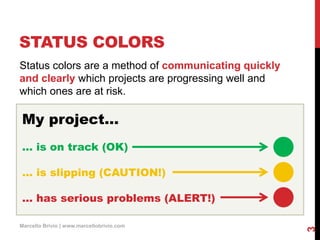
Status colors are a method of communicating quickly 
and clearly which projects are progressing well and 
which ones are at risk. 
My project… 
… is on track (OK) 
… is slipping (CAUTION!) 
… has serious problems (ALERT!) 
Marcello Brivio | www.marcellobrivio.com
KEY ELEMENT 
4 
• TIME: Are we on schedule? 
• COST: Are we on budget? 
• SCOPE: Do we have all we need to meet the 
requirements (without affecting the above points)? 
• RISKS: Do we know the risks and do we have a 
plan to mitigate or retire them? 
• TEAM: Is the team functioning well? 
• STAKEHOLDERS: Are the stakeholders actively 
engaged? 
Marcello Brivio | www.marcellobrivio.com
TIME 
5 
• Project plan accepted and key milestones identified. 
• Project delivered according to plan. 
• Quality of deliverables meeting set standards. 
• Project is tracking to schedule. 
• Project plan not fully defined. 
• Quality of deliverables less than desired. 
• Project initiative behind schedule by < 10%. 
• Quality of deliverables putting project at risk. 
• Project behind schedule by > 10%. 
Marcello Brivio | www.marcellobrivio.com
COST 
6 
• Project costs clearly defined 
• Project financially viable. 
• Project tracking on-budget 
• Project costs not fully defined. 
• Project costs over budget by <10% 
• Project no longer financially viable 
• Project costs over budget by >10% 
Marcello Brivio | www.marcellobrivio.com
SCOPE 
7 
• Scope of the project clearly defined. 
• Project proceeding according to approved scope. 
• Project conforms to architectural environment. 
• Internal and/or external priorities can alter project scope. 
• Pressure to expand scope of project. 
• Project solution not fully conform to architectural environment. 
• Internal and/or external priorities require a change in scope. 
• Project solution does not conform to architectural environment. 
Marcello Brivio | www.marcellobrivio.com
STAKEHOLDERS 
8 
• Executive and sponsors actively engaged and committed. 
• Stakeholders identified and engagement strategy developed. 
• Stakeholders engaged in effective way. 
• Executive and sponsor commitment not visible. 
• Stakeholder engagement strategy developed but not all key. 
• Stakeholders engaged effectively. 
• Stakeholder engagement strategy has not been developed. 
• Sponsors or key stakeholders groups are not engaged. 
Marcello Brivio | www.marcellobrivio.com
RISKS 
9 
• Project Risk management plan is in place. 
• Critical risks identified. 
• Mitigation strategies created. 
• Risks not fully identified. 
• Mitigation strategies not fully developed. 
• Major project risks not identified. 
• Mitigation strategies not identified or not acceptable. 
Marcello Brivio | www.marcellobrivio.com
TEAM 
10 
• Project staffed with the required expertise and capability. 
• Roles and responsibilities clearly articulated and understood. 
• Project team morale and collaboration are high. 
• Gaps in required expertise and capability to deliver the project. 
• Roles and responsibilities not clearly defined. 
• Project team morale and collaboration not optimal. 
• Significant gaps in resourcing requirements. 
• Project team not functioning at acceptable level. 
Marcello Brivio | www.marcellobrivio.com
OVERALL PROJECT STATUS 
(1/3) 
11 
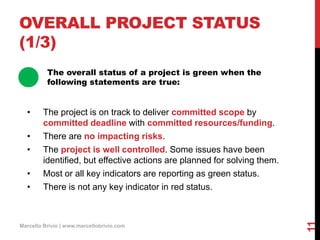
The overall status of a project is green when the 
following statements are true: 
• The project is on track to deliver committed scope by 
committed deadline with committed resources/funding. 
• There are no impacting risks. 
• The project is well controlled. Some issues have been 
identified, but effective actions are planned for solving them. 
• Most or all key indicators are reporting as green status. 
• There is not any key indicator in red status. 
Marcello Brivio | www.marcellobrivio.com
OVERALL PROJECT STATUS 
(2/3) 
12 
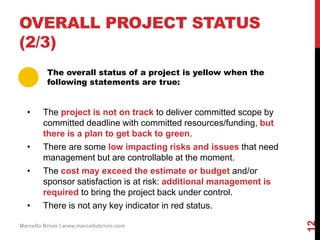
The overall status of a project is yellow when the 
following statements are true: 
• The project is not on track to deliver committed scope by 
committed deadline with committed resources/funding, but 
there is a plan to get back to green. 
• There are some low impacting risks and issues that need 
management but are controllable at the moment. 
• The cost may exceed the estimate or budget and/or 
sponsor satisfaction is at risk: additional management is 
required to bring the project back under control. 
• There is not any key indicator in red status. 
Marcello Brivio | www.marcellobrivio.com
OVERALL PROJECT STATUS 
(3/3) 
13 
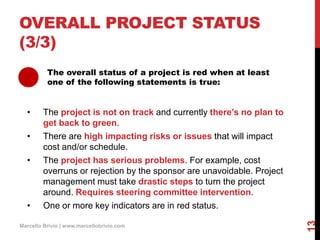
The overall status of a project is red when at least 
one of the following statements is true: 
• The project is not on track and currently there’s no plan to 
get back to green. 
• There are high impacting risks or issues that will impact 
cost and/or schedule. 
• The project has serious problems. For example, cost 
overruns or rejection by the sponsor are unavoidable. Project 
management must take drastic steps to turn the project 
around. Requires steering committee intervention. 
• One or more key indicators are in red status. 
Marcello Brivio | www.marcellobrivio.com

Project Status Determination (GYR Method)

  • 1.
    PROJECT STATUS DETERMINATION Marcello Brivio | www.marcellobrivio.com 1
  • 2.
    AGENDA 1. StatusColors 2. Key Elements 3. Cost 4. Time 5. Scope 6. Stakeholders 7. Risks 8. Team 9. Overall Project Status 2 Marcello Brivio | www.marcellobrivio.com
  • 3.
    STATUS COLORS 3 Status colors are a method of communicating quickly and clearly which projects are progressing well and which ones are at risk. My project… … is on track (OK) … is slipping (CAUTION!) … has serious problems (ALERT!) Marcello Brivio | www.marcellobrivio.com
  • 4.
    KEY ELEMENT 4 • TIME: Are we on schedule? • COST: Are we on budget? • SCOPE: Do we have all we need to meet the requirements (without affecting the above points)? • RISKS: Do we know the risks and do we have a plan to mitigate or retire them? • TEAM: Is the team functioning well? • STAKEHOLDERS: Are the stakeholders actively engaged? Marcello Brivio | www.marcellobrivio.com
  • 5.
    TIME 5 •Project plan accepted and key milestones identified. • Project delivered according to plan. • Quality of deliverables meeting set standards. • Project is tracking to schedule. • Project plan not fully defined. • Quality of deliverables less than desired. • Project initiative behind schedule by < 10%. • Quality of deliverables putting project at risk. • Project behind schedule by > 10%. Marcello Brivio | www.marcellobrivio.com
  • 6.
    COST 6 •Project costs clearly defined • Project financially viable. • Project tracking on-budget • Project costs not fully defined. • Project costs over budget by <10% • Project no longer financially viable • Project costs over budget by >10% Marcello Brivio | www.marcellobrivio.com
  • 7.
    SCOPE 7 •Scope of the project clearly defined. • Project proceeding according to approved scope. • Project conforms to architectural environment. • Internal and/or external priorities can alter project scope. • Pressure to expand scope of project. • Project solution not fully conform to architectural environment. • Internal and/or external priorities require a change in scope. • Project solution does not conform to architectural environment. Marcello Brivio | www.marcellobrivio.com
  • 8.
    STAKEHOLDERS 8 •Executive and sponsors actively engaged and committed. • Stakeholders identified and engagement strategy developed. • Stakeholders engaged in effective way. • Executive and sponsor commitment not visible. • Stakeholder engagement strategy developed but not all key. • Stakeholders engaged effectively. • Stakeholder engagement strategy has not been developed. • Sponsors or key stakeholders groups are not engaged. Marcello Brivio | www.marcellobrivio.com
  • 9.
    RISKS 9 •Project Risk management plan is in place. • Critical risks identified. • Mitigation strategies created. • Risks not fully identified. • Mitigation strategies not fully developed. • Major project risks not identified. • Mitigation strategies not identified or not acceptable. Marcello Brivio | www.marcellobrivio.com
  • 10.
    TEAM 10 •Project staffed with the required expertise and capability. • Roles and responsibilities clearly articulated and understood. • Project team morale and collaboration are high. • Gaps in required expertise and capability to deliver the project. • Roles and responsibilities not clearly defined. • Project team morale and collaboration not optimal. • Significant gaps in resourcing requirements. • Project team not functioning at acceptable level. Marcello Brivio | www.marcellobrivio.com
  • 11.
    OVERALL PROJECT STATUS (1/3) 11 The overall status of a project is green when the following statements are true: • The project is on track to deliver committed scope by committed deadline with committed resources/funding. • There are no impacting risks. • The project is well controlled. Some issues have been identified, but effective actions are planned for solving them. • Most or all key indicators are reporting as green status. • There is not any key indicator in red status. Marcello Brivio | www.marcellobrivio.com
  • 12.
    OVERALL PROJECT STATUS (2/3) 12 The overall status of a project is yellow when the following statements are true: • The project is not on track to deliver committed scope by committed deadline with committed resources/funding, but there is a plan to get back to green. • There are some low impacting risks and issues that need management but are controllable at the moment. • The cost may exceed the estimate or budget and/or sponsor satisfaction is at risk: additional management is required to bring the project back under control. • There is not any key indicator in red status. Marcello Brivio | www.marcellobrivio.com
  • 13.
    OVERALL PROJECT STATUS (3/3) 13 The overall status of a project is red when at least one of the following statements is true: • The project is not on track and currently there’s no plan to get back to green. • There are high impacting risks or issues that will impact cost and/or schedule. • The project has serious problems. For example, cost overruns or rejection by the sponsor are unavoidable. Project management must take drastic steps to turn the project around. Requires steering committee intervention. • One or more key indicators are in red status. Marcello Brivio | www.marcellobrivio.com