NAME
PROJECT NAME
POST-
MORTEM
Performance
Against Goals
GOA
L
List key metrics (items for
measuring success)
State original goal
or goals of project
ACTU
AL
List differences in terms of original
dates (x weeks late, x months
early, etc.)
Summarize what
really happened in
relationship to goals
Performance
Against
Schedule
PLA
N
List key milestones
Summarize original
schedule of project
ACTU
AL
List differences in terms of original
dates (x weeks late, x months early,
etc.)
Summarize what really
happened in
relationship to the plan
Performance
Against Quality
QUALITY
GOAL
List key metrics (items for
measuring success)
State original quality
goal or goals for the
project
ACTU
AL
List progress against metrics
Summarize what really
happened in
relationship to quality
goals
Performance
Against Budget
BUDGE
T
List key cost goals, expenditure
limits
state original quality
goal or goals for the
project
ACTUAL
COST/EXPENDITURE
S
List progress against goals & limits
Summarize what really
happened in
relationship to budget
Post-Mortem
By Department
Project Planning
How Was the Project
Planned?
How did that work? Right set of
people?
Who was responsible for
original plans?
Was there an actual written plan?
How was project plan
communicated?
How well did that work?
Was project well defined
from beginning?
Project Planning
Was the Plan the Right
One?
What was good? What was missing?
Was the plan a good
one?
Was the change good or bad?
How did the changes affect the
project?
How did the plan
evolve over time?
Was the plan realistic?
Make very specific
recommendations.
Key areas for
improvement:
Development
How Was R&D
Managed?
How many teams, number of
people, reporting structure, etc.
How well did that work?
Improvements?
How was the project
managed through R&D?
What methods, timing, etc.
How well did that work?
How did the R&D teams
communicate
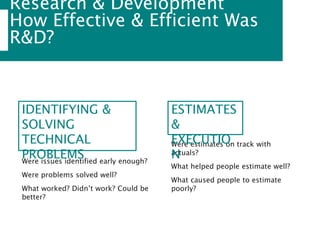
Research & Development
How Effective & Efficient Was
R&D?
Were issues identified early enough?
Were problems solved well?
What worked? Didn’t work? Could be
better?
Were estimates on track with
actuals?
What helped people estimate well?
What caused people to estimate
poorly?
IDENTIFYING &
SOLVING
TECHNICAL
PROBLEMS
ESTIMATES
&
EXECUTIO
N
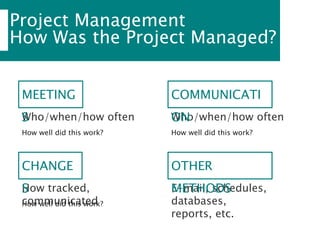
Project Management
How Was the Project Managed?
How well did this work?
Who/when/how often
How well did this work?
Who/when/how often
MEETING
S
COMMUNICATI
ON
How well did this work?
How tracked,
communicated
E-mail, schedules,
databases,
reports, etc.
CHANGE
S
OTHER
METHODS
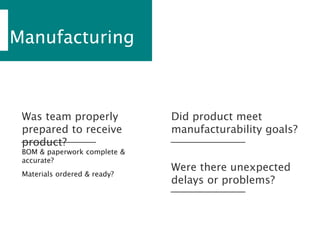
Manufacturing
BOM & paperwork complete &
accurate?
Materials ordered & ready?
Was team properly
prepared to receive
product?
Did product meet
manufacturability goals?
Were there unexpected
delays or problems?
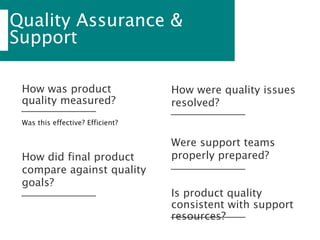
Quality Assurance &
Support
Was this effective? Efficient?
How was product
quality measured?
How were quality issues
resolved?
How did final product
compare against quality
goals?
Were support teams
properly prepared?
Is product quality
consistent with support
resources?
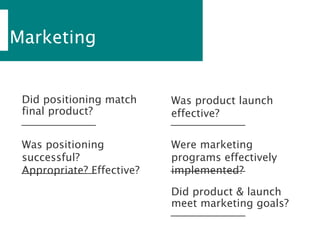
Marketing
Did positioning match
final product?
Was product launch
effective?
Was positioning
successful?
Appropriate? Effective?
Were marketing
programs effectively
implemented?
Did product & launch
meet marketing goals?
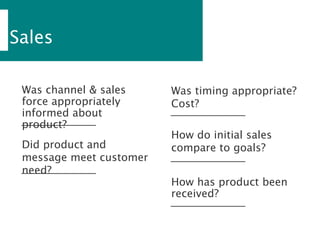
Sales
Was channel & sales
force appropriately
informed about
product?
Was timing appropriate?
Cost?
Did product and
message meet customer
need?
How do initial sales
compare to goals?
How has product been
received?
Key Lessons
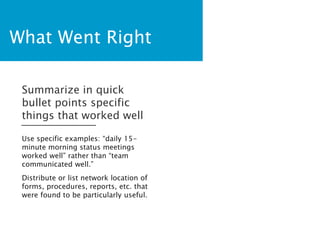
What Went Right
Use specific examples: “daily 15-
minute morning status meetings
worked well” rather than “team
communicated well.”
Distribute or list network location of
forms, procedures, reports, etc. that
were found to be particularly useful.
Summarize in quick
bullet points specific
things that worked well
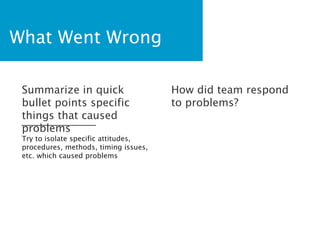
What Went Wrong
Try to isolate specific attitudes,
procedures, methods, timing issues,
etc. which caused problems
Summarize in quick
bullet points specific
things that caused
problems
How did team respond
to problems?
Recommendations
By department or
management level,
record critical
recommendations for
future products of this
type
Distribute document or
network location of
more detailed summary
of this presentation
Questions
& Comments

Project Post Mortem Review Outline

  • 1.
  • 2.
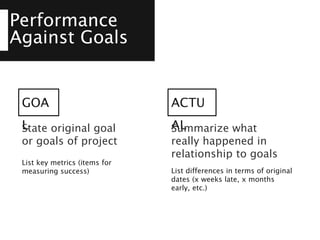
    Performance Against Goals GOA L List keymetrics (items for measuring success) State original goal or goals of project ACTU AL List differences in terms of original dates (x weeks late, x months early, etc.) Summarize what really happened in relationship to goals
  • 3.
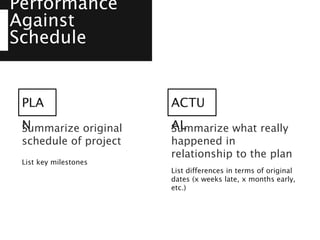
    Performance Against Schedule PLA N List key milestones Summarizeoriginal schedule of project ACTU AL List differences in terms of original dates (x weeks late, x months early, etc.) Summarize what really happened in relationship to the plan
  • 4.
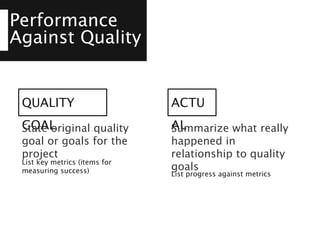
    Performance Against Quality QUALITY GOAL List keymetrics (items for measuring success) State original quality goal or goals for the project ACTU AL List progress against metrics Summarize what really happened in relationship to quality goals
  • 5.
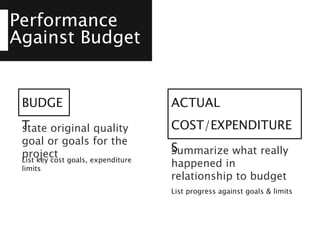
    Performance Against Budget BUDGE T List keycost goals, expenditure limits state original quality goal or goals for the project ACTUAL COST/EXPENDITURE S List progress against goals & limits Summarize what really happened in relationship to budget
  • 6.
  • 7.
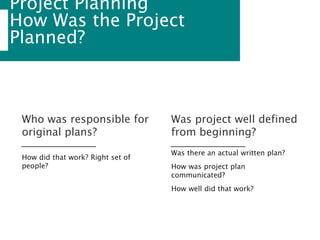
    Project Planning How Wasthe Project Planned? How did that work? Right set of people? Who was responsible for original plans? Was there an actual written plan? How was project plan communicated? How well did that work? Was project well defined from beginning?
  • 8.
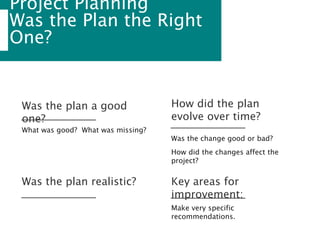
    Project Planning Was thePlan the Right One? What was good? What was missing? Was the plan a good one? Was the change good or bad? How did the changes affect the project? How did the plan evolve over time? Was the plan realistic? Make very specific recommendations. Key areas for improvement:
  • 9.
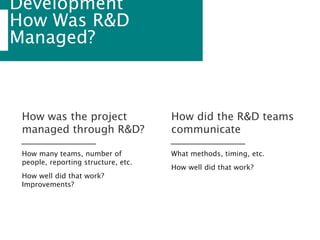
    Development How Was R&D Managed? Howmany teams, number of people, reporting structure, etc. How well did that work? Improvements? How was the project managed through R&D? What methods, timing, etc. How well did that work? How did the R&D teams communicate
  • 10.
    Research & Development HowEffective & Efficient Was R&D? Were issues identified early enough? Were problems solved well? What worked? Didn’t work? Could be better? Were estimates on track with actuals? What helped people estimate well? What caused people to estimate poorly? IDENTIFYING & SOLVING TECHNICAL PROBLEMS ESTIMATES & EXECUTIO N
  • 11.
    Project Management How Wasthe Project Managed? How well did this work? Who/when/how often How well did this work? Who/when/how often MEETING S COMMUNICATI ON How well did this work? How tracked, communicated E-mail, schedules, databases, reports, etc. CHANGE S OTHER METHODS
  • 12.
    Manufacturing BOM & paperworkcomplete & accurate? Materials ordered & ready? Was team properly prepared to receive product? Did product meet manufacturability goals? Were there unexpected delays or problems?
  • 13.
    Quality Assurance & Support Wasthis effective? Efficient? How was product quality measured? How were quality issues resolved? How did final product compare against quality goals? Were support teams properly prepared? Is product quality consistent with support resources?
  • 14.
    Marketing Did positioning match finalproduct? Was product launch effective? Was positioning successful? Appropriate? Effective? Were marketing programs effectively implemented? Did product & launch meet marketing goals?
  • 15.
    Sales Was channel &sales force appropriately informed about product? Was timing appropriate? Cost? Did product and message meet customer need? How do initial sales compare to goals? How has product been received?
  • 16.
  • 17.
    What Went Right Usespecific examples: “daily 15- minute morning status meetings worked well” rather than “team communicated well.” Distribute or list network location of forms, procedures, reports, etc. that were found to be particularly useful. Summarize in quick bullet points specific things that worked well
  • 18.
    What Went Wrong Tryto isolate specific attitudes, procedures, methods, timing issues, etc. which caused problems Summarize in quick bullet points specific things that caused problems How did team respond to problems?
  • 19.
    Recommendations By department or managementlevel, record critical recommendations for future products of this type Distribute document or network location of more detailed summary of this presentation
  • 20.