Copyright © 2010 Pearson Education, Inc. Publishing as Prentice Hall 1-1
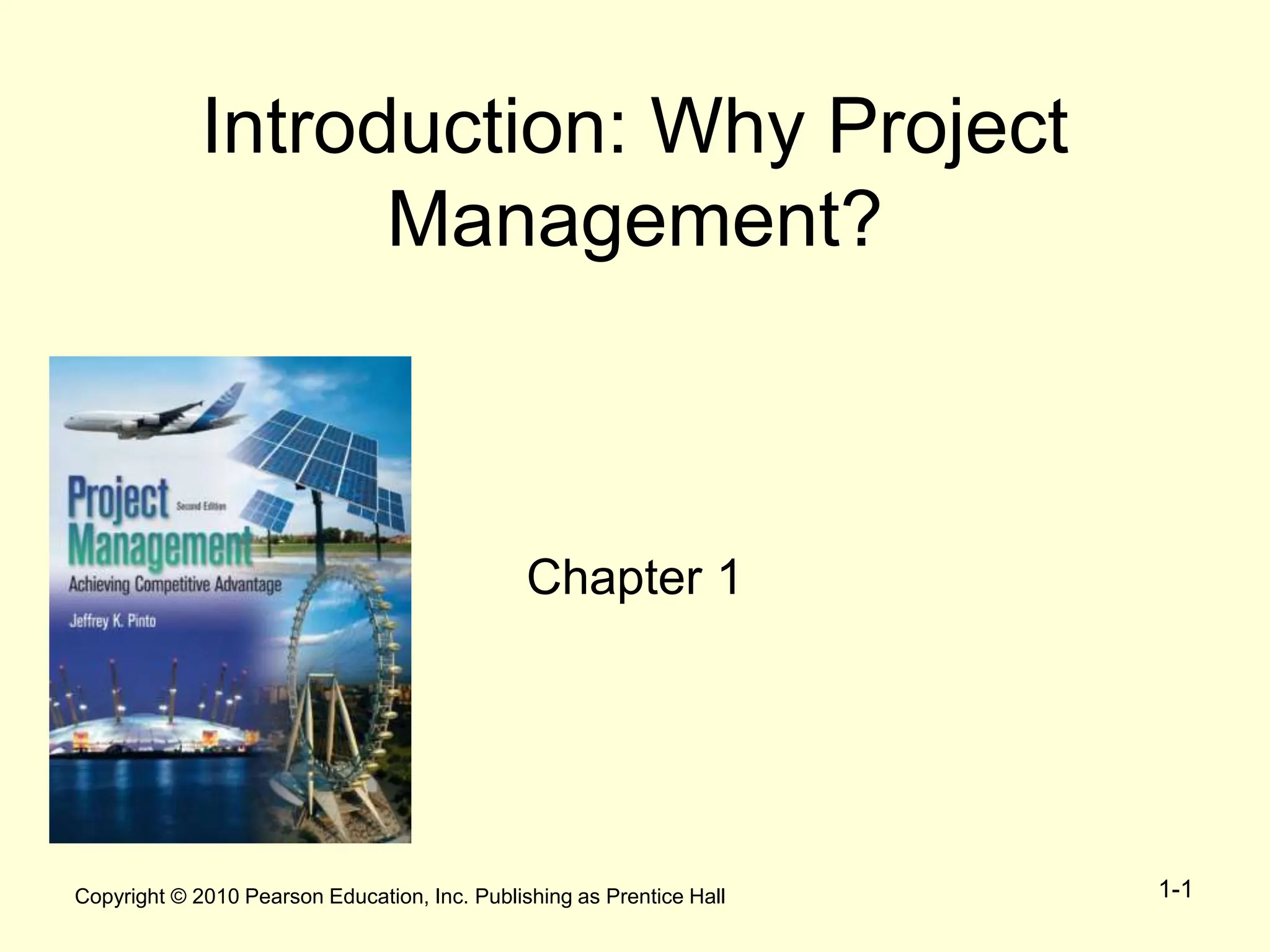
Introduction: Why Project
Management?
Chapter 1
Copyright © 2010 Pearson Education, Inc. Publishing as Prentice Hall 1-2
Introduction
• Examples of projects
– Split the atom
– Chunnel between England and France
– Introduce Windows Vista
– Disneyland’s Expedition Everest
“Projects, rather than repetitive tasks, are now the
basis for most value-added in business”
-Tom Peters
Copyright © 2010 Pearson Education, Inc. Publishing as Prentice Hall 1-3
Project vs. Process Work
Project
• Take place outside the
process world
• Unique and separate
from normal
organization work
• Continually evolving
Process
• Ongoing, day-to-day
activities
• Use existing systems,
properties, and
capabilities
• Typically repetitive
A project is a temporary endeavor undertaken to
create a unique product or service.
PMBoK 2000
Copyright © 2010 Pearson Education, Inc. Publishing as Prentice Hall 1-4
Additional Definitions
• A project is a unique venture with a beginning
and an end, conducted by people to meet
established goals within parameters of cost,
schedule and quality. Buchanan & Boddy 92
• Projects are goal-oriented, involve the
coordinated undertaking of interrelated activities,
are of finite duration, and are all, to a degree
unique. Frame 95
Copyright © 2010 Pearson Education, Inc. Publishing as Prentice Hall 1-5
Elements of Projects
• Complex, one-time processes
• Limited by budget, schedule, and resources
• Developed to resolve a clear goal or set of
goals
• Customer-focused
Copyright © 2010 Pearson Education, Inc. Publishing as Prentice Hall 1-6
General Project Characteristics (1/2)
• Ad-hoc endeavors with a clear life cycle
• Building blocks in the design and execution of
organizational strategies
• Responsible for the newest and most improved
products, services, and organizational processes
• Provide a philosophy and strategy for the management
of change
Copyright © 2010 Pearson Education, Inc. Publishing as Prentice Hall 1-7
General Project Characteristics (2/2)
• Entail crossing functional and organization boundaries
• Traditional management functions of planning,
organizing, motivating, directing, and controlling apply
• Principal outcomes are the satisfaction of customer
requirements within technical, cost, and schedule
constraints
• Terminated upon successful completion
Copyright © 2010 Pearson Education, Inc. Publishing as Prentice Hall 1-8
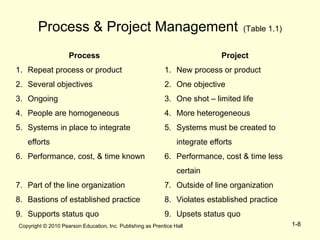
Process & Project Management (Table 1.1)
Process
1. Repeat process or product
2. Several objectives
3. Ongoing
4. People are homogeneous
5. Systems in place to integrate
efforts
6. Performance, cost, & time known
7. Part of the line organization
8. Bastions of established practice
9. Supports status quo
Project
1. New process or product
2. One objective
3. One shot – limited life
4. More heterogeneous
5. Systems must be created to
integrate efforts
6. Performance, cost & time less
certain
7. Outside of line organization
8. Violates established practice
9. Upsets status quo
Copyright © 2010 Pearson Education, Inc. Publishing as Prentice Hall 1-9
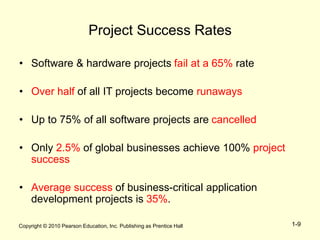
Project Success Rates
• Software & hardware projects fail at a 65% rate
• Over half of all IT projects become runaways
• Up to 75% of all software projects are cancelled
• Only 2.5% of global businesses achieve 100% project
success
• Average success of business-critical application
development projects is 35%.
Copyright © 2010 Pearson Education, Inc. Publishing as Prentice Hall 1-10
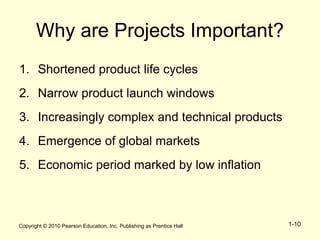
Why are Projects Important?
1. Shortened product life cycles
2. Narrow product launch windows
3. Increasingly complex and technical products
4. Emergence of global markets
5. Economic period marked by low inflation
Copyright © 2010 Pearson Education, Inc. Publishing as Prentice Hall 1-11
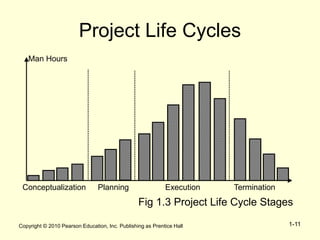
Project Life Cycles
Man Hours
Conceptualization Planning Execution Termination
Fig 1.3 Project Life Cycle Stages
Copyright © 2010 Pearson Education, Inc. Publishing as Prentice Hall 1-12
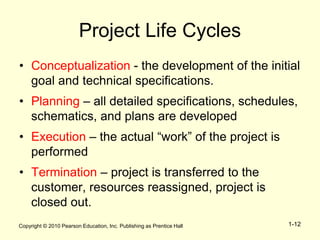
Project Life Cycles
• Conceptualization - the development of the initial
goal and technical specifications.
• Planning – all detailed specifications, schedules,
schematics, and plans are developed
• Execution – the actual “work” of the project is
performed
• Termination – project is transferred to the
customer, resources reassigned, project is
closed out.
Copyright © 2010 Pearson Education, Inc. Publishing as Prentice Hall 1-13
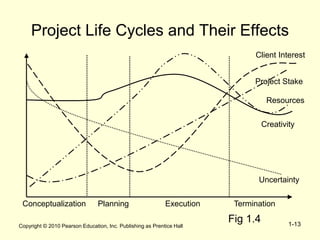
Project Life Cycles and Their Effects
Conceptualization Planning Execution Termination
Uncertainty
Client Interest
Project Stake
Creativity
Resources
Fig 1.4
Copyright © 2010 Pearson Education, Inc. Publishing as Prentice Hall 1-14
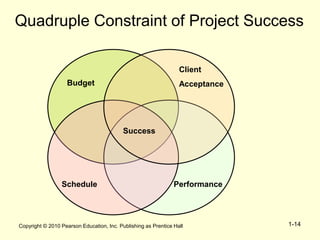
Quadruple Constraint of Project Success
Success
Budget
Client
Acceptance
Schedule Performance
Copyright © 2010 Pearson Education, Inc. Publishing as Prentice Hall 1-15
Six Criteria for IT Project Success
• System quality
• Information quality
• Use
• User satisfaction
• Individual Impact
• Organizational impact
Copyright © 2010 Pearson Education, Inc. Publishing as Prentice Hall 1-16
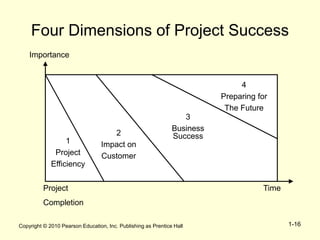
Four Dimensions of Project Success
Project
Completion
Time
Importance
1
Project
Efficiency
4
Preparing for
The Future
2
Impact on
Customer
3
Business
Success
Copyright © 2010 Pearson Education, Inc. Publishing as Prentice Hall 1-17
Developing Project Management Maturity
Project management maturity models
– Center for business practices
– Kerzner’s project management maturity model
– ESI International’s project framework
– SEI’s capability maturity model integration
Copyright © 2010 Pearson Education, Inc. Publishing as Prentice Hall 1-18
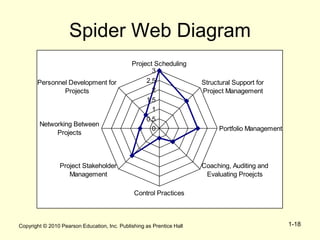
Spider Web Diagram
0
0.5
1
1.5
2
2.5
3
Project Scheduling
Structural Support for
Project Management
Portfolio Management
Coaching, Auditing and
Evaluating Proejcts
Control Practices
Project Stakeholder
Management
Networking Between
Projects
Personnel Development for
Projects
Copyright © 2010 Pearson Education, Inc. Publishing as Prentice Hall 1-19
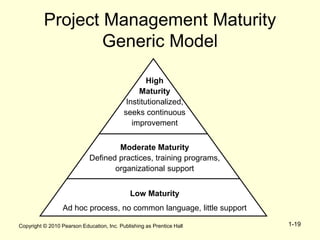
Project Management Maturity
Generic Model
Low Maturity
Ad hoc process, no common language, little support
Moderate Maturity
Defined practices, training programs,
organizational support
High
Maturity
Institutionalized,
seeks continuous
improvement
Copyright © 2010 Pearson Education, Inc. Publishing as Prentice Hall 1-20
Project Elements and
Text Organization
Copyright © 2010 Pearson Education, Inc. Publishing as Prentice Hall 1-21

project management introduction chapter 1

  • 1.
    Copyright © 2010Pearson Education, Inc. Publishing as Prentice Hall 1-1 Introduction: Why Project Management? Chapter 1
  • 2.
    Copyright © 2010Pearson Education, Inc. Publishing as Prentice Hall 1-2 Introduction • Examples of projects – Split the atom – Chunnel between England and France – Introduce Windows Vista – Disneyland’s Expedition Everest “Projects, rather than repetitive tasks, are now the basis for most value-added in business” -Tom Peters
  • 3.
    Copyright © 2010Pearson Education, Inc. Publishing as Prentice Hall 1-3 Project vs. Process Work Project • Take place outside the process world • Unique and separate from normal organization work • Continually evolving Process • Ongoing, day-to-day activities • Use existing systems, properties, and capabilities • Typically repetitive A project is a temporary endeavor undertaken to create a unique product or service. PMBoK 2000
  • 4.
    Copyright © 2010Pearson Education, Inc. Publishing as Prentice Hall 1-4 Additional Definitions • A project is a unique venture with a beginning and an end, conducted by people to meet established goals within parameters of cost, schedule and quality. Buchanan & Boddy 92 • Projects are goal-oriented, involve the coordinated undertaking of interrelated activities, are of finite duration, and are all, to a degree unique. Frame 95
  • 5.
    Copyright © 2010Pearson Education, Inc. Publishing as Prentice Hall 1-5 Elements of Projects • Complex, one-time processes • Limited by budget, schedule, and resources • Developed to resolve a clear goal or set of goals • Customer-focused
  • 6.
    Copyright © 2010Pearson Education, Inc. Publishing as Prentice Hall 1-6 General Project Characteristics (1/2) • Ad-hoc endeavors with a clear life cycle • Building blocks in the design and execution of organizational strategies • Responsible for the newest and most improved products, services, and organizational processes • Provide a philosophy and strategy for the management of change
  • 7.
    Copyright © 2010Pearson Education, Inc. Publishing as Prentice Hall 1-7 General Project Characteristics (2/2) • Entail crossing functional and organization boundaries • Traditional management functions of planning, organizing, motivating, directing, and controlling apply • Principal outcomes are the satisfaction of customer requirements within technical, cost, and schedule constraints • Terminated upon successful completion
  • 8.
    Copyright © 2010Pearson Education, Inc. Publishing as Prentice Hall 1-8 Process & Project Management (Table 1.1) Process 1. Repeat process or product 2. Several objectives 3. Ongoing 4. People are homogeneous 5. Systems in place to integrate efforts 6. Performance, cost, & time known 7. Part of the line organization 8. Bastions of established practice 9. Supports status quo Project 1. New process or product 2. One objective 3. One shot – limited life 4. More heterogeneous 5. Systems must be created to integrate efforts 6. Performance, cost & time less certain 7. Outside of line organization 8. Violates established practice 9. Upsets status quo
  • 9.
    Copyright © 2010Pearson Education, Inc. Publishing as Prentice Hall 1-9 Project Success Rates • Software & hardware projects fail at a 65% rate • Over half of all IT projects become runaways • Up to 75% of all software projects are cancelled • Only 2.5% of global businesses achieve 100% project success • Average success of business-critical application development projects is 35%.
  • 10.
    Copyright © 2010Pearson Education, Inc. Publishing as Prentice Hall 1-10 Why are Projects Important? 1. Shortened product life cycles 2. Narrow product launch windows 3. Increasingly complex and technical products 4. Emergence of global markets 5. Economic period marked by low inflation
  • 11.
    Copyright © 2010Pearson Education, Inc. Publishing as Prentice Hall 1-11 Project Life Cycles Man Hours Conceptualization Planning Execution Termination Fig 1.3 Project Life Cycle Stages
  • 12.
    Copyright © 2010Pearson Education, Inc. Publishing as Prentice Hall 1-12 Project Life Cycles • Conceptualization - the development of the initial goal and technical specifications. • Planning – all detailed specifications, schedules, schematics, and plans are developed • Execution – the actual “work” of the project is performed • Termination – project is transferred to the customer, resources reassigned, project is closed out.
  • 13.
    Copyright © 2010Pearson Education, Inc. Publishing as Prentice Hall 1-13 Project Life Cycles and Their Effects Conceptualization Planning Execution Termination Uncertainty Client Interest Project Stake Creativity Resources Fig 1.4
  • 14.
    Copyright © 2010Pearson Education, Inc. Publishing as Prentice Hall 1-14 Quadruple Constraint of Project Success Success Budget Client Acceptance Schedule Performance
  • 15.
    Copyright © 2010Pearson Education, Inc. Publishing as Prentice Hall 1-15 Six Criteria for IT Project Success • System quality • Information quality • Use • User satisfaction • Individual Impact • Organizational impact
  • 16.
    Copyright © 2010Pearson Education, Inc. Publishing as Prentice Hall 1-16 Four Dimensions of Project Success Project Completion Time Importance 1 Project Efficiency 4 Preparing for The Future 2 Impact on Customer 3 Business Success
  • 17.
    Copyright © 2010Pearson Education, Inc. Publishing as Prentice Hall 1-17 Developing Project Management Maturity Project management maturity models – Center for business practices – Kerzner’s project management maturity model – ESI International’s project framework – SEI’s capability maturity model integration
  • 18.
    Copyright © 2010Pearson Education, Inc. Publishing as Prentice Hall 1-18 Spider Web Diagram 0 0.5 1 1.5 2 2.5 3 Project Scheduling Structural Support for Project Management Portfolio Management Coaching, Auditing and Evaluating Proejcts Control Practices Project Stakeholder Management Networking Between Projects Personnel Development for Projects
  • 19.
    Copyright © 2010Pearson Education, Inc. Publishing as Prentice Hall 1-19 Project Management Maturity Generic Model Low Maturity Ad hoc process, no common language, little support Moderate Maturity Defined practices, training programs, organizational support High Maturity Institutionalized, seeks continuous improvement
  • 20.
    Copyright © 2010Pearson Education, Inc. Publishing as Prentice Hall 1-20 Project Elements and Text Organization
  • 21.
    Copyright © 2010Pearson Education, Inc. Publishing as Prentice Hall 1-21