Download the full version and explore a variety of test banks
or solution manuals at https://testbankmall.com
Solution Manual for Project Management: Achieving
Competitive Advantage, 3/E 3rd Edition Jeffery K.
Pinto
_____ Follow the link below to get your download now _____
https://testbankmall.com/product/solution-manual-for-
project-management-achieving-competitive-advantage-3-e-3rd-
edition-jeffery-k-pinto/
Access testbankmall.com now to download high-quality
test banks or solution manuals
We have selected some products that you may be interested in
Click the link to download now or visit testbankmall.com
for more options!.
Test Bank for Project Management: Achieving Competitive
Advantage, 3/E 3rd Edition Jeffery K. Pinto
https://testbankmall.com/product/test-bank-for-project-management-
achieving-competitive-advantage-3-e-3rd-edition-jeffery-k-pinto/
Project Management Achieving Competitive Advantage 4th
Edition Pinto Solutions Manual
https://testbankmall.com/product/project-management-achieving-
competitive-advantage-4th-edition-pinto-solutions-manual/
Test Bank for Project Management: Achieving Competitive
Advantage 5th Edition Pinto
https://testbankmall.com/product/test-bank-for-project-management-
achieving-competitive-advantage-5th-edition-pinto/
Test Bank for Essential Biochemistry, 4th Edition,
Charlotte W. Pratt, Kathleen Cornely
https://testbankmall.com/product/test-bank-for-essential-
biochemistry-4th-edition-charlotte-w-pratt-kathleen-cornely/
Test Bank for Leadership: Theory and Practice, 7th Edition
Peter G. Northouse
https://testbankmall.com/product/test-bank-for-leadership-theory-and-
practice-7th-edition-peter-g-northouse/
Test bank for Voyages in World History Volume 2 3rd
Edition by Hansen
https://testbankmall.com/product/test-bank-for-voyages-in-world-
history-volume-2-3rd-edition-by-hansen/
Social Problems in a Diverse Society Canadian 4th Edition
Kendall Solutions Manual
https://testbankmall.com/product/social-problems-in-a-diverse-society-
canadian-4th-edition-kendall-solutions-manual/
Solution manual for Money,Banking and Financial Markets
Cecchetti Schoenholtz 4th edition
https://testbankmall.com/product/solution-manual-for-moneybanking-and-
financial-markets-cecchetti-schoenholtz-4th-edition/
Test Bank For Principles of Genetics, 6th edition: D.
Peter Snustad
https://testbankmall.com/product/test-bank-for-principles-of-
genetics-6th-edition-d-peter-snustad/
Test Bank for An Introduction To Community Health, 7th
Edition: James F. McKenzie
https://testbankmall.com/product/test-bank-for-an-introduction-to-
community-health-7th-edition-james-f-mckenzie/
PROJECT MANAGEMENT RESEARCH IN BRIEF
Assessing Information Technology (IT) Project Success
1.5 DEVELOPING PROJECT MANAGEMENT MATURITY
1.6 PROJECT ELEMENTS AND TEXT ORGANIZATION
Summary
Key Terms
Discussion Questions
Case Study 1.1 MegaTech, Inc.
Case Study 1.2 The IT Department at Hamelin Hospital
Case Study 1.3 Disney’s Expedition Everest
Internet Exercises
PMP Certification Sample Questions
Notes
01-02
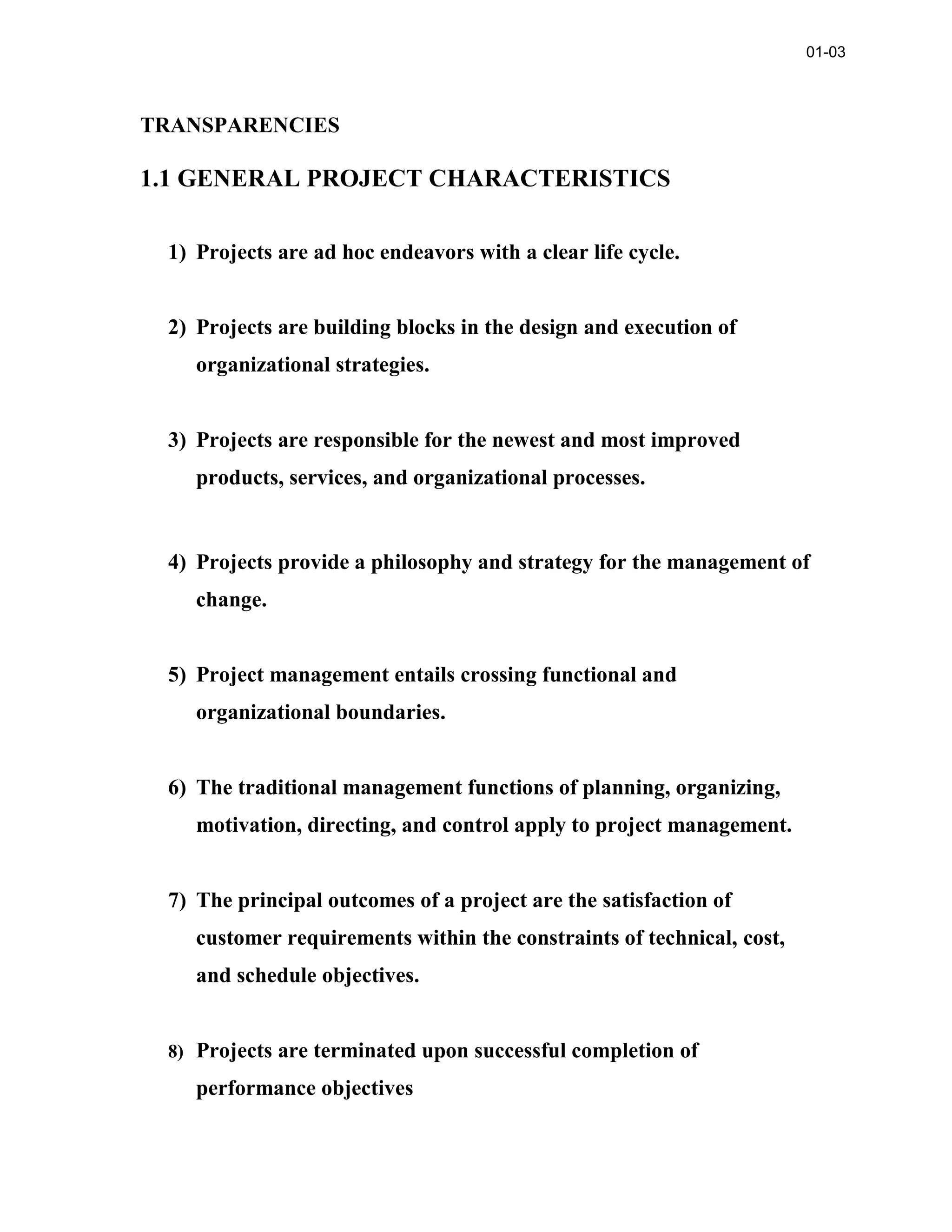
TRANSPARENCIES
1.1 GENERAL PROJECT CHARACTERISTICS
1) Projects are ad hoc endeavors with a clear life cycle.
2) Projects are building blocks in the design and execution of
organizational strategies.
3) Projects are responsible for the newest and most improved
products, services, and organizational processes.
4) Projects provide a philosophy and strategy for the management of
change.
5) Project management entails crossing functional and
organizational boundaries.
6) The traditional management functions of planning, organizing,
motivation, directing, and control apply to project management.
7) The principal outcomes of a project are the satisfaction of
customer requirements within the constraints of technical, cost,
and schedule objectives.
8) Projects are terminated upon successful completion of
performance objectives
01-03
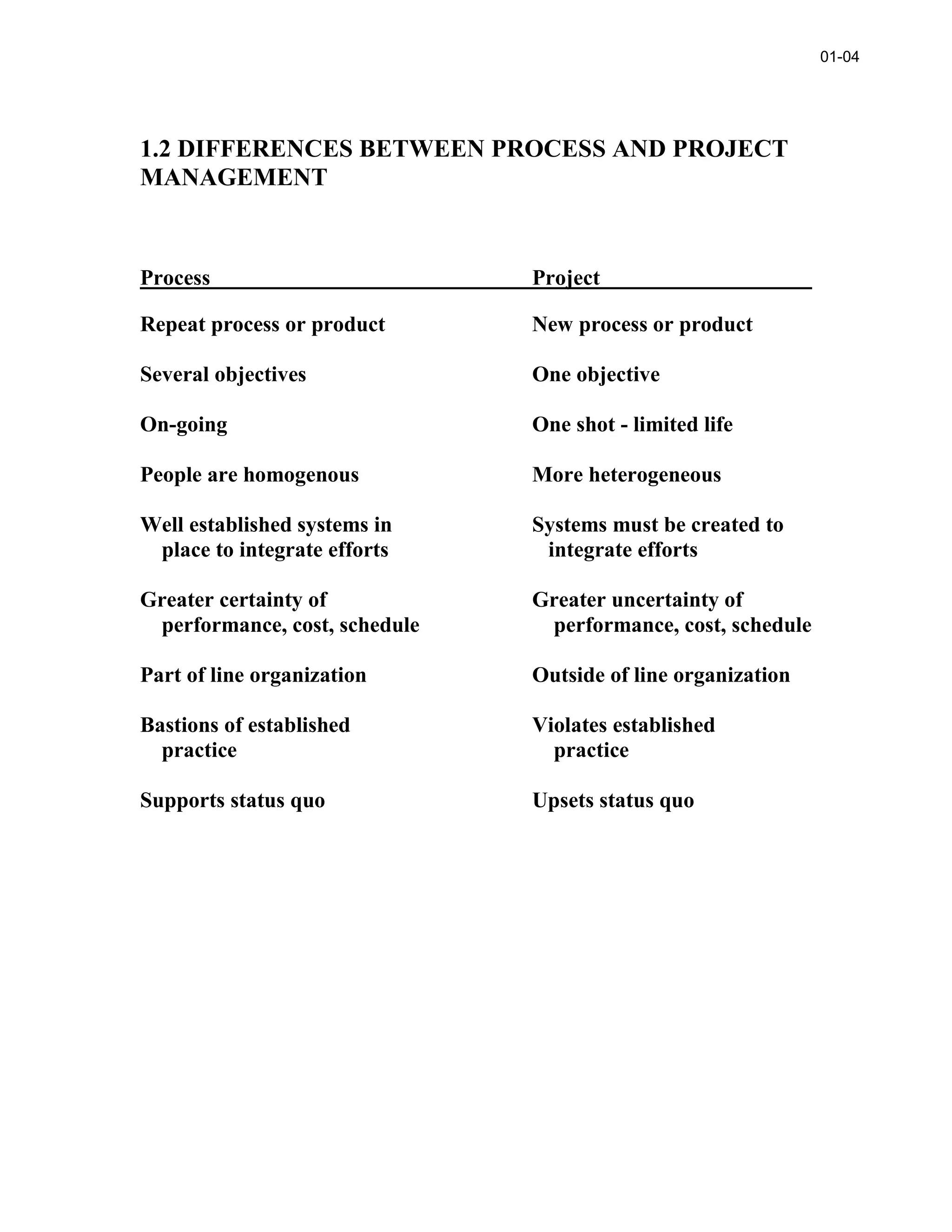
1.2 DIFFERENCES BETWEEN PROCESS AND PROJECT
MANAGEMENT
Process Project
Repeat process or product New process or product
Several objectives One objective
On-going One shot - limited life
People are homogenous More heterogeneous
Well established systems in Systems must be created to
place to integrate efforts integrate efforts
Greater certainty of Greater uncertainty of
performance, cost, schedule performance, cost, schedule
Part of line organization Outside of line organization
Bastions of established Violates established
practice practice
Supports status quo Upsets status quo
01-04
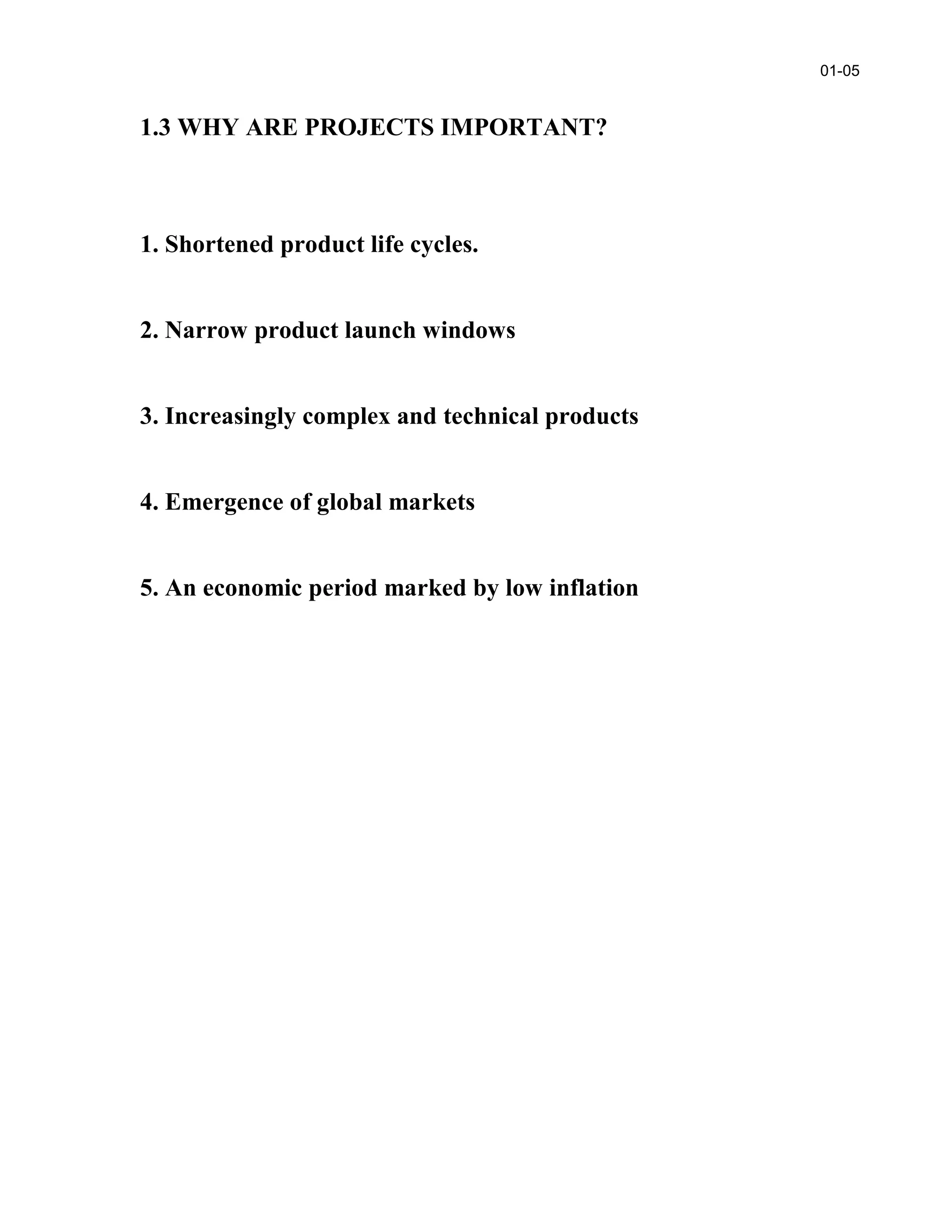
1.3 WHY ARE PROJECTS IMPORTANT?
1. Shortened product life cycles.
2. Narrow product launch windows
3. Increasingly complex and technical products
4. Emergence of global markets
5. An economic period marked by low inflation
01-05
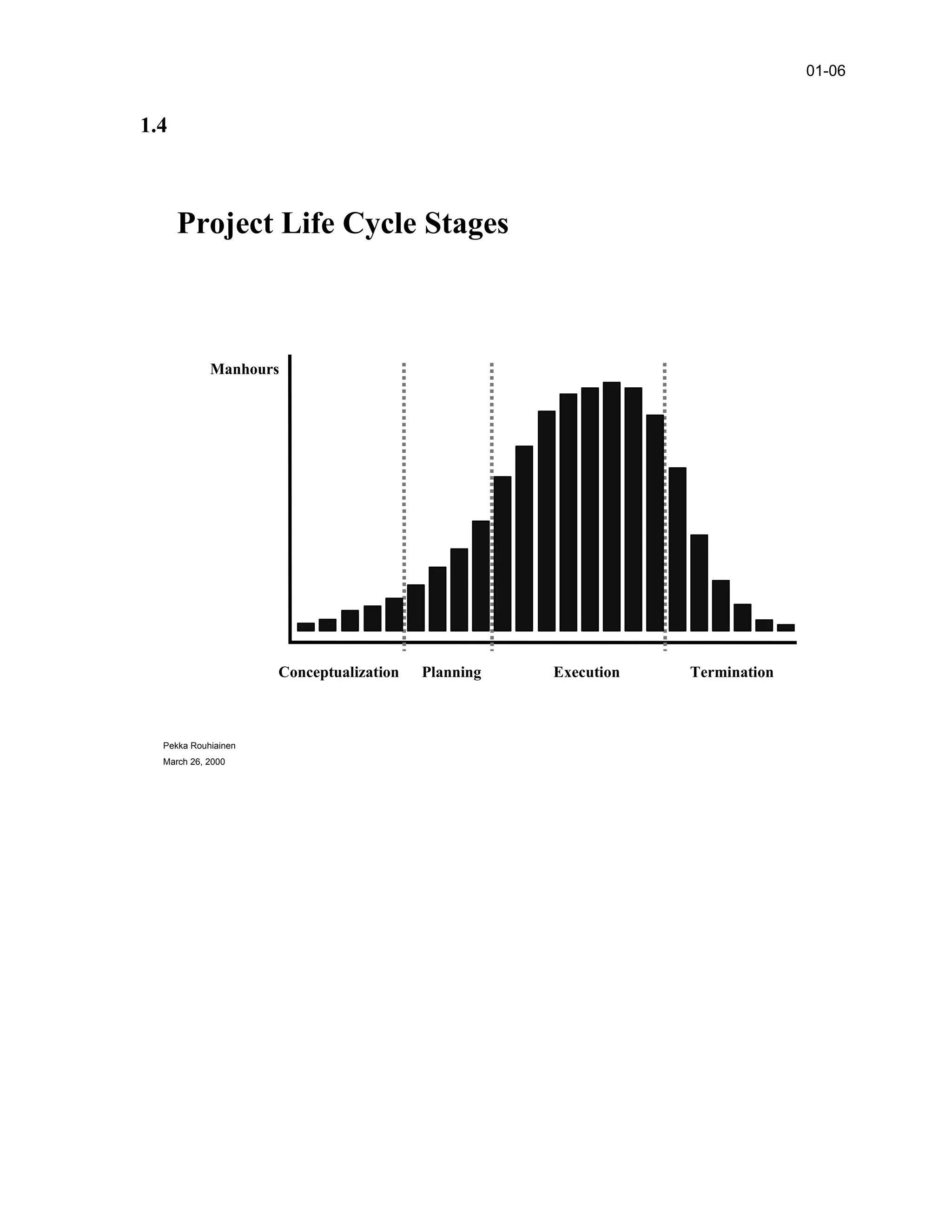
1.4
Pekka Rouhiainen
March 26, 2000
Project Life Cycle Stages
Conceptualization Planning Execution Termination
Manhours
01-06
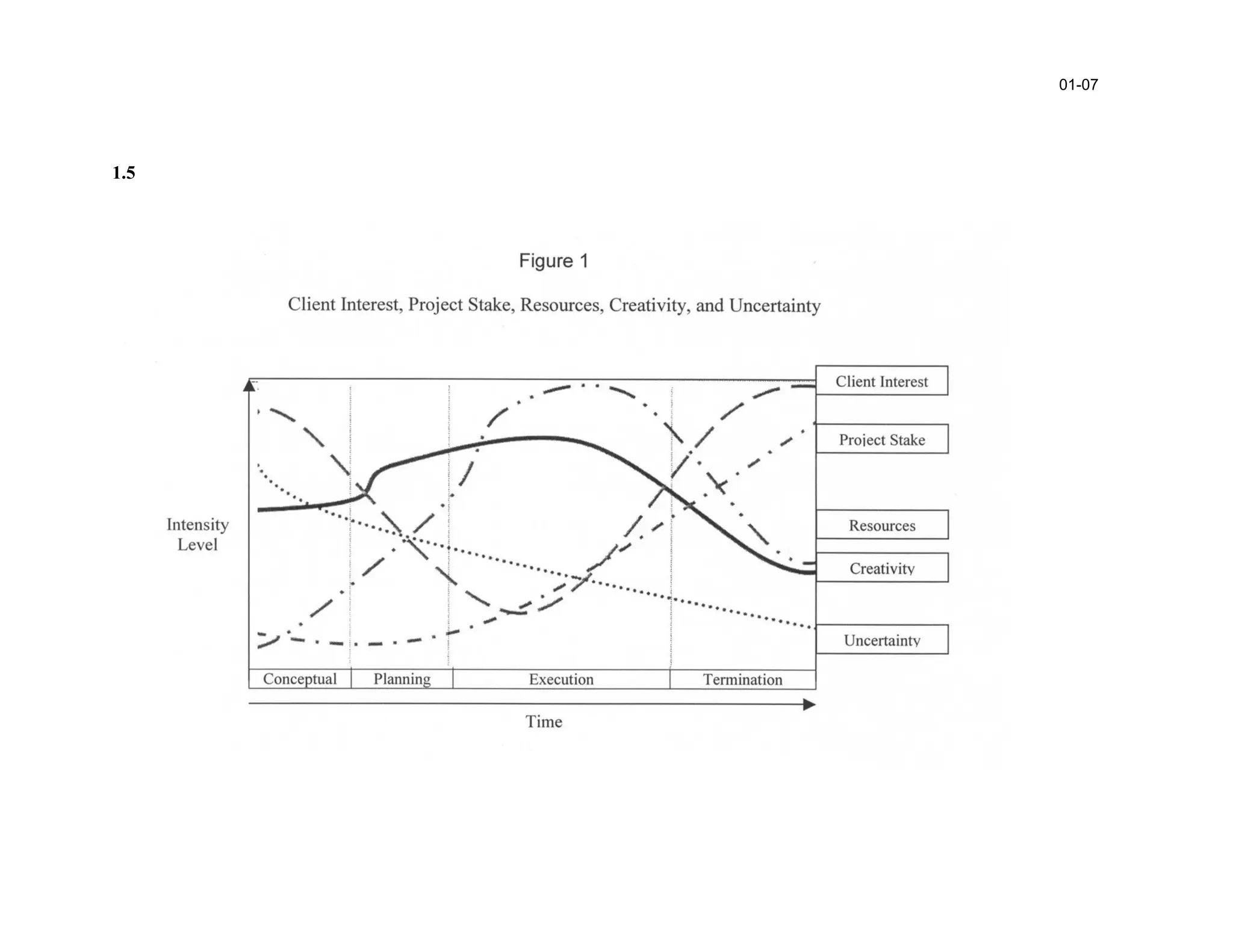
1.5
01-07
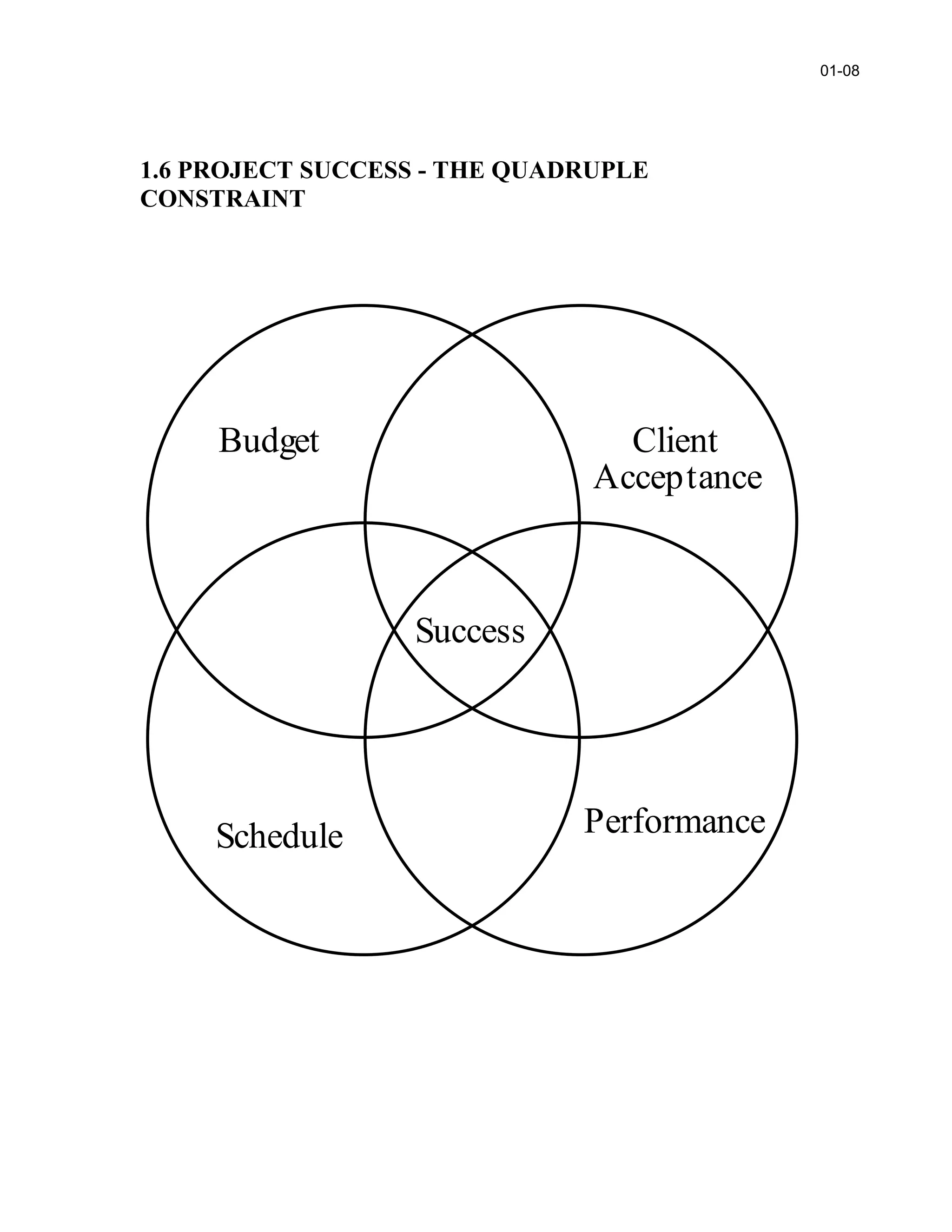
1.6 PROJECT SUCCESS - THE QUADRUPLE
CONSTRAINT
Success
Client
Acceptance
Budget
Schedule Performance
01-08
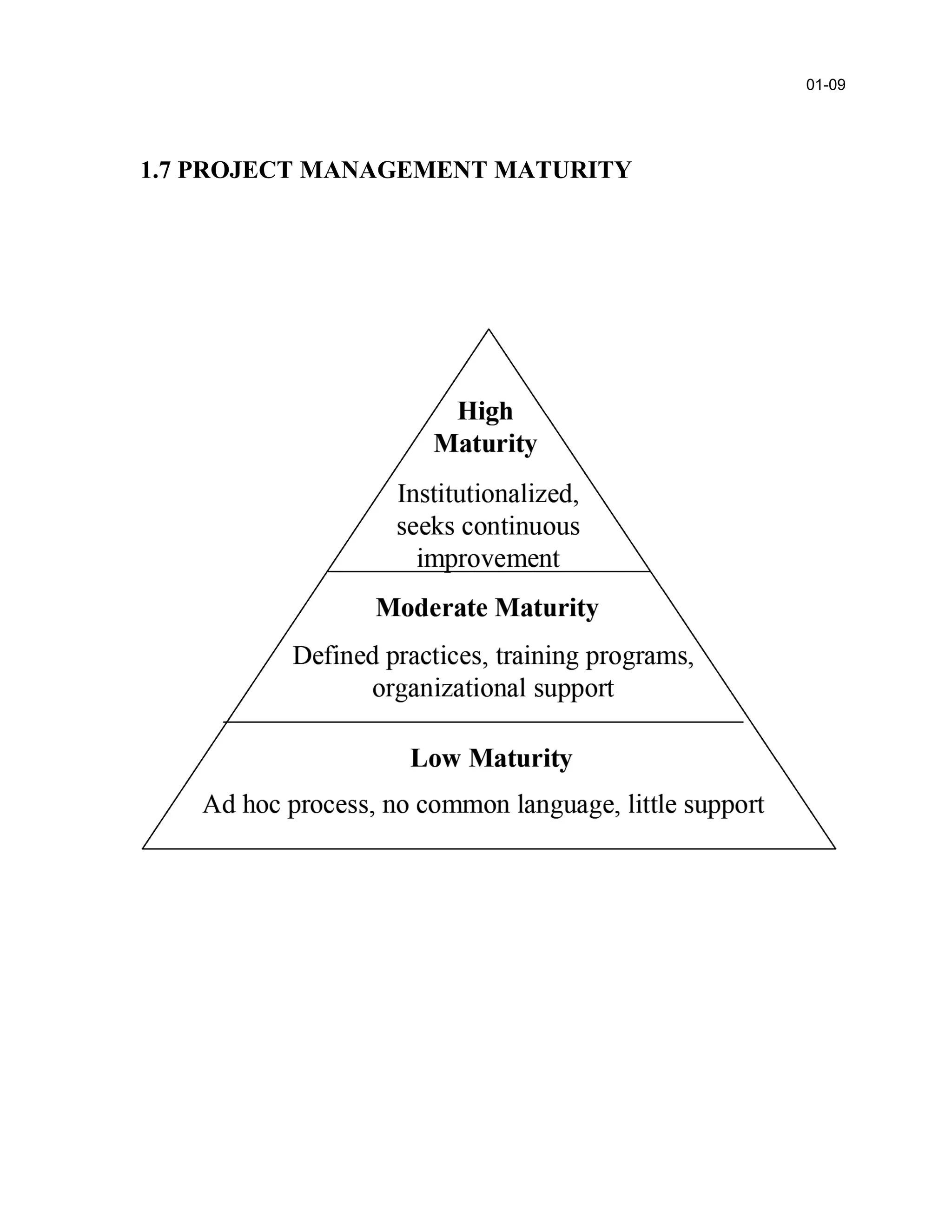
1.7 PROJECT MANAGEMENT MATURITY
01-09
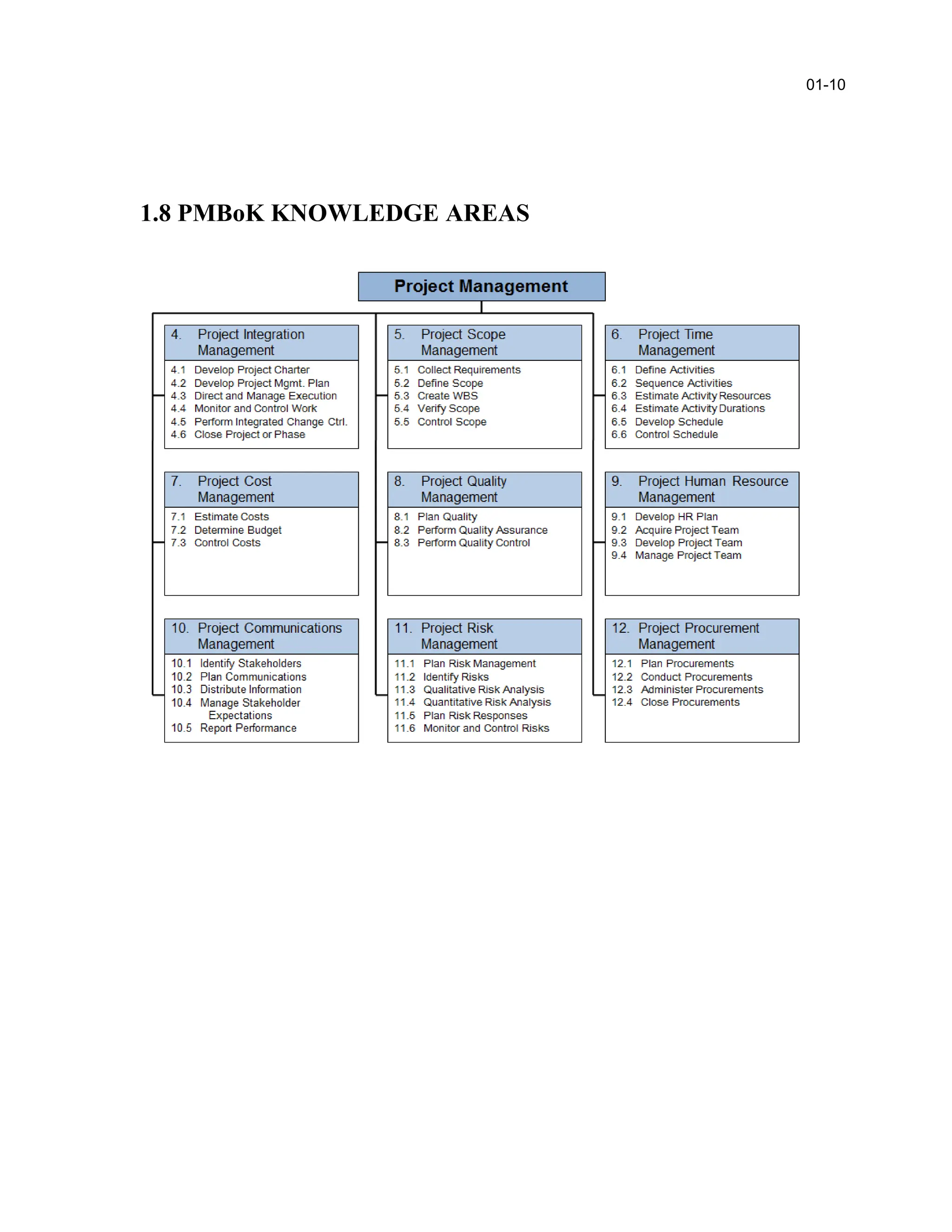
1.8 PMBoK KNOWLEDGE AREAS
01-10
DISCUSSION QUESTIONS
1. What are some of the principle reasons why project management has become such a
popular business tool in recent years?
In today’s market, the length of product life cycles is shortening. This means businesses
are under pressure to produce new or improved products at an increasingly rapid past.
Growing global markets, consumer tastes, and competition demand that products
constantly be improved to be better, faster, sleeker, and offer more features. Most
organizations are planning their next product or product improvement as their latest
innovation is just on its way out the door. Under conventional business practices keeping
up with this demand for innovation can be difficult. Project management offers
companies a manner in which to become more innovative and to develop products at a
faster pace.
2. What do you see as being the primary challenges to introducing a project management
philosophy to most organizations? That is, why is it difficult to shift to a project-based
approach in many companies?
Many companies encounter a resistance to change within their personnel which makes
implementing a new approach, such as project-based, difficult. Employees have to be
trained in the new processes and learn to implement it into their current role. Often
times, employees are adverse to a large shift in current practices due to uncertainty of the
outcome.
3. What are the advantages and disadvantages to using project management?
Advantages:
 Innovative, produce new ideas and new products
 Geared toward accomplishing a specific goal
 Aimed at customer satisfaction
01-11
Disadvantages:
 Inaccurate cost estimates during initial stages may cause project to fail due to lack
of resources
 Low success rate in some industries
 Requires heavy commitment by staff
4. What are the key characteristics all projects possess?
Projects:
 are temporary operations with a defined lifespan
 help develop and execute organizational strategies and goals
 are sources of innovation and progress
 stimulate internal collaboration between members of various functional areas
 are limited by resource and time constraints
 end when objectives are successfully reached
5. Describe the basic elements of the project life cycle. Why is an understanding of the
life cycle relevant for our understanding of projects?
The project life cycle includes the stages of the project’s development. The basic
elements of the cycle include:
 conceptualization: outlines project goal, scope of work, identifies required
resources and stakeholders
 planning: specifications, timetables and other plans are created, work packages
are broken out, assignments are made and process for completion is defined
 execution: actual work of project takes place, majority of teamwork is performed
and, characteristically, majority of costs are incurred
 termination: project is completed and passed on to customer, resources are
reassigned and team members disbanded
01-12
Life cycles provide a guiding point for determining the scope and resource requirements
of specific projects. By outlining a project’s life cycle, many challenges and potential
pitfalls can be pinpointed. More generally, an understanding of life cycles lends itself to
a better understanding of how projects function within an organization and how they
differ from conventional forms of corporate process.
6. Think of a successful project and an unsuccessful project with which you are familiar.
What would you say distinguishes the two, both in terms of the process used to develop
them and their outcomes?
This question is intended for classes with students who have had some experience with
projects in the past. It seeks to get them to examine the causes of success and failure
from their own experience. Instructors should then begin developing a list of the various
causes of success and failure as a point of discussion.
7. Consider the Expedition Everest case: What are the elements in Disney’s approach to
developing their theme rides that you find particularly impressive? How can a firm like
Disney balance the need for efficiency and smooth development of projects with the
desire to be innovative and creative? Based on this case, what principles appear to guide
their development process?
This case lets students comment on the particularly appealing elements in Disney’s
project management approach; for example, their attention to detail and willingness not
to cut corners in terms of cost or schedule to make sure that the ride offers a memorable
experience. The need to balance efficiency and creativity is an interesting one because it
gets to the heart of project trade-offs. There are always more trips to be taken, more time
to be spent, more artifacts that can be gathered to continuously “tweak” the ride;
however, ultimately, they must also adhere to a roll-out schedule that gets the project
completed. How much is enough? How much is too much? These form the basis of
great in-class discussions. Finally, it is important to get the class to consider other factors
that must weigh into project development decisions, like safety and general appeal. For
01-13
example, creating a ride that is too intense for young children would violate Disney’s
“kid friendly” philosophy. Likewise, all new rides must first be completely safe for the
passengers, so any design issues always must be subordinated to safety.
8. Consider the six criteria for successful IT projects. Why is IT project success often so
difficult to assess? Make a case for some set of factors being more important than others.
IT project success is often difficult to assess because the criteria for success - system
quality, information quality, use, user satisfaction, individual impact, and organizational
impact – are not easy to accurately measure. Customer feedback related to user
satisfaction, system quality, and impact may vary from user to user. For instance, while
someone in insurance claims may find the system user friendly and beneficial to
everyday tasks, an employee in actuary may find it cumbersome and difficult to navigate.
When it comes to IT projects and the criterion above, user background, training, and
experience could greatly affect the success rate of the project. These factors may not be
fully known during initial planning and implementation stages.
However, criteria such as system/information quality and use may be easier to assess.
The team should be able to determine whether the designed system meets the
specifications of the customer. All specifications should have been determined from the
beginning, so upon completion test runs should determine if the system meets quality
standards. In the area of use, following implementation, in most cases, it is possible to
track use. Due to their ability to be more concretely measured, these factors, combined
with the overall satisfaction of the customer, may be more important in determining
success of the project than other more arbitrary measures.
9. As organizations seek to become better at managing projects, they often engage in
benchmarking with other companies in similar industries. Discuss the concept of
benchmarking. What are its goals? How does benchmarking work?
01-14
Benchmarking compares the performance of a company to that of industry competitors
and in some cases, for instance where procedures or functions are similar, to that of
superior performers in other industries. To set benchmarks for a company, first a leader
in the industry is selected. Then, the company gathers data of that leader’s performance
measures. The data is analyzed and gaps between the leader/benchmarks and the
company are noted. The company then sets goals and strives to meet the benchmarking
standards. The goal of benchmarking is, therefore, to seek out weak performance areas
within the company and set goals for improvement.
10. Explain the concept of a project management maturity model. What purpose does it
serve?
Implementing project management occurs in phases over time. Companies evolve
through stages of project management. Project management maturity models are a way
to help ensure that companies do so in the correct method and at a competitive pace.
Maturity models provide a starting point for companies new to project management.
Project maturity models offer businesses a way to map out necessary steps to becoming
competitive through project-based work. Maturity models assess a specific company’s
current practices (related to projects), establish the company’s position in relation to its
competitors, and provide guidelines for improvement. They use industry data to establish
a serious of benchmarks. Based on industry competitors, they can then determine stages
required as well as how quickly a company should develop. The company can then
follow the model to achieve the highest level of ability in each pertinent, project
management area.
11. Compare and contrast the four project management maturity models shown in Table
1.3. What strengths and weaknesses do you perceive in each of the models?
The four models each use five levels beginning with an initial ad hoc or sporadic use of
project management and ending with a fully integrated project management system with
emphasis on innovation and continuous improvement. Other similarities among the
01-15
models include an element of benchmarking or use of industry standards to measure
project management performance. The models do vary on the relative pace of
innovation. For instance the ESI’s International Project Framework develops more
slowly in early stages than that of Kerzner’s Project Management Maturity Model. In
addition, some models focus more on learning while others are more directed at control.
Kerzner’s discusses training and curriculum while SEI’s Capability Maturity Model
Integration outlines steps for control and assessment of results.
Center for Business Practices
Strengths: It is mapped out at an appropriate pace; there are no broad leaps from one
stage to the next. Also, it emphasized the role of project management as corporate
processes which mean project management becomes part of the working firm, not just
part of the job duties of a specific group or team.
Weaknesses: This model lacks direction in management training. It refers to
management awareness and support, but does not mention training or formal training.
Kerzner’s Project Management Maturity Model
Strengths: Kerzner’s does a much better job of designating at what levels managers need
to be trained or curriculum developed.
Weaknesses: Benchmarking does not come in until level 4 which maybe a little late. A
firm in this model would have already integrated project management processes; trying to
make any significant adjustments (in accordance with benchmarking figures) after this
integration may be difficult.
ESI International’s Project Framework
01-16
Strengths: This model has two strong qualities. The first is its overt emphasis on
innovation and continuous improvement. Secondly, the model emphasizes the need for
integration and understading throughout the firm.
Weaknesses: The movement between levels 1 through 3 may cause problems for a firm.
In level 1 processes are ill-defined and have little organizational support, this changes
little as the corporation moves to level 2 which has no project control processes. Then, in
level 3 processes are tailored. Given the undefined nature of processes prior to level 3, it
may be hard to reach this goal initially. This may cause companies to become stalled in
level 3.
SEI’s Capability Maturity Model Integration
Strengths: Quality is a top concern even in early stages of this model. Analysis and
insurance procedures are developed at different stages to ensure standards are met.
Weaknesses: On the other hand, the attention to testing may also hinder project
management integration. There may be an overabundance of measures to control,
analyze and qualify in this system. While quality is of importance, the level of time
commitment to those procedures may be the crux of this model. Team members may
become frustrated with the project process if they (or their work) are constantly being
measured, tested and re-measured.
01-17
CASE STUDIES
Case Study 1.1 – MegaTech, Inc.
MegaTech, Inc. is designed to highlight some of the reasons why an organization that had
operated in a relatively stable and predictable environment would seek to move to an
emphasis on project-based work. The trigger event, in this case is the advent of the
NAFTA treaty, which opened up competition on a more price-competitive basis.
Questions:
1) What is it about project management that offers MegaTech a competitive
advantage in its industry?
Project management techniques will allow the firm to combine the advantages of internal
efficiency with external (environmental) responsiveness. For example, it was detrmined
that successful firms offer frequent product updates, which MegaTech’s move has
allowed them to exploit. It has also promoted a team-based atmosphere that is
encouraging cooperation and unity of effort among the different functional departments.
2) What elements of the marketplace in which MegaTech operates led the firm to
believe that project management would improve its operations?
The intense, new competitive nature of the marketplace impels companies to find new
methods for competitive advantage. With many new competitors and serious price
pressure, success will require firms to be fast to market, hold the lid on costs, offer
frequent upgrades and new products – all while encouraging an atmosphere of risk taking
and cooperation.
01-18
Case Study 1.2 – The IT Department at Hamelin Hospital
The IT Department case shows the prevalence of projects in settings that are perhaps not
as obvious (in this case, a large hospital). The case is designed to get students to
understand the ubiquitous nature of project-based work in our modern public and private
organizations. It also demonstrates career paths and how successful work on projects is
often rewarded with corporate success. Projects are not a distraction or a side-line; they
are the principle means by which the IT department’s operations are demonstrated.
Questions:
1) What are the benefits and drawbacks of starting most new hires at the help desk
function?
Most new hires start at the help desk function, where they can become familiar with the
system, learn about problem areas, become sensitive to user’s frustrations and concerns,
and understand how the IT department affects all hospital operations. Students may also
note that though mundane, working at the help desk forces people to “pay their dues” by
demonstrating their commitment to the organization prior to being trusted with enhanced
responsibilities.
2) What are the potential problems with requiring project team members to be
involved in multiple projects at the same time? What are the potential
advantages?
One serious disadvantage is that it stretches departmental resources very thin; people can
be involved in multiple projects and are likely to start letting commitments slip if they are
not careful. Also, it is often difficult to move from assignment to assignment quickly and
seamlessly. Instead, team members experience times when they are not productive as
they try and multi-task across several projects at once. Among the advantages are that
this configuration allows the project team members to work with many different people,
including several project managers, experiencing different managerial styles and
01-19
interpersonal relationships. It also keeps team members interest high because their
involvement in multiple teams and projects ensures that they do not become bored by
routine.
3) What signals does the department send by making “Project Manager” the highest
position in the department?
The main signal is the idea that the career path for successful IT professionals runs
directly through project-based work. They cannot be successful in this organization
unless they are competent at first serving in and then running projects.
01-20
Case Study 1.3 – Disney’s Expedition Everest
The Expedition Everest case is an example of the extreme attention to detail that Disney
pays in all of their rides. Their management is a combination of careful planning coupled
with the imagination and knack for visual effects for which the company is well-known.
The case tells the story of the development of the ride, the numerous steps Disney went
through to get every detail as accurate as possible, and reflects on their overall approach
to project management.
Questions:
1) Suppose you were a project manager for Disney. Based on the information in this
case, what would you say are the critical success metrics they use when designing
a new ride; that is, how would you prioritize the needs for addressing project cost,
schedule, quality, and client acceptance? What evidence can you use to support
this argument?
The case clearly shows that Disney makes it priorities to first be those of quality and
client acceptance. Given the industry they are in, they must first ensure that all their rides
are safe and of the highest quality (customers expect nothing less from the Disney name).
Because these issues are paramount, concerns with cost and schedule are secondary
considerations. One way to see that this is the case is to consider the multiple trips that
Disney Imagineers took to Nepal to gather local artifacts, check the topography and
building styles, and other steps to ensure accuracy. These come at a cost but to Disney,
the overall effect is worth it.
2) Why is Disney’s attention to detail in their rides unique? How do they use the
“atmosphere” discussed in the case to maximize the experience while minimizing
complaints about length of wait for the ride?
01-21
Disney is interested in creating more than simply a ride; they seek to provide their
customers with an experience. In order to maximize this effect, the attention to detail,
including the ancillary buildings they construct and the way in which the grounds are
prepared, are all designed to distract the customer from the sometime lengthy wait for the
ride. The better able Disney is to develop this sense of overall atmosphere, the more their
customers will find the ride memorable and their overall satisfaction with Disney will be
that much higher.
01-22
Other documents randomly have
different content
discriminating: those which had been inveterately hostile he annexed
to Prussia; the others he let off with a fine. He set up the North
German Confederation, embracing all the states north of the river
Main, in place of the old German Confederation; and thus Prussia,
which had now two thirds of the population of Germany, was
undisputed master. The four South German states, Bavaria,
Würtemberg, Hesse, and Baden, signed a secret treaty, by which
they gave the Prussian King the command of their troops in case of
war.
Europe, which had witnessed with astonishment these swift
proceedings, understood now that a great reality had arisen, and
that Bismarck was its heart. In France, surprise gave way to
indignation. Were not the French the arbiters of Europe? How had it
happened that their Emperor had permitted a first-rate power to
organize without their consent? Napoleon III, who knew that his
sham empire could last only so long as he furnished his restless
subjects food for their vanity, strove to convince them that he had
not been outwitted; that he still could dictate terms. He demanded a
share of Rhineland to offset Prussia’s aggrandizement; Bismarck
refused to cede a single inch. Napoleon bullied; Bismarck published
the secret compact with the South Germans. Napoleon forthwith
decided that it was not worth while to go to war.
We have all heard of the sportsman who boasted of always
catching big strings of fish. But one day, after whipping every pool
and getting never a trout, he was fain, on his way home, to stop at
the fishmonger’s and buy a salt herring for supper. Not otherwise did
Napoleon, who had been very forward in announcing that he would
take land wherever he chose, now stoop to offer to buy enough to
appease his greedy countrymen. He would pay ninety million francs
for Luxemburg, and the King of Holland, to whom it belonged, was
willing to sell at that price; but Bismarck would consent only to
withdraw the Prussian garrison from the grand duchy, after
destroying the fortifications, and to its conversion into a neutral
state. That was the sum of the satisfaction Napoleon and his
presumptuous Frenchmen got from their first encounter. A few years
before, Napoleon, who had had frequent interviews with Bismarck
and liked his joviality, set him down as “a not serious man;” whence
we infer that the Emperor was a dull reader of character.
Although, by this arrangement, the Luxemburg affair blew over,
neither France nor Prussia believed that their quarrel was settled.
Deep in the heart of each, instinct whispered that a life-and-death
struggle was inevitable. Bismarck, amid vast labor on the internal
organization of the kingdom, held Prussia ready for war. He would
not be the aggressor, but he would decline no challenge.
In July, 1870, France threw down the glove. When the Spaniards
elected Prince Leopold of Hohenzollern to their vacant throne,
France demanded that King William should compel Leopold to
resign. William replied that, as he had not influenced his kinsman’s
acceptance, he should not interfere. The prince, who was not a
Prussian, withdrew of his own accord. But the French Secretary of
State, the Duc de Gramont, had blustered too loudly to let the
matter end without achieving his purpose of humbling the Prussian
King. He therefore telegraphed Benedetti, the French Ambassador, to
force King William to promise that at no future time should Leopold
be a candidate for the Spanish crown. Benedetti delivered his
message to William in the public garden at Ems; and William,
naturally refusing to bind himself, announced that further
negotiations on the subject would be referred to the Foreign
Minister.
The following morning Bismarck published a dispatch containing a
brief report of the interview; adding, however, that the King
“declined to receive the French Ambassador again, and had him told
by the adjutant in attendance that his Majesty had nothing further to
communicate to the Ambassador.” This deceitful addition produced
exactly the effect which Bismarck intended: every German, whether
Prussian or not, was incensed to learn that the representative
German King had been hectored by the French emissary, and every
Frenchman was enraged that the Prussian King had insulted the
envoy of the “grand nation.” Bismarck, who had feared that another
favorable moment for war was passing, now exulted, and Moltke,
who had for years been carrying the future campaign in his head,
and whose face grew sombre when peace seemed probable, now
smiled a grim, contented smile. In Paris, the ministers, the deputies,
the newspapers, and the populace clamored for war. Apparently,
Napoleon alone felt a slight hesitation; but he could hesitate no
longer when the popular demand became overwhelming. On July 19
France made a formal declaration of war, and the Parisians laid bets
that their victorious troops would celebrate the Fête Napoléon—
August 15—in Berlin. Had not their War Minister, Lebœuf, assured
them that everything was ready, down to the last button on the last
gaiter of the last soldier?
We cannot describe here the terrible campaign which followed. In
numbers, in equipment, in discipline, in generalship, in everything
but bravery, the French were quickly outmatched. When Napoleon
groped madly for some friendly hand to stay his fall, he found that
Bismarck had cut off succor from him. The South Germans, whom
the French had hoped to win over, fought loyally under the
command of Prussia; Austria, who might have been persuaded to
strike back at her late conqueror, dared not move for fear of Russia,
whose friendship Bismarck had secured; and Italy, instead of aiding
France, lost no time in completing her own unification by entering
Rome when the French garrison was withdrawn. Forsaken and
outwitted, the French Empire sank without even an expiring flash of
that tinsel glory which had so long bedizened its corruption. And
when the French people, lashed to desperation, continued the war
which the Empire had brought upon them, they but suffered a long
agony of losses before accepting the inevitable defeat. They paid the
penalty of their former arrogance in every coin known to the
vanquished,—in military ruin, in an enormous indemnity, in the
occupation of their land by the victorious Prussians, and in the
cession of two rich provinces. Nor was that enough: they had to
submit to a humiliation which, to the imagination at least, seems the
worst of all,—the proclamation of the Prussian King William as
German Emperor in their palace at Versailles, the shrine of French
pomp, where two centuries before Louis XIV had embodied the
ambition, the glory, and the pride of France. The German cannon
bombarding beleaguered Paris paused, while the sovereigns of the
German states hailed William as their Emperor.
This consummation of German unity was the logical outcome of an
international war, in which all the Germans had been impelled, by
mutual interests quite as much as by kinship, to join forces against
an alien foe. Twenty years before, Bismarck had opposed German
unity, because it would then have made Prussia the plaything of her
confederates; in this later scheme he was the chief agent, if not the
originator, for he knew that the primacy of Prussia ran no more risk.
Let us pause a moment and look back. Only a decade earlier, in
1861, when Bismarck became minister, Prussia was but a second-
rate power, Germany was a medley of miscellaneous states, Austria
still held her traditional supremacy, the French Emperor seemed
firmly established. Now, in 1871, Austria has been humbled, France
crushed, Napoleon whiffed off into outer darkness, and Prussia
stands unchallenged at the head of United Germany. Many men—the
narrow, patient King, the taciturn Moltke, the energetic Von Roon—
have contributed to this result; but to Bismarck rightly belongs the
highest credit. Slow to prepare and swift to strike, he it was who
measured the full capacity of that great machine, the Prussian army,
and let it do its work the moment Fortune signaled; he it was who
knew that needle guns and discipline would overcome in the end the
long prestige of Austria and the wordy insolence of France. Looking
back, we are amazed at his achievements,—many a step seems
audacious; but if we investigate, we find that Bismarck had never
threatened, never dared, more than his strength at the time
warranted. The gods love men of the positive degree, and reward
them by converting their words into facts.
Of the German Empire thus formed Bismarck was Chancellor for
twenty years. His foreign policy hinged on one necessity,—the
isolation of France. To that end he made a Triple Alliance, in which
Russia and Austria were his partners first, and afterward Italy took
Russia’s place. He prevented the Franco-Russian coalition, which
would place Germany between the hammer and the anvil. From
1871 to 1890 he was not less the arbiter of Europe than the autocrat
of Germany.
Nevertheless, although in the management of home affairs
Bismarck usually prevailed, he prevailed to the detriment of
Germany’s progress in self-government. The Empire, like Prussia
herself, is based on constitutionalism: what hope is there for
constitutionalism, when at any moment the vote of a majority of the
people’s representatives can be nullified by an arbitrary prime
minister? Bismarck carried his measures in one of two ways: he
either formed a temporary combination with mutually discordant
parliamentary groups and thereby secured a majority vote, or, when
unable to do this, by threatening to resign he gave the Emperor an
excuse for vetoing an objectionable bill. Despising representative
government, with its interminable chatter, its red tape, its indiscreet
meddling, and its whimsical revulsions, Bismarck never concealed his
scorn. If he believed a measure to be needed, he went down into
the parliamentary market-place, and by inducements, not of money,
but of concessions, he won over votes. At one time or another, every
group has voted against him and every group has voted for him.
When he was fighting the Vatican, for instance, he conciliated the
Jews; when Jew-baiting was his purpose, he promised the Catholics
favor in return for their support. Being amenable to the Emperor
alone, and not, like the British premier, the head of a party, he dwelt
above the caprice of parties. Men thought, at first, to stagger him by
charges of inconsistency, and quoted his past utterances against his
present policy. He laughed at them. Consistency, he held, is the clog
of men who do not advance; for himself, he had no hesitation in
altering his policy as fast as circumstances required. With
characteristic bluntness, he did not disguise his intentions. “I need
your support,” he would say to a hostile group, “and I will stand by
your bill if you will vote for mine.” “Do ut des” was his motto; “an
honest broker” his self-given nickname.
Such a government cannot properly be called representative; it
dangles between the two incompatibles, constitutionalism and
autocracy. Doubtless Bismarck knew better than the herd of deputies
what would best serve at a given moment the interests of Germany;
but his methods were demoralizing, and so personal that they made
no provision for the future. His system could not be permanent
unless in every generation an autocrat as powerful and disinterested
as himself should arise to wield it; but nature does not repeat her
Bismarcks and her Cromwells. At the end of his career, Germany has
still to undergo her apprenticeship in self-government.
Two important struggles, in which he engaged with all his might,
call for especial mention.
The first is the Culturkampf, or contest with the Pope over the
appointment of Catholic bishops and clergy in Prussia. Bismarck
insisted that the Pope should submit his nominations to the approval
of the King; Pius IX maintained that in spiritual matters he could be
bound by no temporal lord. Bismarck passed stern laws; he withheld
the stipend paid to the Catholic clergy; he imprisoned some of them;
he broke up the parishes of others. It was the mediæval war of
investitures over again, and again the Pope won. Bismarck
discovered that against the intangible resistance of Rome his Krupp
guns were powerless. After fifteen years of ineffectual battling, the
Chancellor surrendered.
Similar discomfiture came to him from the Socialists. When he
entered upon his ministerial career, they were but a gang of noisy
fanatics; when he quitted it, they were a great political party, holding
the balance of power in the Reichstag, and infecting Germany with
their doctrines. At first he thought to extirpate them by violence, but
they throve under persecution; then he propitiated them, and even
strove to forestall them by adopting Socialistic measures in advance
of their demands. If the next epoch is to witness the triumph of
Socialism, as some predict, then Bismarck will surely merit a place in
the Socialists’ Saints’ Calendar; but if, as some of us hope, society
revolts from Socialism before experience teaches how much insanity
underlies this seductive theory, then Bismarck will scarcely be
praised for coquetting with it. For Socialism is but despotism turned
upside down; it would substitute the tyranny of an abstraction—the
state—for the tyranny of a personal autocrat. It rests on the fallacy
that though in every individual citizen there is more or less
imperfection,—one dishonest, another untruthful, another unjust,
another greedy, another licentious, another willing to grasp money
or power at the expense of his neighbor,—yet by adding up all these
units, so imperfect, so selfish, and calling the sum “the state,” you
get a perfect and unselfish organism, which will manage without
flaw or favor the whole business, public, private, and mixed, of
mankind. By what miracle a coil of links, separately weak, can be
converted into an unbreakable chain is a secret which the prophets
of this Utopia have never condescended to reveal. Not more state
interference, but less, is the warning of history.
The fact which is significant for us here is that Socialism has best
thriven in Germany, where, through the innate tendency of the
Germans to a rigid system, the machinery of despotism has been
most carefully elaborated, and where the interference of the state in
the most trivial affairs of life has bred in the masses the notion that
the state can do everything,—even make the poor rich, if they can
only control the lever of the huge machine.
Nevertheless, though Bismarck has been worsted in his contest
with religious and social ideas, his great achievement remains. He
has placed Germany at the head of Europe, and Prussia at the head
of Germany. Will the German Empire created by him last? Who can
say? The historian has no business with prophecy, but he may point
out the existence in the German Empire to-day of conditions that
have hitherto menaced the safety of nations. The common danger
seems the strongest bond of union among the German states.
Defeat by Russia on the east or by France on the west would mean
disaster for the South Germans not less than for the Prussians; and
this peril is formidable enough to cause the Bavarians, for instance,
to fight side by side with the Prussians. But there can be no
homogeneous internal government, no compact nation, so long as
twenty or more dynasties, coequal in dignity though not in power,
flourish simultaneously. Historically speaking, Germany has never
passed through that stage of development in which one dynasty
swallows up its rivals,—the experience of England, France, and
Spain, and even of polyglot Austria.
Again, Germany embraces three unwilling members,—Alsace-
Lorraine, Schleswig, and Prussian Poland,—any of which may serve
as a provocation for war, and must remain a constant source of
racial antipathy. How grievous such political thorns may be, though
small in bulk compared to the body they worry, England has learned
from Ireland.
Finally, if popular government—the ideal of our century—is to
prevail in Germany, the despotism extended and solidified by
Bismarck will be swept away. Possibly, Germany could not have been
united, could not have humbled Austria and crushed France, under a
Liberal system; but will the Germans forever submit to the direction
of an iron chancellor, or glow with exultation at the truculence of a
strutting autocrat who flourishes his sword and proclaims, “My will is
law”? No other modern despotism has been so patriotic, honest, and
successful as that of Bismarck; but will the Germans never awake to
the truth that even the best despotism convicts those who bow to it
of a certain ignoble servility? Or will they, as we have suggested,
transform the tyranny of an autocrat into the tyranny of Socialism?
We will not predict, but we can plainly see that Germany, whether in
her national or in her constitutional condition, has reached no stable
plane of development.
And now what shall we conclude as to Bismarck himself? The
magnitude of his work no man can dispute. For centuries Europe
awaited the unification of Germany, as a necessary step in the
organic growth of both. Feudalism was the principle which bound
Christendom together during the Middle Age; afterward, the dynastic
principle operated to blend peoples into nations; finally, in our time,
the principle of nationality has accomplished what neither feudalism
nor dynasties could accomplish, the attainment of German unity. In
type, Bismarck belongs with the Charlemagnes, the Cromwells, the
Napoleons; but, unlike them, he wrought to found no kingdom for
himself; from first to last he was content to be the servant of the
monarch whom he ruled. As a statesman, he possessed in equal
mixture the qualities of lion and of fox, which Machiavelli long ago
declared indispensable to a prince. He had no scruples. What
benefited Prussia and his King was to him moral, lawful, desirable; to
them he was inflexibly loyal; for them he would suffer popular odium
or incur personal danger. But whoever opposed them was to him an
enemy, to be overcome by persuasion, craft, or force. We discern in
his conduct toward enemies no more regard for morality than in that
of a Mohawk sachem toward his Huron foe. He might spare them,
but from motives of policy; he might persecute them, not to gratify a
thirst for cruelty, but because he deemed persecution the proper
instrument in that case. His justification would be that it was right
that Prussia and Germany should hold the first rank in Europe. The
world, as he saw it, was a field in which nations maintained a pitiless
struggle for existence, and the strongest survived; to make his
nation the strongest was, he conceived, his highest duty. An army of
puny-bodied saints might be beautiful to a pious imagination, but
they would fare ill in an actual conflict with Pomeranian grenadiers.
Dynamic, therefore, and not moral, were Bismarck’s ideals and
methods. To make every citizen a soldier, and to make every soldier
a most effective fighting machine by the scientific application of diet,
drill, discipline, and leadership, was Prussia’s achievement, whereby
she prepared for Bismarck an irresistible weapon. In this application
of science to control with greater exactness than ever before the
movements of large masses of men in war, and to regulate their
actions in peace, consists Prussia’s contribution to government; in
knowing how to use the engine thus constructed lies Bismarck’s
fame. When Germans were building air-castles, and, conscious of
their irresolution, were asking themselves, “Is Germany Hamlet?”
Bismarck saw both a definite goal and the road that led to it. The
sentimentalism which has characterized so much of the action of our
time never diluted his tremendous will. He held that by blood and
iron empires are welded, and that this stern means causes in the
end less suffering than the indecisive compromises of the
sentimentalists. Better, he would say, for ninety-nine men to be
directed by the hundredth man who knows than for them to be left a
prey to their own chaotic, ignorant, and internecine passions. Thus
he is the latest representative of a type which flourished in the age
when the modern ideal of popular government had not yet risen.
How much of his power was due to his unerring perception of the
defects in popular government as it has thus far been exploited, we
have already remarked.
The Germans have not yet perceived that one, perhaps the chief
source of his success was his un-German characteristics. He would
have all Germany bound by rigid laws, but he would not be bound
by them himself. He encouraged his countrymen’s passion for
conventionality and tradition, but remained the most unconventional
of men. Whatever might complete the conversion of Germany into a
vast machine he fostered by every art; but he, the engineer who
held the throttle, was no machine. In a land where everything was
done by prescription, the spectacle of one man doing whatever his
will prompted produced an effect not easily computed. Such
characteristics are un-German, we repeat, and Bismarck displayed
them at all times and in all places. His smoking a cigar in the
Frankfort Diet; his opposition to democracy, when democracy was
the fashion; his resistance to the Prussian Landtag; his arbitrary
methods in the German Parliament,—these are but instances, great
or small, of his un-German nature. And his relations for thirty years
with the King and Emperor whom he seemed to serve show a similar
masterfulness. A single anecdote, told by himself, gives the key to
that service.
At the battle of Sadowa King William persisted in exposing himself
at short range to the enemy’s fire. Bismarck urged him back, but
William was obstinate. “If not for yourself, at least for the sake of
your minister, whom the nation will hold responsible, retire,” pleaded
Bismarck. “Well, then, Bismarck, let us ride on a little,” the King at
last replied. But he rode very slowly. Edging his horse alongside of
the King’s mare, Bismarck gave her a stout kick in the haunch. She
bounded forward, and the King looked round in astonishment. “I
think he saw what I had done,” Bismarck added, in telling the story,
“but he said nothing.”
On Bismarck’s private character I find no imputed stain. He did not
enrich himself by his office, that hideous vice of our time. He did
not, like both Napoleons, convert his palace into a harem; neither
did he tolerate nepotism, nor the putting of incompetent parasites
into responsible positions as a reward for party service. That he
remorselessly crushed his rivals let his obliteration of Count von
Arnim witness. That he subsidized a “reptile press,” or employed
spies, or hounded his assailants, came from his belief that a
statesman too squeamish to fight fire with fire would deserve to be
burnt. Many orators have excelled him in grace, few in effectiveness.
Regarding public speaking as one of the chief perils of the modern
state, because it enables demagogues to dupe the easily swayed
masses, he despised rhetorical artifice. His own speech was un-
German in its directness, un-German in its humor, and it clove to the
heart of a question with the might of a battle-axe,—as, indeed, he
would have used a battle-axe itself to persuade his opponents, five
hundred years ago. Since Napoleon, no other European statesman
has coined so many political proverbs and apt phrases. His letters to
his family are delightfully natural, and reveal a man of keen
observation, capable of enjoying the wholesome pleasures of life,
and brimful of common sense, which a rich gift of humor keeps from
the dulness of Philistines and the pedantry of doctrinaires. His
intercourse with friends seems to have been in a high degree jovial.
Not least interesting to a biographer are those last years of
Bismarck’s life, between March, 1890, and his death, on July 30,
1898, which he passed in eclipse. To be dismissed by a young
sovereign who, but for him, might have been merely a petty German
prince,—to be told that he, the master throne-maker, was
unnecessary to the callow apprentice,—galled the Titan’s heart.
Eight years he was destined to endure this mortification; and
although his countrymen everywhere hailed him as their hero, the
fact of dismissal gave him no repose. Europe has seen no similar
spectacle since she bound Napoleon, Prometheus-like, on St.
Helena. But Napoleon, chafing his life away there, had at least the
satisfaction of reflecting that it took all Europe, allied with Russia’s
blizzards and Spain’s heats, to conquer him. Bismarck, storming in
his exile from power, felt now scorn, now hate, for the “young
fellow” (as he called him) who had turned him out. Here, if ever,
Nemesis showed her work. Bismarck’s whole energy had been bent
for fifty years on fortifying the autocracy of the Prussian monarchs;
and now a young autocrat run from this mould bade him go—and he
went. We may believe that it did not solace Bismarck to find that the
“young fellow” could get on without him; or to see that in England
Gladstone, six years his elder, led his nation till long past eighty;
Gladstone,—whom he had so often jeered at as an empty
rhetorician,—England, which he despised as the home of
representative government. Could it be that constitutionalism was
kinder than despotism to master statesmen?
A great man we may surely pronounce him, long to be the wonder
of a world in which greatness of any kind is rare. If you ask, “How
does he stand beside Washington and Lincoln?” it must be admitted
that his methods would have made them blush, but that his
patriotism was not less enduring than theirs. With the materials at
hand he fashioned an empire; it is futile to speculate whether
another, by using different tools, could have achieved the same
result. Bismarck knew that though his countrymen might talk
eloquently about liberty, they loved to be governed; he knew that
their genius was mechanical, and he triumphed by directing them
along the line of their genius. He would have failed had he appealed
to the love of liberty, by appealing to which Cavour freed Italy; or to
the love of glory, by appealing to which Napoleon was able to
convert half of Europe into a French province. Bismarck knew that
his Prussians must be roused in a different way.
It may be that the empire he created will not last; it is certain that
it cannot escape modifications which will change the aspect he
stamped upon it; but we may be sure that, whatever happens, the
recollection of his Titanic personality will remain. He belongs among
the giants, among the few in whom has been stored for a lifetime a
stupendous energy,—kinsmen of the whirlwind and the volcano,—
whose purpose seems to be to amaze us that the limits of the
human include such as they. At the thought of him, there rises the
vision of mythic Thor with his hammer, and of Odin with his spear;
the legend of Zeus, who at pleasure held or hurled the thunderbolt,
becomes credible.
NAPOLEON III
Madame de Staël said of Rienzi and his Romans: “They mistook
reminiscences for hopes;” of the second French Empire and the third
Napoleon we may say: “They staked their hopes on reminiscences.”
In our individual lives we realize the power of memory,
suggestion, association. If we have ever yielded to a vice, we have
felt, it may be years after, how the sight of the old conditions revives
the old temptation. A glance, a sound, a smell, may be enough to
conjure up a long series of events, whether to grieve or to tempt us,
with more than their original intensity. So we learn that the safest
way to escape the enticement is to avoid the conditions. Recent
psychology has at last begun to measure the subtle power of
suggestion.
But now, suppose that instead of an individual a whole nation has
had a terrific experience of succumbing to temptation, and that a
cunning, unscrupulous man, aware of the force of association and
reminiscence, deliberately applies both to reproduce those conditions
in which the nation first abandoned itself to excess: the case we
have supposed is that of France and Louis Napoleon. Before the
reality of their story the romances of hypnotism pale.
After Sédan it was the fashion to regard Louis Napoleon as the
only culprit in the gilded shame of the Second Empire; we shall see,
however, that the great majority of Frenchmen longed for his
coming, applauded his victories, and by frequent vote sanctioned his
deeds. A free people keeps no worse ruler than it deserves.
The Napoleonic legend, by which Louis Napoleon rose to power,
was not his creation, but that of the French: he was simply shrewd,
and used it. What was this legend?
When allied Europe finally crushed the great Napoleon at
Waterloo, France breathed a sigh of relief. Twenty campaigns had
left her exhausted: she asked only for repose. This the Restoration
gave her. But the gratification of our transient cravings, however
strong they may be, cannot long satisfy; and when the French
recovered from their exhaustion, they felt their permanent cravings
return. The Bourbons, they soon realized, could not appease those
dominant Gallic desires. For the Bourbons had destroyed even that
semblance of liberty Napoleon took care to preserve; they
persecuted democratic ideas; they brought back the old aristocracy,
with its mildewed haughtiness; they babbled of divine right,—as if
the worship of St. Guillotine had not supervened. During twenty
years France had been the arbitress of Europe; now, under the
narrow, forceless Bourbons, she was treated like a second-rate
power. Waterloo had meant not only the destruction of Napoleon,
from which France derived peace, but also humiliation, which galled
Frenchmen more and more as their normal sensitiveness returned.
The Bourbons, knowing that they might be tolerated so long as
they were not despised, got up a military promenade into Spain, to
prove that France could still meddle in her neighbors’ affairs, and
that the Bourbons were not less mighty men of war than the
Bonapartes. They captured the Trocadero, and restored vile King
Ferdinand and his twenty-six cooks to the throne of Spain; and they
hoped that the one-candle power of fame lighted by these exploits
would outdazzle the Sun of Austerlitz. But no, the dynasty of
Bourbon, long since headless, proved to be rootless too: one
evening Charles X played his usual game of whist at St. Cloud; the
next, he was posting out of France with all the speed and secrecy he
could command.
Louis Philippe, who came next, might have been expected to
please everybody: Royalists, because he was himself royal;
Republicans, because he was Philippe Egalité’s son;
constitutionalists, because he hated autocratic methods;
shopkeepers of all kinds, because he was ‘practical.’ And in truth his
administration may be called the Golden Age of the bourgeoisie,—
the great middle class which, in France and elsewhere, was
superseding the old aristocracy. Napoleon had organized a nobility of
the sword; after him came the nobility of the purse. Louis Philippe
could say that under his rule France prospered: her merchants grew
rich; her factories, her railroads, all the organs of commerce, were
healthily active. And yet she was discontented. The spectacle of her
Citizen King walking unattended in the streets of Paris, his plump
thighs encased in democratic trousers, his plump and ruddy face
wearing a complacent smile, his whole air that of the senior partner
in some old, respectable, and rich firm,—even this failed to satisfy
Frenchmen. “He inspires no more enthusiasm than a fat grocer,” was
said of him. Frenchmen did not despise money-making, but they
wanted something more: they wanted gloire.
Let us use the French word, because the English glory has another
meaning. Glory implies something essentially noble,—nay, in the
Lord’s Prayer it is a quality attributed to God himself: but gloire
suggests vanity; it is the food braggarts famish after. The minute-
men at Concord earned true glory; but when the United States,
listening to the seductions of evil politicians, attacked and blasted a
decrepit power,—fivefold smaller in population, twenty-fold weaker in
resources,—they might find gloire among their booty, but glory,
never. As prosperity increased, the Gallic appetite for gloire
increased. Louis Philippe made several attempts to allay it, but he
dared not risk a foreign war, and the failure of his attempts made
him less and less respected.
And now arose the Napoleonic legend, at first no more than a
bright exhalation in the evening, but gradually taking on the sweep,
the definiteness, the fascination, of mirage at noonday. Time enough
had elapsed to dull or quite blot out the recollections of the
hardships and strains, the millions of soldiers killed and wounded,
the taxes, the grievous tyranny; men remembered only the victories,
the rewards, and the splendor. A new generation, unacquainted with
the havoc of war, had grown up, to listen with fervid envy to the
reminiscences of some gray-haired veteran, who had made the great
charge at Wagram or ridden behind Ney at Borodino. Those exploits
were so stupendous as to seem incredible, and yet they were
vouched for by too many survivors to be doubted. Was not Thiers
setting forth the marvelous story in nineteen volumes? Were not
Béranger and even Victor Hugo singing of the departed grandeur?
Were not the booksellers’ shelves loaded with memoirs, lives,
historical statements, polemics? Paris, France, seemed to exist
merely to be the monument of one man. And wherever the young
Frenchman traveled—in Spain, in Italy, along the Rhine or the
Danube, to Vienna, or Cairo, or Moscow—he saw the footprints of
French valor and French audacity, reminders that Napoleon had
made France the mistress of Europe. No Frenchman, were he
Bourbon or Republican, but felt proud to think that his countrymen
had humbled Prussia and Austria.
Confronted by such recollections, the France of Louis Philippe
looked degenerate. It offered nothing to thrill at, to brag over; it
sinned in having—what it could not help—a stupendous past just
behind it. So the Napoleonic legend grew. The body of the great
Emperor was brought home from St. Helena, to perform more
miracles than the mummy of a mediæval saint. Power and gloire
came to be regarded as the products of a Napoleonic régime: to
secure them it was only necessary to put a Bonapartist on the
throne.
Contemporaneous with the expansion of this spell, Socialism grew
up, and taught that, just as the bourgeoisie had overthrown the old
privileged classes in the French Revolution, so now the working
classes must emancipate themselves from the tyranny of the
bourgeoisie. Political equality without industrial equality seemed a
mockery. In this wise the doctrines of a score of Utopians penetrated
society to loosen old bonds and embitter class with class. And
besides all this, there was the usual wrangle of political parties. The
tide of opposition rose, and on February 24, 1848, swept away Louis
Philippe and his minister Guizot. Among the many fortune-seekers
whom that tide brought to land was Louis Napoleon.
He was born in Paris, April 20, 1808, his mother being Hortense
Beauharnais, who had married Louis Bonaparte, King of Holland.
The younger Louis could just remember being petted in the Tuileries
by the great Emperor: then, like all the Bonapartes, he had been
packed off into exile. His youth was chiefly spent on Lake Constance,
at Augsburg, and at Thun. In 1831 he had joined the Carbonari
plotters in Italy. The next year, through the death of his elder
brother and of the great Napoleon’s son, he became the official
Pretender to the Bonapartist hopes. People knew him only as a
visionary, who talked much about his “star,” and by writings and
deeds tried to persuade the world that he too, like his uncle, was a
man of destiny. A few adventurers gathered round him, eager to
take the one chance in a thousand of his success. Accompanied by
some of these, in 1836, he appeared before the French troops at
Strasburg, expecting to be acclaimed Emperor and to march
triumphantly to Paris. He did go to Paris, escorted by policemen; but
his attempt seemed so foolish that Louis Philippe merely paid his
passage to America to be rid of him.
The Prince soon returned to Europe and settled in London, where
he lived the fast life of the average nobleman. In 1840 he set out on
another expedition against France. Carrying a tame eagle with him,
he landed at Boulogne: but again neither the soldiers nor populace
welcomed him; the eagle seems to have been a spiritless fowl,
likewise incapable of arousing enthusiasm; and the Prince shortly
after was under imprisonment for life in the fortress of Ham. Nearly
six years later he bribed a jailer, escaped to London, and, like
Micawber, waited for something to turn up.
The fall of Louis Philippe gave Prince Louis his opportunity. He
hurried to Paris, but was considerate, or cunning, enough to hold
aloof for a while from disturbing public affairs. In those first months
of turmoil many aspirants were destroyed, by their own folly and by
mutual collision. Discreetly, therefore, he stood aside and watched
them disappear.
Of the several factions, the Socialists and Red Republicans first
profited by the Revolution. They organized that colossal folly, the
National Workshops, in which 120,000 loafers received from the
state good wages for pretending to do work which, had they done it,
would have benefited no one. When the state, realizing that it could
not continue this preposterous expense, proposed to close the
workshops, the loafers became sullen: when the wages were cut off,
they throttled Paris. For four days, in June, 1848, they made the
streets of Paris their battle-ground, and succumbed only after 30,000
of their number had been killed, wounded, or captured by
Cavaignac’s troops. The terror inspired by those idlers of Louis
Blanc’s workshops was the corner-stone of the Second Empire.
A few weeks later, Louis Napoleon, elected by five constituencies,
took his seat in the Assembly. His uncle’s name was still his only
political capital. His own record—the Strasburg and Boulogne
episodes—inspired mirth. In person there was nothing commanding
about him. An “olive-swarthy paroquet” some one called him. “His
gray eyes,” says De Tocqueville, “were dull and opaque, like those
thick bull’s-eyes which light the stateroom of a ship, letting the light
pass through, but out of which we can see nothing.” In after years
“inscrutable” was the word commonly chosen to describe his cold,
unblinking gaze. Reserve always characterized his manners; for even
when most affable, his intimates felt that he concealed something or
simulated something.
In the Assembly he strove for no sudden recognition; outside,
however, he and his emissaries busied themselves night and day
fanning the embers of Imperialism; and when, in December, 1848,
the French people voted for a president, Louis Napoleon received
5,434,000 votes, while Cavaignac, his nearest competitor, had but
1,448,000. How had this come about? Old soldiers and peasants
composed the great bulk of his supporters, every one of them glad
to vote for “the nephew of the Emperor.” Next, Socialists, blue
blouses and others, voted for him because they hated Cavaignac for
repressing Red Republicanism in June; and Monarchists of both
stripes, believing that he would be an easy tool for their plots,
preferred him to the unyielding Cavaignac. Mediocrity and other
negative qualities thus availed to transform Louis the Ridiculed into
the first President of the Republic. “We made two blunders in the
case of Louis Napoleon,” said Thiers; “first in deeming him a fool,
and next in deeming him a genius.” Louis Napoleon knew not only
how to profit by both of these blunders, but also how to superinduce
either belief in the French mind.
Having sworn to uphold the Republic, he began his administration.
During several months he let no sign of his ambition flutter into
view, but seemed wholly bent on discharging the duties of president.
In the spring of 1849, however, he put forth a feeler by engineering
the expedition against the Roman Republic. Honest Frenchmen
protested, but a majority in the Assembly supported him; and
presently the instinct to be revenged on the Romans for defending
themselves, and thereby inflicting losses on the French, silenced
many who had disapproved of the expedition at the outset. Only the
Radicals forcibly resisted, but their revolt was quickly put down.
Louis Napoleon gained the prestige of having successfully reasserted
French influence in Italy, where, for a generation, it had been
supplanted by the influence of Austria. Furthermore, by becoming
guardian of the Pope, he propitiated the Clericals, who might some
time be useful. That he also roused the wrath of the Red
Republicans did not spoil his prospects.
One year, two years passed. Faction discredited faction. Every one
looked on the Republic as but a preparation for either Anarchy or the
Empire. The Reds, irreconcilable and ferocious, terrorized the
imagination of every one else. No doubt the majority of honest
Frenchmen—if by honest we mean the really intelligent and patriotic
minority—wished a republic, but those Red Extremists had made all
Republicans indiscriminately odious; and as the Royalist plotters
showed neither courage nor ability, the great multitude of
Frenchmen came to regard the Empire or Anarchy as their only
alternatives. Most of them, having nothing to gain through disorder,
leaned to the side which promised to leash the bloodhounds of
murder and pillage. Spasm after spasm of terror swept over Paris,
and when Paris shudders in the evening the rest of France shudders
by daybreak. Anything to prevent the triumph of the Reds—with
their guillotine and their abolition of private ownership of property—
became the ruling instinct of all other Frenchmen.
Louis Napoleon, we may be sure, took care to encourage the
belief that he alone could save France from the abyss. In addition to
his recognized newspaper organs, he employed a literary bureau to
spread broadcast his portrait, his biography, and even songs with an
Imperialist refrain. He knew the political persuasiveness of cigars
and sausages distributed among the troops, and of wine dispensed
to their officers. He was by turns modest—declaring that his sole
purpose was to obey the Constitution—and bold, announcing that he
would not shrink from making France strong and prosperous,
whenever Frenchmen intrusted that task to him. In his capacity for
waiting, he gave the best proof of his ability; and we must add that
the Assembly, by its folly, gave him indispensable aid.
The Assembly, for instance, restricted the suffrage, in the hope
that, by preventing workmen from voting, the victory of the Reds
might be staved off. Again, the Constitution declared that no
president was eligible for reëlection until he had been four years out
of office. As the time for thinking of Louis Napoleon’s successor
approached, the moderates of all parties urged that the Constitution
be amended, so that he might be quietly reëlected,—there being no
other candidate who promised to preserve order. But the factious
deputies, by a narrow vote, rejected the amendment.
Napoleon now saw his chance, and openly assailed the Assembly.
He posed as the champion of universal suffrage, the true
representative of the people misrepresented by the factious
deputies. They proposed to subject France to the uncertainties of a
political campaign: his continuation in office would mean the certain
maintenance of order. But Napoleon did not rely on demagogy
alone: in secret he plotted a coup d’état.
The trade of house or bank burglar long ago fell into disrepute:
not so that of the state burglar, who, if he succeed, may wear
ermine jauntily,—for ermine, like charity, covers a multitude of sins.
Louis Napoleon, ready to risk everything, laid his plans for stealing
the government of France. The venture was less difficult than it
seems, for if he could win over four or five men the odds would be
with him. He must have the Prefect of Paris, the Commandant of the
Garrison, the Ministers of War and of the Interior: others might
make assurance double sure, but these were absolutely necessary.
Early in the spring of 1851 he set to work. Chief among his
accomplices was his half brother, Morny,—a facile, audacious man,
whose reputation, if he had ever had any, would have been lost long
since in stock-swindling schemes; after him, in importance, came
Persigny, an adventurer who had fastened on Louis Napoleon fifteen
years before; Fleury, a major most active and efficient, without
qualm, for he foresaw a marshal’s bâton; and Maupas, one of those
easy villains who, never having been suspected of honesty, are
spared the fatigue of pretending to be better than they are. If we
assume that all these gentlemen were Imperialists for revenue only,
we shall do them no injustice.
Their first move was to send Fleury to Algiers to secure a general
to act as minister of war. He had not to search long; for Saint
Arnaud, one of the Algerian officers, guessing Fleury’s purpose,
offered his services forthwith. But Saint Arnaud stood only fifty-third
in the line of promotion among French generals; some excuse must
be found for passing by his fifty-two seniors. In a few weeks the
French press and official gazette announced an outbreak of great
violence among the Kabyles in Algeria; a little later they reported
that the insurrection had been subdued by the energy of General
Saint Arnaud; then, another proper interval elapsing, Saint Arnaud
had come to Paris as minister of war.
It took less trouble to dismiss the Prefect of the Seine, and to
substitute Maupas for him. Magnan, who commanded the troops,
had already been corrupted. Half-brother Morny, at the critical
moment, would appear in the Ministry of the Interior. The National
Guard and the Public Printer could both be counted on,—the latter
required for the prompt issuing of manifestoes. Everything being
ready, the President, after some brief delays, set December 2—the
anniversary of Austerlitz, and of the coronation of the great
Napoleon—for committing the crime.
On the evening of December 1, he held his weekly reception at
the Elysée; moved with his habitual courtesy among the guests;
seemed less stiff than usual,—as if relieved of a burden; then went
to his study for a last conference with his fellow-conspirators. The
next morning Paris learned that two hundred leading citizens,
military and political, including many deputies, had been arrested
and taken to Vincennes. Placards declared that the President, having
had news of a plot against the state, had stolen a march on the
plotters, dissolved the Assembly, proclaimed universal suffrage, and
called for a plebiscite to accept or reject the constitution he would
frame. At first, the stupefied Parisians knew not what to do. Then
the deputies who had escaped arrest met and voted to depose the
President; but his gendarmes quickly broke up the meeting, and
lodged the deputies in prison. Thanks to the system of centralization
which France had long boasted of, Morny, from the Ministry of the
Interior, controlled every prefect in France by telegraph. The
provinces were informed that Paris had accepted the coup d’état
almost before Paris had collected her dazed senses on the morning
of the 2d of December.
The chief politicians and other leaders being caged, there was no
one left, except among the workingmen, to direct a resistance. They
did revolt, and Napoleon and Saint Arnaud gave them free play to
raise barricades, to arm and gather. Then the eighty thousand
soldiers in Paris surrounded them, stormed their barricades, and
made no prisoners. Accompanying this suppression of the mob was
the bloodthirsty massacre of a multitude of defenseless men,
women, and children who had collected on the boulevards to see the
troops move against the barricaders. They were shot down in cold
blood, the soldiers (according to general report) having been
rendered ferocious by drink. Thus was achieved the crime of the
coup d’état.
By this crime Napoleon had demonstrated that he had the
necessary force to put down the lawless, and that he did not
hesitate to use it; by massacring the innocent throng, he made the
army his accomplices, against any risk of their fraternizing with the
populace. A fortnight later, 7,439,000 Frenchmen ratified his crime
and elected him president for ten years: only 646,000 voted against
him. Napoleon the Great, by the coup d’état of the 18th Brumaire,
had suppressed the Directory; his imitative nephew could now point
to an equally successful 2d of December.
France acquiesced all the more readily because she was put under
martial law. One hundred thousand suspects were arrested, and
more than ten thousand, were deported to Cayenne and Algeria.
Police inquisitions, military commissions, and the other usual devices
of tyranny quickly smothered resistance. Under the pretense of
suppressing anarchy,—an anarchist meaning any one who did not
submit to Louis Napoleon,—persecution supplanted law and justice.
Had you asked to see most of the Frenchmen whose names were
the most widely known, you would have been told that they were in
exile.
Like his uncle, Louis Napoleon waited a little before putting on the
purple. Only on December 2, 1852, the anniversary of his crime, did
he have himself proclaimed emperor. The mockery of a plebiscite
had preceded, and he had assured France and Europe that the
“Empire means peace.”
Having reached the throne, he made the following arrangements
for staying on it. He organized a Senate and a Council of State,
whose members he appointed. The public were allowed to elect
members to the Corps Législatif, or Legislature; but as his minions
controlled the polls, only such candidates as he preferred were likely
to be chosen. He suffered a few opponents to be elected, in order to
have it appear that he encouraged discussion. Otherwise, he
scarcely took pains to varnish his autocracy. As a deft Chinese carver
incloses a tiny figure in a nest of ivory boxes, so did Bonaparte
imprison the simulacrum of Liberty in the innermost compartment of
the political cage in which he held France captive.
What must the condition of the French people have been that they
submitted! How much antecedent incapacity for government, how
much cherishing of unworthy ideals, were implied by the success of
such an adventurer! And what could patriotism mean, when the
French fatherland meant the land of Louis Napoleon, Morny, Maupas,
Persigny, and their unspeakable underlings? The new Empire gave
France what is called a strong government, by which commercially
she throve. Tradesmen, seeing business improve and their hoards
grow, chafed less at the loss of political freedom. The working
classes were propitiated by public works—the favorite nostrum of
socialists and tyrants—organized on a vast scale. Pensions were
showered on old soldiers, or their widows. Taxes ran high; the public
debt had constantly to be increased: but an air of opulence
pervaded France.
Established at home, Napoleon now looked abroad for gloire.
Before his elevation, some one had warned him that he would find
the French a very hard people to govern. “Not at all,” he replied; “all
that they need is a war every four years.” Europe had formally
recognized him,—no country being more ready than England to
Welcome to our website – the perfect destination for book lovers and
knowledge seekers. We believe that every book holds a new world,
offering opportunities for learning, discovery, and personal growth.
That’s why we are dedicated to bringing you a diverse collection of
books, ranging from classic literature and specialized publications to
self-development guides and children's books.
More than just a book-buying platform, we strive to be a bridge
connecting you with timeless cultural and intellectual values. With an
elegant, user-friendly interface and a smart search system, you can
quickly find the books that best suit your interests. Additionally,
our special promotions and home delivery services help you save time
and fully enjoy the joy of reading.
Join us on a journey of knowledge exploration, passion nurturing, and
personal growth every day!
testbankmall.com

Solution Manual for Project Management: Achieving Competitive Advantage, 3/E 3rd Edition Jeffery K. Pinto


  • 1.
    Download the fullversion and explore a variety of test banks or solution manuals at https://testbankmall.com Solution Manual for Project Management: Achieving Competitive Advantage, 3/E 3rd Edition Jeffery K. Pinto _____ Follow the link below to get your download now _____ https://testbankmall.com/product/solution-manual-for- project-management-achieving-competitive-advantage-3-e-3rd- edition-jeffery-k-pinto/ Access testbankmall.com now to download high-quality test banks or solution manuals

  • 2.
    We have selectedsome products that you may be interested in Click the link to download now or visit testbankmall.com for more options!. Test Bank for Project Management: Achieving Competitive Advantage, 3/E 3rd Edition Jeffery K. Pinto https://testbankmall.com/product/test-bank-for-project-management- achieving-competitive-advantage-3-e-3rd-edition-jeffery-k-pinto/ Project Management Achieving Competitive Advantage 4th Edition Pinto Solutions Manual https://testbankmall.com/product/project-management-achieving- competitive-advantage-4th-edition-pinto-solutions-manual/ Test Bank for Project Management: Achieving Competitive Advantage 5th Edition Pinto https://testbankmall.com/product/test-bank-for-project-management- achieving-competitive-advantage-5th-edition-pinto/ Test Bank for Essential Biochemistry, 4th Edition, Charlotte W. Pratt, Kathleen Cornely https://testbankmall.com/product/test-bank-for-essential- biochemistry-4th-edition-charlotte-w-pratt-kathleen-cornely/

  • 3.
    Test Bank forLeadership: Theory and Practice, 7th Edition Peter G. Northouse https://testbankmall.com/product/test-bank-for-leadership-theory-and- practice-7th-edition-peter-g-northouse/ Test bank for Voyages in World History Volume 2 3rd Edition by Hansen https://testbankmall.com/product/test-bank-for-voyages-in-world- history-volume-2-3rd-edition-by-hansen/ Social Problems in a Diverse Society Canadian 4th Edition Kendall Solutions Manual https://testbankmall.com/product/social-problems-in-a-diverse-society- canadian-4th-edition-kendall-solutions-manual/ Solution manual for Money,Banking and Financial Markets Cecchetti Schoenholtz 4th edition https://testbankmall.com/product/solution-manual-for-moneybanking-and- financial-markets-cecchetti-schoenholtz-4th-edition/ Test Bank For Principles of Genetics, 6th edition: D. Peter Snustad https://testbankmall.com/product/test-bank-for-principles-of- genetics-6th-edition-d-peter-snustad/
  • 4.
    Test Bank forAn Introduction To Community Health, 7th Edition: James F. McKenzie https://testbankmall.com/product/test-bank-for-an-introduction-to- community-health-7th-edition-james-f-mckenzie/
  • 5.
    PROJECT MANAGEMENT RESEARCHIN BRIEF Assessing Information Technology (IT) Project Success 1.5 DEVELOPING PROJECT MANAGEMENT MATURITY 1.6 PROJECT ELEMENTS AND TEXT ORGANIZATION Summary Key Terms Discussion Questions Case Study 1.1 MegaTech, Inc. Case Study 1.2 The IT Department at Hamelin Hospital Case Study 1.3 Disney’s Expedition Everest Internet Exercises PMP Certification Sample Questions Notes 01-02
  • 6.
    TRANSPARENCIES 1.1 GENERAL PROJECTCHARACTERISTICS 1) Projects are ad hoc endeavors with a clear life cycle. 2) Projects are building blocks in the design and execution of organizational strategies. 3) Projects are responsible for the newest and most improved products, services, and organizational processes. 4) Projects provide a philosophy and strategy for the management of change. 5) Project management entails crossing functional and organizational boundaries. 6) The traditional management functions of planning, organizing, motivation, directing, and control apply to project management. 7) The principal outcomes of a project are the satisfaction of customer requirements within the constraints of technical, cost, and schedule objectives. 8) Projects are terminated upon successful completion of performance objectives 01-03
  • 7.
    1.2 DIFFERENCES BETWEENPROCESS AND PROJECT MANAGEMENT Process Project Repeat process or product New process or product Several objectives One objective On-going One shot - limited life People are homogenous More heterogeneous Well established systems in Systems must be created to place to integrate efforts integrate efforts Greater certainty of Greater uncertainty of performance, cost, schedule performance, cost, schedule Part of line organization Outside of line organization Bastions of established Violates established practice practice Supports status quo Upsets status quo 01-04
  • 8.
    1.3 WHY AREPROJECTS IMPORTANT? 1. Shortened product life cycles. 2. Narrow product launch windows 3. Increasingly complex and technical products 4. Emergence of global markets 5. An economic period marked by low inflation 01-05
  • 9.
    1.4 Pekka Rouhiainen March 26,2000 Project Life Cycle Stages Conceptualization Planning Execution Termination Manhours 01-06
  • 10.
  • 11.
    1.6 PROJECT SUCCESS- THE QUADRUPLE CONSTRAINT Success Client Acceptance Budget Schedule Performance 01-08
  • 12.
    1.7 PROJECT MANAGEMENTMATURITY 01-09
  • 13.
  • 14.
    DISCUSSION QUESTIONS 1. Whatare some of the principle reasons why project management has become such a popular business tool in recent years? In today’s market, the length of product life cycles is shortening. This means businesses are under pressure to produce new or improved products at an increasingly rapid past. Growing global markets, consumer tastes, and competition demand that products constantly be improved to be better, faster, sleeker, and offer more features. Most organizations are planning their next product or product improvement as their latest innovation is just on its way out the door. Under conventional business practices keeping up with this demand for innovation can be difficult. Project management offers companies a manner in which to become more innovative and to develop products at a faster pace. 2. What do you see as being the primary challenges to introducing a project management philosophy to most organizations? That is, why is it difficult to shift to a project-based approach in many companies? Many companies encounter a resistance to change within their personnel which makes implementing a new approach, such as project-based, difficult. Employees have to be trained in the new processes and learn to implement it into their current role. Often times, employees are adverse to a large shift in current practices due to uncertainty of the outcome. 3. What are the advantages and disadvantages to using project management? Advantages:  Innovative, produce new ideas and new products  Geared toward accomplishing a specific goal  Aimed at customer satisfaction 01-11
  • 15.
    Disadvantages:  Inaccurate costestimates during initial stages may cause project to fail due to lack of resources  Low success rate in some industries  Requires heavy commitment by staff 4. What are the key characteristics all projects possess? Projects:  are temporary operations with a defined lifespan  help develop and execute organizational strategies and goals  are sources of innovation and progress  stimulate internal collaboration between members of various functional areas  are limited by resource and time constraints  end when objectives are successfully reached 5. Describe the basic elements of the project life cycle. Why is an understanding of the life cycle relevant for our understanding of projects? The project life cycle includes the stages of the project’s development. The basic elements of the cycle include:  conceptualization: outlines project goal, scope of work, identifies required resources and stakeholders  planning: specifications, timetables and other plans are created, work packages are broken out, assignments are made and process for completion is defined  execution: actual work of project takes place, majority of teamwork is performed and, characteristically, majority of costs are incurred  termination: project is completed and passed on to customer, resources are reassigned and team members disbanded 01-12
  • 16.
    Life cycles providea guiding point for determining the scope and resource requirements of specific projects. By outlining a project’s life cycle, many challenges and potential pitfalls can be pinpointed. More generally, an understanding of life cycles lends itself to a better understanding of how projects function within an organization and how they differ from conventional forms of corporate process. 6. Think of a successful project and an unsuccessful project with which you are familiar. What would you say distinguishes the two, both in terms of the process used to develop them and their outcomes? This question is intended for classes with students who have had some experience with projects in the past. It seeks to get them to examine the causes of success and failure from their own experience. Instructors should then begin developing a list of the various causes of success and failure as a point of discussion. 7. Consider the Expedition Everest case: What are the elements in Disney’s approach to developing their theme rides that you find particularly impressive? How can a firm like Disney balance the need for efficiency and smooth development of projects with the desire to be innovative and creative? Based on this case, what principles appear to guide their development process? This case lets students comment on the particularly appealing elements in Disney’s project management approach; for example, their attention to detail and willingness not to cut corners in terms of cost or schedule to make sure that the ride offers a memorable experience. The need to balance efficiency and creativity is an interesting one because it gets to the heart of project trade-offs. There are always more trips to be taken, more time to be spent, more artifacts that can be gathered to continuously “tweak” the ride; however, ultimately, they must also adhere to a roll-out schedule that gets the project completed. How much is enough? How much is too much? These form the basis of great in-class discussions. Finally, it is important to get the class to consider other factors that must weigh into project development decisions, like safety and general appeal. For 01-13
  • 17.
    example, creating aride that is too intense for young children would violate Disney’s “kid friendly” philosophy. Likewise, all new rides must first be completely safe for the passengers, so any design issues always must be subordinated to safety. 8. Consider the six criteria for successful IT projects. Why is IT project success often so difficult to assess? Make a case for some set of factors being more important than others. IT project success is often difficult to assess because the criteria for success - system quality, information quality, use, user satisfaction, individual impact, and organizational impact – are not easy to accurately measure. Customer feedback related to user satisfaction, system quality, and impact may vary from user to user. For instance, while someone in insurance claims may find the system user friendly and beneficial to everyday tasks, an employee in actuary may find it cumbersome and difficult to navigate. When it comes to IT projects and the criterion above, user background, training, and experience could greatly affect the success rate of the project. These factors may not be fully known during initial planning and implementation stages. However, criteria such as system/information quality and use may be easier to assess. The team should be able to determine whether the designed system meets the specifications of the customer. All specifications should have been determined from the beginning, so upon completion test runs should determine if the system meets quality standards. In the area of use, following implementation, in most cases, it is possible to track use. Due to their ability to be more concretely measured, these factors, combined with the overall satisfaction of the customer, may be more important in determining success of the project than other more arbitrary measures. 9. As organizations seek to become better at managing projects, they often engage in benchmarking with other companies in similar industries. Discuss the concept of benchmarking. What are its goals? How does benchmarking work? 01-14
  • 18.
    Benchmarking compares theperformance of a company to that of industry competitors and in some cases, for instance where procedures or functions are similar, to that of superior performers in other industries. To set benchmarks for a company, first a leader in the industry is selected. Then, the company gathers data of that leader’s performance measures. The data is analyzed and gaps between the leader/benchmarks and the company are noted. The company then sets goals and strives to meet the benchmarking standards. The goal of benchmarking is, therefore, to seek out weak performance areas within the company and set goals for improvement. 10. Explain the concept of a project management maturity model. What purpose does it serve? Implementing project management occurs in phases over time. Companies evolve through stages of project management. Project management maturity models are a way to help ensure that companies do so in the correct method and at a competitive pace. Maturity models provide a starting point for companies new to project management. Project maturity models offer businesses a way to map out necessary steps to becoming competitive through project-based work. Maturity models assess a specific company’s current practices (related to projects), establish the company’s position in relation to its competitors, and provide guidelines for improvement. They use industry data to establish a serious of benchmarks. Based on industry competitors, they can then determine stages required as well as how quickly a company should develop. The company can then follow the model to achieve the highest level of ability in each pertinent, project management area. 11. Compare and contrast the four project management maturity models shown in Table 1.3. What strengths and weaknesses do you perceive in each of the models? The four models each use five levels beginning with an initial ad hoc or sporadic use of project management and ending with a fully integrated project management system with emphasis on innovation and continuous improvement. Other similarities among the 01-15
  • 19.
    models include anelement of benchmarking or use of industry standards to measure project management performance. The models do vary on the relative pace of innovation. For instance the ESI’s International Project Framework develops more slowly in early stages than that of Kerzner’s Project Management Maturity Model. In addition, some models focus more on learning while others are more directed at control. Kerzner’s discusses training and curriculum while SEI’s Capability Maturity Model Integration outlines steps for control and assessment of results. Center for Business Practices Strengths: It is mapped out at an appropriate pace; there are no broad leaps from one stage to the next. Also, it emphasized the role of project management as corporate processes which mean project management becomes part of the working firm, not just part of the job duties of a specific group or team. Weaknesses: This model lacks direction in management training. It refers to management awareness and support, but does not mention training or formal training. Kerzner’s Project Management Maturity Model Strengths: Kerzner’s does a much better job of designating at what levels managers need to be trained or curriculum developed. Weaknesses: Benchmarking does not come in until level 4 which maybe a little late. A firm in this model would have already integrated project management processes; trying to make any significant adjustments (in accordance with benchmarking figures) after this integration may be difficult. ESI International’s Project Framework 01-16
  • 20.
    Strengths: This modelhas two strong qualities. The first is its overt emphasis on innovation and continuous improvement. Secondly, the model emphasizes the need for integration and understading throughout the firm. Weaknesses: The movement between levels 1 through 3 may cause problems for a firm. In level 1 processes are ill-defined and have little organizational support, this changes little as the corporation moves to level 2 which has no project control processes. Then, in level 3 processes are tailored. Given the undefined nature of processes prior to level 3, it may be hard to reach this goal initially. This may cause companies to become stalled in level 3. SEI’s Capability Maturity Model Integration Strengths: Quality is a top concern even in early stages of this model. Analysis and insurance procedures are developed at different stages to ensure standards are met. Weaknesses: On the other hand, the attention to testing may also hinder project management integration. There may be an overabundance of measures to control, analyze and qualify in this system. While quality is of importance, the level of time commitment to those procedures may be the crux of this model. Team members may become frustrated with the project process if they (or their work) are constantly being measured, tested and re-measured. 01-17
  • 21.
    CASE STUDIES Case Study1.1 – MegaTech, Inc. MegaTech, Inc. is designed to highlight some of the reasons why an organization that had operated in a relatively stable and predictable environment would seek to move to an emphasis on project-based work. The trigger event, in this case is the advent of the NAFTA treaty, which opened up competition on a more price-competitive basis. Questions: 1) What is it about project management that offers MegaTech a competitive advantage in its industry? Project management techniques will allow the firm to combine the advantages of internal efficiency with external (environmental) responsiveness. For example, it was detrmined that successful firms offer frequent product updates, which MegaTech’s move has allowed them to exploit. It has also promoted a team-based atmosphere that is encouraging cooperation and unity of effort among the different functional departments. 2) What elements of the marketplace in which MegaTech operates led the firm to believe that project management would improve its operations? The intense, new competitive nature of the marketplace impels companies to find new methods for competitive advantage. With many new competitors and serious price pressure, success will require firms to be fast to market, hold the lid on costs, offer frequent upgrades and new products – all while encouraging an atmosphere of risk taking and cooperation. 01-18
  • 22.
    Case Study 1.2– The IT Department at Hamelin Hospital The IT Department case shows the prevalence of projects in settings that are perhaps not as obvious (in this case, a large hospital). The case is designed to get students to understand the ubiquitous nature of project-based work in our modern public and private organizations. It also demonstrates career paths and how successful work on projects is often rewarded with corporate success. Projects are not a distraction or a side-line; they are the principle means by which the IT department’s operations are demonstrated. Questions: 1) What are the benefits and drawbacks of starting most new hires at the help desk function? Most new hires start at the help desk function, where they can become familiar with the system, learn about problem areas, become sensitive to user’s frustrations and concerns, and understand how the IT department affects all hospital operations. Students may also note that though mundane, working at the help desk forces people to “pay their dues” by demonstrating their commitment to the organization prior to being trusted with enhanced responsibilities. 2) What are the potential problems with requiring project team members to be involved in multiple projects at the same time? What are the potential advantages? One serious disadvantage is that it stretches departmental resources very thin; people can be involved in multiple projects and are likely to start letting commitments slip if they are not careful. Also, it is often difficult to move from assignment to assignment quickly and seamlessly. Instead, team members experience times when they are not productive as they try and multi-task across several projects at once. Among the advantages are that this configuration allows the project team members to work with many different people, including several project managers, experiencing different managerial styles and 01-19
  • 23.
    interpersonal relationships. Italso keeps team members interest high because their involvement in multiple teams and projects ensures that they do not become bored by routine. 3) What signals does the department send by making “Project Manager” the highest position in the department? The main signal is the idea that the career path for successful IT professionals runs directly through project-based work. They cannot be successful in this organization unless they are competent at first serving in and then running projects. 01-20
  • 24.
    Case Study 1.3– Disney’s Expedition Everest The Expedition Everest case is an example of the extreme attention to detail that Disney pays in all of their rides. Their management is a combination of careful planning coupled with the imagination and knack for visual effects for which the company is well-known. The case tells the story of the development of the ride, the numerous steps Disney went through to get every detail as accurate as possible, and reflects on their overall approach to project management. Questions: 1) Suppose you were a project manager for Disney. Based on the information in this case, what would you say are the critical success metrics they use when designing a new ride; that is, how would you prioritize the needs for addressing project cost, schedule, quality, and client acceptance? What evidence can you use to support this argument? The case clearly shows that Disney makes it priorities to first be those of quality and client acceptance. Given the industry they are in, they must first ensure that all their rides are safe and of the highest quality (customers expect nothing less from the Disney name). Because these issues are paramount, concerns with cost and schedule are secondary considerations. One way to see that this is the case is to consider the multiple trips that Disney Imagineers took to Nepal to gather local artifacts, check the topography and building styles, and other steps to ensure accuracy. These come at a cost but to Disney, the overall effect is worth it. 2) Why is Disney’s attention to detail in their rides unique? How do they use the “atmosphere” discussed in the case to maximize the experience while minimizing complaints about length of wait for the ride? 01-21
  • 25.
    Disney is interestedin creating more than simply a ride; they seek to provide their customers with an experience. In order to maximize this effect, the attention to detail, including the ancillary buildings they construct and the way in which the grounds are prepared, are all designed to distract the customer from the sometime lengthy wait for the ride. The better able Disney is to develop this sense of overall atmosphere, the more their customers will find the ride memorable and their overall satisfaction with Disney will be that much higher. 01-22
  • 26.
    Other documents randomlyhave different content
  • 27.
    discriminating: those whichhad been inveterately hostile he annexed to Prussia; the others he let off with a fine. He set up the North German Confederation, embracing all the states north of the river Main, in place of the old German Confederation; and thus Prussia, which had now two thirds of the population of Germany, was undisputed master. The four South German states, Bavaria, Würtemberg, Hesse, and Baden, signed a secret treaty, by which they gave the Prussian King the command of their troops in case of war. Europe, which had witnessed with astonishment these swift proceedings, understood now that a great reality had arisen, and that Bismarck was its heart. In France, surprise gave way to indignation. Were not the French the arbiters of Europe? How had it happened that their Emperor had permitted a first-rate power to organize without their consent? Napoleon III, who knew that his sham empire could last only so long as he furnished his restless subjects food for their vanity, strove to convince them that he had not been outwitted; that he still could dictate terms. He demanded a share of Rhineland to offset Prussia’s aggrandizement; Bismarck refused to cede a single inch. Napoleon bullied; Bismarck published the secret compact with the South Germans. Napoleon forthwith decided that it was not worth while to go to war. We have all heard of the sportsman who boasted of always catching big strings of fish. But one day, after whipping every pool and getting never a trout, he was fain, on his way home, to stop at the fishmonger’s and buy a salt herring for supper. Not otherwise did Napoleon, who had been very forward in announcing that he would take land wherever he chose, now stoop to offer to buy enough to appease his greedy countrymen. He would pay ninety million francs for Luxemburg, and the King of Holland, to whom it belonged, was willing to sell at that price; but Bismarck would consent only to withdraw the Prussian garrison from the grand duchy, after destroying the fortifications, and to its conversion into a neutral state. That was the sum of the satisfaction Napoleon and his
  • 28.
    presumptuous Frenchmen gotfrom their first encounter. A few years before, Napoleon, who had had frequent interviews with Bismarck and liked his joviality, set him down as “a not serious man;” whence we infer that the Emperor was a dull reader of character. Although, by this arrangement, the Luxemburg affair blew over, neither France nor Prussia believed that their quarrel was settled. Deep in the heart of each, instinct whispered that a life-and-death struggle was inevitable. Bismarck, amid vast labor on the internal organization of the kingdom, held Prussia ready for war. He would not be the aggressor, but he would decline no challenge. In July, 1870, France threw down the glove. When the Spaniards elected Prince Leopold of Hohenzollern to their vacant throne, France demanded that King William should compel Leopold to resign. William replied that, as he had not influenced his kinsman’s acceptance, he should not interfere. The prince, who was not a Prussian, withdrew of his own accord. But the French Secretary of State, the Duc de Gramont, had blustered too loudly to let the matter end without achieving his purpose of humbling the Prussian King. He therefore telegraphed Benedetti, the French Ambassador, to force King William to promise that at no future time should Leopold be a candidate for the Spanish crown. Benedetti delivered his message to William in the public garden at Ems; and William, naturally refusing to bind himself, announced that further negotiations on the subject would be referred to the Foreign Minister. The following morning Bismarck published a dispatch containing a brief report of the interview; adding, however, that the King “declined to receive the French Ambassador again, and had him told by the adjutant in attendance that his Majesty had nothing further to communicate to the Ambassador.” This deceitful addition produced exactly the effect which Bismarck intended: every German, whether Prussian or not, was incensed to learn that the representative German King had been hectored by the French emissary, and every
  • 29.
    Frenchman was enragedthat the Prussian King had insulted the envoy of the “grand nation.” Bismarck, who had feared that another favorable moment for war was passing, now exulted, and Moltke, who had for years been carrying the future campaign in his head, and whose face grew sombre when peace seemed probable, now smiled a grim, contented smile. In Paris, the ministers, the deputies, the newspapers, and the populace clamored for war. Apparently, Napoleon alone felt a slight hesitation; but he could hesitate no longer when the popular demand became overwhelming. On July 19 France made a formal declaration of war, and the Parisians laid bets that their victorious troops would celebrate the Fête Napoléon— August 15—in Berlin. Had not their War Minister, Lebœuf, assured them that everything was ready, down to the last button on the last gaiter of the last soldier? We cannot describe here the terrible campaign which followed. In numbers, in equipment, in discipline, in generalship, in everything but bravery, the French were quickly outmatched. When Napoleon groped madly for some friendly hand to stay his fall, he found that Bismarck had cut off succor from him. The South Germans, whom the French had hoped to win over, fought loyally under the command of Prussia; Austria, who might have been persuaded to strike back at her late conqueror, dared not move for fear of Russia, whose friendship Bismarck had secured; and Italy, instead of aiding France, lost no time in completing her own unification by entering Rome when the French garrison was withdrawn. Forsaken and outwitted, the French Empire sank without even an expiring flash of that tinsel glory which had so long bedizened its corruption. And when the French people, lashed to desperation, continued the war which the Empire had brought upon them, they but suffered a long agony of losses before accepting the inevitable defeat. They paid the penalty of their former arrogance in every coin known to the vanquished,—in military ruin, in an enormous indemnity, in the occupation of their land by the victorious Prussians, and in the cession of two rich provinces. Nor was that enough: they had to submit to a humiliation which, to the imagination at least, seems the
  • 30.
    worst of all,—theproclamation of the Prussian King William as German Emperor in their palace at Versailles, the shrine of French pomp, where two centuries before Louis XIV had embodied the ambition, the glory, and the pride of France. The German cannon bombarding beleaguered Paris paused, while the sovereigns of the German states hailed William as their Emperor. This consummation of German unity was the logical outcome of an international war, in which all the Germans had been impelled, by mutual interests quite as much as by kinship, to join forces against an alien foe. Twenty years before, Bismarck had opposed German unity, because it would then have made Prussia the plaything of her confederates; in this later scheme he was the chief agent, if not the originator, for he knew that the primacy of Prussia ran no more risk. Let us pause a moment and look back. Only a decade earlier, in 1861, when Bismarck became minister, Prussia was but a second- rate power, Germany was a medley of miscellaneous states, Austria still held her traditional supremacy, the French Emperor seemed firmly established. Now, in 1871, Austria has been humbled, France crushed, Napoleon whiffed off into outer darkness, and Prussia stands unchallenged at the head of United Germany. Many men—the narrow, patient King, the taciturn Moltke, the energetic Von Roon— have contributed to this result; but to Bismarck rightly belongs the highest credit. Slow to prepare and swift to strike, he it was who measured the full capacity of that great machine, the Prussian army, and let it do its work the moment Fortune signaled; he it was who knew that needle guns and discipline would overcome in the end the long prestige of Austria and the wordy insolence of France. Looking back, we are amazed at his achievements,—many a step seems audacious; but if we investigate, we find that Bismarck had never threatened, never dared, more than his strength at the time warranted. The gods love men of the positive degree, and reward them by converting their words into facts.
  • 31.
    Of the GermanEmpire thus formed Bismarck was Chancellor for twenty years. His foreign policy hinged on one necessity,—the isolation of France. To that end he made a Triple Alliance, in which Russia and Austria were his partners first, and afterward Italy took Russia’s place. He prevented the Franco-Russian coalition, which would place Germany between the hammer and the anvil. From 1871 to 1890 he was not less the arbiter of Europe than the autocrat of Germany. Nevertheless, although in the management of home affairs Bismarck usually prevailed, he prevailed to the detriment of Germany’s progress in self-government. The Empire, like Prussia herself, is based on constitutionalism: what hope is there for constitutionalism, when at any moment the vote of a majority of the people’s representatives can be nullified by an arbitrary prime minister? Bismarck carried his measures in one of two ways: he either formed a temporary combination with mutually discordant parliamentary groups and thereby secured a majority vote, or, when unable to do this, by threatening to resign he gave the Emperor an excuse for vetoing an objectionable bill. Despising representative government, with its interminable chatter, its red tape, its indiscreet meddling, and its whimsical revulsions, Bismarck never concealed his scorn. If he believed a measure to be needed, he went down into the parliamentary market-place, and by inducements, not of money, but of concessions, he won over votes. At one time or another, every group has voted against him and every group has voted for him. When he was fighting the Vatican, for instance, he conciliated the Jews; when Jew-baiting was his purpose, he promised the Catholics favor in return for their support. Being amenable to the Emperor alone, and not, like the British premier, the head of a party, he dwelt above the caprice of parties. Men thought, at first, to stagger him by charges of inconsistency, and quoted his past utterances against his present policy. He laughed at them. Consistency, he held, is the clog of men who do not advance; for himself, he had no hesitation in altering his policy as fast as circumstances required. With characteristic bluntness, he did not disguise his intentions. “I need
  • 32.
    your support,” hewould say to a hostile group, “and I will stand by your bill if you will vote for mine.” “Do ut des” was his motto; “an honest broker” his self-given nickname. Such a government cannot properly be called representative; it dangles between the two incompatibles, constitutionalism and autocracy. Doubtless Bismarck knew better than the herd of deputies what would best serve at a given moment the interests of Germany; but his methods were demoralizing, and so personal that they made no provision for the future. His system could not be permanent unless in every generation an autocrat as powerful and disinterested as himself should arise to wield it; but nature does not repeat her Bismarcks and her Cromwells. At the end of his career, Germany has still to undergo her apprenticeship in self-government. Two important struggles, in which he engaged with all his might, call for especial mention. The first is the Culturkampf, or contest with the Pope over the appointment of Catholic bishops and clergy in Prussia. Bismarck insisted that the Pope should submit his nominations to the approval of the King; Pius IX maintained that in spiritual matters he could be bound by no temporal lord. Bismarck passed stern laws; he withheld the stipend paid to the Catholic clergy; he imprisoned some of them; he broke up the parishes of others. It was the mediæval war of investitures over again, and again the Pope won. Bismarck discovered that against the intangible resistance of Rome his Krupp guns were powerless. After fifteen years of ineffectual battling, the Chancellor surrendered. Similar discomfiture came to him from the Socialists. When he entered upon his ministerial career, they were but a gang of noisy fanatics; when he quitted it, they were a great political party, holding the balance of power in the Reichstag, and infecting Germany with their doctrines. At first he thought to extirpate them by violence, but they throve under persecution; then he propitiated them, and even
  • 33.
    strove to forestallthem by adopting Socialistic measures in advance of their demands. If the next epoch is to witness the triumph of Socialism, as some predict, then Bismarck will surely merit a place in the Socialists’ Saints’ Calendar; but if, as some of us hope, society revolts from Socialism before experience teaches how much insanity underlies this seductive theory, then Bismarck will scarcely be praised for coquetting with it. For Socialism is but despotism turned upside down; it would substitute the tyranny of an abstraction—the state—for the tyranny of a personal autocrat. It rests on the fallacy that though in every individual citizen there is more or less imperfection,—one dishonest, another untruthful, another unjust, another greedy, another licentious, another willing to grasp money or power at the expense of his neighbor,—yet by adding up all these units, so imperfect, so selfish, and calling the sum “the state,” you get a perfect and unselfish organism, which will manage without flaw or favor the whole business, public, private, and mixed, of mankind. By what miracle a coil of links, separately weak, can be converted into an unbreakable chain is a secret which the prophets of this Utopia have never condescended to reveal. Not more state interference, but less, is the warning of history. The fact which is significant for us here is that Socialism has best thriven in Germany, where, through the innate tendency of the Germans to a rigid system, the machinery of despotism has been most carefully elaborated, and where the interference of the state in the most trivial affairs of life has bred in the masses the notion that the state can do everything,—even make the poor rich, if they can only control the lever of the huge machine. Nevertheless, though Bismarck has been worsted in his contest with religious and social ideas, his great achievement remains. He has placed Germany at the head of Europe, and Prussia at the head of Germany. Will the German Empire created by him last? Who can say? The historian has no business with prophecy, but he may point out the existence in the German Empire to-day of conditions that have hitherto menaced the safety of nations. The common danger
  • 34.
    seems the strongestbond of union among the German states. Defeat by Russia on the east or by France on the west would mean disaster for the South Germans not less than for the Prussians; and this peril is formidable enough to cause the Bavarians, for instance, to fight side by side with the Prussians. But there can be no homogeneous internal government, no compact nation, so long as twenty or more dynasties, coequal in dignity though not in power, flourish simultaneously. Historically speaking, Germany has never passed through that stage of development in which one dynasty swallows up its rivals,—the experience of England, France, and Spain, and even of polyglot Austria. Again, Germany embraces three unwilling members,—Alsace- Lorraine, Schleswig, and Prussian Poland,—any of which may serve as a provocation for war, and must remain a constant source of racial antipathy. How grievous such political thorns may be, though small in bulk compared to the body they worry, England has learned from Ireland. Finally, if popular government—the ideal of our century—is to prevail in Germany, the despotism extended and solidified by Bismarck will be swept away. Possibly, Germany could not have been united, could not have humbled Austria and crushed France, under a Liberal system; but will the Germans forever submit to the direction of an iron chancellor, or glow with exultation at the truculence of a strutting autocrat who flourishes his sword and proclaims, “My will is law”? No other modern despotism has been so patriotic, honest, and successful as that of Bismarck; but will the Germans never awake to the truth that even the best despotism convicts those who bow to it of a certain ignoble servility? Or will they, as we have suggested, transform the tyranny of an autocrat into the tyranny of Socialism? We will not predict, but we can plainly see that Germany, whether in her national or in her constitutional condition, has reached no stable plane of development.
  • 35.
    And now whatshall we conclude as to Bismarck himself? The magnitude of his work no man can dispute. For centuries Europe awaited the unification of Germany, as a necessary step in the organic growth of both. Feudalism was the principle which bound Christendom together during the Middle Age; afterward, the dynastic principle operated to blend peoples into nations; finally, in our time, the principle of nationality has accomplished what neither feudalism nor dynasties could accomplish, the attainment of German unity. In type, Bismarck belongs with the Charlemagnes, the Cromwells, the Napoleons; but, unlike them, he wrought to found no kingdom for himself; from first to last he was content to be the servant of the monarch whom he ruled. As a statesman, he possessed in equal mixture the qualities of lion and of fox, which Machiavelli long ago declared indispensable to a prince. He had no scruples. What benefited Prussia and his King was to him moral, lawful, desirable; to them he was inflexibly loyal; for them he would suffer popular odium or incur personal danger. But whoever opposed them was to him an enemy, to be overcome by persuasion, craft, or force. We discern in his conduct toward enemies no more regard for morality than in that of a Mohawk sachem toward his Huron foe. He might spare them, but from motives of policy; he might persecute them, not to gratify a thirst for cruelty, but because he deemed persecution the proper instrument in that case. His justification would be that it was right that Prussia and Germany should hold the first rank in Europe. The world, as he saw it, was a field in which nations maintained a pitiless struggle for existence, and the strongest survived; to make his nation the strongest was, he conceived, his highest duty. An army of puny-bodied saints might be beautiful to a pious imagination, but they would fare ill in an actual conflict with Pomeranian grenadiers. Dynamic, therefore, and not moral, were Bismarck’s ideals and methods. To make every citizen a soldier, and to make every soldier a most effective fighting machine by the scientific application of diet, drill, discipline, and leadership, was Prussia’s achievement, whereby she prepared for Bismarck an irresistible weapon. In this application of science to control with greater exactness than ever before the
  • 36.
    movements of largemasses of men in war, and to regulate their actions in peace, consists Prussia’s contribution to government; in knowing how to use the engine thus constructed lies Bismarck’s fame. When Germans were building air-castles, and, conscious of their irresolution, were asking themselves, “Is Germany Hamlet?” Bismarck saw both a definite goal and the road that led to it. The sentimentalism which has characterized so much of the action of our time never diluted his tremendous will. He held that by blood and iron empires are welded, and that this stern means causes in the end less suffering than the indecisive compromises of the sentimentalists. Better, he would say, for ninety-nine men to be directed by the hundredth man who knows than for them to be left a prey to their own chaotic, ignorant, and internecine passions. Thus he is the latest representative of a type which flourished in the age when the modern ideal of popular government had not yet risen. How much of his power was due to his unerring perception of the defects in popular government as it has thus far been exploited, we have already remarked. The Germans have not yet perceived that one, perhaps the chief source of his success was his un-German characteristics. He would have all Germany bound by rigid laws, but he would not be bound by them himself. He encouraged his countrymen’s passion for conventionality and tradition, but remained the most unconventional of men. Whatever might complete the conversion of Germany into a vast machine he fostered by every art; but he, the engineer who held the throttle, was no machine. In a land where everything was done by prescription, the spectacle of one man doing whatever his will prompted produced an effect not easily computed. Such characteristics are un-German, we repeat, and Bismarck displayed them at all times and in all places. His smoking a cigar in the Frankfort Diet; his opposition to democracy, when democracy was the fashion; his resistance to the Prussian Landtag; his arbitrary methods in the German Parliament,—these are but instances, great or small, of his un-German nature. And his relations for thirty years with the King and Emperor whom he seemed to serve show a similar
  • 37.
    masterfulness. A singleanecdote, told by himself, gives the key to that service. At the battle of Sadowa King William persisted in exposing himself at short range to the enemy’s fire. Bismarck urged him back, but William was obstinate. “If not for yourself, at least for the sake of your minister, whom the nation will hold responsible, retire,” pleaded Bismarck. “Well, then, Bismarck, let us ride on a little,” the King at last replied. But he rode very slowly. Edging his horse alongside of the King’s mare, Bismarck gave her a stout kick in the haunch. She bounded forward, and the King looked round in astonishment. “I think he saw what I had done,” Bismarck added, in telling the story, “but he said nothing.” On Bismarck’s private character I find no imputed stain. He did not enrich himself by his office, that hideous vice of our time. He did not, like both Napoleons, convert his palace into a harem; neither did he tolerate nepotism, nor the putting of incompetent parasites into responsible positions as a reward for party service. That he remorselessly crushed his rivals let his obliteration of Count von Arnim witness. That he subsidized a “reptile press,” or employed spies, or hounded his assailants, came from his belief that a statesman too squeamish to fight fire with fire would deserve to be burnt. Many orators have excelled him in grace, few in effectiveness. Regarding public speaking as one of the chief perils of the modern state, because it enables demagogues to dupe the easily swayed masses, he despised rhetorical artifice. His own speech was un- German in its directness, un-German in its humor, and it clove to the heart of a question with the might of a battle-axe,—as, indeed, he would have used a battle-axe itself to persuade his opponents, five hundred years ago. Since Napoleon, no other European statesman has coined so many political proverbs and apt phrases. His letters to his family are delightfully natural, and reveal a man of keen observation, capable of enjoying the wholesome pleasures of life, and brimful of common sense, which a rich gift of humor keeps from
  • 38.
    the dulness ofPhilistines and the pedantry of doctrinaires. His intercourse with friends seems to have been in a high degree jovial. Not least interesting to a biographer are those last years of Bismarck’s life, between March, 1890, and his death, on July 30, 1898, which he passed in eclipse. To be dismissed by a young sovereign who, but for him, might have been merely a petty German prince,—to be told that he, the master throne-maker, was unnecessary to the callow apprentice,—galled the Titan’s heart. Eight years he was destined to endure this mortification; and although his countrymen everywhere hailed him as their hero, the fact of dismissal gave him no repose. Europe has seen no similar spectacle since she bound Napoleon, Prometheus-like, on St. Helena. But Napoleon, chafing his life away there, had at least the satisfaction of reflecting that it took all Europe, allied with Russia’s blizzards and Spain’s heats, to conquer him. Bismarck, storming in his exile from power, felt now scorn, now hate, for the “young fellow” (as he called him) who had turned him out. Here, if ever, Nemesis showed her work. Bismarck’s whole energy had been bent for fifty years on fortifying the autocracy of the Prussian monarchs; and now a young autocrat run from this mould bade him go—and he went. We may believe that it did not solace Bismarck to find that the “young fellow” could get on without him; or to see that in England Gladstone, six years his elder, led his nation till long past eighty; Gladstone,—whom he had so often jeered at as an empty rhetorician,—England, which he despised as the home of representative government. Could it be that constitutionalism was kinder than despotism to master statesmen? A great man we may surely pronounce him, long to be the wonder of a world in which greatness of any kind is rare. If you ask, “How does he stand beside Washington and Lincoln?” it must be admitted that his methods would have made them blush, but that his patriotism was not less enduring than theirs. With the materials at hand he fashioned an empire; it is futile to speculate whether another, by using different tools, could have achieved the same
  • 39.
    result. Bismarck knewthat though his countrymen might talk eloquently about liberty, they loved to be governed; he knew that their genius was mechanical, and he triumphed by directing them along the line of their genius. He would have failed had he appealed to the love of liberty, by appealing to which Cavour freed Italy; or to the love of glory, by appealing to which Napoleon was able to convert half of Europe into a French province. Bismarck knew that his Prussians must be roused in a different way. It may be that the empire he created will not last; it is certain that it cannot escape modifications which will change the aspect he stamped upon it; but we may be sure that, whatever happens, the recollection of his Titanic personality will remain. He belongs among the giants, among the few in whom has been stored for a lifetime a stupendous energy,—kinsmen of the whirlwind and the volcano,— whose purpose seems to be to amaze us that the limits of the human include such as they. At the thought of him, there rises the vision of mythic Thor with his hammer, and of Odin with his spear; the legend of Zeus, who at pleasure held or hurled the thunderbolt, becomes credible.
  • 40.
    NAPOLEON III Madame deStaël said of Rienzi and his Romans: “They mistook reminiscences for hopes;” of the second French Empire and the third Napoleon we may say: “They staked their hopes on reminiscences.” In our individual lives we realize the power of memory, suggestion, association. If we have ever yielded to a vice, we have felt, it may be years after, how the sight of the old conditions revives the old temptation. A glance, a sound, a smell, may be enough to conjure up a long series of events, whether to grieve or to tempt us, with more than their original intensity. So we learn that the safest way to escape the enticement is to avoid the conditions. Recent psychology has at last begun to measure the subtle power of suggestion. But now, suppose that instead of an individual a whole nation has had a terrific experience of succumbing to temptation, and that a cunning, unscrupulous man, aware of the force of association and reminiscence, deliberately applies both to reproduce those conditions in which the nation first abandoned itself to excess: the case we have supposed is that of France and Louis Napoleon. Before the reality of their story the romances of hypnotism pale. After Sédan it was the fashion to regard Louis Napoleon as the only culprit in the gilded shame of the Second Empire; we shall see, however, that the great majority of Frenchmen longed for his coming, applauded his victories, and by frequent vote sanctioned his deeds. A free people keeps no worse ruler than it deserves.
  • 41.
    The Napoleonic legend,by which Louis Napoleon rose to power, was not his creation, but that of the French: he was simply shrewd, and used it. What was this legend? When allied Europe finally crushed the great Napoleon at Waterloo, France breathed a sigh of relief. Twenty campaigns had left her exhausted: she asked only for repose. This the Restoration gave her. But the gratification of our transient cravings, however strong they may be, cannot long satisfy; and when the French recovered from their exhaustion, they felt their permanent cravings return. The Bourbons, they soon realized, could not appease those dominant Gallic desires. For the Bourbons had destroyed even that semblance of liberty Napoleon took care to preserve; they persecuted democratic ideas; they brought back the old aristocracy, with its mildewed haughtiness; they babbled of divine right,—as if the worship of St. Guillotine had not supervened. During twenty years France had been the arbitress of Europe; now, under the narrow, forceless Bourbons, she was treated like a second-rate power. Waterloo had meant not only the destruction of Napoleon, from which France derived peace, but also humiliation, which galled Frenchmen more and more as their normal sensitiveness returned. The Bourbons, knowing that they might be tolerated so long as they were not despised, got up a military promenade into Spain, to prove that France could still meddle in her neighbors’ affairs, and that the Bourbons were not less mighty men of war than the Bonapartes. They captured the Trocadero, and restored vile King Ferdinand and his twenty-six cooks to the throne of Spain; and they hoped that the one-candle power of fame lighted by these exploits would outdazzle the Sun of Austerlitz. But no, the dynasty of Bourbon, long since headless, proved to be rootless too: one evening Charles X played his usual game of whist at St. Cloud; the next, he was posting out of France with all the speed and secrecy he could command.
  • 42.
    Louis Philippe, whocame next, might have been expected to please everybody: Royalists, because he was himself royal; Republicans, because he was Philippe Egalité’s son; constitutionalists, because he hated autocratic methods; shopkeepers of all kinds, because he was ‘practical.’ And in truth his administration may be called the Golden Age of the bourgeoisie,— the great middle class which, in France and elsewhere, was superseding the old aristocracy. Napoleon had organized a nobility of the sword; after him came the nobility of the purse. Louis Philippe could say that under his rule France prospered: her merchants grew rich; her factories, her railroads, all the organs of commerce, were healthily active. And yet she was discontented. The spectacle of her Citizen King walking unattended in the streets of Paris, his plump thighs encased in democratic trousers, his plump and ruddy face wearing a complacent smile, his whole air that of the senior partner in some old, respectable, and rich firm,—even this failed to satisfy Frenchmen. “He inspires no more enthusiasm than a fat grocer,” was said of him. Frenchmen did not despise money-making, but they wanted something more: they wanted gloire. Let us use the French word, because the English glory has another meaning. Glory implies something essentially noble,—nay, in the Lord’s Prayer it is a quality attributed to God himself: but gloire suggests vanity; it is the food braggarts famish after. The minute- men at Concord earned true glory; but when the United States, listening to the seductions of evil politicians, attacked and blasted a decrepit power,—fivefold smaller in population, twenty-fold weaker in resources,—they might find gloire among their booty, but glory, never. As prosperity increased, the Gallic appetite for gloire increased. Louis Philippe made several attempts to allay it, but he dared not risk a foreign war, and the failure of his attempts made him less and less respected. And now arose the Napoleonic legend, at first no more than a bright exhalation in the evening, but gradually taking on the sweep, the definiteness, the fascination, of mirage at noonday. Time enough
  • 43.
    had elapsed todull or quite blot out the recollections of the hardships and strains, the millions of soldiers killed and wounded, the taxes, the grievous tyranny; men remembered only the victories, the rewards, and the splendor. A new generation, unacquainted with the havoc of war, had grown up, to listen with fervid envy to the reminiscences of some gray-haired veteran, who had made the great charge at Wagram or ridden behind Ney at Borodino. Those exploits were so stupendous as to seem incredible, and yet they were vouched for by too many survivors to be doubted. Was not Thiers setting forth the marvelous story in nineteen volumes? Were not Béranger and even Victor Hugo singing of the departed grandeur? Were not the booksellers’ shelves loaded with memoirs, lives, historical statements, polemics? Paris, France, seemed to exist merely to be the monument of one man. And wherever the young Frenchman traveled—in Spain, in Italy, along the Rhine or the Danube, to Vienna, or Cairo, or Moscow—he saw the footprints of French valor and French audacity, reminders that Napoleon had made France the mistress of Europe. No Frenchman, were he Bourbon or Republican, but felt proud to think that his countrymen had humbled Prussia and Austria. Confronted by such recollections, the France of Louis Philippe looked degenerate. It offered nothing to thrill at, to brag over; it sinned in having—what it could not help—a stupendous past just behind it. So the Napoleonic legend grew. The body of the great Emperor was brought home from St. Helena, to perform more miracles than the mummy of a mediæval saint. Power and gloire came to be regarded as the products of a Napoleonic régime: to secure them it was only necessary to put a Bonapartist on the throne. Contemporaneous with the expansion of this spell, Socialism grew up, and taught that, just as the bourgeoisie had overthrown the old privileged classes in the French Revolution, so now the working classes must emancipate themselves from the tyranny of the bourgeoisie. Political equality without industrial equality seemed a
  • 44.
    mockery. In thiswise the doctrines of a score of Utopians penetrated society to loosen old bonds and embitter class with class. And besides all this, there was the usual wrangle of political parties. The tide of opposition rose, and on February 24, 1848, swept away Louis Philippe and his minister Guizot. Among the many fortune-seekers whom that tide brought to land was Louis Napoleon. He was born in Paris, April 20, 1808, his mother being Hortense Beauharnais, who had married Louis Bonaparte, King of Holland. The younger Louis could just remember being petted in the Tuileries by the great Emperor: then, like all the Bonapartes, he had been packed off into exile. His youth was chiefly spent on Lake Constance, at Augsburg, and at Thun. In 1831 he had joined the Carbonari plotters in Italy. The next year, through the death of his elder brother and of the great Napoleon’s son, he became the official Pretender to the Bonapartist hopes. People knew him only as a visionary, who talked much about his “star,” and by writings and deeds tried to persuade the world that he too, like his uncle, was a man of destiny. A few adventurers gathered round him, eager to take the one chance in a thousand of his success. Accompanied by some of these, in 1836, he appeared before the French troops at Strasburg, expecting to be acclaimed Emperor and to march triumphantly to Paris. He did go to Paris, escorted by policemen; but his attempt seemed so foolish that Louis Philippe merely paid his passage to America to be rid of him. The Prince soon returned to Europe and settled in London, where he lived the fast life of the average nobleman. In 1840 he set out on another expedition against France. Carrying a tame eagle with him, he landed at Boulogne: but again neither the soldiers nor populace welcomed him; the eagle seems to have been a spiritless fowl, likewise incapable of arousing enthusiasm; and the Prince shortly after was under imprisonment for life in the fortress of Ham. Nearly six years later he bribed a jailer, escaped to London, and, like Micawber, waited for something to turn up.
  • 45.
    The fall ofLouis Philippe gave Prince Louis his opportunity. He hurried to Paris, but was considerate, or cunning, enough to hold aloof for a while from disturbing public affairs. In those first months of turmoil many aspirants were destroyed, by their own folly and by mutual collision. Discreetly, therefore, he stood aside and watched them disappear. Of the several factions, the Socialists and Red Republicans first profited by the Revolution. They organized that colossal folly, the National Workshops, in which 120,000 loafers received from the state good wages for pretending to do work which, had they done it, would have benefited no one. When the state, realizing that it could not continue this preposterous expense, proposed to close the workshops, the loafers became sullen: when the wages were cut off, they throttled Paris. For four days, in June, 1848, they made the streets of Paris their battle-ground, and succumbed only after 30,000 of their number had been killed, wounded, or captured by Cavaignac’s troops. The terror inspired by those idlers of Louis Blanc’s workshops was the corner-stone of the Second Empire. A few weeks later, Louis Napoleon, elected by five constituencies, took his seat in the Assembly. His uncle’s name was still his only political capital. His own record—the Strasburg and Boulogne episodes—inspired mirth. In person there was nothing commanding about him. An “olive-swarthy paroquet” some one called him. “His gray eyes,” says De Tocqueville, “were dull and opaque, like those thick bull’s-eyes which light the stateroom of a ship, letting the light pass through, but out of which we can see nothing.” In after years “inscrutable” was the word commonly chosen to describe his cold, unblinking gaze. Reserve always characterized his manners; for even when most affable, his intimates felt that he concealed something or simulated something. In the Assembly he strove for no sudden recognition; outside, however, he and his emissaries busied themselves night and day fanning the embers of Imperialism; and when, in December, 1848,
  • 46.
    the French peoplevoted for a president, Louis Napoleon received 5,434,000 votes, while Cavaignac, his nearest competitor, had but 1,448,000. How had this come about? Old soldiers and peasants composed the great bulk of his supporters, every one of them glad to vote for “the nephew of the Emperor.” Next, Socialists, blue blouses and others, voted for him because they hated Cavaignac for repressing Red Republicanism in June; and Monarchists of both stripes, believing that he would be an easy tool for their plots, preferred him to the unyielding Cavaignac. Mediocrity and other negative qualities thus availed to transform Louis the Ridiculed into the first President of the Republic. “We made two blunders in the case of Louis Napoleon,” said Thiers; “first in deeming him a fool, and next in deeming him a genius.” Louis Napoleon knew not only how to profit by both of these blunders, but also how to superinduce either belief in the French mind. Having sworn to uphold the Republic, he began his administration. During several months he let no sign of his ambition flutter into view, but seemed wholly bent on discharging the duties of president. In the spring of 1849, however, he put forth a feeler by engineering the expedition against the Roman Republic. Honest Frenchmen protested, but a majority in the Assembly supported him; and presently the instinct to be revenged on the Romans for defending themselves, and thereby inflicting losses on the French, silenced many who had disapproved of the expedition at the outset. Only the Radicals forcibly resisted, but their revolt was quickly put down. Louis Napoleon gained the prestige of having successfully reasserted French influence in Italy, where, for a generation, it had been supplanted by the influence of Austria. Furthermore, by becoming guardian of the Pope, he propitiated the Clericals, who might some time be useful. That he also roused the wrath of the Red Republicans did not spoil his prospects. One year, two years passed. Faction discredited faction. Every one looked on the Republic as but a preparation for either Anarchy or the Empire. The Reds, irreconcilable and ferocious, terrorized the
  • 47.
    imagination of everyone else. No doubt the majority of honest Frenchmen—if by honest we mean the really intelligent and patriotic minority—wished a republic, but those Red Extremists had made all Republicans indiscriminately odious; and as the Royalist plotters showed neither courage nor ability, the great multitude of Frenchmen came to regard the Empire or Anarchy as their only alternatives. Most of them, having nothing to gain through disorder, leaned to the side which promised to leash the bloodhounds of murder and pillage. Spasm after spasm of terror swept over Paris, and when Paris shudders in the evening the rest of France shudders by daybreak. Anything to prevent the triumph of the Reds—with their guillotine and their abolition of private ownership of property— became the ruling instinct of all other Frenchmen. Louis Napoleon, we may be sure, took care to encourage the belief that he alone could save France from the abyss. In addition to his recognized newspaper organs, he employed a literary bureau to spread broadcast his portrait, his biography, and even songs with an Imperialist refrain. He knew the political persuasiveness of cigars and sausages distributed among the troops, and of wine dispensed to their officers. He was by turns modest—declaring that his sole purpose was to obey the Constitution—and bold, announcing that he would not shrink from making France strong and prosperous, whenever Frenchmen intrusted that task to him. In his capacity for waiting, he gave the best proof of his ability; and we must add that the Assembly, by its folly, gave him indispensable aid. The Assembly, for instance, restricted the suffrage, in the hope that, by preventing workmen from voting, the victory of the Reds might be staved off. Again, the Constitution declared that no president was eligible for reëlection until he had been four years out of office. As the time for thinking of Louis Napoleon’s successor approached, the moderates of all parties urged that the Constitution be amended, so that he might be quietly reëlected,—there being no other candidate who promised to preserve order. But the factious deputies, by a narrow vote, rejected the amendment.
  • 48.
    Napoleon now sawhis chance, and openly assailed the Assembly. He posed as the champion of universal suffrage, the true representative of the people misrepresented by the factious deputies. They proposed to subject France to the uncertainties of a political campaign: his continuation in office would mean the certain maintenance of order. But Napoleon did not rely on demagogy alone: in secret he plotted a coup d’état. The trade of house or bank burglar long ago fell into disrepute: not so that of the state burglar, who, if he succeed, may wear ermine jauntily,—for ermine, like charity, covers a multitude of sins. Louis Napoleon, ready to risk everything, laid his plans for stealing the government of France. The venture was less difficult than it seems, for if he could win over four or five men the odds would be with him. He must have the Prefect of Paris, the Commandant of the Garrison, the Ministers of War and of the Interior: others might make assurance double sure, but these were absolutely necessary. Early in the spring of 1851 he set to work. Chief among his accomplices was his half brother, Morny,—a facile, audacious man, whose reputation, if he had ever had any, would have been lost long since in stock-swindling schemes; after him, in importance, came Persigny, an adventurer who had fastened on Louis Napoleon fifteen years before; Fleury, a major most active and efficient, without qualm, for he foresaw a marshal’s bâton; and Maupas, one of those easy villains who, never having been suspected of honesty, are spared the fatigue of pretending to be better than they are. If we assume that all these gentlemen were Imperialists for revenue only, we shall do them no injustice. Their first move was to send Fleury to Algiers to secure a general to act as minister of war. He had not to search long; for Saint Arnaud, one of the Algerian officers, guessing Fleury’s purpose, offered his services forthwith. But Saint Arnaud stood only fifty-third in the line of promotion among French generals; some excuse must be found for passing by his fifty-two seniors. In a few weeks the
  • 49.
    French press andofficial gazette announced an outbreak of great violence among the Kabyles in Algeria; a little later they reported that the insurrection had been subdued by the energy of General Saint Arnaud; then, another proper interval elapsing, Saint Arnaud had come to Paris as minister of war. It took less trouble to dismiss the Prefect of the Seine, and to substitute Maupas for him. Magnan, who commanded the troops, had already been corrupted. Half-brother Morny, at the critical moment, would appear in the Ministry of the Interior. The National Guard and the Public Printer could both be counted on,—the latter required for the prompt issuing of manifestoes. Everything being ready, the President, after some brief delays, set December 2—the anniversary of Austerlitz, and of the coronation of the great Napoleon—for committing the crime. On the evening of December 1, he held his weekly reception at the Elysée; moved with his habitual courtesy among the guests; seemed less stiff than usual,—as if relieved of a burden; then went to his study for a last conference with his fellow-conspirators. The next morning Paris learned that two hundred leading citizens, military and political, including many deputies, had been arrested and taken to Vincennes. Placards declared that the President, having had news of a plot against the state, had stolen a march on the plotters, dissolved the Assembly, proclaimed universal suffrage, and called for a plebiscite to accept or reject the constitution he would frame. At first, the stupefied Parisians knew not what to do. Then the deputies who had escaped arrest met and voted to depose the President; but his gendarmes quickly broke up the meeting, and lodged the deputies in prison. Thanks to the system of centralization which France had long boasted of, Morny, from the Ministry of the Interior, controlled every prefect in France by telegraph. The provinces were informed that Paris had accepted the coup d’état almost before Paris had collected her dazed senses on the morning of the 2d of December.
  • 50.
    The chief politiciansand other leaders being caged, there was no one left, except among the workingmen, to direct a resistance. They did revolt, and Napoleon and Saint Arnaud gave them free play to raise barricades, to arm and gather. Then the eighty thousand soldiers in Paris surrounded them, stormed their barricades, and made no prisoners. Accompanying this suppression of the mob was the bloodthirsty massacre of a multitude of defenseless men, women, and children who had collected on the boulevards to see the troops move against the barricaders. They were shot down in cold blood, the soldiers (according to general report) having been rendered ferocious by drink. Thus was achieved the crime of the coup d’état. By this crime Napoleon had demonstrated that he had the necessary force to put down the lawless, and that he did not hesitate to use it; by massacring the innocent throng, he made the army his accomplices, against any risk of their fraternizing with the populace. A fortnight later, 7,439,000 Frenchmen ratified his crime and elected him president for ten years: only 646,000 voted against him. Napoleon the Great, by the coup d’état of the 18th Brumaire, had suppressed the Directory; his imitative nephew could now point to an equally successful 2d of December. France acquiesced all the more readily because she was put under martial law. One hundred thousand suspects were arrested, and more than ten thousand, were deported to Cayenne and Algeria. Police inquisitions, military commissions, and the other usual devices of tyranny quickly smothered resistance. Under the pretense of suppressing anarchy,—an anarchist meaning any one who did not submit to Louis Napoleon,—persecution supplanted law and justice. Had you asked to see most of the Frenchmen whose names were the most widely known, you would have been told that they were in exile. Like his uncle, Louis Napoleon waited a little before putting on the purple. Only on December 2, 1852, the anniversary of his crime, did
  • 51.
    he have himselfproclaimed emperor. The mockery of a plebiscite had preceded, and he had assured France and Europe that the “Empire means peace.” Having reached the throne, he made the following arrangements for staying on it. He organized a Senate and a Council of State, whose members he appointed. The public were allowed to elect members to the Corps Législatif, or Legislature; but as his minions controlled the polls, only such candidates as he preferred were likely to be chosen. He suffered a few opponents to be elected, in order to have it appear that he encouraged discussion. Otherwise, he scarcely took pains to varnish his autocracy. As a deft Chinese carver incloses a tiny figure in a nest of ivory boxes, so did Bonaparte imprison the simulacrum of Liberty in the innermost compartment of the political cage in which he held France captive. What must the condition of the French people have been that they submitted! How much antecedent incapacity for government, how much cherishing of unworthy ideals, were implied by the success of such an adventurer! And what could patriotism mean, when the French fatherland meant the land of Louis Napoleon, Morny, Maupas, Persigny, and their unspeakable underlings? The new Empire gave France what is called a strong government, by which commercially she throve. Tradesmen, seeing business improve and their hoards grow, chafed less at the loss of political freedom. The working classes were propitiated by public works—the favorite nostrum of socialists and tyrants—organized on a vast scale. Pensions were showered on old soldiers, or their widows. Taxes ran high; the public debt had constantly to be increased: but an air of opulence pervaded France. Established at home, Napoleon now looked abroad for gloire. Before his elevation, some one had warned him that he would find the French a very hard people to govern. “Not at all,” he replied; “all that they need is a war every four years.” Europe had formally recognized him,—no country being more ready than England to
  • 52.
    Welcome to ourwebsite – the perfect destination for book lovers and knowledge seekers. We believe that every book holds a new world, offering opportunities for learning, discovery, and personal growth. That’s why we are dedicated to bringing you a diverse collection of books, ranging from classic literature and specialized publications to self-development guides and children's books. More than just a book-buying platform, we strive to be a bridge connecting you with timeless cultural and intellectual values. With an elegant, user-friendly interface and a smart search system, you can quickly find the books that best suit your interests. Additionally, our special promotions and home delivery services help you save time and fully enjoy the joy of reading. Join us on a journey of knowledge exploration, passion nurturing, and personal growth every day! testbankmall.com