Janey Lin Zhao 1
ENVS 2030: Management for Built
Environment Professionals II
PROJECT INITIATION DOCUMENT (PID)
Project: Management of Neighbourhood Plans in
Compliance with Local Plan
Date: April 27, 2015
Author: Janey Lin Zhao
Department: Planning Policy
Client: Camden Council
Document Ref: 102939
Version No: 1
Word Count: 1851
ENVS 2039 Project Initiation Document 25/04/2015
Page 2
Table of Contents
1 Purpose of Document 3
2 Background 3
3 Project Definition 4
3.1 Project Objectives 4
3.2 Defined Method Approach 4
3.3 Project Scope 6
3.4 Project Deliverables and/or Desired Outcomes 6
3.5 Exclusions 7
3.6 Constraints 7
3.7 Interfaces 7
3.8 Assumptions 7
4 Project Organisation Structure 8
4.1 Project Management Team Structure 8
4.2 Job Descriptions 9
5 Communication Plan 10
5.1 Approach 10
5.2 Constraints 10
5.3 Methods 10
5.4 Guide to Meetings 10
5.5 Communication Matrix 11
5.6 Escalation Process Identification 11
6 Project Quality Plan 12
7 Project Controls 12
8 Initial Business Case 13
9 Initial Project Plan 15
10 Initial Risk Log 16
ENVS 2039 Project Initiation Document 25/04/2015
Page 3
1 Purpose of Document
The purpose of this document is to define the project, to form the basis for its
management and the assessment of overall success.
2 Background
With the changes in planning legislation rejected by the Planning Inspectorate in
2013, there comes a rewriting of the local plan to be put forward in the next
examination in 2016. There has been pressure from the Camden local authority to
share resources in preparation for the next examination of the local plan in addition
to also support the neighbourhood plans of local communities.
Currently, there are five neighbourhood plans that are being developed by local
communities that need support and guidance to be put forward. Although after
assessment of the current situation, only two of the plans are ready to move forward
while the other three may need additional support. Resources put into the
neighbourhood plans will potentially delay the local plan further, and housing plans
would be determined via planning appeal outside the local plan.
Guidance is needed in order to finance, budget and manage the five plans,
especially as the local plan will be rewritten in the near future. Targets and planning
need to be set to see if the neighbourhood plans need to be completed before or
after the examination and if it affects the content of the local plan. The local plan is
as yet unfinished, as there are no additional resources given by the Head of
Planning, and needs assistance to meet the deadline.
ENVS 2039 Project Initiation Document 25/04/2015
Page 4
3 Project Definition
3.1 Project Objectives
• To minimise conflicts in the policies set in the neighbourhood plans with the
emerging local plan
• To successfully manage and complete two neighbourhood plans by the end
of 2016, and all neighbourhood plans in the next three years (2018)
• To balance the budget between neighbourhood plans with rewriting of the
local plan
• Ensure completion of local plan by 2016 for examination
3.2 Defined Method of Approach
Critical Chain method is a suitable method, especially for setting time limits and the
lack of flexibility in the given project. Tasks are organised in a dependency
sequence that directly impact the project’s completion date.
It works from creating a work breakdown structure, identifying each task from end
completion date to start, to calculate duration needed for each task (usually with a
50% probability occurrence). A second safe duration time is added that acts as a
buffer to increase the probability of completion, which is critical especially in getting
the local plan completed in time (90% to 95%). Recognising that some tasks are
more likely to take more or less time than expected, it uses the buffer to monitor the
project’s schedule and financial performance, as specific estimate dates can never
be perfect. If the rate of buffer consumption were low, the project would be on target
but if it is high, further recovery action or plans need to be developed to recover
loss. The goal is to overcome delay in work or do extra work when there seems to
be more time; it encourages quick movement onto tasks. This protects late due-date
performance and avoids wasting resources (Goldratt, 2015).
For the implementation into the project, resources will be allocated into each task
following a non-linear model, which is ideal as many neighbourhood plans are in
different stages of progress. The plans that are not up to date will receive more
buffers, with the local plan also being a major component. The local plan will have a
separate timeline but some tasks could be interdependent and the buffer would give
ENVS 2039 Project Initiation Document 25/04/2015
Page 5
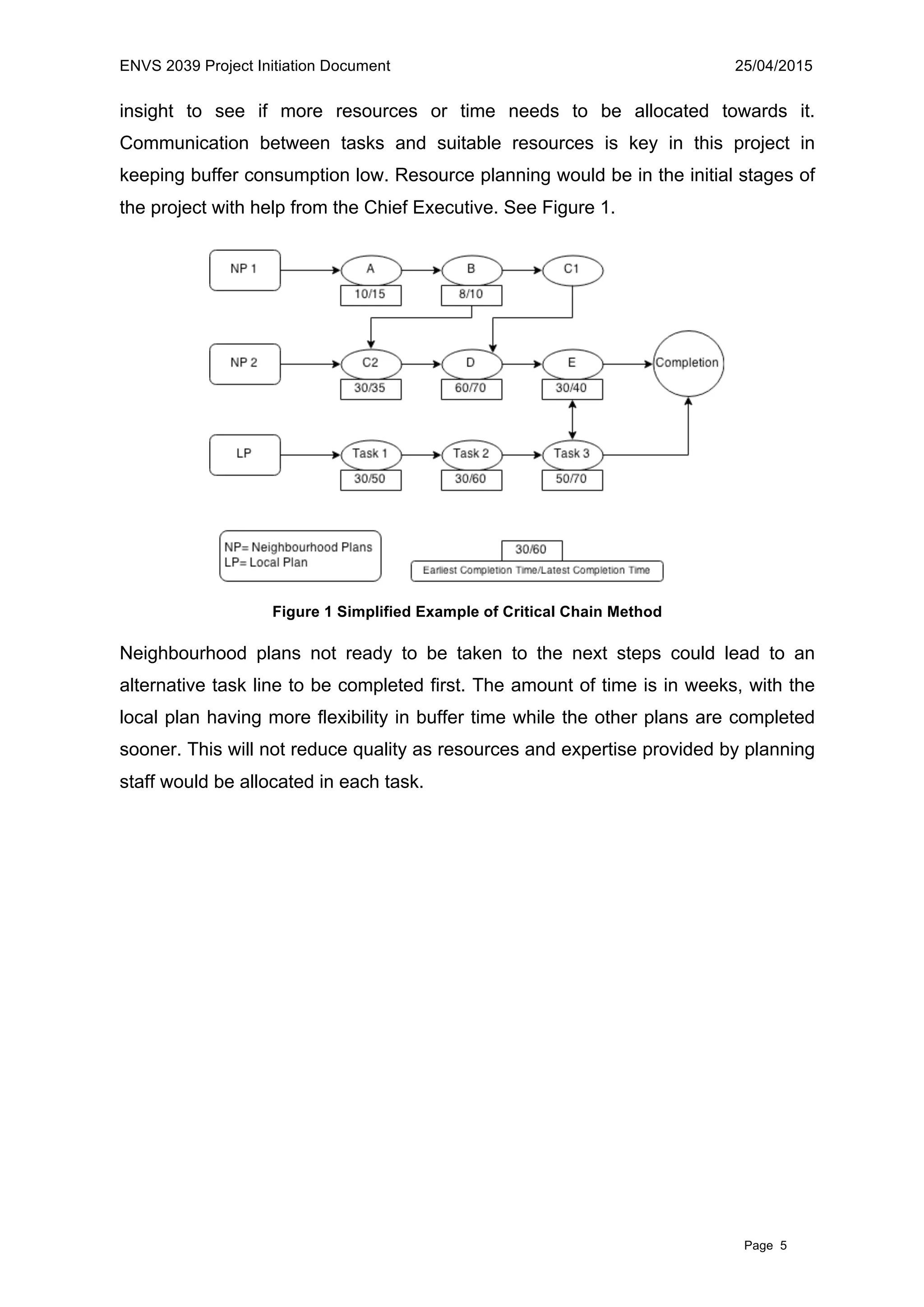
insight to see if more resources or time needs to be allocated towards it.
Communication between tasks and suitable resources is key in this project in
keeping buffer consumption low. Resource planning would be in the initial stages of
the project with help from the Chief Executive. See Figure 1.
Figure 1 Simplified Example of Critical Chain Method
Neighbourhood plans not ready to be taken to the next steps could lead to an
alternative task line to be completed first. The amount of time is in weeks, with the
local plan having more flexibility in buffer time while the other plans are completed
sooner. This will not reduce quality as resources and expertise provided by planning
staff would be allocated in each task.
ENVS 2039 Project Initiation Document 25/04/2015
Page 6
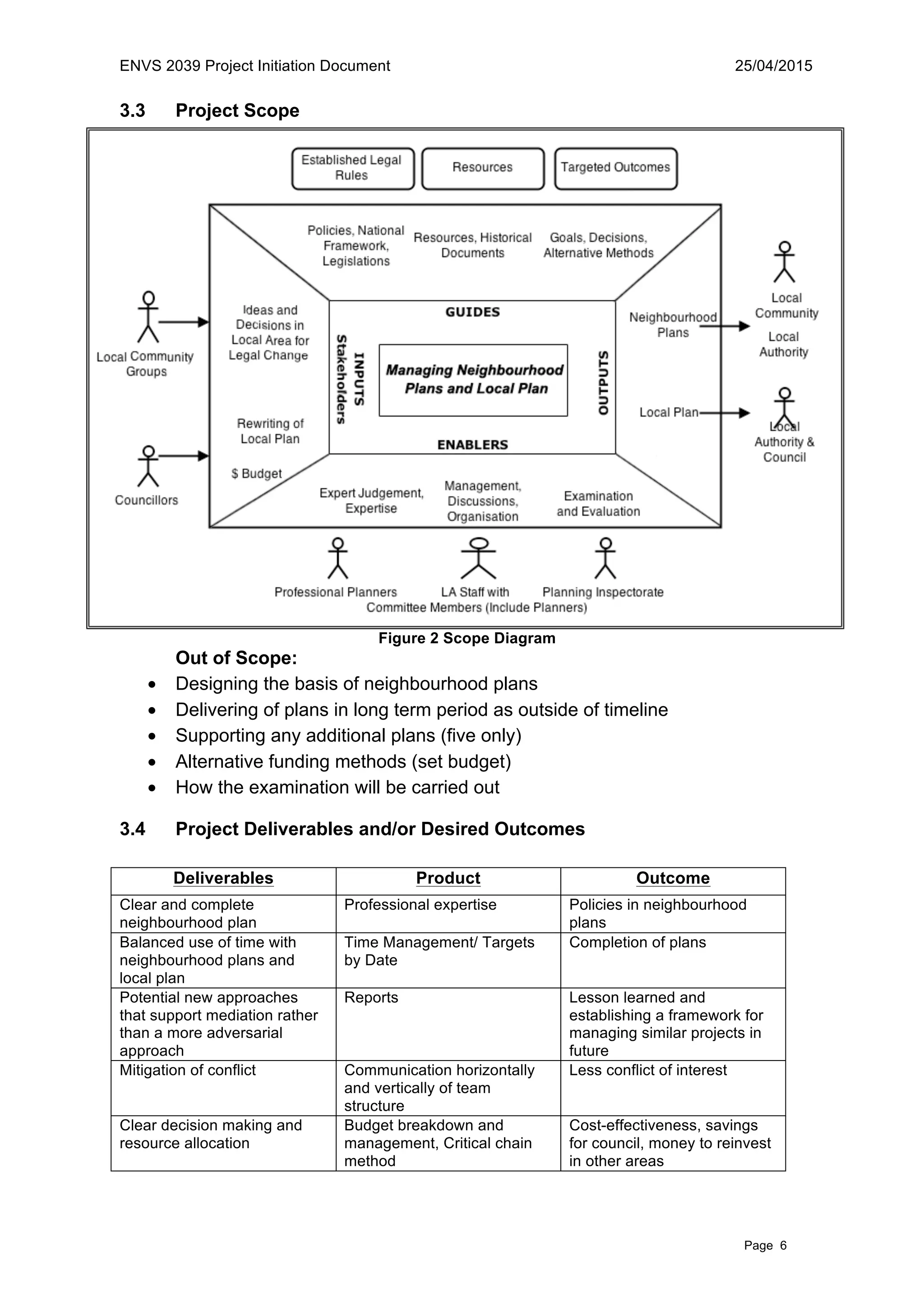
3.3 Project Scope
Figure 2 Scope Diagram
Out of Scope:
• Designing the basis of neighbourhood plans
• Delivering of plans in long term period as outside of timeline
• Supporting any additional plans (five only)
• Alternative funding methods (set budget)
• How the examination will be carried out
3.4 Project Deliverables and/or Desired Outcomes
Deliverables Product Outcome
Clear and complete
neighbourhood plan
Professional expertise Policies in neighbourhood
plans
Balanced use of time with
neighbourhood plans and
local plan
Time Management/ Targets
by Date
Completion of plans
Potential new approaches
that support mediation rather
than a more adversarial
approach
Reports Lesson learned and
establishing a framework for
managing similar projects in
future
Mitigation of conflict Communication horizontally
and vertically of team
structure
Less conflict of interest
Clear decision making and
resource allocation
Budget breakdown and
management, Critical chain
method
Cost-effectiveness, savings
for council, money to reinvest
in other areas
ENVS 2039 Project Initiation Document 25/04/2015
Page 7
3.5 Exclusions
• Long term outcomes by neighbourhood plans whether successful or not.
• Development and use of land by neighbourhood plans or local plan.
• Housing targets and plans.
3.6 Constraints
• Short timeframe of one year (until 2016) for local plan rewriting
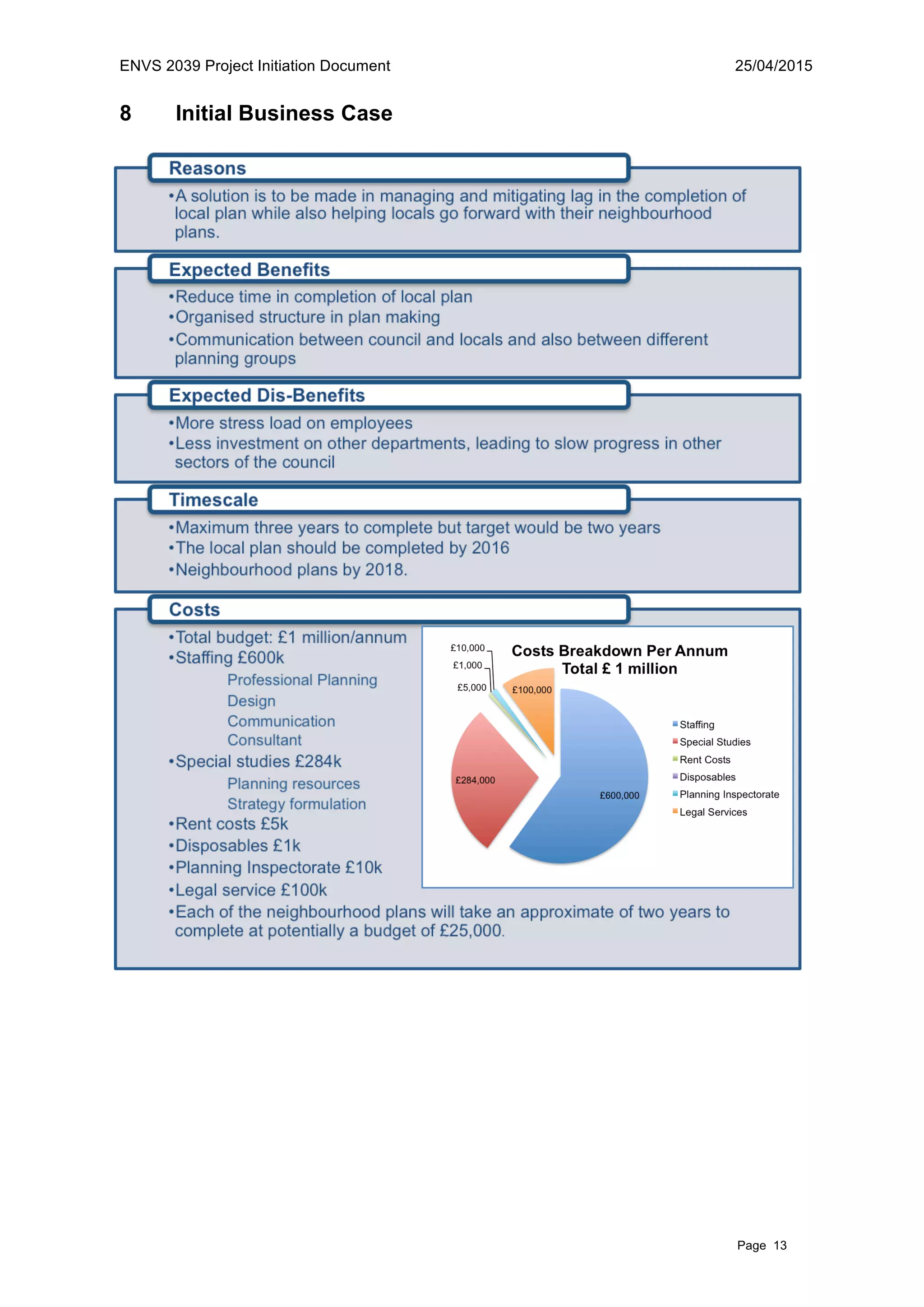
• £1 million budget restriction on funding per annum, must not exceed budget
• £25,000 estimate for each neighbourhood plan, but may not be enough as
plans vary in size
3.7 Interfaces
The main aspect of the project is the neighbourhood plans which is related to the
scope of the local plan. Neighbourhood plans are more specific rather than district
wide plans and will take precedence over local plans in determining planning
permission for local development. As there are mixed views about the local plan,
some councillors would favour neighbourhood plans as they are focused and
created by communities, and therefore more likely to be accepted. It would take into
consideration things that the local plans do not or do not state clearly. Although this
is only in the non-strategic way, and more strategic methods will be laid out in the
local plan. Nevertheless the local plan is still of importance as there has been no
approved plan since 2013. Legalisation will guide how the local plan will be written,
which will also influence how neighbourhood plans will be structured. There should
also be emphasis on completion of the local plan, with resources allocated ready to
move forward with neighbourhood and local plans.
3.8 Assumptions
Judging specific neighbourhood plans; if it is covered within the local plan then the
local plan should take precedence as it can act as the basis for the time being
because of finite time and resources. After local plan approval, neighbourhood plans
can be started again with more information and resources.
Assuming the local plan is not at close completion near the final due date, then the
project would have failed but resources and information from that plan can be put to
develop into more detail into the neighbourhood plans.
ENVS 2039 Project Initiation Document 25/04/2015
Page 8
4 Project Organisation Structure
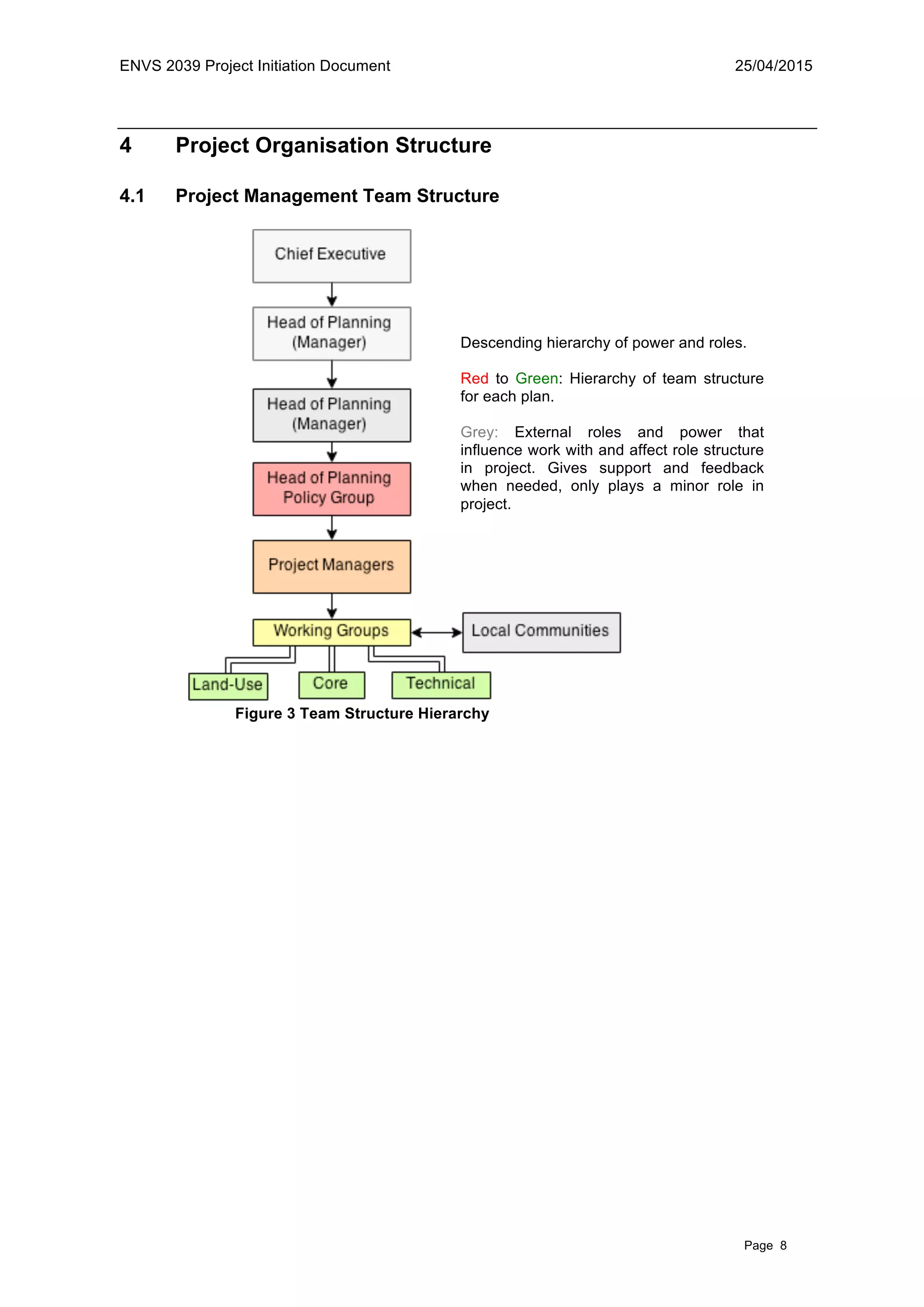
4.1 Project Management Team Structure
Descending hierarchy of power and roles.
Red to Green: Hierarchy of team structure
for each plan.
Grey: External roles and power that
influence work with and affect role structure
in project. Gives support and feedback
when needed, only plays a minor role in
project.
Figure 3 Team Structure Hierarchy
ENVS 2039 Project Initiation Document 25/04/2015
Page 9
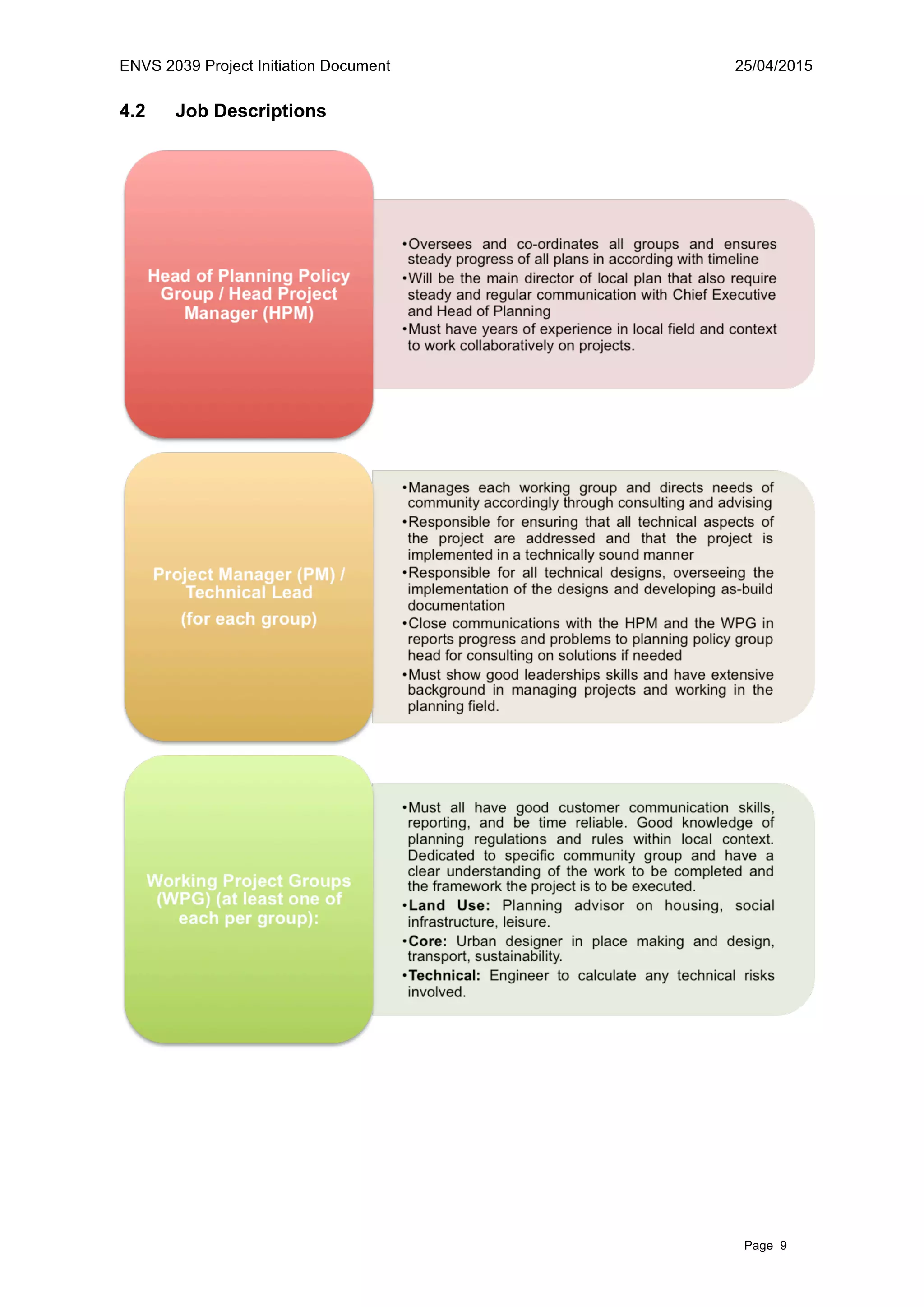
4.2 Job Descriptions
ENVS 2039 Project Initiation Document 25/04/2015
Page 10
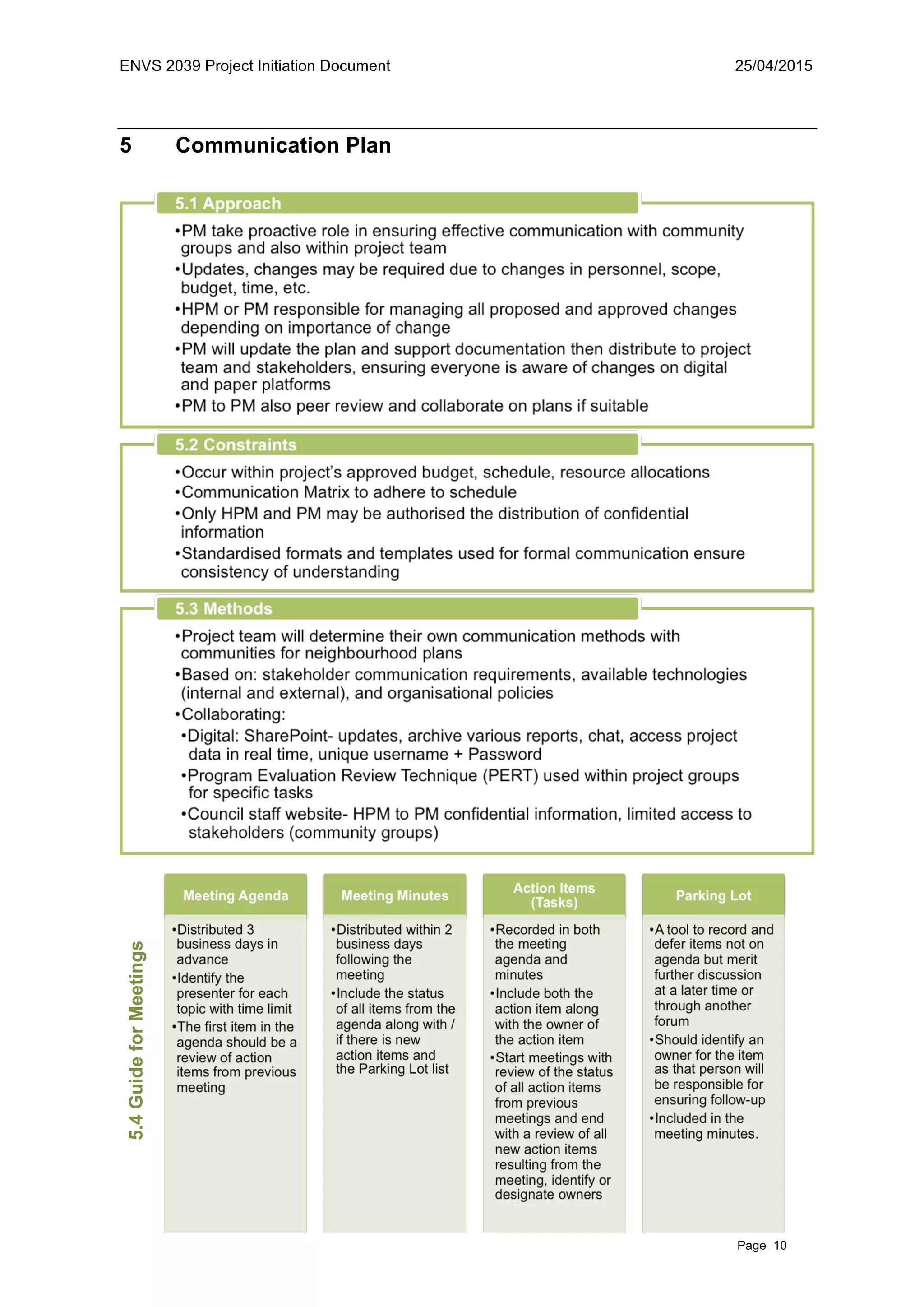
5 Communication Plan5.4GuideforMeetings
ENVS 2039 Project Initiation Document 25/04/2015
Page 11
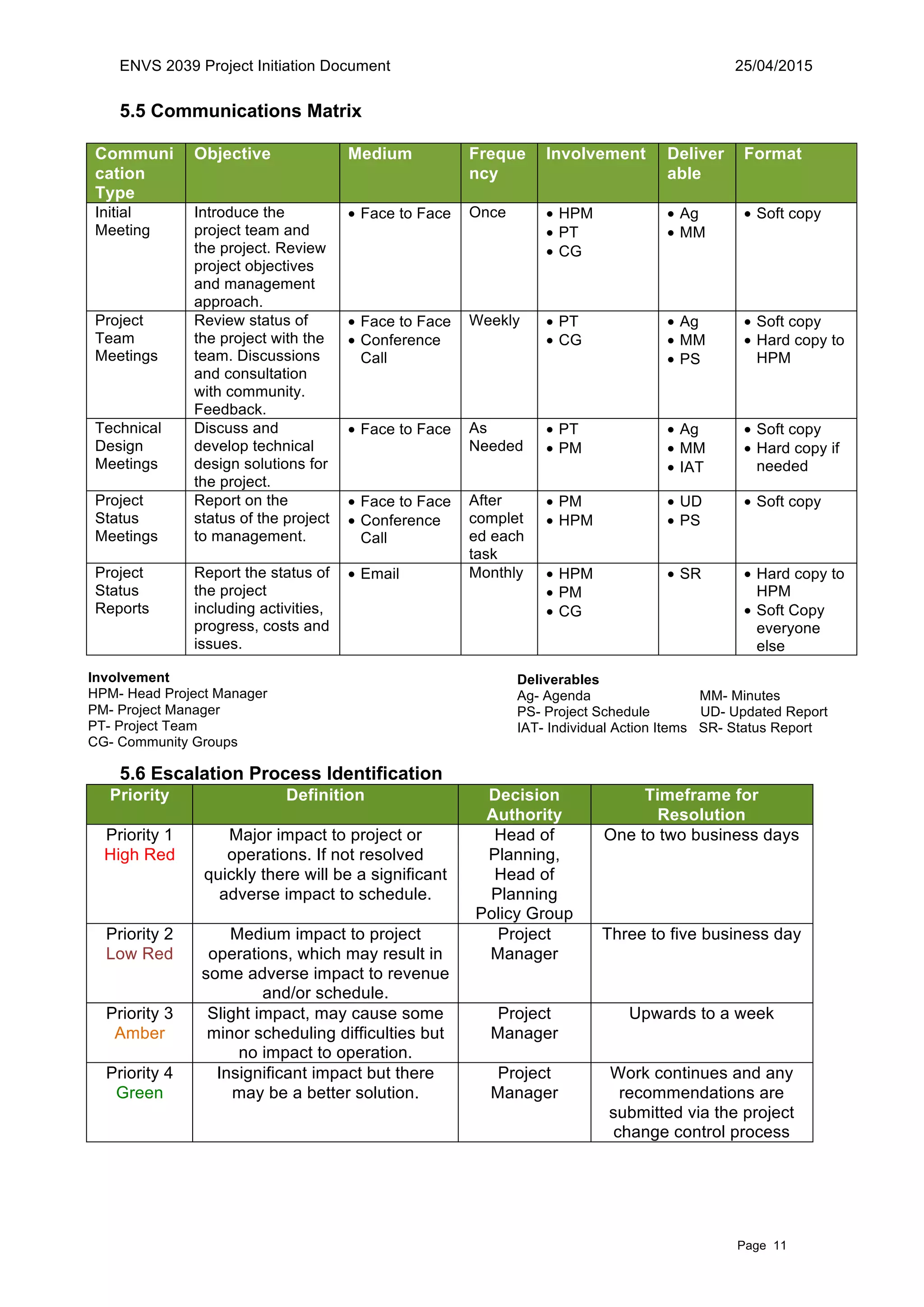
5.5 Communications Matrix
Communi
cation
Type
Objective Medium Freque
ncy
Involvement Deliver
able
Format
Initial
Meeting
Introduce the
project team and
the project. Review
project objectives
and management
approach.
• Face to Face Once • HPM
• PT
• CG
• Ag
• MM
• Soft copy
Project
Team
Meetings
Review status of
the project with the
team. Discussions
and consultation
with community.
Feedback.
• Face to Face
• Conference
Call
Weekly • PT
• CG
• Ag
• MM
• PS
• Soft copy
• Hard copy to
HPM
Technical
Design
Meetings
Discuss and
develop technical
design solutions for
the project.
• Face to Face As
Needed
• PT
• PM
• Ag
• MM
• IAT
• Soft copy
• Hard copy if
needed
Project
Status
Meetings
Report on the
status of the project
to management.
• Face to Face
• Conference
Call
After
complet
ed each
task
• PM
• HPM
• UD
• PS
• Soft copy
Project
Status
Reports
Report the status of
the project
including activities,
progress, costs and
issues.
• Email Monthly • HPM
• PM
• CG
• SR • Hard copy to
HPM
• Soft Copy
everyone
else
5.6 Escalation Process Identification
Priority Definition Decision
Authority
Timeframe for
Resolution
Priority 1
High Red
Major impact to project or
operations. If not resolved
quickly there will be a significant
adverse impact to schedule.
Head of
Planning,
Head of
Planning
Policy Group
One to two business days
Priority 2
Low Red
Medium impact to project
operations, which may result in
some adverse impact to revenue
and/or schedule.
Project
Manager
Three to five business day
Priority 3
Amber
Slight impact, may cause some
minor scheduling difficulties but
no impact to operation.
Project
Manager
Upwards to a week
Priority 4
Green
Insignificant impact but there
may be a better solution.
Project
Manager
Work continues and any
recommendations are
submitted via the project
change control process
Deliverables
Ag- Agenda MM- Minutes
PS- Project Schedule UD- Updated Report
IAT- Individual Action Items SR- Status Report
Involvement
HPM- Head Project Manager
PM- Project Manager
PT- Project Team
CG- Community Groups
Involvement
HPM- Head Project
Manager
PM- Project Manager
PT- Project Team
CG- Community Groups
ENVS 2039 Project Initiation Document 25/04/2015
Page 12
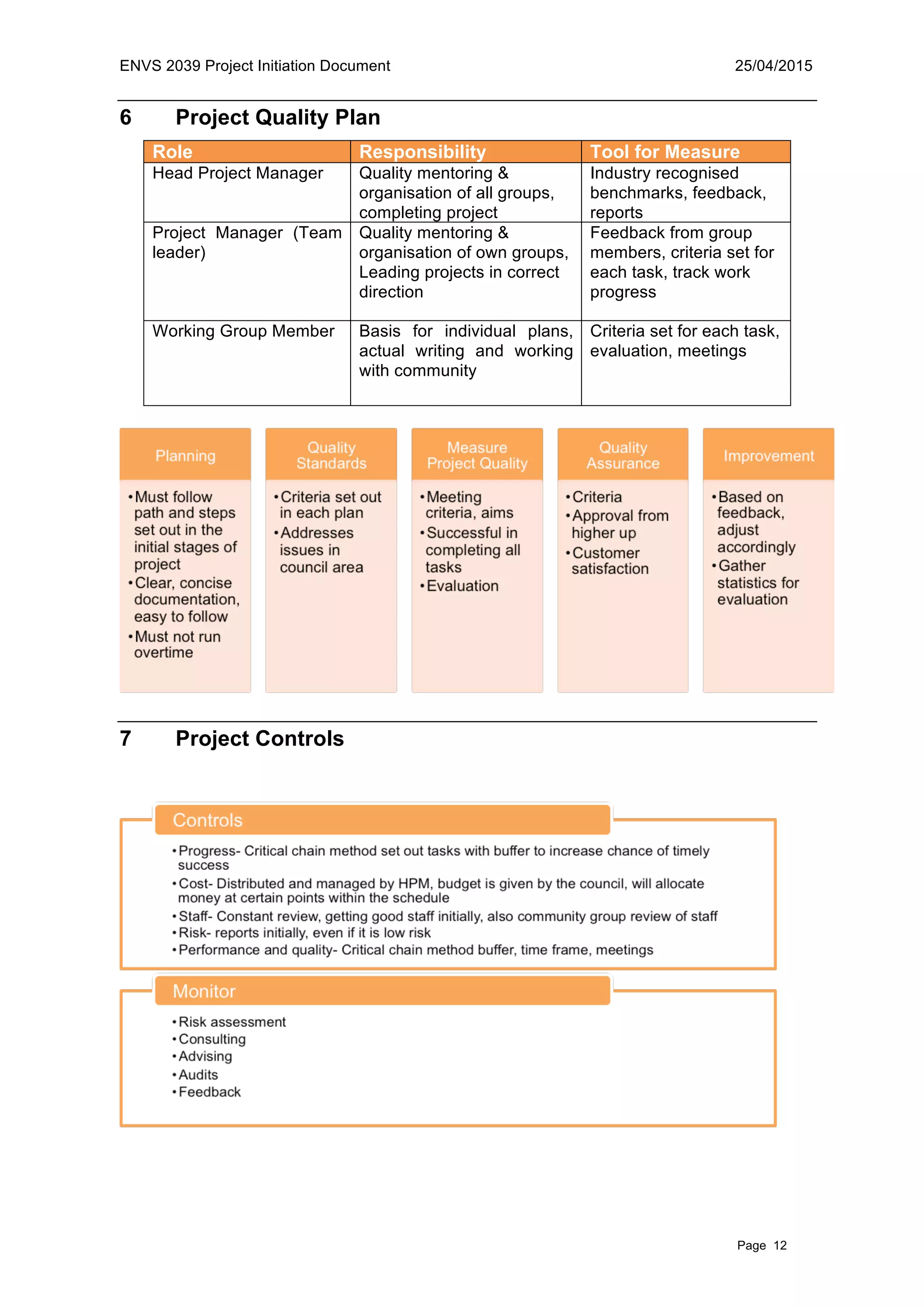
6 Project Quality Plan
Role Responsibility Tool for Measure
Head Project Manager Quality mentoring &
organisation of all groups,
completing project
Industry recognised
benchmarks, feedback,
reports
Project Manager (Team
leader)
Quality mentoring &
organisation of own groups,
Leading projects in correct
direction
Feedback from group
members, criteria set for
each task, track work
progress
Working Group Member Basis for individual plans,
actual writing and working
with community
Criteria set for each task,
evaluation, meetings
7 Project Controls
ENVS 2039 Project Initiation Document 25/04/2015
Page 13
8 Initial Business Case
ENVS 2039 Project Initiation Document 25/04/2015
Page 14
ENVS 2039 Project Initiation Document 25/04/2015
Page 15
9 Initial Project Plan
Purpose
Composition
Derivation
Local plan should be derived from facts and statistics from local context and follow
national policy guidelines. These are to be written by planning employees by the
council.
ENVS 2039 Project Initiation Document 25/04/2015
Page 16
Neighbourhood plans should be derived from local context but importantly by
community group opinions and needs. Written by community groups in partnership
with council.
Project itself derive managers and project team from Camden council, can
outsource some legal or roles that council does not supply to private consultancy
firms.
Format and Presentation
Project outcome will be in the form of a report plan.
Development Skills Required (see 4.2 for more)
- Expert knowledge of national and local policies
- Knowledge about local context and aims of council and community
- Organisational skills in managing multiple groups
- Time oriented and financially organised and efficient
10 Initial Risk Log
Risk Before
RAG
Mitigation After
RAG
Conflict of interest
between NPs
A Horizontal communication project to project,
consultant and discussions
G
Lack of skilled
employees
A Recruitment of high quality personnel, specific
training beforehand
G
Quick usage of
funding
A Close budgeting, time efficiency management to
reduce bureaucracy
A
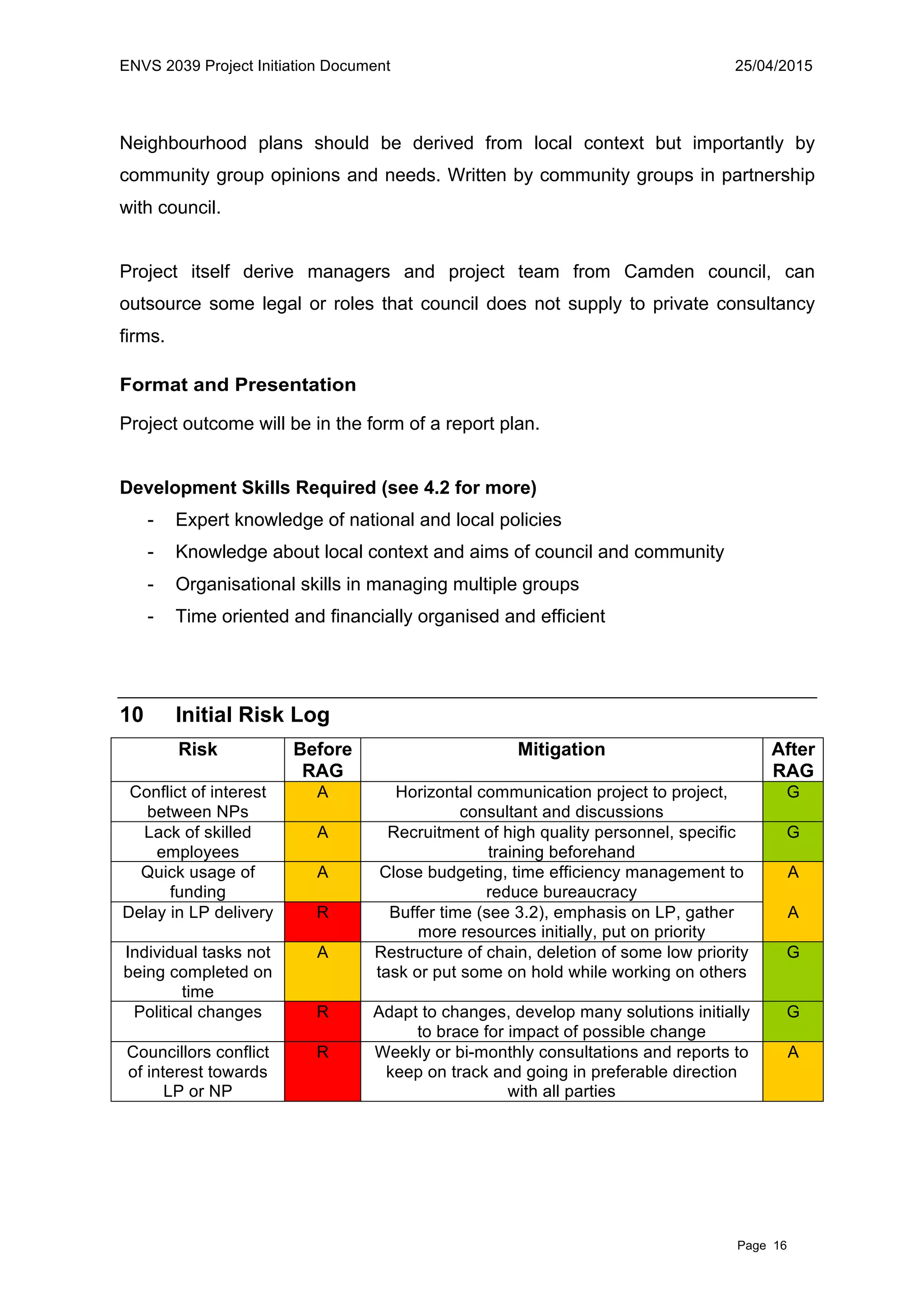
Delay in LP delivery R Buffer time (see 3.2), emphasis on LP, gather
more resources initially, put on priority
A
Individual tasks not
being completed on
time
A Restructure of chain, deletion of some low priority
task or put some on hold while working on others
G
Political changes R Adapt to changes, develop many solutions initially
to brace for impact of possible change
G
Councillors conflict
of interest towards
LP or NP
R Weekly or bi-monthly consultations and reports to
keep on track and going in preferable direction
with all parties
A
References
Baron, A. and Armstrong, M. (2007). Human capital management. London:
Kogan Page Ltd.
Goldratt, (2015). Critical Chain Project Management. [online] Available at:
http://www.goldratt.co.uk/resources/critical_chain/ [Accessed 25 Apr. 2015].
Morphet, J. (2011). Effective practice in spatial planning. New York: Routledge.
Mymanagementguide, (2012). Project Control in 5 Steps. [online] Available at:
http://www.mymanagementguide.com/project-control-steps/ [Accessed 25
Apr. 2015].
Neighbourhood Planning. (2013). 1st ed. [ebook] London: Local Government
Association, pp.3-6. Available at:
http://www.pas.gov.uk/documents/332612/0/Neighbourhood+planning+guide
+for+councillors+Dec+13+update/3a2d7b47-b037-4c0d-a84b-
dacd581847ee [Accessed 25 Apr. 2015].
Nokes, S. (2003). The definitive guide to project management. London: Financial
Times Prentice Hall.
Piscopo, M. (2015). Communications Management Plan Template. [online]
Project Management Docs. Available at:
http://www.projectmanagementdocs.com/project-planning-
templates/communications-management-plan.html [Accessed 25 Apr. 2015].

Project Initiation Document for Management of Neighbourhood Plans in Compliance with Local Plan

  • 1.
    Janey Lin Zhao1 ENVS 2030: Management for Built Environment Professionals II PROJECT INITIATION DOCUMENT (PID) Project: Management of Neighbourhood Plans in Compliance with Local Plan Date: April 27, 2015 Author: Janey Lin Zhao Department: Planning Policy Client: Camden Council Document Ref: 102939 Version No: 1 Word Count: 1851
  • 2.
    ENVS 2039 ProjectInitiation Document 25/04/2015 Page 2 Table of Contents 1 Purpose of Document 3 2 Background 3 3 Project Definition 4 3.1 Project Objectives 4 3.2 Defined Method Approach 4 3.3 Project Scope 6 3.4 Project Deliverables and/or Desired Outcomes 6 3.5 Exclusions 7 3.6 Constraints 7 3.7 Interfaces 7 3.8 Assumptions 7 4 Project Organisation Structure 8 4.1 Project Management Team Structure 8 4.2 Job Descriptions 9 5 Communication Plan 10 5.1 Approach 10 5.2 Constraints 10 5.3 Methods 10 5.4 Guide to Meetings 10 5.5 Communication Matrix 11 5.6 Escalation Process Identification 11 6 Project Quality Plan 12 7 Project Controls 12 8 Initial Business Case 13 9 Initial Project Plan 15 10 Initial Risk Log 16
  • 3.
    ENVS 2039 ProjectInitiation Document 25/04/2015 Page 3 1 Purpose of Document The purpose of this document is to define the project, to form the basis for its management and the assessment of overall success. 2 Background With the changes in planning legislation rejected by the Planning Inspectorate in 2013, there comes a rewriting of the local plan to be put forward in the next examination in 2016. There has been pressure from the Camden local authority to share resources in preparation for the next examination of the local plan in addition to also support the neighbourhood plans of local communities. Currently, there are five neighbourhood plans that are being developed by local communities that need support and guidance to be put forward. Although after assessment of the current situation, only two of the plans are ready to move forward while the other three may need additional support. Resources put into the neighbourhood plans will potentially delay the local plan further, and housing plans would be determined via planning appeal outside the local plan. Guidance is needed in order to finance, budget and manage the five plans, especially as the local plan will be rewritten in the near future. Targets and planning need to be set to see if the neighbourhood plans need to be completed before or after the examination and if it affects the content of the local plan. The local plan is as yet unfinished, as there are no additional resources given by the Head of Planning, and needs assistance to meet the deadline.
  • 4.
    ENVS 2039 ProjectInitiation Document 25/04/2015 Page 4 3 Project Definition 3.1 Project Objectives • To minimise conflicts in the policies set in the neighbourhood plans with the emerging local plan • To successfully manage and complete two neighbourhood plans by the end of 2016, and all neighbourhood plans in the next three years (2018) • To balance the budget between neighbourhood plans with rewriting of the local plan • Ensure completion of local plan by 2016 for examination 3.2 Defined Method of Approach Critical Chain method is a suitable method, especially for setting time limits and the lack of flexibility in the given project. Tasks are organised in a dependency sequence that directly impact the project’s completion date. It works from creating a work breakdown structure, identifying each task from end completion date to start, to calculate duration needed for each task (usually with a 50% probability occurrence). A second safe duration time is added that acts as a buffer to increase the probability of completion, which is critical especially in getting the local plan completed in time (90% to 95%). Recognising that some tasks are more likely to take more or less time than expected, it uses the buffer to monitor the project’s schedule and financial performance, as specific estimate dates can never be perfect. If the rate of buffer consumption were low, the project would be on target but if it is high, further recovery action or plans need to be developed to recover loss. The goal is to overcome delay in work or do extra work when there seems to be more time; it encourages quick movement onto tasks. This protects late due-date performance and avoids wasting resources (Goldratt, 2015). For the implementation into the project, resources will be allocated into each task following a non-linear model, which is ideal as many neighbourhood plans are in different stages of progress. The plans that are not up to date will receive more buffers, with the local plan also being a major component. The local plan will have a separate timeline but some tasks could be interdependent and the buffer would give
  • 5.
    ENVS 2039 ProjectInitiation Document 25/04/2015 Page 5 insight to see if more resources or time needs to be allocated towards it. Communication between tasks and suitable resources is key in this project in keeping buffer consumption low. Resource planning would be in the initial stages of the project with help from the Chief Executive. See Figure 1. Figure 1 Simplified Example of Critical Chain Method Neighbourhood plans not ready to be taken to the next steps could lead to an alternative task line to be completed first. The amount of time is in weeks, with the local plan having more flexibility in buffer time while the other plans are completed sooner. This will not reduce quality as resources and expertise provided by planning staff would be allocated in each task.
  • 6.
    ENVS 2039 ProjectInitiation Document 25/04/2015 Page 6 3.3 Project Scope Figure 2 Scope Diagram Out of Scope: • Designing the basis of neighbourhood plans • Delivering of plans in long term period as outside of timeline • Supporting any additional plans (five only) • Alternative funding methods (set budget) • How the examination will be carried out 3.4 Project Deliverables and/or Desired Outcomes Deliverables Product Outcome Clear and complete neighbourhood plan Professional expertise Policies in neighbourhood plans Balanced use of time with neighbourhood plans and local plan Time Management/ Targets by Date Completion of plans Potential new approaches that support mediation rather than a more adversarial approach Reports Lesson learned and establishing a framework for managing similar projects in future Mitigation of conflict Communication horizontally and vertically of team structure Less conflict of interest Clear decision making and resource allocation Budget breakdown and management, Critical chain method Cost-effectiveness, savings for council, money to reinvest in other areas
  • 7.
    ENVS 2039 ProjectInitiation Document 25/04/2015 Page 7 3.5 Exclusions • Long term outcomes by neighbourhood plans whether successful or not. • Development and use of land by neighbourhood plans or local plan. • Housing targets and plans. 3.6 Constraints • Short timeframe of one year (until 2016) for local plan rewriting • £1 million budget restriction on funding per annum, must not exceed budget • £25,000 estimate for each neighbourhood plan, but may not be enough as plans vary in size 3.7 Interfaces The main aspect of the project is the neighbourhood plans which is related to the scope of the local plan. Neighbourhood plans are more specific rather than district wide plans and will take precedence over local plans in determining planning permission for local development. As there are mixed views about the local plan, some councillors would favour neighbourhood plans as they are focused and created by communities, and therefore more likely to be accepted. It would take into consideration things that the local plans do not or do not state clearly. Although this is only in the non-strategic way, and more strategic methods will be laid out in the local plan. Nevertheless the local plan is still of importance as there has been no approved plan since 2013. Legalisation will guide how the local plan will be written, which will also influence how neighbourhood plans will be structured. There should also be emphasis on completion of the local plan, with resources allocated ready to move forward with neighbourhood and local plans. 3.8 Assumptions Judging specific neighbourhood plans; if it is covered within the local plan then the local plan should take precedence as it can act as the basis for the time being because of finite time and resources. After local plan approval, neighbourhood plans can be started again with more information and resources. Assuming the local plan is not at close completion near the final due date, then the project would have failed but resources and information from that plan can be put to develop into more detail into the neighbourhood plans.
  • 8.
    ENVS 2039 ProjectInitiation Document 25/04/2015 Page 8 4 Project Organisation Structure 4.1 Project Management Team Structure Descending hierarchy of power and roles. Red to Green: Hierarchy of team structure for each plan. Grey: External roles and power that influence work with and affect role structure in project. Gives support and feedback when needed, only plays a minor role in project. Figure 3 Team Structure Hierarchy
  • 9.
    ENVS 2039 ProjectInitiation Document 25/04/2015 Page 9 4.2 Job Descriptions
  • 10.
    ENVS 2039 ProjectInitiation Document 25/04/2015 Page 10 5 Communication Plan5.4GuideforMeetings
  • 11.
    ENVS 2039 ProjectInitiation Document 25/04/2015 Page 11 5.5 Communications Matrix Communi cation Type Objective Medium Freque ncy Involvement Deliver able Format Initial Meeting Introduce the project team and the project. Review project objectives and management approach. • Face to Face Once • HPM • PT • CG • Ag • MM • Soft copy Project Team Meetings Review status of the project with the team. Discussions and consultation with community. Feedback. • Face to Face • Conference Call Weekly • PT • CG • Ag • MM • PS • Soft copy • Hard copy to HPM Technical Design Meetings Discuss and develop technical design solutions for the project. • Face to Face As Needed • PT • PM • Ag • MM • IAT • Soft copy • Hard copy if needed Project Status Meetings Report on the status of the project to management. • Face to Face • Conference Call After complet ed each task • PM • HPM • UD • PS • Soft copy Project Status Reports Report the status of the project including activities, progress, costs and issues. • Email Monthly • HPM • PM • CG • SR • Hard copy to HPM • Soft Copy everyone else 5.6 Escalation Process Identification Priority Definition Decision Authority Timeframe for Resolution Priority 1 High Red Major impact to project or operations. If not resolved quickly there will be a significant adverse impact to schedule. Head of Planning, Head of Planning Policy Group One to two business days Priority 2 Low Red Medium impact to project operations, which may result in some adverse impact to revenue and/or schedule. Project Manager Three to five business day Priority 3 Amber Slight impact, may cause some minor scheduling difficulties but no impact to operation. Project Manager Upwards to a week Priority 4 Green Insignificant impact but there may be a better solution. Project Manager Work continues and any recommendations are submitted via the project change control process Deliverables Ag- Agenda MM- Minutes PS- Project Schedule UD- Updated Report IAT- Individual Action Items SR- Status Report Involvement HPM- Head Project Manager PM- Project Manager PT- Project Team CG- Community Groups Involvement HPM- Head Project Manager PM- Project Manager PT- Project Team CG- Community Groups
  • 12.
    ENVS 2039 ProjectInitiation Document 25/04/2015 Page 12 6 Project Quality Plan Role Responsibility Tool for Measure Head Project Manager Quality mentoring & organisation of all groups, completing project Industry recognised benchmarks, feedback, reports Project Manager (Team leader) Quality mentoring & organisation of own groups, Leading projects in correct direction Feedback from group members, criteria set for each task, track work progress Working Group Member Basis for individual plans, actual writing and working with community Criteria set for each task, evaluation, meetings 7 Project Controls
  • 13.
    ENVS 2039 ProjectInitiation Document 25/04/2015 Page 13 8 Initial Business Case
  • 14.
    ENVS 2039 ProjectInitiation Document 25/04/2015 Page 14
  • 15.
    ENVS 2039 ProjectInitiation Document 25/04/2015 Page 15 9 Initial Project Plan Purpose Composition Derivation Local plan should be derived from facts and statistics from local context and follow national policy guidelines. These are to be written by planning employees by the council.
  • 16.
    ENVS 2039 ProjectInitiation Document 25/04/2015 Page 16 Neighbourhood plans should be derived from local context but importantly by community group opinions and needs. Written by community groups in partnership with council. Project itself derive managers and project team from Camden council, can outsource some legal or roles that council does not supply to private consultancy firms. Format and Presentation Project outcome will be in the form of a report plan. Development Skills Required (see 4.2 for more) - Expert knowledge of national and local policies - Knowledge about local context and aims of council and community - Organisational skills in managing multiple groups - Time oriented and financially organised and efficient 10 Initial Risk Log Risk Before RAG Mitigation After RAG Conflict of interest between NPs A Horizontal communication project to project, consultant and discussions G Lack of skilled employees A Recruitment of high quality personnel, specific training beforehand G Quick usage of funding A Close budgeting, time efficiency management to reduce bureaucracy A Delay in LP delivery R Buffer time (see 3.2), emphasis on LP, gather more resources initially, put on priority A Individual tasks not being completed on time A Restructure of chain, deletion of some low priority task or put some on hold while working on others G Political changes R Adapt to changes, develop many solutions initially to brace for impact of possible change G Councillors conflict of interest towards LP or NP R Weekly or bi-monthly consultations and reports to keep on track and going in preferable direction with all parties A
  • 17.
    References Baron, A. andArmstrong, M. (2007). Human capital management. London: Kogan Page Ltd. Goldratt, (2015). Critical Chain Project Management. [online] Available at: http://www.goldratt.co.uk/resources/critical_chain/ [Accessed 25 Apr. 2015]. Morphet, J. (2011). Effective practice in spatial planning. New York: Routledge. Mymanagementguide, (2012). Project Control in 5 Steps. [online] Available at: http://www.mymanagementguide.com/project-control-steps/ [Accessed 25 Apr. 2015]. Neighbourhood Planning. (2013). 1st ed. [ebook] London: Local Government Association, pp.3-6. Available at: http://www.pas.gov.uk/documents/332612/0/Neighbourhood+planning+guide +for+councillors+Dec+13+update/3a2d7b47-b037-4c0d-a84b- dacd581847ee [Accessed 25 Apr. 2015]. Nokes, S. (2003). The definitive guide to project management. London: Financial Times Prentice Hall. Piscopo, M. (2015). Communications Management Plan Template. [online] Project Management Docs. Available at: http://www.projectmanagementdocs.com/project-planning- templates/communications-management-plan.html [Accessed 25 Apr. 2015].