PROJECT EVALUATION (1.011)
Civil and Environmental Engineering
Massachusetts Institute of Technology
Spring 2011
Lecture 1
Instructors: Professor Joseph Sussman
Carl Martland
Teaching Assistants:
Nihit Jain
Edna Ezzell
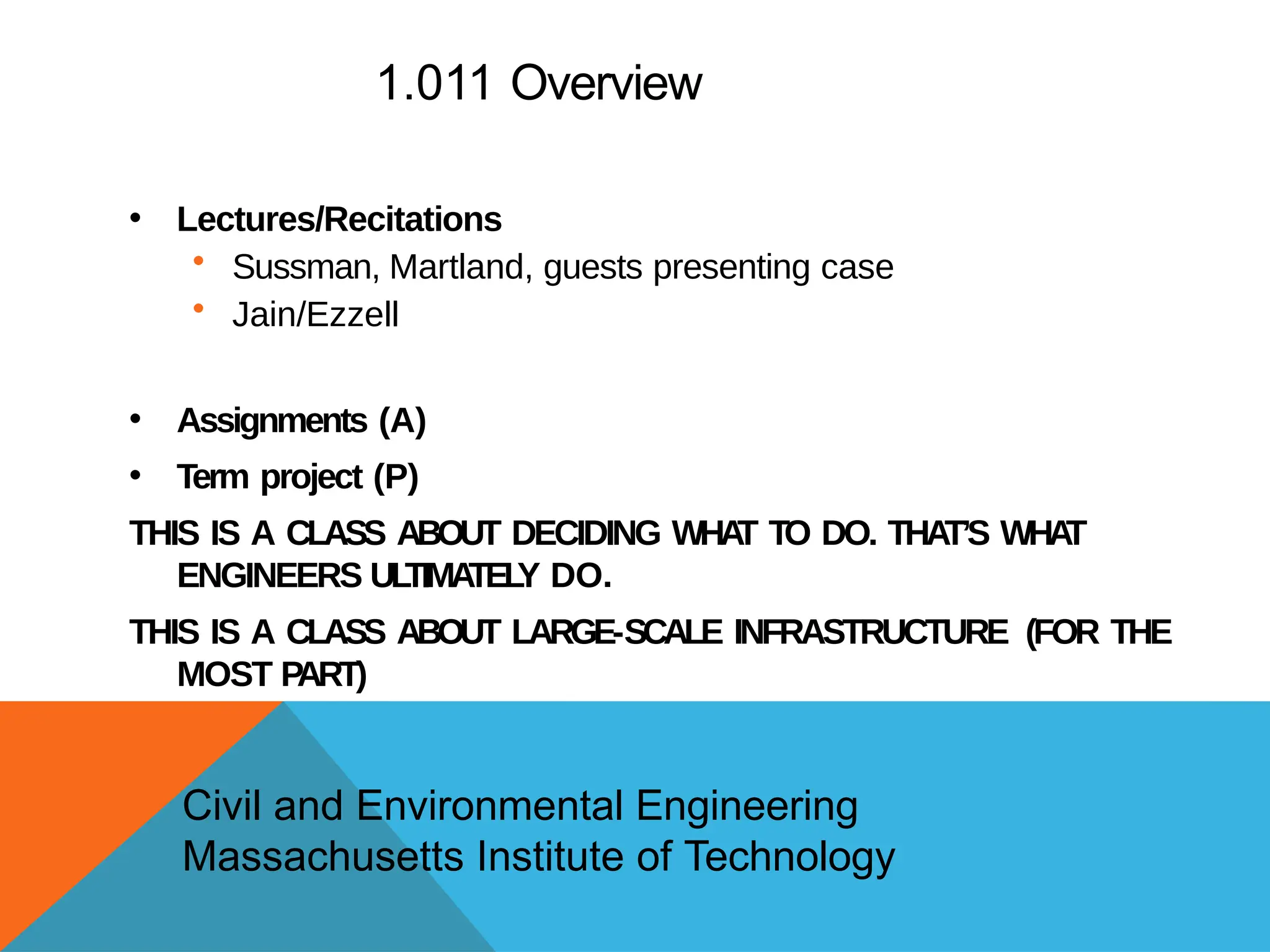
• Lectures/Recitations
• Sussman, Martland, guests presenting case
• Jain/Ezzell
• Assignments (A)
• Term project (P)
THIS IS A CLASS ABOUT DECIDING WHA
T TO DO. THAT’S WHA
T
ENGINEERS UL
TIMA
TEL
Y DO.
THIS IS A CLASS ABOUT LARGE-SCALE INFRASTRUCTURE (FOR THE
MOST P
ART)
Civil and Environmental Engineering
Massachusetts Institute of Technology
1.011 Overview
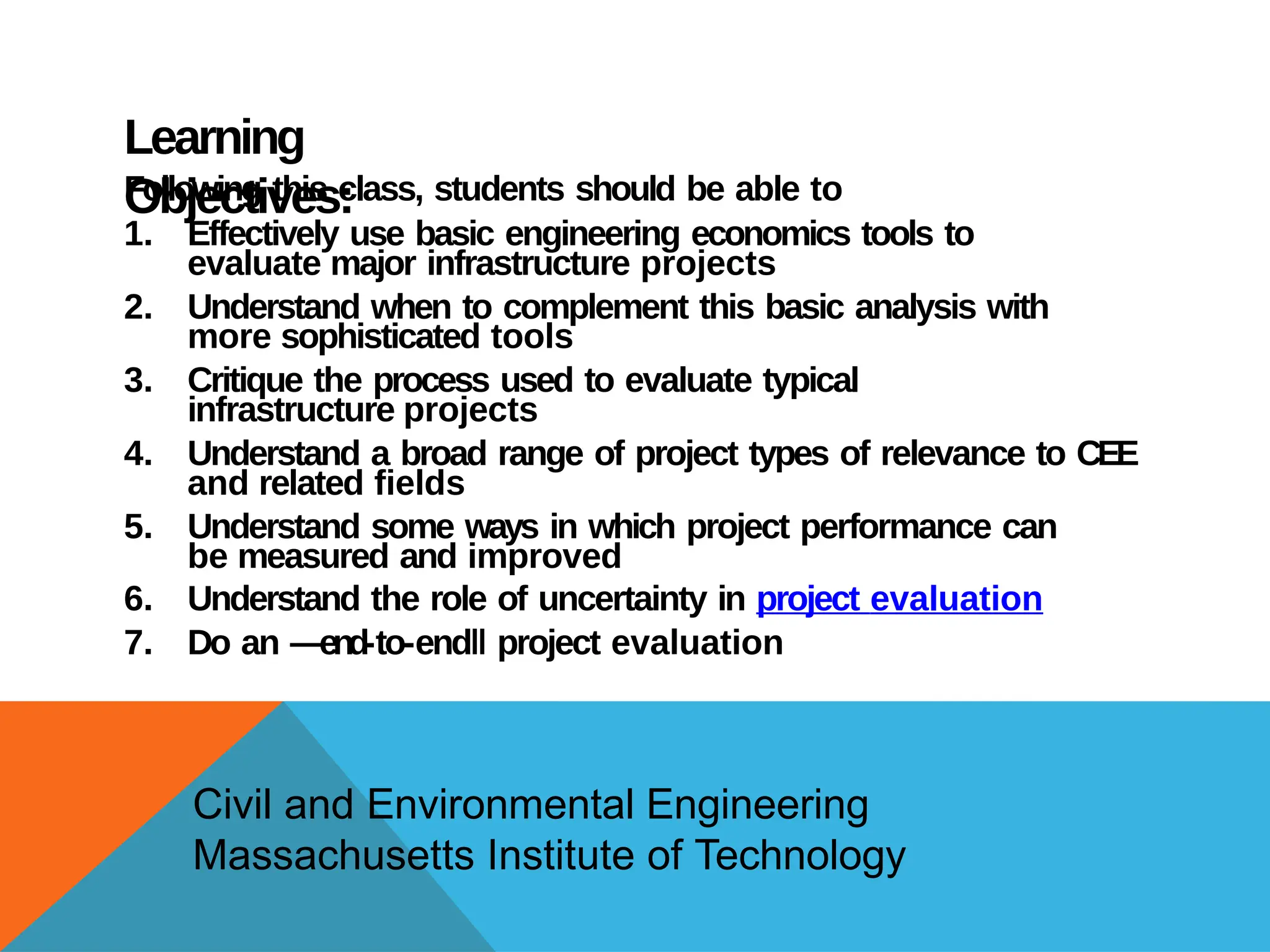
Learning
Objectives:
Civil and Environmental Engineering
Massachusetts Institute of Technology
Following this class, students should be able to
1. Effectively use basic engineering economics tools to
evaluate major infrastructure projects
2. Understand when to complement this basic analysis with
more sophisticated tools
3. Critique the process used to evaluate typical
infrastructure projects
4. Understand a broad range of project types of relevance to CEE
and related fields
5. Understand some ways in which project performance can
be measured and improved
6. Understand the role of uncertainty in project evaluation
7. Do an ―end-to-end‖ project evaluation
• Written self-intros--professional interests, relevant experience,
learning expectation (ungraded)
A1.1 - Basic concepts
I A1.2 - Basic
concepts II
A2 - Large scale project
evaluationA3.1 - Advanced
concepts I
A3.2 - Advanced concepts II
A4 - Peer Project
Evaluations
1-pagers on guest cases--due
the next class after the case
lecture
Civil and Environmental Engineering
Massachusetts Institute of Technology
ASSIGNMENT
S
• Work in teams of 2 or 3
• A project evaluation
• Your choice, subject to instructors’
review
Civil and Environmental Engineering
Massachusetts Institute of Technology
TERM PROJECT
• Background on the project
• If a current or past project, a summary of the costs and benefits
that were considered by decision-makers and how they were
analyzed
• Major issues that affect(ed) the project
• Significant decisions that will be/were made regarding project
design and implementation
• Status of the project and results if it has been completed
• Your own analysis of the relevant costs and benefits (if you choose
an entirely new project, this will be the main body of your project)
• Discussion and critique of the project and the project evaluation
process
Civil and Environmental Engineering
Massachusetts Institute of Technology
THE TERM PROJECT SHOULD BE ABOUT 15 PAGES LONG, INCLUDING:
Teams formed: Lecture 6
Project Description P1: (2pages): Due Lecture 10
P1 needs to address the following topics
 Provide a brief project description
 Why is the project interesting?
 What are the key uncertainties involved
in the project?
Civil and Environmental Engineering
Massachusetts Institute of Technology
PROJECT DUE DATES:
P2 Due Lecture
17:
Civil and Environmental Engineering
Massachusetts Institute of Technology
Progress Report 1: (2 pages)
P2 needs to address the following
topics
 Identification of Stakeholders
 Identification of Benefits and Costs
 Data Sources you are using and
any data problems you are encountering
P3 Due Recitation
10:
Civil and Environmental Engineering
Massachusetts Institute of Technology
Progress Report 2: (2 pages)
P3 needs to address the following
topics
Project finance
Major barriers to a successful
completion of your written project
P4 LECTURE 23:
Copy of powerpoint presentation
due
Civil and Environmental Engineering
Massachusetts Institute of Technology
Lectures 23, 24, and 25:
Presentations to class (participation points for
constructive questions and comments from the
audience)
P5 LECTURE
26:
Civil and Environmental Engineering
Massachusetts Institute of Technology
Final Report due at 11:59pm (last day of classes)
Oral Presentations on term project--
Mini-presentation (<7 minutes)--your initial ideas
(during Recitation 6)
Final presentation at end of term during Lectures 23, 24, 25
Meetings with 1.011 instructing staff -- to be
arranged
Teaching Modalities:
Civil and Environmental Engineering
Massachusetts Institute of Technology
The intent is that the classes should be as interactive as
possible. Occasionally it’s ―
w
e lecture you listen‖ but
we will endeavor to get you involved
In lectures
Methods and concepts
Case studies to illustrate and expand upon methods
and concepts
―Reports from the Front‖ (RFTF)—discussion of current events
of relevance to 1.011
Also, we want you to learn from each other– student
project presentations will comprise the last several
lectures
In recitations
Review and clarification of methods and
concepts Discussion of problem sets/ quiz
Project work
Outside the classroom
Each term project team (see below) will meet with
the teaching staff several times during the
semester
Civil and Environmental Engineering
Massachusetts Institute of Technology
Student Work:
Civil and Environmental Engineering
Massachusetts Institute of Technology
Readings, as assigned
Problem
sets Term
project
Participation
in class.
Contribut
ing to
class
discussi
on
The class will have several guest lecturers discussing projects in their
domain areas. Y
ou will submit a < 1-page summary for each case
turned in the next
you attend that case class
or
class after the case is presented
(whether not) as a part of class
participation.
One in-class exam, open book and notes
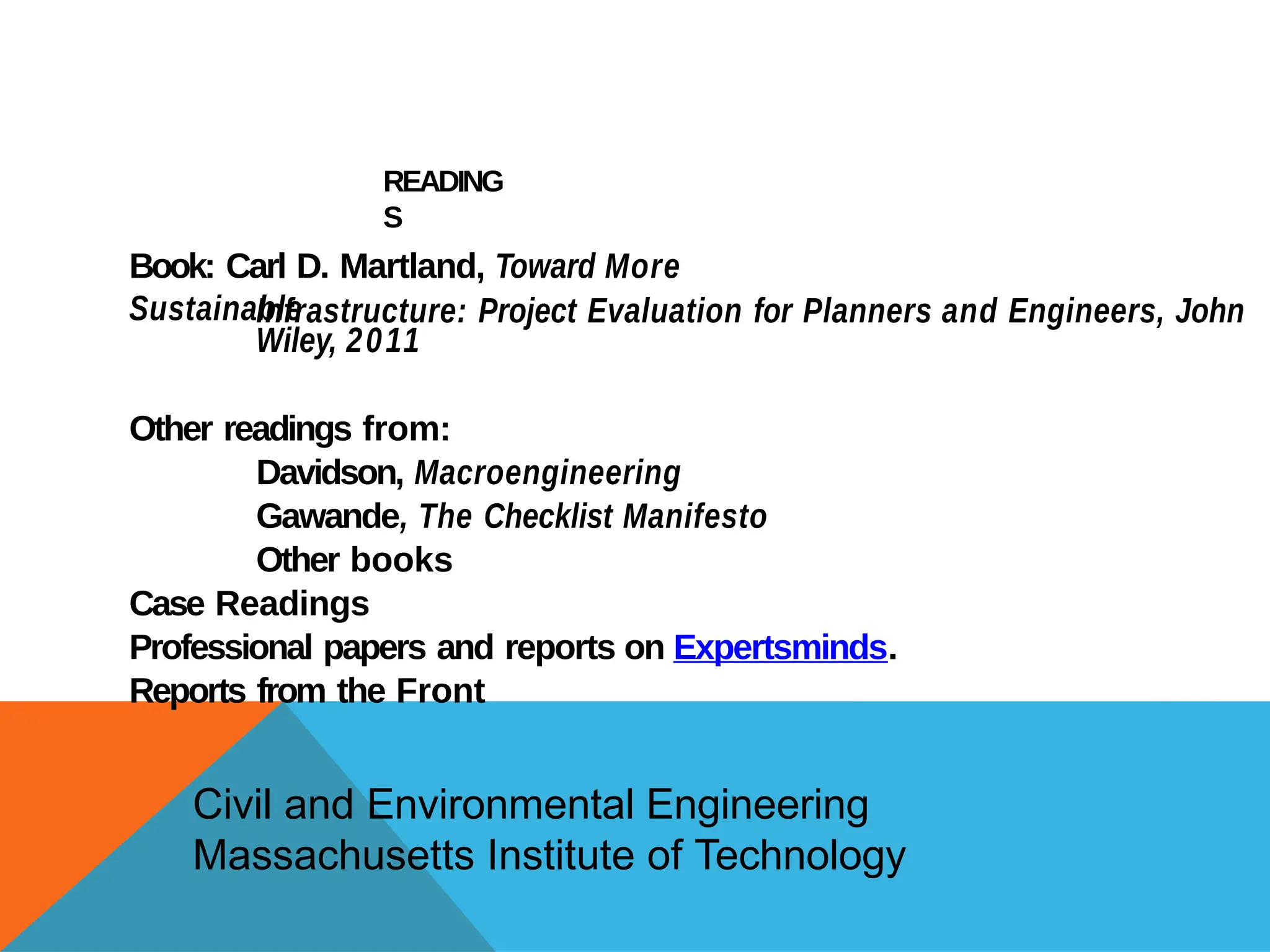
READING
S
Civil and Environmental Engineering
Massachusetts Institute of Technology
Book: Carl D. Martland, Toward More
Sustainable
Infrastructure: Project Evaluation for Planners and Engineers, John
Wiley, 2011
Other readings from:
Davidson, Macroengineering
Gawande, The Checklist Manifesto
Other books
Case Readings
Professional papers and reports on Expertsminds.
Reports from the Front
Civil and Environmental Engineering
Massachusetts Institute of Technology
MIT OpenCourseWare
http://ocw.mit.edu
Project Evaluation
For information about citing these materials or our Terms of Use, visit: http://ocw.mit.edu/terms.

Project Evaluation Presentation for Students

  • 1.
    PROJECT EVALUATION (1.011) Civiland Environmental Engineering Massachusetts Institute of Technology Spring 2011 Lecture 1 Instructors: Professor Joseph Sussman Carl Martland Teaching Assistants: Nihit Jain Edna Ezzell
  • 2.
    • Lectures/Recitations • Sussman,Martland, guests presenting case • Jain/Ezzell • Assignments (A) • Term project (P) THIS IS A CLASS ABOUT DECIDING WHA T TO DO. THAT’S WHA T ENGINEERS UL TIMA TEL Y DO. THIS IS A CLASS ABOUT LARGE-SCALE INFRASTRUCTURE (FOR THE MOST P ART) Civil and Environmental Engineering Massachusetts Institute of Technology 1.011 Overview
  • 3.
    Learning Objectives: Civil and EnvironmentalEngineering Massachusetts Institute of Technology Following this class, students should be able to 1. Effectively use basic engineering economics tools to evaluate major infrastructure projects 2. Understand when to complement this basic analysis with more sophisticated tools 3. Critique the process used to evaluate typical infrastructure projects 4. Understand a broad range of project types of relevance to CEE and related fields 5. Understand some ways in which project performance can be measured and improved 6. Understand the role of uncertainty in project evaluation 7. Do an ―end-to-end‖ project evaluation
  • 4.
    • Written self-intros--professionalinterests, relevant experience, learning expectation (ungraded) A1.1 - Basic concepts I A1.2 - Basic concepts II A2 - Large scale project evaluationA3.1 - Advanced concepts I A3.2 - Advanced concepts II A4 - Peer Project Evaluations 1-pagers on guest cases--due the next class after the case lecture Civil and Environmental Engineering Massachusetts Institute of Technology ASSIGNMENT S
  • 5.
    • Work inteams of 2 or 3 • A project evaluation • Your choice, subject to instructors’ review Civil and Environmental Engineering Massachusetts Institute of Technology TERM PROJECT
  • 6.
    • Background onthe project • If a current or past project, a summary of the costs and benefits that were considered by decision-makers and how they were analyzed • Major issues that affect(ed) the project • Significant decisions that will be/were made regarding project design and implementation • Status of the project and results if it has been completed • Your own analysis of the relevant costs and benefits (if you choose an entirely new project, this will be the main body of your project) • Discussion and critique of the project and the project evaluation process Civil and Environmental Engineering Massachusetts Institute of Technology THE TERM PROJECT SHOULD BE ABOUT 15 PAGES LONG, INCLUDING:
  • 7.
    Teams formed: Lecture6 Project Description P1: (2pages): Due Lecture 10 P1 needs to address the following topics  Provide a brief project description  Why is the project interesting?  What are the key uncertainties involved in the project? Civil and Environmental Engineering Massachusetts Institute of Technology PROJECT DUE DATES:
  • 8.
    P2 Due Lecture 17: Civiland Environmental Engineering Massachusetts Institute of Technology Progress Report 1: (2 pages) P2 needs to address the following topics  Identification of Stakeholders  Identification of Benefits and Costs  Data Sources you are using and any data problems you are encountering
  • 9.
    P3 Due Recitation 10: Civiland Environmental Engineering Massachusetts Institute of Technology Progress Report 2: (2 pages) P3 needs to address the following topics Project finance Major barriers to a successful completion of your written project
  • 10.
    P4 LECTURE 23: Copyof powerpoint presentation due Civil and Environmental Engineering Massachusetts Institute of Technology Lectures 23, 24, and 25: Presentations to class (participation points for constructive questions and comments from the audience)
  • 11.
    P5 LECTURE 26: Civil andEnvironmental Engineering Massachusetts Institute of Technology Final Report due at 11:59pm (last day of classes) Oral Presentations on term project-- Mini-presentation (<7 minutes)--your initial ideas (during Recitation 6) Final presentation at end of term during Lectures 23, 24, 25 Meetings with 1.011 instructing staff -- to be arranged
  • 12.
    Teaching Modalities: Civil andEnvironmental Engineering Massachusetts Institute of Technology The intent is that the classes should be as interactive as possible. Occasionally it’s ― w e lecture you listen‖ but we will endeavor to get you involved In lectures Methods and concepts Case studies to illustrate and expand upon methods and concepts ―Reports from the Front‖ (RFTF)—discussion of current events of relevance to 1.011 Also, we want you to learn from each other– student project presentations will comprise the last several lectures
  • 13.
    In recitations Review andclarification of methods and concepts Discussion of problem sets/ quiz Project work Outside the classroom Each term project team (see below) will meet with the teaching staff several times during the semester Civil and Environmental Engineering Massachusetts Institute of Technology
  • 14.
    Student Work: Civil andEnvironmental Engineering Massachusetts Institute of Technology Readings, as assigned Problem sets Term project Participation in class. Contribut ing to class discussi on The class will have several guest lecturers discussing projects in their domain areas. Y ou will submit a < 1-page summary for each case turned in the next you attend that case class or class after the case is presented (whether not) as a part of class participation. One in-class exam, open book and notes
  • 15.
    READING S Civil and EnvironmentalEngineering Massachusetts Institute of Technology Book: Carl D. Martland, Toward More Sustainable Infrastructure: Project Evaluation for Planners and Engineers, John Wiley, 2011 Other readings from: Davidson, Macroengineering Gawande, The Checklist Manifesto Other books Case Readings Professional papers and reports on Expertsminds. Reports from the Front
  • 16.
    Civil and EnvironmentalEngineering Massachusetts Institute of Technology
  • 17.
    MIT OpenCourseWare http://ocw.mit.edu Project Evaluation Forinformation about citing these materials or our Terms of Use, visit: http://ocw.mit.edu/terms.