T. Manori Perera
BSc. (Hons) in Civil Engineering (University of Moratuwa)
PhD Candidate at University of Moratuwa
GROUP PROJECT
Assignment:- Design and construction of multistory building for
commercial and residential purposes in Battaramulla.
 Three main parties involve in the construction project
1. Client
2. Consultant
3. Contractor
Client’s Brief ( Client’s Requirement)
 How many stories
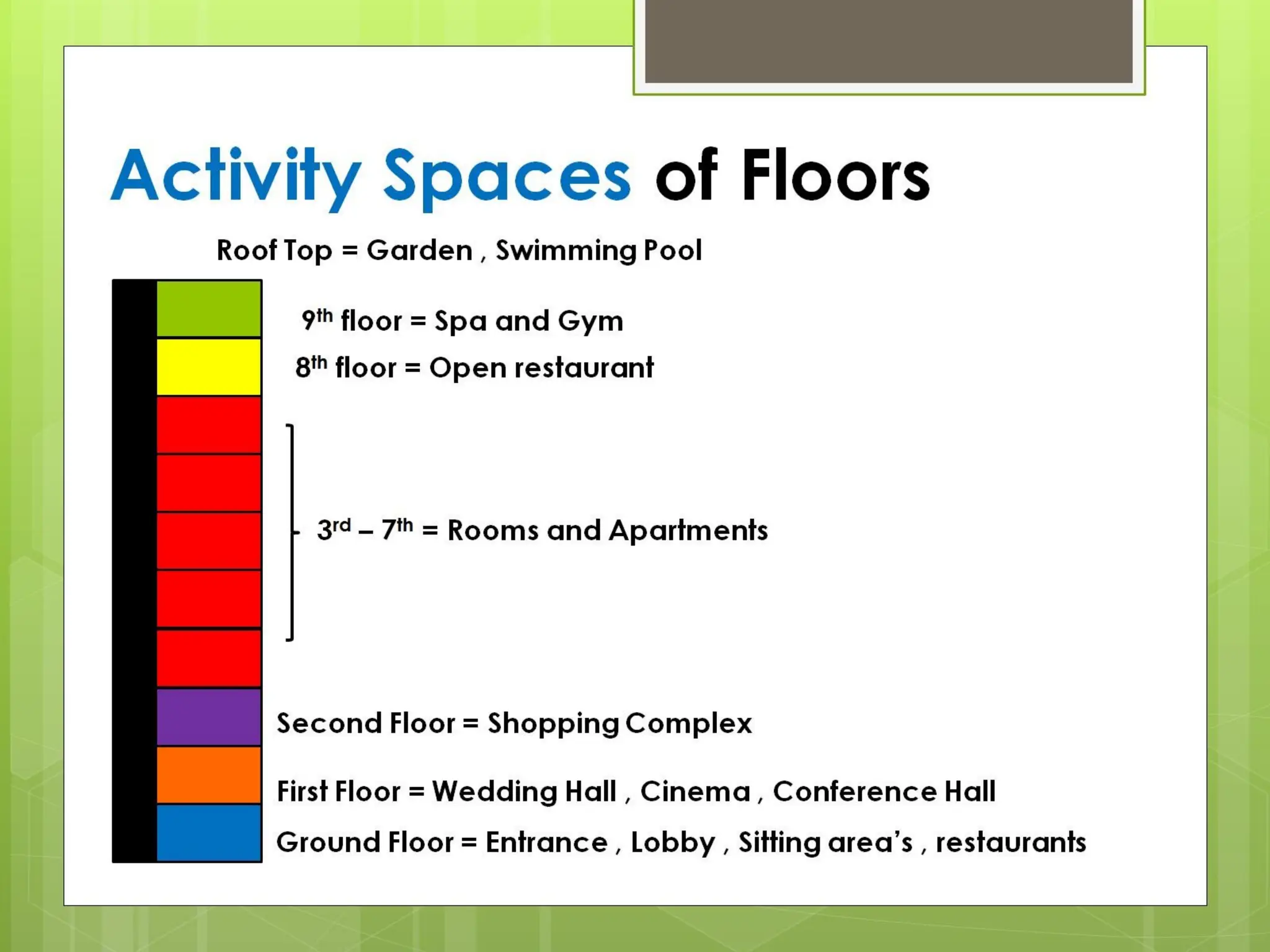
 What are the functional spaces for commercial and residential purposes such as
compartments, office areas, Dining areas, super markets, swimming pool, security
etc
 Parking arrangement for minimum ………
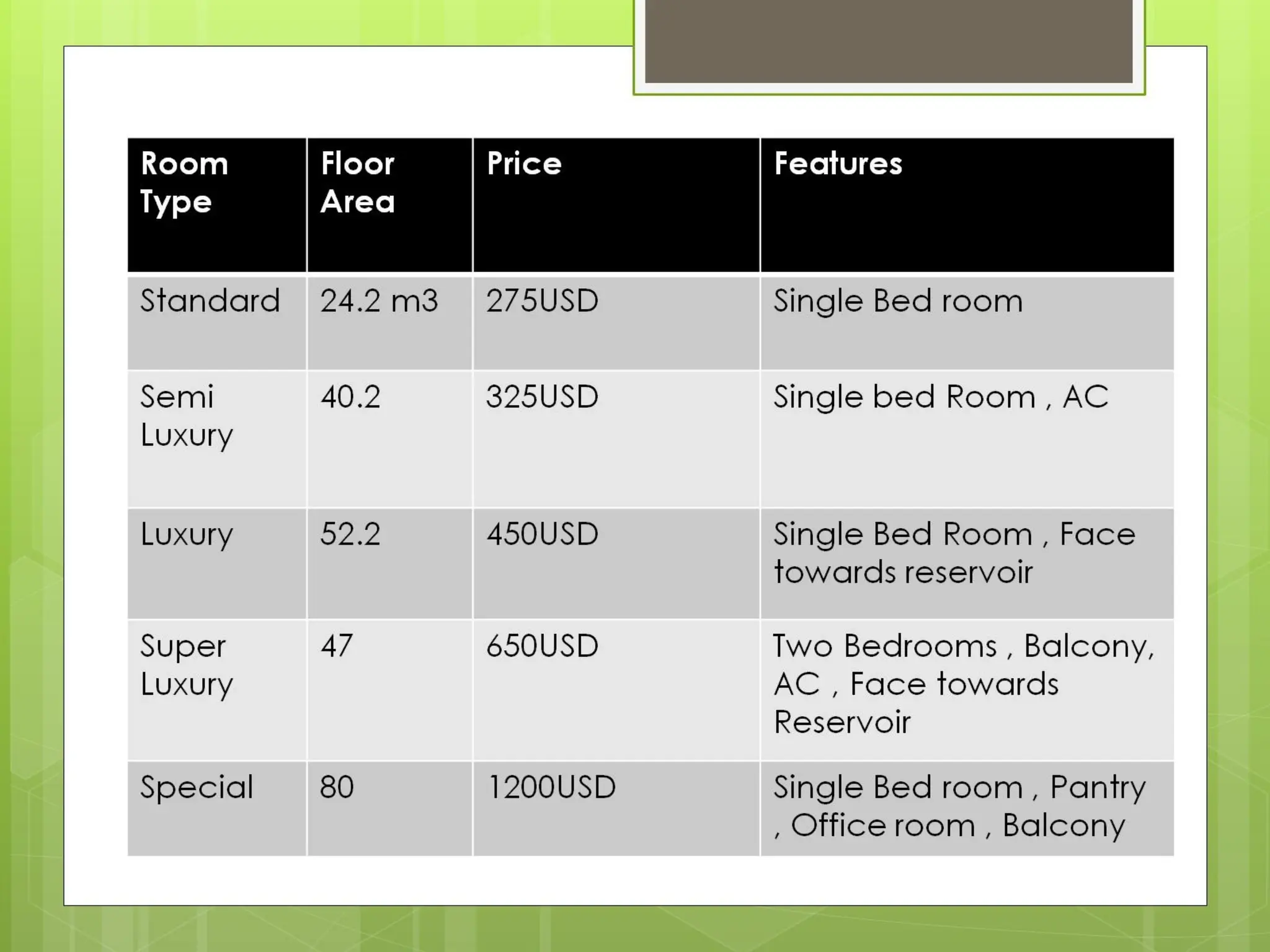
 Categories of compartments eg:- Standard, intermediate and luxury levels by giving
proper names for the categorization
 Efficient solid waste and water disposal system
 LEED Certificate
Project Details
 Client
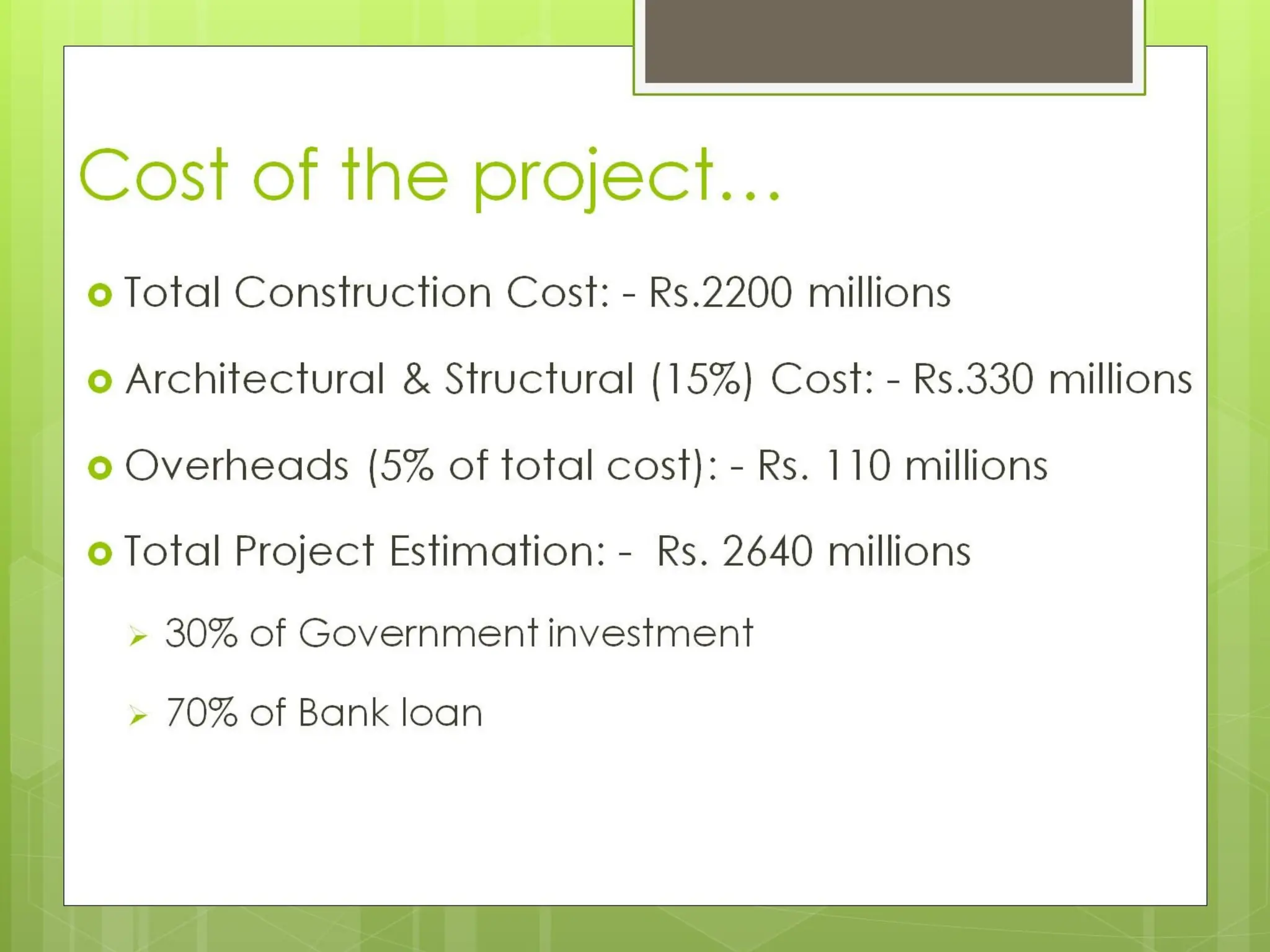
 Project value
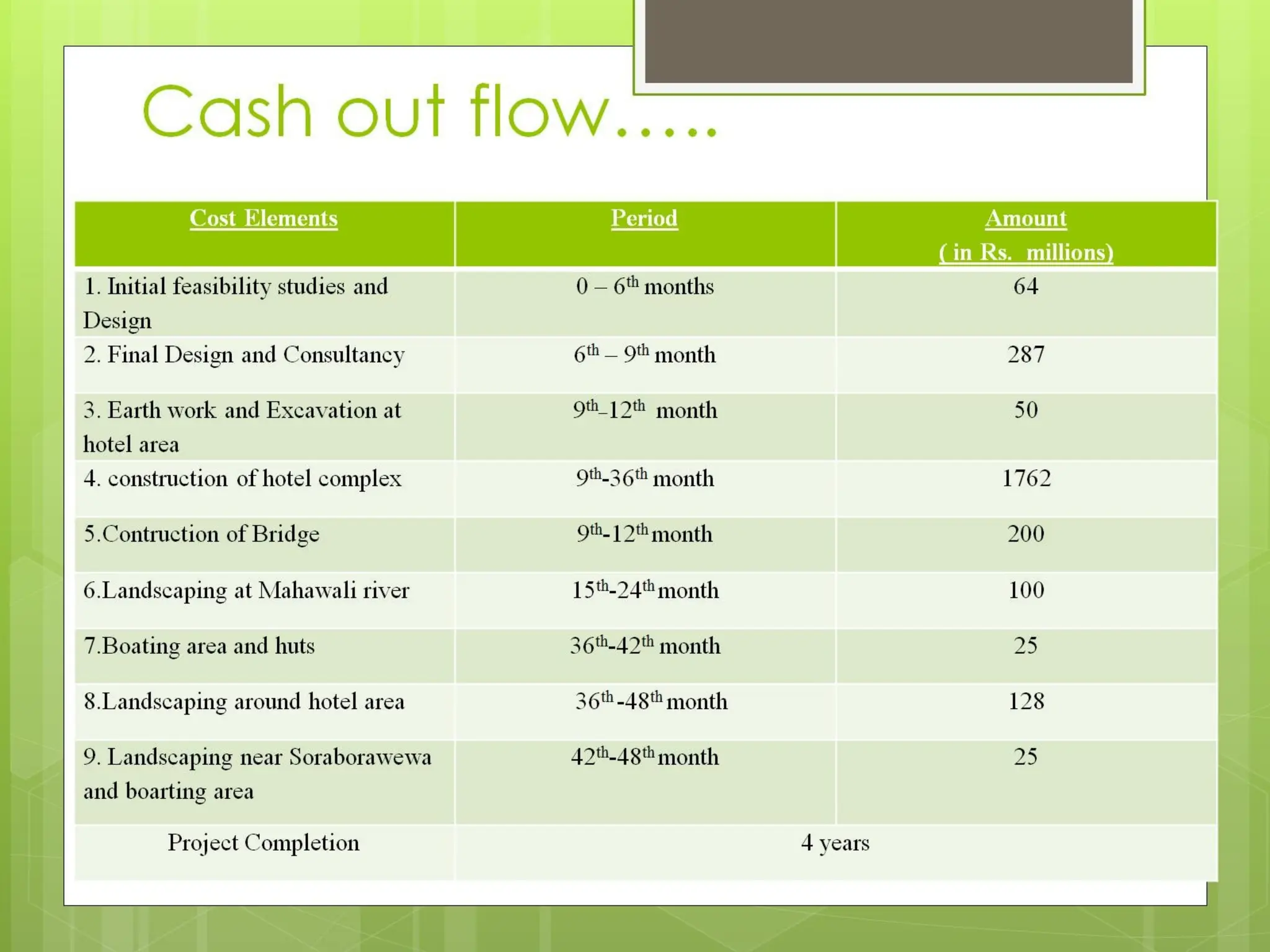
 Project duration
 Land area
 Contractor ( Can select by considering project cost, reputation etc)
Terms of Reference (TOR)
 A TOR is a document which describes the purpose, structure and sets out a
roadmap for a given task .It shows how the scope will be defined, developed, and
verified.
 TORs are especially useful for those who are going to carry out the task in estimating
the required amount of resources (time, financial, human and/or material) and
designing methodologies.
 Purpose
The purpose of the program/project: What was the rational for designing the project?
What are the general and specific objectives of the project?
 Proposed considerations in designing the methodology
Structural Key elements (central core, perimeter columns- use high strength concrete)
Floor to floor height
 Proposed work schedule
 Sustainable material usage, Disposal system, Fire protecting system
 Technologies use to obtain LEED certification (Leadership in Energy and
Environmental Design)
Project Introduction
 Purpose of the construction
 Objectives and benefits of the project
 Key components of the project (Compartments, office rooms,
super markets, gym, swimming pool , restaurants, parking facilities,
children's park etc..)
 Project Location
Optimum utilization of land area with several Landscape futures
Access to the main road or public transport
Contours of site location
Location of the Water Table
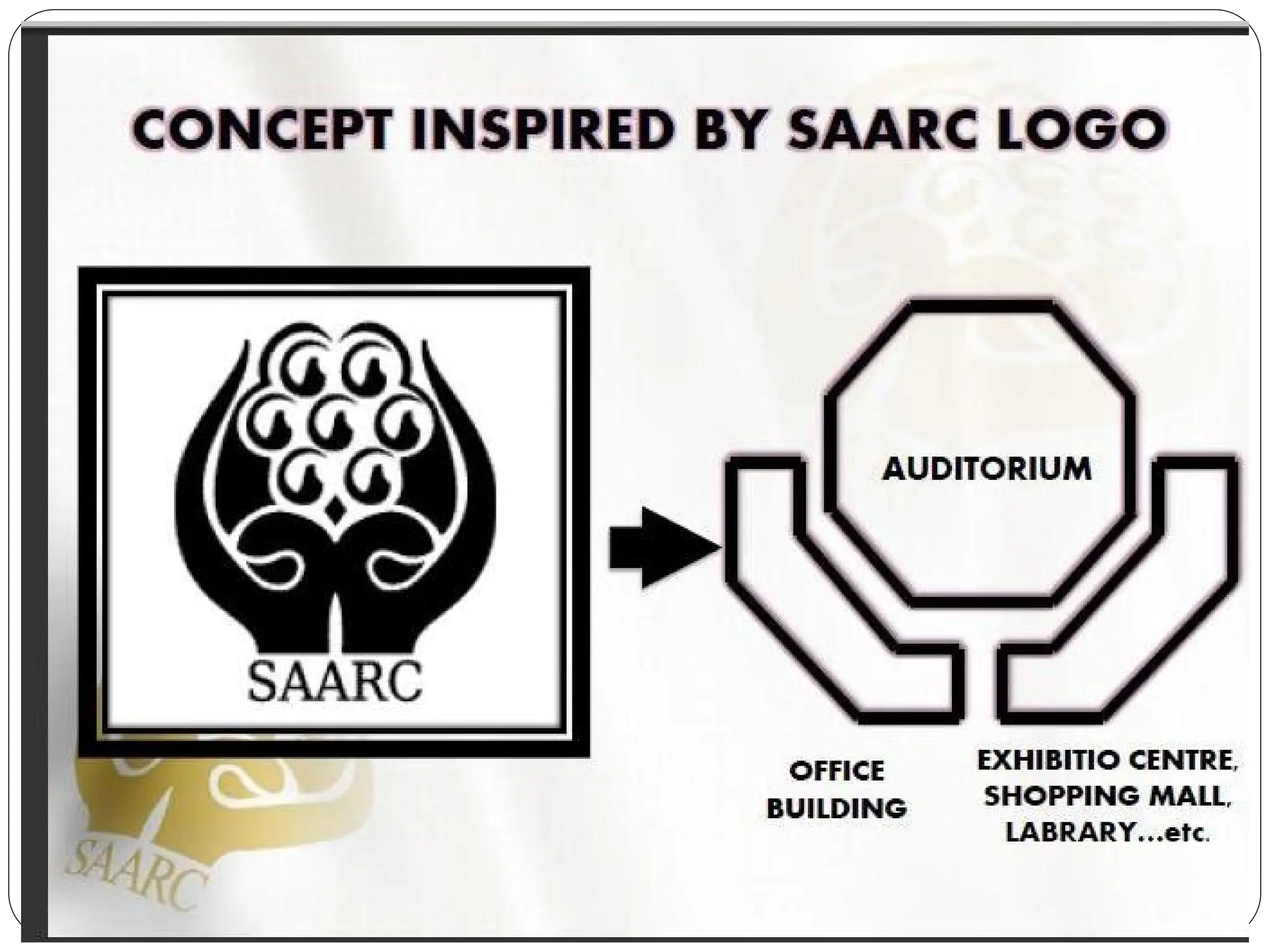
Conceptual design and Architectural design
Maximum utilization of the indoor spaces
Attractive Structure
Blend with the natural beauty ( Diyawanna oya)
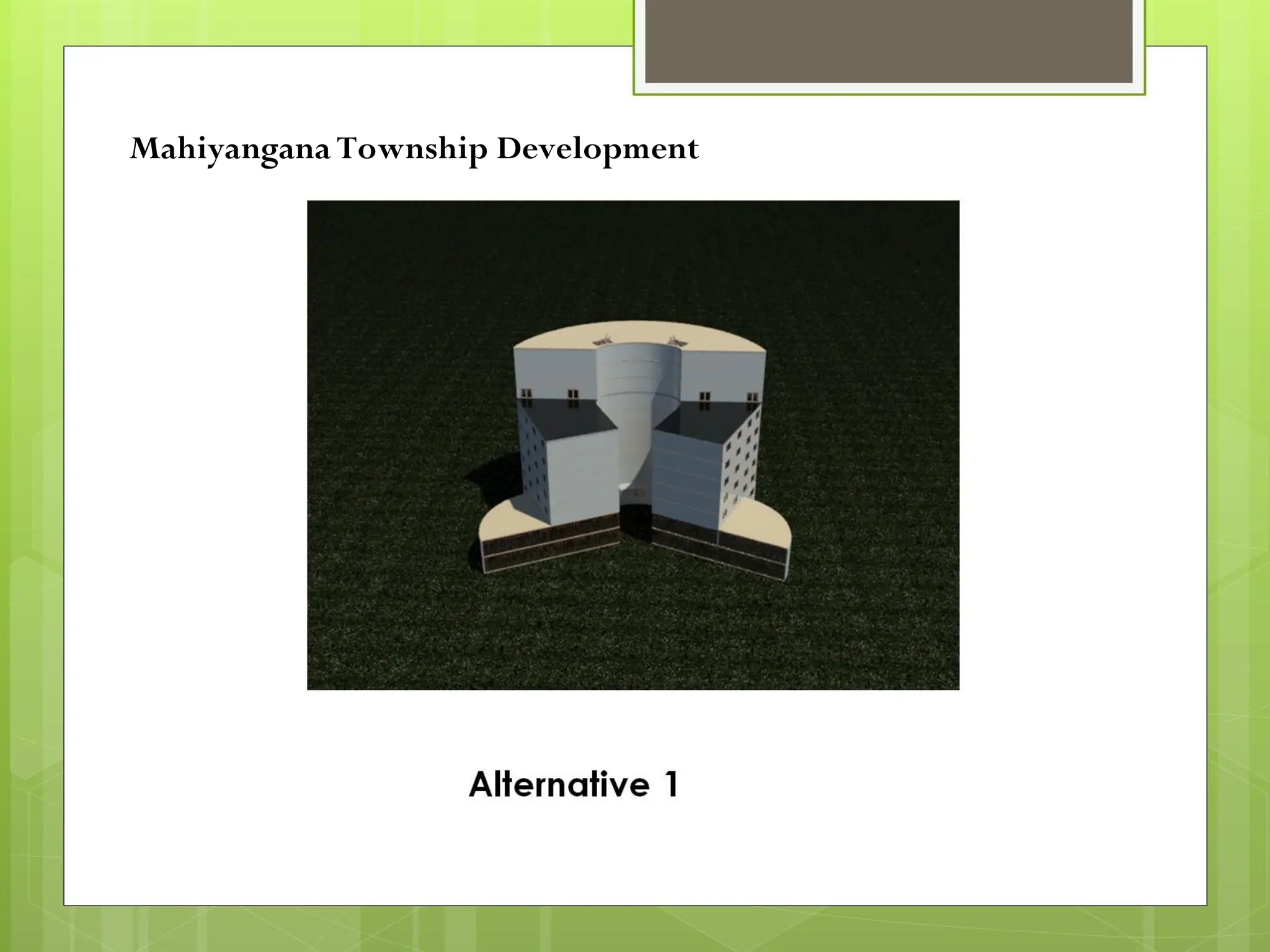
Mahiyangana Township Development
Architectural Design
Architecture is an art of designing the built environment with important
elements such as buildings, landscaping and street design by considering
functional and estatically pleasing appearance
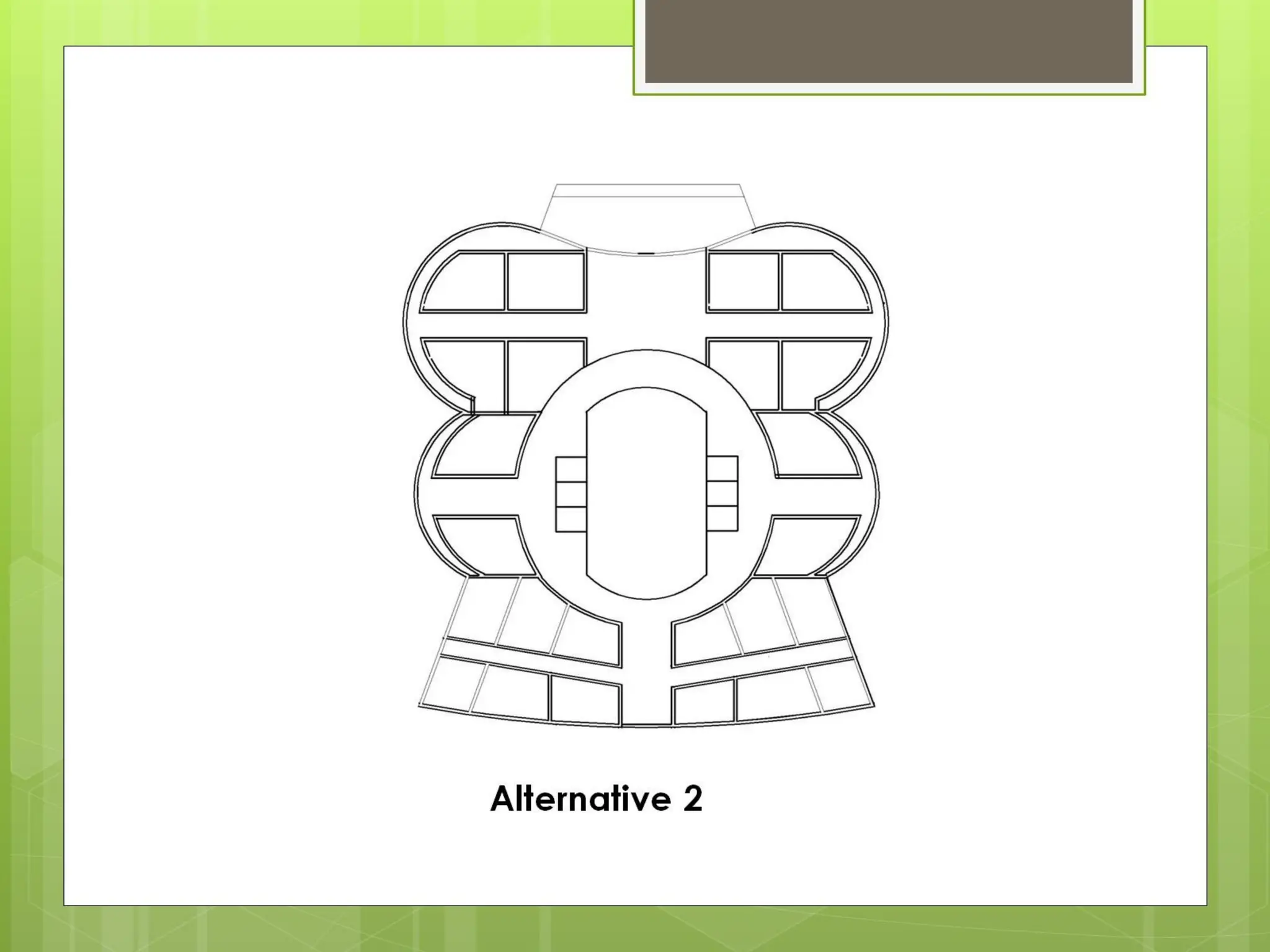
 Architectural Design for Site layout
 Architectural Design for building such as front, side, plan views and floor
arrangement of each
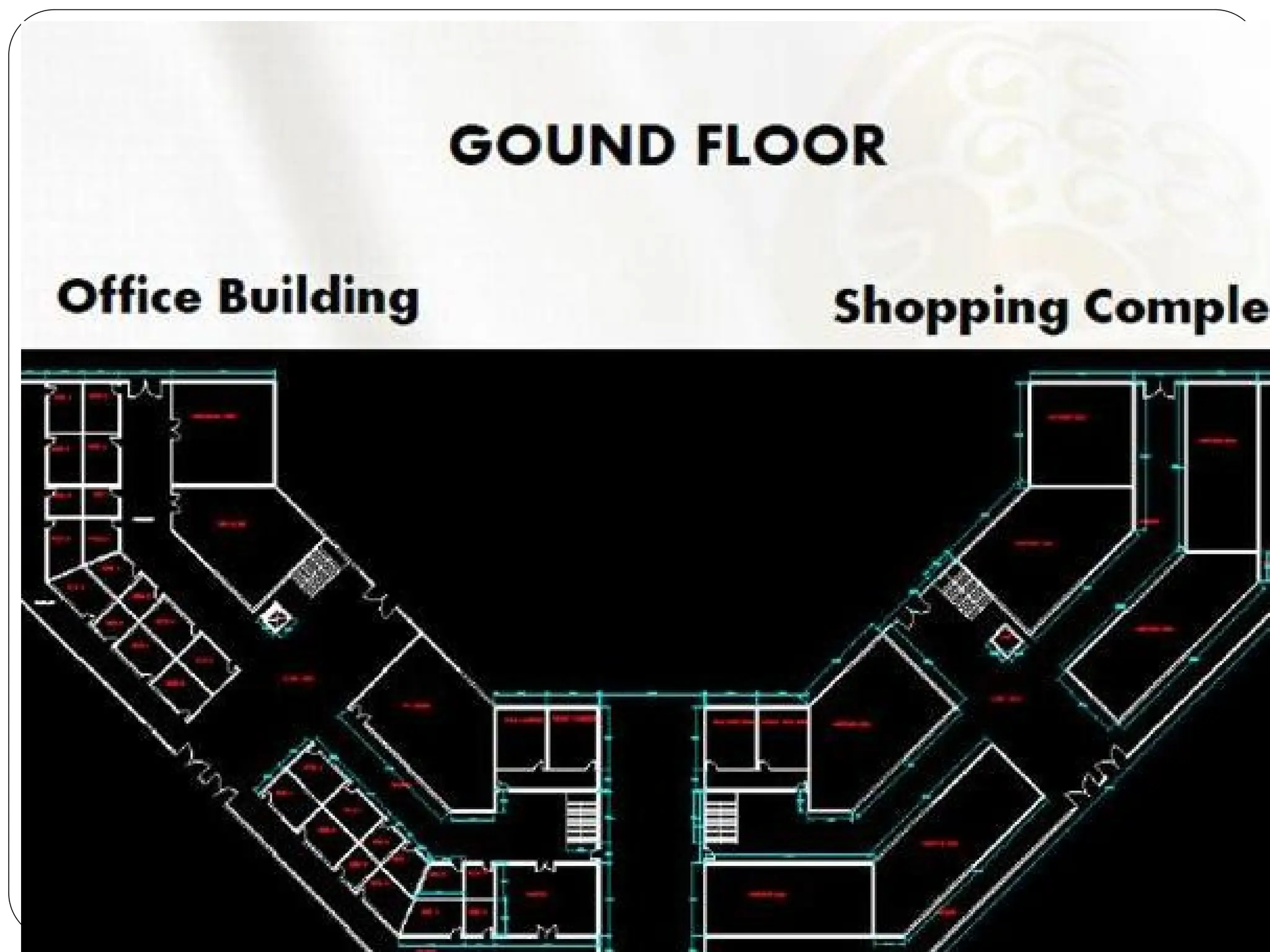
Architectural Drawings
For each floor arrangement and front, side, plan
views
Feasibility Study
Feasibility study will compare the other possible development in this area and priority will be given to
the better project with use of minimum resources
Technical Feasibility
Why the project is technically feasible
 Buildings are maintaining topography
 Soil is laterite soil so can go for shallow foundations or deep foundations
 As this is a rural land no nearby buildings to do an investigation on how much they are affected by
vibrations
 With the sloping ground no need to pump waste water to treatment plants only have break pressures
to reduce pressure
 Materials and labors (sources) are available
Financial Feasibility
Consider about the revenue from the project during the limited time schedule
Environmental Impact Assessment
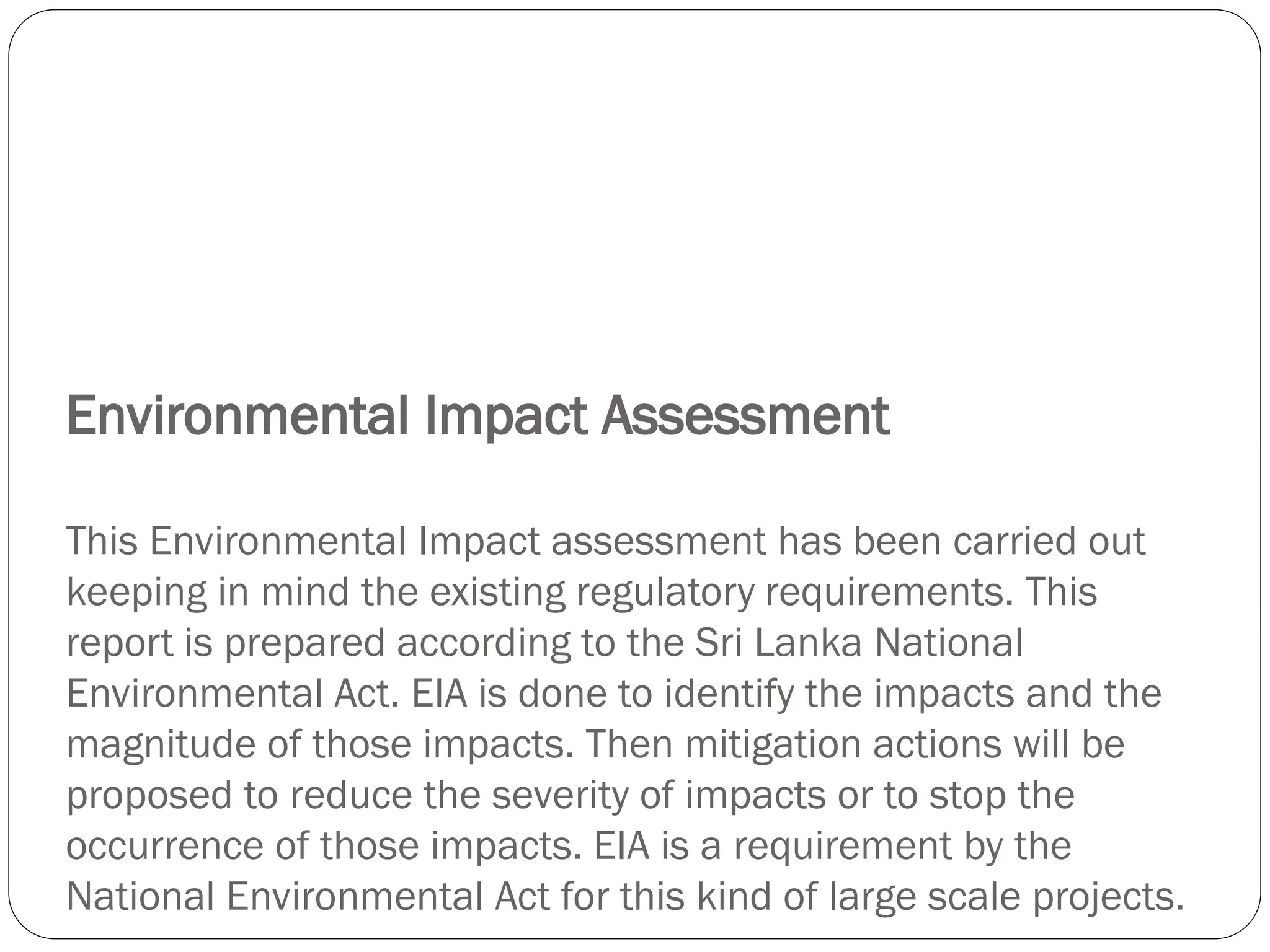
This Environmental Impact assessment has been carried out
keeping in mind the existing regulatory requirements. This
report is prepared according to the Sri Lanka National
Environmental Act. EIA is done to identify the impacts and the
magnitude of those impacts. Then mitigation actions will be
proposed to reduce the severity of impacts or to stop the
occurrence of those impacts. EIA is a requirement by the
National Environmental Act for this kind of large scale projects.
Objectives of the EIA
• To acquire information of the geological, biological, social
and cultural background of the affected area
• To identify the potential impacts to the environment due to
the project
• To propose necessary remedial procedures to mitigate the
adverse impacts to the environment
• To devise an environmental monitoring program
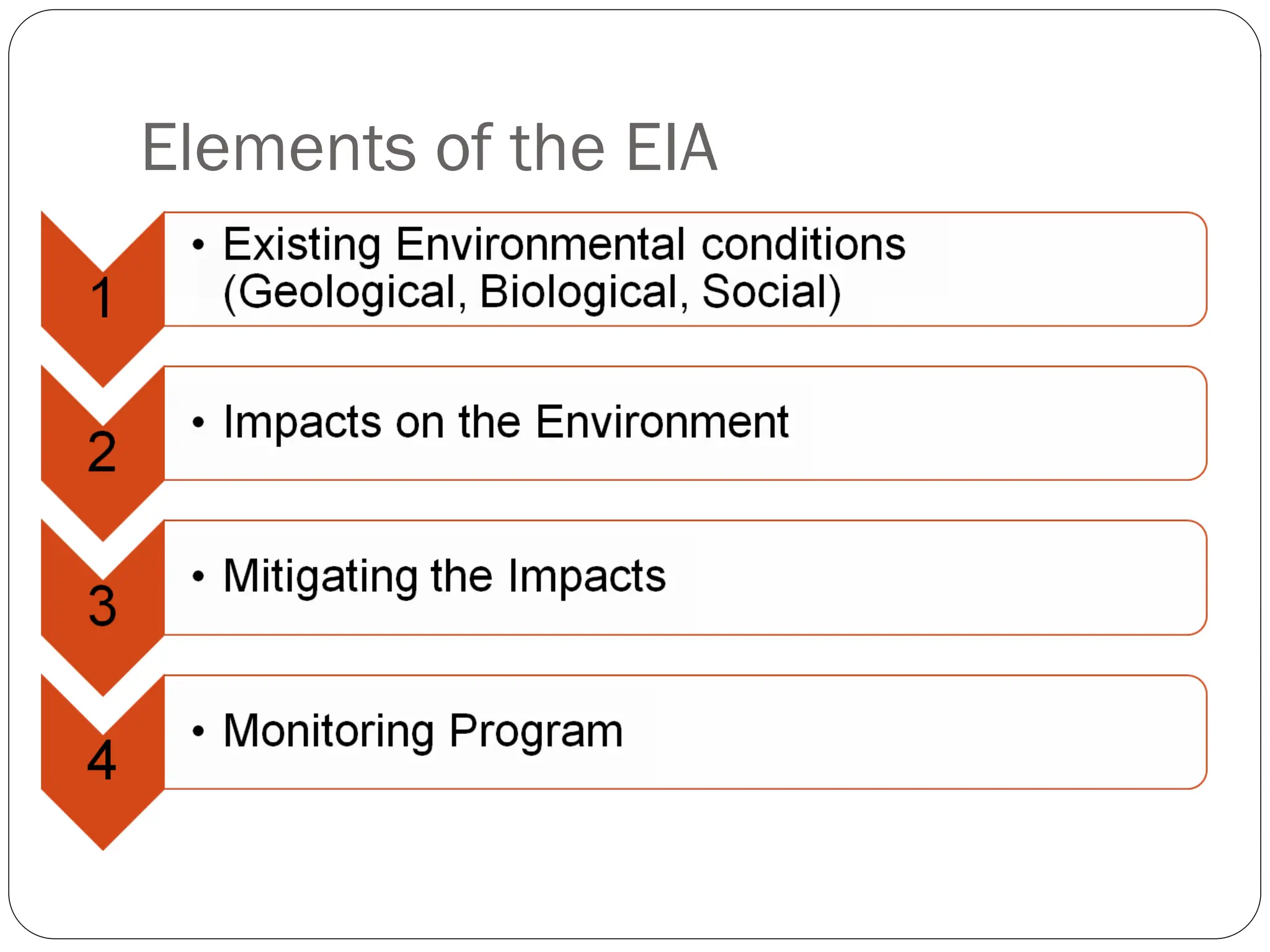
Elements of the EIA
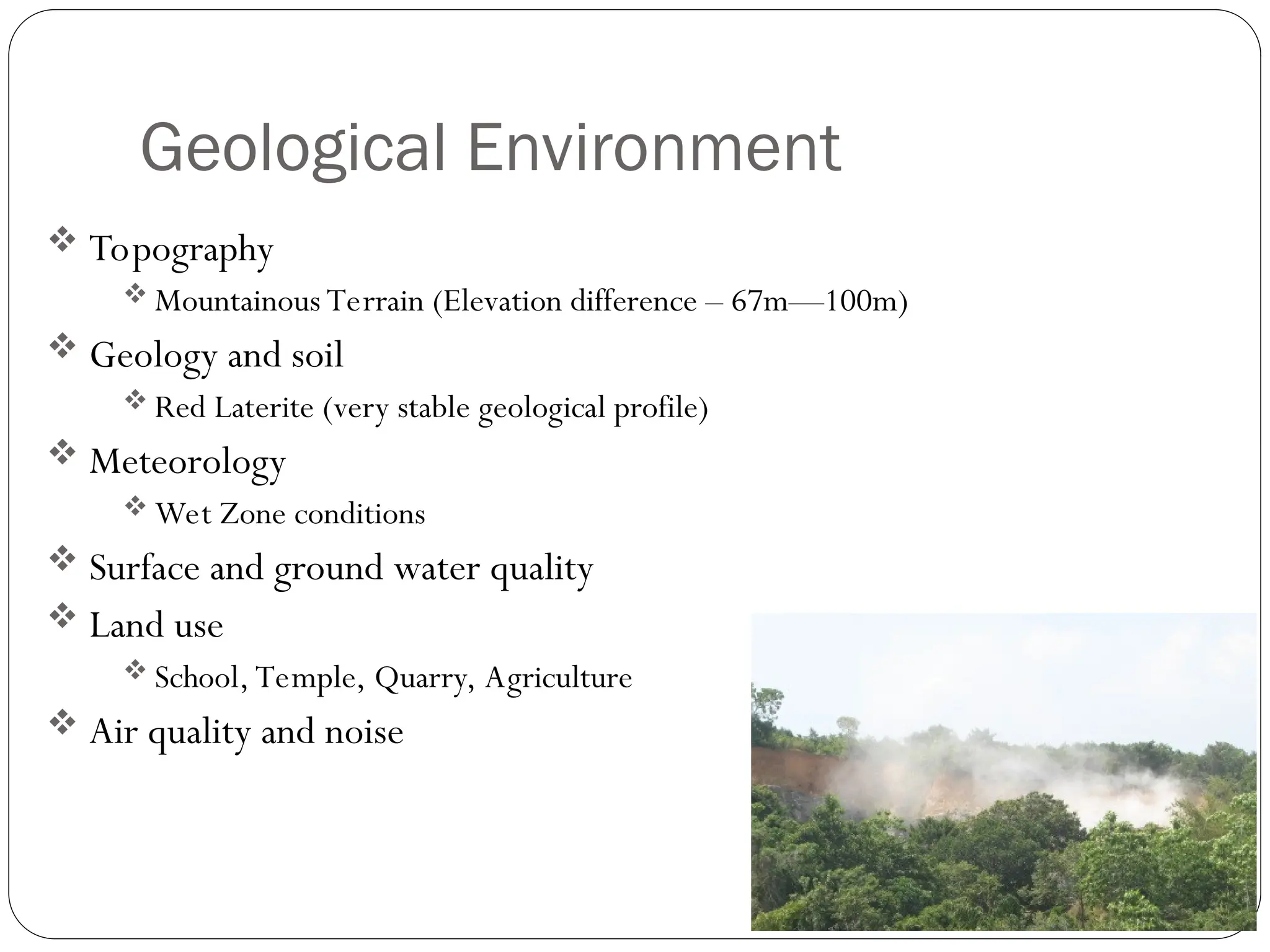
Geological Environment
 Topography
 Mountainous Terrain (Elevation difference – 67m—100m)
 Geology and soil
 Red Laterite (very stable geological profile)
 Meteorology
 Wet Zone conditions
 Surface and ground water quality
 Land use
 School, Temple, Quarry, Agriculture
 Air quality and noise
Construction Stage Impacts- Negative
• Impact on the Geological and Ecological system
– Change in local physiographic and drainage pattern due to changes
on land
– Generation of waste during construction stage
– Noise pollution
• Social environment
– Generation of dust
– Sound pollution and vibration
– Congestion in access roads
– Safety of workers and public
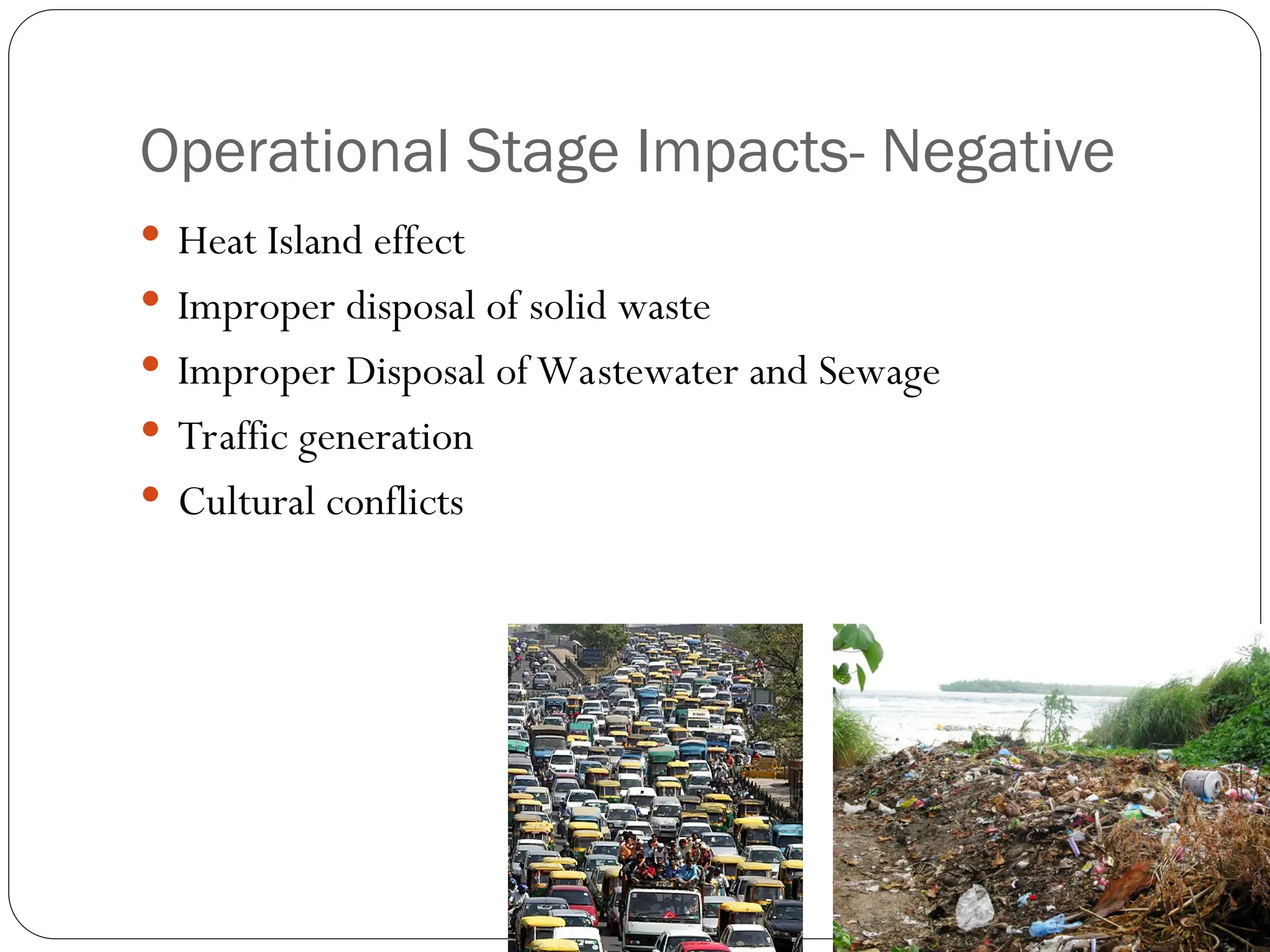
Operational Stage Impacts- Negative
 Heat Island effect
 Improper disposal of solid waste
 Improper Disposal of Wastewater and Sewage
 Traffic generation
 Cultural conflicts
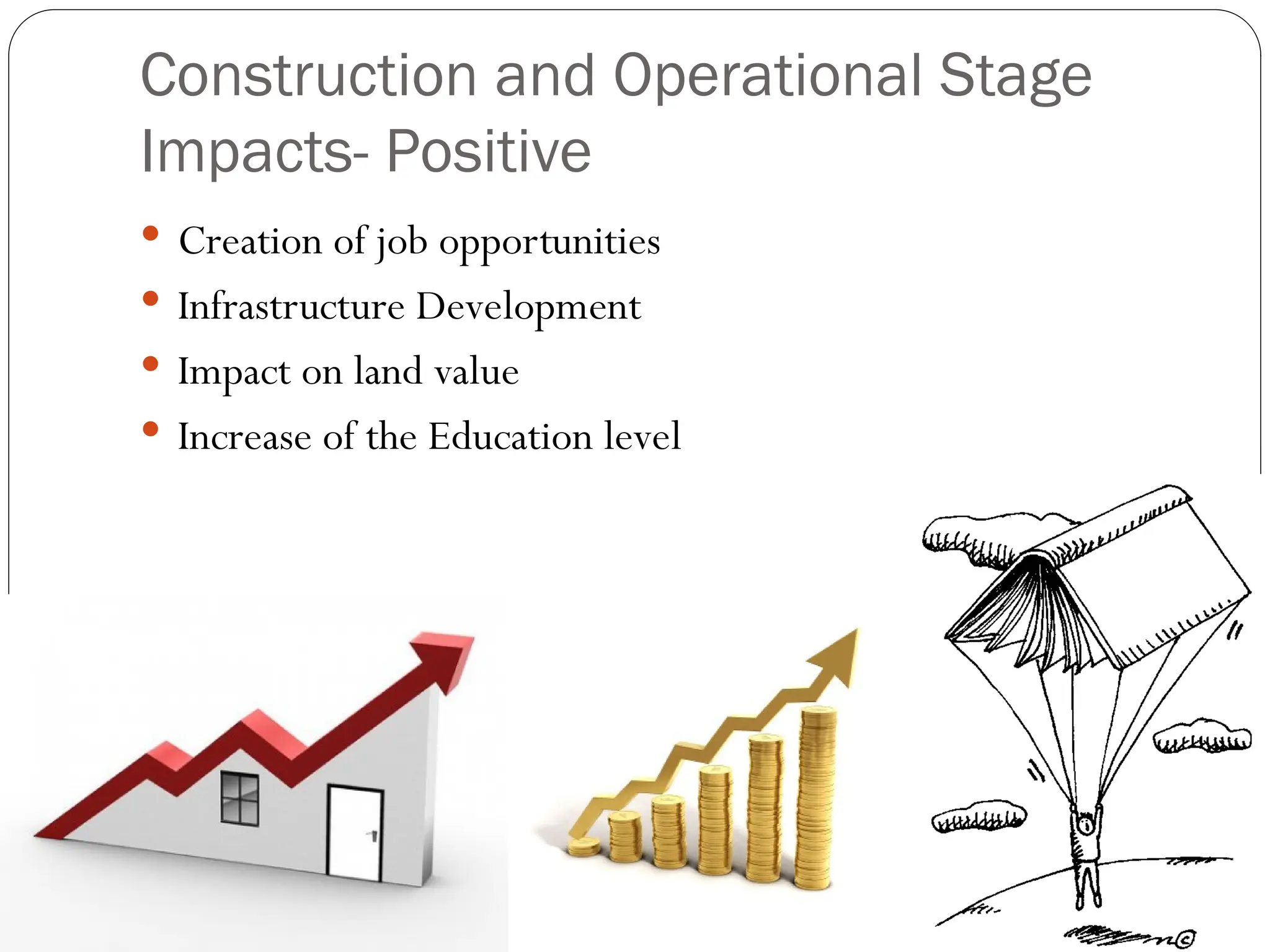
Construction and Operational Stage
Impacts- Positive
 Creation of job opportunities
 Infrastructure Development
 Impact on land value
 Increase of the Education level
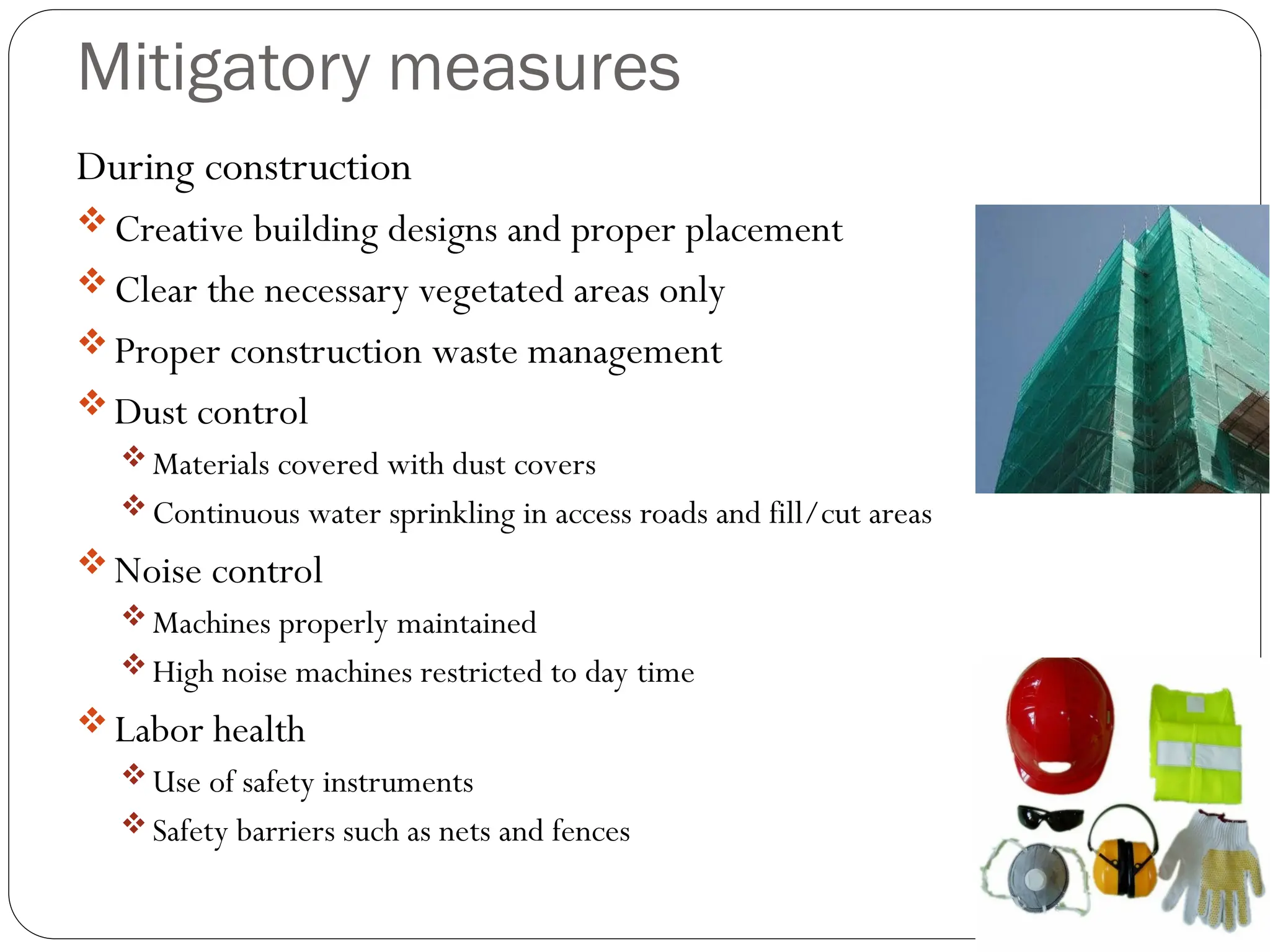
Mitigatory measures
During construction
Creative building designs and proper placement
Clear the necessary vegetated areas only
Proper construction waste management
Dust control
Materials covered with dust covers
Continuous water sprinkling in access roads and fill/cut areas
Noise control
Machines properly maintained
High noise machines restricted to day time
Labor health
Use of safety instruments
Safety barriers such as nets and fences
Mitigatory measures
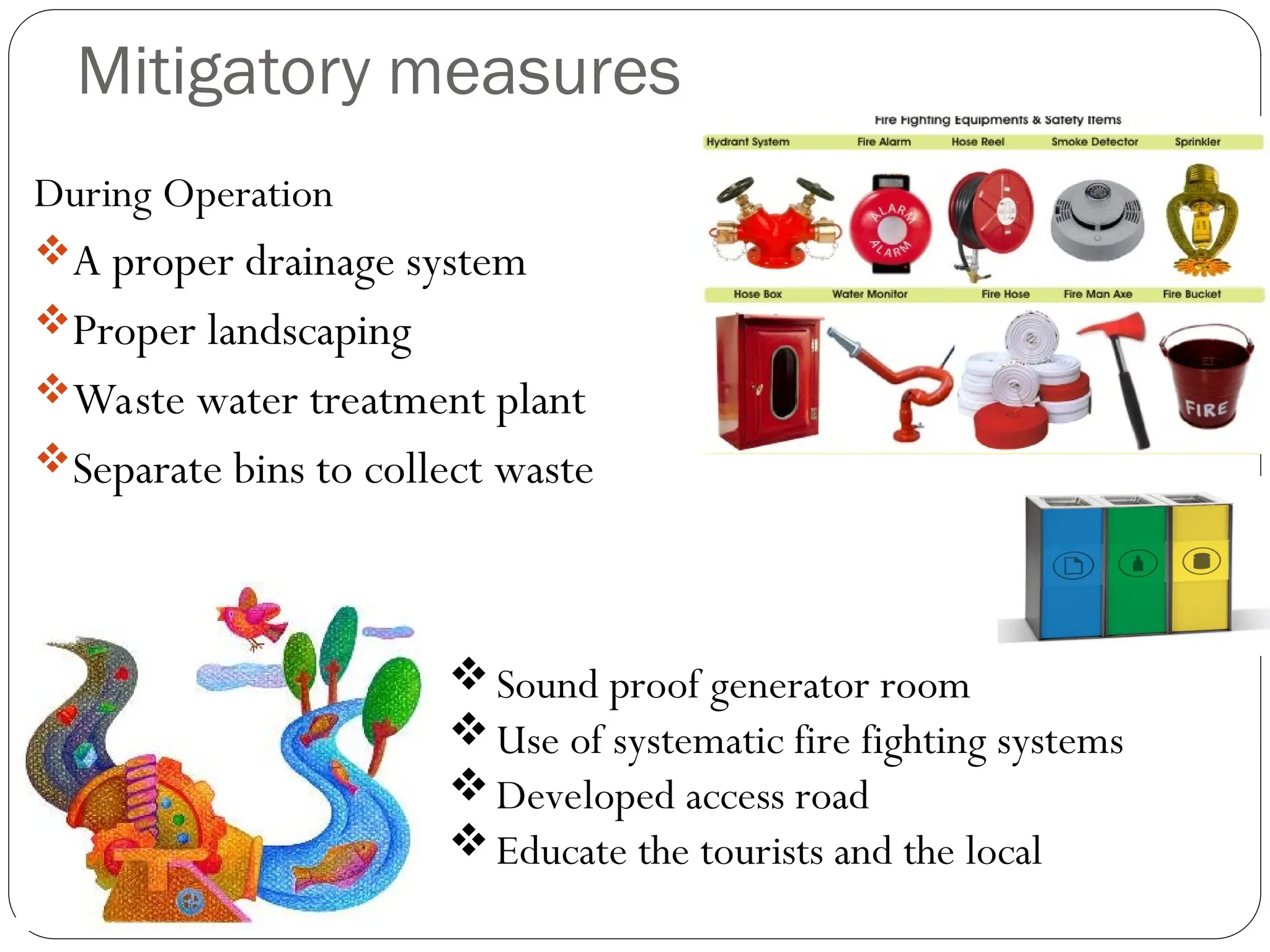
During Operation
A proper drainage system
Proper landscaping
Waste water treatment plant
Separate bins to collect waste
Sound proof generator room
Use of systematic fire fighting systems
Developed access road
Educate the tourists and the local
Monitoring Program
Water quality monitoring
Air quality
Measure vibration levels during construction operations
Waste handling monitoring
Data collection about species
Monitoring the infrastructure
Conclusion
 Overall impact on the environment is Positive considering
the mitigated aspects
 The project is ecologically and socially feasible.
 Thus the EIA is
Traffic Impact Assessment (TIA)
AIM
To identify the current traffic and the possible traffic impacts
expected after the commencement of the proposed project to
maximize benefits and to minimize negative impacts and take
necessary mitigation methods.
Scope of TIA
 Analyses the existing traffic conditions around the proposed site
development
 Estimate the potential traffic generation due to the proposed
development
 Appraise the potential traffic impact of the proposed development
on the surrounding road network
 Identify the possible transportation issues related to the site
development.
 Estimate the parking Requirements and provide an efficient
vehicle circulation within the siteIdentify the possible
transportation issues related to the site development and come up
with road improvement proposals
 Existing Road and Traffic condition
 Existing access road condition
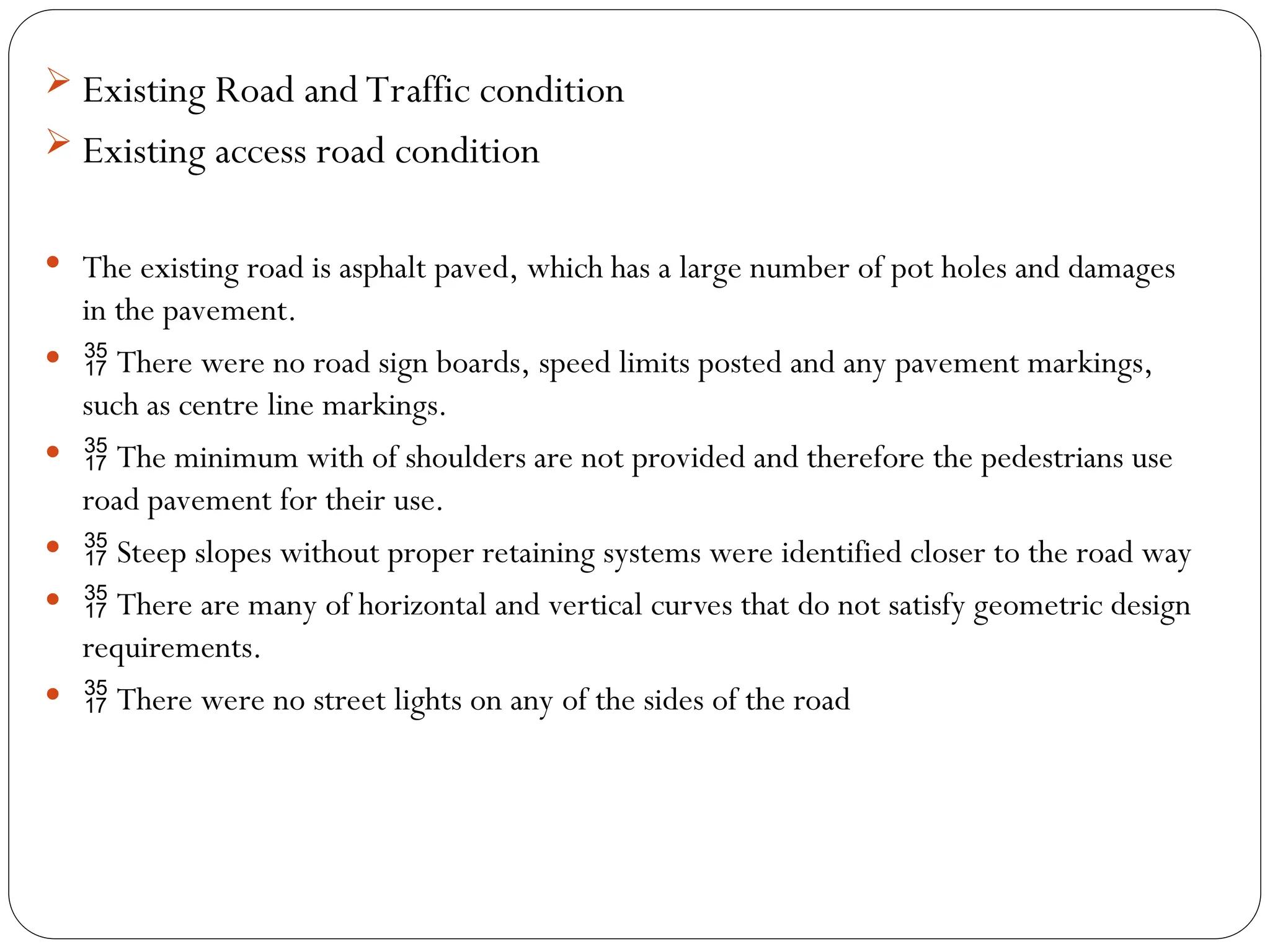
 The existing road is asphalt paved, which has a large number of pot holes and damages
in the pavement.
  There were no road sign boards, speed limits posted and any pavement markings,
such as centre line markings.
  The minimum with of shoulders are not provided and therefore the pedestrians use
road pavement for their use.
  Steep slopes without proper retaining systems were identified closer to the road way
  There are many of horizontal and vertical curves that do not satisfy geometric design
requirements.
  There were no street lights on any of the sides of the road
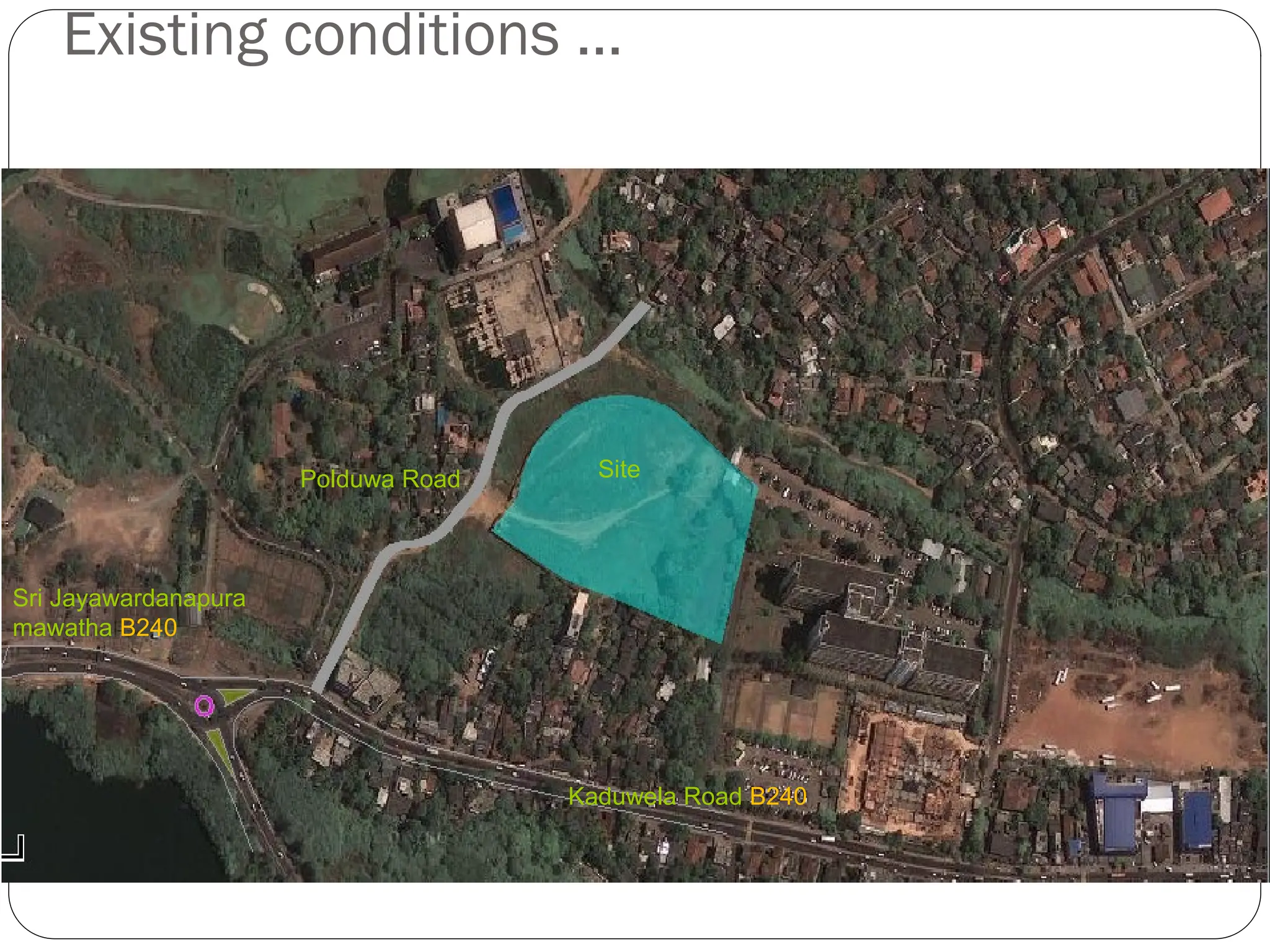
Existing conditions …
Polduwa Road
Kaduwela Road B240
Sri Jayawardanapura
mawatha B240
Site
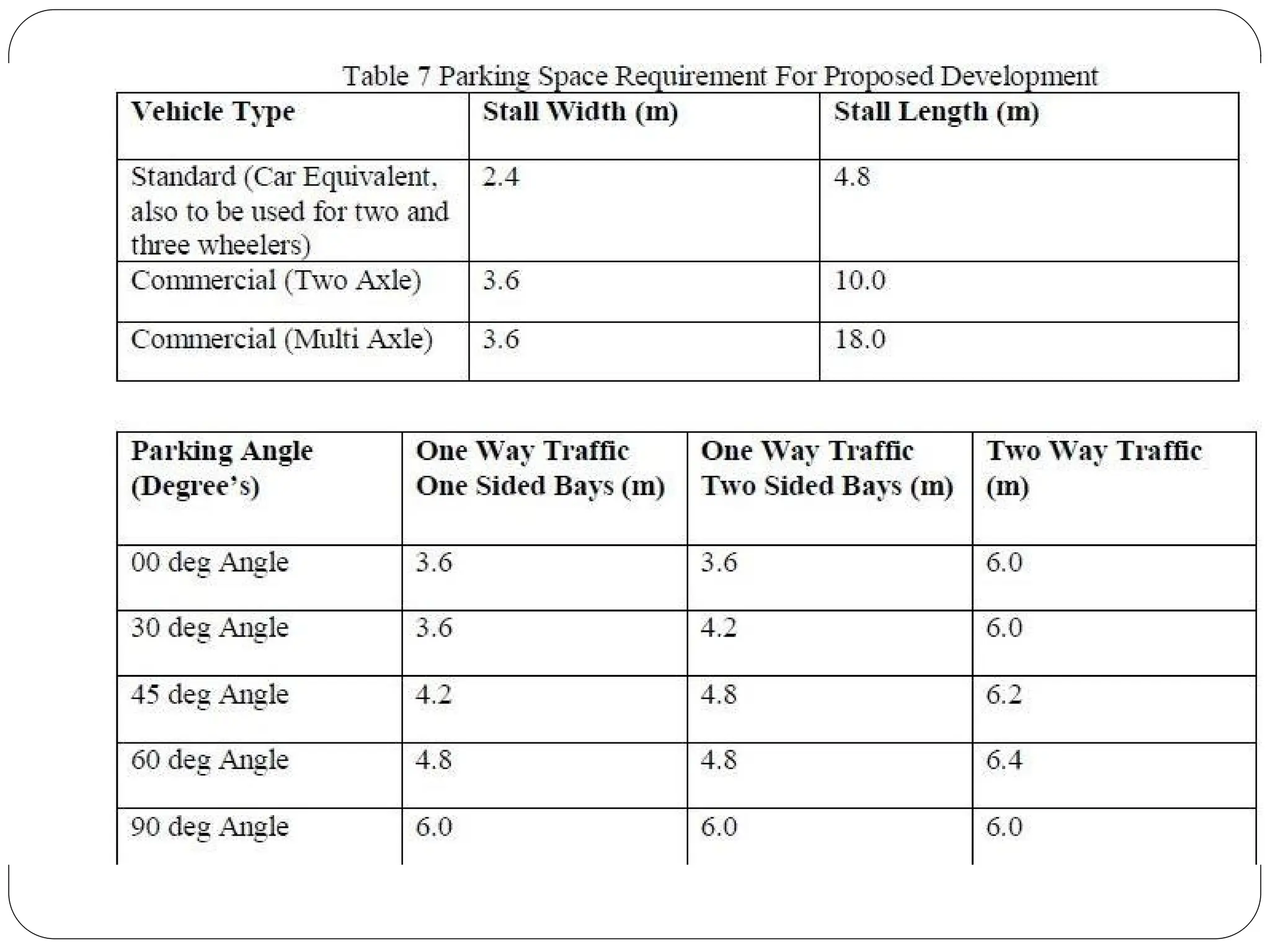
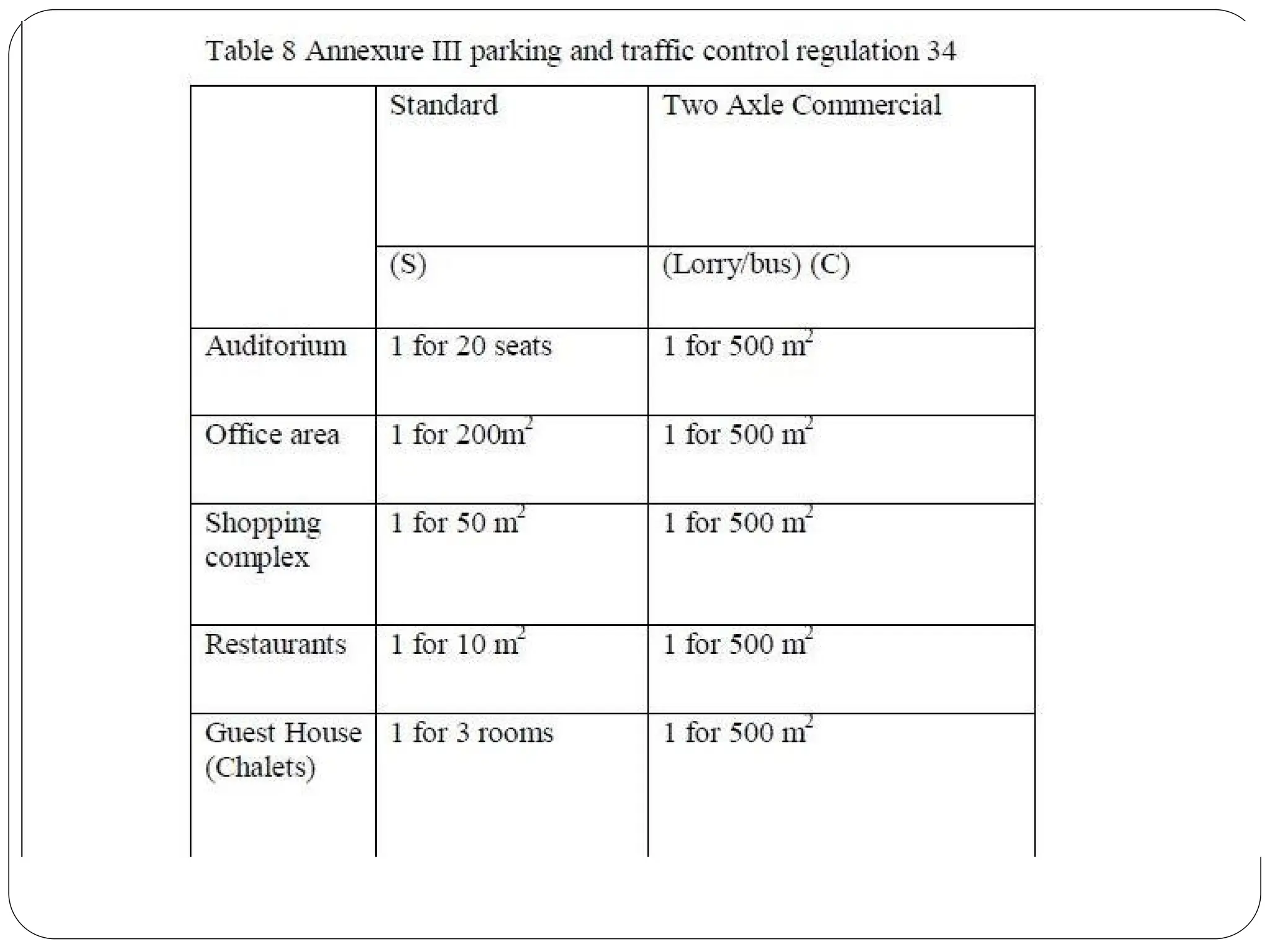
Parking space requirement
From Regulation 34, schedule III of Parking and Traffic
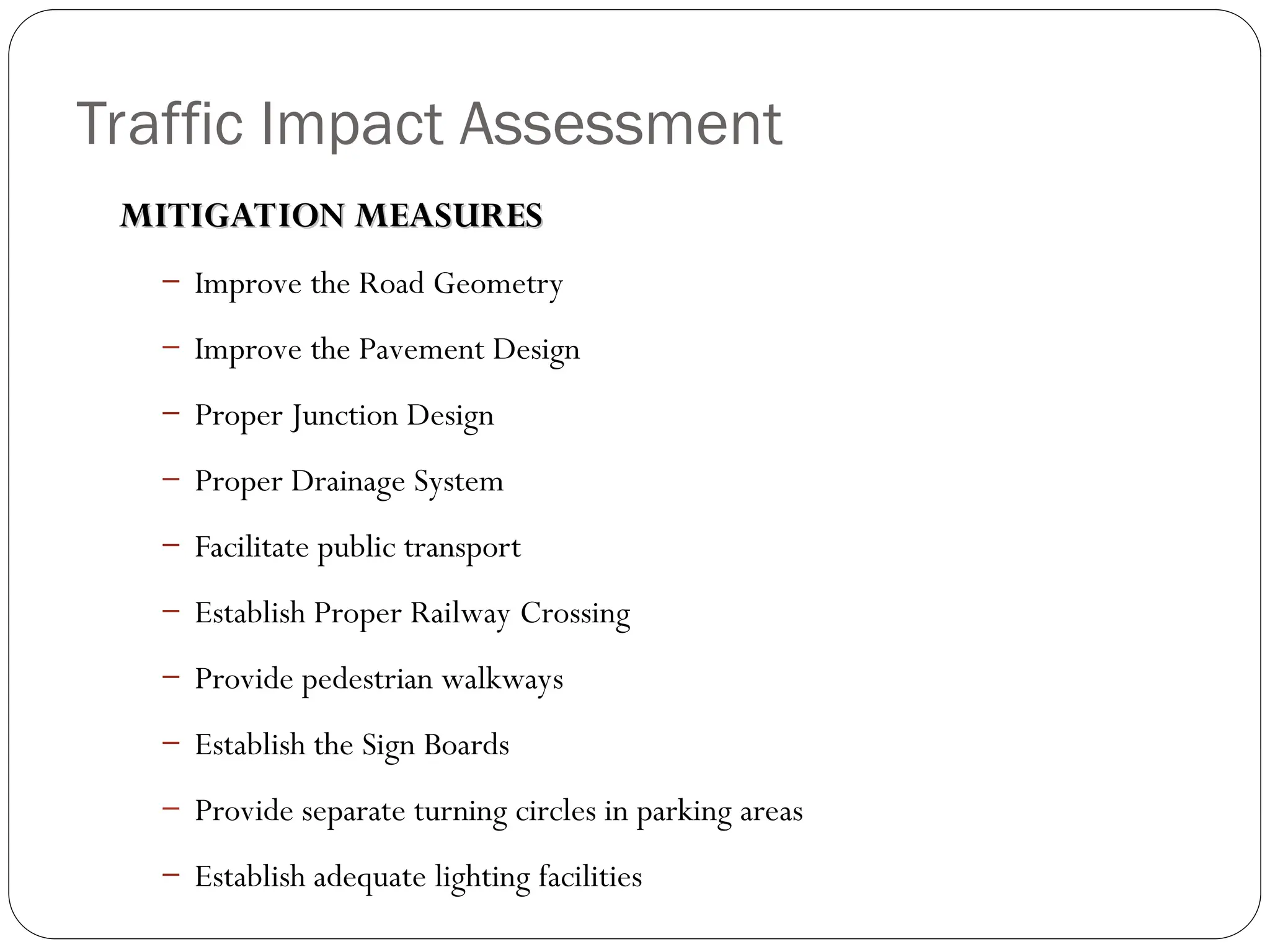
Traffic Impact Assessment
MITIGATION MEASURES
MITIGATION MEASURES
– Improve the Road Geometry
– Improve the Pavement Design
– Proper Junction Design
– Proper Drainage System
– Facilitate public transport
– Establish Proper Railway Crossing
– Provide pedestrian walkways
– Establish the Sign Boards
– Provide separate turning circles in parking areas
– Establish adequate lighting facilities
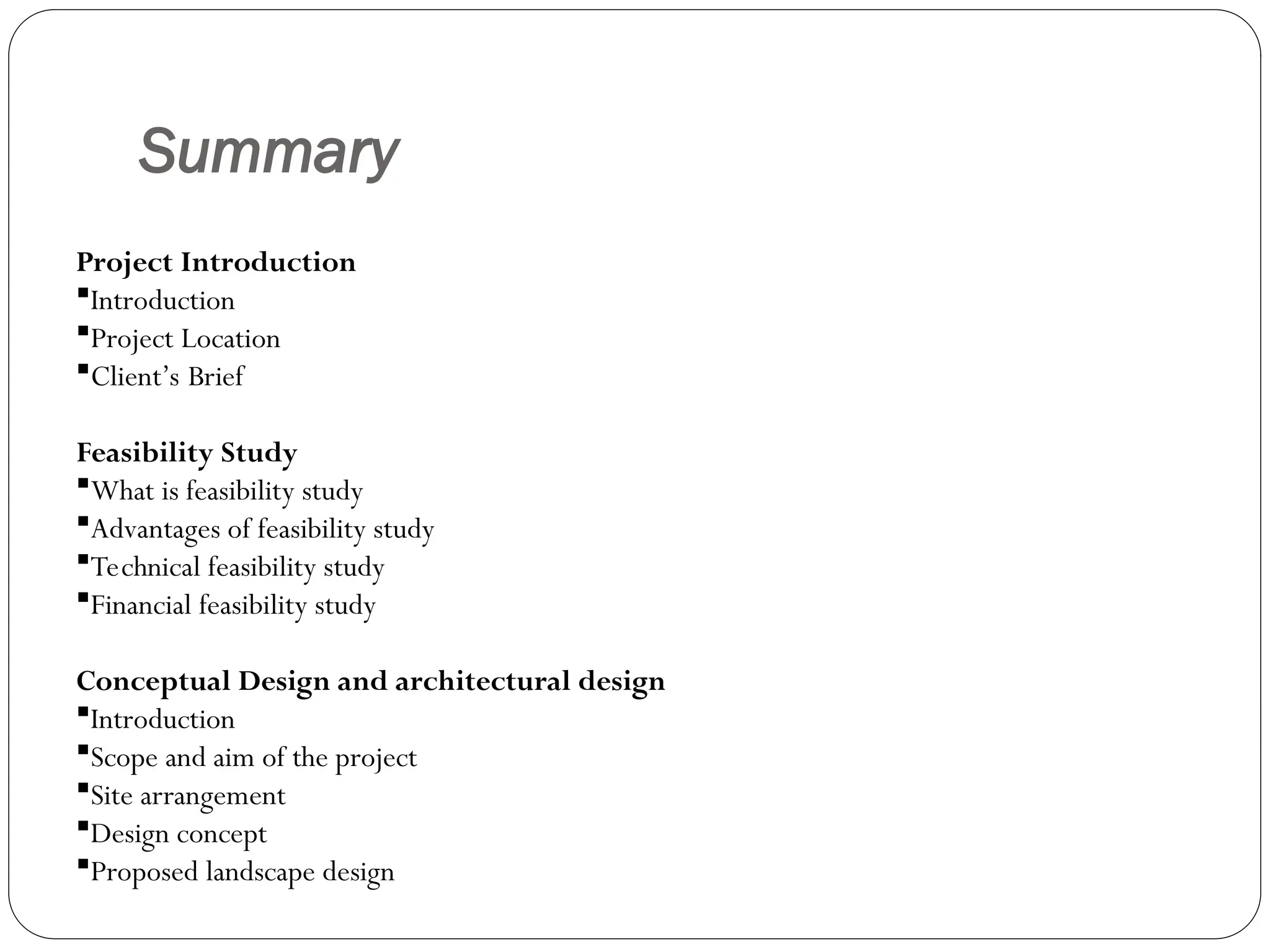
Summary
Project Introduction
Introduction
Project Location
Client’s Brief
Feasibility Study
What is feasibility study
Advantages of feasibility study
Technical feasibility study
Financial feasibility study
Conceptual Design and architectural design
Introduction
Scope and aim of the project
Site arrangement
Design concept
Proposed landscape design
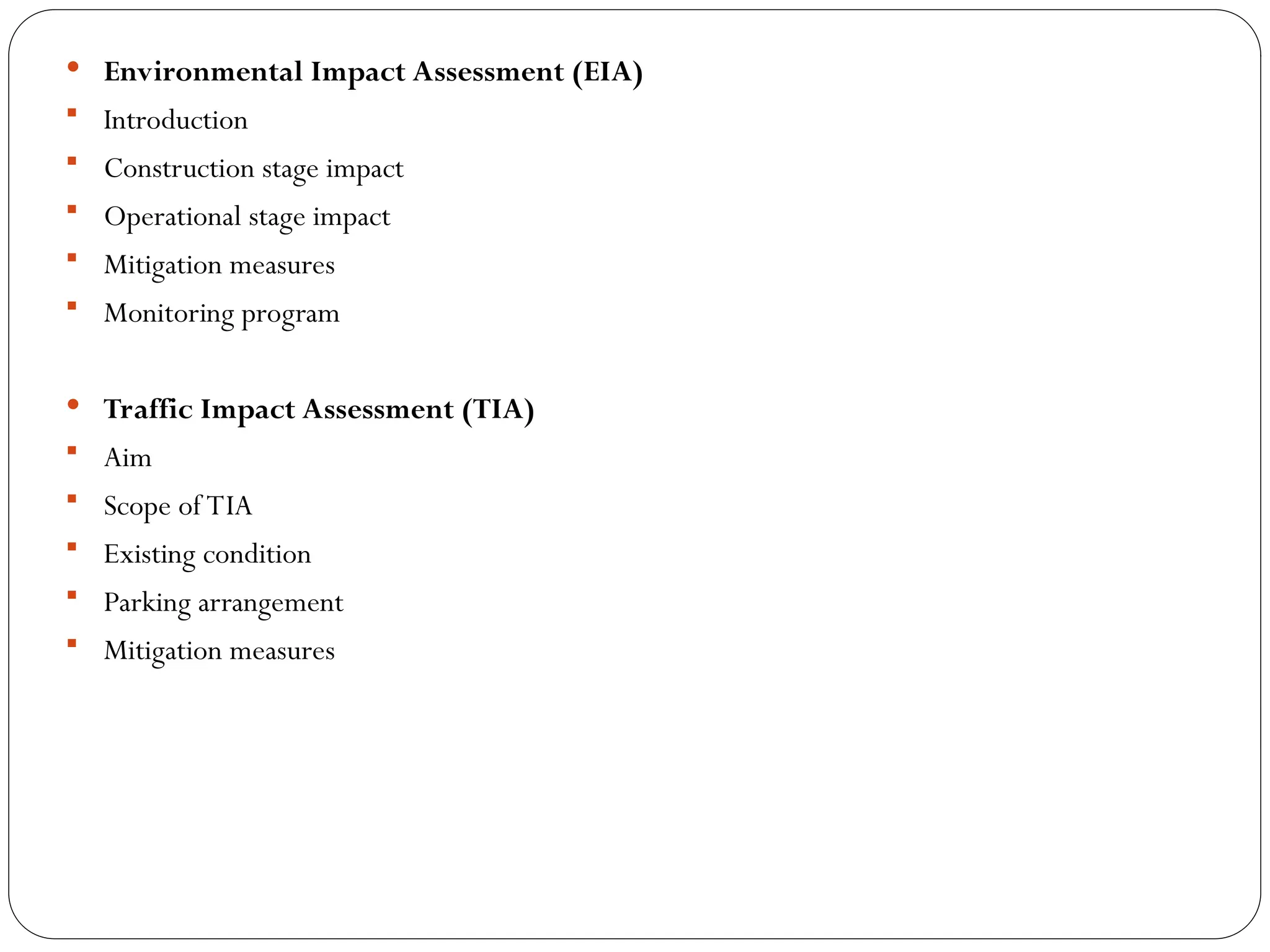
 Environmental Impact Assessment (EIA)
 Introduction
 Construction stage impact
 Operational stage impact
 Mitigation measures
 Monitoring program
 Traffic Impact Assessment (TIA)
 Aim
 Scope of TIA
 Existing condition
 Parking arrangement
 Mitigation measures
ThankYou !!!

2. Introduction (Feasibility study,EIA,TIA).ppt

  • 1.
    T. Manori Perera BSc.(Hons) in Civil Engineering (University of Moratuwa) PhD Candidate at University of Moratuwa GROUP PROJECT
  • 2.
    Assignment:- Design andconstruction of multistory building for commercial and residential purposes in Battaramulla.  Three main parties involve in the construction project 1. Client 2. Consultant 3. Contractor Client’s Brief ( Client’s Requirement)  How many stories  What are the functional spaces for commercial and residential purposes such as compartments, office areas, Dining areas, super markets, swimming pool, security etc  Parking arrangement for minimum ………  Categories of compartments eg:- Standard, intermediate and luxury levels by giving proper names for the categorization  Efficient solid waste and water disposal system  LEED Certificate
  • 3.
    Project Details  Client Project value  Project duration  Land area  Contractor ( Can select by considering project cost, reputation etc) Terms of Reference (TOR)  A TOR is a document which describes the purpose, structure and sets out a roadmap for a given task .It shows how the scope will be defined, developed, and verified.  TORs are especially useful for those who are going to carry out the task in estimating the required amount of resources (time, financial, human and/or material) and designing methodologies.
  • 4.
     Purpose The purposeof the program/project: What was the rational for designing the project? What are the general and specific objectives of the project?  Proposed considerations in designing the methodology Structural Key elements (central core, perimeter columns- use high strength concrete) Floor to floor height  Proposed work schedule  Sustainable material usage, Disposal system, Fire protecting system  Technologies use to obtain LEED certification (Leadership in Energy and Environmental Design)
  • 5.
    Project Introduction  Purposeof the construction  Objectives and benefits of the project  Key components of the project (Compartments, office rooms, super markets, gym, swimming pool , restaurants, parking facilities, children's park etc..)  Project Location Optimum utilization of land area with several Landscape futures Access to the main road or public transport Contours of site location Location of the Water Table
  • 6.
    Conceptual design andArchitectural design Maximum utilization of the indoor spaces Attractive Structure Blend with the natural beauty ( Diyawanna oya)
  • 8.
  • 13.
    Architectural Design Architecture isan art of designing the built environment with important elements such as buildings, landscaping and street design by considering functional and estatically pleasing appearance  Architectural Design for Site layout  Architectural Design for building such as front, side, plan views and floor arrangement of each
  • 21.
    Architectural Drawings For eachfloor arrangement and front, side, plan views
  • 23.
    Feasibility Study Feasibility studywill compare the other possible development in this area and priority will be given to the better project with use of minimum resources Technical Feasibility Why the project is technically feasible  Buildings are maintaining topography  Soil is laterite soil so can go for shallow foundations or deep foundations  As this is a rural land no nearby buildings to do an investigation on how much they are affected by vibrations  With the sloping ground no need to pump waste water to treatment plants only have break pressures to reduce pressure  Materials and labors (sources) are available Financial Feasibility Consider about the revenue from the project during the limited time schedule
  • 27.
    Environmental Impact Assessment ThisEnvironmental Impact assessment has been carried out keeping in mind the existing regulatory requirements. This report is prepared according to the Sri Lanka National Environmental Act. EIA is done to identify the impacts and the magnitude of those impacts. Then mitigation actions will be proposed to reduce the severity of impacts or to stop the occurrence of those impacts. EIA is a requirement by the National Environmental Act for this kind of large scale projects.
  • 28.
    Objectives of theEIA • To acquire information of the geological, biological, social and cultural background of the affected area • To identify the potential impacts to the environment due to the project • To propose necessary remedial procedures to mitigate the adverse impacts to the environment • To devise an environmental monitoring program
  • 29.
  • 30.
    Geological Environment  Topography Mountainous Terrain (Elevation difference – 67m—100m)  Geology and soil  Red Laterite (very stable geological profile)  Meteorology  Wet Zone conditions  Surface and ground water quality  Land use  School, Temple, Quarry, Agriculture  Air quality and noise
  • 31.
    Construction Stage Impacts-Negative • Impact on the Geological and Ecological system – Change in local physiographic and drainage pattern due to changes on land – Generation of waste during construction stage – Noise pollution • Social environment – Generation of dust – Sound pollution and vibration – Congestion in access roads – Safety of workers and public
  • 32.
    Operational Stage Impacts-Negative  Heat Island effect  Improper disposal of solid waste  Improper Disposal of Wastewater and Sewage  Traffic generation  Cultural conflicts
  • 33.
    Construction and OperationalStage Impacts- Positive  Creation of job opportunities  Infrastructure Development  Impact on land value  Increase of the Education level
  • 34.
    Mitigatory measures During construction Creativebuilding designs and proper placement Clear the necessary vegetated areas only Proper construction waste management Dust control Materials covered with dust covers Continuous water sprinkling in access roads and fill/cut areas Noise control Machines properly maintained High noise machines restricted to day time Labor health Use of safety instruments Safety barriers such as nets and fences
  • 35.
    Mitigatory measures During Operation Aproper drainage system Proper landscaping Waste water treatment plant Separate bins to collect waste Sound proof generator room Use of systematic fire fighting systems Developed access road Educate the tourists and the local
  • 36.
    Monitoring Program Water qualitymonitoring Air quality Measure vibration levels during construction operations Waste handling monitoring Data collection about species Monitoring the infrastructure
  • 37.
    Conclusion  Overall impacton the environment is Positive considering the mitigated aspects  The project is ecologically and socially feasible.  Thus the EIA is
  • 38.
    Traffic Impact Assessment(TIA) AIM To identify the current traffic and the possible traffic impacts expected after the commencement of the proposed project to maximize benefits and to minimize negative impacts and take necessary mitigation methods.
  • 39.
    Scope of TIA Analyses the existing traffic conditions around the proposed site development  Estimate the potential traffic generation due to the proposed development  Appraise the potential traffic impact of the proposed development on the surrounding road network  Identify the possible transportation issues related to the site development.  Estimate the parking Requirements and provide an efficient vehicle circulation within the siteIdentify the possible transportation issues related to the site development and come up with road improvement proposals
  • 40.
     Existing Roadand Traffic condition  Existing access road condition  The existing road is asphalt paved, which has a large number of pot holes and damages in the pavement.   There were no road sign boards, speed limits posted and any pavement markings, such as centre line markings.   The minimum with of shoulders are not provided and therefore the pedestrians use road pavement for their use.   Steep slopes without proper retaining systems were identified closer to the road way   There are many of horizontal and vertical curves that do not satisfy geometric design requirements.   There were no street lights on any of the sides of the road
  • 41.
    Existing conditions … PolduwaRoad Kaduwela Road B240 Sri Jayawardanapura mawatha B240 Site
  • 42.
    Parking space requirement FromRegulation 34, schedule III of Parking and Traffic
  • 45.
    Traffic Impact Assessment MITIGATIONMEASURES MITIGATION MEASURES – Improve the Road Geometry – Improve the Pavement Design – Proper Junction Design – Proper Drainage System – Facilitate public transport – Establish Proper Railway Crossing – Provide pedestrian walkways – Establish the Sign Boards – Provide separate turning circles in parking areas – Establish adequate lighting facilities
  • 46.
    Summary Project Introduction Introduction Project Location Client’sBrief Feasibility Study What is feasibility study Advantages of feasibility study Technical feasibility study Financial feasibility study Conceptual Design and architectural design Introduction Scope and aim of the project Site arrangement Design concept Proposed landscape design
  • 47.
     Environmental ImpactAssessment (EIA)  Introduction  Construction stage impact  Operational stage impact  Mitigation measures  Monitoring program  Traffic Impact Assessment (TIA)  Aim  Scope of TIA  Existing condition  Parking arrangement  Mitigation measures
  • 48.