Project
electronics
1
Cellphone
detector
2
Component
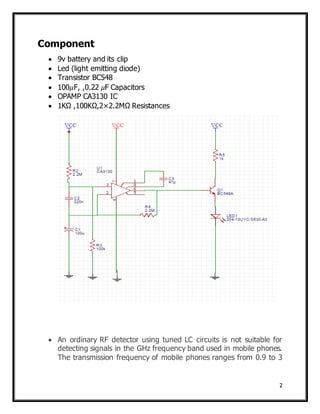
 9v battery and its clip
 Led (light emitting diode)
 Transistor BC548
 100𝜇F, ,0.22 𝜇F Capacitors
 OPAMP CA3130 IC
 1KΩ ,100KΩ,2×2.2MΩ Resistances
 An ordinary RF detector using tuned LC circuits is not suitable for
detecting signals in the GHz frequency band used in mobile phones.
The transmission frequency of mobile phones ranges from 0.9 to 3
3
GHz with a wavelength of 3.3 to 10 cm. So a circuitdetecting gigahertz
signals is required for a mobile bug.
 Here the circuit uses a 220nF disk capacitor (C2) to capture the RF
signals from the mobile phone. The lead length of the capacitor is fixed
as 18 mm with a spacing of 8 mm between the leads to get the desired
frequency. The disk capacitor along with the leads acts as a small
gigahertz loop antenna to collect the RF signals from the mobile
phone.
This handy, pocket-size mobile transmission detector or sniffer can
sense the presence of an activated mobile cell phone from a distance of
0.1meters. So it can be used to prevent use of mobile phones in
examination halls, confidential rooms, etc. It is also useful for detecting the
use of mobile phone for Spying and unauthorized video transmission. The
circuit can detect the incoming and outgoing calls, SMS and video
transmission even if the mobile phone is kept in the silent mode. The
moment the Bug detects RF transmission signal from an activated mobile
phone, it starts sounding a beep alarm and the LED blinks. The alarm
continues until the signal transmission ceases. Assemble the circuit on a
general purpose PCB as compact as possible and enclose in a small box like
junk mobile case. As mentioned earlier, capacitor C3 should have a lead
length of 18 mm with lead spacing of 8 mm. Carefully solder the capacitor
in standing position with equal spacing of the leads. The response can be
optimized by trimming the lead length of C3 for the desired frequency. You
may use a short telescopic type antenna.
When a GSM (Global System of Mobile communication) digital phone is
transmitting, the signal is time shared with 7 other users. That is at any one
4
second, each of the 8 users on the same frequencyis allotted 1/8 of the time
and the signal is reconstituted by the receiver to form the speech. Peak
power output of a mobile phone corresponds to 2 watts with an average of
250 milli watts of continuous power
The network data base stores the information transmitted by the mobile
phone. If the mobile phone moves from one cell to another, it will keep the
connection with the base station having strongest transmission. Mobile
phone always tries to make connection with the available base station. That
is why, the back light of the phone turns on intermittently while traveling.
This will cause severe battery drain. So in long journeys, battery will flat
within a few hours.
Use of capacitor
A capacitor has two electrodes separated by a ‘dielectric’ like paper,
mica etc. The non polarized disc capacitor is used to pass AC and not DC.
Capacitor can store energy and pass AC signals during discharge. 0.22µF
capacitor is selected because it is a low value one and has large surface area
to acceptenergyfrom the mobile radiation. To detect the signal, the sensor
part should be like an aerial. So the capacitor is arranged as a mini loop
aerial (similar to the dipole antenna used in TV).In short with this
arrangement, the capacitor works like an air core coil with ability to
oscillate and discharge current.
APPLICATION
5
 It can be used to prevent use of mobile phones in examination halls,
confidential rooms, etc.
 It is also useful for detecting the use of mobile phone for spying and
unauthorized video transmission.
 It is useful where the use of mobile phone is prohibited like petrol pumps
and gas stations, historical places, religious places and court of laws.
Op-amp IC CA3130
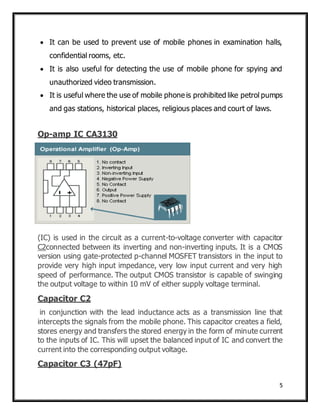
(IC) is used in the circuit as a current-to-voltage converter with capacitor
C2connected between its inverting and non-inverting inputs. It is a CMOS
version using gate-protected p-channel MOSFET transistors in the input to
provide very high input impedance, very low input current and very high
speed of performance. The output CMOS transistor is capable of swinging
the output voltage to within 10 mV of either supply voltage terminal.
Capacitor C2
in conjunction with the lead inductance acts as a transmission line that
intercepts the signals from the mobile phone. This capacitor creates a field,
stores energy and transfers the stored energy in the form of minute current
to the inputs of IC. This will upset the balanced input of IC and convert the
current into the corresponding output voltage.
Capacitor C3 (47pF)
6
is connected across ‘strobe’ (pin 8) and ‘null’ inputs (pin 1) for phase
compensation and gain control to optimise the frequency response.
resistor R2
along with high-value keeps the non-inverting input stable for easy swing of
the output to high state.
resistor R4
Feedback makes the inverting input high when the output becomes high.
References
1. www.google.com
2. www.wikipedia.org
3. www.pdfmachine.com
4. www.efymag.com
5. www.datasheets4u.com

Project electronics

  • 1.
  • 2.
  • 3.
    2 Component  9v batteryand its clip  Led (light emitting diode)  Transistor BC548  100𝜇F, ,0.22 𝜇F Capacitors  OPAMP CA3130 IC  1KΩ ,100KΩ,2×2.2MΩ Resistances  An ordinary RF detector using tuned LC circuits is not suitable for detecting signals in the GHz frequency band used in mobile phones. The transmission frequency of mobile phones ranges from 0.9 to 3
  • 4.
    3 GHz with awavelength of 3.3 to 10 cm. So a circuitdetecting gigahertz signals is required for a mobile bug.  Here the circuit uses a 220nF disk capacitor (C2) to capture the RF signals from the mobile phone. The lead length of the capacitor is fixed as 18 mm with a spacing of 8 mm between the leads to get the desired frequency. The disk capacitor along with the leads acts as a small gigahertz loop antenna to collect the RF signals from the mobile phone. This handy, pocket-size mobile transmission detector or sniffer can sense the presence of an activated mobile cell phone from a distance of 0.1meters. So it can be used to prevent use of mobile phones in examination halls, confidential rooms, etc. It is also useful for detecting the use of mobile phone for Spying and unauthorized video transmission. The circuit can detect the incoming and outgoing calls, SMS and video transmission even if the mobile phone is kept in the silent mode. The moment the Bug detects RF transmission signal from an activated mobile phone, it starts sounding a beep alarm and the LED blinks. The alarm continues until the signal transmission ceases. Assemble the circuit on a general purpose PCB as compact as possible and enclose in a small box like junk mobile case. As mentioned earlier, capacitor C3 should have a lead length of 18 mm with lead spacing of 8 mm. Carefully solder the capacitor in standing position with equal spacing of the leads. The response can be optimized by trimming the lead length of C3 for the desired frequency. You may use a short telescopic type antenna. When a GSM (Global System of Mobile communication) digital phone is transmitting, the signal is time shared with 7 other users. That is at any one
  • 5.
    4 second, each ofthe 8 users on the same frequencyis allotted 1/8 of the time and the signal is reconstituted by the receiver to form the speech. Peak power output of a mobile phone corresponds to 2 watts with an average of 250 milli watts of continuous power The network data base stores the information transmitted by the mobile phone. If the mobile phone moves from one cell to another, it will keep the connection with the base station having strongest transmission. Mobile phone always tries to make connection with the available base station. That is why, the back light of the phone turns on intermittently while traveling. This will cause severe battery drain. So in long journeys, battery will flat within a few hours. Use of capacitor A capacitor has two electrodes separated by a ‘dielectric’ like paper, mica etc. The non polarized disc capacitor is used to pass AC and not DC. Capacitor can store energy and pass AC signals during discharge. 0.22µF capacitor is selected because it is a low value one and has large surface area to acceptenergyfrom the mobile radiation. To detect the signal, the sensor part should be like an aerial. So the capacitor is arranged as a mini loop aerial (similar to the dipole antenna used in TV).In short with this arrangement, the capacitor works like an air core coil with ability to oscillate and discharge current. APPLICATION
  • 6.
    5  It canbe used to prevent use of mobile phones in examination halls, confidential rooms, etc.  It is also useful for detecting the use of mobile phone for spying and unauthorized video transmission.  It is useful where the use of mobile phone is prohibited like petrol pumps and gas stations, historical places, religious places and court of laws. Op-amp IC CA3130 (IC) is used in the circuit as a current-to-voltage converter with capacitor C2connected between its inverting and non-inverting inputs. It is a CMOS version using gate-protected p-channel MOSFET transistors in the input to provide very high input impedance, very low input current and very high speed of performance. The output CMOS transistor is capable of swinging the output voltage to within 10 mV of either supply voltage terminal. Capacitor C2 in conjunction with the lead inductance acts as a transmission line that intercepts the signals from the mobile phone. This capacitor creates a field, stores energy and transfers the stored energy in the form of minute current to the inputs of IC. This will upset the balanced input of IC and convert the current into the corresponding output voltage. Capacitor C3 (47pF)
  • 7.
    6 is connected across‘strobe’ (pin 8) and ‘null’ inputs (pin 1) for phase compensation and gain control to optimise the frequency response. resistor R2 along with high-value keeps the non-inverting input stable for easy swing of the output to high state. resistor R4 Feedback makes the inverting input high when the output becomes high. References 1. www.google.com 2. www.wikipedia.org 3. www.pdfmachine.com 4. www.efymag.com 5. www.datasheets4u.com