PROJECT:- 01
Presented By
HEMANT ASHOK MANDAL
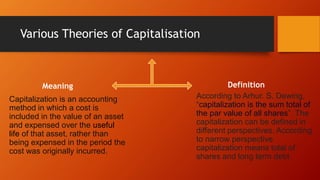
Various Theories of Capitalisation
Meaning
Capitalization is an accounting
method in which a cost is
included in the value of an asset
and expensed over the useful
life of that asset, rather than
being expensed in the period the
cost was originally incurred.
Definition
According to Arhur. S. Dewing,
“capitalization is the sum total of
the par value of all shares”. The
capitalization can be defined in
different perspectives. According
to narrow perspective
capitalization means total of
shares and long term debt
Types of Capitalisation in Finance
Market Capitalization (Market
Cap)
• This is the total value of a
company's outstanding shares
of stock multiplied by the
current market price per share.
It's a measure of the company's
size and is often used to
categorize companies into
different size classes, such as
small-cap, mid-cap, and large-
cap.
Enterprise Value (EV)
• EV is a more comprehensive
measure of a company's value
as it takes into account not only
its equity but also its debt and
cash holdings. It's often used in
valuation scenarios, especially
in mergers and acquisitions.
Rules in Capitalization in Finance
Financial Terms &
Proper Nouns
Capitalize specific financial
terms, including those related
to accounting, investments,
and economic indicators
(e.g., Gross Domestic
Product, Return on
Investment, Dividend).
Capitalize proper nouns such
as company names (e.g.,
Apple Inc., Microsoft
Corporation), financial indices
(e.g., S&P 500, Dow Jones
Industrial Average), and
Acronym
s
Capitalize acronyms
(abbreviations formed
from the initial letters of a
group of words)
commonly used in the
finance field (e.g., IPO for
Initial Public Offering,
ETF for Exchange-
Headings, Titles and
Sentence Capitalization
Capitalize major words in
headings, titles, and
section headings in
financial documents and
reports.
Generally, within
sentences, only proper
nouns and the first word
are capitalized, unless
there's a specific reason
to capitalize another
word for emphasis.
Different situations describe in companies
Overcapitalization:
Overcapitalization occurs when a company has more
capital (both equity and debt) than is required to
support its business operations and growth. In this
situation, the company might have taken on
excessive debt or issued more shares of stock than it
needs, leading to a higher cost of capital and
potentially reduced profitability. Signs of
overcapitalization might include:
• Low return on equity (ROE) and return on assets
(ROA) compared to industry averages.
• Earnings not justifying the amount of invested
capital.
• Idle or underutilized assets due to an excessive
investment.
• Difficulty in generating sufficient returns to cover
interest payments and dividends.
Overcapitalization can lead to reduced financial
flexibility, increased financial risk, and challenges in
effectively deploying excess capital to generate
Undercapitalization:
Undercapitalization refers to a situation where a
company has insufficient capital to effectively support
its operations and growth. This might happen if the
company hasn't raised enough equity capital or has
limited access to debt financing. Undercapitalization
can lead to operational constraints and missed growth
opportunities. Signs of undercapitalization might
include:
• Inability to invest in new projects or expansion due
to lack of funds.
• Difficulty meeting debt obligations and interest
payments.
• Operational inefficiencies and inability to scale.
• Reduced ability to compete with well-capitalized
competitors.
Undercapitalization can limit a company's ability to
innovate, expand, or even survive during challenging
economic periods.
Over Capitalization
Causes
•Over-optimistic growth
projections.
•Aggressive expansion
without timely returns.
•Costly mergers and
acquisitions.
•Mismanagement of
resources.
•External economic
factors.
Implications
•Lower returns on
investment.
•Reduced profitability from
interest payments and idle
assets.
•Inefficient operations and
asset utilization.
•Dissatisfied shareholders.
•Increased financial risk from
Solutions
•Reinvest excess capital in growth
projects.
•Return capital to shareholders
through dividends or buybacks.
•Reduce debt to lower interest
expenses & Strategically realign by
divesting underperforming assets.
•Improve operational efficiency &
Optimize the capital structure
(equity and debt mix).
•Refinance debt for better terms &
Review and adjust expansion
plans & Implement cost control
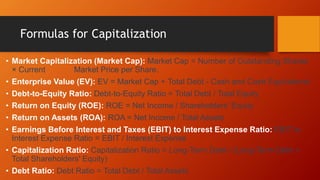
Formulas for Capitalization
• Market Capitalization (Market Cap): Market Cap = Number of Outstanding Shares
× Current Market Price per Share.
• Enterprise Value (EV): EV = Market Cap + Total Debt - Cash and Cash Equivalents
• Debt-to-Equity Ratio: Debt-to-Equity Ratio = Total Debt / Total Equity
• Return on Equity (ROE): ROE = Net Income / Shareholders' Equity
• Return on Assets (ROA): ROA = Net Income / Total Assets
• Earnings Before Interest and Taxes (EBIT) to Interest Expense Ratio: EBIT to
Interest Expense Ratio = EBIT / Interest Expense
• Capitalization Ratio: Capitalization Ratio = Long-Term Debt / (Long-Term Debt +
Total Shareholders' Equity)
• Debt Ratio: Debt Ratio = Total Debt / Total Assets
Practical Example
CASE 1 :- Balanced
Capitalization
XYZ Tech Solutions, a growing
software company, plans to expand its
product line. They raise ₹50 million by
issuing 500,000 new shares at ₹100
each and secure a ₹30 million loan for
technology upgrades. This balanced
approach aligns their ₹80 million
capitalization with their growth plans.
CASE 2 :- Overcapitalization
However, in an overly optimistic move, XYZ
Tech Solutions raises ₹100 million by issuing 1
million shares at ₹100 each and borrows an
additional ₹50 million for rapid expansion into
multiple markets. Unfortunately, these new
markets underperform, resulting in lower-than-
expected revenues and profits. With ₹150
million capitalization, they are overcapitalized,
struggling to effectively utilize the excess
capital they raised. This leads to reduced
profitability and challenges in meeting interest
payments.
Capitalization Strategies of Indian
Companies
Key points illustrating how Indian companies use capitalization
• IPOs: Going public via IPOs raises substantial capital by selling shares to the public
for the first time.
• 2. Rights Issue: Companies offer discounted shares to existing shareholders,
generating funds from their investor base.
• 3. Debt Issuance: Issuing bonds or debentures provides fixed interest payments
over time.
• 4. Private Placements: Select investors receive shares or debt instruments in
private placements.
• 5. Convertible Securities: Firms raise debt with potential for conversion into
equity.
• 6. VC and PE: Startups and growing companies secure funds from venture
capitalists and private equity.
• 7. M&A Financing: Capital funds acquisitions through shares, debt, or both.
• 8. Debt Refinancing: Capital raised improves debt terms and conditions.
• 9. Working Capital: Funds secure liquidity for day-to-day operations.
Introduction:
Indian firms
employ diverse
strategies to raise
funds for growth
and innovation.
These
approaches
involve issuing
shares, debt, or
seeking
investments.
PROJECT 1.pdf

PROJECT 1.pdf

  • 1.
  • 2.
    Various Theories ofCapitalisation Meaning Capitalization is an accounting method in which a cost is included in the value of an asset and expensed over the useful life of that asset, rather than being expensed in the period the cost was originally incurred. Definition According to Arhur. S. Dewing, “capitalization is the sum total of the par value of all shares”. The capitalization can be defined in different perspectives. According to narrow perspective capitalization means total of shares and long term debt
  • 3.
    Types of Capitalisationin Finance Market Capitalization (Market Cap) • This is the total value of a company's outstanding shares of stock multiplied by the current market price per share. It's a measure of the company's size and is often used to categorize companies into different size classes, such as small-cap, mid-cap, and large- cap. Enterprise Value (EV) • EV is a more comprehensive measure of a company's value as it takes into account not only its equity but also its debt and cash holdings. It's often used in valuation scenarios, especially in mergers and acquisitions.
  • 4.
    Rules in Capitalizationin Finance Financial Terms & Proper Nouns Capitalize specific financial terms, including those related to accounting, investments, and economic indicators (e.g., Gross Domestic Product, Return on Investment, Dividend). Capitalize proper nouns such as company names (e.g., Apple Inc., Microsoft Corporation), financial indices (e.g., S&P 500, Dow Jones Industrial Average), and Acronym s Capitalize acronyms (abbreviations formed from the initial letters of a group of words) commonly used in the finance field (e.g., IPO for Initial Public Offering, ETF for Exchange- Headings, Titles and Sentence Capitalization Capitalize major words in headings, titles, and section headings in financial documents and reports. Generally, within sentences, only proper nouns and the first word are capitalized, unless there's a specific reason to capitalize another word for emphasis.
  • 5.
    Different situations describein companies Overcapitalization: Overcapitalization occurs when a company has more capital (both equity and debt) than is required to support its business operations and growth. In this situation, the company might have taken on excessive debt or issued more shares of stock than it needs, leading to a higher cost of capital and potentially reduced profitability. Signs of overcapitalization might include: • Low return on equity (ROE) and return on assets (ROA) compared to industry averages. • Earnings not justifying the amount of invested capital. • Idle or underutilized assets due to an excessive investment. • Difficulty in generating sufficient returns to cover interest payments and dividends. Overcapitalization can lead to reduced financial flexibility, increased financial risk, and challenges in effectively deploying excess capital to generate Undercapitalization: Undercapitalization refers to a situation where a company has insufficient capital to effectively support its operations and growth. This might happen if the company hasn't raised enough equity capital or has limited access to debt financing. Undercapitalization can lead to operational constraints and missed growth opportunities. Signs of undercapitalization might include: • Inability to invest in new projects or expansion due to lack of funds. • Difficulty meeting debt obligations and interest payments. • Operational inefficiencies and inability to scale. • Reduced ability to compete with well-capitalized competitors. Undercapitalization can limit a company's ability to innovate, expand, or even survive during challenging economic periods.
  • 6.
    Over Capitalization Causes •Over-optimistic growth projections. •Aggressiveexpansion without timely returns. •Costly mergers and acquisitions. •Mismanagement of resources. •External economic factors. Implications •Lower returns on investment. •Reduced profitability from interest payments and idle assets. •Inefficient operations and asset utilization. •Dissatisfied shareholders. •Increased financial risk from Solutions •Reinvest excess capital in growth projects. •Return capital to shareholders through dividends or buybacks. •Reduce debt to lower interest expenses & Strategically realign by divesting underperforming assets. •Improve operational efficiency & Optimize the capital structure (equity and debt mix). •Refinance debt for better terms & Review and adjust expansion plans & Implement cost control
  • 7.
    Formulas for Capitalization •Market Capitalization (Market Cap): Market Cap = Number of Outstanding Shares × Current Market Price per Share. • Enterprise Value (EV): EV = Market Cap + Total Debt - Cash and Cash Equivalents • Debt-to-Equity Ratio: Debt-to-Equity Ratio = Total Debt / Total Equity • Return on Equity (ROE): ROE = Net Income / Shareholders' Equity • Return on Assets (ROA): ROA = Net Income / Total Assets • Earnings Before Interest and Taxes (EBIT) to Interest Expense Ratio: EBIT to Interest Expense Ratio = EBIT / Interest Expense • Capitalization Ratio: Capitalization Ratio = Long-Term Debt / (Long-Term Debt + Total Shareholders' Equity) • Debt Ratio: Debt Ratio = Total Debt / Total Assets
  • 8.
    Practical Example CASE 1:- Balanced Capitalization XYZ Tech Solutions, a growing software company, plans to expand its product line. They raise ₹50 million by issuing 500,000 new shares at ₹100 each and secure a ₹30 million loan for technology upgrades. This balanced approach aligns their ₹80 million capitalization with their growth plans. CASE 2 :- Overcapitalization However, in an overly optimistic move, XYZ Tech Solutions raises ₹100 million by issuing 1 million shares at ₹100 each and borrows an additional ₹50 million for rapid expansion into multiple markets. Unfortunately, these new markets underperform, resulting in lower-than- expected revenues and profits. With ₹150 million capitalization, they are overcapitalized, struggling to effectively utilize the excess capital they raised. This leads to reduced profitability and challenges in meeting interest payments.
  • 9.
    Capitalization Strategies ofIndian Companies Key points illustrating how Indian companies use capitalization • IPOs: Going public via IPOs raises substantial capital by selling shares to the public for the first time. • 2. Rights Issue: Companies offer discounted shares to existing shareholders, generating funds from their investor base. • 3. Debt Issuance: Issuing bonds or debentures provides fixed interest payments over time. • 4. Private Placements: Select investors receive shares or debt instruments in private placements. • 5. Convertible Securities: Firms raise debt with potential for conversion into equity. • 6. VC and PE: Startups and growing companies secure funds from venture capitalists and private equity. • 7. M&A Financing: Capital funds acquisitions through shares, debt, or both. • 8. Debt Refinancing: Capital raised improves debt terms and conditions. • 9. Working Capital: Funds secure liquidity for day-to-day operations. Introduction: Indian firms employ diverse strategies to raise funds for growth and innovation. These approaches involve issuing shares, debt, or seeking investments.