Comparative Analysis of Bajaj
 Fin.Serv Schemes with other
           Lenders


    UNDER GUIDANCE OF
        MRS.K.PRIYA
PRIMARY OBJECTIVE:


   To compare the schemes offered by Bajaj FinServ with its
   competitors.


SECONDARY OBJECTIVE:


   To find out Competitors / Schemes similar to Bajaj Fin.Serv.

   To find out the best financing scheme offered by the lenders.

   To Analyze Competitors schemes with reference to Bajaj
   Fin.Serv’s Products.

   To find out the customer perception about Bajaj Finserv.
ABSTRACT:


Consumer durable financing is highly influenced by demographic
factors, the demographic variables such as Age, Gender, Marital
status, Income, Education… affect the purchasing behaviour of
customers. Distribution of population with reference to location such
as rural, urban, semi-urban also has an impact on purchasing
behaviour. Marketers can make better marketing decisions only when
they know why and how individuals make their consumption
decisions. If marketers are able to understand the behaviour of
company precisely, they could consumers are likely to react to various
informational and environmental aspects and could shape their
marketing strategies in such a way that they can achieve a great
competitive advantage in the market. The objective of the study is
find out the important factors which influence the consumer loan
purchases and their perception towards lenders with special reference
to Bajaj FinServ.ltd.
REVIEW OF LITERATURE:


CORPORATE CATALYYST INDIA’s research on consumer
behaviour financing reports that customers who are seeking finance
are conscious about interest being charged for white goods there is
perceptible shift towards low cost financing schemes. India’s
consumer market is riding the crest of the country’s economic boom.
Driven by a young population with access to disposable incomes and
easy finance options, the consumer market has been throwing up
staggering figures. The market share of MNCs in consumer durables
sector is 65 per cent. MNC's major target is the growing middle class
of India. MNCs offer superior Technology to the consumers whereas
the Indian companies compete on the basis of firm grasps of the local
market, their well acknowledged brands, and hold over wide
distribution network. India officially classifies its population in five
groups, based on annual household income (based on year 1995-
96indices). These groups are: Lower Income; three subgroups of
Middle Income; and Higher Income. Household income in the top 20
boom cities in India is projected to grow at 10 per cent annually over
the next eight years, which is likely to increase consumer spending on
durables. With the emergence of concepts such as quick and easy
loan, zero equated monthly installment (EMI) charges, loan through
credit card, loan over phone, it has become easy for Indian consumers
to afford more expensive consumer goods.
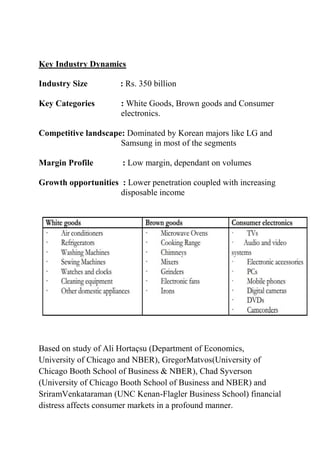
Key Industry Dynamics

Industry Size         : Rs. 350 billion

Key Categories        : White Goods, Brown goods and Consumer
                      electronics.

Competitive landscape: Dominated by Korean majors like LG and
                     Samsung in most of the segments

Margin Profile        : Low margin, dependant on volumes

Growth opportunities : Lower penetration coupled with increasing
                     disposable income


Based on study of Ali Hortaçsu (Department of Economics,
University of Chicago and NBER), GregorMatvos(University of
Chicago Booth School of Business & NBER), Chad Syverson
(University of Chicago Booth School of Business and NBER) and
SriramVenkataraman (UNC Kenan-Flagler Business School) financial
distress affects consumer markets in a profound manner.
The Durable goods channel is a potentially important source of
indirect costs of financial distress. Domestic durable goods
manufacturers alone account for about 7 percent of U.S. value added,
and many other products and services have long-lived “durable-like”
elements in their provisions, making them subject to the mechanism
described above.
Automobiles, the specific subject of our study, represent a significant
fraction of household wealth. They account for about 5 percent of
consumption in the U.S.and are the nonfinancial asset most
commonly held by households (Bucks et al. (2009)). Prima facie
evidence suggests the mechanism does in fact operate in the auto
industry: In a 2006 survey, 23 percent of consumers who avoided the
“Big 3” (more recently referred to as the “Detroit 3”) brands listed
those companies’ financial conditions as a reason for avoidance (J.D.
Power (2006)). Moreover, despite the lack of evidence, policy
programs aimed at helping U.S. car manufacturers were based on the
premise oflargeindirect costs of financial distress, through warranties
in particular. Measuring the size of any such effect is empirically
challenging, however. While financial distress can reduce the demand
for durable goods, causality can also operate in the opposite direction:
negative demand shocks affect firms’ cash flows and therefore can
induce financial distress. This generic problem has plagued the
literature on the effects of financial distress and indirect costs of
bankruptcy, whether these indirect costs are from the consumer,
supplier, or employee side.Our study, besides focusing on an
inherently interesting set of products and firms, can avoid many of
these identification issues.
We study the effect of financial distress on the prices of used cars in
car auctions conducted by a major car auction house in the United
States from January 1, 2006 to November 14, 2008. We compare
shifts in the prices of a manufacturer’s cars to a measure of that
manufacturer’s likelihood of bankruptcy.
As we discuss below, we believe our data is rich enough to provide
sources ofidentification of the links between cars’ values and their
manufacturer’s financial distress that are unlikely to be driven by
reverse causation, where price drops lead to distress rather than vice
versa.
Looking for such effects in used car auctions holds several advantages
over new car markets.Wholesale car markets are very liquid; prices
can rapidly adjust to changes in the economic environment.Their
decentralized nature makes them less exposed to strategic pricing, and
their participants are autodealers who are knowledgeable about the
product and the final demand environment. Additionally, unlike a
drop in new car prices, a decrease in used car prices does not directly
affect manufacturers’ cash flows, decreasing the potential for reverse
causality.
Titman (1984)& researchers have reportedthat during boom period
consumer durable buyers do not care about high interest cost lending
whereas during recession lower interest costs are mandatory to
increase the white good .
In consonance with the global trend, over the years, demand for
consumer durables has increased with rising income levels, double-
income families, changing lifestyles, availability of credit, increasing
consumer awareness and introduction of new models. Products like
air conditioners are no longer perceived as luxury products.
COMPANY PROFILE:

Bajaj Finserv Limited (Bajaj Finserv) is a holding company. Bajaj
Finserv Ltd is a financial services company which is engaged in life
insurance, general insurance, consumer finance and other Financial
products. Apart from financial services, the company is also active in
wind energy generation. Bajaj Finserv Ltd was incorporated on April
30, 2007. The financial services and wind energy businesses were
transferred to Bajaj FinServ Ltd as part of the demerger of Bajaj Auto
Ltd. The demerger is effective from the appointed date on March 31,
2007. The portfolio of the company includes 74% in the two
insurance companies namely Bajaj Allianz Life Insurance company
Ltd and Bajaj General Insurance company Ltd, 50% holding in Bajaj
Allianz Financial Distributors Ltd, 40.53% in Bajaj Auto Finance Ltd
and 100% holding in Bajaj Financial Solutions Ltd. The company is
engaged in life and general insurance through their joint ventures with
Allianz SE namely balaji Allianz Life Insurance Company Ltd and
Bajaj Allianz General Insurance Ltd. Bajaj Allianz Financial
Distributors Ltd is a 50:50 joint venture company between the
company and Allianz SE which is engaged in the business of financial
products. The company operates 138 wind mills in Maharashtra with
an installed capacity of 65.2 MW. It does lending business Under
Bajaj Finance Limited (BFL). Its protection business consists of life
insurance, under the Bajaj Allianz Life Insurance Company (BALIC),
and general insurance, under the Bajaj Allianz General Insurance
Company (BAGIC). The Company’s Financial Advisory and Wealth
Management business consists of Bajaj Financial Solutions Limited
(Bajaj Finsol), which offers financial products and advises clients on
financial and wealth management. Bajaj Auto Finance Ltd offers
various consumer finance products to the customers such as auto
loans, personal loans, loans for consumer durables and computers and
SME finance.
VARIOUS SCHEMES OFFERED:
1) Consumer Finance:

   CONSUMER DURABLES FINANCE

   LIFE STYLE FINANCE

   EMI CARD

   PERSONAL LOANS CROSS SELL

   CO-BRANDED CREDIT CARDS

   TWO AND THREE WHEELER FINANCE

   SALARIED PERSONAL LOANS.


2) SME Finance:

   MORTAGE

   BUSINESS LOANS


3) Commercial Lending:

   CONSTRUCTION EQUIPMENT FINANCE

   INFRASTRUCTURE FINANCE

   VENDOR FINANCING

Project

  • 1.
    Comparative Analysis ofBajaj Fin.Serv Schemes with other Lenders UNDER GUIDANCE OF MRS.K.PRIYA
  • 2.
    PRIMARY OBJECTIVE: To compare the schemes offered by Bajaj FinServ with its competitors. SECONDARY OBJECTIVE: To find out Competitors / Schemes similar to Bajaj Fin.Serv. To find out the best financing scheme offered by the lenders. To Analyze Competitors schemes with reference to Bajaj Fin.Serv’s Products. To find out the customer perception about Bajaj Finserv.
  • 3.
    ABSTRACT: Consumer durable financingis highly influenced by demographic factors, the demographic variables such as Age, Gender, Marital status, Income, Education… affect the purchasing behaviour of customers. Distribution of population with reference to location such as rural, urban, semi-urban also has an impact on purchasing behaviour. Marketers can make better marketing decisions only when they know why and how individuals make their consumption decisions. If marketers are able to understand the behaviour of company precisely, they could consumers are likely to react to various informational and environmental aspects and could shape their marketing strategies in such a way that they can achieve a great competitive advantage in the market. The objective of the study is find out the important factors which influence the consumer loan purchases and their perception towards lenders with special reference to Bajaj FinServ.ltd.
  • 4.
    REVIEW OF LITERATURE: CORPORATECATALYYST INDIA’s research on consumer behaviour financing reports that customers who are seeking finance are conscious about interest being charged for white goods there is perceptible shift towards low cost financing schemes. India’s consumer market is riding the crest of the country’s economic boom. Driven by a young population with access to disposable incomes and easy finance options, the consumer market has been throwing up staggering figures. The market share of MNCs in consumer durables sector is 65 per cent. MNC's major target is the growing middle class of India. MNCs offer superior Technology to the consumers whereas the Indian companies compete on the basis of firm grasps of the local market, their well acknowledged brands, and hold over wide distribution network. India officially classifies its population in five groups, based on annual household income (based on year 1995- 96indices). These groups are: Lower Income; three subgroups of Middle Income; and Higher Income. Household income in the top 20 boom cities in India is projected to grow at 10 per cent annually over the next eight years, which is likely to increase consumer spending on durables. With the emergence of concepts such as quick and easy loan, zero equated monthly installment (EMI) charges, loan through credit card, loan over phone, it has become easy for Indian consumers to afford more expensive consumer goods.
  • 5.
    Key Industry Dynamics IndustrySize : Rs. 350 billion Key Categories : White Goods, Brown goods and Consumer electronics. Competitive landscape: Dominated by Korean majors like LG and Samsung in most of the segments Margin Profile : Low margin, dependant on volumes Growth opportunities : Lower penetration coupled with increasing disposable income Based on study of Ali Hortaçsu (Department of Economics, University of Chicago and NBER), GregorMatvos(University of Chicago Booth School of Business & NBER), Chad Syverson (University of Chicago Booth School of Business and NBER) and SriramVenkataraman (UNC Kenan-Flagler Business School) financial distress affects consumer markets in a profound manner.
  • 6.
    The Durable goodschannel is a potentially important source of indirect costs of financial distress. Domestic durable goods manufacturers alone account for about 7 percent of U.S. value added, and many other products and services have long-lived “durable-like” elements in their provisions, making them subject to the mechanism described above. Automobiles, the specific subject of our study, represent a significant fraction of household wealth. They account for about 5 percent of consumption in the U.S.and are the nonfinancial asset most commonly held by households (Bucks et al. (2009)). Prima facie evidence suggests the mechanism does in fact operate in the auto industry: In a 2006 survey, 23 percent of consumers who avoided the “Big 3” (more recently referred to as the “Detroit 3”) brands listed those companies’ financial conditions as a reason for avoidance (J.D. Power (2006)). Moreover, despite the lack of evidence, policy programs aimed at helping U.S. car manufacturers were based on the premise oflargeindirect costs of financial distress, through warranties in particular. Measuring the size of any such effect is empirically challenging, however. While financial distress can reduce the demand for durable goods, causality can also operate in the opposite direction: negative demand shocks affect firms’ cash flows and therefore can induce financial distress. This generic problem has plagued the literature on the effects of financial distress and indirect costs of bankruptcy, whether these indirect costs are from the consumer, supplier, or employee side.Our study, besides focusing on an inherently interesting set of products and firms, can avoid many of these identification issues. We study the effect of financial distress on the prices of used cars in car auctions conducted by a major car auction house in the United States from January 1, 2006 to November 14, 2008. We compare shifts in the prices of a manufacturer’s cars to a measure of that manufacturer’s likelihood of bankruptcy.
  • 7.
    As we discussbelow, we believe our data is rich enough to provide sources ofidentification of the links between cars’ values and their manufacturer’s financial distress that are unlikely to be driven by reverse causation, where price drops lead to distress rather than vice versa. Looking for such effects in used car auctions holds several advantages over new car markets.Wholesale car markets are very liquid; prices can rapidly adjust to changes in the economic environment.Their decentralized nature makes them less exposed to strategic pricing, and their participants are autodealers who are knowledgeable about the product and the final demand environment. Additionally, unlike a drop in new car prices, a decrease in used car prices does not directly affect manufacturers’ cash flows, decreasing the potential for reverse causality. Titman (1984)& researchers have reportedthat during boom period consumer durable buyers do not care about high interest cost lending whereas during recession lower interest costs are mandatory to increase the white good . In consonance with the global trend, over the years, demand for consumer durables has increased with rising income levels, double- income families, changing lifestyles, availability of credit, increasing consumer awareness and introduction of new models. Products like air conditioners are no longer perceived as luxury products.
  • 8.
    COMPANY PROFILE: Bajaj FinservLimited (Bajaj Finserv) is a holding company. Bajaj Finserv Ltd is a financial services company which is engaged in life insurance, general insurance, consumer finance and other Financial products. Apart from financial services, the company is also active in wind energy generation. Bajaj Finserv Ltd was incorporated on April 30, 2007. The financial services and wind energy businesses were transferred to Bajaj FinServ Ltd as part of the demerger of Bajaj Auto Ltd. The demerger is effective from the appointed date on March 31, 2007. The portfolio of the company includes 74% in the two insurance companies namely Bajaj Allianz Life Insurance company Ltd and Bajaj General Insurance company Ltd, 50% holding in Bajaj Allianz Financial Distributors Ltd, 40.53% in Bajaj Auto Finance Ltd and 100% holding in Bajaj Financial Solutions Ltd. The company is engaged in life and general insurance through their joint ventures with Allianz SE namely balaji Allianz Life Insurance Company Ltd and Bajaj Allianz General Insurance Ltd. Bajaj Allianz Financial Distributors Ltd is a 50:50 joint venture company between the company and Allianz SE which is engaged in the business of financial products. The company operates 138 wind mills in Maharashtra with an installed capacity of 65.2 MW. It does lending business Under Bajaj Finance Limited (BFL). Its protection business consists of life insurance, under the Bajaj Allianz Life Insurance Company (BALIC), and general insurance, under the Bajaj Allianz General Insurance Company (BAGIC). The Company’s Financial Advisory and Wealth Management business consists of Bajaj Financial Solutions Limited (Bajaj Finsol), which offers financial products and advises clients on financial and wealth management. Bajaj Auto Finance Ltd offers various consumer finance products to the customers such as auto loans, personal loans, loans for consumer durables and computers and SME finance.
  • 9.
    VARIOUS SCHEMES OFFERED: 1)Consumer Finance:  CONSUMER DURABLES FINANCE  LIFE STYLE FINANCE  EMI CARD  PERSONAL LOANS CROSS SELL  CO-BRANDED CREDIT CARDS  TWO AND THREE WHEELER FINANCE  SALARIED PERSONAL LOANS. 2) SME Finance:  MORTAGE  BUSINESS LOANS 3) Commercial Lending:  CONSTRUCTION EQUIPMENT FINANCE  INFRASTRUCTURE FINANCE  VENDOR FINANCING