PROGRESSIVE WEB APPS
GDG ISTANBUL
INTRODUCTION TO PROGRESSIVE WEB
APPLICATIONS
WWW
@protechman
+rcaneryildirim
UX/UI Expert @Google Developers
UX Expert @InnovationBox
RESUL CANER
YILDIRIM
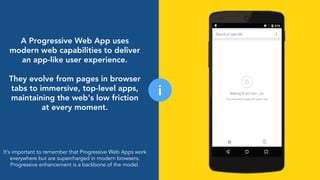
A Progressive Web App uses
modern web capabilities to deliver
an app-like user experience.
They evolve from pages in browser
tabs to immersive, top-level apps,
maintaining the web's low friction
at every moment.
It's important to remember that Progressive Web Apps work
everywhere but are supercharged in modern browsers. 

Progressive enhancement is a backbone of the model.
i
i
i
i Connectivity independent: Enhanced with service workers to
work offline or on low quality networks.
Responsive: Fit any form factor, desktop, mobile, tablet, or
whatever is next.
Progressive: Work for every user, regardless of browser choice
because they’re built with progressive enhancement as a core
tenet.
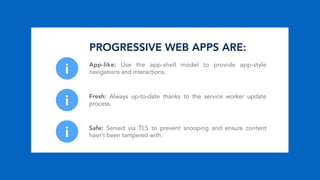
PROGRESSIVE WEB APPS ARE:
i
i
i Safe: Served via TLS to prevent snooping and ensure content
hasn’t been tampered with.
Fresh: Always up-to-date thanks to the service worker update
process.
App-like: Use the app-shell model to provide app-style
navigations and interactions.
PROGRESSIVE WEB APPS ARE:
i
i
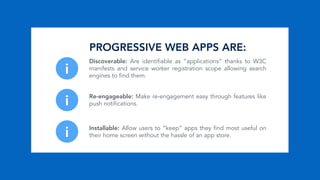
i Installable: Allow users to “keep” apps they find most useful on
their home screen without the hassle of an app store.
Re-engageable: Make re-engagement easy through features like
push notifications.
Discoverable: Are identifiable as “applications” thanks to W3C
manifests and service worker registration scope allowing search
engines to find them.
PROGRESSIVE WEB APPS ARE:
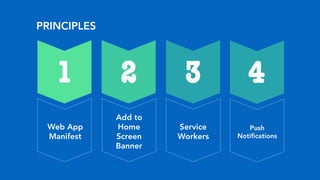
Push
Notifications
4
Service
Workers
Add to
Home
Screen
Banner
Web App
Manifest
321
PRINCIPLES
The Manifest for Web applications is a simple JSON file that
gives you, the developer, the ability to control how your app
appears to the user in the areas that they would expect to
see apps (for example the device home screen), direct what
the user can launch and more importantly how they can
launch it
WEB APP MANIFEST
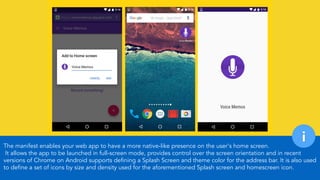
The manifest enables your web app to have a more native-like presence on the user's home screen.

It allows the app to be launched in full-screen mode, provides control over the screen orientation and in recent
versions of Chrome on Android supports defining a Splash Screen and theme color for the address bar. It is also used
to define a set of icons by size and density used for the aforementioned Splash screen and homescreen icon.
i
Chrome on Android has support adding in your site to the
homescreen for a while now, but recent versions also
support proactively suggesting sites be added using native
Web App install banners.
ADD TO HOME SCREEN BANNER
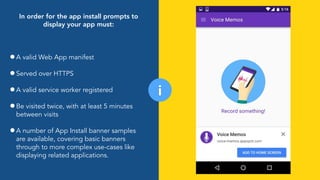
•A valid Web App manifest

•Served over HTTPS

•A valid service worker registered

•Be visited twice, with at least 5 minutes
between visits

•A number of App Install banner samples
are available, covering basic banners
through to more complex use-cases like
displaying related applications.
i
In order for the app install prompts to
display your app must:
A service worker is a script that runs in the background,
separate from your web page. It responds to events,
including network requests made from pages it serves. 

A service worker has an intentionally short lifetime.
SERVICE WORKER 

FOR OFFLINE CACHING
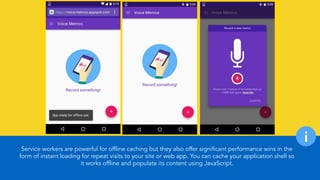
Service workers are powerful for offline caching but they also offer significant performance wins in the
form of instant loading for repeat visits to your site or web app. You can cache your application shell so
it works offline and populate its content using JavaScript.
i
Push notifications allow your users to opt-in to timely
updates from sites they love and allow you to effectively re-
engage them with customized, engaging content.
PUSH NOTIFICATIONS 

FOR RE-ENGAGEMENT
@protechman
+rcaneryildirim
rcaneryildirim@gmail.com
caner@innovationbox.com
THANK YOU!

Progressive web apps

  • 1.
    PROGRESSIVE WEB APPS GDGISTANBUL INTRODUCTION TO PROGRESSIVE WEB APPLICATIONS WWW
  • 2.
    @protechman +rcaneryildirim UX/UI Expert @GoogleDevelopers UX Expert @InnovationBox RESUL CANER YILDIRIM
  • 3.
    A Progressive WebApp uses modern web capabilities to deliver an app-like user experience. They evolve from pages in browser tabs to immersive, top-level apps, maintaining the web's low friction at every moment. It's important to remember that Progressive Web Apps work everywhere but are supercharged in modern browsers. 
 Progressive enhancement is a backbone of the model. i
  • 4.
    i i i Connectivity independent:Enhanced with service workers to work offline or on low quality networks. Responsive: Fit any form factor, desktop, mobile, tablet, or whatever is next. Progressive: Work for every user, regardless of browser choice because they’re built with progressive enhancement as a core tenet. PROGRESSIVE WEB APPS ARE:
  • 5.
    i i i Safe: Servedvia TLS to prevent snooping and ensure content hasn’t been tampered with. Fresh: Always up-to-date thanks to the service worker update process. App-like: Use the app-shell model to provide app-style navigations and interactions. PROGRESSIVE WEB APPS ARE:
  • 6.
    i i i Installable: Allowusers to “keep” apps they find most useful on their home screen without the hassle of an app store. Re-engageable: Make re-engagement easy through features like push notifications. Discoverable: Are identifiable as “applications” thanks to W3C manifests and service worker registration scope allowing search engines to find them. PROGRESSIVE WEB APPS ARE:
  • 7.
  • 8.
    The Manifest forWeb applications is a simple JSON file that gives you, the developer, the ability to control how your app appears to the user in the areas that they would expect to see apps (for example the device home screen), direct what the user can launch and more importantly how they can launch it WEB APP MANIFEST
  • 9.
    The manifest enablesyour web app to have a more native-like presence on the user's home screen.
 It allows the app to be launched in full-screen mode, provides control over the screen orientation and in recent versions of Chrome on Android supports defining a Splash Screen and theme color for the address bar. It is also used to define a set of icons by size and density used for the aforementioned Splash screen and homescreen icon. i
  • 10.
    Chrome on Androidhas support adding in your site to the homescreen for a while now, but recent versions also support proactively suggesting sites be added using native Web App install banners. ADD TO HOME SCREEN BANNER
  • 11.
    •A valid WebApp manifest
 •Served over HTTPS
 •A valid service worker registered
 •Be visited twice, with at least 5 minutes between visits
 •A number of App Install banner samples are available, covering basic banners through to more complex use-cases like displaying related applications. i In order for the app install prompts to display your app must:
  • 12.
    A service workeris a script that runs in the background, separate from your web page. It responds to events, including network requests made from pages it serves. 
 A service worker has an intentionally short lifetime. SERVICE WORKER 
 FOR OFFLINE CACHING
  • 13.
    Service workers arepowerful for offline caching but they also offer significant performance wins in the form of instant loading for repeat visits to your site or web app. You can cache your application shell so it works offline and populate its content using JavaScript. i
  • 14.
    Push notifications allowyour users to opt-in to timely updates from sites they love and allow you to effectively re- engage them with customized, engaging content. PUSH NOTIFICATIONS 
 FOR RE-ENGAGEMENT
  • 15.