‫السنوية‬ ‫التدرجات‬
‫الوطنية‬ ‫التربية‬ ‫وزارة‬1
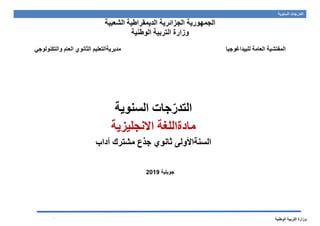
‫الشعبية‬ ‫الديمقراطية‬ ‫الجزائرية‬ ‫الجمهورية‬
‫الوطنية‬ ‫التربية‬ ‫وزارة‬
‫للبيداغوجيا‬ ‫العامة‬ ‫المفتشية‬‫مديريةالتعليم‬‫الثانوي‬‫العام‬‫والتكنولوجي‬
‫جات‬ّ‫التدر‬‫السنوية‬
‫مادة‬‫اللغة‬‫االنجليزية‬
‫السنة‬‫األ‬‫ول‬‫ثانوي‬‫جذع‬‫مشترك‬‫آداب‬
‫جويلية‬2019
‫السنوية‬ ‫التدرجات‬
‫الوطنية‬ ‫التربية‬ ‫وزارة‬2
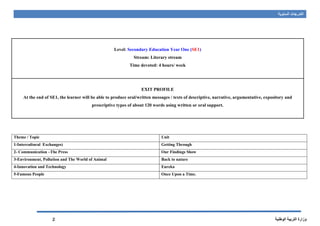
Theme / Topic Unit
1-Intercultural Exchanges) Getting Through
2- Communication –The Press Our Findings Show
3-Environment, Pollution and The World of Animal Back to nature
4-Innovation and Technology Eureka
5-Famous People Once Upon a Time.
Level: Secondary Education Year One (SE1)
Stream: Literary stream
Time devoted: 4 hours/ week
EXIT PROFILE
At the end of SE1, the learner will be able to produce oral/written messages / texts of descriptive, narrative, argumentative, expository and
prescriptive types of about 120 words using written or oral support.
‫السنوية‬ ‫التدرجات‬
‫الوطنية‬ ‫التربية‬ ‫وزارة‬3
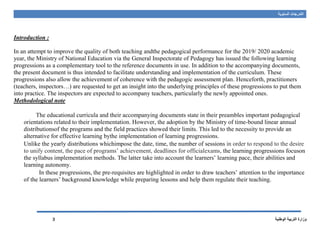
Introduction :
In an attempt to improve the quality of both teaching andthe pedagogical performance for the 2019/ 2020 academic
year, the Ministry of National Education via the General Inspectorate of Pedagogy has issued the following learning
progressions as a complementary tool to the reference documents in use. In addition to the accompanying documents,
the present document is thus intended to facilitate understanding and implementation of the curriculum. These
progressions also allow the achievement of coherence with the pedagogic assessment plan. Henceforth, practitioners
(teachers, inspectors…) are requested to get an insight into the underlying principles of these progressions to put them
into practice. The inspectors are expected to accompany teachers, particularly the newly appointed ones.
Methodological note
The educational curricula and their accompanying documents state in their preambles important pedagogical
orientations related to their implementation. However, the adoption by the Ministry of time-bound linear annual
distributionsof the programs and the field practices showed their limits. This led to the necessity to provide an
alternative for effective learning bythe implementation of learning progressions.
Unlike the yearly distributions whichimpose the date, time, the number of sessions in order to respond to the desire
to unify content, the pace of programs’ achievement, deadlines for officialexams, the learning progressions focuson
the syllabus implementation methods. The latter take into account the learners’ learning pace, their abilities and
learning autonomy.
In these progressions, the pre-requisites are highlighted in order to draw teachers’ attention to the importance
of the learners’ background knowledge while preparing lessons and help them regulate their teaching.
‫السنوية‬ ‫التدرجات‬
‫الوطنية‬ ‫التربية‬ ‫وزارة‬4
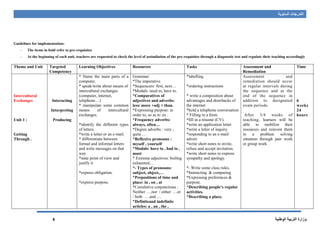
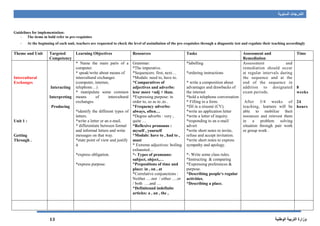
Guidelines for implementation:
- The items in bold refer to pre-requisites
- At the beginning of each unit, teachers are requested to check the level of assimilation of the pre-requisites through a diagnostic test and regulate their teaching accordingly
Theme and Unit Targeted
Competency
Learning Objectives Resources Tasks Assessment and
Remediation
Time
Intercultural
Exchanges
Unit 1 :
Getting
Through .
Interacting
Interpreting
Producing
* Name the main parts of a
computer.
* speak/write about means of
intercultural exchanges
(computer, internet,
telephone…)
* manipulate some common
means of intercultural
exchanges.
*identify the different types
of letters.
*write a letter or an e-mail.
* differentiate between
formal and informal letters
and write messages on that
way.
*state point of view and
justify it
*express obligation.
*express purpose.
Grammar:
*The imperative.
*Sequencers: first, next…
*Modals: need to, have to.
*Comparatives of
adjectives and adverbs:
less/ more +adj + than.
*Expressing purpose: in
order to, so as to ,to .
*Frequency adverbs:
always, often…
*Degree adverbs : very ,
quite …
*Reflexive pronouns :
myself , yourself
*Modals: have to , had to ,
must
* Extreme adjectives: boiling
exhausted…
*- Types of pronouns:
subject, object,…
*Prepositions of time and
place: in , on , at
*Correlative conjunctions :
Neither ….nor / either ….or
/ both ….and …
*Definiteand indefinite
articles: a , an , the ,
*labelling
*ordering instructions
* write a composition about
advantages and drawbacks of
the internet
*hold a telephone conversation
* Filling in a form.
*fill in a résumé (CV).
*write an application letter
*write a letter of inquiry.
*responding to an e-mail/
advert
*write short notes to invite,
refuse and accept invitation.
*write short notes to express
sympathy and apology.
*- Write some class rules.
*Instructing & comparing
*Expressing preferences &
purpose.
*Describing people‘s regular
activities.
*Describing a place.
Assessment and
remediation should occur
at regular intervals during
the sequence and at the
end of the sequence in
addition to designated
exam periods.
After 3/4 weeks of
teaching, learners will be
able to mobilize their
resources and reinvest them
in a problem solving
situation through pair work
or group work .
6
weeks
24
hours
‫السنوية‬ ‫التدرجات‬
‫الوطنية‬ ‫التربية‬ ‫وزارة‬5
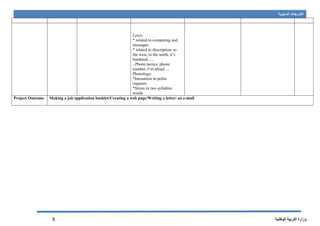
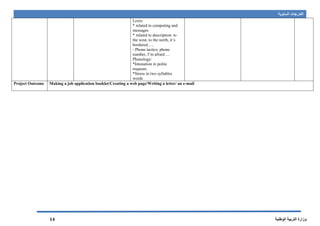
Lexis:
* related to computing and
messages
* related to description: to
the west, to the north, it’s
bordered…..
- Phone tactics: phone
number, I’m afraid….
Phonology:
*Intonation in polite
requests.
*Stress in two syllables
words
Project Outcome Making a job application booklet/Creating a web page/Writing a letter/ an e-mail
‫السنوية‬ ‫التدرجات‬
‫الوطنية‬ ‫التربية‬ ‫وزارة‬6
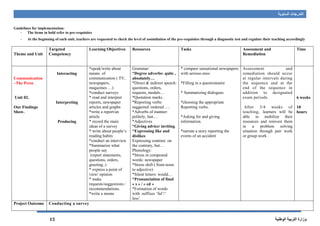
Guidelines for implementation:
- The items in bold refer to pre-requisites
- At the beginning of each unit, teachers are requested to check the level of assimilation of the pre-requisites through a diagnostic test and regulate their teaching accordingly
Theme and Unit
Targeted
Competency
Learning Objectives Resources Tasks Assessment and
Remediation
Time
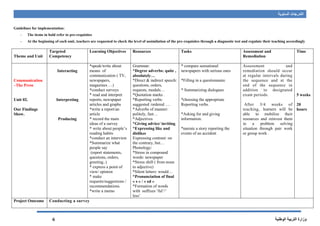
Communication
–The Press
Unit 02.
Our Findings
Show.
Interacting
Interpreting
Producing
*speak/write about
means of
communication ( TV,
newspapers,
magazines …)
*conduct surveys
* read and interpret
reports, newspaper
articles and graphs
*write a report/an
article
* record the main
ideas of a survey
* write about people’s
reading habits
*conduct an interview
*Summarize what
people say
(report statements,
questions, orders,
greeting..)
* express a point of
view/ opinion
* make
requests/suggestions /
recommendations.
*write a memo
Grammar:
*Degree adverbs: quite ,
absolutely…
*Direct & indirect speech:
questions, orders,
requests, modals…
*Quotation marks .
*Reporting verbs:
suggested /ordered ….
*Adverbs of manner:
politely, fast…
*Adjectives
*Giving advice/ inviting.
*Expressing like and
dislikes
Expressing contrast: on
the contrary, but…
Phonology:
*Stress in compound
words: newspaper
*Stress shift ( from noun
to adjective)
*Silent letters: would…
*Pronunciation of final
« s » / « ed »
*Formation of words
with suffixes ‘ful’/‘
less’
* compare sensational
newspapers with serious ones
*Filling in a questionnaire
* Summarizing dialogues
*choosing the appropriate
Reporting verbs.
*Asking for and giving
information.
*narrate a story reporting the
events of an accident
Assessment and
remediation should occur
at regular intervals during
the sequence and at the
end of the sequence in
addition to designated
exam periods.
After 3/4 weeks of
teaching, learners will be
able to mobilize their
resources and reinvest them
in a problem solving
situation through pair work
or group work .
5 weeks
20
hours
Project Outcome Conducting a survey
‫السنوية‬ ‫التدرجات‬
‫الوطنية‬ ‫التربية‬ ‫وزارة‬7
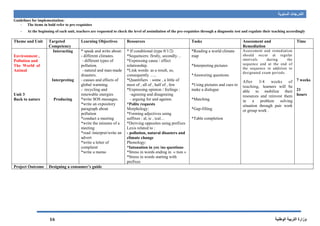
Guidelines for implementation:
- The items in bold refer to pre-requisites
- At the beginning of each unit, teachers are requested to check the level of assimilation of the pre-requisites through a diagnostic test and regulate their teaching accordingly
Theme and Unit Targeted
Competency
Learning Objectives Resources Tasks Assessment and
Remediation
Time
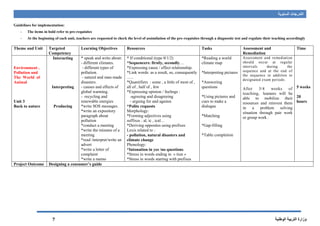
Environment ,
Pollution and
The World of
Animal
Unit 3
Back to nature
Interacting
Interpreting
Producing
* speak and write about:
- different climates.
- different types of
pollution.
- natural and man-made
disasters.
- causes and effects of
global warming.
- recycling and
renewable energies
*write SOS messages.
*write an expository
paragraph about
pollution
*conduct a meeting
*write the minutes of a
meeting
*read /interpret/write an
advert
*write a letter of
complaint
*write a memo
* If conditional (type 0/1/2)
*Sequencers: firstly, secondly…
*Expressing cause / effect relationship.
*Link words: as a result, so, consequently
…..
*Quantifiers : some , a little of most of ,
all of , half of , few
*Expressing opinion / feelings :
-agreeing and disagreeing
- arguing for and against.
*Polite requests
Morphology:
*Forming adjectives using
suffixes : al, ic , ical…
*Deriving opposites using prefixes
Lexis related to :
- pollution, natural disasters and
climate change
Phonology:
*Intonation in yes /no questions
*Stress in words ending in « tion »
*Stress in words starting with prefixes
*Reading a world
climate map
*Interpreting pictures
*Answering
questions
*Using pictures and
cues to make a
dialogue
*Matching
*Gap-filling
*Table completion
Assessment and remediation
should occur at regular
intervals during the
sequence and at the end of
the sequence in addition to
designated exam periods.
After 3/4 weeks of
teaching, learners will be
able to mobilize their
resources and reinvest them
in a problem solving
situation through pair work
or group work .
5 weeks
20
hours
Project Outcome Designing a consumer’s guide
‫السنوية‬ ‫التدرجات‬
‫الوطنية‬ ‫التربية‬ ‫وزارة‬8
Guidelines for implementation:
- The items in bold refer to pre-requisites
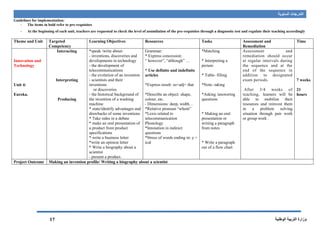
- At the beginning of each unit, teachers are requested to check the level of assimilation of the pre-requisites through a diagnostic test and regulate their teaching accordingly
Theme and Unit Targeted
Competency
Learning Objectives Resources Tasks Assessment and
Remediation
Time
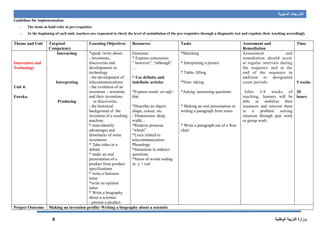
Innovation and
Technology
Unit 4:
Eureka.
Interacting
Interpreting
Producing
*speak /write about:
- inventions,
discoveries and
developments in
technology
- the development of
telecommunications
- the evolution of an
invention - scientists
and their inventions
or discoveries
- the historical
background of the
invention of a washing
machine
* state/identify
advantages and
drawbacks of some
inventions
* Take sides in a
debate
* make an oral
presentation of a
product from product
specifications
* write a business
letter
*write an opinion
letter
* Write a biography
about a scientist
- present a product.
Grammar:
* Express concession:
“ however”, “although”
…
* Use definite and
indefinite articles
*Express result: so+adj+
that
*Describe an object:
shape, colour, etc.
- Dimensions: deep,
width…
*Relative pronoun
“whom”
*Lexis related to
telecommunication
Phonology
*Intonation in indirect
questions
*Stress of words ending
in: y + ical
*Matching
* Interpreting a picture
* Table- filling
*Note- taking
*Asking /answering questions
* Making an oral presentation or
writing a paragraph from notes
* Write a paragraph out of a flow
chart
Assessment and
remediation should occur
at regular intervals during
the sequence and at the
end of the sequence in
addition to designated
exam periods.
After 3/4 weeks of
teaching, learners will be
able to mobilize their
resources and reinvest them
in a problem solving
situation through pair work
or group work .
5 weeks
20
hours
Project Outcome Making an invention profile/ Writing a biography about a scientist
‫السنوية‬ ‫التدرجات‬
‫الوطنية‬ ‫التربية‬ ‫وزارة‬9
Guidelines for implementation:
- The items in bold refer to pre-requisites
- At the beginning of each unit, teachers are requested to check the level of assimilation of the pre-requisites through a diagnostic test and regulate their teaching accordingly
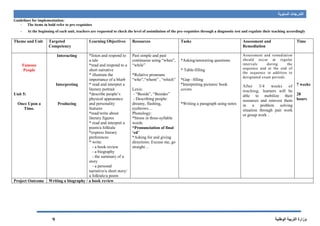
Theme and Unit Targeted
Competency
Learning Objectives Resources Tasks Assessment and
Remediation
Time
Famous
People
Unit 5:
Once Upon a
Time.
Interacting
Interpreting
Producing
*listen and respond to
a tale
*read and respond to a
short narrative
* illustrate the
importance of a blurb
* read and interpret a
literary portrait
*describe people’s
physical appearance
and personality
features
*read/write about
literary figures
* read and interpret a
poem/a folktale
*express literary
preferences
* write:
- a book review
- a biography
- the summary of a
story
- a personal
narrative/a short story/
a folktale/a poem
Past simple and past
continuous using “when”,
“while”
*Relative pronouns
“who”,“whom” , “which”
Lexis:
- “Beside”, “Besides”
- Describing people:
dreamy, flashing,
eyebrows…
Phonology:
*Stress in three-syllable
words
*Pronunciation of final
‘ed’
*Asking for and giving
directions: Excuse me, go
straight…
*Asking/answering questions
* Table-filling
*Gap –filling
*Interpreting pictures/ book
covers
*Writing a paragraph using notes
Assessment and remediation
should occur at regular
intervals during the
sequence and at the end of
the sequence in addition to
designated exam periods.
After 3/4 weeks of
teaching, learners will be
able to mobilize their
resources and reinvest them
in a problem solving
situation through pair work
or group work .
7 weeks
28
hours
Project Outcome Writing a biography / a book review
‫السنوية‬ ‫التدرجات‬
‫الوطنية‬ ‫التربية‬ ‫وزارة‬10
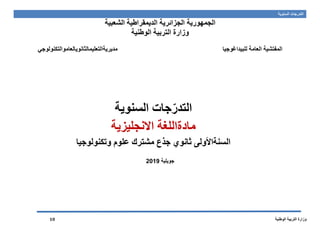
‫الجمهورية‬‫الشعبية‬ ‫الديمقراطية‬ ‫الجزائرية‬
‫الوطنية‬ ‫التربية‬ ‫وزارة‬
‫للبيداغوجيا‬ ‫العامة‬ ‫المفتشية‬‫مديريةالتعليمالثانويالعاموالتكنولوجي‬
‫جات‬ّ‫التدر‬‫السنوية‬
‫مادة‬‫االنجليزية‬ ‫اللغة‬
‫السنة‬‫األ‬‫ول‬‫ثانوي‬‫مشترك‬ ‫جذع‬‫علوم‬‫وتكنولوجيا‬
‫جويلية‬2019
‫السنوية‬ ‫التدرجات‬
‫الوطنية‬ ‫التربية‬ ‫وزارة‬11
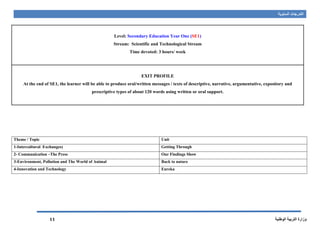
Theme / Topic Unit
1-Intercultural Exchanges) Getting Through
2- Communication –The Press Our Findings Show
3-Environment, Pollution and The World of Animal Back to nature
4-Innovation and Technology Eureka
Level: Secondary Education Year One (SE1)
Stream: Scientific and Technological Stream
Time devoted: 3 hours/ week
EXIT PROFILE
At the end of SE1, the learner will be able to produce oral/written messages / texts of descriptive, narrative, argumentative, expository and
prescriptive types of about 120 words using written or oral support.
‫السنوية‬ ‫التدرجات‬
‫الوطنية‬ ‫التربية‬ ‫وزارة‬12
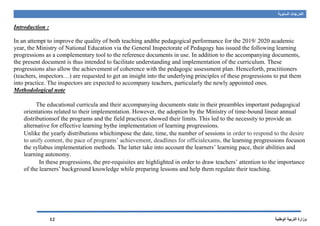
Introduction :
In an attempt to improve the quality of both teaching andthe pedagogical performance for the 2019/ 2020 academic
year, the Ministry of National Education via the General Inspectorate of Pedagogy has issued the following learning
progressions as a complementary tool to the reference documents in use. In addition to the accompanying documents,
the present document is thus intended to facilitate understanding and implementation of the curriculum. These
progressions also allow the achievement of coherence with the pedagogic assessment plan. Henceforth, practitioners
(teachers, inspectors…) are requested to get an insight into the underlying principles of these progressions to put them
into practice. The inspectors are expected to accompany teachers, particularly the newly appointed ones.
Methodological note
The educational curricula and their accompanying documents state in their preambles important pedagogical
orientations related to their implementation. However, the adoption by the Ministry of time-bound linear annual
distributionsof the programs and the field practices showed their limits. This led to the necessity to provide an
alternative for effective learning bythe implementation of learning progressions.
Unlike the yearly distributions whichimpose the date, time, the number of sessions in order to respond to the desire
to unify content, the pace of programs’ achievement, deadlines for officialexams, the learning progressions focuson
the syllabus implementation methods. The latter take into account the learners’ learning pace, their abilities and
learning autonomy.
In these progressions, the pre-requisites are highlighted in order to draw teachers’ attention to the importance
of the learners’ background knowledge while preparing lessons and help them regulate their teaching.
‫السنوية‬ ‫التدرجات‬
‫الوطنية‬ ‫التربية‬ ‫وزارة‬13
Guidelines for implementation:
- The items in bold refer to pre-requisites
- At the beginning of each unit, teachers are requested to check the level of assimilation of the pre-requisites through a diagnostic test and regulate their teaching accordingly
Theme and Unit Targeted
Competency
Learning Objectives Resources Tasks Assessment and
Remediation
Time
Intercultural
Exchanges
Unit 1 :
Getting
Through .
Interacting
Interpreting
Producing
* Name the main parts of a
computer.
* speak/write about means of
intercultural exchanges
(computer, internet,
telephone…)
* manipulate some common
means of intercultural
exchanges.
*identify the different types of
letters.
*write a letter or an e-mail.
* differentiate between formal
and informal letters and write
messages on that way.
*state point of view and justify
it
*express obligation.
*express purpose.
Grammar:
*The imperative.
*Sequencers: first, next…
*Modals: need to, have to.
*Comparatives of
adjectives and adverbs:
less/ more +adj + than.
*Expressing purpose: in
order to, so as to ,to .
*Frequency adverbs:
always, often…
*Degree adverbs : very ,
quite …
*Reflexive pronouns :
myself , yourself
*Modals: have to , had to ,
must
* Extreme adjectives: boiling
exhausted…
*- Types of pronouns:
subject, object,…
*Prepositions of time and
place: in , on , at
*Correlative conjunctions :
Neither ….nor / either ….or
/ both ….and …
*Definiteand indefinite
articles: a , an , the ,
*labelling
*ordering instructions
* write a composition about
advantages and drawbacks of
the internet
*hold a telephone conversation
* Filling in a form.
*fill in a résumé (CV).
*write an application letter
*write a letter of inquiry.
*responding to an e-mail/
advert
*write short notes to invite,
refuse and accept invitation.
*write short notes to express
sympathy and apology.
*- Write some class rules.
*Instructing & comparing
*Expressing preferences &
purpose.
*Describing people‘s regular
activities.
*Describing a place.
Assessment and
remediation should occur
at regular intervals during
the sequence and at the
end of the sequence in
addition to designated
exam periods.
After 3/4 weeks of
teaching, learners will be
able to mobilize their
resources and reinvest them
in a problem solving
situation through pair work
or group work .
8
weeks
24
hours
‫السنوية‬ ‫التدرجات‬
‫الوطنية‬ ‫التربية‬ ‫وزارة‬14
Lexis:
* related to computing and
messages
* related to description: to
the west, to the north, it’s
bordered…..
- Phone tactics: phone
number, I’m afraid….
Phonology:
*Intonation in polite
requests.
*Stress in two syllables
words
Project Outcome Making a job application booklet/Creating a web page/Writing a letter/ an e-mail
‫السنوية‬ ‫التدرجات‬
‫الوطنية‬ ‫التربية‬ ‫وزارة‬15
Guidelines for implementation:
- The items in bold refer to pre-requisites
- At the beginning of each unit, teachers are requested to check the level of assimilation of the pre-requisites through a diagnostic test and regulate their teaching accordingly
Theme and Unit
Targeted
Competency
Learning Objectives Resources Tasks Assessment and
Remediation
Time
Communication
–The Press
Unit 02.
Our Findings
Show.
Interacting
Interpreting
Producing
*speak/write about
means of
communication ( TV,
newspapers,
magazines …)
*conduct surveys
* read and interpret
reports, newspaper
articles and graphs
*write a report/an
article
* record the main
ideas of a survey
* write about people’s
reading habits
*conduct an interview
*Summarize what
people say
(report statements,
questions, orders,
greeting..)
* express a point of
view/ opinion
* make
requests/suggestions /
recommendations.
*write a memo
Grammar:
*Degree adverbs: quite ,
absolutely…
*Direct & indirect speech:
questions, orders,
requests, modals…
*Quotation marks .
*Reporting verbs:
suggested /ordered ….
*Adverbs of manner:
politely, fast…
*Adjectives
*Giving advice/ inviting.
*Expressing like and
dislikes
Expressing contrast: on
the contrary, but…
Phonology:
*Stress in compound
words: newspaper
*Stress shift ( from noun
to adjective)
*Silent letters: would…
*Pronunciation of final
« s » / « ed »
*Formation of words
with suffixes ‘ful’/‘
less’
* compare sensational newspapers
with serious ones
*Filling in a questionnaire
* Summarizing dialogues
*choosing the appropriate
Reporting verbs.
*Asking for and giving
information.
*narrate a story reporting the
events of an accident
Assessment and
remediation should occur
at regular intervals during
the sequence and at the
end of the sequence in
addition to designated
exam periods.
After 3/4 weeks of
teaching, learners will be
able to mobilize their
resources and reinvest them
in a problem solving
situation through pair work
or group work .
6 weeks
18
hours
Project Outcome Conducting a survey
‫السنوية‬ ‫التدرجات‬
‫الوطنية‬ ‫التربية‬ ‫وزارة‬16
Guidelines for implementation:
- The items in bold refer to pre-requisites
- At the beginning of each unit, teachers are requested to check the level of assimilation of the pre-requisites through a diagnostic test and regulate their teaching accordingly
Theme and Unit Targeted
Competency
Learning Objectives Resources Tasks Assessment and
Remediation
Time
Environment ,
Pollution and
The World of
Animal
Unit 3
Back to nature
Interacting
Interpreting
Producing
* speak and write about:
- different climates.
- different types of
pollution.
- natural and man-made
disasters.
- causes and effects of
global warming.
- recycling and
renewable energies
*write SOS messages.
*write an expository
paragraph about
pollution
*conduct a meeting
*write the minutes of a
meeting
*read /interpret/write an
advert
*write a letter of
complaint
*write a memo
* If conditional (type 0/1/2)
*Sequencers: firstly, secondly…
*Expressing cause / effect
relationship.
*Link words: as a result, so,
consequently …..
*Quantifiers : some , a little of
most of , all of , half of , few
*Expressing opinion / feelings :
-agreeing and disagreeing
- arguing for and against.
*Polite requests
Morphology:
*Forming adjectives using
suffixes : al, ic , ical…
*Deriving opposites using prefixes
Lexis related to :
- pollution, natural disasters and
climate change
Phonology:
*Intonation in yes /no questions
*Stress in words ending in « tion »
*Stress in words starting with
prefixes
*Reading a world climate
map
*Interpreting pictures
*Answering questions
*Using pictures and cues to
make a dialogue
*Matching
*Gap-filling
*Table completion
Assessment and remediation
should occur at regular
intervals during the
sequence and at the end of
the sequence in addition to
designated exam periods.
After 3/4 weeks of
teaching, learners will be
able to mobilize their
resources and reinvest them
in a problem solving
situation through pair work
or group work .
7 weeks
21
hours
Project Outcome Designing a consumer’s guide
‫السنوية‬ ‫التدرجات‬
‫الوطنية‬ ‫التربية‬ ‫وزارة‬17
Guidelines for implementation:
- The items in bold refer to pre-requisites
- At the beginning of each unit, teachers are requested to check the level of assimilation of the pre-requisites through a diagnostic test and regulate their teaching accordingly
Theme and Unit Targeted
Competency
Learning Objectives Resources Tasks Assessment and
Remediation
Time
Innovation and
Technology
Unit 4:
Eureka.
Interacting
Interpreting
Producing
*speak /write about:
- inventions, discoveries and
developments in technology
- the development of
telecommunications
- the evolution of an invention
- scientists and their
inventions
or discoveries
- the historical background of
the invention of a washing
machine
* state/identify advantages and
drawbacks of some inventions
* Take sides in a debate
* make an oral presentation of
a product from product
specifications
* write a business letter
*write an opinion letter
* Write a biography about a
scientist
- present a product.
Grammar:
* Express concession:
“ however”, “although” …
* Use definite and indefinite
articles
*Express result: so+adj+ that
*Describe an object: shape,
colour, etc.
- Dimensions: deep, width…
*Relative pronoun “whom”
*Lexis related to
telecommunication
Phonology
*Intonation in indirect
questions
*Stress of words ending in: y +
ical
*Matching
* Interpreting a
picture
* Table- filling
*Note- taking
*Asking /answering
questions
* Making an oral
presentation or
writing a paragraph
from notes
* Write a paragraph
out of a flow chart
Assessment and
remediation should occur
at regular intervals during
the sequence and at the
end of the sequence in
addition to designated
exam periods.
After 3/4 weeks of
teaching, learners will be
able to mobilize their
resources and reinvest them
in a problem solving
situation through pair work
or group work .
7 weeks
21
hours
Project Outcome Making an invention profile/ Writing a biography about a scientist

Progressions 1 as 2019-

  • 1.
    ‫السنوية‬ ‫التدرجات‬ ‫الوطنية‬ ‫التربية‬‫وزارة‬1 ‫الشعبية‬ ‫الديمقراطية‬ ‫الجزائرية‬ ‫الجمهورية‬ ‫الوطنية‬ ‫التربية‬ ‫وزارة‬ ‫للبيداغوجيا‬ ‫العامة‬ ‫المفتشية‬‫مديريةالتعليم‬‫الثانوي‬‫العام‬‫والتكنولوجي‬ ‫جات‬ّ‫التدر‬‫السنوية‬ ‫مادة‬‫اللغة‬‫االنجليزية‬ ‫السنة‬‫األ‬‫ول‬‫ثانوي‬‫جذع‬‫مشترك‬‫آداب‬ ‫جويلية‬2019
  • 2.
    ‫السنوية‬ ‫التدرجات‬ ‫الوطنية‬ ‫التربية‬‫وزارة‬2 Theme / Topic Unit 1-Intercultural Exchanges) Getting Through 2- Communication –The Press Our Findings Show 3-Environment, Pollution and The World of Animal Back to nature 4-Innovation and Technology Eureka 5-Famous People Once Upon a Time. Level: Secondary Education Year One (SE1) Stream: Literary stream Time devoted: 4 hours/ week EXIT PROFILE At the end of SE1, the learner will be able to produce oral/written messages / texts of descriptive, narrative, argumentative, expository and prescriptive types of about 120 words using written or oral support.
  • 3.
    ‫السنوية‬ ‫التدرجات‬ ‫الوطنية‬ ‫التربية‬‫وزارة‬3 Introduction : In an attempt to improve the quality of both teaching andthe pedagogical performance for the 2019/ 2020 academic year, the Ministry of National Education via the General Inspectorate of Pedagogy has issued the following learning progressions as a complementary tool to the reference documents in use. In addition to the accompanying documents, the present document is thus intended to facilitate understanding and implementation of the curriculum. These progressions also allow the achievement of coherence with the pedagogic assessment plan. Henceforth, practitioners (teachers, inspectors…) are requested to get an insight into the underlying principles of these progressions to put them into practice. The inspectors are expected to accompany teachers, particularly the newly appointed ones. Methodological note The educational curricula and their accompanying documents state in their preambles important pedagogical orientations related to their implementation. However, the adoption by the Ministry of time-bound linear annual distributionsof the programs and the field practices showed their limits. This led to the necessity to provide an alternative for effective learning bythe implementation of learning progressions. Unlike the yearly distributions whichimpose the date, time, the number of sessions in order to respond to the desire to unify content, the pace of programs’ achievement, deadlines for officialexams, the learning progressions focuson the syllabus implementation methods. The latter take into account the learners’ learning pace, their abilities and learning autonomy. In these progressions, the pre-requisites are highlighted in order to draw teachers’ attention to the importance of the learners’ background knowledge while preparing lessons and help them regulate their teaching.
  • 4.
    ‫السنوية‬ ‫التدرجات‬ ‫الوطنية‬ ‫التربية‬‫وزارة‬4 Guidelines for implementation: - The items in bold refer to pre-requisites - At the beginning of each unit, teachers are requested to check the level of assimilation of the pre-requisites through a diagnostic test and regulate their teaching accordingly Theme and Unit Targeted Competency Learning Objectives Resources Tasks Assessment and Remediation Time Intercultural Exchanges Unit 1 : Getting Through . Interacting Interpreting Producing * Name the main parts of a computer. * speak/write about means of intercultural exchanges (computer, internet, telephone…) * manipulate some common means of intercultural exchanges. *identify the different types of letters. *write a letter or an e-mail. * differentiate between formal and informal letters and write messages on that way. *state point of view and justify it *express obligation. *express purpose. Grammar: *The imperative. *Sequencers: first, next… *Modals: need to, have to. *Comparatives of adjectives and adverbs: less/ more +adj + than. *Expressing purpose: in order to, so as to ,to . *Frequency adverbs: always, often… *Degree adverbs : very , quite … *Reflexive pronouns : myself , yourself *Modals: have to , had to , must * Extreme adjectives: boiling exhausted… *- Types of pronouns: subject, object,… *Prepositions of time and place: in , on , at *Correlative conjunctions : Neither ….nor / either ….or / both ….and … *Definiteand indefinite articles: a , an , the , *labelling *ordering instructions * write a composition about advantages and drawbacks of the internet *hold a telephone conversation * Filling in a form. *fill in a résumé (CV). *write an application letter *write a letter of inquiry. *responding to an e-mail/ advert *write short notes to invite, refuse and accept invitation. *write short notes to express sympathy and apology. *- Write some class rules. *Instructing & comparing *Expressing preferences & purpose. *Describing people‘s regular activities. *Describing a place. Assessment and remediation should occur at regular intervals during the sequence and at the end of the sequence in addition to designated exam periods. After 3/4 weeks of teaching, learners will be able to mobilize their resources and reinvest them in a problem solving situation through pair work or group work . 6 weeks 24 hours
  • 5.
    ‫السنوية‬ ‫التدرجات‬ ‫الوطنية‬ ‫التربية‬‫وزارة‬5 Lexis: * related to computing and messages * related to description: to the west, to the north, it’s bordered….. - Phone tactics: phone number, I’m afraid…. Phonology: *Intonation in polite requests. *Stress in two syllables words Project Outcome Making a job application booklet/Creating a web page/Writing a letter/ an e-mail
  • 6.
    ‫السنوية‬ ‫التدرجات‬ ‫الوطنية‬ ‫التربية‬‫وزارة‬6 Guidelines for implementation: - The items in bold refer to pre-requisites - At the beginning of each unit, teachers are requested to check the level of assimilation of the pre-requisites through a diagnostic test and regulate their teaching accordingly Theme and Unit Targeted Competency Learning Objectives Resources Tasks Assessment and Remediation Time Communication –The Press Unit 02. Our Findings Show. Interacting Interpreting Producing *speak/write about means of communication ( TV, newspapers, magazines …) *conduct surveys * read and interpret reports, newspaper articles and graphs *write a report/an article * record the main ideas of a survey * write about people’s reading habits *conduct an interview *Summarize what people say (report statements, questions, orders, greeting..) * express a point of view/ opinion * make requests/suggestions / recommendations. *write a memo Grammar: *Degree adverbs: quite , absolutely… *Direct & indirect speech: questions, orders, requests, modals… *Quotation marks . *Reporting verbs: suggested /ordered …. *Adverbs of manner: politely, fast… *Adjectives *Giving advice/ inviting. *Expressing like and dislikes Expressing contrast: on the contrary, but… Phonology: *Stress in compound words: newspaper *Stress shift ( from noun to adjective) *Silent letters: would… *Pronunciation of final « s » / « ed » *Formation of words with suffixes ‘ful’/‘ less’ * compare sensational newspapers with serious ones *Filling in a questionnaire * Summarizing dialogues *choosing the appropriate Reporting verbs. *Asking for and giving information. *narrate a story reporting the events of an accident Assessment and remediation should occur at regular intervals during the sequence and at the end of the sequence in addition to designated exam periods. After 3/4 weeks of teaching, learners will be able to mobilize their resources and reinvest them in a problem solving situation through pair work or group work . 5 weeks 20 hours Project Outcome Conducting a survey
  • 7.
    ‫السنوية‬ ‫التدرجات‬ ‫الوطنية‬ ‫التربية‬‫وزارة‬7 Guidelines for implementation: - The items in bold refer to pre-requisites - At the beginning of each unit, teachers are requested to check the level of assimilation of the pre-requisites through a diagnostic test and regulate their teaching accordingly Theme and Unit Targeted Competency Learning Objectives Resources Tasks Assessment and Remediation Time Environment , Pollution and The World of Animal Unit 3 Back to nature Interacting Interpreting Producing * speak and write about: - different climates. - different types of pollution. - natural and man-made disasters. - causes and effects of global warming. - recycling and renewable energies *write SOS messages. *write an expository paragraph about pollution *conduct a meeting *write the minutes of a meeting *read /interpret/write an advert *write a letter of complaint *write a memo * If conditional (type 0/1/2) *Sequencers: firstly, secondly… *Expressing cause / effect relationship. *Link words: as a result, so, consequently ….. *Quantifiers : some , a little of most of , all of , half of , few *Expressing opinion / feelings : -agreeing and disagreeing - arguing for and against. *Polite requests Morphology: *Forming adjectives using suffixes : al, ic , ical… *Deriving opposites using prefixes Lexis related to : - pollution, natural disasters and climate change Phonology: *Intonation in yes /no questions *Stress in words ending in « tion » *Stress in words starting with prefixes *Reading a world climate map *Interpreting pictures *Answering questions *Using pictures and cues to make a dialogue *Matching *Gap-filling *Table completion Assessment and remediation should occur at regular intervals during the sequence and at the end of the sequence in addition to designated exam periods. After 3/4 weeks of teaching, learners will be able to mobilize their resources and reinvest them in a problem solving situation through pair work or group work . 5 weeks 20 hours Project Outcome Designing a consumer’s guide
  • 8.
    ‫السنوية‬ ‫التدرجات‬ ‫الوطنية‬ ‫التربية‬‫وزارة‬8 Guidelines for implementation: - The items in bold refer to pre-requisites - At the beginning of each unit, teachers are requested to check the level of assimilation of the pre-requisites through a diagnostic test and regulate their teaching accordingly Theme and Unit Targeted Competency Learning Objectives Resources Tasks Assessment and Remediation Time Innovation and Technology Unit 4: Eureka. Interacting Interpreting Producing *speak /write about: - inventions, discoveries and developments in technology - the development of telecommunications - the evolution of an invention - scientists and their inventions or discoveries - the historical background of the invention of a washing machine * state/identify advantages and drawbacks of some inventions * Take sides in a debate * make an oral presentation of a product from product specifications * write a business letter *write an opinion letter * Write a biography about a scientist - present a product. Grammar: * Express concession: “ however”, “although” … * Use definite and indefinite articles *Express result: so+adj+ that *Describe an object: shape, colour, etc. - Dimensions: deep, width… *Relative pronoun “whom” *Lexis related to telecommunication Phonology *Intonation in indirect questions *Stress of words ending in: y + ical *Matching * Interpreting a picture * Table- filling *Note- taking *Asking /answering questions * Making an oral presentation or writing a paragraph from notes * Write a paragraph out of a flow chart Assessment and remediation should occur at regular intervals during the sequence and at the end of the sequence in addition to designated exam periods. After 3/4 weeks of teaching, learners will be able to mobilize their resources and reinvest them in a problem solving situation through pair work or group work . 5 weeks 20 hours Project Outcome Making an invention profile/ Writing a biography about a scientist
  • 9.
    ‫السنوية‬ ‫التدرجات‬ ‫الوطنية‬ ‫التربية‬‫وزارة‬9 Guidelines for implementation: - The items in bold refer to pre-requisites - At the beginning of each unit, teachers are requested to check the level of assimilation of the pre-requisites through a diagnostic test and regulate their teaching accordingly Theme and Unit Targeted Competency Learning Objectives Resources Tasks Assessment and Remediation Time Famous People Unit 5: Once Upon a Time. Interacting Interpreting Producing *listen and respond to a tale *read and respond to a short narrative * illustrate the importance of a blurb * read and interpret a literary portrait *describe people’s physical appearance and personality features *read/write about literary figures * read and interpret a poem/a folktale *express literary preferences * write: - a book review - a biography - the summary of a story - a personal narrative/a short story/ a folktale/a poem Past simple and past continuous using “when”, “while” *Relative pronouns “who”,“whom” , “which” Lexis: - “Beside”, “Besides” - Describing people: dreamy, flashing, eyebrows… Phonology: *Stress in three-syllable words *Pronunciation of final ‘ed’ *Asking for and giving directions: Excuse me, go straight… *Asking/answering questions * Table-filling *Gap –filling *Interpreting pictures/ book covers *Writing a paragraph using notes Assessment and remediation should occur at regular intervals during the sequence and at the end of the sequence in addition to designated exam periods. After 3/4 weeks of teaching, learners will be able to mobilize their resources and reinvest them in a problem solving situation through pair work or group work . 7 weeks 28 hours Project Outcome Writing a biography / a book review
  • 10.
    ‫السنوية‬ ‫التدرجات‬ ‫الوطنية‬ ‫التربية‬‫وزارة‬10 ‫الجمهورية‬‫الشعبية‬ ‫الديمقراطية‬ ‫الجزائرية‬ ‫الوطنية‬ ‫التربية‬ ‫وزارة‬ ‫للبيداغوجيا‬ ‫العامة‬ ‫المفتشية‬‫مديريةالتعليمالثانويالعاموالتكنولوجي‬ ‫جات‬ّ‫التدر‬‫السنوية‬ ‫مادة‬‫االنجليزية‬ ‫اللغة‬ ‫السنة‬‫األ‬‫ول‬‫ثانوي‬‫مشترك‬ ‫جذع‬‫علوم‬‫وتكنولوجيا‬ ‫جويلية‬2019
  • 11.
    ‫السنوية‬ ‫التدرجات‬ ‫الوطنية‬ ‫التربية‬‫وزارة‬11 Theme / Topic Unit 1-Intercultural Exchanges) Getting Through 2- Communication –The Press Our Findings Show 3-Environment, Pollution and The World of Animal Back to nature 4-Innovation and Technology Eureka Level: Secondary Education Year One (SE1) Stream: Scientific and Technological Stream Time devoted: 3 hours/ week EXIT PROFILE At the end of SE1, the learner will be able to produce oral/written messages / texts of descriptive, narrative, argumentative, expository and prescriptive types of about 120 words using written or oral support.
  • 12.
    ‫السنوية‬ ‫التدرجات‬ ‫الوطنية‬ ‫التربية‬‫وزارة‬12 Introduction : In an attempt to improve the quality of both teaching andthe pedagogical performance for the 2019/ 2020 academic year, the Ministry of National Education via the General Inspectorate of Pedagogy has issued the following learning progressions as a complementary tool to the reference documents in use. In addition to the accompanying documents, the present document is thus intended to facilitate understanding and implementation of the curriculum. These progressions also allow the achievement of coherence with the pedagogic assessment plan. Henceforth, practitioners (teachers, inspectors…) are requested to get an insight into the underlying principles of these progressions to put them into practice. The inspectors are expected to accompany teachers, particularly the newly appointed ones. Methodological note The educational curricula and their accompanying documents state in their preambles important pedagogical orientations related to their implementation. However, the adoption by the Ministry of time-bound linear annual distributionsof the programs and the field practices showed their limits. This led to the necessity to provide an alternative for effective learning bythe implementation of learning progressions. Unlike the yearly distributions whichimpose the date, time, the number of sessions in order to respond to the desire to unify content, the pace of programs’ achievement, deadlines for officialexams, the learning progressions focuson the syllabus implementation methods. The latter take into account the learners’ learning pace, their abilities and learning autonomy. In these progressions, the pre-requisites are highlighted in order to draw teachers’ attention to the importance of the learners’ background knowledge while preparing lessons and help them regulate their teaching.
  • 13.
    ‫السنوية‬ ‫التدرجات‬ ‫الوطنية‬ ‫التربية‬‫وزارة‬13 Guidelines for implementation: - The items in bold refer to pre-requisites - At the beginning of each unit, teachers are requested to check the level of assimilation of the pre-requisites through a diagnostic test and regulate their teaching accordingly Theme and Unit Targeted Competency Learning Objectives Resources Tasks Assessment and Remediation Time Intercultural Exchanges Unit 1 : Getting Through . Interacting Interpreting Producing * Name the main parts of a computer. * speak/write about means of intercultural exchanges (computer, internet, telephone…) * manipulate some common means of intercultural exchanges. *identify the different types of letters. *write a letter or an e-mail. * differentiate between formal and informal letters and write messages on that way. *state point of view and justify it *express obligation. *express purpose. Grammar: *The imperative. *Sequencers: first, next… *Modals: need to, have to. *Comparatives of adjectives and adverbs: less/ more +adj + than. *Expressing purpose: in order to, so as to ,to . *Frequency adverbs: always, often… *Degree adverbs : very , quite … *Reflexive pronouns : myself , yourself *Modals: have to , had to , must * Extreme adjectives: boiling exhausted… *- Types of pronouns: subject, object,… *Prepositions of time and place: in , on , at *Correlative conjunctions : Neither ….nor / either ….or / both ….and … *Definiteand indefinite articles: a , an , the , *labelling *ordering instructions * write a composition about advantages and drawbacks of the internet *hold a telephone conversation * Filling in a form. *fill in a résumé (CV). *write an application letter *write a letter of inquiry. *responding to an e-mail/ advert *write short notes to invite, refuse and accept invitation. *write short notes to express sympathy and apology. *- Write some class rules. *Instructing & comparing *Expressing preferences & purpose. *Describing people‘s regular activities. *Describing a place. Assessment and remediation should occur at regular intervals during the sequence and at the end of the sequence in addition to designated exam periods. After 3/4 weeks of teaching, learners will be able to mobilize their resources and reinvest them in a problem solving situation through pair work or group work . 8 weeks 24 hours
  • 14.
    ‫السنوية‬ ‫التدرجات‬ ‫الوطنية‬ ‫التربية‬‫وزارة‬14 Lexis: * related to computing and messages * related to description: to the west, to the north, it’s bordered….. - Phone tactics: phone number, I’m afraid…. Phonology: *Intonation in polite requests. *Stress in two syllables words Project Outcome Making a job application booklet/Creating a web page/Writing a letter/ an e-mail
  • 15.
    ‫السنوية‬ ‫التدرجات‬ ‫الوطنية‬ ‫التربية‬‫وزارة‬15 Guidelines for implementation: - The items in bold refer to pre-requisites - At the beginning of each unit, teachers are requested to check the level of assimilation of the pre-requisites through a diagnostic test and regulate their teaching accordingly Theme and Unit Targeted Competency Learning Objectives Resources Tasks Assessment and Remediation Time Communication –The Press Unit 02. Our Findings Show. Interacting Interpreting Producing *speak/write about means of communication ( TV, newspapers, magazines …) *conduct surveys * read and interpret reports, newspaper articles and graphs *write a report/an article * record the main ideas of a survey * write about people’s reading habits *conduct an interview *Summarize what people say (report statements, questions, orders, greeting..) * express a point of view/ opinion * make requests/suggestions / recommendations. *write a memo Grammar: *Degree adverbs: quite , absolutely… *Direct & indirect speech: questions, orders, requests, modals… *Quotation marks . *Reporting verbs: suggested /ordered …. *Adverbs of manner: politely, fast… *Adjectives *Giving advice/ inviting. *Expressing like and dislikes Expressing contrast: on the contrary, but… Phonology: *Stress in compound words: newspaper *Stress shift ( from noun to adjective) *Silent letters: would… *Pronunciation of final « s » / « ed » *Formation of words with suffixes ‘ful’/‘ less’ * compare sensational newspapers with serious ones *Filling in a questionnaire * Summarizing dialogues *choosing the appropriate Reporting verbs. *Asking for and giving information. *narrate a story reporting the events of an accident Assessment and remediation should occur at regular intervals during the sequence and at the end of the sequence in addition to designated exam periods. After 3/4 weeks of teaching, learners will be able to mobilize their resources and reinvest them in a problem solving situation through pair work or group work . 6 weeks 18 hours Project Outcome Conducting a survey
  • 16.
    ‫السنوية‬ ‫التدرجات‬ ‫الوطنية‬ ‫التربية‬‫وزارة‬16 Guidelines for implementation: - The items in bold refer to pre-requisites - At the beginning of each unit, teachers are requested to check the level of assimilation of the pre-requisites through a diagnostic test and regulate their teaching accordingly Theme and Unit Targeted Competency Learning Objectives Resources Tasks Assessment and Remediation Time Environment , Pollution and The World of Animal Unit 3 Back to nature Interacting Interpreting Producing * speak and write about: - different climates. - different types of pollution. - natural and man-made disasters. - causes and effects of global warming. - recycling and renewable energies *write SOS messages. *write an expository paragraph about pollution *conduct a meeting *write the minutes of a meeting *read /interpret/write an advert *write a letter of complaint *write a memo * If conditional (type 0/1/2) *Sequencers: firstly, secondly… *Expressing cause / effect relationship. *Link words: as a result, so, consequently ….. *Quantifiers : some , a little of most of , all of , half of , few *Expressing opinion / feelings : -agreeing and disagreeing - arguing for and against. *Polite requests Morphology: *Forming adjectives using suffixes : al, ic , ical… *Deriving opposites using prefixes Lexis related to : - pollution, natural disasters and climate change Phonology: *Intonation in yes /no questions *Stress in words ending in « tion » *Stress in words starting with prefixes *Reading a world climate map *Interpreting pictures *Answering questions *Using pictures and cues to make a dialogue *Matching *Gap-filling *Table completion Assessment and remediation should occur at regular intervals during the sequence and at the end of the sequence in addition to designated exam periods. After 3/4 weeks of teaching, learners will be able to mobilize their resources and reinvest them in a problem solving situation through pair work or group work . 7 weeks 21 hours Project Outcome Designing a consumer’s guide
  • 17.
    ‫السنوية‬ ‫التدرجات‬ ‫الوطنية‬ ‫التربية‬‫وزارة‬17 Guidelines for implementation: - The items in bold refer to pre-requisites - At the beginning of each unit, teachers are requested to check the level of assimilation of the pre-requisites through a diagnostic test and regulate their teaching accordingly Theme and Unit Targeted Competency Learning Objectives Resources Tasks Assessment and Remediation Time Innovation and Technology Unit 4: Eureka. Interacting Interpreting Producing *speak /write about: - inventions, discoveries and developments in technology - the development of telecommunications - the evolution of an invention - scientists and their inventions or discoveries - the historical background of the invention of a washing machine * state/identify advantages and drawbacks of some inventions * Take sides in a debate * make an oral presentation of a product from product specifications * write a business letter *write an opinion letter * Write a biography about a scientist - present a product. Grammar: * Express concession: “ however”, “although” … * Use definite and indefinite articles *Express result: so+adj+ that *Describe an object: shape, colour, etc. - Dimensions: deep, width… *Relative pronoun “whom” *Lexis related to telecommunication Phonology *Intonation in indirect questions *Stress of words ending in: y + ical *Matching * Interpreting a picture * Table- filling *Note- taking *Asking /answering questions * Making an oral presentation or writing a paragraph from notes * Write a paragraph out of a flow chart Assessment and remediation should occur at regular intervals during the sequence and at the end of the sequence in addition to designated exam periods. After 3/4 weeks of teaching, learners will be able to mobilize their resources and reinvest them in a problem solving situation through pair work or group work . 7 weeks 21 hours Project Outcome Making an invention profile/ Writing a biography about a scientist