Content
• Saudi ArabiaDigital Transformation
• Ministry of Communication and Information Technology
Strategic Goals for 2030
• Education and its Role in Supporting Digital National
Transformation Plan
• Saudi Arabia Strategic Goal to Increase Women
Participation in the Labor Market
3.
Content
• Saudi ArabiaDigital Transformation
• Ministry of Communication and Information Technology
Strategic Goals for 2030
• Education and its Role in Supporting Digital National
Transformation Plan
• Saudi Arabia Strategic Goal to Increase Women
Participation in the Labor Market
4.
Saudi Arabia DigitalTransformation
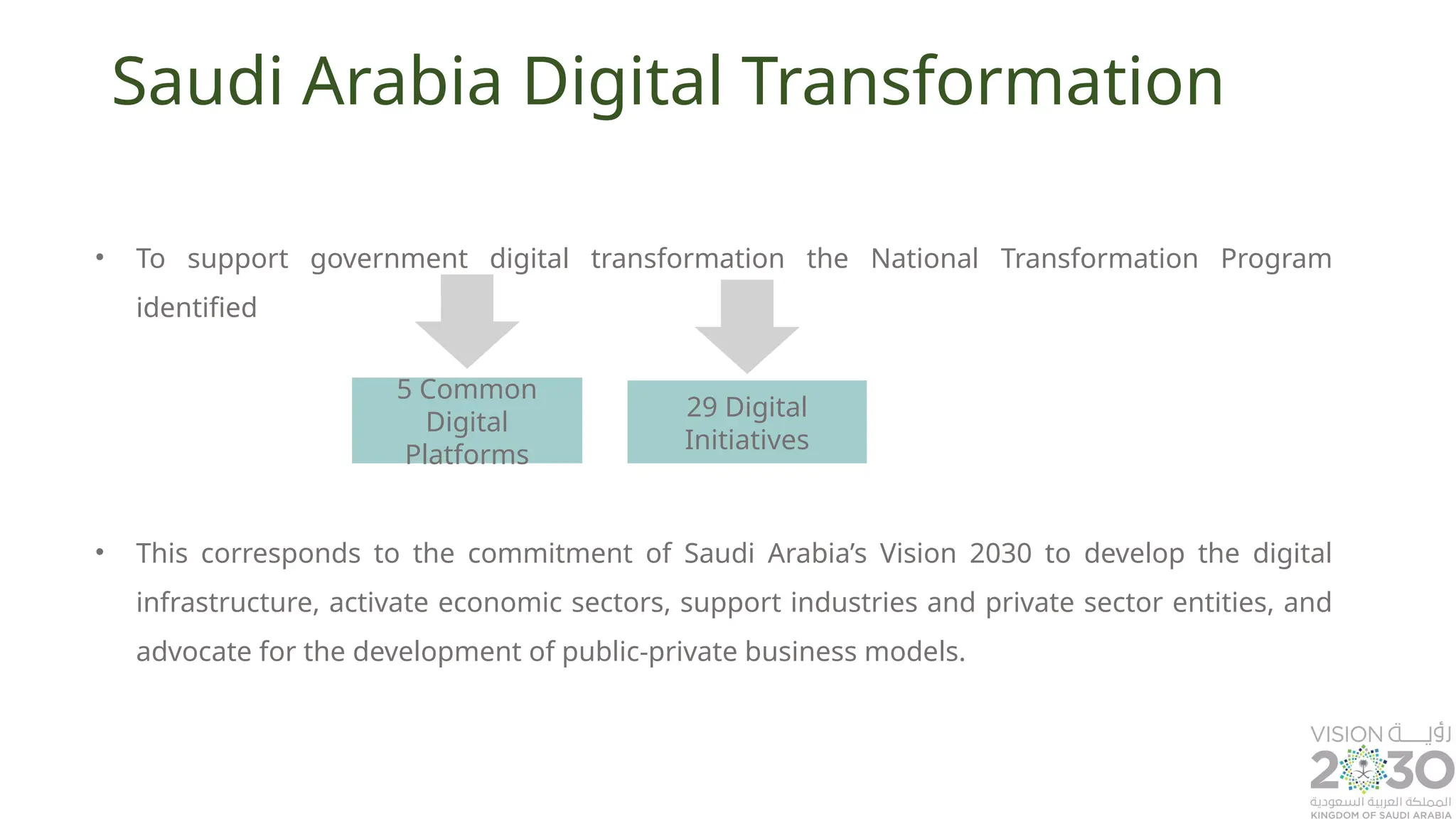
• To support government digital transformation the National Transformation Program
identified
• This corresponds to the commitment of Saudi Arabia’s Vision 2030 to develop the digital
infrastructure, activate economic sectors, support industries and private sector entities, and
advocate for the development of public-private business models.
5 Common
Digital
Platforms
29 Digital
Initiatives
5.
Develop the digitaleconomy
Brief, attributes and metrics
Employment
contribution
of
digital economy
Develop an advanced digital economy (i.e.
part of the economy which functions
primarily by means of digital technology, in
industrial, service, and social sectors),
fueled by innovations and contributing
significantly to the Saudi economy
Size
& sophistication
of digital technologies
adoption in the
industrial sector
Size
& sophistication
of digital economy
in the service sector
Impacts
of digital
technologies
on the social sector
Innovation
in digital
technologies
GDP contribution
of digital economy
Attribute 1 Attribute 2 Attribute 3 Attribute 4 Attribute 5 Attribute 6
Brief
and
Attributes
Source: Expert input, SMO & ADAA alignment
Number of factories /
plants which adopted
Industry 4.0
technologies (e.g., big
data analytics, cloud,
autonomous robots,
augment reality, 3D
printing, simulation,
Industrial Internet)
Number of Industry4.0
techn. solution
providers (global &
domestic) in KSA
Total productivity gain
(in $ value) from
Industry 4.0
technology adoption
Total GDP
contribution of digital
economy (break down
by industrial, service,
and social sector)
New jobs created by
digital economy (such
as data scientists, IT
architects, robot
coordinators)
Total revenue of
digital services (e.g. e-
commerce, IT services,
online advertising,
digital media & content,
gaming)
Number of digital
service providers in
each sub-sector
Total productivity gain
(in $ value) from
digital technology
adoption in traditional
service sector (e.g.
digital banking, digital
government services,
self-driving
transportation)
% of not-for-profit
organizations adopted
digital technologies
Number of people
engaged with NGOs
through social media
platforms
Number of digital
technology solutions
& patents (according to
global criteria)
registered annually
Total R&D spending
on digital technology
research & innovation
as percentage of GDP
Metrics
Brief
Objectives
Digital economy
development
6.
Develop the e-Government
Brief,attributes and metrics
1. focused on measuring access to government services
Source: SMO analysis, ADAA analysis
Brief
and
Attributes
Develop e-Government solutions for citizens,
businesses, NGOs as well as internal
government processes. This includes
increasing penetration, use and customer
satisfaction and the decrease of government
service delivery cost
Attribute 1
Penetration
of e-Government in services
provided to stakeholders and in
internal government processes
Attribute 2
Use
of e-Government services by
stakeholders
Attribute 3
Customer satisfaction from e-
Government services (e.g., on
quality and access)
Attribute 4
Impact
of e-Government services on
delivery cost
Brief
Annual savings realized through
new e-Government initiatives
Percentage of digitized
stakeholder facing services
Percentage of digitized internal
processes services
Number of users of digitized
stakeholder facing services
Average usage rate of digitized
internal processes services
Customer satisfaction rate from e-
Government services
e–Government Development
Index
E-Participation index
Metrics
Objectives
Government performance
improvement
7.
Content
• Saudi ArabiaDigital Transformation
• Ministry of Communication and Information Technology
Strategic Goals for 2030
• Education and its Role in Supporting Digital National
Transformation Plan
• Saudi Arabia Strategic Goal to Increase Women
Participation in the Labor Market
8.
Strategic Goals for2030
Strategic
Objectives 1
Strategic
Objectives 3
Strategic
Objectives 2
Relevant Vision
2030 Objectives
Relevant Vision
2030 Objectives
Relevant Vision
2030 Objectives
• Provide citizens with knowledge
and skills to meet the future
needs of the labor market.
• Develop IT sector
Achieve the highest levels of
transparency and good
governance in all sectors Enhance
interaction between public
authorities and citizens
Expand privatization of
governmental services Improve
performance, productivity and
flexibility of public authorities
Accelerate the restructuring and
regulation of the postal sector
Rehabilitation of specialized Saudi
human capital and employment of
this capital to reduce the gap
between supply and demand in
the ICT sector.
Develop and activate smart
government transactions based on
a common infrastructure
9.
Strategic Goals for2030
Strategic
Objectives 4
Strategic
Objectives 6
Strategic
Objectives 5
Relevant Vision
2030 Objectives
Relevant Vision
2030 Objectives
Relevant Vision
2030 Objectives
Develop IT sector
• Develop IT sector
• Create an attractive environment
for both local and international
investors and enhance their
confidence in our economy
• Boost Small and Medium
enterprises
• Boost Productive Families
• Boost entrepreneurship Empower
women and materialize their
potentials
• Enhance the livability of Saudi
cities
• Develop IT sector
• Achieve the highest levels of
transparency and good
governance in all sectors
• Boost Small and Medium
enterprises
Provide broadband services to all
KSA regions by stimulating
investment in infrastructure and
developing tools, technical and
regulatory frameworks
Provide critical resources,
especially frequency spectrum for
telecommunications and
Information Technology services
Support E-commerce
10.
Strategic Goals for2030
Strategic
Objectives 7
Strategic
Objectives 9
Strategic
Objectives 8
Relevant Vision
2030 Objectives
Relevant Vision
2030 Objectives
Relevant Vision
2030 Objectives
Provide citizens with knowledge
and skills to meet the future needs
of the labor market
• Develop IT sector
• Boost Small and Medium
enterprises
• Support national companies
• Develop IT sector
• Provide citizens with knowledge and
skills to meet the future needs of
the labor market
• Boost Small and Medium
enterprises
• Create an attractive environment for
both local and international
investors and enhance their
confidence in our economy
Increase the IT industry’s
contribution in the non-oil GDP
Bridge the digital gap in the skills of
ICT users
Reduce the percentage of revenue
leakage to the IT industry abroad
11.
Strategic Goals for2030
Strategic
Objectives 10
Relevant Vision
2030 Objectives
Expand privatization of
governmental services
Complete the
transformation of the
Saudi Postal
Corporation towards a
commercially viable
company
12.
Content
• Saudi ArabiaDigital Transformation
• Ministry of Communication and Information Technology
Strategic Goals for 2030
• Education and its Role in Supporting Digital National
Transformation Plan
• Saudi Arabia Strategic Goal to Increase Women
Participation in the Labor Market
13.
Education and itsRole in Supporting Digital National
Transformation Plan
• The Kingdom has over 41 University all of which teaches ICT to
females and has a high rate of females enrollment.
• There are technical schools for females only spread in all
regions focusing in teaching ICT.
14.
14
Low female participationin ICT workforce remains a key challenge to
increasing the conversion of local graduates into the workforce
Computer science graduates, by gender
(%)
Female
44%
Male
56%
Female Male
Female computer science graduates joining ICT industry
(%)
Yes
13%
No
87%
Yes No
• Females represent nearly half of all computer science (CS)
graduates, which is a key group in ICT related studies
• CS graduates are critical to the supply of software engineers as
the courses in a CS degree are directly related to software
engineering
• Female CS graduates are not entering the ICT workforce,
because:
1. Weak private sector employment
2. Inhospitable business environment due to gender
imbalance
3. Lack of support for reproductive and family costs
Source: LinkedIn Research, Arab news, Ministry of Education, Pedersen and Partners, Government websites, Delta Partners analysis
15.
Education and itsRole in Supporting Digital National
Transformation Plan
Saudi Arabia Scholarship Program
The Custodian of the Two Holy Mosques Scholarship Program
aims grants Saudi students the opportunity to study in the
best universities around the globe and specialties in all majors
including ICT.
16.
Numbers of Studentsenrolled in The Scholarship Program
S
e
r
i
e
s
1
0
20,000
40,000
60,000
80,000
100,000
120,000
140,000
0
5,000
10,000
15,000
20,000
25,000
30,000
35,000
40,000
45,000
Male Fmale Male2 Female
The Number
of Females
enrolled in
the program
from 2006 to
2016 is
204,471
17.
17
Programs have beenidentified to support development of a healthy ICT talent
ecosystem
ICT Human Capital
BOOST ICT EDUCATION UPTAKE
Programs
Launch prerequisite-free ICT education programs
Revamp K12 education curriculum
Revamp digital resources in schools
Encourage University-industry collaboration for ICT job placements
Launch digital competitions in schools / universities
Launch online content localization program
Launch program to promote productive and safe use of the Internet
Raise digital awareness and popularize use of the Internet & ICTs
BRIDGE DIGITAL LITERACY GAP
18.
Content
• Saudi ArabiaDigital Transformation
• Ministry of Communication and Information Technology
Strategic Goals for 2030
• Education and its Role in Supporting National
Transformation Plan
• Saudi Arabia Strategic Goal to Increase Women
Participation in the Labor Market
19.
Increase women participationin the labor market
Brief, attributes and metrics
Source: Expert input, SMO & ADAA alignment
Enable women to contribute further to
socio-economic development through a
larger participation in the labor markets
across fields and job levels. This also
involves removing barriers for women to
join the job market
Brief
and
Attributes
Attribute 1
Share of women in active workforce
(in general, or in specific fields)
Attribute 2
Share of women in management
positions
Attribute 3
Readiness of women to integrate
into the labor market
Labor market readiness to integrate
women
Attribute 4
Percentage of female participation in
labor market
Percentage of executive positions in
the private sector that are female
Female satisfaction rate with the
workplace being ready for women
Percentage of female participation in
select sectors (Sectors to be defined)
Global Gender Gap Index- Economic
Participation and Opportunity Pillar
Gender Inequality Index
No. of women in government
functions of grade 11 and above or
the like
No. of companies with women
represented in the Boards of
Directors
Metrics
Brief
Objectives Labor market reform
20.
20
Programs have beenidentified to support development of a healthy ICT talent
ecosystem
ICT Human Capital
BALANCE TALENT DEMAND /
SUPPLY
Provide incentives to employers to hire women in ICT roles
Launch training programs for ICT professionals
Revamp visa procedures for foreign hires in STEM fields
Programs
21.
21
The ICT HumanCapital Development strategy is a comprehensive revamp program
based on three streams and 11 programs
Streams
3
ICT Human Capital
Development strategy
Bridge digital
literacy gap
Balance talent
demand / supply
Programs
11 3 programs
3 programs
Challenges
7+
Lack of ICT
interest
Boost ICT
education uptake
5 programs
Low female
participation
Qualification
mismatch
Not-job-
ready
graduates
Slow visa
process for
STEM
Low digital
literacy rate
…




![[e-Government Program City Paper : Muscat, Oman]](https://cdn.slidesharecdn.com/ss_thumbnails/13omanmuscatpresentationkorea-140728023517-phpapp02-thumbnail.jpg?width=640&height=640&fit=bounds)


