3D Capabilities Profileconstruct of our unique capabilitiesa comprehensive and structured framework of capabilities1/15
We are uniqueOur capabilities profile is uniqueOur development needs are uniqueUnderstanding our capabilitieswill help us develop our talent3D Capabilities profile will help usconstruct our capabilitiesleading to multiple development purposes2/15
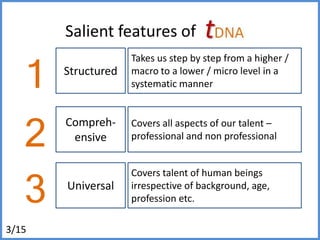
Salient features of 3D Capabilities Profile  1StructuredTakes us step by step from a higher / macro to a lower / micro level in a systematic manner2Compreh-ensiveCovers all aspects of our talent – professional and non professional3UniversalCovers talent of human beings irrespective of background, age, profession etc.3/15
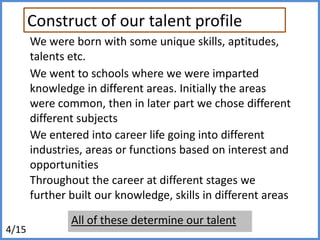
Construct of our capabilitiesprofileWe were born with some unique skills, aptitudes, talents etc.We went to schools where we were imparted knowledge in different areas. Initially the areas were common, then in later part we chose different different subjects We entered into career life going into different industries, areas or functions based on interest and opportunitiesThroughout the career at different stages we further built our knowledge, skills in different areasAll of these determine our capabilities4/15
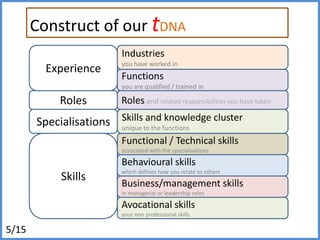
Construct of our capabilitiesExperienceIndustriesyou have worked inFunctionsyou are qualified / trained inRolesRolesand related responsibilities you have takenSpecialisationsSkills and knowledge cluster unique to the functionsSkillsFunctional / Technical skillsassociated with the specialisationsBehavioural skillswhich defines how you relate to othersBusiness/management skillsin managerial or leadership rolesAvocational skillsyour non professional skills5/15
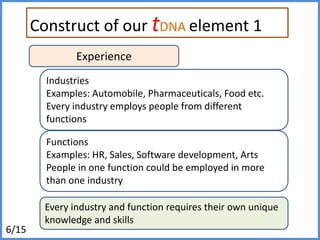
Construct of our capabilities - element 1ExperienceIndustriesExamples: Automobile, Pharmaceuticals, Food etc. Every industry employs people from different functionsFunctionsExamples: HR, Sales, Software development, Arts People in one function could be employed in more than one industryEvery industry and function requires their own unique knowledge and skills6/15
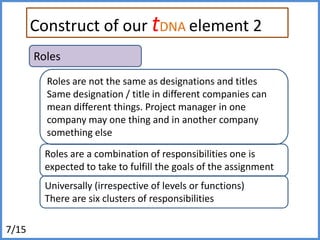
Construct of our capabilities element 2RolesRoles are not the same as designations and titlesSame designation / title in different companies can mean different things. Project manager in one company may one thing and in another company something elseRoles are a combination of responsibilities one is expected to take to fulfill the goals of the assignmentUniversally (irrespective of levels or functions)There are six clusters of responsibilities7/15
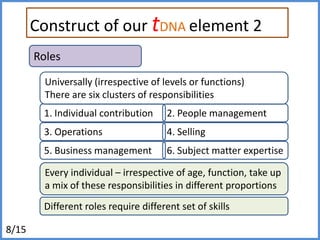
Construct of our capabilities element 2RolesUniversally (irrespective of levels or functions)There are six clusters of responsibilities1. Individual contribution2. People management3. Operations4. Selling5. Business management6. Subject matter expertiseEvery individual – irrespective of age, function, take up a mix of these responsibilities in different proportionsDifferent roles require different set of skills8/15
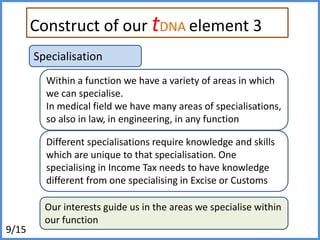
Construct of our capabilities element 3SpecialisationWithin a function we have a variety of areas in which we can specialise.In medical field we have many areas of specialisations, so also in law, in engineering, in any functionDifferent specialisations require knowledge and skills which are unique to that specialisation. One specialising in Income Tax needs to have knowledge different from one specialising in Excise or CustomsOur interests guide us in the areas we specialise within our function9/15
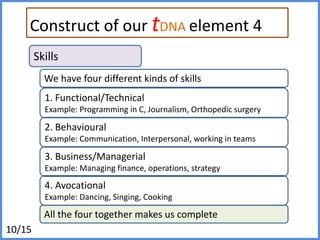
Construct of our capabilities element 4Skills We have four different kinds of skills 1. Functional/TechnicalExample: Programming in C, Journalism, Orthopedic surgery2. BehaviouralExample: Communication, Interpersonal, working in teams3. Business/ManagerialExample: Managing finance, operations, strategy4. AvocationalExample: Dancing, Singing, CookingAll the four together makes us complete10/15
So that’s the construct ofCapabilites profileHow do we use it?11/15
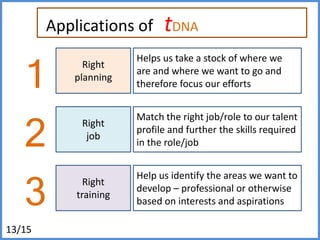
Applications ofcapabilities profile1Right planningHelps us take a stock of where we are and where we want to go and therefore focus our efforts2Right jobMatch the right job/role to our talent profile and further the skills required in the role/job3RighttrainingHelp us identify the areas we want to develop – professional or otherwise based on interests and aspirations12/15
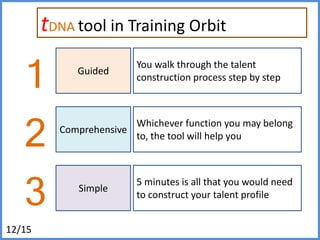
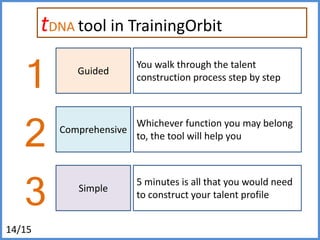
Capabilities Profilerin Training Orbit1GuidedYou walk through the talent construction process step by step2ComprehensiveWhichever function you may belong to, the tool will help you3Simple5 minutes is all that you would need to construct your talent profile13/15
Capabilities Profilerin Training Orbit1GuidedYou walk through the talent construction process step by step2ComprehensiveWhichever function you may belong to, the tool will help you3Simple5 minutes is all that you would need to construct your talent profile14/15
3D Capabilities ProfileConstruct of our talentfostering our growth and developmentBrought to you byTraining Orbitwww.trainingorbit.com15/15

Profiling Our Capabilities

  • 1.
    3D Capabilities Profileconstructof our unique capabilitiesa comprehensive and structured framework of capabilities1/15
  • 2.
    We are uniqueOurcapabilities profile is uniqueOur development needs are uniqueUnderstanding our capabilitieswill help us develop our talent3D Capabilities profile will help usconstruct our capabilitiesleading to multiple development purposes2/15
  • 3.
    Salient features of3D Capabilities Profile 1StructuredTakes us step by step from a higher / macro to a lower / micro level in a systematic manner2Compreh-ensiveCovers all aspects of our talent – professional and non professional3UniversalCovers talent of human beings irrespective of background, age, profession etc.3/15
  • 4.
    Construct of ourcapabilitiesprofileWe were born with some unique skills, aptitudes, talents etc.We went to schools where we were imparted knowledge in different areas. Initially the areas were common, then in later part we chose different different subjects We entered into career life going into different industries, areas or functions based on interest and opportunitiesThroughout the career at different stages we further built our knowledge, skills in different areasAll of these determine our capabilities4/15
  • 5.
    Construct of ourcapabilitiesExperienceIndustriesyou have worked inFunctionsyou are qualified / trained inRolesRolesand related responsibilities you have takenSpecialisationsSkills and knowledge cluster unique to the functionsSkillsFunctional / Technical skillsassociated with the specialisationsBehavioural skillswhich defines how you relate to othersBusiness/management skillsin managerial or leadership rolesAvocational skillsyour non professional skills5/15
  • 6.
    Construct of ourcapabilities - element 1ExperienceIndustriesExamples: Automobile, Pharmaceuticals, Food etc. Every industry employs people from different functionsFunctionsExamples: HR, Sales, Software development, Arts People in one function could be employed in more than one industryEvery industry and function requires their own unique knowledge and skills6/15
  • 7.
    Construct of ourcapabilities element 2RolesRoles are not the same as designations and titlesSame designation / title in different companies can mean different things. Project manager in one company may one thing and in another company something elseRoles are a combination of responsibilities one is expected to take to fulfill the goals of the assignmentUniversally (irrespective of levels or functions)There are six clusters of responsibilities7/15
  • 8.
    Construct of ourcapabilities element 2RolesUniversally (irrespective of levels or functions)There are six clusters of responsibilities1. Individual contribution2. People management3. Operations4. Selling5. Business management6. Subject matter expertiseEvery individual – irrespective of age, function, take up a mix of these responsibilities in different proportionsDifferent roles require different set of skills8/15
  • 9.
    Construct of ourcapabilities element 3SpecialisationWithin a function we have a variety of areas in which we can specialise.In medical field we have many areas of specialisations, so also in law, in engineering, in any functionDifferent specialisations require knowledge and skills which are unique to that specialisation. One specialising in Income Tax needs to have knowledge different from one specialising in Excise or CustomsOur interests guide us in the areas we specialise within our function9/15
  • 10.
    Construct of ourcapabilities element 4Skills We have four different kinds of skills 1. Functional/TechnicalExample: Programming in C, Journalism, Orthopedic surgery2. BehaviouralExample: Communication, Interpersonal, working in teams3. Business/ManagerialExample: Managing finance, operations, strategy4. AvocationalExample: Dancing, Singing, CookingAll the four together makes us complete10/15
  • 11.
    So that’s theconstruct ofCapabilites profileHow do we use it?11/15
  • 12.
    Applications ofcapabilities profile1RightplanningHelps us take a stock of where we are and where we want to go and therefore focus our efforts2Right jobMatch the right job/role to our talent profile and further the skills required in the role/job3RighttrainingHelp us identify the areas we want to develop – professional or otherwise based on interests and aspirations12/15
  • 13.
    Capabilities Profilerin TrainingOrbit1GuidedYou walk through the talent construction process step by step2ComprehensiveWhichever function you may belong to, the tool will help you3Simple5 minutes is all that you would need to construct your talent profile13/15
  • 14.
    Capabilities Profilerin TrainingOrbit1GuidedYou walk through the talent construction process step by step2ComprehensiveWhichever function you may belong to, the tool will help you3Simple5 minutes is all that you would need to construct your talent profile14/15
  • 15.
    3D Capabilities ProfileConstructof our talentfostering our growth and developmentBrought to you byTraining Orbitwww.trainingorbit.com15/15