Professionalising Data Analytics and Artificial Intelligence
Matthias Duschl and Fabian Winter
Big data and complex statistical analysis methods have gained huge
­attention in all industries. Many non-native digital companies, including
insurance businesses, have also invested significantly in data analytics and
artificial intelligence (AI) initiatives. During the initial phase, analytics use
cases along the entire insurance value chain have been explored. It is now
essential that we systematically professionalise our data analytics and AI
activities to sustain and fully reap the real benefits.
Most non-native digital companies invested heavily in data analytics and AI
­initiatives (see Infobox) as they understood that this will be a key enabler for
the insurance business to cope with challenges such as changing customer
behaviour, regulatory requirements, high labour costs and increasing competi-
tion with InsurTech start-ups. A recent McKinsey survey found that data
and analytics leaders at global life and P&C companies invested as much as
$80 million per year in data analytics in 20161. Nowadays, data analytics has
become an integrated part of the insurance value chain. Yet still many insurers,
among them many smaller and medium-sized companies, face challenges in
scaling their solutions.
During the emergence of new technologies, recurring patterns can be
observed. Gartner, a technology research company, depicts the perception of
new technologies as a hype cycle. Innovations are typically followed by inflated
expectations. Yet productivity gains can only be realised time-shifted, once
new technologies are fully adopted. This is often reflected in the business
strategies of involved companies, which initially focus on exploration, followed
by a phase of exploitation, in which business models, processes and organisa-
tions are adapted accordingly.
1 https://www.mckinsey.com/industries/financial-services/our-insights/raising-returns-on-analytics-
investments-in-insurance
Munich Re
Professionalising Data Analytics
and Artificial Intelligence
Page 2/8
Also in the insurance industry, most companies adopted an initial exploratory
mode to understand the value of data analytics and AI. During this phase, sev-
eral use cases are tried out along the entire insurance value chain, involving
newly compiled teams and external partners. First movers were usually located
in data rich environments. Health insurers, for example, are equipped with a
wealth of personal data on diagnosis, treatment and prescribed drugs. Also at
Munich Re, the first analytics team was founded in 2010 in health insurance,
demonstrating business value of sophisticated statistical models applied to
medical or claims management. The timeline shows important data analytics
milestones and their adoption in the insurance industry.
Today, many insurance companies are facing the challenge to fully exploit the
potential benefit from data analytics and AI initiatives. For example, legacy IT
systems cannot be adapted quickly enough to new infrastructure requirements
in data storing, processing and massive parallel computing. Furthermore, data
quality is still poor in terms of completeness, fragmentation or governance and
not enough talent is available to master advanced analytical models. In addi-
tion, insights have not always resulted in actions or changed processes auto-
matically. Besides, an initial de-coupling in the exploration phase from a pro-
duction mode resulted in significant technical debt and a limited “frontline”
adoption of the analytical solutions in productive systems.
The insurance industry has now reached a point where careful strategies
are required to professionalise data analytics and AI initiatives – without fully
losing the curiosity and agility of the exploratory phase – to impact and drive
the entire organisation. Insurers should therefore start to reflect on how their
learnings from initial use cases and prototypes can be sustained to fully reap
the real benefits of big data and advanced statistical methods. A data and
­analytics strategy shall find company-specific responses for the following core
elements.
Timeline of general data analytics milestones and their adoption in the insurance industry
LSTM improves text
modelling
Insurance companies
start using ML for
claims  sales
GBM for regression
and classification
problems published
Hadoop appears
First MR analytics
team in health
­insurance
Insurer Aetna
­introduces virtual
assistant “Ann“
Amazon Redshift
and Google BigQue
were released
Development
of analytics
Insurance
industry
­adoption
	1997	1990s	1999	2006	 2010		 2011
Munich Re
Professionalising Data Analytics
and Artificial Intelligence
Page 3/8
1. Organisation
6. Culture
5. Processes
4. Data
3. Methods
2. Capabilities
Insurance companies need to craft strategies
at least in six big data and analytics-related
core elements for professionalising their data
analytics and AI initiatives
Professionalising
Data Analytics
­Initiatives
ery
Andrew Ng starts
to teach ML courses
at Stanford University
GANs for producing
photorealistic images
Agnik develops a
“Connected Car
­Insurance Program”
(Telematic)
DAV inclusion
of data science
curriculum
MR offers Analytics
Suite to its insurance
clients
“Applied Insurance
Analytics” of Patricia
L. Saporito
Google makes
­TensorFlow
available as open
source
First Data Science
Programmes
at the two Munich
Universities
	 2014	 2015	 2016	 2017	 2018
Munich Re
Professionalising Data Analytics
and Artificial Intelligence
Page 4/8
First, scalable organisational structures are required. This refers both to an
increasing division of responsibilities and an appropriate degree of decentrali-
sation of analytics activities. The former is reflected by emerging job profiles
like machine learning engineers, data privacy experts or visual data scientists,
but also domain specialisations such as forensic analytics experts or digital
sales analytics consultants. Insurers need to organise these responsibilities
effectively, also by considering the integration with other functions such as
business, legal or IT. The optimal composition of central and decentral
resources need to be identified for each insurer separately and depends on
­factors like size, line of business or grown structures. A strong Chief Data
Officer or Chief Analytics Officer might ensure coherence in quality standards
and data architecture.
Second, every insurance company requires a minimum level of analytics
­capabilities, either for executing analytics projects internally or, in case of an
outsourcing strategy, to be able at least to effectively coordinate providers.
Hence, recruitment of these new skills for the insurance industry shall be
strongly quality assured. Already in 2011, Munich Re introduced an assessment
center for coherently measuring data science skills in order to ensure the
global quality of applicants. Besides from recruiting, a differentiated training
approach for spreading data analytics capabilities into the entire organisation
becomes increasingly important, especially due to the challenge in finding
scarce data analytics experts in the labour market. Especially the mathemati-
cally inclined staff, like actuaries, can be enabled to catch up with new
­methods and tools.
Third, methods need to foster production-ready data science by end-to-end
thinking along the analytics model lifecycle. Many companies have only been
focusing on model development during their exploration phase. Statistically
sound models also need to be deployed in the target IT system, results from
industrialised models need to be tracked and measured and models need to be
maintained and continuously improved. Within increasing numbers of models
in production, an appropriate and tool-enabled model management framework
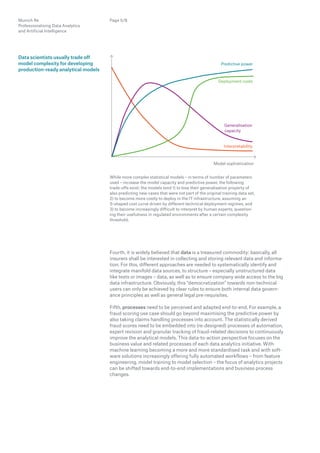
is recommended. This production view also changes the way new models are
developed. For instance, the data scientists need to carefully understand
trade-offs between model complexity, capacity and prediction power on the
one hand, and model generalisation properties, ease of deployment and inter-
pretability or transparency on the other hand. This becomes especially relevant
with the new GDPR for personal data and in traditionally strongly regulated
industries like insurance.
Munich Re
Professionalising Data Analytics
and Artificial Intelligence
Page 5/8
While more complex statistical models – in terms of number of parameters
used – increase the model capacity and predictive power, the following
trade-offs exist: the models tend 1) to lose their generalisation property of
also predicting new cases that were not part of the original training data set,
2) to become more costly to deploy in the IT infrastructure, assuming an
S-shaped cost curve driven by different technical deployment regimes, and
3) to become increasingly difficult to interpret by human experts, question-
ing their usefulness in regulated environments after a certain complexity
threshold.
Data scientists usually trade off
model complexity for developing
production-ready analytical models
Fourth, it is widely believed that data is a treasured commodity: basically, all
insurers shall be interested in collecting and storing relevant data and informa-
tion. For this, different approaches are needed to systematically identify and
integrate manifold data sources, to structure – especially unstructured data
like texts or images – data, as well as to ensure company wide access to the big
data infrastructure. Obviously, this “democratization” towards non-technical
users can only be achieved by clear rules to ensure both internal data govern-
ance principles as well as general legal pre-requisites.
Fifth, processes need to be perceived and adapted end-to-end. For example, a
fraud scoring use case should go beyond maximising the predictive power by
also taking claims handling processes into account. The statistically derived
fraud scores need to be embedded into (re-designed) processes of automation,
expert revision and granular tracking of fraud-related decisions to continuously
improve the analytical models. This data-to-action perspective focuses on the
business value and related processes of each data analytics initiative. With
machine learning becoming a more and more standardised task and with soft-
ware solutions increasingly offering fully automated workflows – from feature
engineering, model training to model selection – the focus of analytics projects
can be shifted towards end-to-end implementations and business process
changes.
Predictive power
Deployment costs
Generalisation
 capacity
Interpretability
Model sophistication
Munich Re
Professionalising Data Analytics
and Artificial Intelligence
Page 6/8
Finally, culture is a key element of the transformation towards insight-driven
decision making (“management by data”). Beyond data democratisation and
a comprehensive analytics training approach, this transformation still highly
depends on top-management support. As long as the exploration mode is
­prevalent and the business value of data analytics initiatives is not fully
exploited, some resistance might prevail within insurance companies. A recent
survey among executives in large companies has shown that only one-third
have succeeded in making the shift towards a culture in which decisions
mainly stem from data insights.2 Therefore, it is important to quickly remove
the gap towards professionalised data analytics as a means to legitimate this
cultural transformation. Insurance companies, therefore, need a clear measure-
ment catalogue to ensure buy-in by both employees and management. Part of
the measures could be a communication strategy at the one hand, and explicit
data and analytics related targets on the other hand for intensifying the expo-
sure to these new topics of high strategic value.
2 Davenport, Thomas and Bean, Randy (2018) Big Companies are embracing analytics, but most still don’t
have a data-driven culture. Harvard Business Review.
Munich Re
Professionalising Data Analytics
and Artificial Intelligence
Page 7/8
New opportunities and challenges with Artificial Intelligence
Artificial intelligence is the latest focal point within the analytics investment portfolio of
all companies aiming to become more data driven. In the broad sense, AI is often defined
as the use of digital systems that are capable of performing tasks commonly thought to
require artificial intelligence.3 The most rapid progress in recent years, however, was made
in a specific machine learning technique called Deep Learning that learns representations
from all kinds of data. It can be applied in fields such as computer vision, speech recogni-
tion or natural language processing. In some cases, Deep Learning has already surpassed
human capabilities, e.g. in strategic games or interpretation of complex data.
Although the statistical methods used are not fundamentally new and are rooted in long
academic research history on neural networks and numerical optimisation, they are now
leaving the academic sphere and increasingly shape competitiveness and society in a
broader sense. The impact is made possible by three major factors: 1) computing power
has grown exponentially and therefore very complex model architectures can now be opti-
mised, 2) due to digitalisation, a vast amount of labelled and unlabelled data like pictures,
text and videos is now available and 3) standardised software frameworks, mostly open-
source, have matured and make it possible to build complex Deep Learning models with
just a handful of lines of code. The major potentials of AI initiatives include:
−− For the first time, information from unstructured data can now be unleashed in an effec-
tive way without much human involvement. Therefore, almost unlimited amounts of texts
or images can be used to improve the quality and speed of decisions. For example, early
loss estimations from satellite images help insurers to optimise their loss adjustment
steering immediately after incurred events.
−− A purely data-driven decision making (that learns from the data over time automatically)
reduces the constraints on the currently scarcely available business experts with analyti-
cal capabilities. For example, a marketing expert can now focus on designing and immedi-
ately testing new cross-selling strategies instead of spending hours in manually crafting
target groups.
−− Specifically, AI can assist in the automation of frequent but still individual tasks. This can
help insurers to process individual claims without human intervention, saving time and
money and also avoiding frustration on the client side.
However, companies engaging with AI also face new challenges:
−− While most traditional data analytics tasks could be performed on the existing IT infra-
structure, new methods like Deep Learning heavily rely on computing power that is mainly
realised through specific hardware architectures like GPUs or TPUs. Therefore, many
companies have adopted cloud services to benefit from scalability and elasticity. Besides,
service-oriented architectures allow easy integration of both internally developed and
externally available AI services.
−− The improved predictive power comes at a cost of interpretability. Decision outcomes
from deep neural networks with hundreds of layers are not tractable by human experts
anymore. If personal data is involved, this conflicts with legal requirements. However,
­latest research in the academic community is increasingly focused on topics like causality
in machine learning or interpretable Deep Learning.4
−− AI solutions become new targets for cyber attacks. For instance, audio files can be
­manipulated in such ways that they instruct the AI system to perform specific tasks
­without being recognisable for human listeners. These kinds of attacks are based on
adversarial examples or poisoned data and represent a new class of threat that exploits
vulnerabilities of AI systems and drives the scale and scope of cyber risks.
3 See, for instance, https://img1.wsimg.com/blobby/go/3d82daa4-97fe-4096-9c6b-376b92c619de/
downloads/1c6q2kc4v_50335.pdf?imm_mid=0fbae9cmp=em-data-na-na-newsltr_ai_20180226
4 For examples, Frosst, Nicholas and Hinton, Geoffrey (2017) Distilling a Neural Network Into a Soft
Decision Tree
Munich Re
Professionalising Data Analytics
and Artificial Intelligence
Page 8/8
© 2018
Münchener Rückversicherungs-Gesellschaft
Königinstrasse 107, 80802 München, Germany
Picture credits: GettyImages/Wenjie Dong
Münchener Rückversicherungs-Gesellschaft
(Munich Reinsurance Company) is a reinsurance
­company organised under the laws of Germany.
In some ­countries, including in the United States,
Munich Reinsurance Company holds the status of
an unauthorised reinsurer. Policies are underwritten
by Munich Reinsurance Company or its affiliated
­insurance and reinsurance subsidiaries. Certain
­coverages are not available in all juris­dictions.
Any description in this document is for general
information purposes only and does not consti-
tute an offer to sell or a solicitation of an offer to
buy any product.
Wolfgang Hauner
Chief Data Officer
whauner@munichre.com
Dr. Fabian Winter
Head of Analytics
fwinter@munichre.com
Dr. Andreas Nawroth
Head of Artificial Intelligence
anawroth@munichre.com
Andreas Kohlmaier
Head of Data Engineering
akohlmaier@munichre.com
Contacts

Professionalising Data Analytics and Artificial Intelligence

  • 1.
    Professionalising Data Analyticsand Artificial Intelligence Matthias Duschl and Fabian Winter Big data and complex statistical analysis methods have gained huge ­attention in all industries. Many non-native digital companies, including insurance businesses, have also invested significantly in data analytics and artificial intelligence (AI) initiatives. During the initial phase, analytics use cases along the entire insurance value chain have been explored. It is now essential that we systematically professionalise our data analytics and AI activities to sustain and fully reap the real benefits. Most non-native digital companies invested heavily in data analytics and AI ­initiatives (see Infobox) as they understood that this will be a key enabler for the insurance business to cope with challenges such as changing customer behaviour, regulatory requirements, high labour costs and increasing competi- tion with InsurTech start-ups. A recent McKinsey survey found that data and analytics leaders at global life and P&C companies invested as much as $80 million per year in data analytics in 20161. Nowadays, data analytics has become an integrated part of the insurance value chain. Yet still many insurers, among them many smaller and medium-sized companies, face challenges in scaling their solutions. During the emergence of new technologies, recurring patterns can be observed. Gartner, a technology research company, depicts the perception of new technologies as a hype cycle. Innovations are typically followed by inflated expectations. Yet productivity gains can only be realised time-shifted, once new technologies are fully adopted. This is often reflected in the business strategies of involved companies, which initially focus on exploration, followed by a phase of exploitation, in which business models, processes and organisa- tions are adapted accordingly. 1 https://www.mckinsey.com/industries/financial-services/our-insights/raising-returns-on-analytics- investments-in-insurance
  • 2.
    Munich Re Professionalising DataAnalytics and Artificial Intelligence Page 2/8 Also in the insurance industry, most companies adopted an initial exploratory mode to understand the value of data analytics and AI. During this phase, sev- eral use cases are tried out along the entire insurance value chain, involving newly compiled teams and external partners. First movers were usually located in data rich environments. Health insurers, for example, are equipped with a wealth of personal data on diagnosis, treatment and prescribed drugs. Also at Munich Re, the first analytics team was founded in 2010 in health insurance, demonstrating business value of sophisticated statistical models applied to medical or claims management. The timeline shows important data analytics milestones and their adoption in the insurance industry. Today, many insurance companies are facing the challenge to fully exploit the potential benefit from data analytics and AI initiatives. For example, legacy IT systems cannot be adapted quickly enough to new infrastructure requirements in data storing, processing and massive parallel computing. Furthermore, data quality is still poor in terms of completeness, fragmentation or governance and not enough talent is available to master advanced analytical models. In addi- tion, insights have not always resulted in actions or changed processes auto- matically. Besides, an initial de-coupling in the exploration phase from a pro- duction mode resulted in significant technical debt and a limited “frontline” adoption of the analytical solutions in productive systems. The insurance industry has now reached a point where careful strategies are required to professionalise data analytics and AI initiatives – without fully losing the curiosity and agility of the exploratory phase – to impact and drive the entire organisation. Insurers should therefore start to reflect on how their learnings from initial use cases and prototypes can be sustained to fully reap the real benefits of big data and advanced statistical methods. A data and ­analytics strategy shall find company-specific responses for the following core elements. Timeline of general data analytics milestones and their adoption in the insurance industry LSTM improves text modelling Insurance companies start using ML for claims sales GBM for regression and classification problems published Hadoop appears First MR analytics team in health ­insurance Insurer Aetna ­introduces virtual assistant “Ann“ Amazon Redshift and Google BigQue were released Development of analytics Insurance industry ­adoption 1997 1990s 1999 2006 2010 2011
  • 3.
    Munich Re Professionalising DataAnalytics and Artificial Intelligence Page 3/8 1. Organisation 6. Culture 5. Processes 4. Data 3. Methods 2. Capabilities Insurance companies need to craft strategies at least in six big data and analytics-related core elements for professionalising their data analytics and AI initiatives Professionalising Data Analytics ­Initiatives ery Andrew Ng starts to teach ML courses at Stanford University GANs for producing photorealistic images Agnik develops a “Connected Car ­Insurance Program” (Telematic) DAV inclusion of data science curriculum MR offers Analytics Suite to its insurance clients “Applied Insurance Analytics” of Patricia L. Saporito Google makes ­TensorFlow available as open source First Data Science Programmes at the two Munich Universities 2014 2015 2016 2017 2018
  • 4.
    Munich Re Professionalising DataAnalytics and Artificial Intelligence Page 4/8 First, scalable organisational structures are required. This refers both to an increasing division of responsibilities and an appropriate degree of decentrali- sation of analytics activities. The former is reflected by emerging job profiles like machine learning engineers, data privacy experts or visual data scientists, but also domain specialisations such as forensic analytics experts or digital sales analytics consultants. Insurers need to organise these responsibilities effectively, also by considering the integration with other functions such as business, legal or IT. The optimal composition of central and decentral resources need to be identified for each insurer separately and depends on ­factors like size, line of business or grown structures. A strong Chief Data Officer or Chief Analytics Officer might ensure coherence in quality standards and data architecture. Second, every insurance company requires a minimum level of analytics ­capabilities, either for executing analytics projects internally or, in case of an outsourcing strategy, to be able at least to effectively coordinate providers. Hence, recruitment of these new skills for the insurance industry shall be strongly quality assured. Already in 2011, Munich Re introduced an assessment center for coherently measuring data science skills in order to ensure the global quality of applicants. Besides from recruiting, a differentiated training approach for spreading data analytics capabilities into the entire organisation becomes increasingly important, especially due to the challenge in finding scarce data analytics experts in the labour market. Especially the mathemati- cally inclined staff, like actuaries, can be enabled to catch up with new ­methods and tools. Third, methods need to foster production-ready data science by end-to-end thinking along the analytics model lifecycle. Many companies have only been focusing on model development during their exploration phase. Statistically sound models also need to be deployed in the target IT system, results from industrialised models need to be tracked and measured and models need to be maintained and continuously improved. Within increasing numbers of models in production, an appropriate and tool-enabled model management framework is recommended. This production view also changes the way new models are developed. For instance, the data scientists need to carefully understand trade-offs between model complexity, capacity and prediction power on the one hand, and model generalisation properties, ease of deployment and inter- pretability or transparency on the other hand. This becomes especially relevant with the new GDPR for personal data and in traditionally strongly regulated industries like insurance.
  • 5.
    Munich Re Professionalising DataAnalytics and Artificial Intelligence Page 5/8 While more complex statistical models – in terms of number of parameters used – increase the model capacity and predictive power, the following trade-offs exist: the models tend 1) to lose their generalisation property of also predicting new cases that were not part of the original training data set, 2) to become more costly to deploy in the IT infrastructure, assuming an S-shaped cost curve driven by different technical deployment regimes, and 3) to become increasingly difficult to interpret by human experts, question- ing their usefulness in regulated environments after a certain complexity threshold. Data scientists usually trade off model complexity for developing production-ready analytical models Fourth, it is widely believed that data is a treasured commodity: basically, all insurers shall be interested in collecting and storing relevant data and informa- tion. For this, different approaches are needed to systematically identify and integrate manifold data sources, to structure – especially unstructured data like texts or images – data, as well as to ensure company wide access to the big data infrastructure. Obviously, this “democratization” towards non-technical users can only be achieved by clear rules to ensure both internal data govern- ance principles as well as general legal pre-requisites. Fifth, processes need to be perceived and adapted end-to-end. For example, a fraud scoring use case should go beyond maximising the predictive power by also taking claims handling processes into account. The statistically derived fraud scores need to be embedded into (re-designed) processes of automation, expert revision and granular tracking of fraud-related decisions to continuously improve the analytical models. This data-to-action perspective focuses on the business value and related processes of each data analytics initiative. With machine learning becoming a more and more standardised task and with soft- ware solutions increasingly offering fully automated workflows – from feature engineering, model training to model selection – the focus of analytics projects can be shifted towards end-to-end implementations and business process changes. Predictive power Deployment costs Generalisation  capacity Interpretability Model sophistication
  • 6.
    Munich Re Professionalising DataAnalytics and Artificial Intelligence Page 6/8 Finally, culture is a key element of the transformation towards insight-driven decision making (“management by data”). Beyond data democratisation and a comprehensive analytics training approach, this transformation still highly depends on top-management support. As long as the exploration mode is ­prevalent and the business value of data analytics initiatives is not fully exploited, some resistance might prevail within insurance companies. A recent survey among executives in large companies has shown that only one-third have succeeded in making the shift towards a culture in which decisions mainly stem from data insights.2 Therefore, it is important to quickly remove the gap towards professionalised data analytics as a means to legitimate this cultural transformation. Insurance companies, therefore, need a clear measure- ment catalogue to ensure buy-in by both employees and management. Part of the measures could be a communication strategy at the one hand, and explicit data and analytics related targets on the other hand for intensifying the expo- sure to these new topics of high strategic value. 2 Davenport, Thomas and Bean, Randy (2018) Big Companies are embracing analytics, but most still don’t have a data-driven culture. Harvard Business Review.
  • 7.
    Munich Re Professionalising DataAnalytics and Artificial Intelligence Page 7/8 New opportunities and challenges with Artificial Intelligence Artificial intelligence is the latest focal point within the analytics investment portfolio of all companies aiming to become more data driven. In the broad sense, AI is often defined as the use of digital systems that are capable of performing tasks commonly thought to require artificial intelligence.3 The most rapid progress in recent years, however, was made in a specific machine learning technique called Deep Learning that learns representations from all kinds of data. It can be applied in fields such as computer vision, speech recogni- tion or natural language processing. In some cases, Deep Learning has already surpassed human capabilities, e.g. in strategic games or interpretation of complex data. Although the statistical methods used are not fundamentally new and are rooted in long academic research history on neural networks and numerical optimisation, they are now leaving the academic sphere and increasingly shape competitiveness and society in a broader sense. The impact is made possible by three major factors: 1) computing power has grown exponentially and therefore very complex model architectures can now be opti- mised, 2) due to digitalisation, a vast amount of labelled and unlabelled data like pictures, text and videos is now available and 3) standardised software frameworks, mostly open- source, have matured and make it possible to build complex Deep Learning models with just a handful of lines of code. The major potentials of AI initiatives include: −− For the first time, information from unstructured data can now be unleashed in an effec- tive way without much human involvement. Therefore, almost unlimited amounts of texts or images can be used to improve the quality and speed of decisions. For example, early loss estimations from satellite images help insurers to optimise their loss adjustment steering immediately after incurred events. −− A purely data-driven decision making (that learns from the data over time automatically) reduces the constraints on the currently scarcely available business experts with analyti- cal capabilities. For example, a marketing expert can now focus on designing and immedi- ately testing new cross-selling strategies instead of spending hours in manually crafting target groups. −− Specifically, AI can assist in the automation of frequent but still individual tasks. This can help insurers to process individual claims without human intervention, saving time and money and also avoiding frustration on the client side. However, companies engaging with AI also face new challenges: −− While most traditional data analytics tasks could be performed on the existing IT infra- structure, new methods like Deep Learning heavily rely on computing power that is mainly realised through specific hardware architectures like GPUs or TPUs. Therefore, many companies have adopted cloud services to benefit from scalability and elasticity. Besides, service-oriented architectures allow easy integration of both internally developed and externally available AI services. −− The improved predictive power comes at a cost of interpretability. Decision outcomes from deep neural networks with hundreds of layers are not tractable by human experts anymore. If personal data is involved, this conflicts with legal requirements. However, ­latest research in the academic community is increasingly focused on topics like causality in machine learning or interpretable Deep Learning.4 −− AI solutions become new targets for cyber attacks. For instance, audio files can be ­manipulated in such ways that they instruct the AI system to perform specific tasks ­without being recognisable for human listeners. These kinds of attacks are based on adversarial examples or poisoned data and represent a new class of threat that exploits vulnerabilities of AI systems and drives the scale and scope of cyber risks. 3 See, for instance, https://img1.wsimg.com/blobby/go/3d82daa4-97fe-4096-9c6b-376b92c619de/ downloads/1c6q2kc4v_50335.pdf?imm_mid=0fbae9cmp=em-data-na-na-newsltr_ai_20180226 4 For examples, Frosst, Nicholas and Hinton, Geoffrey (2017) Distilling a Neural Network Into a Soft Decision Tree
  • 8.
    Munich Re Professionalising DataAnalytics and Artificial Intelligence Page 8/8 © 2018 Münchener Rückversicherungs-Gesellschaft Königinstrasse 107, 80802 München, Germany Picture credits: GettyImages/Wenjie Dong Münchener Rückversicherungs-Gesellschaft (Munich Reinsurance Company) is a reinsurance ­company organised under the laws of Germany. In some ­countries, including in the United States, Munich Reinsurance Company holds the status of an unauthorised reinsurer. Policies are underwritten by Munich Reinsurance Company or its affiliated ­insurance and reinsurance subsidiaries. Certain ­coverages are not available in all juris­dictions. Any description in this document is for general information purposes only and does not consti- tute an offer to sell or a solicitation of an offer to buy any product. Wolfgang Hauner Chief Data Officer whauner@munichre.com Dr. Fabian Winter Head of Analytics fwinter@munichre.com Dr. Andreas Nawroth Head of Artificial Intelligence anawroth@munichre.com Andreas Kohlmaier Head of Data Engineering akohlmaier@munichre.com Contacts