Professional Etiquette
Dr. Lisa Bullard
CHE 451
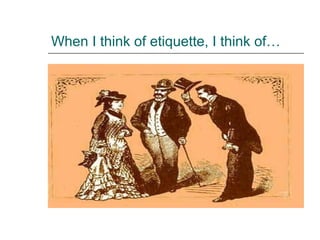
When I think of etiquette, I think of…
Etiquette – A Ticket
Original meaning:
 A ticket proving that the bearer knew
the rules required for admittance
behind closed doors
Etiquette – A Ticket
 Etiquette still “opens doors”
 Life is more pleasurable and easier
when we know what to expect from
other people, what they expect of
us, and how to respond in an
appropriate way
Principles of Etiquette
 Do unto others as you would have them
do unto you. – Luke 6:31
 One should seek for others the happiness
one desires for one’s self. – Buddha
 The true rule of life is to guard and do by
the things of others as they do by their
own. – Hindu
 What you would not wish done to
yourself, do not do unto others. – Chinese
The Case for Etiquette
 Good manners open doors that
position and money cannot.
 Treating people courteously
because we feel that they are
important or can help our career is
an inauthentic reason. Other
people will soon recognize the
insincerity.
Question 1
In the business arena:
a) Only men should stand for handshaking and all
introductions
b) Only women should stand for handshaking and all
introductions
c) It is not necessary for men or women to stand for
handshaking and all introductions
d) Both men and women should stand for handshaking
and all introductions
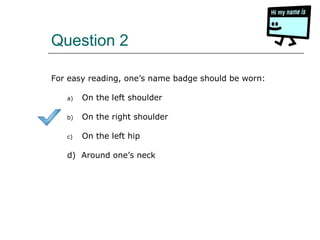
Question 2
For easy reading, one’s name badge should be worn:
a) On the left shoulder
b) On the right shoulder
c) On the left hip
d) Around one’s neck
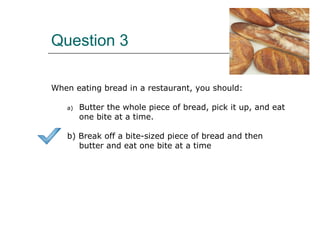
Question 3
When eating bread in a restaurant, you should:
a) Butter the whole piece of bread, pick it up, and eat
one bite at a time.
b) Break off a bite-sized piece of bread and then
butter and eat one bite at a time
Question 4
The best way to meet people at a business
or social function is to:
a) Head for the bar or buffet immediately upon arrival
b) Introduce yourself to two people who are standing
close and talking softly
c) Look confident, standing in the center of the room,
and wait for someone to approach you
d) Introduce yourself to a person standing alone
e) Stick close to those you know very well and forget
about the rest
Question 5
When making a business introduction,
you should :
a) Wing it
b) Introduce the less important/junior person to the
more important/senior person
c) Introduce the more important/senior person to the
less important/senior person
d) Don’t do anything. It is their responsibility to
introduce themselves.
Question 6
When expressing thanks to someone who has
given you a gift, you:
a) Send an email because it is faster and more
efficient
b) Send a handwritten note within 48 hours
c) Pick up the phone and call within 72 hours
d) Consider a verbal thank you sufficient
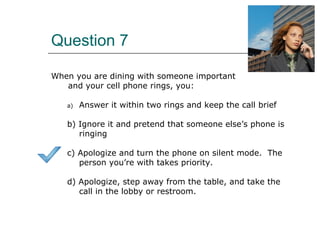
Question 7
When you are dining with someone important
and your cell phone rings, you:
a) Answer it within two rings and keep the call brief
b) Ignore it and pretend that someone else’s phone is
ringing
c) Apologize and turn the phone on silent mode. The
person you’re with takes priority.
d) Apologize, step away from the table, and take the
call in the lobby or restroom.
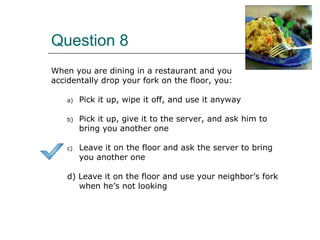
Question 8
When you are dining in a restaurant and you
accidentally drop your fork on the floor, you:
a) Pick it up, wipe it off, and use it anyway
b) Pick it up, give it to the server, and ask him to
bring you another one
c) Leave it on the floor and ask the server to bring
you another one
d) Leave it on the floor and use your neighbor’s fork
when he’s not looking
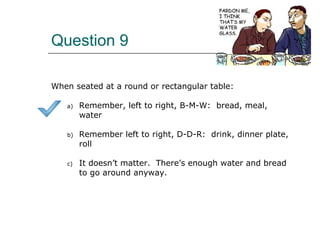
Question 9
When seated at a round or rectangular table:
a) Remember, left to right, B-M-W: bread, meal,
water
b) Remember left to right, D-D-R: drink, dinner plate,
roll
c) It doesn’t matter. There’s enough water and bread
to go around anyway.
Question 10
If you have a morsel of food lodged in your teeth and you
want to remove it, you:
a) Take your knife when no one is looking and remove
the morsel promptly with the blade
b) Raise your napkin to your mouth and discreetly use
a sugar packet or your business card to remove the
morsel
c) Politely ask your server for a toothpick
d) Excuse yourself and go to the restroom to pick your
teeth in private
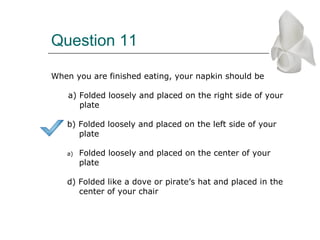
Question 11
When you are finished eating, your napkin should be
a) Folded loosely and placed on the right side of your
plate
b) Folded loosely and placed on the left side of your
plate
a) Folded loosely and placed on the center of your
plate
d) Folded like a dove or pirate’s hat and placed in the
center of your chair
Question 12
When two business people communicate, how far apart
should they stand?
a) 1.5 feet
b) 3 feet
c) 7 feet
Question 13
It is acceptable to tell a business colleague that
his/her zipper is unzipped.
a) True
b) False
Question 14
When answering a business phone, always answer
a) With a simple hello. It sounds more approachable
and less pretentious.
b) With your name
c) With your name, department, title, and a greeting
Question 15
When you reach a doorway at the same time as
another person, the following rules apply:
a) Whoever arrives first should open it and hold it for
those who are following
b) Men should always open doors for women
c) Women should open doors for men to prove that
they are no longer oppressed
d) Always open the door for someone of either sex if
that person has his or her hands full
Question 16
When exiting an elevator and a more senior person is
toward the back, always:
a) Step aside to let the more important person exit
first
b) Exit first if you are closest to the door
Question 17
On “Casual Friday”, which item(s) of clothing
is (are) generally considered inappropriate?
a) Khaki slacks
b) Sweat pants
c) Baseball caps
d) Polo-type shirts
e) Loafers
f) Flip flops
g) Jeans
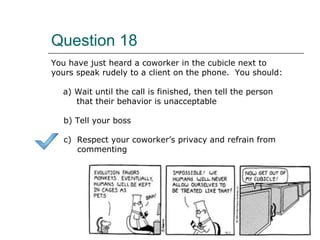
Question 18
You have just heard a coworker in the cubicle next to
yours speak rudely to a client on the phone. You should:
a) Wait until the call is finished, then tell the person
that their behavior is unacceptable
b) Tell your boss
c) Respect your coworker’s privacy and refrain from
commenting
Question 19
You have exchanged a couple of angry emails with a
coworker who, in your opinion, is being unreasonable. It’s
getting out of hand. You should:
a) Stop the communication and let things cool off
b) Send one more blistering email, summarizing the
situation and how upset you are with that person’s
behavior, and :cc the recipient’s supervisor
c) Change the medium. Call the person on the
telephone or go sit down face to face.
Real Interviewing Mistakes
That You WILL NOT Make
 Not cutting the tags off your suit
because you plan to return it.
 Canceling an interview or plant trip
because you have homework or
tests.
 Accepting a job offer, then turning it
down later if you get a better offer
or get in grad school.
 Accepting the first offer you receive
“just to get it over with”.
How To Introduce Yourself
 Stand up
 Look the person in the eye
 Extend your hand for a firm web-to-web
handshake. Avoid:
 Bone-crushing handshakes
 “Wet fish” handshakes
 Grabbing someone’s fingers
 Say your name and something about
yourself
“Hello, I’m John Smith. I work in Process
Improvement over in Polymers Division.”
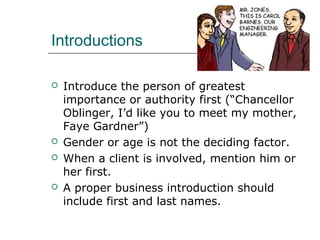
Introductions
 Introduce the person of greatest
importance or authority first (“Chancellor
Oblinger, I’d like you to meet my mother,
Faye Gardner”)
 Gender or age is not the deciding factor.
 When a client is involved, mention him or
her first.
 A proper business introduction should
include first and last names.
Avoid Your Coworkers’ Pet Peeves
 Or, how to avoid a reputation as the
office slob, pest, or jerk
Cubicle Courtesies
 Avoid loud phone conversations,
especially of a personal nature
 Do not wear strong perfume or
cologne
 Do not eat smelly food (e.g. fish)
 Do not stand in front of someone’s
cubicle and carry on a conversation
 Do not walk into a cubicle when
someone is on the phone (leave
them a note or email instead)
Kitchen
 If you drink the last cup of coffee,
make a new pot
 If you drink the last of the bottled
water, put on a new container
 Do not leave your dirty coffee cups
in the sink
 Do not eat other people’s food
 Do not leave your own food in the
refrigerator for too long
Office Citizenship
 Put things back where they belong
(stapler, hole punch, tape, etc.)
 Indicate a reorder if you use the
last of anything
 Refill the paper tray in the copier if
you empty it
 Learn how to unjam the copier
 Clear the copier settings after using
Office Citizenship
 Refill the gas tank of the company’s
car after using. Remove any fast
food wrappers or cups.
 After using a conference room,
clean up your papers, etc. Put the
chairs back around the table and
erase the white board.
 Do not leave dried up markers in
the white board tray.
 Don’t be a candy moocher.
Connecting With Others
 Learn everyone’s names quickly and
use them.
 Accept and initiate lunch invitations
 Recognize others’ accomplishments
 Keep a filled candy jar on your desk
 Keep nice notecards and/or a
variety of cards (sympathy, get
well, new baby) and use them
Find Your Own Style
 Figure out what you’re comfortable
with and do it
 Don’t try to be someone you’re not
 Don’t discount the importance of
such gestures just because you’re
uncomfortable – find your own style
and be authentic
Eating Out/Receptions
 It’s not about the food.
 It’s not about the beverages.
Restaurants
 Know how to use a standard table
setting. Start with utensils on the
outside and work your way “in”.
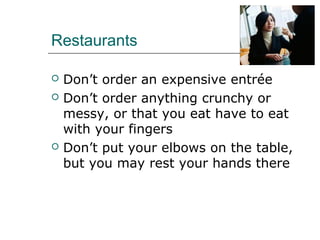
Restaurants
 Don’t order an expensive entrée
 Don’t order anything crunchy or
messy, or that you eat have to eat
with your fingers
 Don’t put your elbows on the table,
but you may rest your hands there
Restaurants
 Don’t start eating until your host or
hostess does, or until everyone has
been served
 Cut meat one piece at a time
 Rest silverware on your plate when
speaking
Restaurants
 Don’t bring your face
down to the plate – bring your
utensil up to you
 Don’t help yourself to an item
you’ve been asked to pass until the
person who requested it has served
him or herself
Restaurants
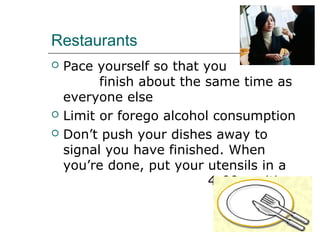
 Pace yourself so that you
finish about the same time as
everyone else
 Limit or forego alcohol consumption
 Don’t push your dishes away to
signal you have finished. When
you’re done, put your utensils in a
4:00 position.
Summary
 Knowledge of social skills does not
guarantee that all doors will open or
guarantee achievement of personal
and career goals
 It is likely that the door to many of
these rooms will likely be
closed for those who lack
these skills
 Etiquette makes the
workplace more
enjoyable
Further Reading
 The Etiquette Edge: The Unspoken
Rules for Business Success by
Beverly Langford
 Business Class: Etiquette Essentials
for Success at Work by Jacqueline
Whitmore
 What Not To Do at Work by Linda
Beam

Professional etiquette short version

  • 1.
  • 2.
    When I thinkof etiquette, I think of…
  • 3.
    When I thinkof etiquette, I think of…
  • 4.
    When I thinkof etiquette, I think of…
  • 5.
    When I thinkof etiquette, I think of…
  • 6.
    Etiquette – ATicket Original meaning:  A ticket proving that the bearer knew the rules required for admittance behind closed doors
  • 7.
    Etiquette – ATicket  Etiquette still “opens doors”  Life is more pleasurable and easier when we know what to expect from other people, what they expect of us, and how to respond in an appropriate way
  • 8.
    Principles of Etiquette Do unto others as you would have them do unto you. – Luke 6:31  One should seek for others the happiness one desires for one’s self. – Buddha  The true rule of life is to guard and do by the things of others as they do by their own. – Hindu  What you would not wish done to yourself, do not do unto others. – Chinese
  • 9.
    The Case forEtiquette  Good manners open doors that position and money cannot.  Treating people courteously because we feel that they are important or can help our career is an inauthentic reason. Other people will soon recognize the insincerity.
  • 10.
    Question 1 In thebusiness arena: a) Only men should stand for handshaking and all introductions b) Only women should stand for handshaking and all introductions c) It is not necessary for men or women to stand for handshaking and all introductions d) Both men and women should stand for handshaking and all introductions
  • 11.
    Question 2 For easyreading, one’s name badge should be worn: a) On the left shoulder b) On the right shoulder c) On the left hip d) Around one’s neck
  • 12.
    Question 3 When eatingbread in a restaurant, you should: a) Butter the whole piece of bread, pick it up, and eat one bite at a time. b) Break off a bite-sized piece of bread and then butter and eat one bite at a time
  • 13.
    Question 4 The bestway to meet people at a business or social function is to: a) Head for the bar or buffet immediately upon arrival b) Introduce yourself to two people who are standing close and talking softly c) Look confident, standing in the center of the room, and wait for someone to approach you d) Introduce yourself to a person standing alone e) Stick close to those you know very well and forget about the rest
  • 14.
    Question 5 When makinga business introduction, you should : a) Wing it b) Introduce the less important/junior person to the more important/senior person c) Introduce the more important/senior person to the less important/senior person d) Don’t do anything. It is their responsibility to introduce themselves.
  • 15.
    Question 6 When expressingthanks to someone who has given you a gift, you: a) Send an email because it is faster and more efficient b) Send a handwritten note within 48 hours c) Pick up the phone and call within 72 hours d) Consider a verbal thank you sufficient
  • 16.
    Question 7 When youare dining with someone important and your cell phone rings, you: a) Answer it within two rings and keep the call brief b) Ignore it and pretend that someone else’s phone is ringing c) Apologize and turn the phone on silent mode. The person you’re with takes priority. d) Apologize, step away from the table, and take the call in the lobby or restroom.
  • 17.
    Question 8 When youare dining in a restaurant and you accidentally drop your fork on the floor, you: a) Pick it up, wipe it off, and use it anyway b) Pick it up, give it to the server, and ask him to bring you another one c) Leave it on the floor and ask the server to bring you another one d) Leave it on the floor and use your neighbor’s fork when he’s not looking
  • 18.
    Question 9 When seatedat a round or rectangular table: a) Remember, left to right, B-M-W: bread, meal, water b) Remember left to right, D-D-R: drink, dinner plate, roll c) It doesn’t matter. There’s enough water and bread to go around anyway.
  • 19.
    Question 10 If youhave a morsel of food lodged in your teeth and you want to remove it, you: a) Take your knife when no one is looking and remove the morsel promptly with the blade b) Raise your napkin to your mouth and discreetly use a sugar packet or your business card to remove the morsel c) Politely ask your server for a toothpick d) Excuse yourself and go to the restroom to pick your teeth in private
  • 20.
    Question 11 When youare finished eating, your napkin should be a) Folded loosely and placed on the right side of your plate b) Folded loosely and placed on the left side of your plate a) Folded loosely and placed on the center of your plate d) Folded like a dove or pirate’s hat and placed in the center of your chair
  • 21.
    Question 12 When twobusiness people communicate, how far apart should they stand? a) 1.5 feet b) 3 feet c) 7 feet
  • 22.
    Question 13 It isacceptable to tell a business colleague that his/her zipper is unzipped. a) True b) False
  • 23.
    Question 14 When answeringa business phone, always answer a) With a simple hello. It sounds more approachable and less pretentious. b) With your name c) With your name, department, title, and a greeting
  • 24.
    Question 15 When youreach a doorway at the same time as another person, the following rules apply: a) Whoever arrives first should open it and hold it for those who are following b) Men should always open doors for women c) Women should open doors for men to prove that they are no longer oppressed d) Always open the door for someone of either sex if that person has his or her hands full
  • 25.
    Question 16 When exitingan elevator and a more senior person is toward the back, always: a) Step aside to let the more important person exit first b) Exit first if you are closest to the door
  • 26.
    Question 17 On “CasualFriday”, which item(s) of clothing is (are) generally considered inappropriate? a) Khaki slacks b) Sweat pants c) Baseball caps d) Polo-type shirts e) Loafers f) Flip flops g) Jeans
  • 27.
    Question 18 You havejust heard a coworker in the cubicle next to yours speak rudely to a client on the phone. You should: a) Wait until the call is finished, then tell the person that their behavior is unacceptable b) Tell your boss c) Respect your coworker’s privacy and refrain from commenting
  • 28.
    Question 19 You haveexchanged a couple of angry emails with a coworker who, in your opinion, is being unreasonable. It’s getting out of hand. You should: a) Stop the communication and let things cool off b) Send one more blistering email, summarizing the situation and how upset you are with that person’s behavior, and :cc the recipient’s supervisor c) Change the medium. Call the person on the telephone or go sit down face to face.
  • 29.
    Real Interviewing Mistakes ThatYou WILL NOT Make  Not cutting the tags off your suit because you plan to return it.  Canceling an interview or plant trip because you have homework or tests.  Accepting a job offer, then turning it down later if you get a better offer or get in grad school.  Accepting the first offer you receive “just to get it over with”.
  • 30.
    How To IntroduceYourself  Stand up  Look the person in the eye  Extend your hand for a firm web-to-web handshake. Avoid:  Bone-crushing handshakes  “Wet fish” handshakes  Grabbing someone’s fingers  Say your name and something about yourself “Hello, I’m John Smith. I work in Process Improvement over in Polymers Division.”
  • 31.
    Introductions  Introduce theperson of greatest importance or authority first (“Chancellor Oblinger, I’d like you to meet my mother, Faye Gardner”)  Gender or age is not the deciding factor.  When a client is involved, mention him or her first.  A proper business introduction should include first and last names.
  • 32.
    Avoid Your Coworkers’Pet Peeves  Or, how to avoid a reputation as the office slob, pest, or jerk
  • 33.
    Cubicle Courtesies  Avoidloud phone conversations, especially of a personal nature  Do not wear strong perfume or cologne  Do not eat smelly food (e.g. fish)  Do not stand in front of someone’s cubicle and carry on a conversation  Do not walk into a cubicle when someone is on the phone (leave them a note or email instead)
  • 34.
    Kitchen  If youdrink the last cup of coffee, make a new pot  If you drink the last of the bottled water, put on a new container  Do not leave your dirty coffee cups in the sink  Do not eat other people’s food  Do not leave your own food in the refrigerator for too long
  • 35.
    Office Citizenship  Putthings back where they belong (stapler, hole punch, tape, etc.)  Indicate a reorder if you use the last of anything  Refill the paper tray in the copier if you empty it  Learn how to unjam the copier  Clear the copier settings after using
  • 36.
    Office Citizenship  Refillthe gas tank of the company’s car after using. Remove any fast food wrappers or cups.  After using a conference room, clean up your papers, etc. Put the chairs back around the table and erase the white board.  Do not leave dried up markers in the white board tray.  Don’t be a candy moocher.
  • 37.
    Connecting With Others Learn everyone’s names quickly and use them.  Accept and initiate lunch invitations  Recognize others’ accomplishments  Keep a filled candy jar on your desk  Keep nice notecards and/or a variety of cards (sympathy, get well, new baby) and use them
  • 38.
    Find Your OwnStyle  Figure out what you’re comfortable with and do it  Don’t try to be someone you’re not  Don’t discount the importance of such gestures just because you’re uncomfortable – find your own style and be authentic
  • 39.
    Eating Out/Receptions  It’snot about the food.  It’s not about the beverages.
  • 40.
    Restaurants  Know howto use a standard table setting. Start with utensils on the outside and work your way “in”.
  • 41.
    Restaurants  Don’t orderan expensive entrée  Don’t order anything crunchy or messy, or that you eat have to eat with your fingers  Don’t put your elbows on the table, but you may rest your hands there
  • 42.
    Restaurants  Don’t starteating until your host or hostess does, or until everyone has been served  Cut meat one piece at a time  Rest silverware on your plate when speaking
  • 43.
    Restaurants  Don’t bringyour face down to the plate – bring your utensil up to you  Don’t help yourself to an item you’ve been asked to pass until the person who requested it has served him or herself
  • 44.
    Restaurants  Pace yourselfso that you finish about the same time as everyone else  Limit or forego alcohol consumption  Don’t push your dishes away to signal you have finished. When you’re done, put your utensils in a 4:00 position.
  • 45.
    Summary  Knowledge ofsocial skills does not guarantee that all doors will open or guarantee achievement of personal and career goals  It is likely that the door to many of these rooms will likely be closed for those who lack these skills  Etiquette makes the workplace more enjoyable
  • 46.
    Further Reading  TheEtiquette Edge: The Unspoken Rules for Business Success by Beverly Langford  Business Class: Etiquette Essentials for Success at Work by Jacqueline Whitmore  What Not To Do at Work by Linda Beam