Professional Communications
CyberSecurity Bootcamp Presentation
08Feb2024
Kye-Anne Wilborn, MBA, MM, Phd(c)
Dean Center of Excellence in Business
& Professional Services
AGENDA
• Introduction
• Types of Communications
• Talk About It…
• Informal – vs – Formal Communication
• Professional/College Communications
• Talk About It…
• Check for Understanding
• Q&A
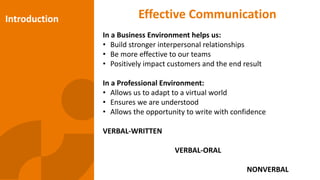
Effective Communication
In a Business Environment helps us:
• Build stronger interpersonal relationships
• Be more effective to our teams
• Positively impact customers and the end result
In a Professional Environment:
• Allows us to adapt to a virtual world
• Ensures we are understood
• Allows the opportunity to write with confidence
VERBAL-WRITTEN
VERBAL-ORAL
NONVERBAL
Introduction
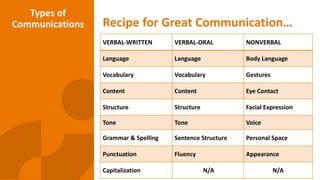
Recipe for Great Communication…
VERBAL-WRITTEN VERBAL-ORAL NONVERBAL
Language Language Body Language
Vocabulary Vocabulary Gestures
Content Content Eye Contact
Structure Structure Facial Expression
Tone Tone Voice
Grammar & Spelling Sentence Structure Personal Space
Punctuation Fluency Appearance
Capitalization N/A N/A
Types of
Communications
Discussion:
What does it mean:
• Verbal-Written?
• Verbal-Oral?
• Nonverbal?
Talk About It…
Informal – vs – Formal Communications
Informal:
• Has a more relaxed tone and sounds
casual
• Most commonly used with peers and/or
family members
• Requires less emphasis on grammar and
spelling
Informal – vs – Formal Communications
Formal:
• Uses standard language and a formal
tone
• Most commonly used with non-peers
and people you don’t know well; and
colleagues!
• Necessary in business, career, and
educational settings
Informal – vs – Formal Communications
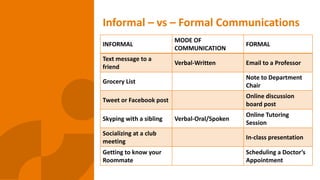
INFORMAL
MODE OF
COMMUNICATION
FORMAL
Text message to a
friend
Verbal-Written Email to a Professor
Grocery List
Note to Department
Chair
Tweet or Facebook post
Online discussion
board post
Skyping with a sibling Verbal-Oral/Spoken
Online Tutoring
Session
Socializing at a club
meeting
In-class presentation
Getting to know your
Roommate
Scheduling a Doctor’s
Appointment
Informal – vs – Formal Communications
INFORMAL
MODE OF
COMMUNICATION
FORMAL
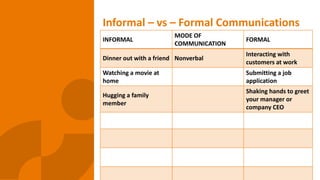
Dinner out with a friend Nonverbal
Interacting with
customers at work
Watching a movie at
home
Submitting a job
application
Hugging a family
member
Shaking hands to greet
your manager or
company CEO
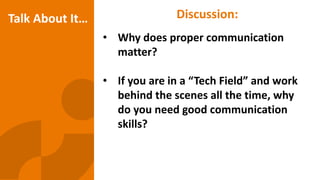
Discussion:
• Why does proper communication
matter?
• If you are in a “Tech Field” and work
behind the scenes all the time, why
do you need good communication
skills?
Talk About It…
Professional Communications
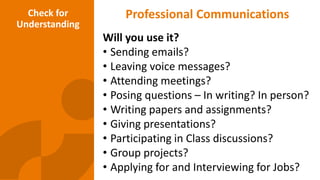
Will you use it?
• Sending emails?
• Leaving voice messages?
• Attending meetings?
• Posing questions – In writing? In person?
• Writing papers and assignments?
• Giving presentations?
• Participating in Class discussions?
• Group projects?
• Applying for and Interviewing for Jobs?
Check for
Understanding
QUICK QUIZ
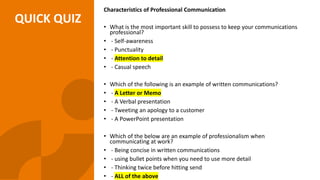
Characteristics of Professional Communication
• What is the most important skill to possess to keep your communications
professional?
• - Self-awareness
• - Punctuality
• - Attention to detail
• - Casual speech
• Which of the following is an example of written communications?
• - A Letter or Memo
• - A Verbal presentation
• - Tweeting an apology to a customer
• - A PowerPoint presentation
• Which of the below are an example of professionalism when
communicating at work?
• - Being concise in written communications
• - using bullet points when you need to use more detail
• - Thinking twice before hitting send
• - ALL of the above
Q&A
THANK YOU!
Dean Kye-Anne Wilborn
COEB
KWilborn2@ccc.edu

Professional Communications_08Feb2024.pdf

  • 1.
    Professional Communications CyberSecurity BootcampPresentation 08Feb2024 Kye-Anne Wilborn, MBA, MM, Phd(c) Dean Center of Excellence in Business & Professional Services
  • 2.
    AGENDA • Introduction • Typesof Communications • Talk About It… • Informal – vs – Formal Communication • Professional/College Communications • Talk About It… • Check for Understanding • Q&A
  • 3.
    Effective Communication In aBusiness Environment helps us: • Build stronger interpersonal relationships • Be more effective to our teams • Positively impact customers and the end result In a Professional Environment: • Allows us to adapt to a virtual world • Ensures we are understood • Allows the opportunity to write with confidence VERBAL-WRITTEN VERBAL-ORAL NONVERBAL Introduction
  • 4.
    Recipe for GreatCommunication… VERBAL-WRITTEN VERBAL-ORAL NONVERBAL Language Language Body Language Vocabulary Vocabulary Gestures Content Content Eye Contact Structure Structure Facial Expression Tone Tone Voice Grammar & Spelling Sentence Structure Personal Space Punctuation Fluency Appearance Capitalization N/A N/A Types of Communications
  • 5.
    Discussion: What does itmean: • Verbal-Written? • Verbal-Oral? • Nonverbal? Talk About It…
  • 6.
    Informal – vs– Formal Communications Informal: • Has a more relaxed tone and sounds casual • Most commonly used with peers and/or family members • Requires less emphasis on grammar and spelling
  • 7.
    Informal – vs– Formal Communications Formal: • Uses standard language and a formal tone • Most commonly used with non-peers and people you don’t know well; and colleagues! • Necessary in business, career, and educational settings
  • 8.
    Informal – vs– Formal Communications INFORMAL MODE OF COMMUNICATION FORMAL Text message to a friend Verbal-Written Email to a Professor Grocery List Note to Department Chair Tweet or Facebook post Online discussion board post Skyping with a sibling Verbal-Oral/Spoken Online Tutoring Session Socializing at a club meeting In-class presentation Getting to know your Roommate Scheduling a Doctor’s Appointment
  • 9.
    Informal – vs– Formal Communications INFORMAL MODE OF COMMUNICATION FORMAL Dinner out with a friend Nonverbal Interacting with customers at work Watching a movie at home Submitting a job application Hugging a family member Shaking hands to greet your manager or company CEO
  • 10.
    Discussion: • Why doesproper communication matter? • If you are in a “Tech Field” and work behind the scenes all the time, why do you need good communication skills? Talk About It…
  • 11.
    Professional Communications Will youuse it? • Sending emails? • Leaving voice messages? • Attending meetings? • Posing questions – In writing? In person? • Writing papers and assignments? • Giving presentations? • Participating in Class discussions? • Group projects? • Applying for and Interviewing for Jobs? Check for Understanding
  • 12.
    QUICK QUIZ Characteristics ofProfessional Communication • What is the most important skill to possess to keep your communications professional? • - Self-awareness • - Punctuality • - Attention to detail • - Casual speech • Which of the following is an example of written communications? • - A Letter or Memo • - A Verbal presentation • - Tweeting an apology to a customer • - A PowerPoint presentation • Which of the below are an example of professionalism when communicating at work? • - Being concise in written communications • - using bullet points when you need to use more detail • - Thinking twice before hitting send • - ALL of the above
  • 13.
  • 14.
    THANK YOU! Dean Kye-AnneWilborn COEB KWilborn2@ccc.edu