Lesson 1: COMMUNICATINGWITH MEMBERS
OF THE WORKPLACE EFFECTIVELY
◦Successful communication among members of
the workplace comes to light when they strive to
develop interpersonal skills. People come from
different walks of life, so it imperative that every
individual strive to acquire skills for
communicating and interacting with others.
3.
What can bedone to establish a pleasant and
professional atmosphere in the workplace?
◦ One of the key factors is effective communication.
◦ ❖ Relaying information means using the appropriate language,
tone, style, and format.
◦ ❖ Communication in the workplace requires the same elements.
◦ ❖ You have also to consider the specific domain, sector, field, or
industry to which your workplace belongs.
◦ • For example, your work maybe in government, the academe,
the corporate world, media, health, or social services.
4.
◦ Each organizationor community has specific philosophies, values,
and ideals that shape the way communication is practiced.
◦ ❖ Thus, in any kind of professional setting, you have to consider
the culture established by the founders and senior associates and
adjust to it accordingly.
◦ ❖ You are expected to meet prescribed standards and work within
specific norms to achieve common goals and objectives.
◦ • For example, if the culture promotes conventions such as
adhering to certain dress code, you cannot just disregard them to
show your individualism.
5.
◦Showing respect forthe company policies reflects
maturity and integrity.
◦❖ However, there may be opportunities to introduce
a new culture for a more efficient and innovative
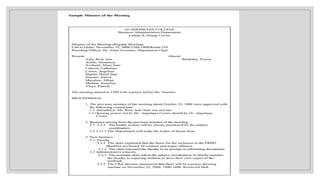
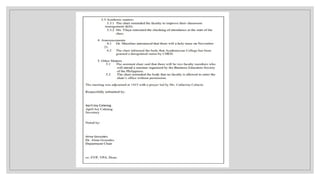
organization (Inett 2016; Guo and Sanchez 2009).
◦ • For example, to help negotiate heavy traffic
during the morning rush, you are inspired by the
idea of ride-sharing within your department when
going to work.
6.
◦❖ As youhave learned, communication is not only
verbal.
◦❖ When it comes to face-to-face communication, people
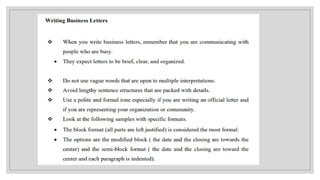
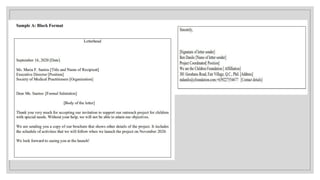
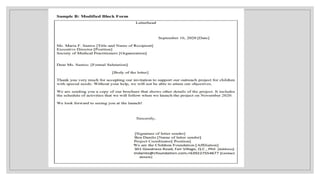
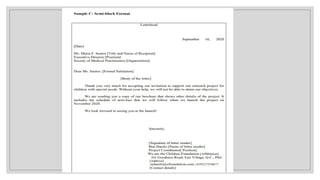
read your facial expression and body language.
◦• If you keep looking at your watch, your colleague may
sense that you are in a hurry and do not have time to
listen.
◦• If you raise your eyebrows after hearing a suggestion,
you maybe communicating that you are not convinced
that it will work.
7.
◦❖ Indeed, whenyou join an organization or
community, consider yourself as a relevant member
of one big team.
◦❖ Keep in mind your primary responsibilities and
objectives. Interacting with colleagues in the
workplace means listening purposefully,
responding appropriately, expressing ideas
respectfully, negotiating proactively, and solving
problems efficiently.
8.
Using Appropriate Languagein the
Workplace
◦ ❖ Professional communication requires that you use language that
is most appropriate to a given situation in your workplace.
◦ When you are in a meeting, assembly, conference, or a formal
event, you are always expected to use a polite tone.
◦ ❖ You have to address your heads, clients, and colleagues
according to their official titles or positions (e.g., Doctor, Professor,
President, Justice, Honorable, Representative, Ms., Mr.).
◦ ❖ You need also to learn how to craft an effective email that
commands respect and elicits a prompt response.
9.
◦❖ However, thereare instances when informal
language may be used in the workplace.
◦• For example, conversations during break time
or after-office hours with peers may not call for
such formal language.
◦• In fact, being formal all the time may result in
your alienating the rest of the department.
◦ • There is an art to knowing the appropriate
language register based on unique contexts.
10.
◦❖ However, thereare instances when formal
language may be used in the workplace.
◦• For example, conversations during break time
or after-office hours with peers may not call for
such formal language.
◦• In fact, being formal all the time may result in
your alienating the rest of the department.
◦ • There is an art to knowing the appropriate
language register based on unique contexts.
11.
◦ ❖ Vulgarlanguage or slang that demeans is considered
offensive in the workplace.
◦ ❖ In addition, remember to use jargon only if you are
among colleagues who belong to the same profession;
otherwise, do not use jargon in the company of
colleagues who are not familiar with your field of
expertise or interest.
◦ ❖ Indeed, the workplace consists of diverse individuals.
◦ ❖ Hence, using politically correct terms means to avoid
offending people belonging to a specific race, religion,
gender, age range, class, and group is important.
12.
◦ ❖ Politicalcorrectness in language means using words that
have positive suggestions or connotations to avoid
discrimination.
◦ ❖ As in any community, being in a work place means being
aware of your beliefs, and principles, as well as your dormant
or unexamined biases.
◦ ❖ Make sure you do not discriminate against a particular
group through your attitudes, behavior, and decisions.
◦ ❖ If you talk politely to your heads and associates, but talk
disrespectfully to the staff or your peers, then you are not
treating people equally with respect.
13.
Using the AppropriateTone, Style, and
Format in Professional Communication
◦ ❖ Tone refers to the attitude that is reflected in the words that
you use, in both writing and speaking.
◦ ❖ Your tone may be sincere, optimistic, sarcastic, pessimistic,
and so on.
◦ ❖ People usually respond to the tone that you use.
◦ • For example, if you say “Sorry” with a sincere tone, then
people are more likely to accept your apology.
◦ • But if you say it sarcastically, the response can be negative.
14.
◦ ❖ Whenyou write messages, style and format also suggest your
tone.
◦ ❖ Exclamation marks may suggest emotions or excitement or
anger.
◦ ❖ Emoticons in email messages suggest informality and may not
be appropriate if you are writing a formal request or proposal.
◦ ❖ Words in all CAPS may indicate antagonism and may offend the
recipient.
◦ ❖ Consider also the specific style and format that your
organization requires.
15.
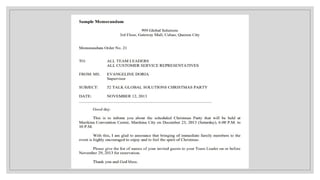
Writing Memorandum
◦ ❖When you send an official announcement, a directive, a
guideline, or a reminder to your colleagues within your department
or across departments, you will have to write a memorandum or, in
short, a memo.
◦ ❖ Memos may be used to:
◦ • Formally document a verbal message
◦ • Inform, notify, or update colleagues about certain concerns
◦ • Request, remind, or recommend
◦ • Serve as an introduction to specific document
16.
◦❖ When youwrite a memo, you have to indicate
the time, the date, the recipients, and the subject.
◦• Recipients are usually busy, and they do not
have much time to read lengthy emails.
◦• If there are details that need to be presented,
place them in a separate document and send
them as an attachment.
17.
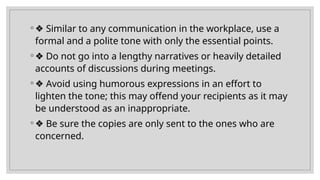
◦ ❖ Similarto any communication in the workplace, use a
formal and a polite tone with only the essential points.
◦ ❖ Do not go into a lengthy narratives or heavily detailed
accounts of discussions during meetings.
◦ ❖ Avoid using humorous expressions in an effort to
lighten the tone; this may offend your recipients as it may
be understood as an inappropriate.
◦ ❖ Be sure the copies are only sent to the ones who are
concerned.
19.
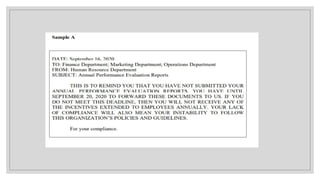
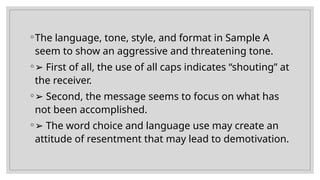
◦The language, tone,style, and format in Sample A
seem to show an aggressive and threatening tone.
◦➢ First of all, the use of all caps indicates “shouting” at
the receiver.
◦➢ Second, the message seems to focus on what has
not been accomplished.
◦➢ The word choice and language use may create an
attitude of resentment that may lead to demotivation.
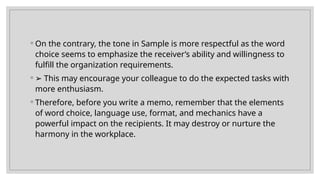
21.
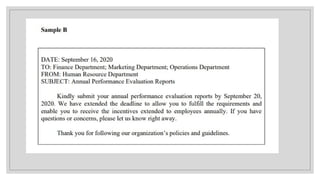
◦ On thecontrary, the tone in Sample is more respectful as the word
choice seems to emphasize the receiver’s ability and willingness to
fulfill the organization requirements.
◦ ➢ This may encourage your colleague to do the expected tasks with
more enthusiasm.
◦ Therefore, before you write a memo, remember that the elements
of word choice, language use, format, and mechanics have a
powerful impact on the recipients. It may destroy or nurture the
harmony in the workplace.
23.
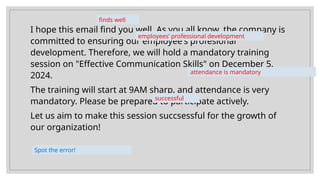
I hope thisemail find you well. As you all know, the company is
committed to ensuring our employee's profesional
development. Therefore, we will hold a mandatory training
session on "Effective Communication Skills" on December 5,
2024.
The training will start at 9AM sharp, and attendance is very
mandatory. Please be prepared to participate actively.
Let us aim to make this session succsessful for the growth of
our organization!
finds well
employees’ professional development
attendance is mandatory
successful
Spot the error!
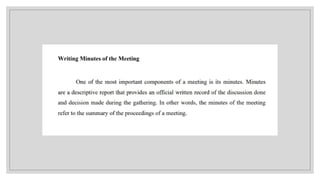
28.
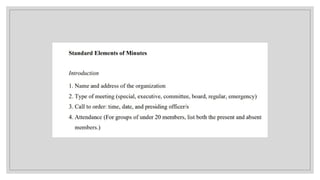
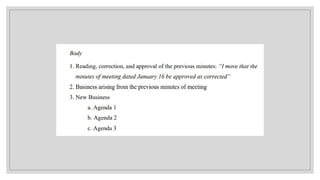
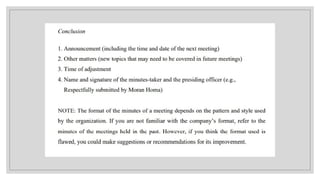
Here are somecustom elements you can
include in your meeting minutes:
• Supplementary documents
• Action items
• Purpose of meeting
• Items to be discussed next time
• Project status updates and voting results
• Next steps, like research and follow-ups
• A section to define attendees who are guests, nonvoters, or speakers
• Corrections or amendments to previous meeting minutes
29.
5 tips forwriting meeting minutes
1. Be consistent
It helps to use a template every time you take meeting
minutes. That way, they’re all laid out the same way, and you
won’t have to waste time adding headings and bullet points.
This is useful later when other people in the organization
need to reference them. Some organizations even put their
agenda and expected attendees on the meeting notes for
efficiency.
30.
5 tips forwriting meeting minutes
2. Record it
When you start in your secretary role, you might have trouble
keeping up with note-taking. If you’re experiencing this, consider
recording the meeting. You can do this with any smartphone,
audio recording device, or camera. Later, you can use an artificial
intelligence transcription service or just listen back to the
recording as a refresher when needed. Before recording, though,
be sure to let your attendees know they are being recorded.
31.
5 tips forwriting meeting minutes
◦ 3. Make your notes viewable during the meeting
◦Sometimes, meetings are collaborative. This can
sometimes feel chaotic and make it difficult to keep
track of everything. Making the notes viewable on a
projector or sharing your screen or document during
meetings allows your teammates to contribute to
them.
32.
5 tips forwriting meeting minutes
◦ 4. Summarize
◦ When you’re writing meeting notes, summarize. You should
document as much information as possible, but don’t write
everything verbatim. It’s not necessary to record everything
that was said during the meeting notes. You also might
have difficulty keeping up if you try to write the entire
conversation word-for-word. Simplify and clarify what
happened during the meeting.
33.
5 tips forwriting meeting minutes
◦5. Label comments with initials
◦If multiple people in the meeting have input on a
matter, it can help to use attendees’ initials to
indicate who contributed what. You can also use
initials to indicate who will be in charge of the next
steps. This shorthand technique is an efficient way
to clarify a multiperson conversation.
34.
Why are meetingminutes important?
• Create a historical record
• Show progress over time
• Offer legal protection for the organization
• Adhere to local bylaws
• Explain why an organization made a decision
• Serve as a reminder of assignments or projects
• Act as evidence of deadlines
• Inform members who were unable to attend
35.
Guidelines in PreparingMinutes of the
Meeting
◦ 1. Use the chronological order.
◦ 2. Minutes should be factual, brief, and free from editorial comments or
subtle slanting of factual statements. Example of an editorial comment is:
As always, Mr. Garcia rejected the proposition of Ms. Roces.
◦ 3. Capture the gist of the meeting. Summarize rather than transcribe.
◦ 4. Verbatim record is required for parliamentary points: motions,
resolutions, and points of order. Motions and amendments should be
stated accurately including the name of the maker. The name of the
seconder of the motion should not be entered unless ordered by the body.
36.
◦ 5. Duringvoting, the number of votes on each side must be
entered.
◦ 6. Use the meeting’s agenda to guide you in organizing the
information.
◦ 7. Focus on action taken rather than topics discussed.
◦ 8. Be objective. If someone who is your adversary provided an
excellent suggestion, include it.
◦ 9. Type the minutes while the facts are still fresh.
37.
◦ 11.Place pagenumber at the bottom of the paper.
◦ 12. All sums of money mentioned should be written in
both figures and words.
◦ 13. Place corrections made in the previous minutes above
the affected line or in the margin.
◦ 14. Never discard the original minutes. If you retype the
page, attach the original to the revised one.
44.
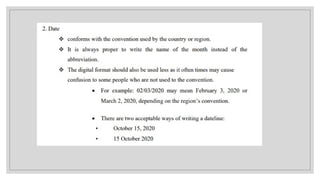
◦ ❖ Twopunctuation styles are used in business letters: open and
mixed.
◦ • Open punctuation means that no punctuation marks are used after the
salutation and the complimentary close.
◦ • Open punctuation is considered a time-saving style and is used with block
letter style.
◦ • Mixed punctuation may be used with modified block letter style, in which as
the salutation and complimentary close are followed by punctuation marks.
◦ • The proper punctuation with this style is a comma after the complimentary
close and a colon (for business letters) or a comma (for personal letters) after
the salutation.
49.
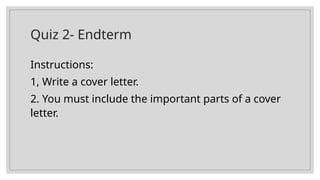
Quiz 1 -End term
Instructions:
1. Write a memorandum that informs, notifies, or updates
colleagues about certain concerns in the company or workplace.
You may also request or remind your colleagues in your memo.
2. Important components of a memo must be included.
50.
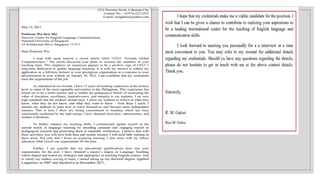
Lesson 2: WRITINGYOUR COVER LETTER
❖ Cover letters accompany your application
when applying for a new position. You can
use cover letters to introduce yourself,
describe your interest in a company and
outline your qualifying skills.
51.
Tips in Preparinga Cover Letter
Content
1. 1. Never begin your letter with ho-hum phrases (e.g., “Enclosed please find my
résumé for…”). To be more creative, you may begin with the following topics:
a. Begin with a question that stimulates the reader’s interest.
b. Lead in with a name of someone you both know (e.g., When Dr. Gilda
Nomer mentioned your name in a conference…)
c. Start out with a quote that applies to the type of business of the
employer.
d. Explain how you learned about the job opening you are applying for.
However, though readers want attention-getters, do not be tempted to use
shallow gimmickry.
52.
◦ 2. Thecover letter must not simply repeat the content of your
résumé. Emphasize concrete examples
◦ 3. Address the letter to a specific person. If you do not know the
specific addressee, call the company and inquire.
◦ 4. be specific with the position you are applying for. do not use
general or incidental job vacancies.
◦ 5. Avoid superfluous information. Do not begin with “let me tell you
something about myself. My name is …” Moreover, do not include
lots of specifics (dates, numbers, names, places). Just choose the
hard factual information.
53.
◦ 7. Minimizeopinions about yourself. When you claim one, be sure to
support it with specific and factual evidence.
◦ 8. Highlight two or three of your most significant accomplishments or
abilities.
◦ 9. Use the active voice and powerful action verbs.
◦ 10. Be sure you observe correct grammar, spelling, vocabulary, and
usage. Avoid jargon, clichés, and verbosity. Readers expect good
grammar and writing. Any typographical and grammatical error may
cause the reader to doubt your competence.
54.
◦ 11. Bedirect to the point because some readers are impatient.
◦ 12. Be factual. Never misrepresent yourself by overstating your
experience and skills. In short, don’t exaggerate.
◦ 13. Do not beg for the job (e.g., “Please call today! I’ll be waiting by the
phone. I am desperately eager to start.”)
◦ 14. As you write, imagine that you are writing a script for your interview:
how you could break the ice at the beginning of the interview; how you
can convey positive personality; the things you want to talk about during
the interview; and what you hope to get from the interview.
56.
Parts of aCover Letter
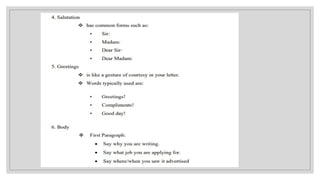
◦ A. Introduction
. State your purpose in writing the letter. Indicate your source
of information: newspaper, magazine, the internet, personal
contact. State an eye-catching or attention-getting statement about
yourself that will make the reader continue reading your
credentials. Show your enthusiasm to work with the company
◦ B. Body
◦ -Present your work experience, academic qualifications,
training, some personal qualities with specific evidence.. Be
sure to segregate and organize your paragraphs.
57.
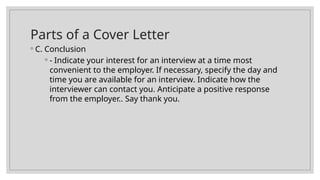
Parts of aCover Letter
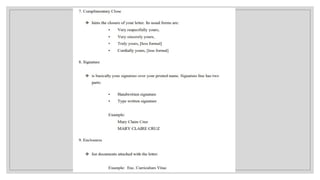
◦ C. Conclusion
◦ - Indicate your interest for an interview at a time most
convenient to the employer. If necessary, specify the day and
time you are available for an interview. Indicate how the
interviewer can contact you. Anticipate a positive response
from the employer.. Say thank you.
60.
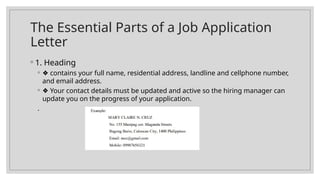
The Essential Partsof a Job Application
Letter
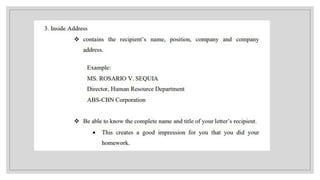
◦ 1. Heading
◦ ❖ contains your full name, residential address, landline and cellphone number,
and email address.
◦ ❖ Your contact details must be updated and active so the hiring manager can
update you on the progress of your application.
.