Production Evidence
Editing
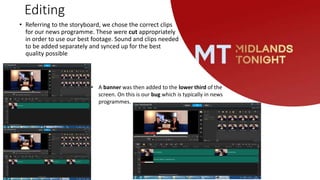
• Referring to the storyboard, we chose the correct clips
for our news programme. These were cut appropriately
in order to use our best footage. Sound and clips needed
to be added separately and synced up for the best
quality possible
• A banner was then added to the lower third of the
screen. On this is our bug which is typically in news
programmes.
Editing
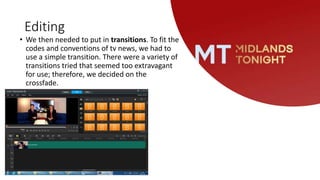
• We then needed to put in transitions. To fit the
codes and conventions of tv news, we had to
use a simple transition. There were a variety of
transitions tried that seemed too extravagant
for use; therefore, we decided on the
crossfade.
Editing
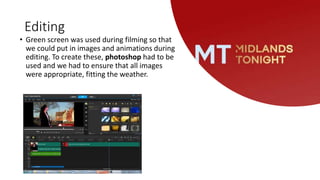
• Green screen was used during filming so that
we could put in images and animations during
editing. To create these, photoshop had to be
used and we had to ensure that all images
were appropriate, fitting the weather.
Mise en scene
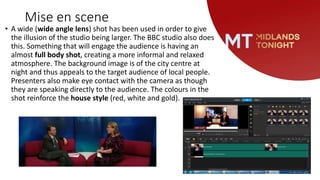
• A wide (wide angle lens) shot has been used in order to give
the illusion of the studio being larger. The BBC studio also does
this. Something that will engage the audience is having an
almost full body shot, creating a more informal and relaxed
atmosphere. The background image is of the city centre at
night and thus appeals to the target audience of local people.
Presenters also make eye contact with the camera as though
they are speaking directly to the audience. The colours in the
shot reinforce the house style (red, white and gold).
Mise en scene
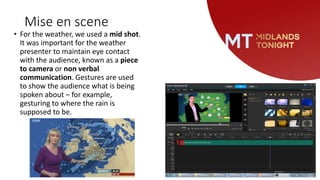
• For the weather, we used a mid shot.
It was important for the weather
presenter to maintain eye contact
with the audience, known as a piece
to camera or non verbal
communication. Gestures are used
to show the audience what is being
spoken about – for example,
gesturing to where the rain is
supposed to be.
Costumes
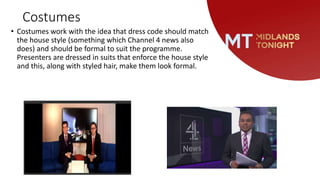
• Costumes work with the idea that dress code should match
the house style (something which Channel 4 news also
does) and should be formal to suit the programme.
Presenters are dressed in suits that enforce the house style
and this, along with styled hair, make them look formal.
Costumes
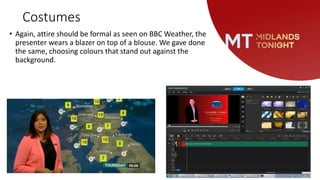
• Again, attire should be formal as seen on BBC Weather, the
presenter wears a blazer on top of a blouse. We gave done
the same, choosing colours that stand out against the
background.

Prodution evidence

  • 1.
  • 2.
    Editing • Referring tothe storyboard, we chose the correct clips for our news programme. These were cut appropriately in order to use our best footage. Sound and clips needed to be added separately and synced up for the best quality possible • A banner was then added to the lower third of the screen. On this is our bug which is typically in news programmes.
  • 3.
    Editing • We thenneeded to put in transitions. To fit the codes and conventions of tv news, we had to use a simple transition. There were a variety of transitions tried that seemed too extravagant for use; therefore, we decided on the crossfade.
  • 4.
    Editing • Green screenwas used during filming so that we could put in images and animations during editing. To create these, photoshop had to be used and we had to ensure that all images were appropriate, fitting the weather.
  • 5.
    Mise en scene •A wide (wide angle lens) shot has been used in order to give the illusion of the studio being larger. The BBC studio also does this. Something that will engage the audience is having an almost full body shot, creating a more informal and relaxed atmosphere. The background image is of the city centre at night and thus appeals to the target audience of local people. Presenters also make eye contact with the camera as though they are speaking directly to the audience. The colours in the shot reinforce the house style (red, white and gold).
  • 6.
    Mise en scene •For the weather, we used a mid shot. It was important for the weather presenter to maintain eye contact with the audience, known as a piece to camera or non verbal communication. Gestures are used to show the audience what is being spoken about – for example, gesturing to where the rain is supposed to be.
  • 7.
    Costumes • Costumes workwith the idea that dress code should match the house style (something which Channel 4 news also does) and should be formal to suit the programme. Presenters are dressed in suits that enforce the house style and this, along with styled hair, make them look formal.
  • 8.
    Costumes • Again, attireshould be formal as seen on BBC Weather, the presenter wears a blazer on top of a blouse. We gave done the same, choosing colours that stand out against the background.