Exploring Microservices Architecture
with Spring Boot
In the ever-evolving landscape of software development, the concept of microservices has
gained significant traction. This architectural style, when coupled with the power of Spring
Boot, has revolutionised the way we design and build applications. In this comprehensive
guide, we'll delve deep into the realm of microservices with Spring Boot. Additionally, we'll
highlight why enrolling in a Java training course in Jabalpur, Faridabad, Rohtak, Noida,
Delhi, Jaipur, and various other Indian cities is essential to unlock the full potential of this
technology.
The Rise of Microservices
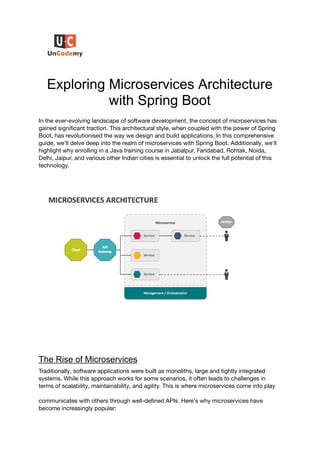
Traditionally, software applications were built as monoliths, large and tightly integrated
systems. While this approach works for some scenarios, it often leads to challenges in
terms of scalability, maintainability, and agility. This is where microservices come into play
communicates with others through well-defined APIs. Here's why microservices have
become increasingly popular:
1. Scalability: Microservices allow you to scale individual components of your application
independently, providing better resource utilisation.
2. Flexibility: Developers can choose the best technology stack for each microservice,
enabling flexibility and innovation.
3. Easier Maintenance: Smaller codebases are easier to understand, test, and maintain,
reducing the risk of introducing bugs.
4. Faster Development: Teams can work on different microservices simultaneously,
accelerating development cycles.
5. Resilience: Even if one microservice fails, the rest of the application can continue to
function, enhancing overall system reliability.
Spring Boot: Empowering Microservices
Spring Boot is a framework that simplifies the development of production-ready
microservices. It provides a set of tools and conventions that make it easy to create
standalone, production-grade Spring-based applications. Here's why Spring Boot is a
preferred choice for building microservices:
1. Rapid Development: Spring Boot offers a range of pre-built templates and libraries that
speed up development. You can focus on writing business logic rather than configuring
infrastructure.
2. Microservices Features: Spring Boot includes features like embedded application
servers, which are ideal for microservices deployment.
3. Production-Ready: It comes with built-in support for monitoring, metrics, and health
checks, making your microservices production-ready from day one.
4. Integration: Spring Boot seamlessly integrates with other Spring projects like Spring
Cloud for building robust, distributed systems.
5. Community and Ecosystem: Spring Boot has a vast community and an extensive
ecosystem of extensions and libraries, which simplifies microservices development.
.
The Need for Java Training
While microservices with Spring Boot offer numerous advantages, harnessing their full
potential requires a strong foundation in Java, especially if you're new to the language or
framework. Enrolling in a Java training course institute in Jabalpur, Faridabad, Rohtak,
Noida, Delhi, Jaipur, and various other Indian cities across, such as Ranchi, Patna, Agra,
Lucknow, and Kolkata, can provide several benefits:
1. Java Fundamentals: A Java training course covers the fundamentals of the language,
including syntax, data structures, and object-oriented programming. This knowledge is
crucial for writing efficient Spring Boot applications.
2. Spring Framework: Understanding Java is the first step, but a course also dives into the
Spring framework, upon which Spring Boot is built. You'll grasp concepts like dependency
injection, aspect-oriented programming, and more.
3. Hands-On Experience: Courses typically include hands-on labs and projects that allow
you to apply what you've learned. This practical experience is invaluable when working on
real-world microservices projects.
4. Troubleshooting Skills: Java training equips you with troubleshooting skills, which are
essential for diagnosing and fixing issues in your microservices architecture.
5. Industry Insights: Reputed Java training institutes often have industry experts as
instructors, providing you with insights and best practices used in the field.
Conclusion
Microservices architecture with Spring Boot represents a significant shift in how we build
and maintain software applications. Its advantages in terms of scalability, flexibility, and
maintainability have made it a go-to choice for modern software development.
However, to become proficient in building microservices with Spring Boot, a solid
understanding of Java is imperative. Enrolling in a Java training course in various Indian
cities not only provides you with the necessary skills but also positions you for a successful
and rewarding career in the world of microservices development.
Source Link: https://lockabee.com/read-blog/83660

Exploring Microservices Architecture with Spring Boot

  • 1.
    Exploring Microservices Architecture withSpring Boot In the ever-evolving landscape of software development, the concept of microservices has gained significant traction. This architectural style, when coupled with the power of Spring Boot, has revolutionised the way we design and build applications. In this comprehensive guide, we'll delve deep into the realm of microservices with Spring Boot. Additionally, we'll highlight why enrolling in a Java training course in Jabalpur, Faridabad, Rohtak, Noida, Delhi, Jaipur, and various other Indian cities is essential to unlock the full potential of this technology. The Rise of Microservices Traditionally, software applications were built as monoliths, large and tightly integrated systems. While this approach works for some scenarios, it often leads to challenges in terms of scalability, maintainability, and agility. This is where microservices come into play communicates with others through well-defined APIs. Here's why microservices have become increasingly popular:
  • 2.
    1. Scalability: Microservicesallow you to scale individual components of your application independently, providing better resource utilisation. 2. Flexibility: Developers can choose the best technology stack for each microservice, enabling flexibility and innovation. 3. Easier Maintenance: Smaller codebases are easier to understand, test, and maintain, reducing the risk of introducing bugs. 4. Faster Development: Teams can work on different microservices simultaneously, accelerating development cycles. 5. Resilience: Even if one microservice fails, the rest of the application can continue to function, enhancing overall system reliability. Spring Boot: Empowering Microservices Spring Boot is a framework that simplifies the development of production-ready microservices. It provides a set of tools and conventions that make it easy to create standalone, production-grade Spring-based applications. Here's why Spring Boot is a preferred choice for building microservices: 1. Rapid Development: Spring Boot offers a range of pre-built templates and libraries that speed up development. You can focus on writing business logic rather than configuring infrastructure. 2. Microservices Features: Spring Boot includes features like embedded application servers, which are ideal for microservices deployment. 3. Production-Ready: It comes with built-in support for monitoring, metrics, and health checks, making your microservices production-ready from day one. 4. Integration: Spring Boot seamlessly integrates with other Spring projects like Spring Cloud for building robust, distributed systems. 5. Community and Ecosystem: Spring Boot has a vast community and an extensive ecosystem of extensions and libraries, which simplifies microservices development. .
  • 3.
    The Need forJava Training While microservices with Spring Boot offer numerous advantages, harnessing their full potential requires a strong foundation in Java, especially if you're new to the language or framework. Enrolling in a Java training course institute in Jabalpur, Faridabad, Rohtak, Noida, Delhi, Jaipur, and various other Indian cities across, such as Ranchi, Patna, Agra, Lucknow, and Kolkata, can provide several benefits: 1. Java Fundamentals: A Java training course covers the fundamentals of the language, including syntax, data structures, and object-oriented programming. This knowledge is crucial for writing efficient Spring Boot applications. 2. Spring Framework: Understanding Java is the first step, but a course also dives into the Spring framework, upon which Spring Boot is built. You'll grasp concepts like dependency injection, aspect-oriented programming, and more. 3. Hands-On Experience: Courses typically include hands-on labs and projects that allow you to apply what you've learned. This practical experience is invaluable when working on real-world microservices projects. 4. Troubleshooting Skills: Java training equips you with troubleshooting skills, which are essential for diagnosing and fixing issues in your microservices architecture. 5. Industry Insights: Reputed Java training institutes often have industry experts as instructors, providing you with insights and best practices used in the field. Conclusion Microservices architecture with Spring Boot represents a significant shift in how we build and maintain software applications. Its advantages in terms of scalability, flexibility, and maintainability have made it a go-to choice for modern software development. However, to become proficient in building microservices with Spring Boot, a solid understanding of Java is imperative. Enrolling in a Java training course in various Indian cities not only provides you with the necessary skills but also positions you for a successful and rewarding career in the world of microservices development. Source Link: https://lockabee.com/read-blog/83660