Dr. J.S.R.A. Prasad
Dept. of Sanskrit Studies
University of Hyderabad
Dasapadartha sastra is a text that belongs
to the Vaiseshika School of philosophy. In
648 A.D., it was translated into Chinese by
H. Ui. Later, very unfortunately, we lost
the original ms. in Sanskrit.
A Sanskrit scholar restored it back to
Sanskrit based on the foreign version. This
was possible only as the Chinese
translator has maintained the originality
of the base text.
Today, as there is no such scholarship or
expertise to recreate the content, it is a threat
once the manuscript treasure diminishes by
sheer neglect.
Most of the mss., are inaccessible for various
reasons. In the Oriental collection of the
Osmania University, if one approaches in
regard of an unpublished text, one’s effort will
end in acquiring a mere 20% content of the
desired text. In many other institutions also,
one can experience similar plight.
One of the reasons may be that some
researchers misuse the content of these
unpublished mss.
Many of the custodians or curators are not
informed of the process of digitization of
mss., and catalogs. Also, we still follow the
age old preserving techniques which
resulting in gradual disappearance of the
unveiled knowledge.
Statistical methods are not applicable.
For the last 200 years these ancient
manuscripts remained a subject of study and
research by Indian and Western scholars. But
despite the best efforts made by them only
25% of Indian ancient and classical literature
could be published. It is, therefore, a
desideratum that more and more texts on
various branches of Indian literature,
particularly those bearing on sciences and
arts, should be brought out in good
text-critical editions.
Many of the mss. were destroyed by the
insects or by the hostile weather conditions.
Such a way, in numerous places, hundreds
of our precious mss., are lost.
Out of the thousand branches of the
Samaveda, our access is now restricted to a
mere eleven branches. Similarly we lost many
shastric texts ranging from vyakarana to
sangeetha, partly or fully due to lack of
knowledge of preservation.
This author has himself found for his
dismay, how the mss., get destroyed of
sheer ignorance. One of his friends has
informed him about the treasure of mss.,
available in a village near Hyderabad.
After two months of continuous efforts,
ultimately the custodian comes online only
to confirm that out of six hundred mss.,
which they bequeathed from their father,
now, only six mss., are in usable condition.
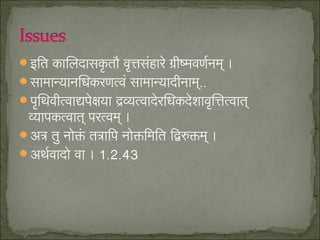
इतति ककाललिदकासकक तितौ वकत्तससहकाररे गग्रीष्मवररनमम् ।
सकामकान्यकानलधिकररत्वस सकामकान्यकादग्रीनकामम्..
पकलथिवग्रीत्वकाद्यपरेक्षयका द्रव्यत्वकादरेरलधिकदरेशकावकलत्तत्वकातिम्
व्यकापकत्वकातिम् परत्वमम् ।
अत्र तितु ननोकस तित्रकातप ननोकतमतति तद्विरुकमम् ।
अथिरवकादनो वका । 1.2.43
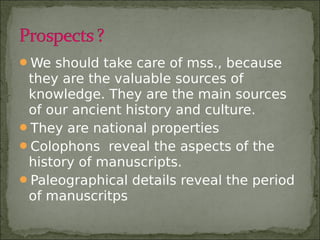
We should take care of mss., because
they are the valuable sources of
knowledge. They are the main sources
of our ancient history and culture.
They are national properties
Colophons reveal the aspects of the
history of manuscripts.
Paleographical details reveal the period
of manuscritps
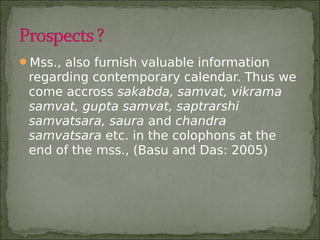
Mss., also furnish valuable information
regarding contemporary calendar. Thus we
come accross sakabda, samvat, vikrama
samvat, gupta samvat, saptrarshi
samvatsara, saura and chandra
samvatsara etc. in the colophons at the
end of the mss., (Basu and Das: 2005)
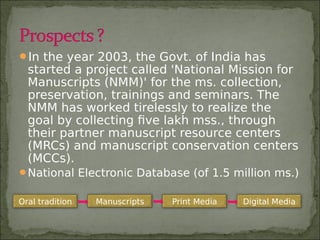
In the year 2003, the Govt. of India has
started a project called 'National Mission for
Manuscripts (NMM)' for the ms. collection,
preservation, trainings and seminars. The
NMM has worked tirelessly to realize the
goal by collecting five lakh mss., through
their partner manuscript resource centers
(MRCs) and manuscript conservation centers
(MCCs).
National Electronic Database (of 1.5 million ms.)
Oral tradition Manuscripts Print Media Digital Media
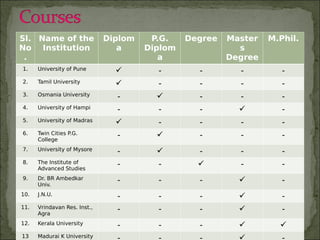
Sl.
No
.
Name of the
Institution
Diplom
a
P.G.
Diplom
a
Degree Master
s
Degree
M.Phil.
1. University of Pune  - - - -
2. Tamil University  - - - -
3. Osmania University -  - - -
4. University of Hampi - - -  -
5. University of Madras  - - - -
6. Twin Cities P.G.
College
-  - - -
7. University of Mysore -  - - -
8. The Institute of
Advanced Studies
- -  - -
9. Dr. BR Ambedkar
Univ.
- - -  -
10. J.N.U. - - -  -
11. Vrindavan Res. Inst.,
Agra
- - -  -
12. Kerala University - - -  
13 Madurai K University
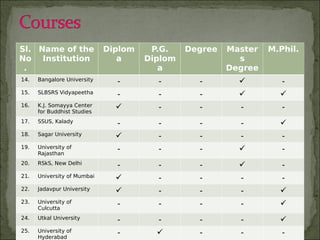
Sl.
No
.
Name of the
Institution
Diplom
a
P.G.
Diplom
a
Degree Master
s
Degree
M.Phil.
14. Bangalore University - - -  -
15. SLBSRS Vidyapeetha - - -  
16. K.J. Somayya Center
for Buddhist Studies
 - - - -
17. SSUS, Kalady - - - - 
18. Sagar University  - - - -
19. University of
Rajasthan
- - -  -
20. RSkS, New Delhi - - -  -
21. University of Mumbai  - - - -
22. Jadavpur University  - - - 
23. University of
Culcutta
- - - - 
24. Utkal University - - - - 
25. University of
Hyderabad
-  - - -
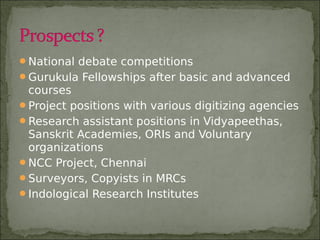
National debate competitions
Gurukula Fellowships after basic and advanced
courses
Project positions with various digitizing agencies
Research assistant positions in Vidyapeethas,
Sanskrit Academies, ORIs and Voluntary
organizations
NCC Project, Chennai
Surveyors, Copyists in MRCs
Indological Research Institutes
Problems and prospects in manuscripts

Problems and prospects in manuscripts

  • 1.
    Dr. J.S.R.A. Prasad Dept.of Sanskrit Studies University of Hyderabad
  • 2.
    Dasapadartha sastra isa text that belongs to the Vaiseshika School of philosophy. In 648 A.D., it was translated into Chinese by H. Ui. Later, very unfortunately, we lost the original ms. in Sanskrit. A Sanskrit scholar restored it back to Sanskrit based on the foreign version. This was possible only as the Chinese translator has maintained the originality of the base text.
  • 3.
    Today, as thereis no such scholarship or expertise to recreate the content, it is a threat once the manuscript treasure diminishes by sheer neglect. Most of the mss., are inaccessible for various reasons. In the Oriental collection of the Osmania University, if one approaches in regard of an unpublished text, one’s effort will end in acquiring a mere 20% content of the desired text. In many other institutions also, one can experience similar plight.
  • 4.
    One of thereasons may be that some researchers misuse the content of these unpublished mss. Many of the custodians or curators are not informed of the process of digitization of mss., and catalogs. Also, we still follow the age old preserving techniques which resulting in gradual disappearance of the unveiled knowledge. Statistical methods are not applicable.
  • 5.
    For the last200 years these ancient manuscripts remained a subject of study and research by Indian and Western scholars. But despite the best efforts made by them only 25% of Indian ancient and classical literature could be published. It is, therefore, a desideratum that more and more texts on various branches of Indian literature, particularly those bearing on sciences and arts, should be brought out in good text-critical editions.
  • 6.
    Many of themss. were destroyed by the insects or by the hostile weather conditions. Such a way, in numerous places, hundreds of our precious mss., are lost. Out of the thousand branches of the Samaveda, our access is now restricted to a mere eleven branches. Similarly we lost many shastric texts ranging from vyakarana to sangeetha, partly or fully due to lack of knowledge of preservation.
  • 7.
    This author hashimself found for his dismay, how the mss., get destroyed of sheer ignorance. One of his friends has informed him about the treasure of mss., available in a village near Hyderabad. After two months of continuous efforts, ultimately the custodian comes online only to confirm that out of six hundred mss., which they bequeathed from their father, now, only six mss., are in usable condition.
  • 8.
    इतति ककाललिदकासकक तितौवकत्तससहकाररे गग्रीष्मवररनमम् । सकामकान्यकानलधिकररत्वस सकामकान्यकादग्रीनकामम्.. पकलथिवग्रीत्वकाद्यपरेक्षयका द्रव्यत्वकादरेरलधिकदरेशकावकलत्तत्वकातिम् व्यकापकत्वकातिम् परत्वमम् । अत्र तितु ननोकस तित्रकातप ननोकतमतति तद्विरुकमम् । अथिरवकादनो वका । 1.2.43
  • 9.
    We should takecare of mss., because they are the valuable sources of knowledge. They are the main sources of our ancient history and culture. They are national properties Colophons reveal the aspects of the history of manuscripts. Paleographical details reveal the period of manuscritps
  • 10.
    Mss., also furnishvaluable information regarding contemporary calendar. Thus we come accross sakabda, samvat, vikrama samvat, gupta samvat, saptrarshi samvatsara, saura and chandra samvatsara etc. in the colophons at the end of the mss., (Basu and Das: 2005)
  • 11.
    In the year2003, the Govt. of India has started a project called 'National Mission for Manuscripts (NMM)' for the ms. collection, preservation, trainings and seminars. The NMM has worked tirelessly to realize the goal by collecting five lakh mss., through their partner manuscript resource centers (MRCs) and manuscript conservation centers (MCCs). National Electronic Database (of 1.5 million ms.) Oral tradition Manuscripts Print Media Digital Media
  • 12.
    Sl. No . Name of the Institution Diplom a P.G. Diplom a DegreeMaster s Degree M.Phil. 1. University of Pune  - - - - 2. Tamil University  - - - - 3. Osmania University -  - - - 4. University of Hampi - - -  - 5. University of Madras  - - - - 6. Twin Cities P.G. College -  - - - 7. University of Mysore -  - - - 8. The Institute of Advanced Studies - -  - - 9. Dr. BR Ambedkar Univ. - - -  - 10. J.N.U. - - -  - 11. Vrindavan Res. Inst., Agra - - -  - 12. Kerala University - - -   13 Madurai K University
  • 13.
    Sl. No . Name of the Institution Diplom a P.G. Diplom a DegreeMaster s Degree M.Phil. 14. Bangalore University - - -  - 15. SLBSRS Vidyapeetha - - -   16. K.J. Somayya Center for Buddhist Studies  - - - - 17. SSUS, Kalady - - - -  18. Sagar University  - - - - 19. University of Rajasthan - - -  - 20. RSkS, New Delhi - - -  - 21. University of Mumbai  - - - - 22. Jadavpur University  - - -  23. University of Culcutta - - - -  24. Utkal University - - - -  25. University of Hyderabad -  - - -
  • 14.
    National debate competitions GurukulaFellowships after basic and advanced courses Project positions with various digitizing agencies Research assistant positions in Vidyapeethas, Sanskrit Academies, ORIs and Voluntary organizations NCC Project, Chennai Surveyors, Copyists in MRCs Indological Research Institutes