1/4
Problem set 6 - Model Answer
Select the correct answer
1. The flux of the electric field ‫ܧ‬ሬറ = 24ଓ̂ + 30ଔ̂ + 16݇෠ ே
஼
through a (2.0 ݉ଶ
) portion of the (‫)ݕݔ‬ plane is:
(a) 32 N·m2
/C (b) 34 N·m2
/C (c) 42 N·m2
/C (d) 48 N·m2
/C (e) 60 N·m2
/C
Answer: a
The area vector is normal to the area surface ݀‫ܣ‬റ = ݀‫݇ܣ‬෠
→ ߶ = ∫ ‫ܧ‬ሬറ. ݀‫ܣ‬റ = ∫ ൫24ଓ̂ + 30ଔ̂ + 16݇෠൯. ݀‫݇ܣ‬෠ = 16∫ ݀‫ܣ‬ → ߶
= 16 × 2 = 32
ܰ݉ଶ
‫ܥ‬
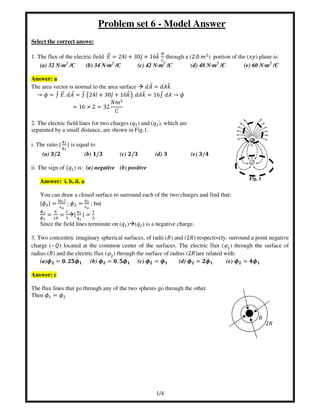
2. The electric field lines for two charges (‫ݍ‬ଵ) and (‫ݍ‬ଶ), which are
separated by a small distance, are shown in Fig.1.
i. The ratio |
௤భ
௤మ
| is equal to
(a) ૜/૛ (b) ૚/૜ (c) ૛/૜ (d) ૜ (e) ૜/૝
ii. The sign of (‫ݍ‬ଵ) is: (a) negative (b) positive
Answer: i. b, ii. a
You can draw a closed surface to surround each of the two charges and find that:
|߶ଵ| =
|௤భ|
ఢ೚
; ߶ଶ =
௤మ
ఢ೚
; but
థభ
థమ
=
଺
ଵ଼
=
ଵ
ଷ
|
௤భ
௤మ
| =
ଵ
ଷ
Since the field lines terminate on (‫ݍ‬ଵ) (‫ݍ‬ଵ) is a negative charge.
3. Two concentric imaginary spherical surfaces, of radii (ܴ) and (2ܴ) respectively, surround a point negative
charge (– ܳ) located at the common center of the surfaces. The electric flux (ϕଵ
) through the surface of
radius (ܴ) and the electric flux (ϕଶ
) through the surface of radius (2ܴ)are related with:
(a)ࣘ૛ = ૙. ૛૞ࣘ૚ (b) ࣘ૛ = ૙. ૞ࣘ૚ (c) ࣘ૛ = ࣘ૚ (d) ࣘ૛ = ૛ࣘ૚ (e) ࣘ૛ = ૝ࣘ૚
Answer: c
The flux lines that go through any of the two spheres go through the other.
Then ߶ଵ = ߶ଶ
Fig. 1
ܴ
2ܴ
2/4
4. A point charge (ܳ), located at the center of the flat surface of a hemisphere of radius (ܴ), is shown in
Fig.2.
i. The electric flux through the flat face of the hemisphere is
(a) ࢆࢋ࢘࢕ (b) ࡽ/ππππࡾ૛
(ic) ࡽ/૛εεεε࢕
(d) ࡽ/εεεε࢕ (e) ࡽ/૝ππππࡾ૛
ii. The electric flux through the curved surface of the hemisphere is
(a) ࢆࢋ࢘࢕ (b) ࡽ/૛εεεε࢕ (c) ࡽ/ππππࡾ૛
(d) ࡽ/εεεε࢕ (e) ࡽ/૝ππππࡾ૛
Answer: i.a, ii.b
The flux through the whole hemisphere is given by: ߶ =
ஊ௤೔೙
ఢ೚
=
ொ
ଶఢ೚
The flux through the flat surface is ߶௙௟௔௧ = 0 [See the next figure].
߶ = ߶௙௟௔௧ + ߶௖௨௥௩௘ௗ = ߶௖௨௥௩௘ௗ
Then the whole flux goes through the curved surface.
5. The electric field just outside the surface of a hollow conducting sphere of radius (20 ܿ݉) has a
magnitude of (500 ܰ/‫)ܥ‬ and directed outward. An unknown charge (ܳ) is introduced into the center of the
sphere and it is noted that the electric field is still directed outward but has decreased to (100 ܰ/‫.)ܥ‬ The
magnitude of the charge (ܳ) is:
(a) ૚. ૞ ࢔࡯ (b) ૚. ૡ ࢔࡯ (c) ૚. ૜ ࢔࡯ (d) ૚. ૚ ࢔࡯ (e) ૛. ૠ ࢔࡯
Answer : b
‫ܧ‬ଵ =
௞௤೚
ோమ = 500; ‫ܧ‬ଶ =
௞(௤೚ାொ)
ோమ = 100 500 +
௞ொ
ோమ = 100 ܳ = −1.8݊‫ܥ‬ |ܳ| = 1.8 ݊‫ܥ‬
6. A hemispherical surface (half of a spherical surface) of radius (ܴ) is located in a uniform electric field of
magnitude (‫)ܧ‬ that is parallel to the axis of symmetry of the hemisphere. What is the magnitude of the
electric flux through the hemispherical surface?
(a) ࣊ࡾ૛
ࡱ (b) ૝ππππࡾ૛
ࡱ/3 (c) ૛ππππࡾ૛
ࡱ/૜ (d) ππππࡾ૛
ࡱ/૛ (e) ππππࡾ૛
ࡱ/૜
Answer: a
It is difficult to evaluate the flux though the curved surface using ߶௖௨௥௩௘ௗ = ∫ ‫ܧ‬ሬറ. ݀‫ܣ‬റ since
the angle (ߠ) between (‫ܧ‬ሬറ) and (݀‫ܣ‬റ) is not easy to determine. Luckily, the lines that go
through the flat surface are the same as those going through the curved surface. Then we
can use:
߶௙௟௔௧ = ∫ ‫ܧ‬ሬറ. ݀‫ܣ‬റ = ‫ܴߨܧ‬ଶ
߶௖௨௥௩௘ௗ = ߨܴଶ
‫ܧ‬
7. The electric field intensity just outside a charged conductor of surface charge density (σσσσ) is:
(a) perpendicular to its surface and has a magnitude (σσσσ/૛εεεε࢕)
(b) perpendicular to its surface and has a magnitude (σσσσ/εεεε࢕)
(c) parallel to its surface and has a magnitude (σσσσ/૛εεεε࢕)
(d) parallel to its surface and has a magnitude (σσσσ/εεεε࢕)
(e) Zero
Answer: b
R
Fig. 2
Point charge
(Q)
No line goes through the
flat surface.
‫ܧ‬ሬറ
݀‫ܣ‬റ
ߠ
3/4
Z
λλλλ = 3 µC/m
ߪ = −
1.5
4ߨ
ߤ‫ܥ‬
݉ଶ
-∞
∞
r = 0.2 m
Fig. 4
8. Charge of uniform surface density (0.195
௡஼
௠మ) is distributed over an infinite conducting sheet lying in the
(‫)ݕݔ‬ plane. Determine the magnitude of the electric field at any point having (‫ݖ‬ = 2.0 ݉).
(a) ૚ૠ ࡺ/࡯ (b) ૚૚ ࡺ/࡯ (c) ૛૜ ࡺ/࡯ (d) ૛ૡ ࡺ/࡯ (e) ૝૙ ࡺ/࡯
Answer: b
For a sheet [thickness = zero ], the electric field is found to be (‫ܧ‬ =
ఙ
ଶఢ೚
= 11
ே
஼
) using Gauss’s law [review
the lecture].The z-position is not important since (‫)ܧ‬ is independent of (‫)ݖ‬ and depends only on (ߪ) and (߳௢)
9. Three parallel infinite sheets of charge with different charge densities are
shown in Fig. 3. The electric field intensity in region (I) is equal to:
(a)
ఙ
ଶఢ೚
ଓ̂ (b)
ఙ
ఢ೚
ଓ̂ (c)
ఙ
ଶఢ೚
ଓ̂ (d) −
ఙ
ଶఢ೚
ଓ̂ (e) none of the previous.
Answer: a
Note: account for the sign of the charge ONLY once, when you find the
direction of the field on the figure.
‫ﺧﺬ‬‫ﻣﺮﺓ‬ ‫ﺍﻟﺸﺤﻨﺔ‬ ‫ﺇﺷﺎﺭﺓ‬ ‫ﺗﺄﺛﻴﺮ‬‫ﻭﺍﺣﺪﺓ‬‫ﻓﻘﻂ‬ ‫ﺍﻟﺮﺳﻢ‬ ‫ﻋﻠﻰ‬ ‫ﺍﻟﻤﺠﺎﻝ‬ ‫ﺍﺗﺠﺎﻩ‬ ‫ﺗﺤﺪﻳﺪ‬ ‫ﻋﻨﺪ‬ ‫ﻫﻲ‬ ‫ﻭ‬.
You assume a positive test charge at the observation point (or the point of calculation).
For any sheet of surface charge density (ߪ)
From the (2ߪ) sheet: ‫ܧ‬ଵ
ሬሬሬሬറ =
ଶఙ
ଶఢ೚
(−ଓ̂)
From the (−2ߪ) sheet: ‫ܧ‬ଶ
ሬሬሬሬറ =
ଶఙ
ଶఢ೚
(ଓ̂)
From the (2ߪ) sheet: ‫ܧ‬ଷ
ሬሬሬሬറ =
ఙ
ଶఢ೚
(ଓ̂)
Then, the resultant is ‫ܧ‬ሬറ =
ఙ
ଶఢ೚
(ଓ̂)
Problems
1. A uniform line charge of (λ = 3 µ‫)݉/ܥ‬ lies along the Z-axis
and is surrounded by a coaxial cylindrical sheet of charge of
radius (0.2 ݉) as shown in Fig. 4. The cylinder has surface charge
density of (σ = ቀ−
ଵ.ହ
ସπ
ቁ
µ஼
௠మ
). Both distributions are infinite in
extent with Z-axis. Using Gauss’s law, find the electric field
intensity at (‫ݎ‬ = 0.1 ݉) and (‫ݎ‬ = 0.5 ݉).
(ε௢ = 8.85‫01ݔ‬ିଵଶ
‫)݉/ܨ‬
Answer:
The best Gaussian surface is a cylinder with its axis of symmetry lying on
the z-axis. Inside the cylinder, the only charge included inside the closed
Gaussian surface is the charge from the line:
ර ‫ܧ‬ଵ
ሬሬሬሬറ . ݀‫ܣ‬ሬሬሬሬሬറ =
Σ‫ݍ‬
߳௢
→ ‫ܧ‬ଵ2ߨ‫ܮݎ‬ =
ߣ‫ܮ‬
߳௢
→ ‫ܧ‬ଵ = 540000
ܰ
‫ܥ‬
Outside the cylinder, we have the charged line and the charged cylindrical sheet included inside the
Gaussian surface:
ර ‫ܧ‬ଶ
ሬሬሬሬറ . ݀‫ܣ‬ሬሬሬሬሬറ =
Σ‫ݍ‬
߳௢
→ ‫ܧ‬ଶ2ߨ‫ܮݎ‬ =
ߣ‫ܮ‬ + ߪ2ߨܴ‫ܮ‬
߳௢
→ ‫ܧ‬ଶ = 102588
ܰ
‫ܥ‬
2σσσσ -2σσσσ -σσσσ
I II III IV
y
x
Fig. 3
2. A closed surface with dimensions
0.6 ݉) is located as in Fig. 5. The left edge of the closed surface is
located at position (‫ݔ‬ = ܽ). The electric field throughout the region is
non-uniform and given by ‫ܧ‬ሬറ = (3 + 2
Calculate the net electric flux through
charge is enclosed by the surface?
Answer:
߶ = ∫ (3 + 2‫ݔ‬ଶ
߶ = ∫ (3 +
߶ = 3.32 ‫ܣ‬ଵ − 5‫ܣ‬ଶ = (5 − 3.32)(ܾܽ
A closed surface with dimensions (ܽ = ܾ = 0.4 ݉) and (ܿ =
. The left edge of the closed surface is
. The electric field throughout the region is
2‫ݔ‬ଶ)ଓറ
ே
஼
, where (‫)ݔ‬ is in meters.
through the closed surface. What net
)ଓ̂. ݀‫ܣ‬ଵ ଓ̂|௫ୀ௔ା௖ + ∫ (3 + 2‫ݔ‬ଶ)ଓ̂. −݀‫ܣ‬ଶଓ̂ |௫ୀ௔
( + 2(1)ଶ)ଓ̂. ݀‫ܣ‬ଵ ଓ̂ + ∫ (3 + 2(0.4)ଶ)ଓ̂. −݀‫ܣ‬ଶଓ̂
)(ܾܽ) = 0.2688
ே௠మ
஼
Σ‫ݍ‬௜௡ = ߳௢߶ = 2.37 ‫ܥ݌‬
With Best wishes
Physics staff members
With Best wishes
Physics staff members
Fig. 5

Problem set 6

  • 1.
    1/4 Problem set 6- Model Answer Select the correct answer 1. The flux of the electric field ‫ܧ‬ሬറ = 24ଓ̂ + 30ଔ̂ + 16݇෠ ே ஼ through a (2.0 ݉ଶ ) portion of the (‫)ݕݔ‬ plane is: (a) 32 N·m2 /C (b) 34 N·m2 /C (c) 42 N·m2 /C (d) 48 N·m2 /C (e) 60 N·m2 /C Answer: a The area vector is normal to the area surface ݀‫ܣ‬റ = ݀‫݇ܣ‬෠ → ߶ = ∫ ‫ܧ‬ሬറ. ݀‫ܣ‬റ = ∫ ൫24ଓ̂ + 30ଔ̂ + 16݇෠൯. ݀‫݇ܣ‬෠ = 16∫ ݀‫ܣ‬ → ߶ = 16 × 2 = 32 ܰ݉ଶ ‫ܥ‬ 2. The electric field lines for two charges (‫ݍ‬ଵ) and (‫ݍ‬ଶ), which are separated by a small distance, are shown in Fig.1. i. The ratio | ௤భ ௤మ | is equal to (a) ૜/૛ (b) ૚/૜ (c) ૛/૜ (d) ૜ (e) ૜/૝ ii. The sign of (‫ݍ‬ଵ) is: (a) negative (b) positive Answer: i. b, ii. a You can draw a closed surface to surround each of the two charges and find that: |߶ଵ| = |௤భ| ఢ೚ ; ߶ଶ = ௤మ ఢ೚ ; but థభ థమ = ଺ ଵ଼ = ଵ ଷ | ௤భ ௤మ | = ଵ ଷ Since the field lines terminate on (‫ݍ‬ଵ) (‫ݍ‬ଵ) is a negative charge. 3. Two concentric imaginary spherical surfaces, of radii (ܴ) and (2ܴ) respectively, surround a point negative charge (– ܳ) located at the common center of the surfaces. The electric flux (ϕଵ ) through the surface of radius (ܴ) and the electric flux (ϕଶ ) through the surface of radius (2ܴ)are related with: (a)ࣘ૛ = ૙. ૛૞ࣘ૚ (b) ࣘ૛ = ૙. ૞ࣘ૚ (c) ࣘ૛ = ࣘ૚ (d) ࣘ૛ = ૛ࣘ૚ (e) ࣘ૛ = ૝ࣘ૚ Answer: c The flux lines that go through any of the two spheres go through the other. Then ߶ଵ = ߶ଶ Fig. 1 ܴ 2ܴ
  • 2.
    2/4 4. A pointcharge (ܳ), located at the center of the flat surface of a hemisphere of radius (ܴ), is shown in Fig.2. i. The electric flux through the flat face of the hemisphere is (a) ࢆࢋ࢘࢕ (b) ࡽ/ππππࡾ૛ (ic) ࡽ/૛εεεε࢕ (d) ࡽ/εεεε࢕ (e) ࡽ/૝ππππࡾ૛ ii. The electric flux through the curved surface of the hemisphere is (a) ࢆࢋ࢘࢕ (b) ࡽ/૛εεεε࢕ (c) ࡽ/ππππࡾ૛ (d) ࡽ/εεεε࢕ (e) ࡽ/૝ππππࡾ૛ Answer: i.a, ii.b The flux through the whole hemisphere is given by: ߶ = ஊ௤೔೙ ఢ೚ = ொ ଶఢ೚ The flux through the flat surface is ߶௙௟௔௧ = 0 [See the next figure]. ߶ = ߶௙௟௔௧ + ߶௖௨௥௩௘ௗ = ߶௖௨௥௩௘ௗ Then the whole flux goes through the curved surface. 5. The electric field just outside the surface of a hollow conducting sphere of radius (20 ܿ݉) has a magnitude of (500 ܰ/‫)ܥ‬ and directed outward. An unknown charge (ܳ) is introduced into the center of the sphere and it is noted that the electric field is still directed outward but has decreased to (100 ܰ/‫.)ܥ‬ The magnitude of the charge (ܳ) is: (a) ૚. ૞ ࢔࡯ (b) ૚. ૡ ࢔࡯ (c) ૚. ૜ ࢔࡯ (d) ૚. ૚ ࢔࡯ (e) ૛. ૠ ࢔࡯ Answer : b ‫ܧ‬ଵ = ௞௤೚ ோమ = 500; ‫ܧ‬ଶ = ௞(௤೚ାொ) ோమ = 100 500 + ௞ொ ோమ = 100 ܳ = −1.8݊‫ܥ‬ |ܳ| = 1.8 ݊‫ܥ‬ 6. A hemispherical surface (half of a spherical surface) of radius (ܴ) is located in a uniform electric field of magnitude (‫)ܧ‬ that is parallel to the axis of symmetry of the hemisphere. What is the magnitude of the electric flux through the hemispherical surface? (a) ࣊ࡾ૛ ࡱ (b) ૝ππππࡾ૛ ࡱ/3 (c) ૛ππππࡾ૛ ࡱ/૜ (d) ππππࡾ૛ ࡱ/૛ (e) ππππࡾ૛ ࡱ/૜ Answer: a It is difficult to evaluate the flux though the curved surface using ߶௖௨௥௩௘ௗ = ∫ ‫ܧ‬ሬറ. ݀‫ܣ‬റ since the angle (ߠ) between (‫ܧ‬ሬറ) and (݀‫ܣ‬റ) is not easy to determine. Luckily, the lines that go through the flat surface are the same as those going through the curved surface. Then we can use: ߶௙௟௔௧ = ∫ ‫ܧ‬ሬറ. ݀‫ܣ‬റ = ‫ܴߨܧ‬ଶ ߶௖௨௥௩௘ௗ = ߨܴଶ ‫ܧ‬ 7. The electric field intensity just outside a charged conductor of surface charge density (σσσσ) is: (a) perpendicular to its surface and has a magnitude (σσσσ/૛εεεε࢕) (b) perpendicular to its surface and has a magnitude (σσσσ/εεεε࢕) (c) parallel to its surface and has a magnitude (σσσσ/૛εεεε࢕) (d) parallel to its surface and has a magnitude (σσσσ/εεεε࢕) (e) Zero Answer: b R Fig. 2 Point charge (Q) No line goes through the flat surface. ‫ܧ‬ሬറ ݀‫ܣ‬റ ߠ
  • 3.
    3/4 Z λλλλ = 3µC/m ߪ = − 1.5 4ߨ ߤ‫ܥ‬ ݉ଶ -∞ ∞ r = 0.2 m Fig. 4 8. Charge of uniform surface density (0.195 ௡஼ ௠మ) is distributed over an infinite conducting sheet lying in the (‫)ݕݔ‬ plane. Determine the magnitude of the electric field at any point having (‫ݖ‬ = 2.0 ݉). (a) ૚ૠ ࡺ/࡯ (b) ૚૚ ࡺ/࡯ (c) ૛૜ ࡺ/࡯ (d) ૛ૡ ࡺ/࡯ (e) ૝૙ ࡺ/࡯ Answer: b For a sheet [thickness = zero ], the electric field is found to be (‫ܧ‬ = ఙ ଶఢ೚ = 11 ே ஼ ) using Gauss’s law [review the lecture].The z-position is not important since (‫)ܧ‬ is independent of (‫)ݖ‬ and depends only on (ߪ) and (߳௢) 9. Three parallel infinite sheets of charge with different charge densities are shown in Fig. 3. The electric field intensity in region (I) is equal to: (a) ఙ ଶఢ೚ ଓ̂ (b) ఙ ఢ೚ ଓ̂ (c) ఙ ଶఢ೚ ଓ̂ (d) − ఙ ଶఢ೚ ଓ̂ (e) none of the previous. Answer: a Note: account for the sign of the charge ONLY once, when you find the direction of the field on the figure. ‫ﺧﺬ‬‫ﻣﺮﺓ‬ ‫ﺍﻟﺸﺤﻨﺔ‬ ‫ﺇﺷﺎﺭﺓ‬ ‫ﺗﺄﺛﻴﺮ‬‫ﻭﺍﺣﺪﺓ‬‫ﻓﻘﻂ‬ ‫ﺍﻟﺮﺳﻢ‬ ‫ﻋﻠﻰ‬ ‫ﺍﻟﻤﺠﺎﻝ‬ ‫ﺍﺗﺠﺎﻩ‬ ‫ﺗﺤﺪﻳﺪ‬ ‫ﻋﻨﺪ‬ ‫ﻫﻲ‬ ‫ﻭ‬. You assume a positive test charge at the observation point (or the point of calculation). For any sheet of surface charge density (ߪ) From the (2ߪ) sheet: ‫ܧ‬ଵ ሬሬሬሬറ = ଶఙ ଶఢ೚ (−ଓ̂) From the (−2ߪ) sheet: ‫ܧ‬ଶ ሬሬሬሬറ = ଶఙ ଶఢ೚ (ଓ̂) From the (2ߪ) sheet: ‫ܧ‬ଷ ሬሬሬሬറ = ఙ ଶఢ೚ (ଓ̂) Then, the resultant is ‫ܧ‬ሬറ = ఙ ଶఢ೚ (ଓ̂) Problems 1. A uniform line charge of (λ = 3 µ‫)݉/ܥ‬ lies along the Z-axis and is surrounded by a coaxial cylindrical sheet of charge of radius (0.2 ݉) as shown in Fig. 4. The cylinder has surface charge density of (σ = ቀ− ଵ.ହ ସπ ቁ µ஼ ௠మ ). Both distributions are infinite in extent with Z-axis. Using Gauss’s law, find the electric field intensity at (‫ݎ‬ = 0.1 ݉) and (‫ݎ‬ = 0.5 ݉). (ε௢ = 8.85‫01ݔ‬ିଵଶ ‫)݉/ܨ‬ Answer: The best Gaussian surface is a cylinder with its axis of symmetry lying on the z-axis. Inside the cylinder, the only charge included inside the closed Gaussian surface is the charge from the line: ර ‫ܧ‬ଵ ሬሬሬሬറ . ݀‫ܣ‬ሬሬሬሬሬറ = Σ‫ݍ‬ ߳௢ → ‫ܧ‬ଵ2ߨ‫ܮݎ‬ = ߣ‫ܮ‬ ߳௢ → ‫ܧ‬ଵ = 540000 ܰ ‫ܥ‬ Outside the cylinder, we have the charged line and the charged cylindrical sheet included inside the Gaussian surface: ර ‫ܧ‬ଶ ሬሬሬሬറ . ݀‫ܣ‬ሬሬሬሬሬറ = Σ‫ݍ‬ ߳௢ → ‫ܧ‬ଶ2ߨ‫ܮݎ‬ = ߣ‫ܮ‬ + ߪ2ߨܴ‫ܮ‬ ߳௢ → ‫ܧ‬ଶ = 102588 ܰ ‫ܥ‬ 2σσσσ -2σσσσ -σσσσ I II III IV y x Fig. 3
  • 4.
    2. A closedsurface with dimensions 0.6 ݉) is located as in Fig. 5. The left edge of the closed surface is located at position (‫ݔ‬ = ܽ). The electric field throughout the region is non-uniform and given by ‫ܧ‬ሬറ = (3 + 2 Calculate the net electric flux through charge is enclosed by the surface? Answer: ߶ = ∫ (3 + 2‫ݔ‬ଶ ߶ = ∫ (3 + ߶ = 3.32 ‫ܣ‬ଵ − 5‫ܣ‬ଶ = (5 − 3.32)(ܾܽ A closed surface with dimensions (ܽ = ܾ = 0.4 ݉) and (ܿ = . The left edge of the closed surface is . The electric field throughout the region is 2‫ݔ‬ଶ)ଓറ ே ஼ , where (‫)ݔ‬ is in meters. through the closed surface. What net )ଓ̂. ݀‫ܣ‬ଵ ଓ̂|௫ୀ௔ା௖ + ∫ (3 + 2‫ݔ‬ଶ)ଓ̂. −݀‫ܣ‬ଶଓ̂ |௫ୀ௔ ( + 2(1)ଶ)ଓ̂. ݀‫ܣ‬ଵ ଓ̂ + ∫ (3 + 2(0.4)ଶ)ଓ̂. −݀‫ܣ‬ଶଓ̂ )(ܾܽ) = 0.2688 ே௠మ ஼ Σ‫ݍ‬௜௡ = ߳௢߶ = 2.37 ‫ܥ݌‬ With Best wishes Physics staff members With Best wishes Physics staff members Fig. 5