By: Christie Potter
BaileyWeaver “88 Kings and Queens” Oct 25, 2009 via Flickr,CreativeCommons Attribution
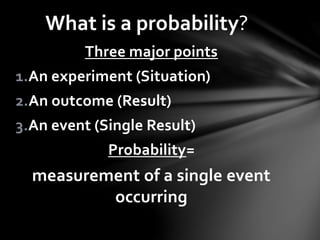
What is a probability?
Three major points
1.An experiment (Situation)
2.An outcome (Result)
3.An event (Single Result)
Probability=
measurement of a single event
occurring
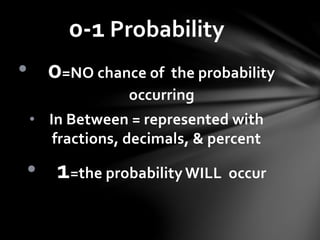
• 0=NO chance of the probability
occurring
• In Between = represented with
fractions, decimals, & percent
• 1=the probability WILL occur
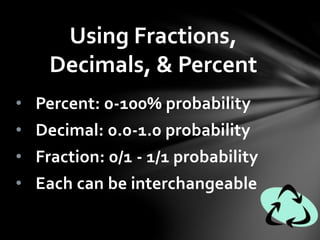
0-1 Probability
• Percent: 0-100% probability
• Decimal: 0.0-1.0 probability
• Fraction: 0/1 - 1/1 probability
• Each can be interchangeable
Using Fractions,
Decimals, & Percent
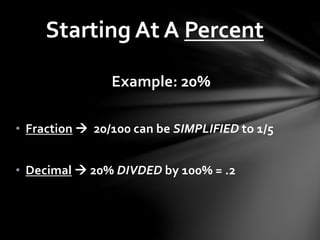
Example: 20%
• Fraction  20/100 can be SIMPLIFIED to 1/5
• Decimal  20% DIVDED by 100% = .2
Starting At A Percent
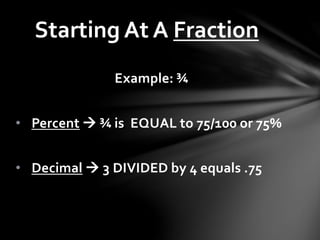
Example: ¾
• Percent  ¾ is EQUAL to 75/100 or 75%
• Decimal  3 DIVIDED by 4 equals .75
Starting At A Fraction
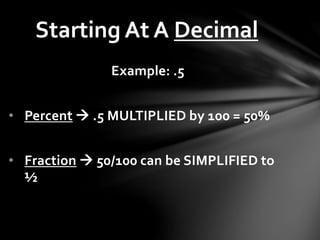
Example: .5
• Percent  .5 MULTIPLIED by 100 = 50%
• Fraction  50/100 can be SIMPLIFIED to
½
Starting At A Decimal
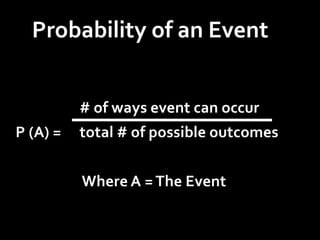
# of ways event can occur
P (A) = total # of possible outcomes
Where A = The Event
Probability of an Event
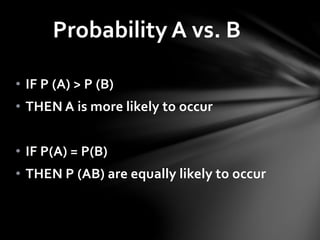
• IF P (A) > P (B)
• THEN A is more likely to occur
• IF P(A) = P(B)
• THEN P (AB) are equally likely to occur
Probability A vs. B
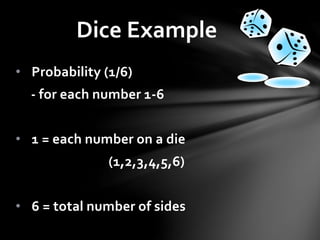
Dice Example
• Probability (1/6)
- for each number 1-6
• 1 = each number on a die
(1,2,3,4,5,6)
• 6 = total number of sides
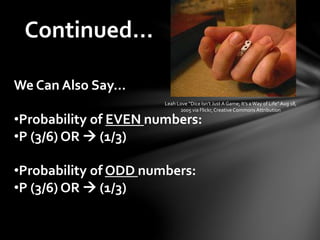
Continued…
We Can Also Say…
•Probability of EVEN numbers:
•P (3/6) OR  (1/3)
•Probability of ODD numbers:
•P (3/6) OR  (1/3)
Leah Love “Dice Isn’t Just A Game; It’s aWay of Life” Aug 18,
2005 via Flickr,Creative Commons Attribution
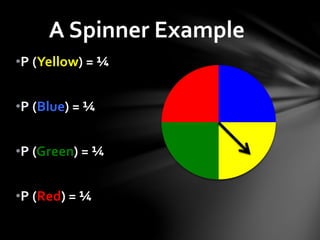
•P (Yellow) = ¼
•P (Blue) = ¼
•P (Green) = ¼
•P (Red) = ¼
A Spinner Example
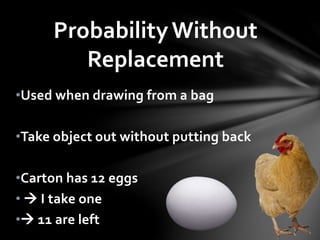
•Used when drawing from a bag
•Take object out without putting back
•Carton has 12 eggs
•  I take one
• 11 are left
ProbabilityWithout
Replacement
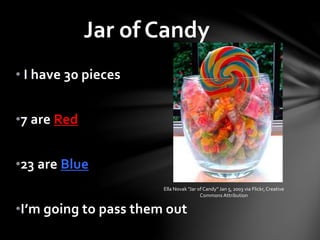
• I have 30 pieces
•7 are Red
•23 are Blue
•I’m going to pass them out
Jar of Candy
Ella Novak “Jar of Candy” Jan 5, 2003 via Flickr,Creative
Commons Attribution
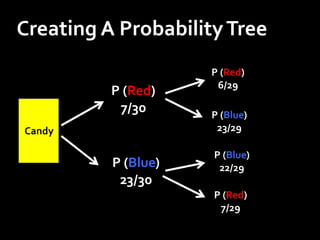
Creating A ProbabilityTree
Candy
P (Red)
7/30
P (Blue)
23/30
P (Red)
6/29
P (Blue)
23/29
P (Red)
7/29
P (Blue)
22/29
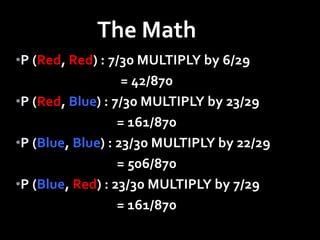
•P (Red, Red) : 7/30 MULTIPLY by 6/29
= 42/870
•P (Red, Blue) : 7/30 MULTIPLY by 23/29
= 161/870
•P (Blue, Blue) : 23/30 MULTIPLY by 22/29
= 506/870
•P (Blue, Red) : 23/30 MULTIPLY by 7/29
= 161/870
The Math
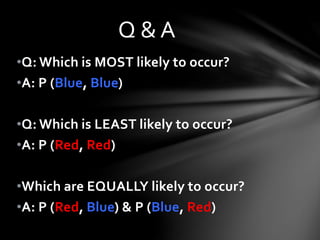
•Q: Which is MOST likely to occur?
•A: P (Blue, Blue)
•Q: Which is LEAST likely to occur?
•A: P (Red, Red)
•Which are EQUALLY likely to occur?
•A: P (Red, Blue) & P (Blue, Red)
Q & A

Probabilities

  • 1.
    By: Christie Potter BaileyWeaver“88 Kings and Queens” Oct 25, 2009 via Flickr,CreativeCommons Attribution
  • 2.
    What is aprobability? Three major points 1.An experiment (Situation) 2.An outcome (Result) 3.An event (Single Result) Probability= measurement of a single event occurring
  • 3.
    • 0=NO chanceof the probability occurring • In Between = represented with fractions, decimals, & percent • 1=the probability WILL occur 0-1 Probability
  • 4.
    • Percent: 0-100%probability • Decimal: 0.0-1.0 probability • Fraction: 0/1 - 1/1 probability • Each can be interchangeable Using Fractions, Decimals, & Percent
  • 5.
    Example: 20% • Fraction 20/100 can be SIMPLIFIED to 1/5 • Decimal  20% DIVDED by 100% = .2 Starting At A Percent
  • 6.
    Example: ¾ • Percent ¾ is EQUAL to 75/100 or 75% • Decimal  3 DIVIDED by 4 equals .75 Starting At A Fraction
  • 7.
    Example: .5 • Percent .5 MULTIPLIED by 100 = 50% • Fraction  50/100 can be SIMPLIFIED to ½ Starting At A Decimal
  • 8.
    # of waysevent can occur P (A) = total # of possible outcomes Where A = The Event Probability of an Event
  • 9.
    • IF P(A) > P (B) • THEN A is more likely to occur • IF P(A) = P(B) • THEN P (AB) are equally likely to occur Probability A vs. B
  • 10.
    Dice Example • Probability(1/6) - for each number 1-6 • 1 = each number on a die (1,2,3,4,5,6) • 6 = total number of sides
  • 11.
    Continued… We Can AlsoSay… •Probability of EVEN numbers: •P (3/6) OR  (1/3) •Probability of ODD numbers: •P (3/6) OR  (1/3) Leah Love “Dice Isn’t Just A Game; It’s aWay of Life” Aug 18, 2005 via Flickr,Creative Commons Attribution
  • 12.
    •P (Yellow) =¼ •P (Blue) = ¼ •P (Green) = ¼ •P (Red) = ¼ A Spinner Example
  • 13.
    •Used when drawingfrom a bag •Take object out without putting back •Carton has 12 eggs •  I take one • 11 are left ProbabilityWithout Replacement
  • 14.
    • I have30 pieces •7 are Red •23 are Blue •I’m going to pass them out Jar of Candy Ella Novak “Jar of Candy” Jan 5, 2003 via Flickr,Creative Commons Attribution
  • 15.
    Creating A ProbabilityTree Candy P(Red) 7/30 P (Blue) 23/30 P (Red) 6/29 P (Blue) 23/29 P (Red) 7/29 P (Blue) 22/29
  • 16.
    •P (Red, Red): 7/30 MULTIPLY by 6/29 = 42/870 •P (Red, Blue) : 7/30 MULTIPLY by 23/29 = 161/870 •P (Blue, Blue) : 23/30 MULTIPLY by 22/29 = 506/870 •P (Blue, Red) : 23/30 MULTIPLY by 7/29 = 161/870 The Math
  • 17.
    •Q: Which isMOST likely to occur? •A: P (Blue, Blue) •Q: Which is LEAST likely to occur? •A: P (Red, Red) •Which are EQUALLY likely to occur? •A: P (Red, Blue) & P (Blue, Red) Q & A