

Probabilistic Programming
in Python with PyMC3
John Salvatier
@johnsalvatier
About me
● Author of PyMC3 rewrite
● ex-Amazonian
● Seattle Effective Altruists founder
Probabilistic Programming
● Write program that could generate your data
● Automatic inference for unknown parameters
PyMC3
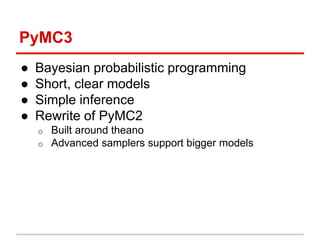
● Bayesian probabilistic programming
● Short, clear models
● Simple inference
● Rewrite of PyMC2
o Built around theano
o Advanced samplers support bigger models
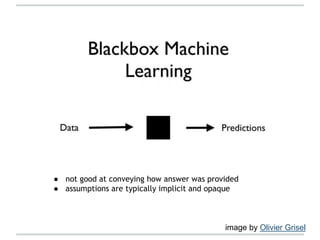
● not good at conveying how answer was provided
● assumptions are typically implicit and opaque
image by Olivier Grisel
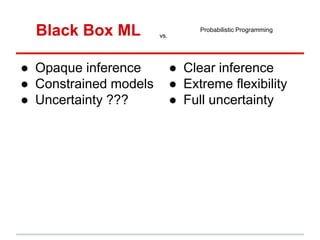
Black Box ML
● Opaque inference
● Constrained models
● Uncertainty ???
● Clear inference
● Extreme flexibility
● Full uncertainty
Probabilistic Programming
vs.
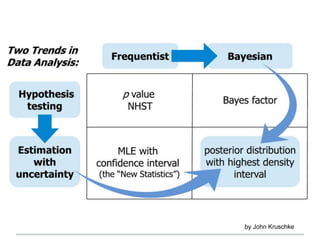
by John Kruschke
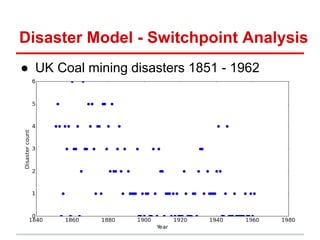
Disaster Model - Switchpoint Analysis
● UK Coal mining disasters 1851 - 1962
from pymc3 import *
year = np.arange(len(disaster_data))
with Model() as disaster_model:
switchpoint = DiscreteUniform('switchpoint', lower=0, upper=len(year))
early_mean = Exponential('early_mean')
late_mean = Exponential('late_mean')
rate = switch(switchpoint >= year, early_mean, late_mean)
disasters = Poisson('disasters', rate, observed=disaster_data)
with disaster_model:
trace = sample(10000, step=[Metropolis(), NUTS()])
traceplot(trace, ['early_mean', 'late_mean', 'switchpoint'])
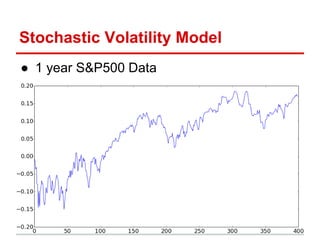
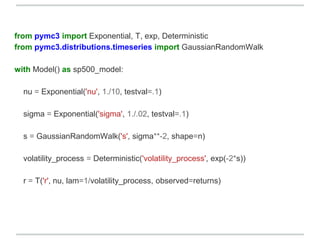
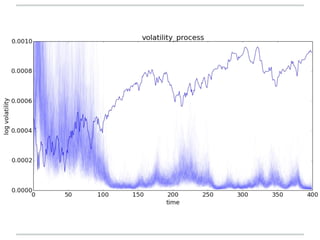
Stochastic Volatility Model
● 1 year S&P500 Data
from pymc3 import Exponential, T, exp, Deterministic
from pymc3.distributions.timeseries import GaussianRandomWalk
with Model() as sp500_model:
nu = Exponential('nu', 1./10, testval=.1)
sigma = Exponential('sigma', 1./.02, testval=.1)
s = GaussianRandomWalk('s', sigma**-2, shape=n)
volatility_process = Deterministic('volatility_process', exp(-2*s))
r = T('r', nu, lam=1/volatility_process, observed=returns)
PyMC3
● Powerful model specification syntax
o NumPy like broadcasting and functions
● Full bayesian inference
● State of the art methods
o Handle thousands of estimated parameters
Other Features
● Custom distributions and operators
● Handle missing values easily with Pandas
nans
● Generalized Linear Models
o glm('y ~ x1 + x2', df)
● Variational inference coming soon
Further Resources
● Twitter: @johnsalvatier
● Tutorial: http://bit.ly/1OuFqzb
● github: https://github.com/pymc-devs/pymc3
Chris Fonnesbeck - Vanderbilt
Thomas Wiecki - Quantopian

Probabilistic programming in python with PyMC3- John Salvatier

  • 1.
    Probabilistic Programming in Pythonwith PyMC3 John Salvatier @johnsalvatier
  • 2.
    About me ● Authorof PyMC3 rewrite ● ex-Amazonian ● Seattle Effective Altruists founder
  • 3.
    Probabilistic Programming ● Writeprogram that could generate your data ● Automatic inference for unknown parameters
  • 4.
    PyMC3 ● Bayesian probabilisticprogramming ● Short, clear models ● Simple inference ● Rewrite of PyMC2 o Built around theano o Advanced samplers support bigger models
  • 5.
    ● not goodat conveying how answer was provided ● assumptions are typically implicit and opaque image by Olivier Grisel
  • 6.
    Black Box ML ●Opaque inference ● Constrained models ● Uncertainty ??? ● Clear inference ● Extreme flexibility ● Full uncertainty Probabilistic Programming vs.
  • 8.
  • 9.
    Disaster Model -Switchpoint Analysis ● UK Coal mining disasters 1851 - 1962
  • 10.
    from pymc3 import* year = np.arange(len(disaster_data)) with Model() as disaster_model: switchpoint = DiscreteUniform('switchpoint', lower=0, upper=len(year)) early_mean = Exponential('early_mean') late_mean = Exponential('late_mean') rate = switch(switchpoint >= year, early_mean, late_mean) disasters = Poisson('disasters', rate, observed=disaster_data)
  • 11.
    with disaster_model: trace =sample(10000, step=[Metropolis(), NUTS()]) traceplot(trace, ['early_mean', 'late_mean', 'switchpoint'])
  • 12.
  • 13.
    from pymc3 importExponential, T, exp, Deterministic from pymc3.distributions.timeseries import GaussianRandomWalk with Model() as sp500_model: nu = Exponential('nu', 1./10, testval=.1) sigma = Exponential('sigma', 1./.02, testval=.1) s = GaussianRandomWalk('s', sigma**-2, shape=n) volatility_process = Deterministic('volatility_process', exp(-2*s)) r = T('r', nu, lam=1/volatility_process, observed=returns)
  • 15.
    PyMC3 ● Powerful modelspecification syntax o NumPy like broadcasting and functions ● Full bayesian inference ● State of the art methods o Handle thousands of estimated parameters
  • 16.
    Other Features ● Customdistributions and operators ● Handle missing values easily with Pandas nans ● Generalized Linear Models o glm('y ~ x1 + x2', df) ● Variational inference coming soon
  • 17.
    Further Resources ● Twitter:@johnsalvatier ● Tutorial: http://bit.ly/1OuFqzb ● github: https://github.com/pymc-devs/pymc3 Chris Fonnesbeck - Vanderbilt Thomas Wiecki - Quantopian