Probabilistic Deep
Learning for Energy
Time
Series Forecasting: A
Comparative Study
Ramakrishna Garine, Sunil Pradhan Sharma
University of North Texas, Capital One
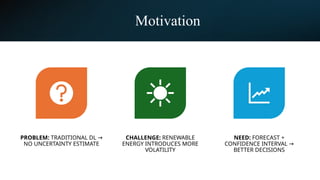
Motivation
PROBLEM: TRADITIONAL DL →
NO UNCERTAINTY ESTIMATE
CHALLENGE: RENEWABLE
ENERGY INTRODUCES MORE
VOLATILITY
NEED: FORECAST +
CONFIDENCE INTERVAL →
BETTER DECISIONS
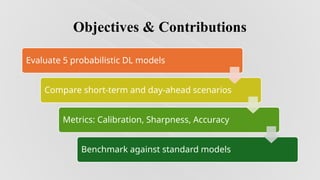
Objectives & Contributions
Evaluate 5 probabilistic DL models
Compare short-term and day-ahead scenarios
Metrics: Calibration, Sharpness, Accuracy
Benchmark against standard models
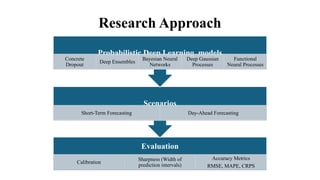
Research Approach
Evaluation
Calibration
Sharpness (Width of
prediction intervals)
Accuracy Metrics
RMSE, MAPE, CRPS
Scenarios
Short-Term Forecasting Day-Ahead Forecasting
Probabilistic Deep Learning models
Concrete
Dropout
Deep Ensembles
Bayesian Neural
Networks
Deep Gaussian
Processes
Functional
Neural Processes
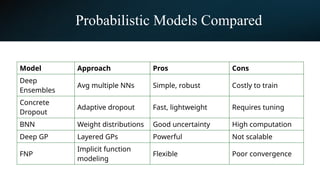
Probabilistic Models Compared
Model Approach Pros Cons
Deep
Ensembles
Avg multiple NNs Simple, robust Costly to train
Concrete
Dropout
Adaptive dropout Fast, lightweight Requires tuning
BNN Weight distributions Good uncertainty High computation
Deep GP Layered GPs Powerful Not scalable
FNP
Implicit function
modeling
Flexible Poor convergence
Data & Setup
Data Source: Germany Load Data
(ENTSO-E)
Resolution: 15-min intervals
Train/Test Split: 80/20
Short-term: Predict next step
Day-ahead: Predict 24 hours ahead
BN
N
Concrete
Sim
ple N
N
Q
uantile Regression
D
eep
Ensem
bles
D
eep
G
P
FN
P
0
6
Short-term load forecasting
RMSE MAPE [%] CRPS
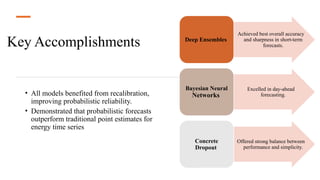
Key Accomplishments
• All models benefited from recalibration,
improving probabilistic reliability.
• Demonstrated that probabilistic forecasts
outperform traditional point estimates for
energy time series
Achieved best overall accuracy
and sharpness in short-term
forecasts.
Deep Ensembles
Excelled in day-ahead
forecasting.
Bayesian Neural
Networks
Offered strong balance between
performance and simplicity.
Concrete
Dropout
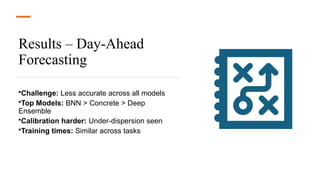
Results – Day-Ahead
Forecasting
•Challenge: Less accurate across all models
•Top Models: BNN > Concrete > Deep
Ensemble
•Calibration harder: Under-dispersion seen
•Training times: Similar across tasks
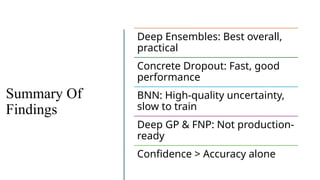
Summary Of
Findings
Deep Ensembles: Best overall,
practical
Concrete Dropout: Fast, good
performance
BNN: High-quality uncertainty,
slow to train
Deep GP & FNP: Not production-
ready
Confidence > Accuracy alone
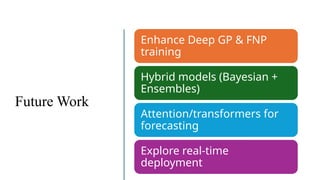
Future Work
Enhance Deep GP & FNP
training
Hybrid models (Bayesian +
Ensembles)
Attention/transformers for
forecasting
Explore real-time
deployment
Q&A • Let's Connect on LinkedIn
• Search for “Ramakrishna Garine “
Thank you !

Probabilistic Deep Learning for Energy Time_Presentation_v1.pptx

  • 1.
    Probabilistic Deep Learning forEnergy Time Series Forecasting: A Comparative Study Ramakrishna Garine, Sunil Pradhan Sharma University of North Texas, Capital One
  • 2.
    Motivation PROBLEM: TRADITIONAL DL→ NO UNCERTAINTY ESTIMATE CHALLENGE: RENEWABLE ENERGY INTRODUCES MORE VOLATILITY NEED: FORECAST + CONFIDENCE INTERVAL → BETTER DECISIONS
  • 3.
    Objectives & Contributions Evaluate5 probabilistic DL models Compare short-term and day-ahead scenarios Metrics: Calibration, Sharpness, Accuracy Benchmark against standard models
  • 4.
    Research Approach Evaluation Calibration Sharpness (Widthof prediction intervals) Accuracy Metrics RMSE, MAPE, CRPS Scenarios Short-Term Forecasting Day-Ahead Forecasting Probabilistic Deep Learning models Concrete Dropout Deep Ensembles Bayesian Neural Networks Deep Gaussian Processes Functional Neural Processes
  • 5.
    Probabilistic Models Compared ModelApproach Pros Cons Deep Ensembles Avg multiple NNs Simple, robust Costly to train Concrete Dropout Adaptive dropout Fast, lightweight Requires tuning BNN Weight distributions Good uncertainty High computation Deep GP Layered GPs Powerful Not scalable FNP Implicit function modeling Flexible Poor convergence
  • 6.
    Data & Setup DataSource: Germany Load Data (ENTSO-E) Resolution: 15-min intervals Train/Test Split: 80/20 Short-term: Predict next step Day-ahead: Predict 24 hours ahead BN N Concrete Sim ple N N Q uantile Regression D eep Ensem bles D eep G P FN P 0 6 Short-term load forecasting RMSE MAPE [%] CRPS
  • 7.
    Key Accomplishments • Allmodels benefited from recalibration, improving probabilistic reliability. • Demonstrated that probabilistic forecasts outperform traditional point estimates for energy time series Achieved best overall accuracy and sharpness in short-term forecasts. Deep Ensembles Excelled in day-ahead forecasting. Bayesian Neural Networks Offered strong balance between performance and simplicity. Concrete Dropout
  • 8.
    Results – Day-Ahead Forecasting •Challenge:Less accurate across all models •Top Models: BNN > Concrete > Deep Ensemble •Calibration harder: Under-dispersion seen •Training times: Similar across tasks
  • 9.
    Summary Of Findings Deep Ensembles:Best overall, practical Concrete Dropout: Fast, good performance BNN: High-quality uncertainty, slow to train Deep GP & FNP: Not production- ready Confidence > Accuracy alone
  • 10.
    Future Work Enhance DeepGP & FNP training Hybrid models (Bayesian + Ensembles) Attention/transformers for forecasting Explore real-time deployment
  • 11.
    Q&A • Let'sConnect on LinkedIn • Search for “Ramakrishna Garine “
  • 12.